Public Financial Management
  Public Expenditure Management :
        Comparatives Analysis
        (New Zealand and Australia)

            Presented By :
 Mohd Amar Bin Aziz               (811821)
 Raja Abumanshur Matridi          (810083)
Public Expenditure Management
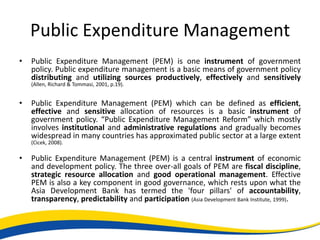
•   Public Expenditure Management (PEM) is one instrument of government
    policy. Public expenditure management is a basic means of government policy
    distributing and utilizing sources productively, effectively and sensitively
    (Allen, Richard & Tommasi, 2001, p.19).


•   Public Expenditure Management (PEM) which can be defined as efficient,
    effective and sensitive allocation of resources is a basic instrument of
    government policy. “Public Expenditure Management Reform” which mostly
    involves institutional and administrative regulations and gradually becomes
    widespread in many countries has approximated public sector at a large extent
    (Cicek, 2008).

•   Public Expenditure Management (PEM) is a central instrument of economic
    and development policy. The three over-all goals of PEM are fiscal discipline,
    strategic resource allocation and good operational management. Effective
    PEM is also a key component in good governance, which rests upon what the
    Asia Development Bank has termed the 'four pillars' of accountability,
    transparency, predictability and participation (Asia Development Bank Institute, 1999).
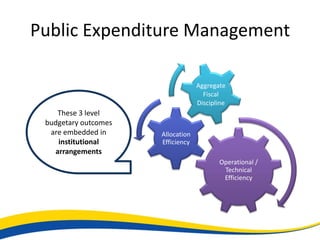
Public Expenditure Management

                                   Aggregate
                                     Fiscal
                                   Discipline
    These 3 level
 budgetary outcomes
  are embedded in     Allocation
    institutional     Efficiency
   arrangements
                                          Operational /
                                           Technical
                                           Efficiency
Institutional Arrangements
•   The institutional arrangements refer to the delegation, distribution, or sharing of
    power related to growth management decision-making and implementation
    authority. On the Government-Governance scale to the left Government power
    represents planning as the exclusive domain of a state or regional public agency;
    Governance reflects relative degrees of delegated or shared power with smaller
    units of government and/or non profit and private entities (Washington Office of
    Community Development, 2000).


•   Institutional arrangements are interpreted as different (in)formal regimes and
    coalitions for collective action and inter-agent coordination, ranging from public-
    private cooperation and contracting schemes, organizational networking to policy
    arrangements (Geels, 2004; Klein & Teisman, 2000).

•   Institutions are commonly defined as the ‘rules of the game’, including norms,
    beliefs, values, habits and behaviour (Menard, 2000).
Aggregate Fiscal Discipline
• Allowing budgets to be set consistent with a
  realistic macroeconomic framework and a
  sustainable fiscal program, and brought in on
  target (International Monetary Fund, 2008).
Allocation Efficiency
• requiring that resource allocations reflect the
  policies and priorities of the government’s
  program (International Monetary Fund, 2008).
Operating Efficiency
• requiring that resources are utilized efficiently
  and effectively towards to the purpose for
  which they have been allocated (International
  Monetary Fund, 2008).
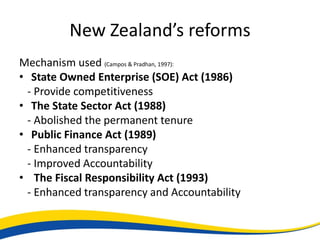
New Zealand’s reforms
Mechanism used (Campos & Pradhan, 1997):
• State Owned Enterprise (SOE) Act (1986)
  - Provide competitiveness
• The State Sector Act (1988)
  - Abolished the permanent tenure
• Public Finance Act (1989)
  - Enhanced transparency
  - Improved Accountability
• The Fiscal Responsibility Act (1993)
  - Enhanced transparency and Accountability
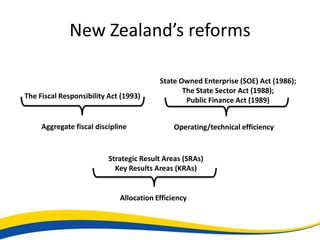
New Zealand’s reforms

                                         State Owned Enterprise (SOE) Act (1986);
                                                The State Sector Act (1988);
The Fiscal Responsibility Act (1993)
                                                 Public Finance Act (1989)


     Aggregate fiscal discipline             Operating/technical efficiency


                          Strategic Result Areas (SRAs)
                            Key Results Areas (KRAs)


                             Allocation Efficiency
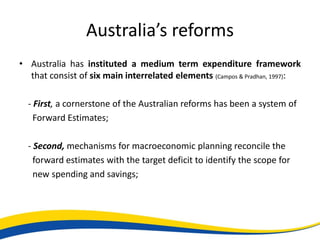
Australia’s reforms
• Australia has instituted a medium term expenditure framework
  that consist of six main interrelated elements (Campos & Pradhan, 1997):

  - First, a cornerstone of the Australian reforms has been a system of
    Forward Estimates;

  - Second, mechanisms for macroeconomic planning reconcile the
    forward estimates with the target deficit to identify the scope for
    new spending and savings;
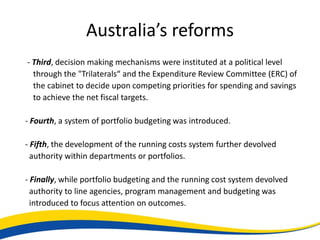
Australia’s reforms
- Third, decision making mechanisms were instituted at a political level
  through the "Trilaterals“ and the Expenditure Review Committee (ERC) of
  the cabinet to decide upon competing priorities for spending and savings
  to achieve the net fiscal targets.

- Fourth, a system of portfolio budgeting was introduced.

- Fifth, the development of the running costs system further devolved
  authority within departments or portfolios.

- Finally, while portfolio budgeting and the running cost system devolved
  authority to line agencies, program management and budgeting was
  introduced to focus attention on outcomes.
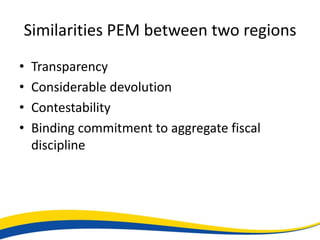
Similarities PEM between two regions
•   Transparency
•   Considerable devolution
•   Contestability
•   Binding commitment to aggregate fiscal
    discipline
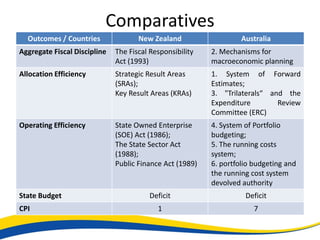
Comparatives
  Outcomes / Countries               New Zealand                   Australia
Aggregate Fiscal Discipline   The Fiscal Responsibility   2. Mechanisms for
                              Act (1993)                  macroeconomic planning
Allocation Efficiency         Strategic Result Areas      1. System of Forward
                              (SRAs);                     Estimates;
                              Key Result Areas (KRAs)     3. "Trilaterals“ and the
                                                          Expenditure        Review
                                                          Committee (ERC)
Operating Efficiency          State Owned Enterprise      4. System of Portfolio
                              (SOE) Act (1986);           budgeting;
                              The State Sector Act        5. The running costs
                              (1988);                     system;
                              Public Finance Act (1989)   6. portfolio budgeting and
                                                          the running cost system
                                                          devolved authority
State Budget                            Deficit                     Deficit
CPI                                        1                           7
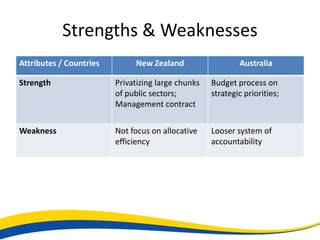
Strengths & Weaknesses
Attributes / Countries        New Zealand                   Australia

Strength                 Privatizing large chunks   Budget process on
                         of public sectors;         strategic priorities;
                         Management contract


Weakness                 Not focus on allocative    Looser system of
                         efficiency                 accountability
Thank you

Public financial management

  • 1.
    Public Financial Management Public Expenditure Management : Comparatives Analysis (New Zealand and Australia) Presented By : Mohd Amar Bin Aziz (811821) Raja Abumanshur Matridi (810083)
  • 2.
    Public Expenditure Management • Public Expenditure Management (PEM) is one instrument of government policy. Public expenditure management is a basic means of government policy distributing and utilizing sources productively, effectively and sensitively (Allen, Richard & Tommasi, 2001, p.19). • Public Expenditure Management (PEM) which can be defined as efficient, effective and sensitive allocation of resources is a basic instrument of government policy. “Public Expenditure Management Reform” which mostly involves institutional and administrative regulations and gradually becomes widespread in many countries has approximated public sector at a large extent (Cicek, 2008). • Public Expenditure Management (PEM) is a central instrument of economic and development policy. The three over-all goals of PEM are fiscal discipline, strategic resource allocation and good operational management. Effective PEM is also a key component in good governance, which rests upon what the Asia Development Bank has termed the 'four pillars' of accountability, transparency, predictability and participation (Asia Development Bank Institute, 1999).
  • 3.
    Public Expenditure Management Aggregate Fiscal Discipline These 3 level budgetary outcomes are embedded in Allocation institutional Efficiency arrangements Operational / Technical Efficiency
  • 4.
    Institutional Arrangements • The institutional arrangements refer to the delegation, distribution, or sharing of power related to growth management decision-making and implementation authority. On the Government-Governance scale to the left Government power represents planning as the exclusive domain of a state or regional public agency; Governance reflects relative degrees of delegated or shared power with smaller units of government and/or non profit and private entities (Washington Office of Community Development, 2000). • Institutional arrangements are interpreted as different (in)formal regimes and coalitions for collective action and inter-agent coordination, ranging from public- private cooperation and contracting schemes, organizational networking to policy arrangements (Geels, 2004; Klein & Teisman, 2000). • Institutions are commonly defined as the ‘rules of the game’, including norms, beliefs, values, habits and behaviour (Menard, 2000).
  • 5.
    Aggregate Fiscal Discipline •Allowing budgets to be set consistent with a realistic macroeconomic framework and a sustainable fiscal program, and brought in on target (International Monetary Fund, 2008).
  • 6.
    Allocation Efficiency • requiringthat resource allocations reflect the policies and priorities of the government’s program (International Monetary Fund, 2008).
  • 7.
    Operating Efficiency • requiringthat resources are utilized efficiently and effectively towards to the purpose for which they have been allocated (International Monetary Fund, 2008).
  • 8.
    New Zealand’s reforms Mechanismused (Campos & Pradhan, 1997): • State Owned Enterprise (SOE) Act (1986) - Provide competitiveness • The State Sector Act (1988) - Abolished the permanent tenure • Public Finance Act (1989) - Enhanced transparency - Improved Accountability • The Fiscal Responsibility Act (1993) - Enhanced transparency and Accountability
  • 9.
    New Zealand’s reforms State Owned Enterprise (SOE) Act (1986); The State Sector Act (1988); The Fiscal Responsibility Act (1993) Public Finance Act (1989) Aggregate fiscal discipline Operating/technical efficiency Strategic Result Areas (SRAs) Key Results Areas (KRAs) Allocation Efficiency
  • 10.
    Australia’s reforms • Australiahas instituted a medium term expenditure framework that consist of six main interrelated elements (Campos & Pradhan, 1997): - First, a cornerstone of the Australian reforms has been a system of Forward Estimates; - Second, mechanisms for macroeconomic planning reconcile the forward estimates with the target deficit to identify the scope for new spending and savings;
  • 11.
    Australia’s reforms - Third,decision making mechanisms were instituted at a political level through the "Trilaterals“ and the Expenditure Review Committee (ERC) of the cabinet to decide upon competing priorities for spending and savings to achieve the net fiscal targets. - Fourth, a system of portfolio budgeting was introduced. - Fifth, the development of the running costs system further devolved authority within departments or portfolios. - Finally, while portfolio budgeting and the running cost system devolved authority to line agencies, program management and budgeting was introduced to focus attention on outcomes.
  • 12.
    Similarities PEM betweentwo regions • Transparency • Considerable devolution • Contestability • Binding commitment to aggregate fiscal discipline
  • 13.
    Comparatives Outcomes/ Countries New Zealand Australia Aggregate Fiscal Discipline The Fiscal Responsibility 2. Mechanisms for Act (1993) macroeconomic planning Allocation Efficiency Strategic Result Areas 1. System of Forward (SRAs); Estimates; Key Result Areas (KRAs) 3. "Trilaterals“ and the Expenditure Review Committee (ERC) Operating Efficiency State Owned Enterprise 4. System of Portfolio (SOE) Act (1986); budgeting; The State Sector Act 5. The running costs (1988); system; Public Finance Act (1989) 6. portfolio budgeting and the running cost system devolved authority State Budget Deficit Deficit CPI 1 7
  • 14.
    Strengths & Weaknesses Attributes/ Countries New Zealand Australia Strength Privatizing large chunks Budget process on of public sectors; strategic priorities; Management contract Weakness Not focus on allocative Looser system of efficiency accountability
  • 15.