PUBERTY
DR. JYOTI KUMBAR
Definition
• Period which links childhood to adulthood.
• Period of gradual development of secondary sexual
characters.
• Biological, Morphological, and Psychological changes that
lead to full sexual maturity and eventually fertility.
Morphological Changes
Tanner and Marshall:
• Breast
• Pubic and axillary hair growth
• Growth in height
• Menstruation
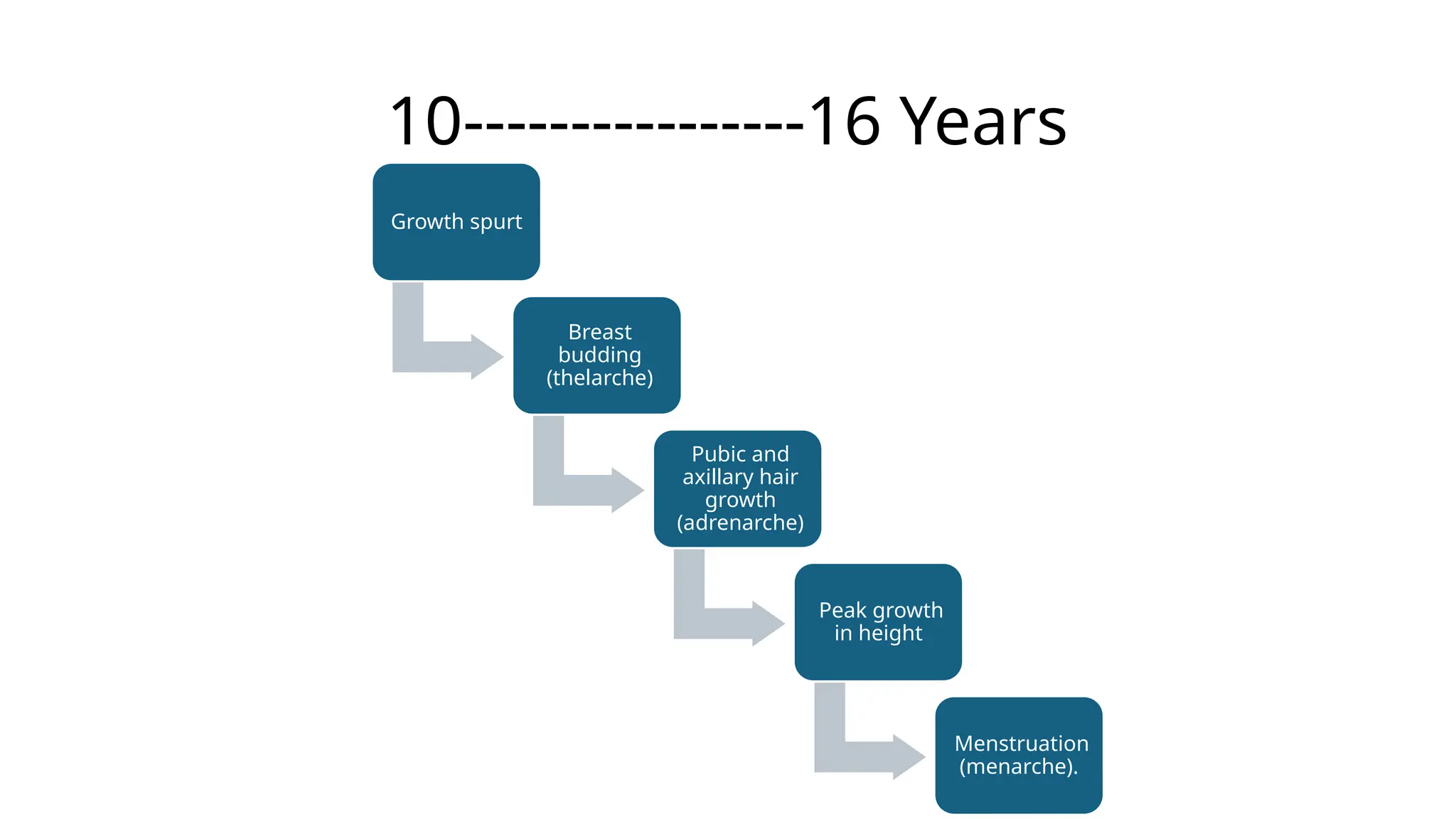
10----------------16 Years
Growth spurt
Breast
budding
(thelarche)
Pubic and
axillary hair
growth
(adrenarche)
Peak growth
in height
Menstruation
(menarche).
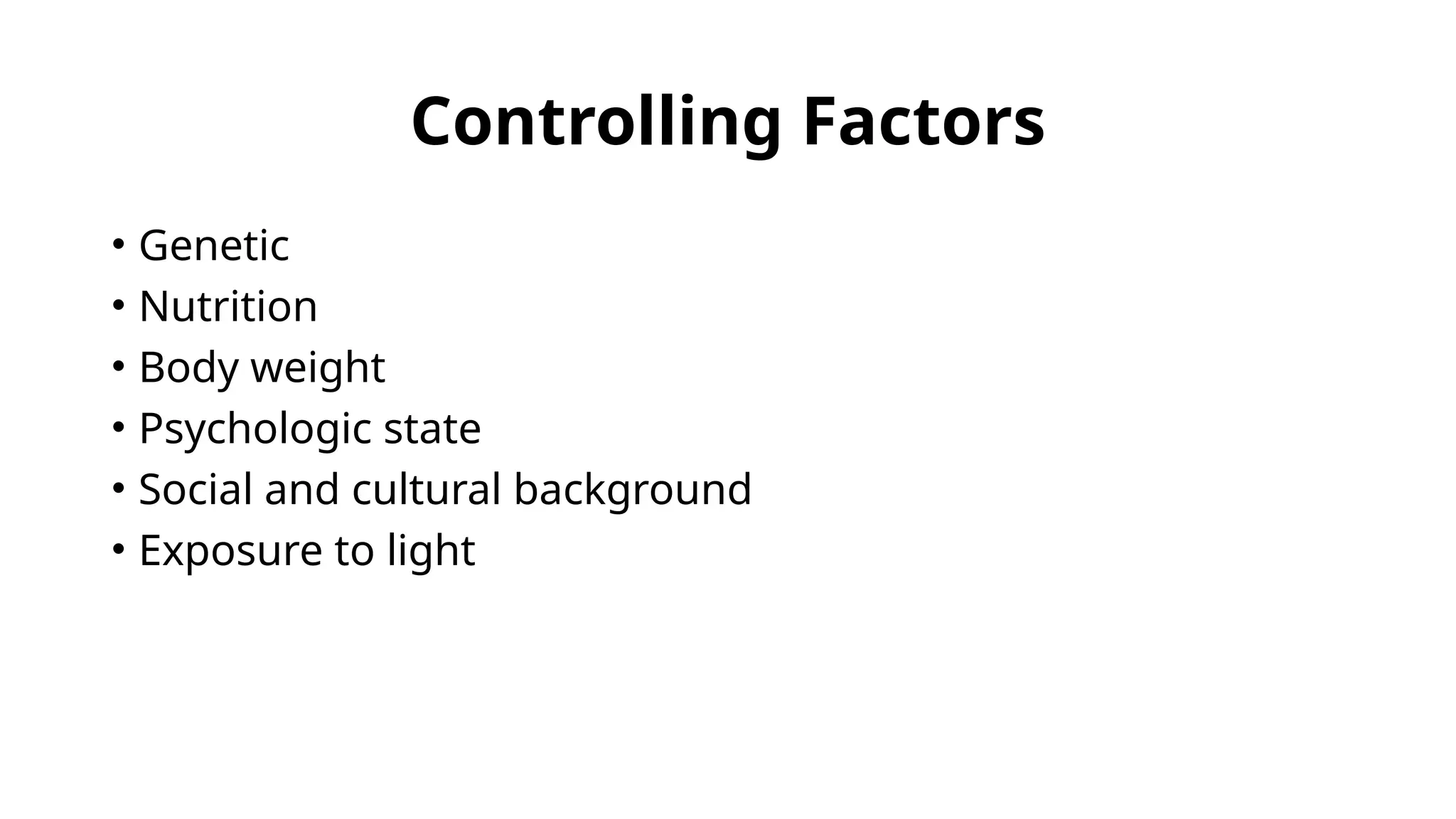
Controlling Factors
• Genetic
• Nutrition
• Body weight
• Psychologic state
• Social and cultural background
• Exposure to light
Endocrinology
• The levels of gonadal steroids and gonadotropins (FSH, LH)
are low until the age of 6–8 years.
• This is mainly due to the negative feedback effect of
estrogen to the hypothalamic pituitary system (gonadostat).
• The gonadostat remains very sensitive (6–15 times) to the
negative feedback effect, even though the level of estradiol
is very low (10 pg/ml) during that time.
• As puberty approaches this negative feedback effect of
estrogen is gradually lost. This results in some significant
changes in the endocrine function of the girl
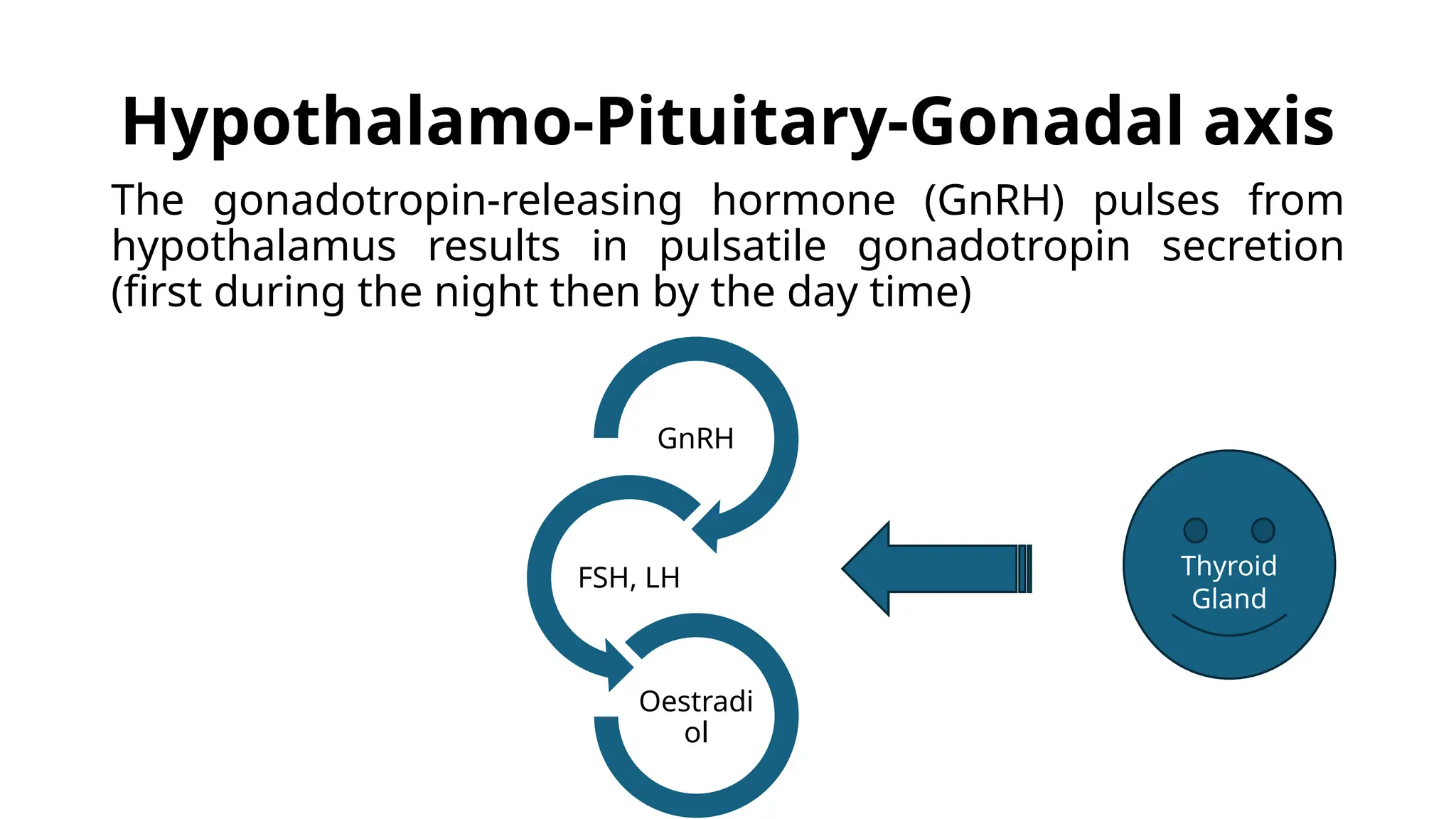
Hypothalamo-Pituitary-Gonadal axis
The gonadotropin-releasing hormone (GnRH) pulses from
hypothalamus results in pulsatile gonadotropin secretion
(first during the night then by the day time)
GnRH
FSH, LH
Oestradi
ol
Thyroid
Gland
Adrenarche
Adrenal Glands
Androstenedione,
Dehydroepiandrosterone (DHA),
Dehydroepiandrosterone sulfate
(DHAS)
Increased sebum formation, pubic
and axillary hair, and change in voice
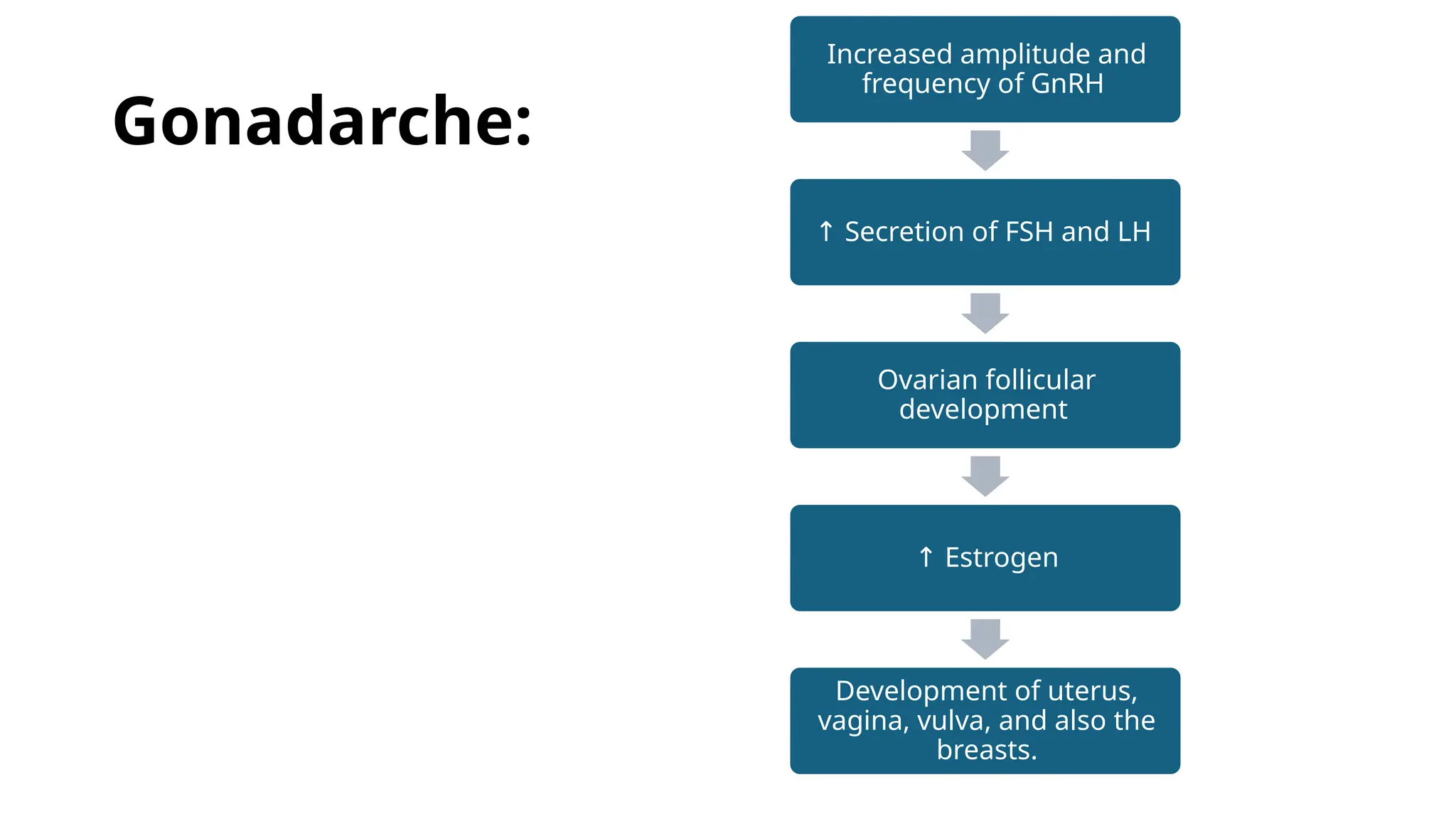
Gonadarche:
Increased amplitude and
frequency of GnRH
↑ Secretion of FSH and LH
Ovarian follicular
development
↑ Estrogen
Development of uterus,
vagina, vulva, and also the
breasts.
Menarche
Definition: The onset of first
menstruation in life
Age: Between10 and 16 years, the
peak time being 13 years.
Endometrial
Proliferation
Due to
Oestrogen
Oestrogen
level falls
temporarily
Shedding of
Endometrium
What does a first period Indicate?
• Intact hypothalamic pituitary ovarian axis
• Functioning ovaries
• Presence of responsive endometrium to the endogenous
ovarian steroids
• Presence of a patent uterovaginal canal.
• Usually anovular
• The menses may be irregular to start with
Growth:
Growth
Hormone
IGF-1
Oestrogen
Changes in Genital Organs:
Ovaries:
Shape: Elongated shape becomes bulky and oval
The ovarian bulk is due to follicular enlargement at various
stages of development and proliferation of stromal cells
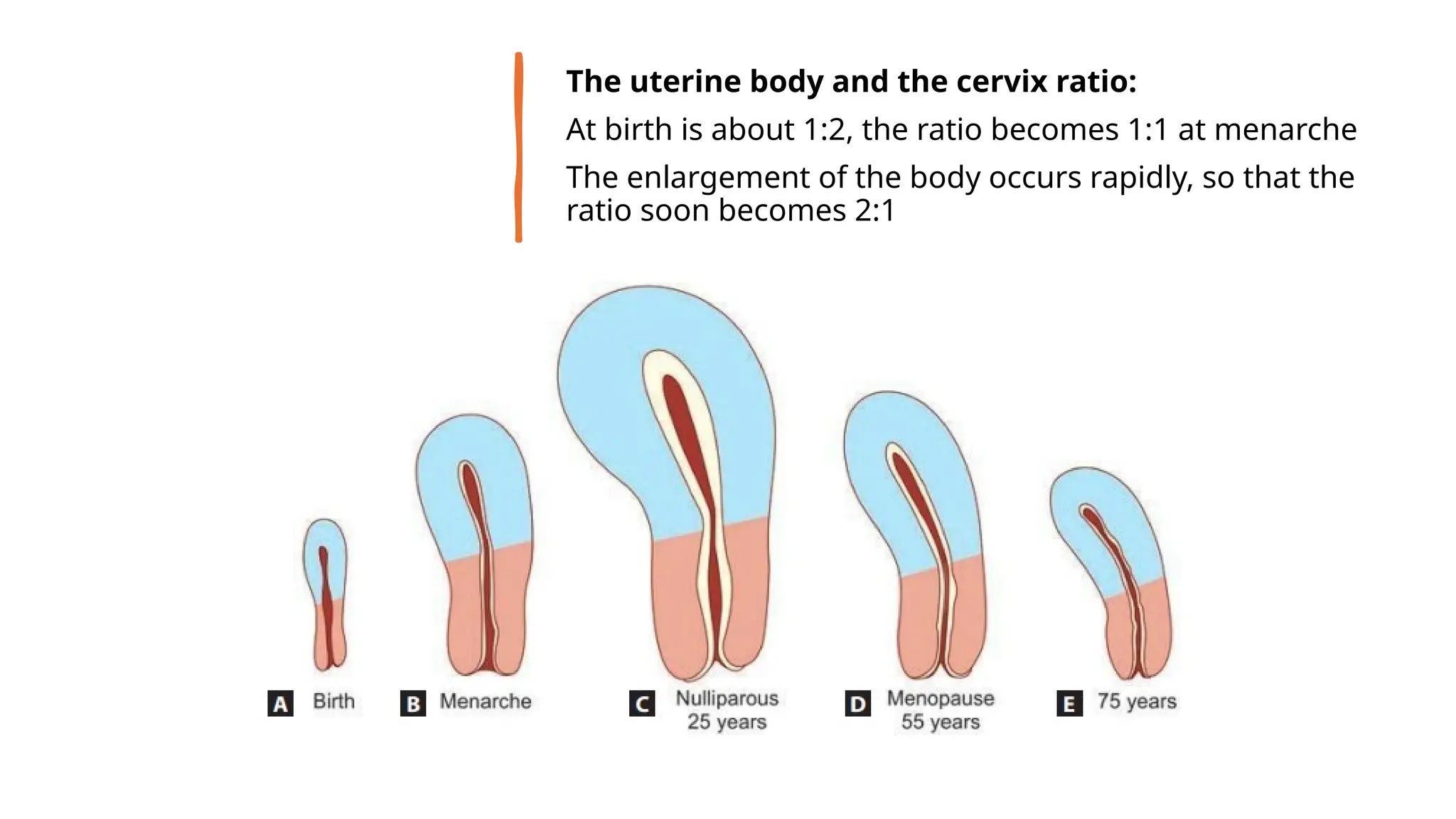
The uterine body and the cervix ratio:
At birth is about 1:2, the ratio becomes 1:1 at menarche
The enlargement of the body occurs rapidly, so that the
ratio soon becomes 2:1
Vagina:
The thin epithelium in a child become stratified epithelium of
many layers.
The cells are rich in glycogen due to estrogen.
Doderlein’s bacilli appear which convert glycogen into lactic
acid; the vaginal pH becomes acidic, ranging between 4 and 5.
Vulva:
More reactive to steroid hormones.
The mons pubis and the labia minora increase in size.
Breast:
Under the influence of estrogen, there is marked proliferation
of duct systems and deposition of fat
The breast becomes prominent and round
Tanner Staging
Common Disorders of Puberty
• Precocious puberty
• Delayed puberty
• Menstrual abnormalities (amenorrhea, menorrhagia,
dysmenorrhea)
• Others (infection, neoplasm, hirsutism, etc.)
PRECOCIOUS
PUBERTY
Definition: Girls who
exhibit any secondary sex
characteristics before the
age of 8 or menstruate
before the age of 10.
Investigations:
• To rule out any pathology in the CNS, ovary, and adrenal.
• In cases when no cause can be detected in any of the types
mentioned, the periodic evaluation at 6 monthly intervals is
to be made to detect any life threatening pathology at the
earliest
Treatment:
• The exogenous estrogen therapy or its inadvertent intake
should be stopped
• Cortisone therapy for adrenal hyperplasia
• Surgery to remove the adrenal or ovarian tumor
• Eliminate the excess source of either androgen or estrogen
• The intracranial tumor requires neurosurgery or
radiotherapy
• Primary hypothyroidism needs thyroid replacement therapy
DELAYED
PUBERTY
Puberty is said to be delayed when
the breast tissue and/or pubic hair
have not appeared by 13–14 years
or menarche appears as late as 16
years
The normal upper age limit of
menarche is 15 years
Diagnosis:
• History taking
• Physical examination
Examination of secondary sexual characters:
Mature:
To evaluate for Müllerian agenesis/dysgenesis.
Asynchronous development of breasts, pubic hair androgen
→
insensitivity syndrome.
Immature secondary sexual characters:
Serum FSH, PRL, TSH, T4
↑FSH: Karyotype for gonadal dysgenesis/premature gonadal
failure
Low/normal FSH sellar CT/MRI normal
→ → →
constitutional/chronic illness/malnutrition
Abnormal sellar CT/MRI → hypopituitarism/CNS tumor
TSH: TSH hypothyroidism
↑ →
Treatment
• According to the etiology
• Assurance, improvement of general health and treatment of
any illness may be of help in non-endocrinal causes
• Cases with hypogonadism may be treated with cyclic
estrogen.
• Hypergonadotropic hypogonadism should have
chromosomal study to exclude intersexuality.
PUBERTY
MENORRHAGIA
• The periods may be
heavy, irregular or scanty
initially.
• Eventually, the majority of
these teenaged girls
establish a normal cycle
and are fertile
Investigations:
• Routine hematological examination
• Bleeding time, clotting time, platelet count
• Thyroid profile (TSH, T3, T4)
• Coagulation parameters [PT, PTT, factor VIII and von Willebrand
factor (VWF)]
• Imaging study of the pelvis by ultrasonography or MRI to exclude
pelvic pathology may be needed.
• Examination under anesthesia (EUA) and uterine curettage may be
needed to exclude any pelvic pathology (pregnancy complications).
The curetted material is sent for histopathological study

Manageme
nt:

Physiological changes of puberty and abnormalities

  • 1.
  • 2.
    Definition • Period whichlinks childhood to adulthood. • Period of gradual development of secondary sexual characters. • Biological, Morphological, and Psychological changes that lead to full sexual maturity and eventually fertility.
  • 3.
    Morphological Changes Tanner andMarshall: • Breast • Pubic and axillary hair growth • Growth in height • Menstruation
  • 4.
    10----------------16 Years Growth spurt Breast budding (thelarche) Pubicand axillary hair growth (adrenarche) Peak growth in height Menstruation (menarche).
  • 5.
    Controlling Factors • Genetic •Nutrition • Body weight • Psychologic state • Social and cultural background • Exposure to light
  • 6.
    Endocrinology • The levelsof gonadal steroids and gonadotropins (FSH, LH) are low until the age of 6–8 years. • This is mainly due to the negative feedback effect of estrogen to the hypothalamic pituitary system (gonadostat). • The gonadostat remains very sensitive (6–15 times) to the negative feedback effect, even though the level of estradiol is very low (10 pg/ml) during that time. • As puberty approaches this negative feedback effect of estrogen is gradually lost. This results in some significant changes in the endocrine function of the girl
  • 7.
    Hypothalamo-Pituitary-Gonadal axis The gonadotropin-releasinghormone (GnRH) pulses from hypothalamus results in pulsatile gonadotropin secretion (first during the night then by the day time) GnRH FSH, LH Oestradi ol Thyroid Gland
  • 8.
    Adrenarche Adrenal Glands Androstenedione, Dehydroepiandrosterone (DHA), Dehydroepiandrosteronesulfate (DHAS) Increased sebum formation, pubic and axillary hair, and change in voice
  • 9.
    Gonadarche: Increased amplitude and frequencyof GnRH ↑ Secretion of FSH and LH Ovarian follicular development ↑ Estrogen Development of uterus, vagina, vulva, and also the breasts.
  • 10.
    Menarche Definition: The onsetof first menstruation in life Age: Between10 and 16 years, the peak time being 13 years. Endometrial Proliferation Due to Oestrogen Oestrogen level falls temporarily Shedding of Endometrium
  • 11.
    What does afirst period Indicate? • Intact hypothalamic pituitary ovarian axis • Functioning ovaries • Presence of responsive endometrium to the endogenous ovarian steroids • Presence of a patent uterovaginal canal. • Usually anovular • The menses may be irregular to start with
  • 12.
  • 13.
    Changes in GenitalOrgans: Ovaries: Shape: Elongated shape becomes bulky and oval The ovarian bulk is due to follicular enlargement at various stages of development and proliferation of stromal cells
  • 14.
    The uterine bodyand the cervix ratio: At birth is about 1:2, the ratio becomes 1:1 at menarche The enlargement of the body occurs rapidly, so that the ratio soon becomes 2:1
  • 15.
    Vagina: The thin epitheliumin a child become stratified epithelium of many layers. The cells are rich in glycogen due to estrogen. Doderlein’s bacilli appear which convert glycogen into lactic acid; the vaginal pH becomes acidic, ranging between 4 and 5. Vulva: More reactive to steroid hormones. The mons pubis and the labia minora increase in size.
  • 16.
    Breast: Under the influenceof estrogen, there is marked proliferation of duct systems and deposition of fat The breast becomes prominent and round
  • 17.
  • 18.
    Common Disorders ofPuberty • Precocious puberty • Delayed puberty • Menstrual abnormalities (amenorrhea, menorrhagia, dysmenorrhea) • Others (infection, neoplasm, hirsutism, etc.)
  • 19.
    PRECOCIOUS PUBERTY Definition: Girls who exhibitany secondary sex characteristics before the age of 8 or menstruate before the age of 10.
  • 20.
    Investigations: • To ruleout any pathology in the CNS, ovary, and adrenal. • In cases when no cause can be detected in any of the types mentioned, the periodic evaluation at 6 monthly intervals is to be made to detect any life threatening pathology at the earliest
  • 21.
    Treatment: • The exogenousestrogen therapy or its inadvertent intake should be stopped • Cortisone therapy for adrenal hyperplasia • Surgery to remove the adrenal or ovarian tumor • Eliminate the excess source of either androgen or estrogen • The intracranial tumor requires neurosurgery or radiotherapy • Primary hypothyroidism needs thyroid replacement therapy
  • 22.
    DELAYED PUBERTY Puberty is saidto be delayed when the breast tissue and/or pubic hair have not appeared by 13–14 years or menarche appears as late as 16 years The normal upper age limit of menarche is 15 years
  • 23.
    Diagnosis: • History taking •Physical examination Examination of secondary sexual characters: Mature: To evaluate for Müllerian agenesis/dysgenesis. Asynchronous development of breasts, pubic hair androgen → insensitivity syndrome. Immature secondary sexual characters: Serum FSH, PRL, TSH, T4
  • 24.
    ↑FSH: Karyotype forgonadal dysgenesis/premature gonadal failure Low/normal FSH sellar CT/MRI normal → → → constitutional/chronic illness/malnutrition Abnormal sellar CT/MRI → hypopituitarism/CNS tumor TSH: TSH hypothyroidism ↑ →
  • 25.
    Treatment • According tothe etiology • Assurance, improvement of general health and treatment of any illness may be of help in non-endocrinal causes • Cases with hypogonadism may be treated with cyclic estrogen. • Hypergonadotropic hypogonadism should have chromosomal study to exclude intersexuality.
  • 26.
    PUBERTY MENORRHAGIA • The periodsmay be heavy, irregular or scanty initially. • Eventually, the majority of these teenaged girls establish a normal cycle and are fertile
  • 27.
    Investigations: • Routine hematologicalexamination • Bleeding time, clotting time, platelet count • Thyroid profile (TSH, T3, T4) • Coagulation parameters [PT, PTT, factor VIII and von Willebrand factor (VWF)] • Imaging study of the pelvis by ultrasonography or MRI to exclude pelvic pathology may be needed. • Examination under anesthesia (EUA) and uterine curettage may be needed to exclude any pelvic pathology (pregnancy complications). The curetted material is sent for histopathological study
  • 28.