Capabilities & More *
Pat Dotter

Southwestern Area Manager, PTAC MN
pdotter@mnptac.org
www.mnptac.org
507-549-3193

October 9, 2013
www.mnptac.org

1
Agenda for the Today
 Line Cards (one page capabilities)
 Capability Statements
 Past Performance Narrative
Discuss structure, design, information & review of:

 Business Cards
 Letterhead, Email Signatures

www.mnptac.org
 Capabilities Statement *
(one page – “Line Card”)
Electronic Extension of your Business Card –
₋ Much more information – NO BS, No fillers
₋ ONE page, business capabilities, information
Core Competencies, Past performance
Differentiators, Capacity
no less than 10pt font
Design – Layout: your choice, pix(s)? (optional)
Logos – for company & contracts or programs
(Include the tag line, other branding?)
₋ Balanced appearance, organized, informational,
stress the key points, name drop, wrap up
₋
₋
₋
₋
₋

www.mnptac.org
Capabilities Statement “DO’s”
• Brag about BUSINESS, Capabilities
(discrete, logo or statement, small print)

• Major accomplishments, projects
(new technology, new industry, etc.)
• General personnel statements
• Past Projects, “includes”, largest project
• Extra Values, Problems you can solve
• Name drop the best
www.mnptac.org
Capabilities Statement “DO’s”
• DUNS, CAGE, NAICS with descriptors
• Certifications, Verifications
(federal first, then state)

• Phone, Fax, Professional email, physical
address with zip+4
• Business name, tagline if needed
• Web address, contact email
• Socio-economic category
• GSA Contract logos, program
• Name drop the best (speaks to capabilities)
www.mnptac.org
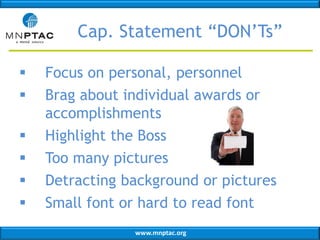
Cap. Statement “DON’Ts”







Focus on personal, personnel
Brag about individual awards or
accomplishments
Highlight the Boss
Too many pictures
Detracting background or pictures
Small font or hard to read font
www.mnptac.org
 Capabilities Statement *
(Line Cards)
 Focused on Business
 One page Elevator Speech (Capabilities)
 A “Snap Shot” of what the business can
bring to the table
 Include the criteria – NAICS, DUNS, CAGE,
Socio-Econ Goal, contacts, info, web
address, location, physical address, etc.
 Look Good, balanced, effective, communicate
YOUR JOB TO MAKE IT WORK
www.mnptac.org
 Line Cards *

Line Card Review
&
Evaluation Techniques

www.mnptac.org
 Capabilities Statement
(for contract)

• Used to evaluate the businesses capacity to perform
• Used to make final decision, B2B comparison
Should include:
- experience
- past performance
- key personnel & qualifications
- facilities, equipment
- understanding of work to be performed
www.mnptac.org
 Capabilities Statement *
• This should be a living document
• Updated on a regular basis
• Any time changes occur
• Different document created from this base
for each specific agency or solicitation
• Should align with the project focus
• Project focus changes, key people
www.mnptac.org
 Past Performance Narrative *
This should be a living document base:
• Created at end of every project
• Archived for future use in Solicitations

Narrative should include:
• Specifics of the project
• Attention to details, methods, systems
• Key personnel involved, qualifications
• Project focus, results
www.mnptac.org
 Past Performance Narrative
Should also include:
• Any problems that occurred
• Subsequent resolutions
• Key players, names, contact info
• Key agency/company people, info, contacts
From this database, future agency specific
documents will be created as needed

www.mnptac.org
 Past Performance Narrative
Each new document created should:
• Align with the particular project focus
• Provide the appropriate key personnel
• Meet the requirements of that particular
solicitation (page limitations, font size)

• Follow all instructions
Ultimate Goal:

project the exact type of company, with exact
capabilities for the project proposed
www.mnptac.org
Agenda for the Today
 Line Cards (one page capabilities)
 Capability Statements

 Past Performance Narrative
 Discuss structure, design, information & review of:

Business Cards
Letterhead, Email Signatures

www.mnptac.org
 Business Cards *
•

Purpose?
– Who you are, what you do, contact info,
calling card, business name, your title,
location

•

Criteria – Government Perspective
– What is your business, what does your
business do, where can I find your business,
how can your business help me?
www.mnptac.org

15
“What is your Business??”
• What’s in YOUR business name?
Alphabet? Actual Business? Mystery service?
Will a stranger know what this business does?

•

What does your business do?
- Do you need a tagline?
• 3 to 5 word explanation, not brand recognition,
that clearly provides a picture of what you do

- NAICS codes – pick your focus, your best
www.mnptac.org

16
“Where do I find your Business?”
• LOCATION, DUNs, CAGE, website url?
– Location – City and State, physical address not
necessary

– D-U-N-S (Data Universal Numbering System)
number is a unique nine digit identification number,
for each physical location of your business, used to
identify a business. It is a “social security number” for
businesses world-wide, but not officially used for
anything other than identification of a business and
not even necessarily required. DUNs IS required to do
business with the government
www.mnptac.org

17
“Where do I find your Business?”
• LOCATION, DUNS, CAGE, website url?
– CAGE (Commercial and Government Entity) Code standardized method which identifies specific facility and its
location. Always 5 alpha-numeric characters assigned by the
DLIS (Defense Logistics Information System)

– Website url – do you have one? Use www. Or http://

– Contact information – person, title, phone, email
(professional)
www.mnptac.org

18
“How can YOUR business help me?”
How can your BUSINESS help Uncle Sam?
• What do you bring to the table?
- Are you a preference program goal? 8a, Minority,
WOSB, EDWOSB, SDVOSB, VOSB, or HUBZone? DBE
through DOT? (socio-economic marketing)

- Are you on a GSA schedule? GSA program?
Schedule #, GSA STARS?, Approved PBS, TMSS?
- Others? Room for GSA logo?

• State certifications?
- list Federal first, then State
www.mnptac.org

19
 Business Cards
• Format of the business card:
–
–
–

Font size 10 +, style
Layout – (follow any logo rules if they apply)
Detractors? – color, background color,
combinations of colors or style? Too busy?

• This is the first “FACE” of YOUR
company

www.mnptac.org

20
 Business Cards









Purpose?
Criteria – Government Perspective
What is your Business?
What does your business do?
Where do I find your Business
Who do I talk to?
How can your BUSINESS help Uncle Sam?
Format?
www.mnptac.org

21
 Email Signature
• Signature – extension of YOU & the business
- your contact name, title, phone, email
- Business name, tagline (optional), logo
(optional), important qualifiers (socioecon goals)
• EMAIL!

• Message Board – your choice

www.mnptac.org

22
Agenda for the Today
 Line Cards (one page capabilities)
 Capability Statements
 Past Performance Narrative
 Discuss structure, design, information & review of:

 Business Cards
 Letterhead, Email Signatures

www.mnptac.org
Need help?
Call a Local PTAC
visit our website:
www.mnptac.org

www.mnptac.org
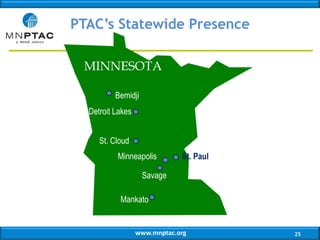
PTAC’s Statewide Presence
MINNESOTA
Bemidji
Detroit Lakes
St. Cloud

Minneapolis

St. Paul

Savage

Mankato

www.mnptac.org

25
The Procurement Technical Assistance Center’s mission
is to strengthen Minnesota’s economy by stimulating
job creation, growth and business retention and helping
companies pursue government contracts.
www.mnptac.org

26
www.mnptac.org

27
www.mnptac.org

28

Capability statements p dotter 031009

  • 1.
    Capabilities & More* Pat Dotter Southwestern Area Manager, PTAC MN pdotter@mnptac.org www.mnptac.org 507-549-3193 October 9, 2013 www.mnptac.org 1
  • 2.
    Agenda for theToday  Line Cards (one page capabilities)  Capability Statements  Past Performance Narrative Discuss structure, design, information & review of:  Business Cards  Letterhead, Email Signatures www.mnptac.org
  • 3.
     Capabilities Statement* (one page – “Line Card”) Electronic Extension of your Business Card – ₋ Much more information – NO BS, No fillers ₋ ONE page, business capabilities, information Core Competencies, Past performance Differentiators, Capacity no less than 10pt font Design – Layout: your choice, pix(s)? (optional) Logos – for company & contracts or programs (Include the tag line, other branding?) ₋ Balanced appearance, organized, informational, stress the key points, name drop, wrap up ₋ ₋ ₋ ₋ ₋ www.mnptac.org
  • 4.
    Capabilities Statement “DO’s” •Brag about BUSINESS, Capabilities (discrete, logo or statement, small print) • Major accomplishments, projects (new technology, new industry, etc.) • General personnel statements • Past Projects, “includes”, largest project • Extra Values, Problems you can solve • Name drop the best www.mnptac.org
  • 5.
    Capabilities Statement “DO’s” •DUNS, CAGE, NAICS with descriptors • Certifications, Verifications (federal first, then state) • Phone, Fax, Professional email, physical address with zip+4 • Business name, tagline if needed • Web address, contact email • Socio-economic category • GSA Contract logos, program • Name drop the best (speaks to capabilities) www.mnptac.org
  • 6.
    Cap. Statement “DON’Ts”       Focuson personal, personnel Brag about individual awards or accomplishments Highlight the Boss Too many pictures Detracting background or pictures Small font or hard to read font www.mnptac.org
  • 7.
     Capabilities Statement* (Line Cards)  Focused on Business  One page Elevator Speech (Capabilities)  A “Snap Shot” of what the business can bring to the table  Include the criteria – NAICS, DUNS, CAGE, Socio-Econ Goal, contacts, info, web address, location, physical address, etc.  Look Good, balanced, effective, communicate YOUR JOB TO MAKE IT WORK www.mnptac.org
  • 8.
     Line Cards* Line Card Review & Evaluation Techniques www.mnptac.org
  • 9.
     Capabilities Statement (forcontract) • Used to evaluate the businesses capacity to perform • Used to make final decision, B2B comparison Should include: - experience - past performance - key personnel & qualifications - facilities, equipment - understanding of work to be performed www.mnptac.org
  • 10.
     Capabilities Statement* • This should be a living document • Updated on a regular basis • Any time changes occur • Different document created from this base for each specific agency or solicitation • Should align with the project focus • Project focus changes, key people www.mnptac.org
  • 11.
     Past PerformanceNarrative * This should be a living document base: • Created at end of every project • Archived for future use in Solicitations Narrative should include: • Specifics of the project • Attention to details, methods, systems • Key personnel involved, qualifications • Project focus, results www.mnptac.org
  • 12.
     Past PerformanceNarrative Should also include: • Any problems that occurred • Subsequent resolutions • Key players, names, contact info • Key agency/company people, info, contacts From this database, future agency specific documents will be created as needed www.mnptac.org
  • 13.
     Past PerformanceNarrative Each new document created should: • Align with the particular project focus • Provide the appropriate key personnel • Meet the requirements of that particular solicitation (page limitations, font size) • Follow all instructions Ultimate Goal: project the exact type of company, with exact capabilities for the project proposed www.mnptac.org
  • 14.
    Agenda for theToday  Line Cards (one page capabilities)  Capability Statements  Past Performance Narrative  Discuss structure, design, information & review of: Business Cards Letterhead, Email Signatures www.mnptac.org
  • 15.
     Business Cards* • Purpose? – Who you are, what you do, contact info, calling card, business name, your title, location • Criteria – Government Perspective – What is your business, what does your business do, where can I find your business, how can your business help me? www.mnptac.org 15
  • 16.
    “What is yourBusiness??” • What’s in YOUR business name? Alphabet? Actual Business? Mystery service? Will a stranger know what this business does? • What does your business do? - Do you need a tagline? • 3 to 5 word explanation, not brand recognition, that clearly provides a picture of what you do - NAICS codes – pick your focus, your best www.mnptac.org 16
  • 17.
    “Where do Ifind your Business?” • LOCATION, DUNs, CAGE, website url? – Location – City and State, physical address not necessary – D-U-N-S (Data Universal Numbering System) number is a unique nine digit identification number, for each physical location of your business, used to identify a business. It is a “social security number” for businesses world-wide, but not officially used for anything other than identification of a business and not even necessarily required. DUNs IS required to do business with the government www.mnptac.org 17
  • 18.
    “Where do Ifind your Business?” • LOCATION, DUNS, CAGE, website url? – CAGE (Commercial and Government Entity) Code standardized method which identifies specific facility and its location. Always 5 alpha-numeric characters assigned by the DLIS (Defense Logistics Information System) – Website url – do you have one? Use www. Or http:// – Contact information – person, title, phone, email (professional) www.mnptac.org 18
  • 19.
    “How can YOURbusiness help me?” How can your BUSINESS help Uncle Sam? • What do you bring to the table? - Are you a preference program goal? 8a, Minority, WOSB, EDWOSB, SDVOSB, VOSB, or HUBZone? DBE through DOT? (socio-economic marketing) - Are you on a GSA schedule? GSA program? Schedule #, GSA STARS?, Approved PBS, TMSS? - Others? Room for GSA logo? • State certifications? - list Federal first, then State www.mnptac.org 19
  • 20.
     Business Cards •Format of the business card: – – – Font size 10 +, style Layout – (follow any logo rules if they apply) Detractors? – color, background color, combinations of colors or style? Too busy? • This is the first “FACE” of YOUR company www.mnptac.org 20
  • 21.
     Business Cards         Purpose? Criteria– Government Perspective What is your Business? What does your business do? Where do I find your Business Who do I talk to? How can your BUSINESS help Uncle Sam? Format? www.mnptac.org 21
  • 22.
     Email Signature •Signature – extension of YOU & the business - your contact name, title, phone, email - Business name, tagline (optional), logo (optional), important qualifiers (socioecon goals) • EMAIL! • Message Board – your choice www.mnptac.org 22
  • 23.
    Agenda for theToday  Line Cards (one page capabilities)  Capability Statements  Past Performance Narrative  Discuss structure, design, information & review of:  Business Cards  Letterhead, Email Signatures www.mnptac.org
  • 24.
    Need help? Call aLocal PTAC visit our website: www.mnptac.org www.mnptac.org
  • 25.
    PTAC’s Statewide Presence MINNESOTA Bemidji DetroitLakes St. Cloud Minneapolis St. Paul Savage Mankato www.mnptac.org 25
  • 26.
    The Procurement TechnicalAssistance Center’s mission is to strengthen Minnesota’s economy by stimulating job creation, growth and business retention and helping companies pursue government contracts. www.mnptac.org 26
  • 27.
  • 28.