The law of mental health care.
ICD10 classification
Classification of mental
Disorders.
• All systems of mental disorders and diagnosis
stem from the work of Kraepelin.
• He claimed certain groups of symptoms occur
together often, thus allowing us to call them
diseases or syndromes.
• He regarded each mental illness as distinct
from all others with its own origins,
symptoms, course and outcomes.
• He originally classified two major groups:
• Dementia praecox (Schizophrenia)
• Manic-depressive psychosis (faulty
metabolism).
• This helped to establish the organic nature of
mental disorders and formed the basis of the
Diagnostic statistical manual of mental
disorders (DSM).
• This helped to establish the organic nature of
mental disorders and formed the basis of the:
• Diagnostic statistical manual of mental
disorders (DSM). The APA’s official classification system
• The International classification Of Diseases
(ICD). Published by the World Health Organisation (WHO)
• His classification is also embodied in the Mental health Act
(1983). The act contains three major categories of mental
disturbances.
• Mental illness, personality Disorder, and Mental impairment.
DSM-IV-TR & ICD-10.
• DSM-IV-TR
• Larger no. of
discrete categories.
• Uses a multi-axial
system.
• Uses term psychotic.
• ICD-10
• More general
categories.
• Generally single axis.
But uses broad aetiology.
Uses term neurotic.
DSM-IV-TR
• The inclusion of the axes reflect the
assumption that most disorders are
caused by the interaction of:
• Biological
• Sociological
• Psychological factors.
• The patient is assessed more broadly
giving a more global in depth picture.
DSM-IV-TR (1994)
• DSM IV (1994):
Ø Effort to develop a consistent worldwide system of
classification that would be compatible with the ICD-
10.
Ø Huge review of all research on psychopathology to
update the classification system.
Ø Distinction between organically based disorders and
psychologically based disorders was eliminated.
Ø Increased considerations of cultural factors.
Diagnostic assessment: Clinical History
 Onset, duration and
severity of current
symptoms
Ø Previous mental
illness
Medical history
Ø Childhood history
Ø Occupational
functioning
Educational history
Ø Marital and
relationship history
Ø Family history
Ø Religion
Ø Psychosexual
history
Ø Current living
situation
Assessment Procedures
 Mental Status Examination
· Projective tests e.g. Rorschach,
TAT.
· Objective tests e.g. MMPI
· Organic tests e.g. Blood tests, CAT
scan
• Collateral information
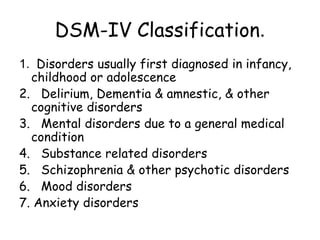
DSM-IV Classification.
1. Disorders usually first diagnosed in infancy,
childhood or adolescence
2. Delirium, Dementia & amnestic, & other
cognitive disorders
3. Mental disorders due to a general medical
condition
4. Substance related disorders
5. Schizophrenia & other psychotic disorders
6. Mood disorders
7. Anxiety disorders
DSM-IV Classification.
9. Somatoform disorders
10.Factitious disorders
11.Dissociative disorders
12.Sexual & Gender identity disorders
13.Eating disorders
14.Sleep disorders
15.Impulse control disorders not elsewhere classified
16.Adjustment disorders
17.Personality disorders
18.Other conditions that may be a focus of clinical
attention
DSM-IV-TR
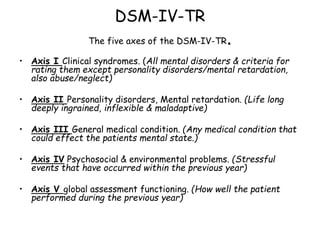
The five axes of the DSM-IV-TR.
• Axis I Clinical syndromes. (All mental disorders & criteria for
rating them except personality disorders/mental retardation,
also abuse/neglect)
• Axis II Personality disorders, Mental retardation. (Life long
deeply ingrained, inflexible & maladaptive)
• Axis III General medical condition. (Any medical condition that
could effect the patients mental state.)
• Axis IV Psychosocial & environmental problems. (Stressful
events that have occurred within the previous year)
• Axis V global assessment functioning. (How well the patient
performed during the previous year)
ICD-10
• It was agreed whilst being constructed that because of the
incomplete and often controversial state of knowledge about the
aetiology of most psychiatric disorders, the classification would
be worked out on a descriptive basis.
• Implying that disorders should be grouped according to
similarities and differences of symptoms and signs so that a
particular disorder should occur in only one place.
• However it soon became clear this would not appeal to clinicians
(they like to make aetiology very important!!) This therefore
makes the ICD-10 impure from a taxonomic point of view, but
still more likely to be used by clinicians than the DSM-IV-TR.
The use of diagnostic criteria
• Both systems have introduced explicit operational
criteria for diagnosis. That is:
• For each disorder there is a specified list of
symptoms, all of which must be present , for a
specified period of time, in relation to age and
gender, stipulation as to what other diagnoses
mustn’t be present and the personal and social
consequences of the disorder.
• The aim is to make diagnosis more reliable and valid
by laying down rules for the inclusion or exclusion of
cases.
Problems with the classification
of mental disorder.
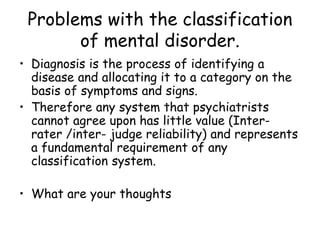
• Diagnosis is the process of identifying a
disease and allocating it to a category on the
basis of symptoms and signs.
• Therefore any system that psychiatrists
cannot agree upon has little value (Inter-
rater /inter- judge reliability) and represents
a fundamental requirement of any
classification system.
• What are your thoughts
Example of Diagnosis:
• Patient: Johnnie Walker
– Axis I: Major depressive Disorder
– Axis II: Narcissistic Personality Disorder
– some features only
– Axis III: Poor liver functioning, frequent
migraines.
– Axis IV: Recently retrenched
– Axis V: 65
Problems with DSM
classification.
• Labeling:
Ø Tends to be reductionistic.
Ø May lead to stigmatisation, or person
taking on the sick role and identifying
with the label.
Ø Labels are “sticky”. (Rosenhan study and
2005 Darwin Awards)
Ø Instrument of social control: gives mental
health professionals control over
people’s lives.
Problems with the classification
of mental disorder.
• Early studies have shown time after time poor
diagnostic reliability. WHY???
• One reason may lie in the fact that information elicited
in interviews vary widely, also the interpretation of the
said information is largely subjective.
• Secondly trained psychiatrist from different countries
showed great variation in their interpretations.
• E.g. UK-US Diagnostic project showed American &
British psychiatrists the same videotaped clinical
interviews and asked them to make a diagnosis. New
York psychiatrists diagnosed schizophrenia twice as
often, while the London psychiatrists diagnosed
mania and depression twice as often.(Cooper et al
1972)

mental disorders .pptx

  • 1.
    The law ofmental health care. ICD10 classification
  • 2.
    Classification of mental Disorders. •All systems of mental disorders and diagnosis stem from the work of Kraepelin. • He claimed certain groups of symptoms occur together often, thus allowing us to call them diseases or syndromes. • He regarded each mental illness as distinct from all others with its own origins, symptoms, course and outcomes.
  • 3.
    • He originallyclassified two major groups: • Dementia praecox (Schizophrenia) • Manic-depressive psychosis (faulty metabolism). • This helped to establish the organic nature of mental disorders and formed the basis of the Diagnostic statistical manual of mental disorders (DSM).
  • 4.
    • This helpedto establish the organic nature of mental disorders and formed the basis of the: • Diagnostic statistical manual of mental disorders (DSM). The APA’s official classification system • The International classification Of Diseases (ICD). Published by the World Health Organisation (WHO) • His classification is also embodied in the Mental health Act (1983). The act contains three major categories of mental disturbances. • Mental illness, personality Disorder, and Mental impairment.
  • 5.
    DSM-IV-TR & ICD-10. •DSM-IV-TR • Larger no. of discrete categories. • Uses a multi-axial system. • Uses term psychotic. • ICD-10 • More general categories. • Generally single axis. But uses broad aetiology. Uses term neurotic.
  • 6.
    DSM-IV-TR • The inclusionof the axes reflect the assumption that most disorders are caused by the interaction of: • Biological • Sociological • Psychological factors. • The patient is assessed more broadly giving a more global in depth picture.
  • 7.
    DSM-IV-TR (1994) • DSMIV (1994): Ø Effort to develop a consistent worldwide system of classification that would be compatible with the ICD- 10. Ø Huge review of all research on psychopathology to update the classification system. Ø Distinction between organically based disorders and psychologically based disorders was eliminated. Ø Increased considerations of cultural factors.
  • 8.
    Diagnostic assessment: ClinicalHistory  Onset, duration and severity of current symptoms Ø Previous mental illness Medical history Ø Childhood history Ø Occupational functioning Educational history Ø Marital and relationship history Ø Family history Ø Religion Ø Psychosexual history Ø Current living situation
  • 9.
    Assessment Procedures  MentalStatus Examination · Projective tests e.g. Rorschach, TAT. · Objective tests e.g. MMPI · Organic tests e.g. Blood tests, CAT scan • Collateral information
  • 10.
    DSM-IV Classification. 1. Disordersusually first diagnosed in infancy, childhood or adolescence 2. Delirium, Dementia & amnestic, & other cognitive disorders 3. Mental disorders due to a general medical condition 4. Substance related disorders 5. Schizophrenia & other psychotic disorders 6. Mood disorders 7. Anxiety disorders
  • 11.
    DSM-IV Classification. 9. Somatoformdisorders 10.Factitious disorders 11.Dissociative disorders 12.Sexual & Gender identity disorders 13.Eating disorders 14.Sleep disorders 15.Impulse control disorders not elsewhere classified 16.Adjustment disorders 17.Personality disorders 18.Other conditions that may be a focus of clinical attention
  • 12.
    DSM-IV-TR The five axesof the DSM-IV-TR. • Axis I Clinical syndromes. (All mental disorders & criteria for rating them except personality disorders/mental retardation, also abuse/neglect) • Axis II Personality disorders, Mental retardation. (Life long deeply ingrained, inflexible & maladaptive) • Axis III General medical condition. (Any medical condition that could effect the patients mental state.) • Axis IV Psychosocial & environmental problems. (Stressful events that have occurred within the previous year) • Axis V global assessment functioning. (How well the patient performed during the previous year)
  • 13.
    ICD-10 • It wasagreed whilst being constructed that because of the incomplete and often controversial state of knowledge about the aetiology of most psychiatric disorders, the classification would be worked out on a descriptive basis. • Implying that disorders should be grouped according to similarities and differences of symptoms and signs so that a particular disorder should occur in only one place. • However it soon became clear this would not appeal to clinicians (they like to make aetiology very important!!) This therefore makes the ICD-10 impure from a taxonomic point of view, but still more likely to be used by clinicians than the DSM-IV-TR.
  • 14.
    The use ofdiagnostic criteria • Both systems have introduced explicit operational criteria for diagnosis. That is: • For each disorder there is a specified list of symptoms, all of which must be present , for a specified period of time, in relation to age and gender, stipulation as to what other diagnoses mustn’t be present and the personal and social consequences of the disorder. • The aim is to make diagnosis more reliable and valid by laying down rules for the inclusion or exclusion of cases.
  • 15.
    Problems with theclassification of mental disorder. • Diagnosis is the process of identifying a disease and allocating it to a category on the basis of symptoms and signs. • Therefore any system that psychiatrists cannot agree upon has little value (Inter- rater /inter- judge reliability) and represents a fundamental requirement of any classification system. • What are your thoughts
  • 16.
    Example of Diagnosis: •Patient: Johnnie Walker – Axis I: Major depressive Disorder – Axis II: Narcissistic Personality Disorder – some features only – Axis III: Poor liver functioning, frequent migraines. – Axis IV: Recently retrenched – Axis V: 65
  • 17.
    Problems with DSM classification. •Labeling: Ø Tends to be reductionistic. Ø May lead to stigmatisation, or person taking on the sick role and identifying with the label. Ø Labels are “sticky”. (Rosenhan study and 2005 Darwin Awards) Ø Instrument of social control: gives mental health professionals control over people’s lives.
  • 18.
    Problems with theclassification of mental disorder. • Early studies have shown time after time poor diagnostic reliability. WHY??? • One reason may lie in the fact that information elicited in interviews vary widely, also the interpretation of the said information is largely subjective. • Secondly trained psychiatrist from different countries showed great variation in their interpretations. • E.g. UK-US Diagnostic project showed American & British psychiatrists the same videotaped clinical interviews and asked them to make a diagnosis. New York psychiatrists diagnosed schizophrenia twice as often, while the London psychiatrists diagnosed mania and depression twice as often.(Cooper et al 1972)