Psychology in UX-Getting Out of the BuildingHow to ask the right questions and get more value from user research 
Presented by AgileThought UX Designer, Seth Jacobs
Overview –major points for discussion 
www.agilethought.com 2 
•User research overview 
•How questions are utilized in user research 
•Why you get certain types of answers 
•How to formulate the right kind of question 
•How gathered data can generate thought models
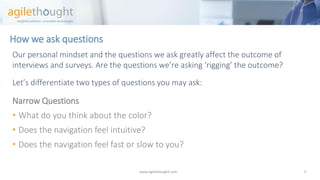
User research in the world todayThe primary steps a user researcher utilizes in the world today: 
1) Identify Objectives:What do you need to know? 
2) Form Hypotheses: What do you know/expect/anticipate? 
3) Initiate Methods: How do you plan to obtain the data you need? 
4)Gather Data: Extract data from the methods you’ve initiated. 
5) Use Data: Take the data you’ve collected and use it to make decisions. 
www.agilethought.com 3
Current research methods 
In no particular order: 
1) Market Research:What does the market look like, what are people saying, etc. 
2)Interviews: Observational, Contextual 
3) Surveys: We all know what a survey is. 
4) Trend Research: Discover what’s currently popular in the world. 
www.agilethought.com 4
How we ask questions 
Our personal mindset and the questions we ask greatly affect the outcome of interviews and surveys. Are the questions we’re asking ‘rigging’ the outcome? 
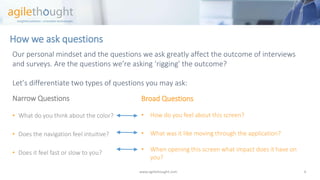
Let’s differentiate two types of questions you may ask: 
Narrow Questions 
•What do you think about the color? 
•Does the navigation feel intuitive? 
•Does the navigation feel fast or slow to you? 
www.agilethought.com 5
How we ask questions 
Our personal mindset and the questions we ask greatly affect the outcome of interviews and surveys. Are the questions we’re asking ‘rigging’ the outcome? 
Let’s differentiate two types of questions you may ask: 
Narrow Questions 
•What do you think about the color? 
•Does the navigation feel intuitive? 
•Does it feel fast or slow to you? 
www.agilethought.com 6 
Broad Questions 
•How do you feel about this screen? 
•What was it like moving through the application? 
•When opening this screen what impact does it have on you?
The answers we get 
When we ask narrow questions, we get narrow answers. When we ask broad and non- leading questions, the user feedback you get is more raw and thus valuable. Subsequently, the data you gather becomes more powerful. 
User Answers 
www.agilethought.com 7 
Does the navigation feel intuitive? 
It’s ok. The font looks really small on the navigation, that could make it hard to see. 
What was it like moving through the application? 
•I had no problems getting where I needed to be. 
•It was somewhat hard to add games to my profile. 
•It took me a minute to find the payment settings. 
“You only need about five users at a minimum.” 
-Nielsen Norman
What influences answers? 
Understanding the mental and physiological impact of the questions you ask is crucial. What goes on inside one’s head? What are some typical habits to factor in when drafting questions for user research? 
Here are a few major influences to look for: 
•User researchers often have their own ideas. 
•Sometimes the questions asked are formulated to prove the researcher’s own ideas. 
•Each person is different and so is the hierarchy of their thoughts. 
•The brain’s Neocortex contains a hierarchy of thought pattern recognizers that ultimately outlines a user’s thought process. Answers given by a user stems from where your question falls within their hierarchy of thoughts. 
•People don’t want more work than necessary. They easily overload on data and their memory is fragile. 
•People seek social validation and recognition. 
•Answers given could stem from a desire to be social. 
•Oxytocin levels vary and change from person to person –no two people are the same. 
www.agilethought.com 8
How to form questions 
The ultimate goal when asking questions is to get as much data as possible. With some practice, it becomes easy and rewarding to question and counter-question a user. 
Hereare a few question templates: 
www.agilethought.com 9 
General 
1) What kind of impact did xyzhave on you? 
2) How do you feel about this xyz? 
3) What was xyzlike from your viewpoint? 
4) How would you describe xyz? 
5) What part of the xyzbrings you the most value? 
Workflow-based 
1) Can you tell me about your experience with the storearea? 
2) How was the storearea from your viewpoint? 
3) What was it like using the storesection?
Form thought models 
www.agilethought.com 10 
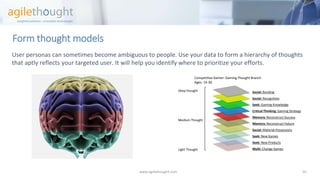
User personas can sometimes become ambiguous to people. Use your data to form a hierarchy of thoughts that aptly reflects your targeted user. It will help you identify where to prioritize your efforts. 
Social:Bonding 
Social:Recognition 
Seek:Gaming Knowledge 
Critical Thinking:Gaming Strategy 
Memory: Reconstruct Success 
Memory:Reconstruct Failure 
Social: Material Possessions 
Seek:New Games 
Seek:New Products 
Multi:Change Games 
Competitive Gamer: Gaming Thought Branch Ages: 14-30 
Deep thought 
Medium Thought 
Light Thought
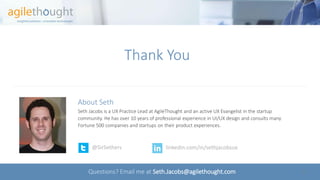
Seth Jacobs is a UX Practice Lead at AgileThought and an active UX Evangelist in the startup community. He has over 10 years of professional experience in UI/UX design and consults many Fortune 500 companies and startups on their product experiences. 
About Seth 
Thank You 
@SirSethers 
Questions? Email me at Seth.Jacobs@agilethought.com 11 
linkedin.com/in/sethjacobsux

Psychology In UX

  • 1.
    Psychology in UX-GettingOut of the BuildingHow to ask the right questions and get more value from user research Presented by AgileThought UX Designer, Seth Jacobs
  • 2.
    Overview –major pointsfor discussion www.agilethought.com 2 •User research overview •How questions are utilized in user research •Why you get certain types of answers •How to formulate the right kind of question •How gathered data can generate thought models
  • 3.
    User research inthe world todayThe primary steps a user researcher utilizes in the world today: 1) Identify Objectives:What do you need to know? 2) Form Hypotheses: What do you know/expect/anticipate? 3) Initiate Methods: How do you plan to obtain the data you need? 4)Gather Data: Extract data from the methods you’ve initiated. 5) Use Data: Take the data you’ve collected and use it to make decisions. www.agilethought.com 3
  • 4.
    Current research methods In no particular order: 1) Market Research:What does the market look like, what are people saying, etc. 2)Interviews: Observational, Contextual 3) Surveys: We all know what a survey is. 4) Trend Research: Discover what’s currently popular in the world. www.agilethought.com 4
  • 5.
    How we askquestions Our personal mindset and the questions we ask greatly affect the outcome of interviews and surveys. Are the questions we’re asking ‘rigging’ the outcome? Let’s differentiate two types of questions you may ask: Narrow Questions •What do you think about the color? •Does the navigation feel intuitive? •Does the navigation feel fast or slow to you? www.agilethought.com 5
  • 6.
    How we askquestions Our personal mindset and the questions we ask greatly affect the outcome of interviews and surveys. Are the questions we’re asking ‘rigging’ the outcome? Let’s differentiate two types of questions you may ask: Narrow Questions •What do you think about the color? •Does the navigation feel intuitive? •Does it feel fast or slow to you? www.agilethought.com 6 Broad Questions •How do you feel about this screen? •What was it like moving through the application? •When opening this screen what impact does it have on you?
  • 7.
    The answers weget When we ask narrow questions, we get narrow answers. When we ask broad and non- leading questions, the user feedback you get is more raw and thus valuable. Subsequently, the data you gather becomes more powerful. User Answers www.agilethought.com 7 Does the navigation feel intuitive? It’s ok. The font looks really small on the navigation, that could make it hard to see. What was it like moving through the application? •I had no problems getting where I needed to be. •It was somewhat hard to add games to my profile. •It took me a minute to find the payment settings. “You only need about five users at a minimum.” -Nielsen Norman
  • 8.
    What influences answers? Understanding the mental and physiological impact of the questions you ask is crucial. What goes on inside one’s head? What are some typical habits to factor in when drafting questions for user research? Here are a few major influences to look for: •User researchers often have their own ideas. •Sometimes the questions asked are formulated to prove the researcher’s own ideas. •Each person is different and so is the hierarchy of their thoughts. •The brain’s Neocortex contains a hierarchy of thought pattern recognizers that ultimately outlines a user’s thought process. Answers given by a user stems from where your question falls within their hierarchy of thoughts. •People don’t want more work than necessary. They easily overload on data and their memory is fragile. •People seek social validation and recognition. •Answers given could stem from a desire to be social. •Oxytocin levels vary and change from person to person –no two people are the same. www.agilethought.com 8
  • 9.
    How to formquestions The ultimate goal when asking questions is to get as much data as possible. With some practice, it becomes easy and rewarding to question and counter-question a user. Hereare a few question templates: www.agilethought.com 9 General 1) What kind of impact did xyzhave on you? 2) How do you feel about this xyz? 3) What was xyzlike from your viewpoint? 4) How would you describe xyz? 5) What part of the xyzbrings you the most value? Workflow-based 1) Can you tell me about your experience with the storearea? 2) How was the storearea from your viewpoint? 3) What was it like using the storesection?
  • 10.
    Form thought models www.agilethought.com 10 User personas can sometimes become ambiguous to people. Use your data to form a hierarchy of thoughts that aptly reflects your targeted user. It will help you identify where to prioritize your efforts. Social:Bonding Social:Recognition Seek:Gaming Knowledge Critical Thinking:Gaming Strategy Memory: Reconstruct Success Memory:Reconstruct Failure Social: Material Possessions Seek:New Games Seek:New Products Multi:Change Games Competitive Gamer: Gaming Thought Branch Ages: 14-30 Deep thought Medium Thought Light Thought
  • 11.
    Seth Jacobs isa UX Practice Lead at AgileThought and an active UX Evangelist in the startup community. He has over 10 years of professional experience in UI/UX design and consults many Fortune 500 companies and startups on their product experiences. About Seth Thank You @SirSethers Questions? Email me at Seth.Jacobs@agilethought.com 11 linkedin.com/in/sethjacobsux