The Agile Journey
by Ryan Dorrell, AgileThought CTO and Co-Founder
A bad system beats a good person every time.
2
You don’t need to change. Survival is optional.
- W. Edwards Deming
A Case Study in Agile
Rapidly Shifting Market – a company founded in analog technology with the rest of the world moving to
digital.
Complex Organizational Structures – no clear flow for products and services to be delivered to customers.
Products often took months to deliver.
Heavyweight Delivery Methodology – new products and services often missed the mark because they were
late, resulting in revenue struggles.
Low Morale – low morale and excitement about the work.
Internal Cultural Divide Between Teams – “Us” versus “Them” between business and IT.
3
(re)Defining Agile – Beyond Software
4
 Customer collaboration
 Prioritization by business value
 Incrementally create and deliver working
products
 Respond to change faster
 Higher quality, faster, at lower cost and
lower risk
http://en.wikipedia.org/wiki/Toyota_Production_System
Lean – A History Lesson
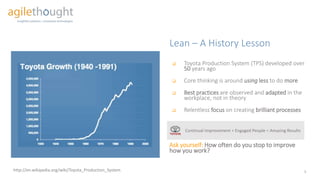
 Toyota Production System (TPS) developed over
50 years ago
 Core thinking is around using less to do more
 Best practices are observed and adapted in the
workplace, not in theory
 Relentless focus on creating brilliant processes
Ask yourself: How often do you stop to improve
how you work?
Continual Improvement + Engaged People = Amazing Results
5
Lean Principles
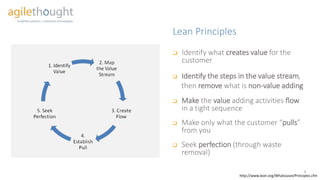
 Identify what creates value for the
customer
 Identify the steps in the value stream,
then remove what is non-value adding
 Make the value adding activities flow
in a tight sequence
 Make only what the customer “pulls”
from you
 Seek perfection (through waste
removal)
http://www.lean.org/WhatsLean/Principles.cfm
6
Kanban Principles
7
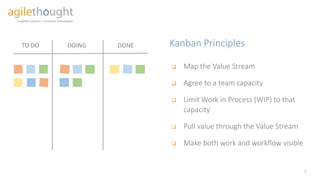
 Map the Value Stream
 Agree to a team capacity
 Limit Work in Process (WIP) to that
capacity
 Pull value through the Value Stream
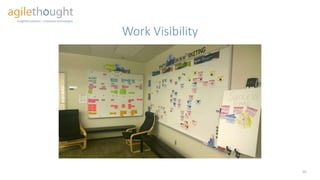
 Make both work and workflow visible
TO DO DOING DONE
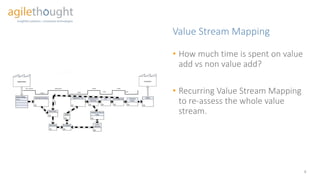
Value Stream Mapping
How much time is spent on value add
vs non value add?
Recurring Value Stream Mapping to re-
assess the whole value stream.
8
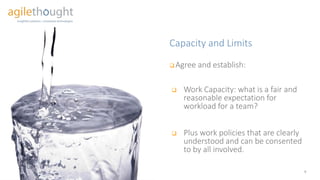
Capacity and Limits
9
Agree and establish
 Work Capacity: what is a fair and
reasonable expectation for
workload for a team?
 Plus work policies that are
clearly understood and can be
consented to by all involved.
Work Visibility
10
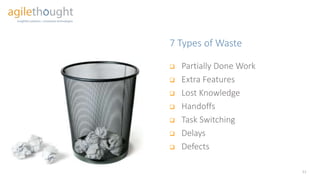
7 Types of Waste
11
 Partially Done Work
 Extra Features
 Lost Knowledge
 Handoffs
 Task Switching
 Delays
 Defects
Metrics
12
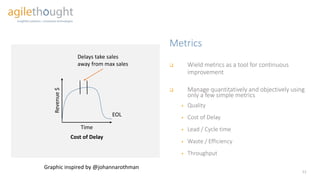
 Wield metrics as a tool for continuous
improvement
 Manage quantitatively and objectively using
only a few simple metrics
 Quality
 Cost of Delay
 Lead / Cycle time
 Waste / Efficiency
 Throughput
Revenue$
Time
EOL
Delays take sales
away from max sales
Cost of Delay
Graphic inspired by @johannarothman
The Path to Lean and Agile
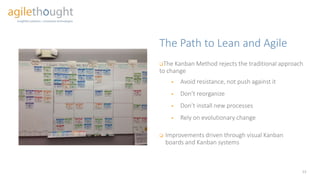
 The Kanban Method rejects the traditional approach
to change
 Avoid resistance, not push against it
 Don’t reorganize
 Don’t install new processes
 Rely on evolutionary change
13
 Improvements driven through visual Kanban
boards and Kanban systems
Using the Kanban Method
14
 Start with your existing work flow
 Everyone agrees to pursue evolutionary change
 Respect existing roles, responsibilities and job titles
initially – but agree that they may change
 Encourage leadership
 Learn to view what you do as a set of services (that
can be improved)
 Map, understand and track the workflow to improve
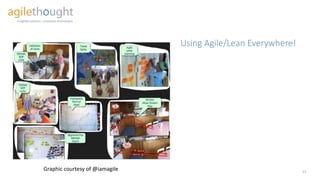
Using Agile/Lean Everywhere!
15
Graphic courtesy of @iamagile
A Case Study in Agile, revisited
Pragmatically implemented Scrum/Kanban
Philosophy of servant leadership
Executive engagement
 Entire business project portfolio is visualized with Kanban
Aggressive attitude towards eliminating non-value add activities
16
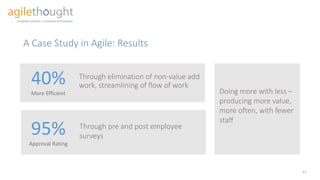
Doing more with less –
producing more value,
more often, with fewer
staff
A Case Study in Agile: Results
17
Through elimination of non-value add
work, streamlining of flow of work40%
More Efficient
95%
Approval Rating
Through pre and post employee
surveys
Are you ready?
18
1. Is my organization ready for cultural change?
2. Am I prepared to have an engaged workforce?
3. Am I ready to make necessary, but possibly difficult, changes?
4. Am I willing to adapt my leadership style if necessary?
5. Am I willing to empower and trust my teams?
Visit our library of free webinar videos!
Previous Webinars:
• Azure + Visual Studio Online: How to build, test, deploy and monitor seamlessly
• 6 Steps To Achieving Predictable Release Management With Visual Studio 2013
• How To Create High Value Development Teams
• 5 TFS Features That Will Dramatically Improve Your Team's Performance
19
With 20 years of professional software development experience, Ryan has been deeply involved in
building a wide range of applications. He has extensive experience building web-based transactional
systems, as well as cloud data management applications. Recently, Ryan has led AgileThought into
many new areas of technical capability, such as mobile and cloud development.
About Ryan
Thank You
@ryan_dorrell
Looking for ALM Solutions for Your Business? Email me at ryan.dorrell@agilethought.com20
linkedin.com/in/ryandorrell

The Agile Journey

  • 1.
    The Agile Journey byRyan Dorrell, AgileThought CTO and Co-Founder
  • 2.
    A bad systembeats a good person every time. 2 You don’t need to change. Survival is optional. - W. Edwards Deming
  • 3.
    A Case Studyin Agile Rapidly Shifting Market – a company founded in analog technology with the rest of the world moving to digital. Complex Organizational Structures – no clear flow for products and services to be delivered to customers. Products often took months to deliver. Heavyweight Delivery Methodology – new products and services often missed the mark because they were late, resulting in revenue struggles. Low Morale – low morale and excitement about the work. Internal Cultural Divide Between Teams – “Us” versus “Them” between business and IT. 3
  • 4.
    (re)Defining Agile –Beyond Software 4  Customer collaboration  Prioritization by business value  Incrementally create and deliver working products  Respond to change faster  Higher quality, faster, at lower cost and lower risk
  • 5.
    http://en.wikipedia.org/wiki/Toyota_Production_System Lean – AHistory Lesson  Toyota Production System (TPS) developed over 50 years ago  Core thinking is around using less to do more  Best practices are observed and adapted in the workplace, not in theory  Relentless focus on creating brilliant processes Ask yourself: How often do you stop to improve how you work? Continual Improvement + Engaged People = Amazing Results 5
  • 6.
    Lean Principles  Identifywhat creates value for the customer  Identify the steps in the value stream, then remove what is non-value adding  Make the value adding activities flow in a tight sequence  Make only what the customer “pulls” from you  Seek perfection (through waste removal) http://www.lean.org/WhatsLean/Principles.cfm 6
  • 7.
    Kanban Principles 7  Mapthe Value Stream  Agree to a team capacity  Limit Work in Process (WIP) to that capacity  Pull value through the Value Stream  Make both work and workflow visible TO DO DOING DONE
  • 8.
    Value Stream Mapping Howmuch time is spent on value add vs non value add? Recurring Value Stream Mapping to re- assess the whole value stream. 8
  • 9.
    Capacity and Limits 9 Agreeand establish  Work Capacity: what is a fair and reasonable expectation for workload for a team?  Plus work policies that are clearly understood and can be consented to by all involved.
  • 10.
  • 11.
    7 Types ofWaste 11  Partially Done Work  Extra Features  Lost Knowledge  Handoffs  Task Switching  Delays  Defects
  • 12.
    Metrics 12  Wield metricsas a tool for continuous improvement  Manage quantitatively and objectively using only a few simple metrics  Quality  Cost of Delay  Lead / Cycle time  Waste / Efficiency  Throughput Revenue$ Time EOL Delays take sales away from max sales Cost of Delay Graphic inspired by @johannarothman
  • 13.
    The Path toLean and Agile  The Kanban Method rejects the traditional approach to change  Avoid resistance, not push against it  Don’t reorganize  Don’t install new processes  Rely on evolutionary change 13  Improvements driven through visual Kanban boards and Kanban systems
  • 14.
    Using the KanbanMethod 14  Start with your existing work flow  Everyone agrees to pursue evolutionary change  Respect existing roles, responsibilities and job titles initially – but agree that they may change  Encourage leadership  Learn to view what you do as a set of services (that can be improved)  Map, understand and track the workflow to improve
  • 15.
  • 16.
    A Case Studyin Agile, revisited Pragmatically implemented Scrum/Kanban Philosophy of servant leadership Executive engagement  Entire business project portfolio is visualized with Kanban Aggressive attitude towards eliminating non-value add activities 16
  • 17.
    Doing more withless – producing more value, more often, with fewer staff A Case Study in Agile: Results 17 Through elimination of non-value add work, streamlining of flow of work40% More Efficient 95% Approval Rating Through pre and post employee surveys
  • 18.
    Are you ready? 18 1.Is my organization ready for cultural change? 2. Am I prepared to have an engaged workforce? 3. Am I ready to make necessary, but possibly difficult, changes? 4. Am I willing to adapt my leadership style if necessary? 5. Am I willing to empower and trust my teams?
  • 19.
    Visit our libraryof free webinar videos! Previous Webinars: • Azure + Visual Studio Online: How to build, test, deploy and monitor seamlessly • 6 Steps To Achieving Predictable Release Management With Visual Studio 2013 • How To Create High Value Development Teams • 5 TFS Features That Will Dramatically Improve Your Team's Performance 19
  • 20.
    With 20 yearsof professional software development experience, Ryan has been deeply involved in building a wide range of applications. He has extensive experience building web-based transactional systems, as well as cloud data management applications. Recently, Ryan has led AgileThought into many new areas of technical capability, such as mobile and cloud development. About Ryan Thank You @ryan_dorrell Looking for ALM Solutions for Your Business? Email me at ryan.dorrell@agilethought.com20 linkedin.com/in/ryandorrell

Editor's Notes

  • #6 Toyota goal – do more with less They have a relentless focus on improving the work Toyota is often studied but only the tools are adopted, this results in failed implementations or only realising a small % of the benefits Toyota warn - Brilliant people working within broken processes wont get the same results This is often ignored by those looking to learn from Toyota. Cultural value – 1000s of brains in the workforce - introduce opportunities for team members to make suggestions for improvement. I know best how to improve my job as I do it every day, I should be able to suggest how to improve and work with my manager on implementing those improvements.
  • #7 Value adding – essentially why are we here as a business Non value adding – study work end to end, from customer request to delivery. Non value adding is failure demand e.g. I asked for this by the 12th and got it on the 14th or you gave me something that didn’t work or wasn’t what I asked for. Making work flow, removing bottlenecks. Simple things like making hand offs clean; visit someone you hand off work to and ask them how it could be improved. Imagine everyone doing this corporate wide how much more effective we would be. Imagine doing this with our partners! IT should be about delivering the right thing at the right time, supply and demand.