








What drugs do people use most?
Apart from medicines and caffeine, tmost
Irish people use is alcoholegal drugs that
people are most likely to try are:
1
2
3
4

Cannabis
Cocaine
Amphetamine
Nitrites, poppers
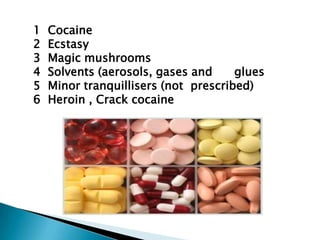
1
2
3
4
5
6

Cocaine
Ecstasy
Magic mushrooms
Solvents (aerosols, gases and
glues
Minor tranquillisers (not prescribed)
Heroin , Crack cocaine


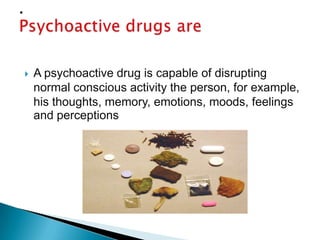
A psychoactive drug is capable of disrupting
normal conscious activity the person, for example,
his thoughts, memory, emotions, moods, feelings
and perceptions





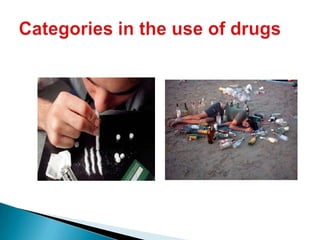
1 - Use - actual drug consumption
2 - Abuse - This situation is characterized by
continuing to use it even when the user
generates personal problems (physical,
psychological) and social problems (dealing with
people, work, etc..)
3 - Dependence - A situation in which the
uniusuario has lost all control over the use of the
drug. The urgent need for consumption takes
you to organize your everyday life around it (like
getting the drug, when eaten, etc..). In terms of
the effects the person is in the position of having
to take the drug to prevent joint discomfort that
causes the lack thereof.










* Is a substance that can alter the normal body function.
* Cause: one capable of altering normal conscious activity of
the person, for example, his thoughts, memory, emotions,
moods, feelings and perceptions. The psychoactive effects of
drugs may be different but also may have certain aspects that
are similar.
Different psychoactive drugs produce different effects and are
used for medicinal purposes, social and routine. These
substances are divided into four basic categories:
*
*
*
*

depressants
stimulants
opiates
hallucinogens.








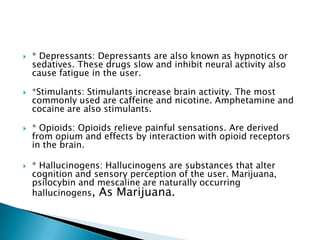
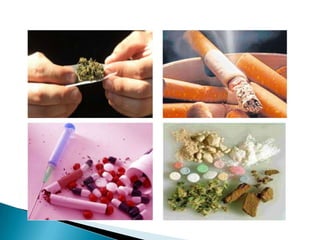
* Depressants: Depressants are also known as hypnotics or
sedatives. These drugs slow and inhibit neural activity also
cause fatigue in the user.
*Stimulants: Stimulants increase brain activity. The most
commonly used are caffeine and nicotine. Amphetamine and
cocaine are also stimulants.
* Opioids: Opioids relieve painful sensations. Are derived
from opium and effects by interaction with opioid receptors
in the brain.

* Hallucinogens: Hallucinogens are substances that alter
cognition and sensory perception of the user. Marijuana,
psilocybin and mescaline are naturally occurring
hallucinogens, As Marijuana.


*DEPRESSANTS :



BARBITURATES, SEDATIVE AND ANXIOLYTIC :





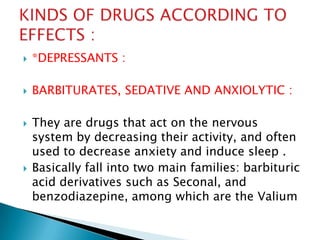
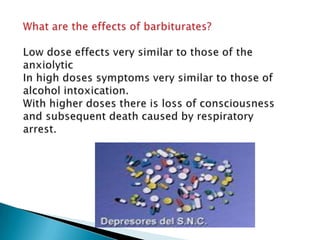
They are drugs that act on the nervous
system by decreasing their activity, and often
used to decrease anxiety and induce sleep .
Basically fall into two main families: barbituric
acid derivatives such as Seconal, and
benzodiazepine, among which are the Valium


•

•

•

•

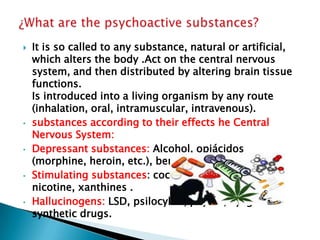
It is so called to any substance, natural or artificial,
which alters the body .Act on the central nervous
system, and then distributed by altering brain tissue
functions.
Is introduced into a living organism by any route
(inhalation, oral, intramuscular, intravenous).
substances according to their effects he Central
Nervous System:
Depressant substances: Alcohol, opiácidos
(morphine, heroin, etc.), benzodiazepines .
Stimulating substances: cocaine, amphetamines,
nicotine, xanthines .
Hallucinogens: LSD, psilocybin, peyote, ayaguasca
synthetic drugs.
PSYCHOACTIVE
SUBSTANCE
PRESENTED BY:
Ana María Orrego Prieto
GRADE:
802 J M
TEACHER:
GORETTI AZUERO




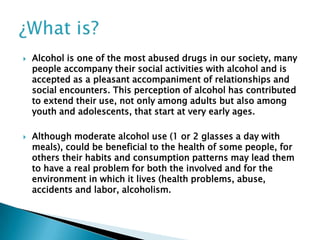
Alcohol is one of the most abused drugs in our society, many
people accompany their social activities with alcohol and is
accepted as a pleasant accompaniment of relationships and
social encounters. This perception of alcohol has contributed
to extend their use, not only among adults but also among
youth and adolescents, that start at very early ages.

Although moderate alcohol use (1 or 2 glasses a day with
meals), could be beneficial to the health of some people, for
others their habits and consumption patterns may lead them
to have a real problem for both the involved and for the
environment in which it lives (health problems, abuse,
accidents and labor, alcoholism.






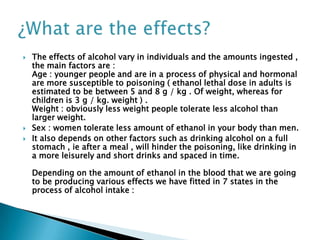
The effects of alcohol vary in individuals and the amounts ingested ,
the main factors are :
Age : younger people and are in a process of physical and hormonal
are more susceptible to poisoning ( ethanol lethal dose in adults is
estimated to be between 5 and 8 g / kg . Of weight, whereas for
children is 3 g / kg. weight ) .
Weight : obviously less weight people tolerate less alcohol than
larger weight.
Sex : women tolerate less amount of ethanol in your body than men.
It also depends on other factors such as drinking alcohol on a full
stomach , ie after a meal , will hinder the poisoning, like drinking in
a more leisurely and short drinks and spaced in time.
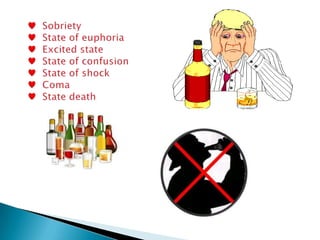
Depending on the amount of ethanol in the blood that we are going
to be producing various effects we have fitted in 7 states in the
process of alcohol intake :
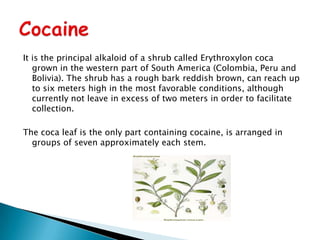
It is the principal alkaloid of a shrub called Erythroxylon coca
grown in the western part of South America (Colombia, Peru and
Bolivia). The shrub has a rough bark reddish brown, can reach up
to six meters high in the most favorable conditions, although
currently not leave in excess of two meters in order to facilitate
collection.
The coca leaf is the only part containing cocaine, is arranged in
groups of seven approximately each stem.
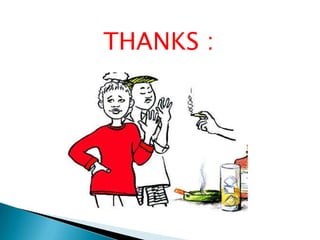
THANKS :

HILOS CONDUCTORES TRANSVERSALES Psychoactive substance grade 802 jm

  • 4.
          What drugs dopeople use most? Apart from medicines and caffeine, tmost Irish people use is alcoholegal drugs that people are most likely to try are: 1 2 3 4 Cannabis Cocaine Amphetamine Nitrites, poppers
  • 5.
    1 2 3 4 5 6 Cocaine Ecstasy Magic mushrooms Solvents (aerosols,gases and glues Minor tranquillisers (not prescribed) Heroin , Crack cocaine
  • 7.
     A psychoactive drugis capable of disrupting normal conscious activity the person, for example, his thoughts, memory, emotions, moods, feelings and perceptions
  • 8.
       1 - Use- actual drug consumption 2 - Abuse - This situation is characterized by continuing to use it even when the user generates personal problems (physical, psychological) and social problems (dealing with people, work, etc..) 3 - Dependence - A situation in which the uniusuario has lost all control over the use of the drug. The urgent need for consumption takes you to organize your everyday life around it (like getting the drug, when eaten, etc..). In terms of the effects the person is in the position of having to take the drug to prevent joint discomfort that causes the lack thereof.
  • 11.
           * Is asubstance that can alter the normal body function. * Cause: one capable of altering normal conscious activity of the person, for example, his thoughts, memory, emotions, moods, feelings and perceptions. The psychoactive effects of drugs may be different but also may have certain aspects that are similar. Different psychoactive drugs produce different effects and are used for medicinal purposes, social and routine. These substances are divided into four basic categories: * * * * depressants stimulants opiates hallucinogens.
  • 12.
        * Depressants: Depressantsare also known as hypnotics or sedatives. These drugs slow and inhibit neural activity also cause fatigue in the user. *Stimulants: Stimulants increase brain activity. The most commonly used are caffeine and nicotine. Amphetamine and cocaine are also stimulants. * Opioids: Opioids relieve painful sensations. Are derived from opium and effects by interaction with opioid receptors in the brain. * Hallucinogens: Hallucinogens are substances that alter cognition and sensory perception of the user. Marijuana, psilocybin and mescaline are naturally occurring hallucinogens, As Marijuana.
  • 15.
     *DEPRESSANTS :  BARBITURATES, SEDATIVEAND ANXIOLYTIC :   They are drugs that act on the nervous system by decreasing their activity, and often used to decrease anxiety and induce sleep . Basically fall into two main families: barbituric acid derivatives such as Seconal, and benzodiazepine, among which are the Valium
  • 18.
     • • • • It is socalled to any substance, natural or artificial, which alters the body .Act on the central nervous system, and then distributed by altering brain tissue functions. Is introduced into a living organism by any route (inhalation, oral, intramuscular, intravenous). substances according to their effects he Central Nervous System: Depressant substances: Alcohol, opiácidos (morphine, heroin, etc.), benzodiazepines . Stimulating substances: cocaine, amphetamines, nicotine, xanthines . Hallucinogens: LSD, psilocybin, peyote, ayaguasca synthetic drugs.
  • 20.
    PSYCHOACTIVE SUBSTANCE PRESENTED BY: Ana MaríaOrrego Prieto GRADE: 802 J M TEACHER: GORETTI AZUERO
  • 21.
      Alcohol is oneof the most abused drugs in our society, many people accompany their social activities with alcohol and is accepted as a pleasant accompaniment of relationships and social encounters. This perception of alcohol has contributed to extend their use, not only among adults but also among youth and adolescents, that start at very early ages. Although moderate alcohol use (1 or 2 glasses a day with meals), could be beneficial to the health of some people, for others their habits and consumption patterns may lead them to have a real problem for both the involved and for the environment in which it lives (health problems, abuse, accidents and labor, alcoholism.
  • 22.
       The effects ofalcohol vary in individuals and the amounts ingested , the main factors are : Age : younger people and are in a process of physical and hormonal are more susceptible to poisoning ( ethanol lethal dose in adults is estimated to be between 5 and 8 g / kg . Of weight, whereas for children is 3 g / kg. weight ) . Weight : obviously less weight people tolerate less alcohol than larger weight. Sex : women tolerate less amount of ethanol in your body than men. It also depends on other factors such as drinking alcohol on a full stomach , ie after a meal , will hinder the poisoning, like drinking in a more leisurely and short drinks and spaced in time. Depending on the amount of ethanol in the blood that we are going to be producing various effects we have fitted in 7 states in the process of alcohol intake :
  • 25.
    It is theprincipal alkaloid of a shrub called Erythroxylon coca grown in the western part of South America (Colombia, Peru and Bolivia). The shrub has a rough bark reddish brown, can reach up to six meters high in the most favorable conditions, although currently not leave in excess of two meters in order to facilitate collection. The coca leaf is the only part containing cocaine, is arranged in groups of seven approximately each stem.
  • 28.