Anxiety Disorders
What is anxiety?
• A feeling of apprehension caused by anticipation of
danger, which may be external or internal.
• May occur following loss or in conflict situations
such as between what we want and what the external
situation is.
• Anxiety is an unpleasant distressing emotion
• Usually associated with bodily discomfort
• When anxiety is intense or cause impairment, it
becomes pathological.
• The most striking feature of anxiety disorders
are mental and physical symptoms of anxiety,
occurring in the absence of organic brain
disease or other psychiatric disorders.
FEAR & ANXIETY
 Fear is a response to a known, external, definite, or nonconflictual threat
 Anxiety is a response to a threat that is unknown, internal, vague or
conflictual.
Normal Anxiety
 Everybody experiences anxiety – a diffuse, unpleasant, vague sense of
apprehension, often accompanied by autonomic symptoms, such as
headache, perspiration palpitations, tightness in the chest, mild stomach
discomfort, and restlessness, as indicated by an inability to sit on stand still
for long. The Particular constellation of symptoms present during anxiety
tends to vary among people.
Normal anxiety is advantageous response to threatening situation. For example
Infants threatened by separation from parents
Children on their first day at school
Adolescents on their first date
Adults contemplating old age & death and
Anyone faced with illness all experience normal anxiety.
• Such anxiety normally accompanies growth, change, new experiences, and
finding an identity and meaning in life. By contrast, pathological anxiety, by
virtue of its intensity or duration, is an inappropriate response.
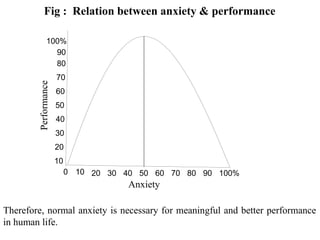
0 10 20 30 40 50 60 70 80 90 100%
10
20
30
40
50
60
70
80
90
100%
Anxiety
Performance
Fig : Relation between anxiety & performance
Therefore, normal anxiety is necessary for meaningful and better performance
in human life.
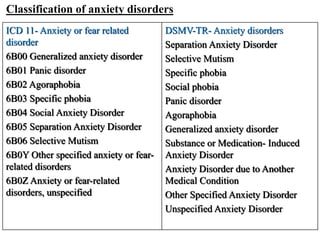
Classification of anxiety disorders
ICD 11- Anxiety or fear related
disorder
6B00 Generalized anxiety disorder
6B01 Panic disorder
6B02 Agoraphobia
6B03 Specific phobia
6B04 Social Anxiety Disorder
6B05 Separation Anxiety Disorder
6B06 Selective Mutism
6B0Y Other specified anxiety or fear-
related disorders
6B0Z Anxiety or fear-related
disorders, unspecified
DSMV-TR- Anxiety disorders
Separation Anxiety Disorder
Selective Mutism
Specific phobia
Social phobia
Panic disorder
Agoraphobia
Generalized anxiety disorder
Substance or Medication- Induced
Anxiety Disorder
Anxiety Disorder due to Another
Medical Condition
Other Specified Anxiety Disorder
Unspecified Anxiety Disorder
Symptoms of Anxiety
1. Psychological arousal
Fearful anticipation
Irritability
Sensitive to noise
Restlessness
Poor concentration
Worrying thoughts
. Autonomic arousal
a. GI tract
dry mouth
difficulty in swallowing
epigastric discomfort
excessive wind
frequent or loose motions
b. Respiratory
constriction in the chest
difficulty in inhalation
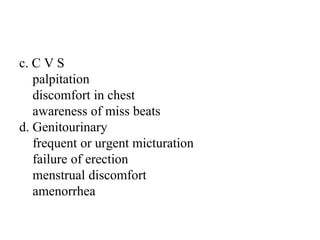
c. C V S
palpitation
discomfort in chest
awareness of miss beats
d. Genitourinary
frequent or urgent micturation
failure of erection
menstrual discomfort
amenorrhea
3. Muscle tension
tremor
head ache
aching muscles
4. Hyperventilation
dizziness
tingling in extremities
feeling of breathlessness
5. Sleep disturbances
insomnia
night terror
Generalized anxiety disorder
• Chronic persistent excessive anxiety or worry which
is difficult to control and is not focused on 1or 2
areas.
• Worry has to last for at least 6 months.
• Other symptoms are
muscle tension, autonomic over activity
psychological arousal, sleep disturbances
other features like depression and obsession
Clinical signs
• face is strained, furrowed brow and tense
posture
• restless and tremble
• skin is pale and sweating especially hands,
feet and axilla.
• readiness to tears
Differential Diagnosis
• Depressive disorders
• Substance misuse
• Panic disorder
• Phobic disorder
• Physical disorders like thyrotoxicosis,
pheochromocytoma, hypoglycemia
Management
Educate the patient and family about illness
1.Explain nature of anxiety
2. Anxiety can be manifested as physical symptoms
3. Anxiety and worry can be made worse by stress
4.Doing practices to reduce the effects of stress eg,
relaxation meditation, regular exercises
II.Supportive counseling
III. Relaxation training
IV. Medication
If symptoms cause significant distress, anti anxiety
medications may be used for not longer than 2 weeks.
1. Benzodiazepines
2.Beta blockers like propranolol
3.Antidepressants
4.Buspirone
V. Referral for specialist consultation
Panic Disorders
• Attack of extreme anxiety with intense
sympathetic arousal.
• Sudden unexpected onset of intense anxiety
and terror.
• Somatic symptoms like palpitation, chest pain,
nausea or abdominal pain, dizziness, fear of
losing control or fear of dying are common.
• Attack escalate very fast and usually peak up within
ten minutes.
• Usually describe sense of acute fear and need to
escape from situation where attack has been
experienced.
• Continue to experience persistent concern about
future attack.
• Avoidance of situations where they have previously
experienced panic attacks.
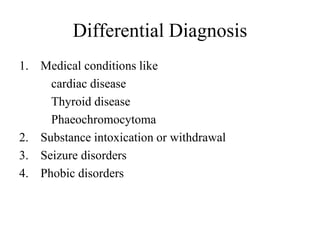
Differential Diagnosis
1. Medical conditions like
cardiac disease
Thyroid disease
Phaeochromocytoma
2. Substance intoxication or withdrawal
3. Seizure disorders
4. Phobic disorders
Management
1. Educate patient and family about illness
a. anxiety often produce physical symptoms which
are not signs of another disease.
b. mental and physical symptoms of anxiety are
reinforce each other. Concentration on physical
symptoms will increase fear.
c. not to avoid any situation and places related to
panic attack.
d. reassuring the patient.
2. Relaxation and slow breathing exercise
3. Medication
a. many patients do not need medication.
b. for crisis intervention, anti-anxiety medications
can be helpful.
4. Referral for specialist consultation
Phobic Anxiety Disorders
• Anxiety symptoms occur intermittently and
arise only in particular situations.
• Avoid circumstances that provoke anxiety.
• Anticipatory anxiety when there is the prospect
of encountering each circumstances.
Types
1. Social phobia
Fear of of public situations
2. Agoraphobia
Fear of situations from which they
cannot escape easily.
3. Simple phobia
Fear of objects of isolated situation.
Management
1. Educate the patient and family
a. Avoidance of fear situations may increase the fear.
b. confrontation of fear situations will reduce the fear.
c. avoid using alcohol or benzodiazepines to cope with fear
situation.
2. Behavior therapy (desensitization)
3. Medication
Many patients do not need medication.
Anti-anxiety drugs may helpful in crisis intervention.
Anti-depressants may helpful in associate depression.
4. Referral for specialist consultation.
Obsessive Compulsive Disorders
• Obsessions are recurrently persistent thoughts,
impulses or images that enter the mind despite
the person afford to exclude them.
• Compulsions are repetitive, purposeful and
intentional behaviors that are performed in
response to obsession.
Diagnostic Features
1. Patient recognize that the obsessional thoughts,
impulses and images are his or her own.
2. Patient is trying to resist them but failed.
3. Patient has realize that they are senseless and
unpleasurable.
4. It keeps on recurring the mind.
5. Some patients use to present with obsession rituals
(repetitive stereotype actions. Eg; repeated hand
washing)
Management
1. Educate the patient and family
a. They are not early signs of madness.
b. Encourage the relatives to be firm but to have
sympathetic attitudes
c. It often runs fluctuating course with long periods of
remissions.
2. Exposure and response prevention
3. Medications
Clomipramine (tricyclic anti- depressant ) is the drug of
choice. More effective for obsessional thoughts without
rituals. Anti-depressants like SSRI group are also
useful.
4. Referral to specialist consultation.
• pGrf;ygbdjcif;?onfpdwfrif;ukd
odrf;oGif;rykduf? tvkdvkdufu?
rkdufírqkH;? urÇmokOf;vnf;?
rkduftkH;rnfom? rwefygwnfh/
ygarmu©OD;at;armif
SIR STANLEY Davidson(1894–1981)
“ His main thesis was that if you could take a good history and do
a careful physical examination, the rest might not be too difficult
or expansive.“
Professor John Richmond
Edinburgh 1999.
• “Psychiatric treatment starts at the beginning of the very first
interview with the patient.”
Royal college of psychiatrist.
 The first step to relieve anxiety and depression is to give
attention to the emotional side of the patient. Confronted by
any sick, frightened or disturbed person, doctors should
always remember that empathy, warmth and care must be
paid to such a person.
 Once the Patient realizes that you care how he feel, then you
have given him a bridge which he can cross to meet you and
which you can cross to meet him.
Thuta , 1999
GAD.pptx

GAD.pptx

  • 1.
  • 2.
    What is anxiety? •A feeling of apprehension caused by anticipation of danger, which may be external or internal. • May occur following loss or in conflict situations such as between what we want and what the external situation is. • Anxiety is an unpleasant distressing emotion • Usually associated with bodily discomfort • When anxiety is intense or cause impairment, it becomes pathological.
  • 3.
    • The moststriking feature of anxiety disorders are mental and physical symptoms of anxiety, occurring in the absence of organic brain disease or other psychiatric disorders.
  • 4.
    FEAR & ANXIETY Fear is a response to a known, external, definite, or nonconflictual threat  Anxiety is a response to a threat that is unknown, internal, vague or conflictual. Normal Anxiety  Everybody experiences anxiety – a diffuse, unpleasant, vague sense of apprehension, often accompanied by autonomic symptoms, such as headache, perspiration palpitations, tightness in the chest, mild stomach discomfort, and restlessness, as indicated by an inability to sit on stand still for long. The Particular constellation of symptoms present during anxiety tends to vary among people.
  • 5.
    Normal anxiety isadvantageous response to threatening situation. For example Infants threatened by separation from parents Children on their first day at school Adolescents on their first date Adults contemplating old age & death and Anyone faced with illness all experience normal anxiety. • Such anxiety normally accompanies growth, change, new experiences, and finding an identity and meaning in life. By contrast, pathological anxiety, by virtue of its intensity or duration, is an inappropriate response.
  • 6.
    0 10 2030 40 50 60 70 80 90 100% 10 20 30 40 50 60 70 80 90 100% Anxiety Performance Fig : Relation between anxiety & performance Therefore, normal anxiety is necessary for meaningful and better performance in human life.
  • 7.
    Classification of anxietydisorders ICD 11- Anxiety or fear related disorder 6B00 Generalized anxiety disorder 6B01 Panic disorder 6B02 Agoraphobia 6B03 Specific phobia 6B04 Social Anxiety Disorder 6B05 Separation Anxiety Disorder 6B06 Selective Mutism 6B0Y Other specified anxiety or fear- related disorders 6B0Z Anxiety or fear-related disorders, unspecified DSMV-TR- Anxiety disorders Separation Anxiety Disorder Selective Mutism Specific phobia Social phobia Panic disorder Agoraphobia Generalized anxiety disorder Substance or Medication- Induced Anxiety Disorder Anxiety Disorder due to Another Medical Condition Other Specified Anxiety Disorder Unspecified Anxiety Disorder
  • 8.
    Symptoms of Anxiety 1.Psychological arousal Fearful anticipation Irritability Sensitive to noise Restlessness Poor concentration Worrying thoughts
  • 9.
    . Autonomic arousal a.GI tract dry mouth difficulty in swallowing epigastric discomfort excessive wind frequent or loose motions b. Respiratory constriction in the chest difficulty in inhalation
  • 10.
    c. C VS palpitation discomfort in chest awareness of miss beats d. Genitourinary frequent or urgent micturation failure of erection menstrual discomfort amenorrhea
  • 11.
    3. Muscle tension tremor headache aching muscles 4. Hyperventilation dizziness tingling in extremities feeling of breathlessness 5. Sleep disturbances insomnia night terror
  • 12.
    Generalized anxiety disorder •Chronic persistent excessive anxiety or worry which is difficult to control and is not focused on 1or 2 areas. • Worry has to last for at least 6 months. • Other symptoms are muscle tension, autonomic over activity psychological arousal, sleep disturbances other features like depression and obsession
  • 13.
    Clinical signs • faceis strained, furrowed brow and tense posture • restless and tremble • skin is pale and sweating especially hands, feet and axilla. • readiness to tears
  • 14.
    Differential Diagnosis • Depressivedisorders • Substance misuse • Panic disorder • Phobic disorder • Physical disorders like thyrotoxicosis, pheochromocytoma, hypoglycemia
  • 15.
    Management Educate the patientand family about illness 1.Explain nature of anxiety 2. Anxiety can be manifested as physical symptoms 3. Anxiety and worry can be made worse by stress 4.Doing practices to reduce the effects of stress eg, relaxation meditation, regular exercises
  • 16.
    II.Supportive counseling III. Relaxationtraining IV. Medication If symptoms cause significant distress, anti anxiety medications may be used for not longer than 2 weeks. 1. Benzodiazepines 2.Beta blockers like propranolol 3.Antidepressants 4.Buspirone V. Referral for specialist consultation
  • 17.
    Panic Disorders • Attackof extreme anxiety with intense sympathetic arousal. • Sudden unexpected onset of intense anxiety and terror. • Somatic symptoms like palpitation, chest pain, nausea or abdominal pain, dizziness, fear of losing control or fear of dying are common.
  • 18.
    • Attack escalatevery fast and usually peak up within ten minutes. • Usually describe sense of acute fear and need to escape from situation where attack has been experienced. • Continue to experience persistent concern about future attack. • Avoidance of situations where they have previously experienced panic attacks.
  • 19.
    Differential Diagnosis 1. Medicalconditions like cardiac disease Thyroid disease Phaeochromocytoma 2. Substance intoxication or withdrawal 3. Seizure disorders 4. Phobic disorders
  • 20.
    Management 1. Educate patientand family about illness a. anxiety often produce physical symptoms which are not signs of another disease. b. mental and physical symptoms of anxiety are reinforce each other. Concentration on physical symptoms will increase fear. c. not to avoid any situation and places related to panic attack. d. reassuring the patient.
  • 21.
    2. Relaxation andslow breathing exercise 3. Medication a. many patients do not need medication. b. for crisis intervention, anti-anxiety medications can be helpful. 4. Referral for specialist consultation
  • 22.
    Phobic Anxiety Disorders •Anxiety symptoms occur intermittently and arise only in particular situations. • Avoid circumstances that provoke anxiety. • Anticipatory anxiety when there is the prospect of encountering each circumstances.
  • 23.
    Types 1. Social phobia Fearof of public situations 2. Agoraphobia Fear of situations from which they cannot escape easily. 3. Simple phobia Fear of objects of isolated situation.
  • 24.
    Management 1. Educate thepatient and family a. Avoidance of fear situations may increase the fear. b. confrontation of fear situations will reduce the fear. c. avoid using alcohol or benzodiazepines to cope with fear situation. 2. Behavior therapy (desensitization) 3. Medication Many patients do not need medication. Anti-anxiety drugs may helpful in crisis intervention. Anti-depressants may helpful in associate depression. 4. Referral for specialist consultation.
  • 25.
    Obsessive Compulsive Disorders •Obsessions are recurrently persistent thoughts, impulses or images that enter the mind despite the person afford to exclude them. • Compulsions are repetitive, purposeful and intentional behaviors that are performed in response to obsession.
  • 26.
    Diagnostic Features 1. Patientrecognize that the obsessional thoughts, impulses and images are his or her own. 2. Patient is trying to resist them but failed. 3. Patient has realize that they are senseless and unpleasurable. 4. It keeps on recurring the mind. 5. Some patients use to present with obsession rituals (repetitive stereotype actions. Eg; repeated hand washing)
  • 27.
    Management 1. Educate thepatient and family a. They are not early signs of madness. b. Encourage the relatives to be firm but to have sympathetic attitudes c. It often runs fluctuating course with long periods of remissions. 2. Exposure and response prevention 3. Medications Clomipramine (tricyclic anti- depressant ) is the drug of choice. More effective for obsessional thoughts without rituals. Anti-depressants like SSRI group are also useful. 4. Referral to specialist consultation.
  • 28.
    • pGrf;ygbdjcif;?onfpdwfrif;ukd odrf;oGif;rykduf? tvkdvkdufu? rkdufírqkH;?urÇmokOf;vnf;? rkduftkH;rnfom? rwefygwnfh/ ygarmu©OD;at;armif
  • 29.
    SIR STANLEY Davidson(1894–1981) “His main thesis was that if you could take a good history and do a careful physical examination, the rest might not be too difficult or expansive.“ Professor John Richmond Edinburgh 1999.
  • 30.
    • “Psychiatric treatmentstarts at the beginning of the very first interview with the patient.” Royal college of psychiatrist.
  • 31.
     The firststep to relieve anxiety and depression is to give attention to the emotional side of the patient. Confronted by any sick, frightened or disturbed person, doctors should always remember that empathy, warmth and care must be paid to such a person.  Once the Patient realizes that you care how he feel, then you have given him a bridge which he can cross to meet you and which you can cross to meet him. Thuta , 1999