THEORIES OF HUMAN
DEVELOPMENT
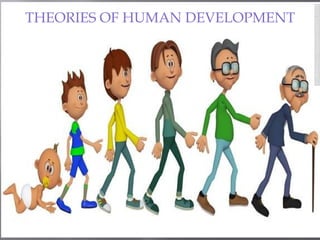
THEORIES OF HUMAN DEVELOPMENT
Human Development
refers to the physical, cognitive and
psychosocial development of humans
throughout the lifespan.
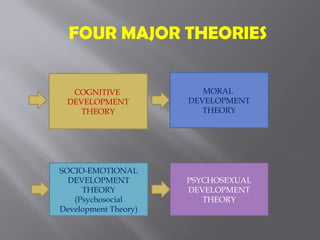
FOUR MAJOR THEORIES
COGNITIVE
DEVELOPMENT
THEORY
MORAL
DEVELOPMENT
THEORY
SOCIO-EMOTIONAL
DEVELOPMENT
THEORY
(Psychosocial
Development Theory)
PSYCHOSEXUAL
DEVELOPMENT
THEORY
COGNITIVE DEVELOPMENT
Cognitive Development is the process of acquire
knowledge, ability to learn and solve problems. It
involves growth or changes in the individuals
thought, perception, intelligence, reasoning,
memory and language.
Jean Piaget was theS first psychologist to make a
study of cognitive development. His contributions
include a stage theoryof child cognitive
development, deatailed observational studies of
cognition in children, and a series of simple but
ingenious tests to reveal different cognitive abilities.
PIAGETS STAGES OF COGNITIVE
DEVELOPMENT
1.Sensori- Motor Stage- this stagess is initially
reflexive in grasping, sucking and reaching
becomes more organize in his body movement.
2.Pre-operational Stage(2-7)- intelligence at this
stage is intuitive in nature.
3.Concrete- Operational Stage (8-11) - can think
logically and perceive different features of objects
and situations.
4.Formal Operational Stage(12-15)- more logical
and can solve abstract problems.
LANGUAGE AND LITERACY
DEVELOPMENT THEORY
LANGUAGE DEVELOPMENT
Refers to childrens emerging
abilities to understand and use
language. Language skills are
receptive- the ability to listen to
and understand language and
expressive- the ability to use
language to communicate ideas,
thoughts and feelings.
Language and Literacy skills can develop in any language, and for the most
part, they develop first in the child’s home language.
Erikson’s Theory of Psychosocial Development
(Socio-emotional)
Erikson maintained that personality develops in a
predetermined order through eight stages of
psychosocial development, from infancy to
adulthood. During each stage, the person
experiences a psychosocial/socio- emotional crisis
that could positively or negatively affect
personality development.
1. Trust Vs. Mistrust (approximately 18 months of age)
Trust.This sense of trust allows the child to feel secure even when threatened and extends
into their other relationships, maintaining their sense of security amidst potential threats.
Mistrust: This could lead to a belief in an inconsistent and unpredictable world, fostering a
sense of mistrust, suspicion, and anxiety.Under such circumstances, the child may lack
confidence in their ability to influence events, viewing the world with apprehension.
Stage 2. Autonomy Vs. Shame And Doubt (b/n ages 18 months to 3 years)
Autonomy: They will feel comfortable making decisions, explore their surroundings more
freely, and have a sense of self-control.
Shame and Doubt: On the other hand, if children are overly controlled or criticized, they
may begin to feel ashamed.This can lead to a lack of confidence, fear of trying new things,
and a sense of inadequacy about their self-control abilities.
Stage 3. Initiative Vs. Guilt (3-5 years)
Initiative:They can start planning activities, accomplish tasks, and face challenges.The
children will learn to take the initiative and assert control over their environment.They can
begin to think for themselves, formulate plans, and execute them, which helps foster a sense
of purpose.
Guilt: .This could potentially lead to feelings of guilt, self-doubt, and lack of initiative.
Stage 4. Industry Vs. Inferiority (5-12 year)
Industry:They start learning to work and cooperate with others and begin to understand
that they can use their skills to complete tasks. This leads to a sense of confidence in their
ability to achieve goals.
Inferiority:.They may start to feel that they aren’t as good as their peers or that their efforts
aren’t valued, leading to a lack of self-confidence and a feeling of inadequacy.
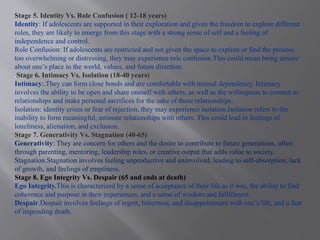
Stage 5. Identity Vs. Role Confusion ( 12-18 years)
Identity: If adolescents are supported in their exploration and given the freedom to explore different
roles, they are likely to emerge from this stage with a strong sense of self and a feeling of
independence and control.
Role Confusion: If adolescents are restricted and not given the space to explore or find the process
too overwhelming or distressing, they may experience role confusion.This could mean being unsure
about one’s place in the world, values, and future direction.
.Stage 6. Intimacy Vs. Isolation (18-40 years)
Intimacy:.They can form close bonds and are comfortable with mutual dependency. Intimacy
involves the ability to be open and share oneself with others, as well as the willingness to commit to
relationships and make personal sacrifices for the sake of these relationships.
Isolation: identity crises or fear of rejection, they may experience isolation.Isolation refers to the
inability to form meaningful, intimate relationships with others. This could lead to feelings of
loneliness, alienation, and exclusion.
Stage 7. Generativity Vs. Stagnation (40-65)
Generativity: They are concern for others and the desire to contribute to future generations, often
through parenting, mentoring, leadership roles, or creative output that adds value to society.
Stagnation.Stagnation involves feeling unproductive and uninvolved, leading to self-absorption, lack
of growth, and feelings of emptiness.
Stage 8. Ego Integrity Vs. Despair (65 and ends at death)
Ego Integrity.This is characterized by a sense of acceptance of their life as it was, the ability to find
coherence and purpose in their experiences, and a sense of wisdom and fulfillment.
Despair.Despair involves feelings of regret, bitterness, and disappointment with one’s life, and a fear
of impending death.
Lawrence Kohlberg's Theory of
Moral Development
 Moral Development- process through which
children develop proper attitudes and
behaviors toward other people in society,
based on social and cultural norms, rules, and
laws. Also discuss about morals and values.
Kohlberg believed that moral growth occurs
through interaction with ones environment,
and progress through defined stages.
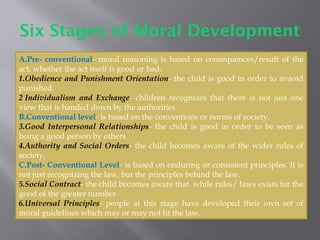
Six Stages of Moral Development
A.Pre- conventional- moral reasoning is based on consequences/result of the
act, whether the act itself is good or bad.
1.Obedience and Punishment Orientation- the child is good in order to avaoid
punished.
2.Individualism and Exchange- children recognizes that there is not just one
view that is handed down by the authorities.
B.Conventional level- is based on the conventions or norms of society.
3.Good Interpersonal Relationships- the child is good in order to be seen as
being a good person by others.
4.Authority and Social Orders- the child becomes aware of the wider rules of
society,
C.Post- Conventional Level- is based on enduring or consistent principles. It is
not just recognizing the law, but the principles behind the law.
5.Social Contract- the child becomes aware that while rules/ laws exists for the
good of the greater number.
6.Universal Principles- people at this stage have developed their own set of
moral guidelines which may or may not fit the law.
Freud’s Theory of Psychosexual
Development
Founder of Psychosocial development theory. Freud’s views
about human development are more than a century old. He can
be considered the most well-known psychologist because of his
very interesting theory about the unconscious and also about
sexual development.
Freud identified specific erogenous zones for each stage of
development.Erogenous zone or “pleasure area’ become a focal
points for the particular stage. Especially sensitive to sexual
stimulation, as certain areas of the body. Arousing or tending to
arouse sexual desire; sexualy stimulating.Fixation occurs when
needs are not met along the area.The term subsequently came to
denote object relationships with and attachments to people or
things in general persisting from childhood into adult life.
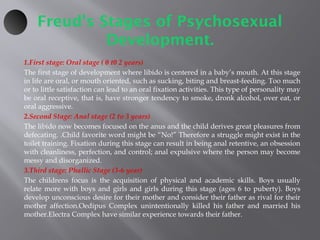
Freud’s Stages of Psychosexual
Development.
1.First stage: Oral stage ( 0 t0 2 years)
The first stage of development where libido is centered in a baby’s mouth. At this stage
in life are oral, or mouth oriented, such as sucking, biting and breast-feeding. Too much
or to little satisfaction can lead to an oral fixation activities. This type of personality may
be oral receptive, that is, have stronger tendency to smoke, dronk alcohol, over eat, or
oral aggressive.
2.Second Stage: Anal stage (2 to 3 years)
The libido now becomes focused on the anus and the child derives great pleasures from
defecating. .Child favorite word might be “No!” Therefore a struggle might exist in the
toilet training. Fixation during this stage can result in being anal retentive, an obsession
with cleanliness, perfection, and control; anal expulsive where the person may become
messy and disorganized.
3.Third stage: Phallic Stage (3-6 year)
The childrens focus is the acquisition of physical and academic skills. Boys usually
relate more with boys and girls and girls during this stage (ages 6 to puberty). Boys
develop unconscious desire for their mother and consider their father as rival for their
mother affection.Oedipus Complex unintentionally killed his father and married his
mother.Electra Complex have similar experience towards their father.
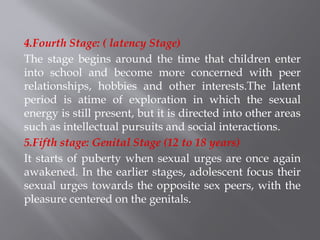
4.Fourth Stage: ( latency Stage)
The stage begins around the time that children enter
into school and become more concerned with peer
relationships, hobbies and other interests.The latent
period is atime of exploration in which the sexual
energy is still present, but it is directed into other areas
such as intellectual pursuits and social interactions.
5.Fifth stage: Genital Stage (12 to 18 years)
It starts of puberty when sexual urges are once again
awakened. In the earlier stages, adolescent focus their
sexual urges towards the opposite sex peers, with the
pleasure centered on the genitals.
THANK YOU!

POWEPOINT PRESENTATION PPT-HUMAN-DEVT..pptx

  • 1.
  • 2.
    Human Development refers tothe physical, cognitive and psychosocial development of humans throughout the lifespan.
  • 3.
  • 4.
    COGNITIVE DEVELOPMENT Cognitive Developmentis the process of acquire knowledge, ability to learn and solve problems. It involves growth or changes in the individuals thought, perception, intelligence, reasoning, memory and language. Jean Piaget was theS first psychologist to make a study of cognitive development. His contributions include a stage theoryof child cognitive development, deatailed observational studies of cognition in children, and a series of simple but ingenious tests to reveal different cognitive abilities.
  • 5.
    PIAGETS STAGES OFCOGNITIVE DEVELOPMENT 1.Sensori- Motor Stage- this stagess is initially reflexive in grasping, sucking and reaching becomes more organize in his body movement. 2.Pre-operational Stage(2-7)- intelligence at this stage is intuitive in nature. 3.Concrete- Operational Stage (8-11) - can think logically and perceive different features of objects and situations. 4.Formal Operational Stage(12-15)- more logical and can solve abstract problems.
  • 6.
    LANGUAGE AND LITERACY DEVELOPMENTTHEORY LANGUAGE DEVELOPMENT Refers to childrens emerging abilities to understand and use language. Language skills are receptive- the ability to listen to and understand language and expressive- the ability to use language to communicate ideas, thoughts and feelings. Language and Literacy skills can develop in any language, and for the most part, they develop first in the child’s home language.
  • 7.
    Erikson’s Theory ofPsychosocial Development (Socio-emotional) Erikson maintained that personality develops in a predetermined order through eight stages of psychosocial development, from infancy to adulthood. During each stage, the person experiences a psychosocial/socio- emotional crisis that could positively or negatively affect personality development.
  • 8.
    1. Trust Vs.Mistrust (approximately 18 months of age) Trust.This sense of trust allows the child to feel secure even when threatened and extends into their other relationships, maintaining their sense of security amidst potential threats. Mistrust: This could lead to a belief in an inconsistent and unpredictable world, fostering a sense of mistrust, suspicion, and anxiety.Under such circumstances, the child may lack confidence in their ability to influence events, viewing the world with apprehension. Stage 2. Autonomy Vs. Shame And Doubt (b/n ages 18 months to 3 years) Autonomy: They will feel comfortable making decisions, explore their surroundings more freely, and have a sense of self-control. Shame and Doubt: On the other hand, if children are overly controlled or criticized, they may begin to feel ashamed.This can lead to a lack of confidence, fear of trying new things, and a sense of inadequacy about their self-control abilities. Stage 3. Initiative Vs. Guilt (3-5 years) Initiative:They can start planning activities, accomplish tasks, and face challenges.The children will learn to take the initiative and assert control over their environment.They can begin to think for themselves, formulate plans, and execute them, which helps foster a sense of purpose. Guilt: .This could potentially lead to feelings of guilt, self-doubt, and lack of initiative. Stage 4. Industry Vs. Inferiority (5-12 year) Industry:They start learning to work and cooperate with others and begin to understand that they can use their skills to complete tasks. This leads to a sense of confidence in their ability to achieve goals. Inferiority:.They may start to feel that they aren’t as good as their peers or that their efforts aren’t valued, leading to a lack of self-confidence and a feeling of inadequacy.
  • 9.
    Stage 5. IdentityVs. Role Confusion ( 12-18 years) Identity: If adolescents are supported in their exploration and given the freedom to explore different roles, they are likely to emerge from this stage with a strong sense of self and a feeling of independence and control. Role Confusion: If adolescents are restricted and not given the space to explore or find the process too overwhelming or distressing, they may experience role confusion.This could mean being unsure about one’s place in the world, values, and future direction. .Stage 6. Intimacy Vs. Isolation (18-40 years) Intimacy:.They can form close bonds and are comfortable with mutual dependency. Intimacy involves the ability to be open and share oneself with others, as well as the willingness to commit to relationships and make personal sacrifices for the sake of these relationships. Isolation: identity crises or fear of rejection, they may experience isolation.Isolation refers to the inability to form meaningful, intimate relationships with others. This could lead to feelings of loneliness, alienation, and exclusion. Stage 7. Generativity Vs. Stagnation (40-65) Generativity: They are concern for others and the desire to contribute to future generations, often through parenting, mentoring, leadership roles, or creative output that adds value to society. Stagnation.Stagnation involves feeling unproductive and uninvolved, leading to self-absorption, lack of growth, and feelings of emptiness. Stage 8. Ego Integrity Vs. Despair (65 and ends at death) Ego Integrity.This is characterized by a sense of acceptance of their life as it was, the ability to find coherence and purpose in their experiences, and a sense of wisdom and fulfillment. Despair.Despair involves feelings of regret, bitterness, and disappointment with one’s life, and a fear of impending death.
  • 10.
    Lawrence Kohlberg's Theoryof Moral Development  Moral Development- process through which children develop proper attitudes and behaviors toward other people in society, based on social and cultural norms, rules, and laws. Also discuss about morals and values. Kohlberg believed that moral growth occurs through interaction with ones environment, and progress through defined stages.
  • 11.
    Six Stages ofMoral Development A.Pre- conventional- moral reasoning is based on consequences/result of the act, whether the act itself is good or bad. 1.Obedience and Punishment Orientation- the child is good in order to avaoid punished. 2.Individualism and Exchange- children recognizes that there is not just one view that is handed down by the authorities. B.Conventional level- is based on the conventions or norms of society. 3.Good Interpersonal Relationships- the child is good in order to be seen as being a good person by others. 4.Authority and Social Orders- the child becomes aware of the wider rules of society, C.Post- Conventional Level- is based on enduring or consistent principles. It is not just recognizing the law, but the principles behind the law. 5.Social Contract- the child becomes aware that while rules/ laws exists for the good of the greater number. 6.Universal Principles- people at this stage have developed their own set of moral guidelines which may or may not fit the law.
  • 12.
    Freud’s Theory ofPsychosexual Development Founder of Psychosocial development theory. Freud’s views about human development are more than a century old. He can be considered the most well-known psychologist because of his very interesting theory about the unconscious and also about sexual development. Freud identified specific erogenous zones for each stage of development.Erogenous zone or “pleasure area’ become a focal points for the particular stage. Especially sensitive to sexual stimulation, as certain areas of the body. Arousing or tending to arouse sexual desire; sexualy stimulating.Fixation occurs when needs are not met along the area.The term subsequently came to denote object relationships with and attachments to people or things in general persisting from childhood into adult life.
  • 13.
    Freud’s Stages ofPsychosexual Development. 1.First stage: Oral stage ( 0 t0 2 years) The first stage of development where libido is centered in a baby’s mouth. At this stage in life are oral, or mouth oriented, such as sucking, biting and breast-feeding. Too much or to little satisfaction can lead to an oral fixation activities. This type of personality may be oral receptive, that is, have stronger tendency to smoke, dronk alcohol, over eat, or oral aggressive. 2.Second Stage: Anal stage (2 to 3 years) The libido now becomes focused on the anus and the child derives great pleasures from defecating. .Child favorite word might be “No!” Therefore a struggle might exist in the toilet training. Fixation during this stage can result in being anal retentive, an obsession with cleanliness, perfection, and control; anal expulsive where the person may become messy and disorganized. 3.Third stage: Phallic Stage (3-6 year) The childrens focus is the acquisition of physical and academic skills. Boys usually relate more with boys and girls and girls during this stage (ages 6 to puberty). Boys develop unconscious desire for their mother and consider their father as rival for their mother affection.Oedipus Complex unintentionally killed his father and married his mother.Electra Complex have similar experience towards their father.
  • 14.
    4.Fourth Stage: (latency Stage) The stage begins around the time that children enter into school and become more concerned with peer relationships, hobbies and other interests.The latent period is atime of exploration in which the sexual energy is still present, but it is directed into other areas such as intellectual pursuits and social interactions. 5.Fifth stage: Genital Stage (12 to 18 years) It starts of puberty when sexual urges are once again awakened. In the earlier stages, adolescent focus their sexual urges towards the opposite sex peers, with the pleasure centered on the genitals.
  • 15.