Bangladesh university of engineering and
technology
Overview on power sector of Bangladesh
&
power system master plan(psmp)-2010
Submitted by
HASAN SHAHRIAR SAJIB
Studying B.Sc. Engineering
Mechanical Engineering
Bangladesh University of Engineering
& Technology (BUET)
Power System Master Plan 2010:
The study for master plan on coal power development in the people’s republic of
Bangladesh.
Related organization:
 Power Division
Ministry of Power, Energy and Mineral Resource
 Japan international cooperative agency
 The Tokyo electric power co. inc.
 Counterpart organization
o Ministry of Power, Energy and Mineral Resources (MPEMR)
 Power Division
 Energy and Mineral Resources Division (EMRD)
 Power Cell
o Economic Relations Division, Ministry of Finance
o Bangladesh Power Development Board (BPDB)
o Barapukuria Coal Mine Company Ltd (BCMCL)
o Power Grid Company of Bangladesh (PGCB)
o Dhaka Power Distribution Company Limited (DPDC)
o Dhaka Electric Supply Company Limited (DESCO)
o Rural Electrification Board (REB)
o Bangladesh Oil, Gas Mineral Corporation (Petrobangla)
o Electricity Generation Company of Bangladesh (EGCB)
o Ashganj Power Station Company Limited (APSCL)
o North-
West Power Generation Company Ltd (NWPGCL)
o Geological Survey of Bangladesh (GSB)
o Ministry of Environment and Forestry Affairs (MOE)
Objectives:
 formulate the Master Plan for the attainment of stable power supply by achieving the
3Es; Economic Growth, Energy Security and Environmental Protection simultaneously
.
 reduce poverty in a period as swift as possible by achieving high economic growth.
 Planning electrification via the stabilization and efficiency of the electric power supply
system can be expected to reduce poverty
 promote development thatwill provide a self-
reinforcing cycle of poverty reduction
and 3E simultaneous achievement.
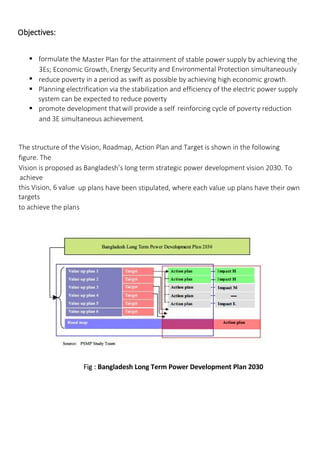
The structure of the Vision, Roadmap, Action Plan and Target is shown in the following
figure. The
Vision is proposed as Bangladesh’s long term strategic power development vision 2030. To
achieve
this Vision, 6 value-
up plans have been stipulated, where each value-
up plans have their own
targets
to achieve the plans
Fig : Bangladesh Long Term Power Development Plan 2030
Plan 1:
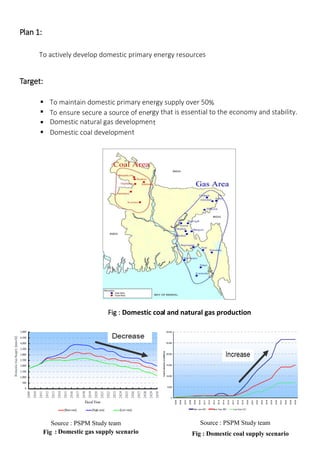
To actively develop domestic primary energy resources
Target:
 To maintain domestic primary energy supply over 50%
 To ensure secure a source of energy that is essential to the economy and stability.
 Domestic natural gas development
 Domestic coal development
Fig : Domestic coal and natural gas production
Fig : Domestic gas supply scenario
Source : PSPM Study team
Fig : Domestic coal supply scenario
Source : PSPM Study team
Plan 2:
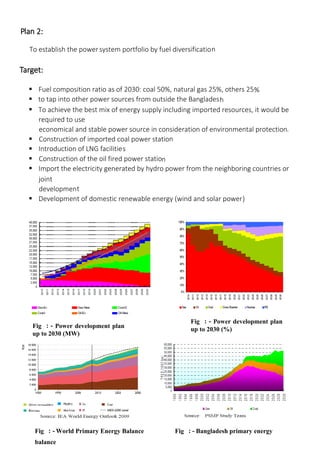
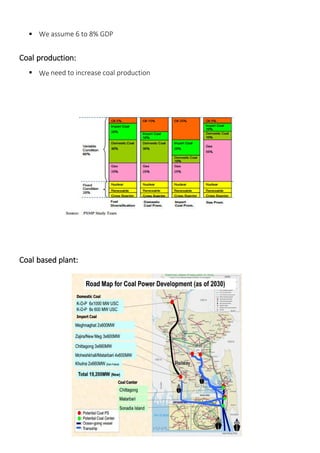
To establish the powersystem portfolio by fuel diversification
Target:
 Fuel composition ratio as of 2030: coal 50%, natural gas 25%, others 25%
 to tap into other power sources from outside the Bangladesh
 To achieve the best mix of energy supply including imported resources, it would be
required to use
economical and stable power source in consideration of environmental protection.
 Construction of imported coal power station
 Introduction of LNG facilities
 Construction of the oil fired power station
 Import the electricity generated by hydro power from the neighboring countries or
joint
development
 Development of domestic renewable energy (wind and solar power)
Fig : - Power development plan
up to 2030 (%)
Fig : - Power development plan
up to 2030 (MW)
Fig : - World Primary Energy Balance Fig : - Bangladesh primary energy
balance
Plan 3:
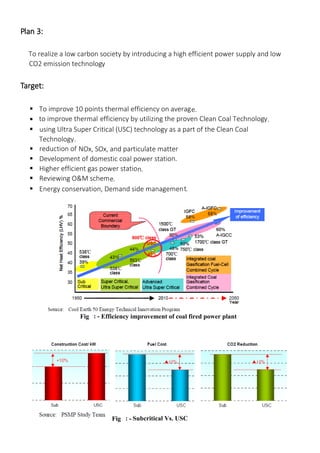
To realize a low carbon society by introducing a high efficient power supply and low
CO2 emission technology .
Target:
 To improve 10 points thermal efficiency on average.
 to improve thermal efficiency by utilizing the proven Clean Coal Technology.
 using Ultra Super Critical (USC) technology as a part of the Clean Coal
Technology.
 reduction of NOx, SOx, and particulate matter.
 Development of domestic coal power station.
 Higher efficient gas power station.
 Reviewing O&M scheme.
 Energy conservation, Demand side management.
Fig : - Efficiency improvement of coal fired power plant
Fig : - Subcritical Vs. USC
Plan 4:
To build an infrastructure necessary for stable power supply under joint coordination
by the multi-
sector
Target:
 To jointly build a deep sea port facility by power, industry and commercial sector
 to develop a gas transmission
line, a fuel center, a deep sea port, a domestic waterway, a railway and so on
 cooperation with other sectors such as industry and commercial
enterprises will be needed to achieve cost reduction and a synergy effect.
 Construction of deep sea port
 Improvement of the power transmission system
 Enhancement of gas transmission line
 Construction of fuel center
 Strengthening the domestic waterway
 Construction of Special Economic Zone adjacent to the deep sea port
Plan 5:
To build an efficient and effective mechanism, organization and regulations for stable
power supply.
Target:
 To build an efficient and effective mechanism, organization and regulations for stable
power supply
 To formulate regulations for compulsory regular inspection of power stations by
leadership of government.
 To revise the tariff structure to recover maintenance costs and future investment for
plant and equipment
 introduction of Power Development Surcharge into the power tariff
 Promotion of private investment to realize the Master Plan
 To create an effective and efficient power market
Plan 6:
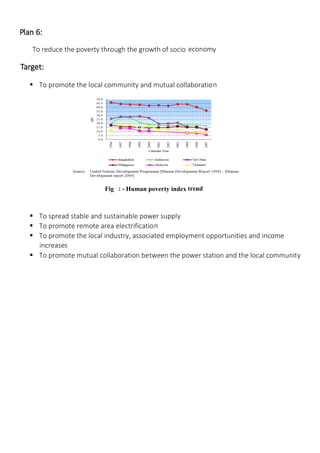
To reduce the poverty through the growth of socio-
economy
Target:
 To promote the local community and mutual collaboration
 To spread stable and sustainable power supply
 To promote remote area electrification
 To promote the local industry, associated employment opportunities and income
increases
 To promote mutual collaboration between the power station and the local community
Fig : - Human poverty index trend
Overview on power sector of Bangladesh
At a Glance :
 Electricity Growth : 10.5% (in 2016)
 Generation Capacity : 12,780 MW (in 2016)
 Total Consumers : 31,57,030(in 2015)
 Transmission Lines : 9,800 km(in 2016)
 Distribution Lines : 3,01,654 km(in 2013)
 Distribution Losses : 13.54%(in 2014-15)
 Per Capita Generation : 285kWh (in 2013)
 Access to Electricity : 68%(in 2015)
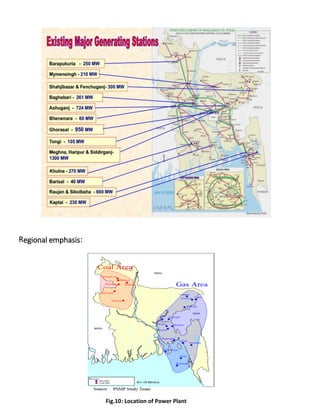
Fig.10: Location of Power Plant
 Coal field is mostly in southern part of Bangladesh. So coal based power plant need to
build in this region as raw material and less transport cost
 If we use imported coal that need easy transport system and less time consumption
for coal based power plant.So plant may be near bay of bangle.
 There are several power plants run on gas all gas field is east-north region and for easy
distribution system gas based power plant may build in this region.
Fuel diversification:
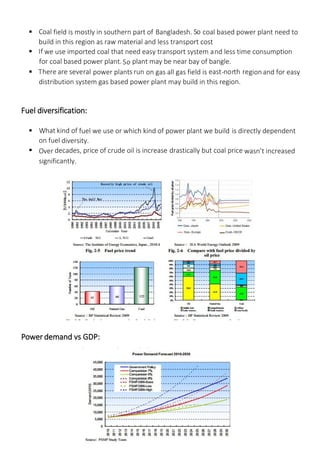
 What kind of fuel we use or which kind of power plant we build is directly dependent
on fuel diversity.
 Over decades, price of crude oil is increase drastically but coal price wasn’t increased
significantly.
Power demand vs GDP:
 We assume 6 to 8% GDP
Coal production:
 We need to increase coal production
Coal based plant:
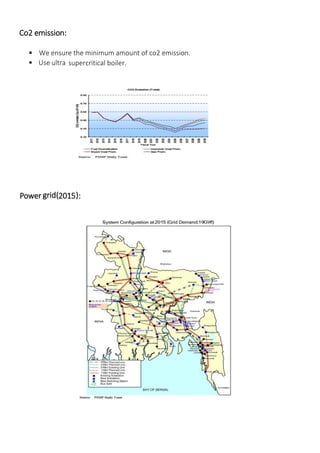
Co2 emission:
 We ensure the minimum amount of co2 emission.
 Use ultra-
supercritical boiler.
Power grid(2015):
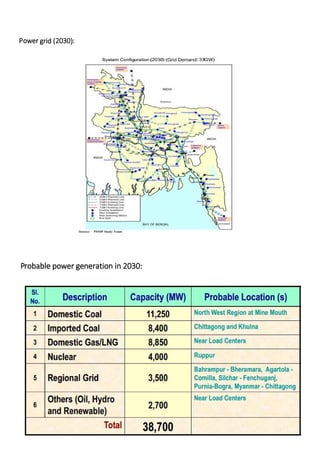
Power grid (2030):
Probable power generation in 2030:
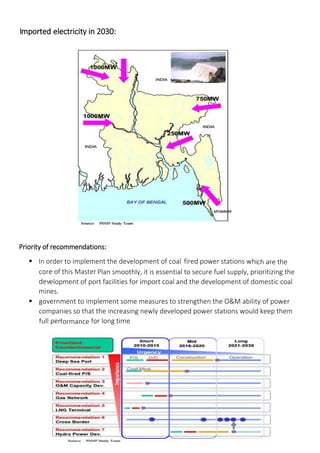
Imported electricity in 2030:
Priority of recommendations:
 In order to implement the development of coal-
fired power stations which are the
core of this Master Plan smoothly, it is essential to secure fuel supply, prioritizing the
development of port facilities for import coal and the development of domestic coal
mines.
 government to implement some measures to strengthen the O&M ability of power
companies so that the increasing newly developed power stations would keep them
full performance for long time.

Psmp 2010

  • 1.
    Bangladesh university ofengineering and technology Overview on power sector of Bangladesh & power system master plan(psmp)-2010 Submitted by HASAN SHAHRIAR SAJIB Studying B.Sc. Engineering Mechanical Engineering Bangladesh University of Engineering & Technology (BUET)
  • 2.
    Power System MasterPlan 2010: The study for master plan on coal power development in the people’s republic of Bangladesh. Related organization:  Power Division Ministry of Power, Energy and Mineral Resource  Japan international cooperative agency  The Tokyo electric power co. inc.  Counterpart organization o Ministry of Power, Energy and Mineral Resources (MPEMR)  Power Division  Energy and Mineral Resources Division (EMRD)  Power Cell o Economic Relations Division, Ministry of Finance o Bangladesh Power Development Board (BPDB) o Barapukuria Coal Mine Company Ltd (BCMCL) o Power Grid Company of Bangladesh (PGCB) o Dhaka Power Distribution Company Limited (DPDC) o Dhaka Electric Supply Company Limited (DESCO) o Rural Electrification Board (REB) o Bangladesh Oil, Gas Mineral Corporation (Petrobangla) o Electricity Generation Company of Bangladesh (EGCB) o Ashganj Power Station Company Limited (APSCL) o North- West Power Generation Company Ltd (NWPGCL) o Geological Survey of Bangladesh (GSB) o Ministry of Environment and Forestry Affairs (MOE)
  • 3.
    Objectives:  formulate theMaster Plan for the attainment of stable power supply by achieving the 3Es; Economic Growth, Energy Security and Environmental Protection simultaneously .  reduce poverty in a period as swift as possible by achieving high economic growth.  Planning electrification via the stabilization and efficiency of the electric power supply system can be expected to reduce poverty  promote development thatwill provide a self- reinforcing cycle of poverty reduction and 3E simultaneous achievement. The structure of the Vision, Roadmap, Action Plan and Target is shown in the following figure. The Vision is proposed as Bangladesh’s long term strategic power development vision 2030. To achieve this Vision, 6 value- up plans have been stipulated, where each value- up plans have their own targets to achieve the plans Fig : Bangladesh Long Term Power Development Plan 2030
  • 4.
    Plan 1: To activelydevelop domestic primary energy resources Target:  To maintain domestic primary energy supply over 50%  To ensure secure a source of energy that is essential to the economy and stability.  Domestic natural gas development  Domestic coal development Fig : Domestic coal and natural gas production Fig : Domestic gas supply scenario Source : PSPM Study team Fig : Domestic coal supply scenario Source : PSPM Study team
  • 5.
    Plan 2: To establishthe powersystem portfolio by fuel diversification Target:  Fuel composition ratio as of 2030: coal 50%, natural gas 25%, others 25%  to tap into other power sources from outside the Bangladesh  To achieve the best mix of energy supply including imported resources, it would be required to use economical and stable power source in consideration of environmental protection.  Construction of imported coal power station  Introduction of LNG facilities  Construction of the oil fired power station  Import the electricity generated by hydro power from the neighboring countries or joint development  Development of domestic renewable energy (wind and solar power) Fig : - Power development plan up to 2030 (%) Fig : - Power development plan up to 2030 (MW) Fig : - World Primary Energy Balance Fig : - Bangladesh primary energy balance
  • 6.
    Plan 3: To realizea low carbon society by introducing a high efficient power supply and low CO2 emission technology . Target:  To improve 10 points thermal efficiency on average.  to improve thermal efficiency by utilizing the proven Clean Coal Technology.  using Ultra Super Critical (USC) technology as a part of the Clean Coal Technology.  reduction of NOx, SOx, and particulate matter.  Development of domestic coal power station.  Higher efficient gas power station.  Reviewing O&M scheme.  Energy conservation, Demand side management. Fig : - Efficiency improvement of coal fired power plant Fig : - Subcritical Vs. USC
  • 7.
    Plan 4: To buildan infrastructure necessary for stable power supply under joint coordination by the multi- sector Target:  To jointly build a deep sea port facility by power, industry and commercial sector  to develop a gas transmission line, a fuel center, a deep sea port, a domestic waterway, a railway and so on  cooperation with other sectors such as industry and commercial enterprises will be needed to achieve cost reduction and a synergy effect.  Construction of deep sea port  Improvement of the power transmission system  Enhancement of gas transmission line  Construction of fuel center  Strengthening the domestic waterway  Construction of Special Economic Zone adjacent to the deep sea port Plan 5: To build an efficient and effective mechanism, organization and regulations for stable power supply. Target:  To build an efficient and effective mechanism, organization and regulations for stable power supply  To formulate regulations for compulsory regular inspection of power stations by leadership of government.  To revise the tariff structure to recover maintenance costs and future investment for plant and equipment  introduction of Power Development Surcharge into the power tariff  Promotion of private investment to realize the Master Plan  To create an effective and efficient power market
  • 8.
    Plan 6: To reducethe poverty through the growth of socio- economy Target:  To promote the local community and mutual collaboration  To spread stable and sustainable power supply  To promote remote area electrification  To promote the local industry, associated employment opportunities and income increases  To promote mutual collaboration between the power station and the local community Fig : - Human poverty index trend Overview on power sector of Bangladesh At a Glance :  Electricity Growth : 10.5% (in 2016)  Generation Capacity : 12,780 MW (in 2016)  Total Consumers : 31,57,030(in 2015)  Transmission Lines : 9,800 km(in 2016)  Distribution Lines : 3,01,654 km(in 2013)  Distribution Losses : 13.54%(in 2014-15)  Per Capita Generation : 285kWh (in 2013)  Access to Electricity : 68%(in 2015)
  • 9.
  • 10.
     Coal fieldis mostly in southern part of Bangladesh. So coal based power plant need to build in this region as raw material and less transport cost  If we use imported coal that need easy transport system and less time consumption for coal based power plant.So plant may be near bay of bangle.  There are several power plants run on gas all gas field is east-north region and for easy distribution system gas based power plant may build in this region. Fuel diversification:  What kind of fuel we use or which kind of power plant we build is directly dependent on fuel diversity.  Over decades, price of crude oil is increase drastically but coal price wasn’t increased significantly. Power demand vs GDP:
  • 11.
     We assume6 to 8% GDP Coal production:  We need to increase coal production Coal based plant:
  • 12.
    Co2 emission:  Weensure the minimum amount of co2 emission.  Use ultra- supercritical boiler. Power grid(2015):
  • 13.
    Power grid (2030): Probablepower generation in 2030:
  • 14.
    Imported electricity in2030: Priority of recommendations:  In order to implement the development of coal- fired power stations which are the core of this Master Plan smoothly, it is essential to secure fuel supply, prioritizing the development of port facilities for import coal and the development of domestic coal mines.  government to implement some measures to strengthen the O&M ability of power companies so that the increasing newly developed power stations would keep them full performance for long time.