INTERNATIONAL ISLAMIC UNIVERSITY MALAYSIA
COURSE OUTLINE
Kulliyyah Islamic Revealed Knowledge and Human Sciences
Department Political Science
Programme Bachelor of Human Sciences (Political Science)
Course Title Introduction to Economics
Course Code PSCI 1500
Status Core
Level -
Credit Hours 3
Contact Hours 3
Pre-requisites
(if any)
-
Co-requisites
(if any)
-
Instructor(s) Zurul Aisya Osman
(Email: zurul.osman@gmail.com)
Semester
Offered
Every Semester
Course
Synopsis
The course focuses on basic theoretical tools of conventional micro and
macroeconomics. An appraisal of these constructs from the Islamic
perspective is also discussed.
Course
Objectives
The objectives of this course are to:
1. Familiarize students with relevant economic concepts both
conventional and Islamic;
2. Enable students to acquire understanding and exposure to
economic theories and policies; and
3. Enable students to appreciate the role of economic policies and
their applications in managing public affairs.
Learning
Outcomes
Upon completion of this course, students should be able to:
1. Illustrate the Concepts of Scarcity, Choice and Opportunity Cost,
Excess Demand, Excess Supply and Equilibrium Quantities and
Prices from Islamic and Western Perspective (C3,EM2);
2. Respond to the changes in the underlying determinants of market
demand and supply of government intervention (P3,LL2);
3. Differentiate between short-run and long-run production relations
(A3).
Instructional
Strategies
Content-based teaching and class room teaching
Course
Assessment
State weightage
of each type of
assessment.
Summative Assessment
Method %
Midterm Exam 1 30
Midterm Exam 2 30
Final Examination 40
TOTAL 100
Content Outlines
Weeks Topics Task/Reading
1
Tue (09/09)
Thu (11/09)
1. Economics : definition and scope; the economic
problem, wants and scarce resources; The Production
Possibilities Curve; Microeconomics and
Macroeconomics; Islamic Perspective of Scarcity
Welch &
Welch (2010):
Chapter 1.
2
Tue (16/09) –
Public Holiday
Thu (18/09)
2. Basic economic decisions; Classifying economic
systems; The Capitalist system; The Socialist system;
The Mixed economy; The Islamic system
Welch &
Welch (2010):
Chapter 2.
3 & 4
Tue (23/09)
Thu (25/09)
Tue (30/09)
Thu (02/10)
3. Demand – The law of demand, the demand curve,
determinants of demand, and changes in quantity
demanded; Supply - The law of supply, the supply
curve, determinants of supply, and changes in quantity
supplied
Welch &
Welch (2010):
Chapter 3.
٠ Price determination – Surpluses, shortages,
equilibrium price and quantity, rationing function of
prices, changes in supply, demand and market
equilibrium.
4. Markets where prices are controlled – Price floors and
ceilings.
٠ Elasticity – price elasticity of demand and price
elasticity of supply.
Tue (07/10 –
Thu 09/10)
MID SEMESTER BREAK
5
Tue (14/10)
Thu (16/10)
5. Types of business organizations; Islamic principles on
business organizations
Welch &
Welch (2010):
Chapter 10.
6
Tue (21/10)
Thu (23/10)
Public Holiday
Tuesday, 21/10/2014
8.00 pm – 9.30 pm, LR 22
MIDTERM EXAM 1 (Topics 1 – 5)
7
Tue (28/10)
Thu (30/10)
6. Unemployment – Defining unemployment,
consequences of unemployment and types of
unemployment; Inflation – Defining inflation,
consequences of inflation, and causes of inflationary
pressure.
Welch &
Welch (2010):
Chapter 4.
7. Economic growth – Potential growth and actual
growth, measuring production and growth, and causes
of growth
8 - 9
Tue (04/11)
Thu (06/11)
Tue (11/11)
8. Business cycle and causes of economic fluctuations
Aggregate spending and its components
Leakages, injections and the circular flow of income
The Multiplier Effect
Macroeconomics Policies
Welch &
Welch (2010):
Chapter 5.
9 - 10
Thu (13/11)
Tue (18/11)
9. Government expenditure and revenues; Instruments
and mechanics of fiscal policy; Government budgets
and national debt, Government’s policies on
International Trade
Welch &
Welch (2010):
Chapter 6 &
16
10. Sources of revenue in an Islamic economy, heads and
patterns of expenditures in an Islamic economy, public
debt, foreign aid and cooperation among Muslim
countries as a solution to debt and foreign aid from
conventional sources.
10
Thu (20/11)
Thursday, 20/11/2014
8.00 pm – 9.30 pm, LR 22
MIDTERM EXAM 2 (Topics 6 – 10)
11 - 12
Tue (25/11)
Thu (27/11)
Tue (02/12)
Thu (0412)
11. The meaning and function of money; The banking
system, commercial banking, central banking, riba and
Islamic banking; The central bank, its operations and
functions.
Welch &
Welch (2010):
Chapter 7 & 8.
12. Monetary theory, money creation and money
multiplier; monetary policy; tools and monetary
policy, types of monetary policy, and effects of
monetary policy.
13
Tue (09/12)
Thu (11/12)
13. Short-run and long run cost of production, Social Cost
(and Social Benefits).
Welch &
Welch (2010):
Chapter 11 &
12.
14
Tue (16/12)
Thu (18/12)
14. Market structures – Perfect competition, Monopolistic
competition, Oligopoly and Monopoly
Welch &
Welch (2010):
Chapter 13.
15. Market structure from and Islamic perspective
(monopoly, monopolizing behaviour, etc.); Profit
maximization - Price and output determination
REVISION PERIOD
END-OF SEMESTER EXAMINATION
References Required
Welch, P.J. & Welch, G.F (2010). Economics: Theory and Practice. 9th
ed.,
New Jersey: John Wiley and Sons Inc.
Recommended
Haneef, M.A. (n.d). Principles of Microeconomics: An Islamic Perspective.
Karachi: University of Karachi Press
McConnell, C.R, Brue, S.L. & Flynn, S.M. (2009). Economics: Principles,
Problems, and Policies. 18th
ed., New York: McGraw-Hill/Irwin
Proposed Start Date (Semester) Semester 1, 2014/2015 (08/09/14)
Batch of Students to be Affected Semester 3, 2005/2006 and onwards

PSCI 1500 - Course Outline

  • 1.
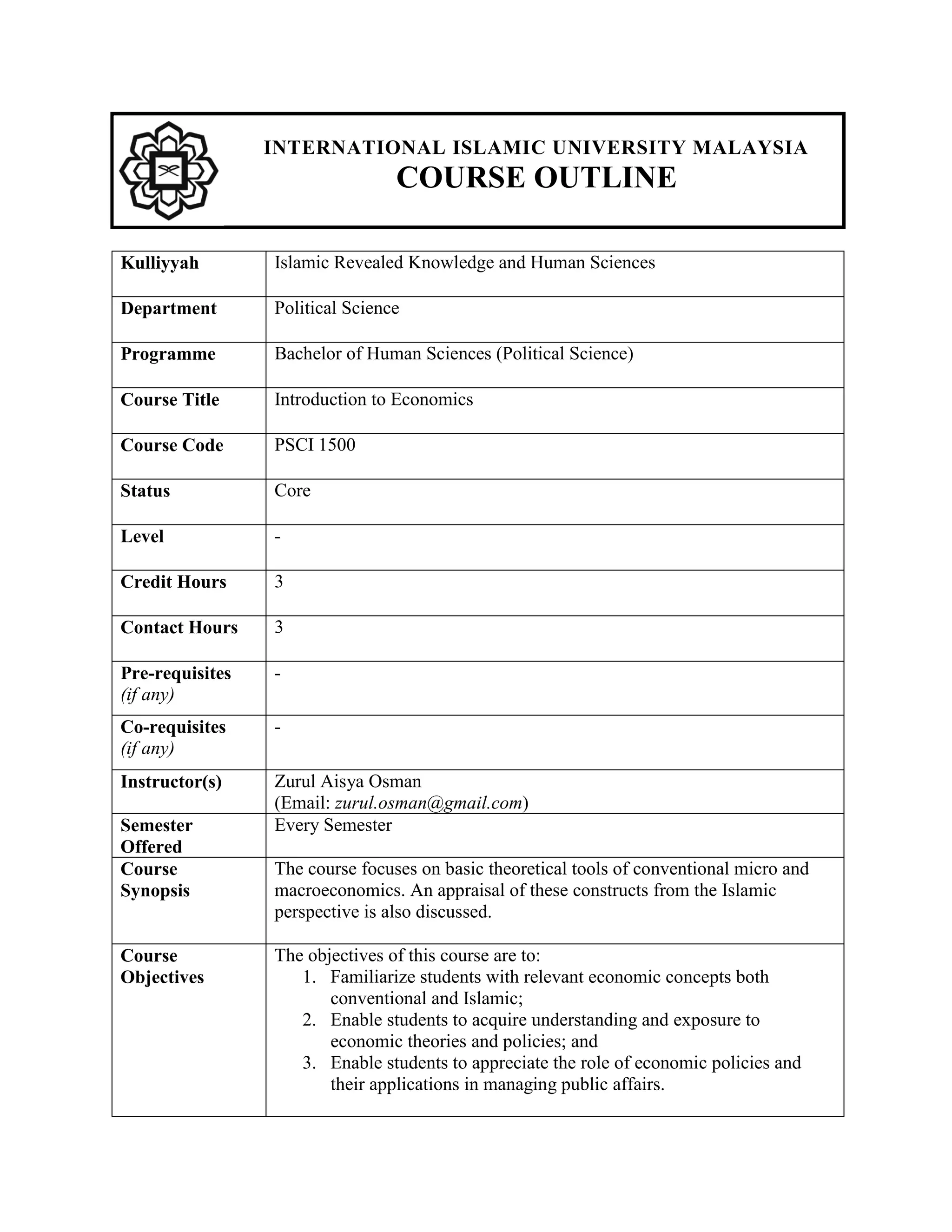
    INTERNATIONAL ISLAMIC UNIVERSITYMALAYSIA COURSE OUTLINE Kulliyyah Islamic Revealed Knowledge and Human Sciences Department Political Science Programme Bachelor of Human Sciences (Political Science) Course Title Introduction to Economics Course Code PSCI 1500 Status Core Level - Credit Hours 3 Contact Hours 3 Pre-requisites (if any) - Co-requisites (if any) - Instructor(s) Zurul Aisya Osman (Email: zurul.osman@gmail.com) Semester Offered Every Semester Course Synopsis The course focuses on basic theoretical tools of conventional micro and macroeconomics. An appraisal of these constructs from the Islamic perspective is also discussed. Course Objectives The objectives of this course are to: 1. Familiarize students with relevant economic concepts both conventional and Islamic; 2. Enable students to acquire understanding and exposure to economic theories and policies; and 3. Enable students to appreciate the role of economic policies and their applications in managing public affairs.
  • 2.
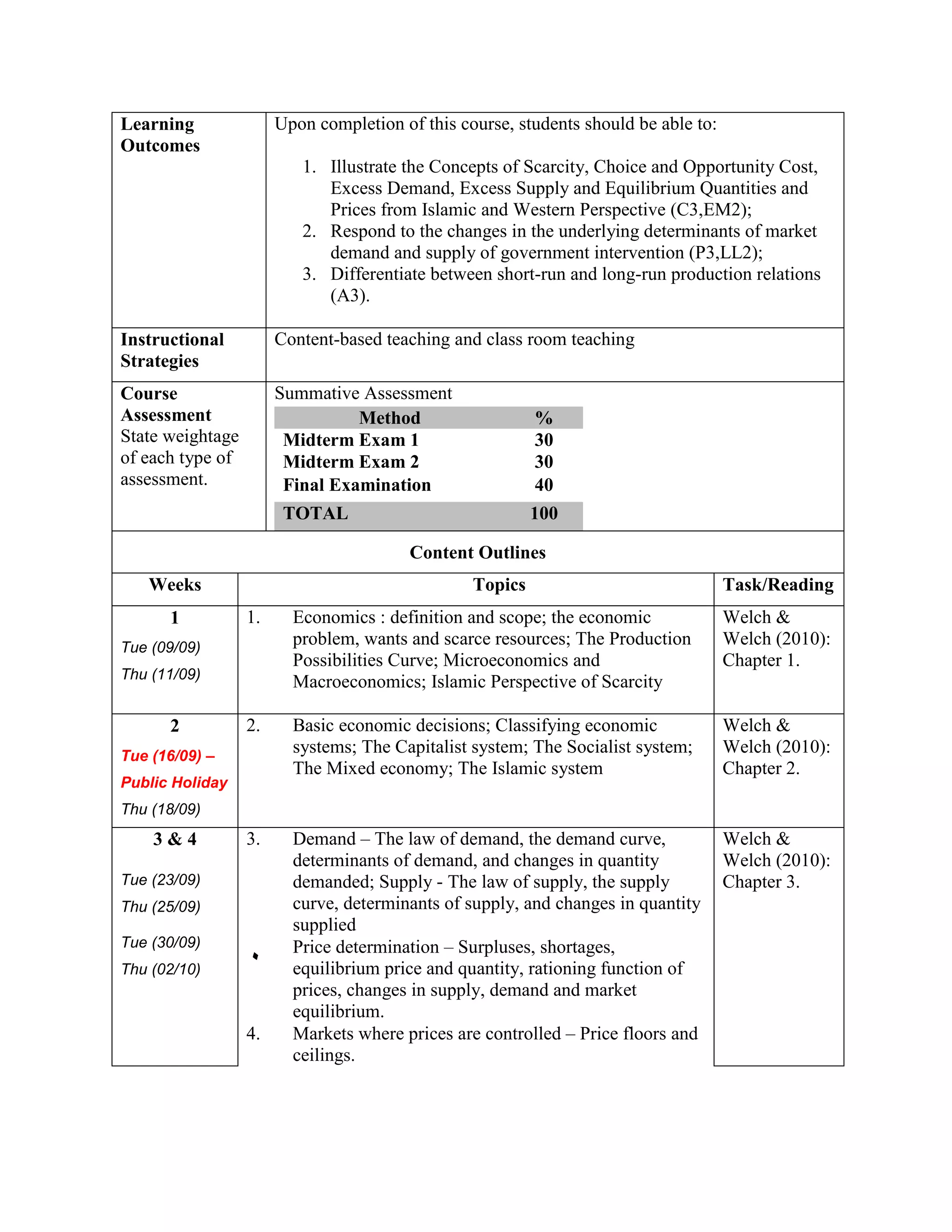
    Learning Outcomes Upon completion ofthis course, students should be able to: 1. Illustrate the Concepts of Scarcity, Choice and Opportunity Cost, Excess Demand, Excess Supply and Equilibrium Quantities and Prices from Islamic and Western Perspective (C3,EM2); 2. Respond to the changes in the underlying determinants of market demand and supply of government intervention (P3,LL2); 3. Differentiate between short-run and long-run production relations (A3). Instructional Strategies Content-based teaching and class room teaching Course Assessment State weightage of each type of assessment. Summative Assessment Method % Midterm Exam 1 30 Midterm Exam 2 30 Final Examination 40 TOTAL 100 Content Outlines Weeks Topics Task/Reading 1 Tue (09/09) Thu (11/09) 1. Economics : definition and scope; the economic problem, wants and scarce resources; The Production Possibilities Curve; Microeconomics and Macroeconomics; Islamic Perspective of Scarcity Welch & Welch (2010): Chapter 1. 2 Tue (16/09) – Public Holiday Thu (18/09) 2. Basic economic decisions; Classifying economic systems; The Capitalist system; The Socialist system; The Mixed economy; The Islamic system Welch & Welch (2010): Chapter 2. 3 & 4 Tue (23/09) Thu (25/09) Tue (30/09) Thu (02/10) 3. Demand – The law of demand, the demand curve, determinants of demand, and changes in quantity demanded; Supply - The law of supply, the supply curve, determinants of supply, and changes in quantity supplied Welch & Welch (2010): Chapter 3. ٠ Price determination – Surpluses, shortages, equilibrium price and quantity, rationing function of prices, changes in supply, demand and market equilibrium. 4. Markets where prices are controlled – Price floors and ceilings.
  • 3.
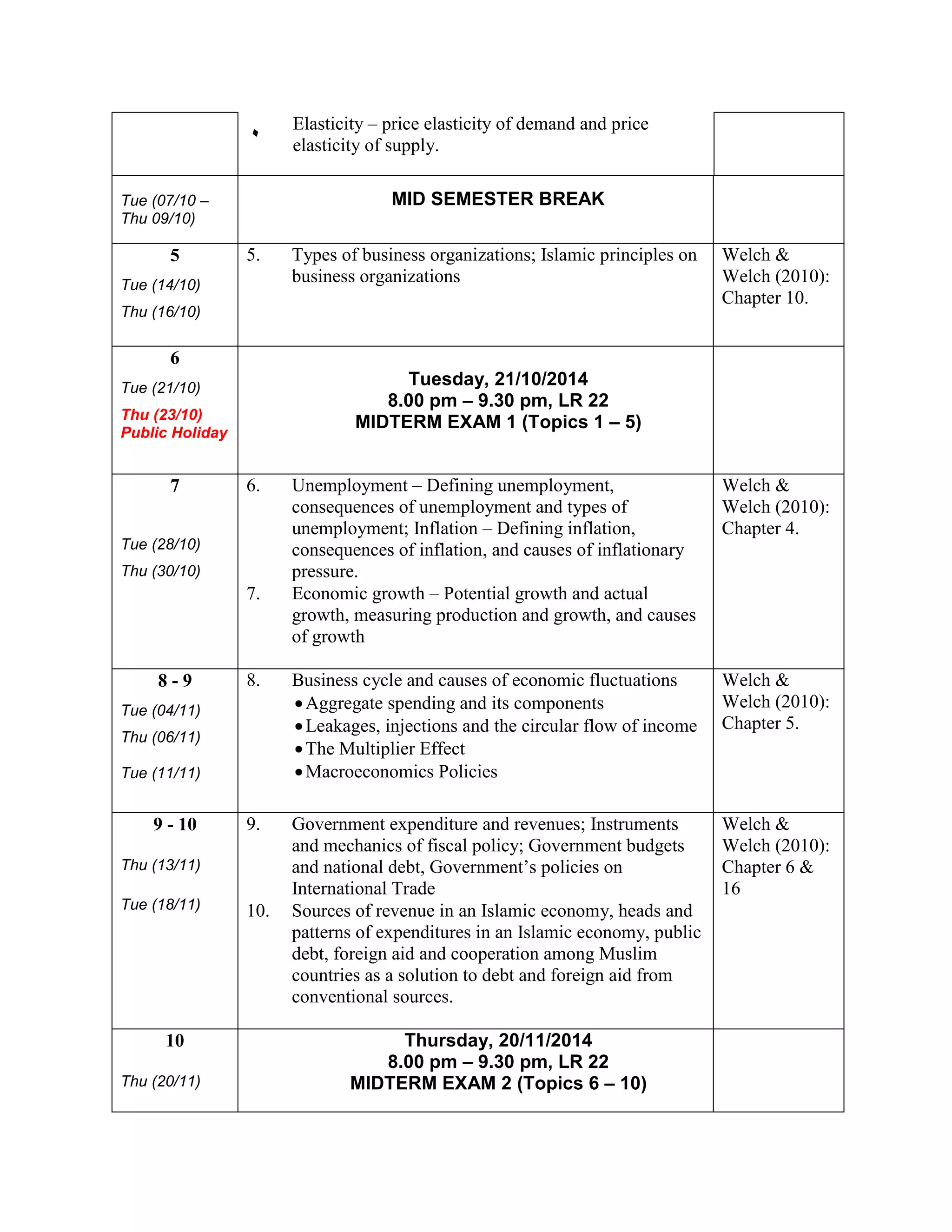
    ٠ Elasticity –price elasticity of demand and price elasticity of supply. Tue (07/10 – Thu 09/10) MID SEMESTER BREAK 5 Tue (14/10) Thu (16/10) 5. Types of business organizations; Islamic principles on business organizations Welch & Welch (2010): Chapter 10. 6 Tue (21/10) Thu (23/10) Public Holiday Tuesday, 21/10/2014 8.00 pm – 9.30 pm, LR 22 MIDTERM EXAM 1 (Topics 1 – 5) 7 Tue (28/10) Thu (30/10) 6. Unemployment – Defining unemployment, consequences of unemployment and types of unemployment; Inflation – Defining inflation, consequences of inflation, and causes of inflationary pressure. Welch & Welch (2010): Chapter 4. 7. Economic growth – Potential growth and actual growth, measuring production and growth, and causes of growth 8 - 9 Tue (04/11) Thu (06/11) Tue (11/11) 8. Business cycle and causes of economic fluctuations Aggregate spending and its components Leakages, injections and the circular flow of income The Multiplier Effect Macroeconomics Policies Welch & Welch (2010): Chapter 5. 9 - 10 Thu (13/11) Tue (18/11) 9. Government expenditure and revenues; Instruments and mechanics of fiscal policy; Government budgets and national debt, Government’s policies on International Trade Welch & Welch (2010): Chapter 6 & 16 10. Sources of revenue in an Islamic economy, heads and patterns of expenditures in an Islamic economy, public debt, foreign aid and cooperation among Muslim countries as a solution to debt and foreign aid from conventional sources. 10 Thu (20/11) Thursday, 20/11/2014 8.00 pm – 9.30 pm, LR 22 MIDTERM EXAM 2 (Topics 6 – 10)
  • 4.
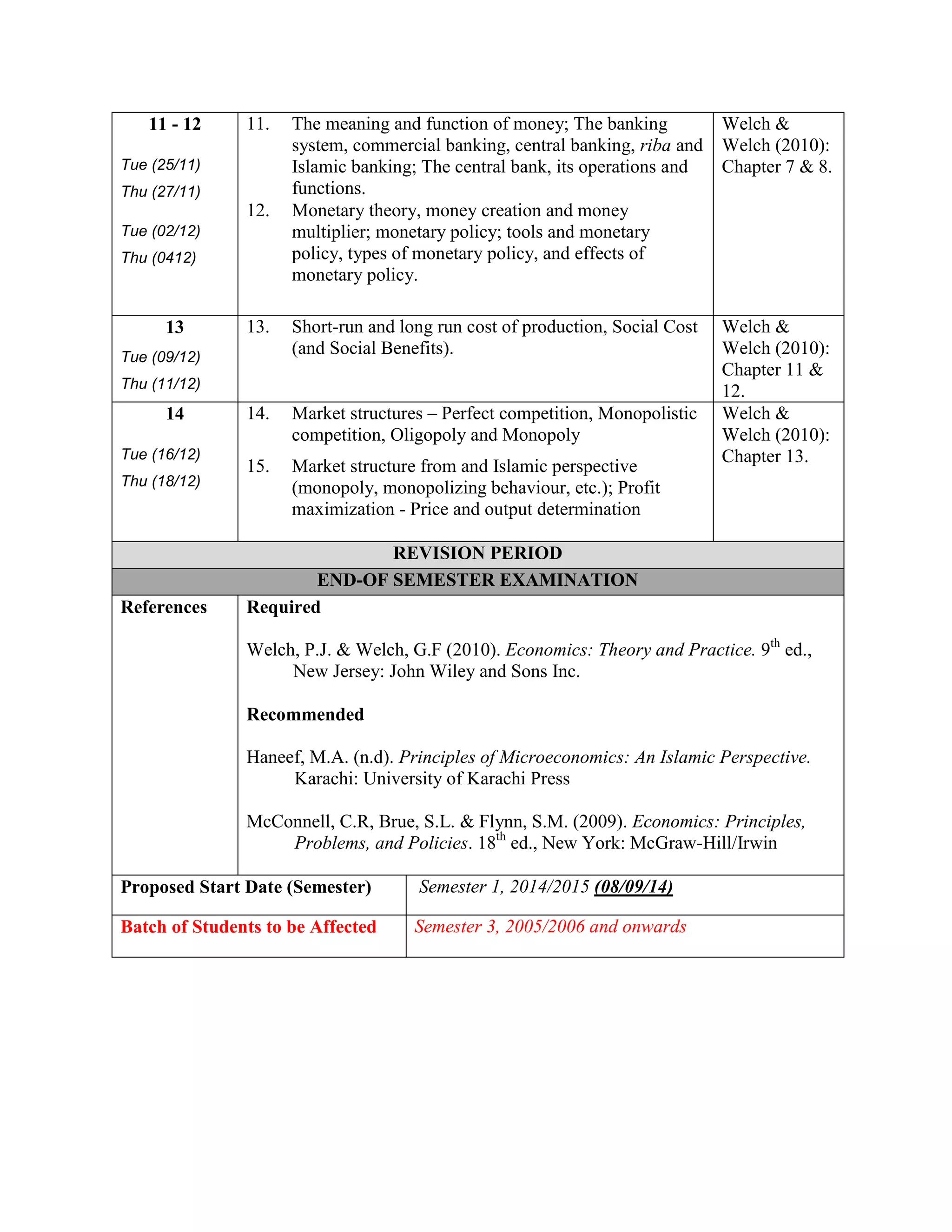
    11 - 12 Tue(25/11) Thu (27/11) Tue (02/12) Thu (0412) 11. The meaning and function of money; The banking system, commercial banking, central banking, riba and Islamic banking; The central bank, its operations and functions. Welch & Welch (2010): Chapter 7 & 8. 12. Monetary theory, money creation and money multiplier; monetary policy; tools and monetary policy, types of monetary policy, and effects of monetary policy. 13 Tue (09/12) Thu (11/12) 13. Short-run and long run cost of production, Social Cost (and Social Benefits). Welch & Welch (2010): Chapter 11 & 12. 14 Tue (16/12) Thu (18/12) 14. Market structures – Perfect competition, Monopolistic competition, Oligopoly and Monopoly Welch & Welch (2010): Chapter 13. 15. Market structure from and Islamic perspective (monopoly, monopolizing behaviour, etc.); Profit maximization - Price and output determination REVISION PERIOD END-OF SEMESTER EXAMINATION References Required Welch, P.J. & Welch, G.F (2010). Economics: Theory and Practice. 9th ed., New Jersey: John Wiley and Sons Inc. Recommended Haneef, M.A. (n.d). Principles of Microeconomics: An Islamic Perspective. Karachi: University of Karachi Press McConnell, C.R, Brue, S.L. & Flynn, S.M. (2009). Economics: Principles, Problems, and Policies. 18th ed., New York: McGraw-Hill/Irwin Proposed Start Date (Semester) Semester 1, 2014/2015 (08/09/14) Batch of Students to be Affected Semester 3, 2005/2006 and onwards