Download to read offline

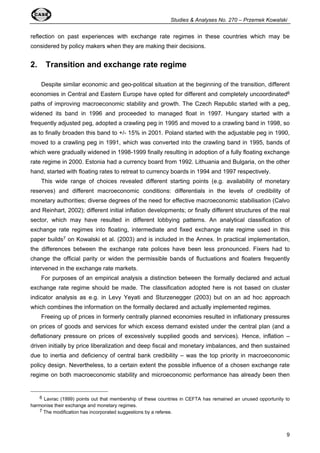
![Studies Analyses No. 270 – Przemek Kowalski
11
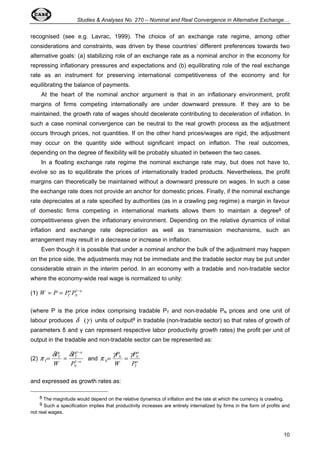
(3) [ ]
ˆ = (1 - ) ˆ - ˆ +
ˆ
= - +
p a P P
d
T T N
ˆ ˆ ˆ ˆ
p a [ P P
] g
N N T
If the purchasing power parity is assumed to hold in the tradables sector:
(4) ˆ ˆ ˆ *
T T P = E + P
equations (3) become:
(5) [ ]
ˆ = (1 - ) ˆ + ˆ * - ˆ +
ˆ
= - - +
p a E P P
d
T T N
ˆ ˆ ˆ ˆ * ˆ
p a [ P E P
] g
N N T
Equations (3) and (5) show that, assuming away productivity growth differences, in a fixed
exchange rate regime in order for tradables profits to be unaffected, prices in the non-tradable
sector would have to be growing at the rate equal to that of foreign tradables. If growth of prices in
non-tradables is higher, tradable profits are reduced, ceteris paribus, through the wage mechanism
(1). This problem will be less significant in an economy with large share of tradables (high a) 10
which is similar to the observation about the role of openness for the choice of an exchange rate
regime made by McKinnon(1963).
In a floating exchange rate regime the nominal exchange rate can adjust so that profitability of
the tradable sector is maintained. It has to be pointed out that the nominal depreciation and
resulting tradables price inflation (4) is not necessarily detrimental to profitability of the non-tradable
sector as the non-tradable prices are not bound by external constraints and may be more
easily adjusted. Under such a scenario we deal with a pass-through of nominal depreciation into
domestic prices but no effect on profitability of either tradable or non-tradable sector.
Hence, especially in an environment characterised by a degree of inflationary inertia, the
nominal exchange rate may be an important tool of preserving competitiveness or smoothing
fluctuations. Of course, as (5) indicates, exogenous productivity growth may compensate or even
outweigh the negative effects without undermining the argument that profits may be affected by
behaviour of nominal exchange rate. It is also clear that a crawling peg, provides a margin of extra
profitability for the tradable sector while also generating or sustaining inflation.
The mechanism described above provides a rough intuition of how profits, especially in the
tradable sector, may be affected. This, however, prompts a further question of how this may feed
into the productivity growth. As Lafrance and Schembri (2000) point out both the exchange rate
and productivity depend on a large set of underlying factors and a simple causal relationship is
unlikely. However, the traditional assumption of productivity being exogenous to nominal exchange
rate regime (see e.g. Harris, 2001) is not fully realistic. The Harrod-Balassa-Samuelson is the most
famous theoretical framework that is based on this assumption. A competing paradigm is related to
10 In our framework this is modeled through parameter a, which describes the weight of tradables in the price index
P (Equation 1).](https://image.slidesharecdn.com/sa270-141105055252-conversion-gate02/85/CASE-Network-Studies-and-Analyses-270-Nominal-and-Real-Convergence-in-Alternative-Exchange-Rate-Regimes-in-Transition-Countries-Implications-for-the-EMU-Accession-11-320.jpg)
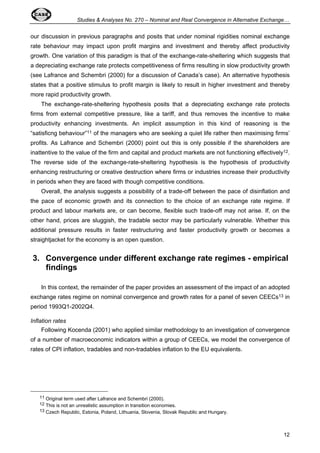
![Studies Analyses No. 270 – Przemek Kowalski
21
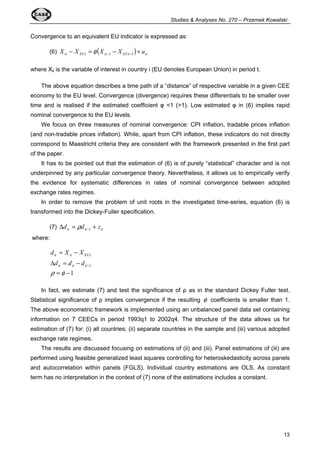
Table 5. Non-tradables inflation rate convergence by country
country Implied t-statistic 95% conf. interval Implied 95% conf,
interval
No. of
observations
CZE -0,09 ** 0,91 -1,76 -0,20 0,01 0,80 1,01 31
EST -0,07 0,93 -1,32 -0,17 0,04 0,83 1,04 35
HUN -0,02 0,98 -0,51 -0,11 0,07 0,89 1,07 35
LIT -0,14 *** 0,86 -2,84 -0,24 -0,04 0,76 0,96 27
POL -0,06 0,94 -1,36 -0,16 0,03 0,84 1,03 27
SLK -0,14 ** 0,86 -1,79 -0,29 0,02 0,71 1,02 31
SLO -0,02 0,98 -0,51 -0,11 0,07 0,89 1,07 35
***,**,* denote significance at 1,5 and 10% rescpectively
Table 6. Non-tradables inflation rate convergence by regime
regime Implied z-statistic 95% conf.
interval
Implied 95% conf,
interval
No. of
observations
Floating -0,11 *** 0,89 -3,07 -0,18 -0,04 0,82 0,96 65
Intermediate -0,04 0,96 -0,94 -0,11 0,04 0,89 1,04 76
Fixed -0,11 *** 0,89 -4,20 -0,16 -0,06 0,84 0,94 80
***,**,* denote significance at 1,5 and 10% rescpectively
Table 7. Growth equation estimated with FGLS
Coef. Std. Err. z P|z| [95% Conf. Interval]
GFCF 0,13 0,06 2,26 0,02 0,02 0,24
FDI 0,15 0,10 1,49 0,14 -0,05 0,36
EX -0,03 0,02 -1,47 0,14 -0,07 0,01
GGFC -0,07 0,07 -1,09 0,28 -0,21 0,06
GDPPC 0,00 0,00 2,26 0,02 0,00 0,00
FLOAT -2,89 0,73 -3,94 0,00 -4,33 -1,46
FIX 1,37 0,73 1,88 0,06 -0,06 2,80
INF -6,40 2,16 -2,97 0,00 -10,63 -2,17
C 1,68 1,78 0,94 0,35 -1,82 5,17](https://image.slidesharecdn.com/sa270-141105055252-conversion-gate02/85/CASE-Network-Studies-and-Analyses-270-Nominal-and-Real-Convergence-in-Alternative-Exchange-Rate-Regimes-in-Transition-Countries-Implications-for-the-EMU-Accession-21-320.jpg)
![Studies Analyses No. 270 – Nominal and Real Convergence in Alternative Exchange…
22
Table 8. Growth equation estimated with FGLS with heteroscedastic panels
Coef. Std. Err. z P|z| [95% Conf. Interval]
GFCF 0,03 0,04 0,62 0,53 -0,06 0,11
FDI 0,05 0,09 0,57 0,57 -0,12 0,22
EX -0,03 0,02 -1,71 0,09 -0,06 0,00
GGFC -0,10 0,04 -2,30 0,02 -0,19 -0,02
GDPPC 0,00 0,00 3,19 0,00 0,00 0,00
FLOAT -2,29 0,63 -3,62 0,00 -3,53 -1,05
FIX 2,42 0,55 4,40 0,00 1,34 3,50
INF -8,54 2,55 -3,35 0,00 -13,54 -3,55
C 5,26 1,66 3,17 0,00 2,00 8,52
Table 9. Growth equation estimated with FGLS with heteroscedastic panels and autocorrelation
within panels
Coef. Std. Err. z P|z| [95% Conf. Interval]
GFCF 0,06 0,06 1,10 0,27 -0,05 0,17
FDI 0,03 0,09 0,38 0,71 -0,14 0,21
EX -0,01 0,02 -0,46 0,65 -0,06 0,04
GGFC -0,08 0,07 -1,14 0,25 -0,22 0,06
GDPPC 0,00 0,00 1,55 0,12 0,00 0,00
FLOAT -1,71 0,80 -2,12 0,03 -3,28 -0,13
FIX 2,36 0,75 3,15 0,00 0,89 3,83
INF -4,84 2,67 -1,81 0,07 -10,08 0,39
C 2,65 2,12 1,25 0,21 -1,49 6,80
Table 10. Growth equation estimated with FE with robust standard errors
Coef. Std. Err. t P|t| [95% Conf. Interval]
GFCF 0,18 0,12 1,49 0,14 -0,06 0,42
FDI 0,16 0,16 1,05 0,29 -0,14 0,47
EX 0,13 0,03 4,03 0,00 0,07 0,20
GGFC -0,05 0,32 -0,16 0,87 -0,69 0,59
GDPPC (dropped)
FLOAT -2,66 0,53 -5,07 0,00 -3,70 -1,62
FIX 4,76 1,30 3,65 0,00 2,19 7,33
INF -4,93 1,63 -3,03 0,00 -8,14 -1,72
C -9,56 7,13 -1,34 0,18 -23,62 4,50](https://image.slidesharecdn.com/sa270-141105055252-conversion-gate02/85/CASE-Network-Studies-and-Analyses-270-Nominal-and-Real-Convergence-in-Alternative-Exchange-Rate-Regimes-in-Transition-Countries-Implications-for-the-EMU-Accession-22-320.jpg)
![Studies Analyses No. 270 – Przemek Kowalski
23
Table 11. Growth equation estimated with random effects
dgdp Coef. Std. Err. z P|z| [95% Conf. Interval]
GFCF 0,13 0,06 2,21 0,03 0,01 0,24
FDI 0,15 0,11 1,45 0,15 -0,05 0,36
EX -0,03 0,02 -1,44 0,15 -0,07 0,01
GGFC -0,07 0,07 -1,07 0,29 -0,21 0,06
GDPPC 0,00 0,00 2,21 0,03 0,00 0,00
FLOAT -2,89 0,75 -3,85 0,00 -4,36 -1,42
FIX 1,37 0,75 1,83 0,07 -0,09 2,84
INF -6,40 2,21 -2,90 0,00 -10,73 -2,07
C 1,68 1,82 0,92 0,36 -1,90 5,25](https://image.slidesharecdn.com/sa270-141105055252-conversion-gate02/85/CASE-Network-Studies-and-Analyses-270-Nominal-and-Real-Convergence-in-Alternative-Exchange-Rate-Regimes-in-Transition-Countries-Implications-for-the-EMU-Accession-23-320.jpg)

This paper examines nominal and real convergence in Central and Eastern European countries (CEECs) and their implications for European Monetary Union (EMU) accession, focusing on the role of exchange rate regimes. Results suggest that fixed exchange rates facilitate inflation control and support real GDP growth without compromising nominal convergence. The findings imply that the choice of exchange rate framework is crucial for macroeconomic stability and growth during the transition to EMU.


