Major Asian Religions
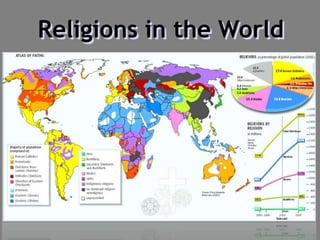
Religions in the World
Religions in Asia
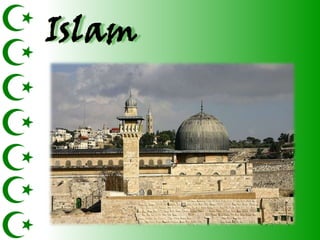
Islam
Origins
 Islam originated in the Middle East. It builds up on
  Jewish and Christian traditions.
 The word Islam means both ―peace‖ and
  ―submission‖.
 Its followers are called Muslims, or ―one who
  submits to the will of God‖.
 Mohammed received the revelation throughout 23
  years, dictated by the archangel Gabriel. He
  started preaching and Islam became a political as
  well as religious movement.
God
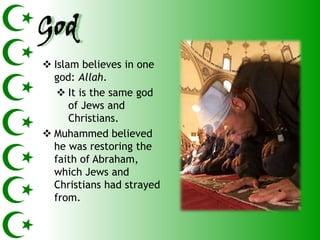
 Islam believes in one
  god: Allah.
    It is the same god
      of Jews and
      Christians.
 Muhammed believed
  he was restoring the
  faith of Abraham,
  which Jews and
  Christians had strayed
  from.
After Muhammed
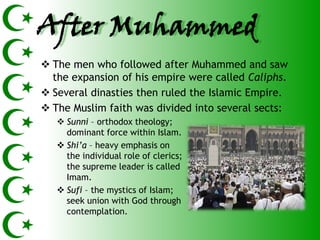
 The men who followed after Muhammed and saw
  the expansion of his empire were called Caliphs.
 Several dinasties then ruled the Islamic Empire.
 The Muslim faith was divided into several sects:
    Sunni – orthodox theology;
     dominant force within Islam.
    Shi’a – heavy emphasis on
     the individual role of clerics;
     the supreme leader is called
     Imam.
    Sufi – the mystics of Islam;
     seek union with God through
     contemplation.
Basic Beliefs
 All events in life (both good and bad) are seen as a
  trial from Allah for the life to come.
 They believe in a reckoning with Allah, for the
  choices and actions undertaken in a single human
  life.
 On the Day of Judgment, Allah will decide whether
  individuals will go to Paraside or Hell.
    Devout Christians and Jews can attain paradise as well.
 Death is not because of our sins (original sin), but
  simply a reality that brings us back to our Creator.
 Muslims must follow the example of the Prophet.
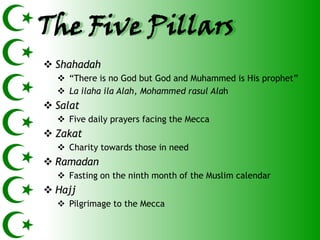
The Five Pillars
 Shahadah
   ―There is no God but God and Muhammed is His prophet‖
   La ilaha ila Alah, Mohammed rasul Alah
 Salat
   Five daily prayers facing the Mecca
 Zakat
   Charity towards those in need
 Ramadan
   Fasting on the ninth month of the Muslim calendar
 Hajj
   Pilgrimage to the Mecca
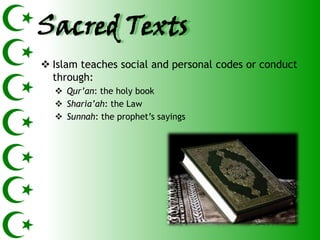
Sacred Texts
 Islam teaches social and personal codes or conduct
  through:
   Qur’an: the holy book
   Sharia’ah: the Law
   Sunnah: the prophet’s sayings
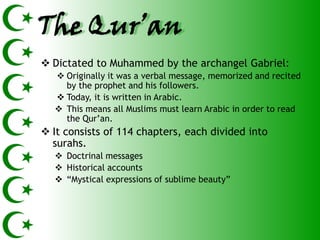
The Qur’an
 Dictated to Muhammed by the archangel Gabriel:
   Originally it was a verbal message, memorized and recited
    by the prophet and his followers.
   Today, it is written in Arabic.
   This means all Muslims must learn Arabic in order to read
    the Qur’an.
 It consists of 114 chapters, each divided into
  surahs.
   Doctrinal messages
   Historical accounts
   ―Mystical expressions of sublime beauty‖
Misconceptions about
Islam
 Muslim [does not] equal Arab.
 ―Sword of Islam‖ forcibly [did not] impose Islam
  on cultures conquered by the Muslim Empire.
 Jihad, [not] meaning all Muslims must engage in a
  holy war against those who do not accept Islam.
    Jiahd means ―struggle‖ against the self first and
     foremost.
 Islam [does not] degrade and oppress women.
 The Qur’an [does not] advocate the slaughter of
  unbelievers or suicide attackers fighting for
  Islam.
Hinduis
Origins
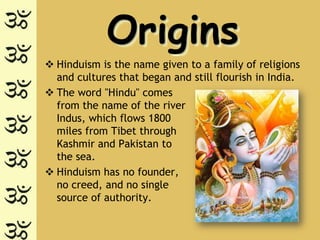
 Hinduism is the name given to a family of religions
  and cultures that began and still flourish in India.
 The word "Hindu" comes
  from the name of the river
  Indus, which flows 1800
  miles from Tibet through
  Kashmir and Pakistan to
  the sea.
 Hinduism has no founder,
  no creed, and no single
  source of authority.
God
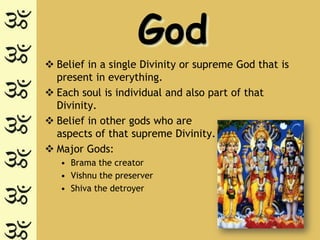
 Belief in a single Divinity or supreme God that is
  present in everything.
 Each soul is individual and also part of that
  Divinity.
 Belief in other gods who are
  aspects of that supreme Divinity.
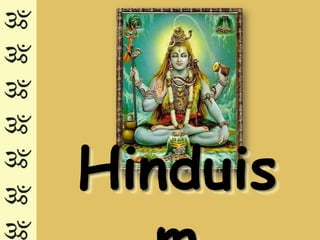
 Major Gods:
   • Brama the creator
   • Vishnu the preserver
   • Shiva the detroyer
Basic Beliefs
 For many Hindus, religion is a matter of practice
  rather than of beliefs. It's more what you do than
  what you believe.
 Belief that every soul is trapped in a cycle of
  birth and then death and then rebirth. Their
  ultimate aim is escape from the cycle altogether.
 This life, and this world, are only part of a
  training process.
 Hindus believe the universe doesn't have a
  beginning and an end. It's a cyclical pattern, so
  once it ends, it begins again.
Basic Beliefs
 There are 4 legitimate goals in life
  (purusharthas):
   •   dharma (appropriate living),
   •   artha (the pursuit of material gain by lawful means),
   •   kama (delight of the senses),
   •   moksha (release from rebirth).
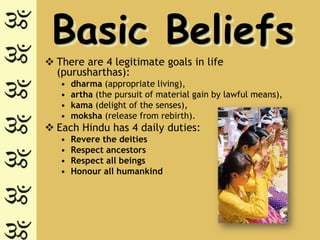
 Each Hindu has 4 daily duties:
   •   Revere the deities
   •   Respect ancestors
   •   Respect all beings
   •   Honour all humankind
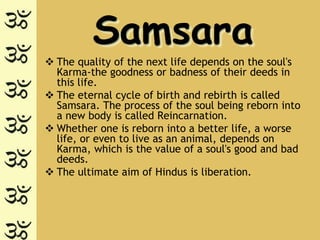
Samsara
 The quality of the next life depends on the soul's
  Karma-the goodness or badness of their deeds in
  this life.
 The eternal cycle of birth and rebirth is called
  Samsara. The process of the soul being reborn into
  a new body is called Reincarnation.
 Whether one is reborn into a better life, a worse
  life, or even to live as an animal, depends on
  Karma, which is the value of a soul's good and bad
  deeds.
 The ultimate aim of Hindus is liberation.
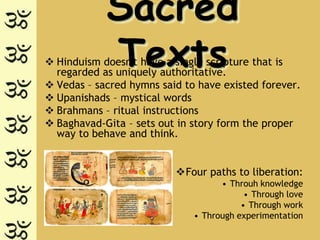
Sacred
            Texts
 Hinduism doesn't have a single scripture that is
  regarded as uniquely authoritative.
 Vedas – sacred hymns said to have existed forever.
 Upanishads – mystical words
 Brahmans – ritual instructions
 Baghavad-Gita – sets out in story form the proper
  way to behave and think.


                          Four paths to liberation:
                                    • Throuh knowledge
                                          • Through love
                                         • Through work
                              • Through experimentation
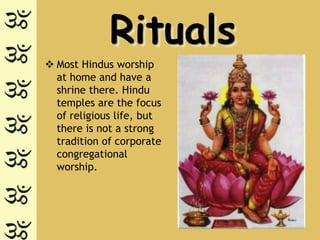
Rituals
 Most Hindus worship
  at home and have a
  shrine there. Hindu
  temples are the focus
  of religious life, but
  there is not a strong
  tradition of corporate
  congregational
  worship.
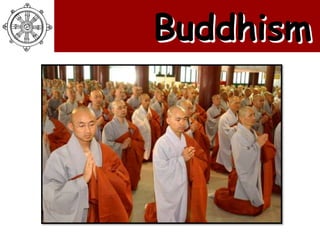
Buddhism
Origins
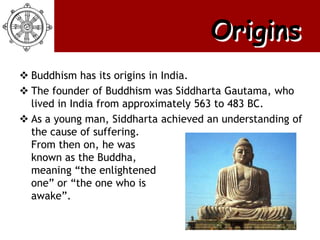
 Buddhism has its origins in India.
 The founder of Buddhism was Siddharta Gautama, who
  lived in India from approximately 563 to 483 BC.
 As a young man, Siddharta achieved an understanding of
  the cause of suffering.
  From then on, he was
  known as the Buddha,
  meaning ―the enlightened
  one‖ or ―the one who is
  awake‖.
God

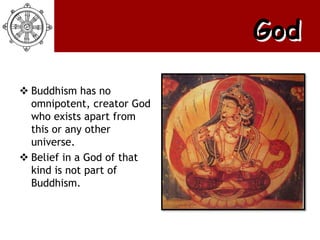
 Buddhism has no
  omnipotent, creator God
  who exists apart from
  this or any other
  universe.
 Belief in a God of that
  kind is not part of
  Buddhism.
Basic Beliefs
 In his sermons, Siddharta taught the four main ideas
  that he had understood in his enlightenment. He calles
  those ideas the four noble truths.
   • First – Everything in life is suffering and sorrow.
   • Second – The cause of all suffering is people’s selfish desire for
     the temporary pleasures of this world.
   • Third – The way to end all suffering is to end all desires.
   • Fourth – The way to overcome such desires and attain
     enlightenment is to follow the Noble Eightfold Path, which is
     called the Middle Way between desires and self-denial.
     Following this path could lead to nirvana, release from
     selfishness and pain.
Dukkha
 All existence is dukkha; without permanence and
  therefore filled with suffering. This comes from a
  search to find something permanent in a world where
  nothing permanently exists.
 Life is a continuing process of birth and death, but the
  soul remains. The form in which one is reborn, animal
  or human, in heaven or in hell, depends on karma-
  impersonal ethical law.
 One can escape from this process by attaining nirvana
  or enlightenment.
 Enlightenment can be reached by following the
  Eightfold Path.
The Eightfold
                             Path
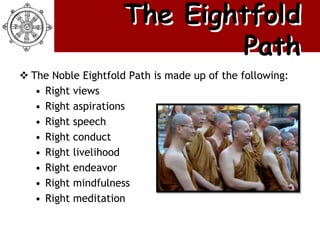
 The Noble Eightfold Path is made up of the following:
   • Right views
   • Right aspirations
   • Right speech
   • Right conduct
   • Right livelihood
   • Right endeavor
   • Right mindfulness
   • Right meditation
Sacred Texts
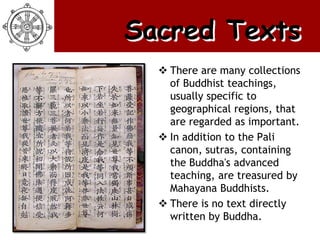
   There are many collections
    of Buddhist teachings,
    usually specific to
    geographical regions, that
    are regarded as important.
   In addition to the Pali
    canon, sutras, containing
    the Buddha's advanced
    teaching, are treasured by
    Mahayana Buddhists.
   There is no text directly
    written by Buddha.
Worship
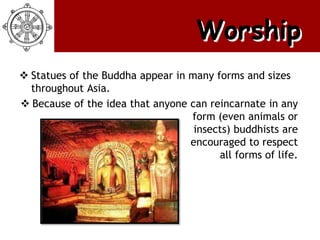
 Statues of the Buddha appear in many forms and sizes
  throughout Asia.
 Because of the idea that anyone can reincarnate in any
                                  form (even animals or
                                   insects) buddhists are
                                  encouraged to respect
                                        all forms of life.
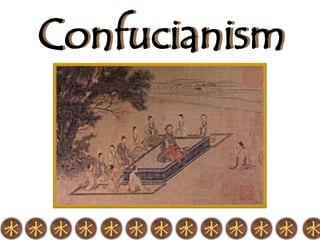
Confucianism
Origins
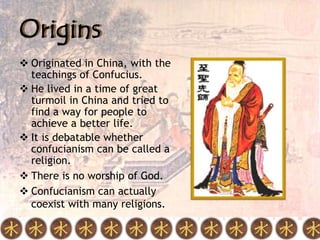
 Originated in China, with the
  teachings of Confucius.
 He lived in a time of great
  turmoil in China and tried to
  find a way for people to
  achieve a better life.
 It is debatable whether
  confucianism can be called a
  religion.
 There is no worship of God.
 Confucianism can actually
  coexist with many religions.
Basic Beliefs
 Cultivation of virtue is a central tenet of
  Confucianism.
    Lǐ — ritual. This originally meant "to sacrifice." This refers
     to proper behavior and following rituals.
    Xiào — filial piety, This was considered among the greatest
     of virtues, and had to be shown towards both the living and
     the dead.
    Zhōng — loyalty. Refering to the relationship between ruler
     and minister.
    Rén — humaneness. the Confucian version of the Golden
     Rule, which is phrased in the negative: "Do not do to others
     what you would not like them to do to you."
    Jūnzǐ — the perfect gentleman. Those who cultivate
     themselves morally and follow all proscriptions.
Social Order
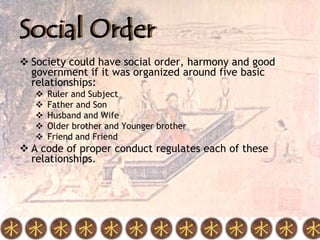
 Society could have social order, harmony and good
  government if it was organized around five basic
  relationships:
      Ruler and Subject
      Father and Son
      Husband and Wife
      Older brother and Younger brother
      Friend and Friend
 A code of proper conduct regulates each of these
  relationships.
Sacred Texts
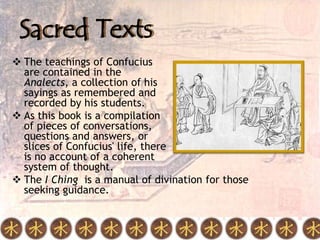
 The teachings of Confucius
  are contained in the
  Analects, a collection of his
  sayings as remembered and
  recorded by his students.
 As this book is a compilation
  of pieces of conversations,
  questions and answers, or
  slices of Confucius' life, there
  is no account of a coherent
  system of thought.
 The I Ching is a manual of divination for those
  seeking guidance.
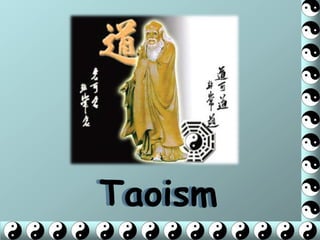
Taoism
Origins
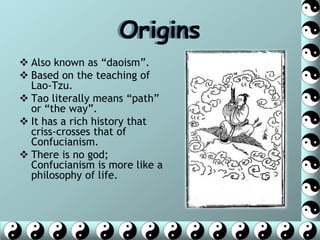
 Also known as ―daoism‖.
 Based on the teaching of
  Lao-Tzu.
 Tao literally means ―path‖
  or ―the way‖.
 It has a rich history that
  criss-crosses that of
  Confucianism.
 There is no god;
  Confucianism is more like a
  philosophy of life.
Basic Beliefs
 The individual should seek the truth by means of a
  patient, accepting focus on natural patterns.
    Practices like feng shui are designed to work with those natural
     patterns.
 Rejects Confucian emphasis on social hierarchy.
 Emphasizes spontaneity and self-reliance. Rejects
  calculated, goal-oriented efforts.
 Refrains from trying to influence political or social
  institutions.
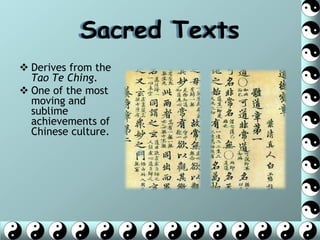
Sacred Texts
 Derives from the
  Tao Te Ching.
 One of the most
  moving and
  sublime
  achievements of
  Chinese culture.
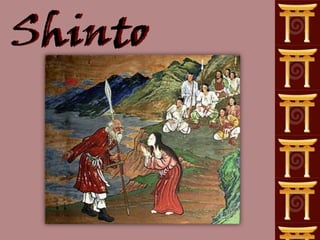
Shinto
Origins
 Indigenous, nature focused religion of Japan
  that incorporates ancient mythological rites.
 The Emperor of Japan is regarded as a direct
  descendant of Amaterasu (God).
 Shinto is completely assimilated into Japanese
  day-to-day tradition and customs.
 It has no founder.
 Nature worhips; with reverence of nature
  spirits.
    Kami – something possesing a power that an
     individual believer does not have.
Basic Beliefs
 Emphasized harmony of natural beauty and a
  poetic appreciation of reality.
 Natural events are considered to be
  manifestations of heavenly energy within
  Shinto.
 Core beliefs:
    Affirmation of family and tradition.
    Affirmation of reverence toward nature.
    Affirmation of physical cleanliness.
    Affirmation of matsuri, or festivals held in honor of
     one or more kami.
Sacred Texts
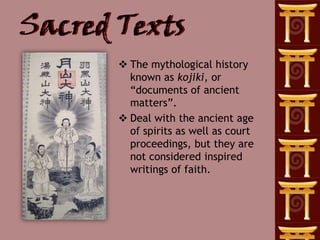
        The mythological history
         known as kojiki, or
         ―documents of ancient
         matters‖.
        Deal with the ancient age
         of spirits as well as court
         proceedings, but they are
         not considered inspired
         writings of faith.

Asian Religions

  • 1.
  • 2.
  • 3.
  • 4.
  • 5.
    Origins  Islam originatedin the Middle East. It builds up on Jewish and Christian traditions.  The word Islam means both ―peace‖ and ―submission‖.  Its followers are called Muslims, or ―one who submits to the will of God‖.  Mohammed received the revelation throughout 23 years, dictated by the archangel Gabriel. He started preaching and Islam became a political as well as religious movement.
  • 6.
    God  Islam believesin one god: Allah.  It is the same god of Jews and Christians.  Muhammed believed he was restoring the faith of Abraham, which Jews and Christians had strayed from.
  • 7.
    After Muhammed  Themen who followed after Muhammed and saw the expansion of his empire were called Caliphs.  Several dinasties then ruled the Islamic Empire.  The Muslim faith was divided into several sects:  Sunni – orthodox theology; dominant force within Islam.  Shi’a – heavy emphasis on the individual role of clerics; the supreme leader is called Imam.  Sufi – the mystics of Islam; seek union with God through contemplation.
  • 8.
    Basic Beliefs  Allevents in life (both good and bad) are seen as a trial from Allah for the life to come.  They believe in a reckoning with Allah, for the choices and actions undertaken in a single human life.  On the Day of Judgment, Allah will decide whether individuals will go to Paraside or Hell.  Devout Christians and Jews can attain paradise as well.  Death is not because of our sins (original sin), but simply a reality that brings us back to our Creator.  Muslims must follow the example of the Prophet.
  • 9.
    The Five Pillars Shahadah  ―There is no God but God and Muhammed is His prophet‖  La ilaha ila Alah, Mohammed rasul Alah  Salat  Five daily prayers facing the Mecca  Zakat  Charity towards those in need  Ramadan  Fasting on the ninth month of the Muslim calendar  Hajj  Pilgrimage to the Mecca
  • 10.
    Sacred Texts  Islamteaches social and personal codes or conduct through:  Qur’an: the holy book  Sharia’ah: the Law  Sunnah: the prophet’s sayings
  • 11.
    The Qur’an  Dictatedto Muhammed by the archangel Gabriel:  Originally it was a verbal message, memorized and recited by the prophet and his followers.  Today, it is written in Arabic.  This means all Muslims must learn Arabic in order to read the Qur’an.  It consists of 114 chapters, each divided into surahs.  Doctrinal messages  Historical accounts  ―Mystical expressions of sublime beauty‖
  • 12.
    Misconceptions about Islam  Muslim[does not] equal Arab.  ―Sword of Islam‖ forcibly [did not] impose Islam on cultures conquered by the Muslim Empire.  Jihad, [not] meaning all Muslims must engage in a holy war against those who do not accept Islam.  Jiahd means ―struggle‖ against the self first and foremost.  Islam [does not] degrade and oppress women.  The Qur’an [does not] advocate the slaughter of unbelievers or suicide attackers fighting for Islam.
  • 13.
  • 14.
    Origins  Hinduism isthe name given to a family of religions and cultures that began and still flourish in India.  The word "Hindu" comes from the name of the river Indus, which flows 1800 miles from Tibet through Kashmir and Pakistan to the sea.  Hinduism has no founder, no creed, and no single source of authority.
  • 15.
    God  Belief ina single Divinity or supreme God that is present in everything.  Each soul is individual and also part of that Divinity.  Belief in other gods who are aspects of that supreme Divinity.  Major Gods: • Brama the creator • Vishnu the preserver • Shiva the detroyer
  • 16.
    Basic Beliefs  Formany Hindus, religion is a matter of practice rather than of beliefs. It's more what you do than what you believe.  Belief that every soul is trapped in a cycle of birth and then death and then rebirth. Their ultimate aim is escape from the cycle altogether.  This life, and this world, are only part of a training process.  Hindus believe the universe doesn't have a beginning and an end. It's a cyclical pattern, so once it ends, it begins again.
  • 17.
    Basic Beliefs  Thereare 4 legitimate goals in life (purusharthas): • dharma (appropriate living), • artha (the pursuit of material gain by lawful means), • kama (delight of the senses), • moksha (release from rebirth).  Each Hindu has 4 daily duties: • Revere the deities • Respect ancestors • Respect all beings • Honour all humankind
  • 18.
    Samsara  The qualityof the next life depends on the soul's Karma-the goodness or badness of their deeds in this life.  The eternal cycle of birth and rebirth is called Samsara. The process of the soul being reborn into a new body is called Reincarnation.  Whether one is reborn into a better life, a worse life, or even to live as an animal, depends on Karma, which is the value of a soul's good and bad deeds.  The ultimate aim of Hindus is liberation.
  • 19.
    Sacred Texts  Hinduism doesn't have a single scripture that is regarded as uniquely authoritative.  Vedas – sacred hymns said to have existed forever.  Upanishads – mystical words  Brahmans – ritual instructions  Baghavad-Gita – sets out in story form the proper way to behave and think. Four paths to liberation: • Throuh knowledge • Through love • Through work • Through experimentation
  • 20.
    Rituals  Most Hindusworship at home and have a shrine there. Hindu temples are the focus of religious life, but there is not a strong tradition of corporate congregational worship.
  • 21.
  • 22.
    Origins  Buddhism hasits origins in India.  The founder of Buddhism was Siddharta Gautama, who lived in India from approximately 563 to 483 BC.  As a young man, Siddharta achieved an understanding of the cause of suffering. From then on, he was known as the Buddha, meaning ―the enlightened one‖ or ―the one who is awake‖.
  • 23.
    God  Buddhism hasno omnipotent, creator God who exists apart from this or any other universe.  Belief in a God of that kind is not part of Buddhism.
  • 24.
    Basic Beliefs  Inhis sermons, Siddharta taught the four main ideas that he had understood in his enlightenment. He calles those ideas the four noble truths. • First – Everything in life is suffering and sorrow. • Second – The cause of all suffering is people’s selfish desire for the temporary pleasures of this world. • Third – The way to end all suffering is to end all desires. • Fourth – The way to overcome such desires and attain enlightenment is to follow the Noble Eightfold Path, which is called the Middle Way between desires and self-denial. Following this path could lead to nirvana, release from selfishness and pain.
  • 25.
    Dukkha  All existenceis dukkha; without permanence and therefore filled with suffering. This comes from a search to find something permanent in a world where nothing permanently exists.  Life is a continuing process of birth and death, but the soul remains. The form in which one is reborn, animal or human, in heaven or in hell, depends on karma- impersonal ethical law.  One can escape from this process by attaining nirvana or enlightenment.  Enlightenment can be reached by following the Eightfold Path.
  • 26.
    The Eightfold Path  The Noble Eightfold Path is made up of the following: • Right views • Right aspirations • Right speech • Right conduct • Right livelihood • Right endeavor • Right mindfulness • Right meditation
  • 27.
    Sacred Texts  There are many collections of Buddhist teachings, usually specific to geographical regions, that are regarded as important.  In addition to the Pali canon, sutras, containing the Buddha's advanced teaching, are treasured by Mahayana Buddhists.  There is no text directly written by Buddha.
  • 28.
    Worship  Statues ofthe Buddha appear in many forms and sizes throughout Asia.  Because of the idea that anyone can reincarnate in any form (even animals or insects) buddhists are encouraged to respect all forms of life.
  • 29.
  • 30.
    Origins  Originated inChina, with the teachings of Confucius.  He lived in a time of great turmoil in China and tried to find a way for people to achieve a better life.  It is debatable whether confucianism can be called a religion.  There is no worship of God.  Confucianism can actually coexist with many religions.
  • 31.
    Basic Beliefs  Cultivationof virtue is a central tenet of Confucianism.  Lǐ — ritual. This originally meant "to sacrifice." This refers to proper behavior and following rituals.  Xiào — filial piety, This was considered among the greatest of virtues, and had to be shown towards both the living and the dead.  Zhōng — loyalty. Refering to the relationship between ruler and minister.  Rén — humaneness. the Confucian version of the Golden Rule, which is phrased in the negative: "Do not do to others what you would not like them to do to you."  Jūnzǐ — the perfect gentleman. Those who cultivate themselves morally and follow all proscriptions.
  • 32.
    Social Order  Societycould have social order, harmony and good government if it was organized around five basic relationships:  Ruler and Subject  Father and Son  Husband and Wife  Older brother and Younger brother  Friend and Friend  A code of proper conduct regulates each of these relationships.
  • 33.
    Sacred Texts  Theteachings of Confucius are contained in the Analects, a collection of his sayings as remembered and recorded by his students.  As this book is a compilation of pieces of conversations, questions and answers, or slices of Confucius' life, there is no account of a coherent system of thought.  The I Ching is a manual of divination for those seeking guidance.
  • 34.
  • 35.
    Origins  Also knownas ―daoism‖.  Based on the teaching of Lao-Tzu.  Tao literally means ―path‖ or ―the way‖.  It has a rich history that criss-crosses that of Confucianism.  There is no god; Confucianism is more like a philosophy of life.
  • 36.
    Basic Beliefs  Theindividual should seek the truth by means of a patient, accepting focus on natural patterns.  Practices like feng shui are designed to work with those natural patterns.  Rejects Confucian emphasis on social hierarchy.  Emphasizes spontaneity and self-reliance. Rejects calculated, goal-oriented efforts.  Refrains from trying to influence political or social institutions.
  • 37.
    Sacred Texts  Derivesfrom the Tao Te Ching.  One of the most moving and sublime achievements of Chinese culture.
  • 38.
  • 39.
    Origins  Indigenous, naturefocused religion of Japan that incorporates ancient mythological rites.  The Emperor of Japan is regarded as a direct descendant of Amaterasu (God).  Shinto is completely assimilated into Japanese day-to-day tradition and customs.  It has no founder.  Nature worhips; with reverence of nature spirits.  Kami – something possesing a power that an individual believer does not have.
  • 40.
    Basic Beliefs  Emphasizedharmony of natural beauty and a poetic appreciation of reality.  Natural events are considered to be manifestations of heavenly energy within Shinto.  Core beliefs:  Affirmation of family and tradition.  Affirmation of reverence toward nature.  Affirmation of physical cleanliness.  Affirmation of matsuri, or festivals held in honor of one or more kami.
  • 41.
    Sacred Texts  The mythological history known as kojiki, or ―documents of ancient matters‖.  Deal with the ancient age of spirits as well as court proceedings, but they are not considered inspired writings of faith.

Editor's Notes

  • #2 Source:Toropov, Brandon and FatherLukeBuckles. The Complete Idiot’s Guide toWorldReligions. ThirdEdition. Alpha: UnitedStates, 2004.
  • #3 Source:“Map of worldreligions.” Mapsorama.com. 21 october 2009 <http://www.mapsorama.com/map-of-world-religions/>.