DRONE
TECHNOLOGY
CONTENTS
1. WHAT IS DRONE ?
2. TYPES OF DRONE
3. MULTI ROTOR DRONES
4. FIXED WING DRONES
5. SINGLE ROTOR DRONES
6. FIXED WING HYBRIDVTOL
7. ADVANTAGES OF DRONE
8. DISADVANTAGE OF
DRONE
9. TIMELINE OF DRONE
WHAT IS DRONE?
• A drone is an unmanned aircraft. Drones are more formally
known as unmanned aerial vehicles (UAVs) or unmanned aircraft
systems. Essentially, a drone is a flying robot that can be
remotely controlled or fly autonomously using software-
controlled flight plans in its embedded systems, that work in
conjunction with onboard sensors and a global positioning
system (GPS).
TYPES OF DRONES
Here’s a rundown of the four main types of
drones, their uses, their strengths and
weaknesses:
1.Multi-Rotor Drones
2.Fixed-Wing Drones
3.Single-Rotor Drones
4.Fixed-Wing Hybrid VTOL
Multi-Rotor Drones
Multi-rotor drones are the easiest and cheapest option for getting an ‘eye in
the sky.’ They also offer greater control over position and framing, and
hence they are perfect for aerial photography and surveillance. They are
called multi-rotor because they have more than one motor, more commonly
tricopters (3 rotors), quadcopters (4 rotors), hexacopters (6 rotors) and
octocopters (8 rotors), among others. By far, quadcopters are the most
popular multi-rotor drones.
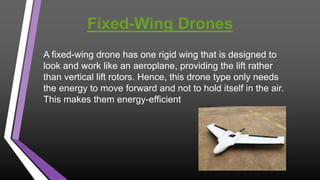
Fixed-Wing Drones
A fixed-wing drone has one rigid wing that is designed to
look and work like an aeroplane, providing the lift rather
than vertical lift rotors. Hence, this drone type only needs
the energy to move forward and not to hold itself in the air.
This makes them energy-efficient.
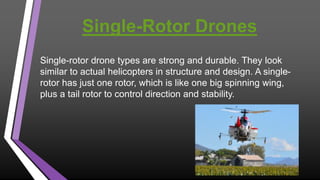
Single-Rotor Drones
Single-rotor drone types are strong and durable. They look
similar to actual helicopters in structure and design. A single-
rotor has just one rotor, which is like one big spinning wing,
plus a tail rotor to control direction and stability.
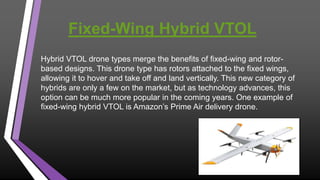
Fixed-Wing Hybrid VTOL
Hybrid VTOL drone types merge the benefits of fixed-wing and rotor-
based designs. This drone type has rotors attached to the fixed wings,
allowing it to hover and take off and land vertically. This new category of
hybrids are only a few on the market, but as technology advances, this
option can be much more popular in the coming years. One example of
fixed-wing hybrid VTOL is Amazon’s Prime Air delivery drone.
Advantages of Drones
UAVs were most often associated with the military. They were initially used for anti-
aircraft target practice, intelligence gathering and, more controversially, as weapons
platforms. Drones are now also used in a range of civilian roles, including the
following:
•search and rescue
•surveillance
•traffic monitoring
•weather monitoring
•firefighting
•personal use
•drone-based photography
•videography
•agriculture
•delivery services
Disadvantages of Drones
After several years of practice using drones, a list of typical hazards accompanying their use
can be formed:
•Short flight time
•Statistics of the dangerous or criminal use of drones
•They are easily affected by the weather
•Drone collisions with people. Risk of injury
•Flights over areas where flights are prohibited or inappropriate
•Dangerous proximity to aircraft, including helicopters, etc.
•Collisions with buildings, structures, monuments
•The use of drones for the transport of criminal goods, primarily drugs
•Voyeurism
•Hooliganism, terrorist acts
•The use of commercial drones for military purposes
•The dangers of using data collected by commercial UAVs
TIMELINE OF DRONES
Drones History Timeline
Historical Timeline of UAV Technology
•1783 –The FirstUAV. ...
•1849 –The First Military Use of UAVs. ...
•1858 – First Aerial Photograph. ...
•1896 – First Camera on a UAV. ...
•1898 –The First Radio-Controlled Craft. ...
•1915 – BritishUse of Aerial Reconnaissance Photos. ...
•1917 – First UAVTorpedo the Kettering Bug.
•1935 –The First Modern Drone is Developed
•1936 – US Drone Program Begins
•1937 – U.S. Navy Develops a Radio-Controlled UAVTorpedo
•1941 – Actor Reginald Denny invents the Radio Plane
•1943 –The Beginnings of First-PersonView (FPV) Flight
•1973 – Israel Develops UAVs for Surveillance and Scouting
•1982 – Battlefield UAVs
•2014 – Use of Drones Rapidly Grows in Industry and with Consumers
•2020 – Pandemic Alleviation

DRONE TECHNOLOGY.pptx

  • 1.
  • 2.
    CONTENTS 1. WHAT ISDRONE ? 2. TYPES OF DRONE 3. MULTI ROTOR DRONES 4. FIXED WING DRONES 5. SINGLE ROTOR DRONES 6. FIXED WING HYBRIDVTOL 7. ADVANTAGES OF DRONE 8. DISADVANTAGE OF DRONE 9. TIMELINE OF DRONE
  • 3.
    WHAT IS DRONE? •A drone is an unmanned aircraft. Drones are more formally known as unmanned aerial vehicles (UAVs) or unmanned aircraft systems. Essentially, a drone is a flying robot that can be remotely controlled or fly autonomously using software- controlled flight plans in its embedded systems, that work in conjunction with onboard sensors and a global positioning system (GPS).
  • 4.
    TYPES OF DRONES Here’sa rundown of the four main types of drones, their uses, their strengths and weaknesses: 1.Multi-Rotor Drones 2.Fixed-Wing Drones 3.Single-Rotor Drones 4.Fixed-Wing Hybrid VTOL
  • 5.
    Multi-Rotor Drones Multi-rotor dronesare the easiest and cheapest option for getting an ‘eye in the sky.’ They also offer greater control over position and framing, and hence they are perfect for aerial photography and surveillance. They are called multi-rotor because they have more than one motor, more commonly tricopters (3 rotors), quadcopters (4 rotors), hexacopters (6 rotors) and octocopters (8 rotors), among others. By far, quadcopters are the most popular multi-rotor drones.
  • 6.
    Fixed-Wing Drones A fixed-wingdrone has one rigid wing that is designed to look and work like an aeroplane, providing the lift rather than vertical lift rotors. Hence, this drone type only needs the energy to move forward and not to hold itself in the air. This makes them energy-efficient.
  • 7.
    Single-Rotor Drones Single-rotor dronetypes are strong and durable. They look similar to actual helicopters in structure and design. A single- rotor has just one rotor, which is like one big spinning wing, plus a tail rotor to control direction and stability.
  • 8.
    Fixed-Wing Hybrid VTOL HybridVTOL drone types merge the benefits of fixed-wing and rotor- based designs. This drone type has rotors attached to the fixed wings, allowing it to hover and take off and land vertically. This new category of hybrids are only a few on the market, but as technology advances, this option can be much more popular in the coming years. One example of fixed-wing hybrid VTOL is Amazon’s Prime Air delivery drone.
  • 9.
    Advantages of Drones UAVswere most often associated with the military. They were initially used for anti- aircraft target practice, intelligence gathering and, more controversially, as weapons platforms. Drones are now also used in a range of civilian roles, including the following: •search and rescue •surveillance •traffic monitoring •weather monitoring •firefighting •personal use •drone-based photography •videography •agriculture •delivery services
  • 10.
    Disadvantages of Drones Afterseveral years of practice using drones, a list of typical hazards accompanying their use can be formed: •Short flight time •Statistics of the dangerous or criminal use of drones •They are easily affected by the weather •Drone collisions with people. Risk of injury •Flights over areas where flights are prohibited or inappropriate •Dangerous proximity to aircraft, including helicopters, etc. •Collisions with buildings, structures, monuments •The use of drones for the transport of criminal goods, primarily drugs •Voyeurism •Hooliganism, terrorist acts •The use of commercial drones for military purposes •The dangers of using data collected by commercial UAVs
  • 11.
    TIMELINE OF DRONES DronesHistory Timeline Historical Timeline of UAV Technology •1783 –The FirstUAV. ... •1849 –The First Military Use of UAVs. ... •1858 – First Aerial Photograph. ... •1896 – First Camera on a UAV. ... •1898 –The First Radio-Controlled Craft. ... •1915 – BritishUse of Aerial Reconnaissance Photos. ... •1917 – First UAVTorpedo the Kettering Bug. •1935 –The First Modern Drone is Developed •1936 – US Drone Program Begins •1937 – U.S. Navy Develops a Radio-Controlled UAVTorpedo •1941 – Actor Reginald Denny invents the Radio Plane •1943 –The Beginnings of First-PersonView (FPV) Flight •1973 – Israel Develops UAVs for Surveillance and Scouting •1982 – Battlefield UAVs •2014 – Use of Drones Rapidly Grows in Industry and with Consumers •2020 – Pandemic Alleviation