PRESENT
TENSES
PRESENT
SIMPLE
AFFIRMATIVE
I play
You play
He plays
She plays
It plays
We play
You play
They play
I go
You go
He goes
She goes
It goes
We go
You go
They go
PRESENT SIMPLE
I study
You study
He studies
She studies
It studies
We study
You study
They study
AFFIRMATIVE
Spelling
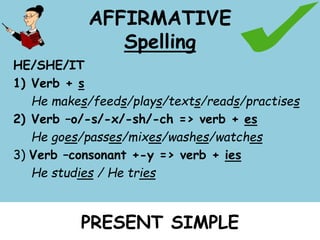
HE/SHE/IT
1) Verb + s
He makes/feeds/plays/texts/reads/practises
2) Verb –o/-s/-x/-sh/-ch => verb + es
He goes/passes/mixes/washes/watches
3) Verb –consonant +-y => verb + ies
He studies / He tries
PRESENT SIMPLE
NEGATIVE
I don’t play
You don’t play
He doesn’t play
She doesn’t play
It doesn’t play
We don’t play
You don’t play
They don’t play
PRESENT SIMPLE
INTERROGATIVE
Do I play?
Do you play?
Does he play?
Does she play?
Does it play?
Do we play?
Do you play?
Do they play?
PRESENT SIMPLE
SHORT ANWERS
Yes, I do.
Yes, you do.
Yes, he does.
Yes, she does.
Yes, it does.
Yes, we do.
Yes, you do.
Yes, they do.
No, I don’t.
No, you don’t.
No, he doesn’t.
No, she doesn’t.
No, it doesn’t.
No, we don’t.
No, you don’t.
No, they don’t.
PRESENT SIMPLE
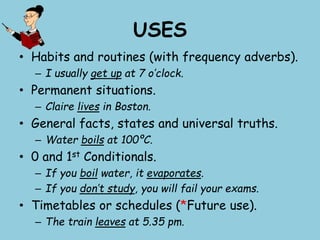
USES
• Habits and routines (with frequency adverbs).
– I usually get up at 7 o’clock.
• Permanent situations.
– Claire lives in Boston.
• General facts, states and universal truths.
– Water boils at 100ºC.
• 0 and 1st Conditionals.
– If you boil water, it evaporates.
– If you don’t study, you will fail your exams.
• Timetables or schedules (*Future use).
– The train leaves at 5.35 pm.
TIME EXPRESSIONS
• Every day/month, once/twice/three
times… a week/month…, always, usually,
often, sometimes, hardly ever, never, on
Mondays/Tuesdays…, at the weekend, etc.
PRESENT
CONTINUOUS
AFFIRMATIVE
I am playing
You are playing
He is playing
She is playing
It is playing
We are playing
You are playing
They are playing
PRESENT CONTINUOUS
I‘m playing
You‘re playing
He‘s playing
She‘s playing
It‘s playing
We‘re playing
You‘re playing
They re playing
NEGATIVE
I am not playing
You are not playing
He is not playing
She is not playing
It is not playing
We are not playing
You are not playing
They are not playing
PRESENT CONTINUOUS
I‘m not playing
You aren’t playing
He isn’t playing
She isn’t playing
It isn’t playing
We aren’t playing
You aren’t playing
They aren’t playing
INTERROGATIVE
Am I playing?
Are you playing?
Is he playing?
Is she playing?
Is it playing?
Are we playing?
Are you playing?
Are they playing?
PRESENT CONTINUOUS
SHORT ANWERS
Yes, I am.
Yes, you are.
Yes, he is.
Yes, she is.
Yes, it is.
Yes, we are.
Yes, you are.
Yes, they are.
No, I’m not.
No, you aren’t.
No, he isn’t.
No, she isn’t.
No, it isn’t.
No, we aren’t.
No, you aren’t.
No, they aren’t.
PRESENT CONTINUOUS
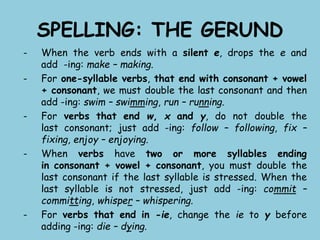
SPELLING: THE GERUND
- When the verb ends with a silent e, drops the e and
add -ing: make – making.
- For one-syllable verbs, that end with consonant + vowel
+ consonant, we must double the last consonant and then
add -ing: swim – swimming, run – running.
- For verbs that end w, x and y, do not double the
last consonant; just add -ing: follow – following, fix –
fixing, enjoy – enjoying.
- When verbs have two or more syllables ending
in consonant + vowel + consonant, you must double the
last consonant if the last syllable is stressed. When the
last syllable is not stressed, just add -ing: commit –
committing, whisper – whispering.
- For verbs that end in -ie, change the ie to y before
adding -ing: die – dying.
USES
• Actions happening at or around the
moment of speaking.
– You are listening to me right now.
– I’m reading a book about Frida Kahlo.
• Temporary situations
– My mum is working in the evening this week.
• For complaints about something that
happens frequently.
– My neighbours are always arguing.
• Fixed arrangements (*Future use).
– I’m seeing my dentist at 11.20 tomorrow morning.
TIME EXPRESSIONS
• Now, at the moment, at present, nowadays,
today, still, always* (for complaints or
emphasis).
PRESENT
PERFECT
SIMPLE
AFFIRMATIVE
I have played
You have played
He has played
She has played
It has played
We have played
You have played
They have played
PRESENT PERFECT SIMPLE
I‘ve played
You‘ve played
He‘s played
She‘s played
It‘s played
We‘ve played
You’ve played
They‘ve played
NEGATIVE
I have not played
You have not played
He has not played
She has not played
It has not played
We have not played
You have not played
They have not played
PRESENT PERFECT SIMPLE
I haven’t played
You haven’t played
He hasn’t played
She hasn’t played
It hasn’t played
We haven’t played
You haven’t played
They haven’t played
INTERROGATIVE
Have I played?
Have you played?
Has he played?
Has she played?
Has it played?
Have we played?
Have you played?
Have they played?
PRESENT PERFECT SIMPLE
SHORT ANWERS
Yes, I have.
Yes, you have.
Yes, he has.
Yes, she has.
Yes, it has.
Yes, we have.
Yes, you have.
Yes, they have.
No, I haven’t.
No, you haven’t.
No, he hasn’t.
No, she hasn’t.
No, it hasn’t.
No, we haven’t.
No, you haven’t.
No, they haven’t.
PRESENT PERFECT SIMPLE
USES
• Recently completed actions.
– Peter has just arrived.
• Past actions connected with the present.
– Susan has lived in Leeds for 10 years.
• Finished actions with a present result.
– My mum has made 3 pizzas so far today.
• Life or personal experiences (emphasis on
number).
– Caroline has been to Argentina twice.
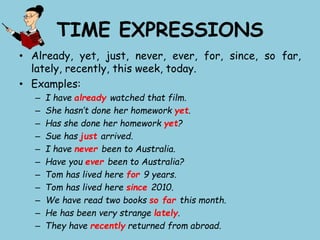
TIME EXPRESSIONS
• Already, yet, just, never, ever, for, since, so far,
lately, recently, this week, today.
• Examples:
– I have already watched that film.
– She hasn’t done her homework yet.
– Has she done her homework yet?
– Sue has just arrived.
– I have never been to Australia.
– Have you ever been to Australia?
– Tom has lived here for 9 years.
– Tom has lived here since 2010.
– We have read two books so far this month.
– He has been very strange lately.
– They have recently returned from abroad.
PRESENT
PERFECT
CONTINUOUS
AFFIRMATIVE
I have been playing
You have been playing
He has been playing
She has been playing
It has been playing
We have been playing
You have been playing
They have been playing
PRESENT PERFECT CONTINUOUS
NEGATIVE
I haven’t been playing
You haven’t been playing
He hasn’t been playing
She hasn’t been playing
It hasn’t been playing
We haven’t been playing
You haven’t been playing
They haven’t been playing
PRESENT PERFECT CONTINUOUS
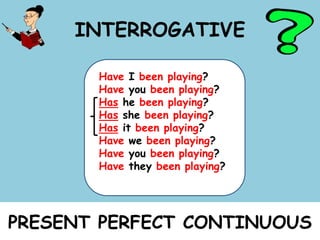
INTERROGATIVE
Have I been playing?
Have you been playing?
Has he been playing?
Has she been playing?
Has it been playing?
Have we been playing?
Have you been playing?
Have they been playing?
PRESENT PERFECT CONTINUOUS
SHORT ANWERS
Yes, I have.
Yes, you have.
Yes, he has.
Yes, she has.
Yes, it has.
Yes, we have.
Yes, you have.
Yes, they have.
No, I haven’t.
No, you haven’t.
No, he hasn’t.
No, she hasn’t.
No, it hasn’t.
No, we haven’t.
No, you haven’t.
No, they haven’t.
PRESENT PERFECT CONTINUOUS
USES
• Recent past actions with present results.
– He has been running the whole day and he is
exhausted now.
• Actions that started in the past and continue
up to the present.
– He has been working in this company for six
months.
• Emphasis on the duration of the action.
– I have been waiting for you for half an hour.
TIME EXPRESSIONS
• How long?, for, since, all day long, the
whole day.
Prsent tenses

Prsent tenses

  • 1.
  • 2.
  • 3.
    AFFIRMATIVE I play You play Heplays She plays It plays We play You play They play I go You go He goes She goes It goes We go You go They go PRESENT SIMPLE I study You study He studies She studies It studies We study You study They study
  • 4.
    AFFIRMATIVE Spelling HE/SHE/IT 1) Verb +s He makes/feeds/plays/texts/reads/practises 2) Verb –o/-s/-x/-sh/-ch => verb + es He goes/passes/mixes/washes/watches 3) Verb –consonant +-y => verb + ies He studies / He tries PRESENT SIMPLE
  • 5.
    NEGATIVE I don’t play Youdon’t play He doesn’t play She doesn’t play It doesn’t play We don’t play You don’t play They don’t play PRESENT SIMPLE
  • 6.
    INTERROGATIVE Do I play? Doyou play? Does he play? Does she play? Does it play? Do we play? Do you play? Do they play? PRESENT SIMPLE
  • 7.
    SHORT ANWERS Yes, Ido. Yes, you do. Yes, he does. Yes, she does. Yes, it does. Yes, we do. Yes, you do. Yes, they do. No, I don’t. No, you don’t. No, he doesn’t. No, she doesn’t. No, it doesn’t. No, we don’t. No, you don’t. No, they don’t. PRESENT SIMPLE
  • 8.
    USES • Habits androutines (with frequency adverbs). – I usually get up at 7 o’clock. • Permanent situations. – Claire lives in Boston. • General facts, states and universal truths. – Water boils at 100ºC. • 0 and 1st Conditionals. – If you boil water, it evaporates. – If you don’t study, you will fail your exams. • Timetables or schedules (*Future use). – The train leaves at 5.35 pm.
  • 9.
    TIME EXPRESSIONS • Everyday/month, once/twice/three times… a week/month…, always, usually, often, sometimes, hardly ever, never, on Mondays/Tuesdays…, at the weekend, etc.
  • 10.
  • 11.
    AFFIRMATIVE I am playing Youare playing He is playing She is playing It is playing We are playing You are playing They are playing PRESENT CONTINUOUS I‘m playing You‘re playing He‘s playing She‘s playing It‘s playing We‘re playing You‘re playing They re playing
  • 12.
    NEGATIVE I am notplaying You are not playing He is not playing She is not playing It is not playing We are not playing You are not playing They are not playing PRESENT CONTINUOUS I‘m not playing You aren’t playing He isn’t playing She isn’t playing It isn’t playing We aren’t playing You aren’t playing They aren’t playing
  • 13.
    INTERROGATIVE Am I playing? Areyou playing? Is he playing? Is she playing? Is it playing? Are we playing? Are you playing? Are they playing? PRESENT CONTINUOUS
  • 14.
    SHORT ANWERS Yes, Iam. Yes, you are. Yes, he is. Yes, she is. Yes, it is. Yes, we are. Yes, you are. Yes, they are. No, I’m not. No, you aren’t. No, he isn’t. No, she isn’t. No, it isn’t. No, we aren’t. No, you aren’t. No, they aren’t. PRESENT CONTINUOUS
  • 15.
    SPELLING: THE GERUND -When the verb ends with a silent e, drops the e and add -ing: make – making. - For one-syllable verbs, that end with consonant + vowel + consonant, we must double the last consonant and then add -ing: swim – swimming, run – running. - For verbs that end w, x and y, do not double the last consonant; just add -ing: follow – following, fix – fixing, enjoy – enjoying. - When verbs have two or more syllables ending in consonant + vowel + consonant, you must double the last consonant if the last syllable is stressed. When the last syllable is not stressed, just add -ing: commit – committing, whisper – whispering. - For verbs that end in -ie, change the ie to y before adding -ing: die – dying.
  • 16.
    USES • Actions happeningat or around the moment of speaking. – You are listening to me right now. – I’m reading a book about Frida Kahlo. • Temporary situations – My mum is working in the evening this week. • For complaints about something that happens frequently. – My neighbours are always arguing. • Fixed arrangements (*Future use). – I’m seeing my dentist at 11.20 tomorrow morning.
  • 17.
    TIME EXPRESSIONS • Now,at the moment, at present, nowadays, today, still, always* (for complaints or emphasis).
  • 18.
  • 19.
    AFFIRMATIVE I have played Youhave played He has played She has played It has played We have played You have played They have played PRESENT PERFECT SIMPLE I‘ve played You‘ve played He‘s played She‘s played It‘s played We‘ve played You’ve played They‘ve played
  • 20.
    NEGATIVE I have notplayed You have not played He has not played She has not played It has not played We have not played You have not played They have not played PRESENT PERFECT SIMPLE I haven’t played You haven’t played He hasn’t played She hasn’t played It hasn’t played We haven’t played You haven’t played They haven’t played
  • 21.
    INTERROGATIVE Have I played? Haveyou played? Has he played? Has she played? Has it played? Have we played? Have you played? Have they played? PRESENT PERFECT SIMPLE
  • 22.
    SHORT ANWERS Yes, Ihave. Yes, you have. Yes, he has. Yes, she has. Yes, it has. Yes, we have. Yes, you have. Yes, they have. No, I haven’t. No, you haven’t. No, he hasn’t. No, she hasn’t. No, it hasn’t. No, we haven’t. No, you haven’t. No, they haven’t. PRESENT PERFECT SIMPLE
  • 23.
    USES • Recently completedactions. – Peter has just arrived. • Past actions connected with the present. – Susan has lived in Leeds for 10 years. • Finished actions with a present result. – My mum has made 3 pizzas so far today. • Life or personal experiences (emphasis on number). – Caroline has been to Argentina twice.
  • 24.
    TIME EXPRESSIONS • Already,yet, just, never, ever, for, since, so far, lately, recently, this week, today. • Examples: – I have already watched that film. – She hasn’t done her homework yet. – Has she done her homework yet? – Sue has just arrived. – I have never been to Australia. – Have you ever been to Australia? – Tom has lived here for 9 years. – Tom has lived here since 2010. – We have read two books so far this month. – He has been very strange lately. – They have recently returned from abroad.
  • 25.
  • 26.
    AFFIRMATIVE I have beenplaying You have been playing He has been playing She has been playing It has been playing We have been playing You have been playing They have been playing PRESENT PERFECT CONTINUOUS
  • 27.
    NEGATIVE I haven’t beenplaying You haven’t been playing He hasn’t been playing She hasn’t been playing It hasn’t been playing We haven’t been playing You haven’t been playing They haven’t been playing PRESENT PERFECT CONTINUOUS
  • 28.
    INTERROGATIVE Have I beenplaying? Have you been playing? Has he been playing? Has she been playing? Has it been playing? Have we been playing? Have you been playing? Have they been playing? PRESENT PERFECT CONTINUOUS
  • 29.
    SHORT ANWERS Yes, Ihave. Yes, you have. Yes, he has. Yes, she has. Yes, it has. Yes, we have. Yes, you have. Yes, they have. No, I haven’t. No, you haven’t. No, he hasn’t. No, she hasn’t. No, it hasn’t. No, we haven’t. No, you haven’t. No, they haven’t. PRESENT PERFECT CONTINUOUS
  • 30.
    USES • Recent pastactions with present results. – He has been running the whole day and he is exhausted now. • Actions that started in the past and continue up to the present. – He has been working in this company for six months. • Emphasis on the duration of the action. – I have been waiting for you for half an hour.
  • 31.
    TIME EXPRESSIONS • Howlong?, for, since, all day long, the whole day.