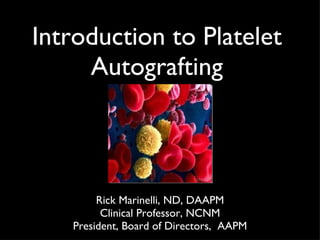
Rick Marinelli, ND, DAAPM Clinical Professor, NCNM President, Board of Directors,  AAPM Introduction to Platelet Autografting
 
 
Normal Collagen  Structure
Myotendinous Junction
The Fibro-Osseous Junction
Tendinopathy  Results When Normal Healing Fails
DELIVERING A CONCENTRATION OF AUTOLOGOUS PROTEINS TO THE SURGICAL SITE MAY IMPROVE THE HEALING RATE Hemostatic Barrier Inflammation Debridement Tissue  Regeneration Tissue  Remodeling Body’s Response to Tissue Injury [Time] Application of proteins from a platelet concentrate may dramatically improve the early phases of the Healing Cascade
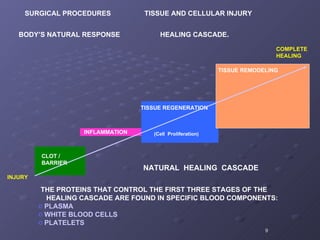
SURGICAL PROCEDURES   TISSUE AND   CELLULAR INJURY BODY’S NATURAL RESPONSE  HEALING CASCADE . COMPLETE HEALING NATURAL  HEALING  CASCADE CLOT / BARRIER CLOT / BARRIER INFLAMMATION TISSUE REGENERATION (Cell  Proliferation) TISSUE REMODELING THE PROTEINS THAT CONTROL THE FIRST THREE STAGES OF THE  HEALING CASCADE ARE FOUND IN SPECIFIC BLOOD COMPONENTS: PLASMA WHITE BLOOD CELLS PLATELETS  INJURY
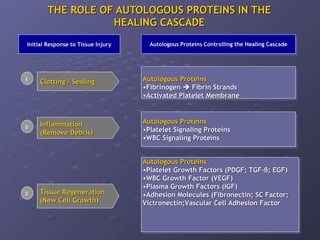
THE ROLE OF AUTOLOGOUS PROTEINS IN THE HEALING CASCADE Initial Response to Tissue Injury Autologous Proteins Controlling the Healing Cascade Clotting / Sealing Inflammation (Remove Debris) Tissue Regeneration (New Cell Growth) Autologous Proteins Fibrinogen    Fibrin Strands Activated Platelet Membrane Autologous Proteins Platelet Signaling Proteins WBC Signaling Proteins Autologous Proteins Platelet Growth Factors (PDGF; TGF-ß; EGF) WBC Growth Factor (VEGF) Plasma Growth Factors (IGF) Adhesion Molecules (Fibronectin; SC Factor; Victronectin;Vascular Cell Adhesion Factor 1 2 3
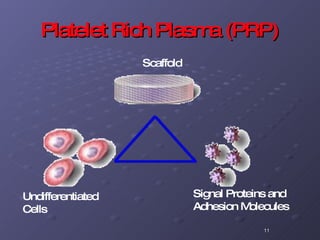
Platelet Rich Plasma (PRP) Scaffold Signal Proteins and Adhesion Molecules Undifferentiated Cells
Growth Factors Growth Factors Receptor Signaling Molecules Transcription Factors
Application of Autologous Platelet Gel: Usable throughout surgical site Creates an intricate network of fibrin polymers working to that seal the wound, provide hemostasis, and contract the wound Provides a release of concentrated wound growth factors Stabilizes bone and soft tissue graft materials Optimizes wound site for healing Autologous Growth Factors Provide: Enhanced healing Enhanced angiogenesis Improved bone regeneration Hastened bone maturity Increased collagen content Enhanced wound strength Bactericidal effect at wound site “ Leading to hastened and improved healing.” Benefits of Platelet Gel (Physiologic Perspective)
Dose-Dependent Mitogenic Effects of Platelet Releasate on hMSC’s Mitogenic Stimulation of Human Mesenchymal Stem Cells by Platelet Releasate Suggests a Mechanism for Enhancement of  Bone Repair by Platelet Concentrate, Poster AAOS Meeting 2002 Haynesworth, SE; Kadiyala, S; Liang, L; Bruder, SP; DePuy AcroMed,  DePuy Orthopedics, and Case Western Reserve University.   QTY of  hMSC’s Conclusions: Platelet Concentrate and VEGF stimulate chemotactic migration of  hMSC’s in a dose-dependent manner. Platelet Concentrate stimulates proliferation of hMSC’s in a dose- dependent manner How Many Platelets Is Enough? ---- Platelet Concentrates---  227 % INCREASE  IN  CELL POPULATION WITH 5 TIMES INCREASE IN PLATELETS
RESEARCH STUDIES RELATED TO THE EFFECT OF PLATELET CONCENTRATE ON CELL PROLIFERATION OSTEOBLASTS “… platelet-supplemented medium stimulates proliferation   and maintains the  differentiated function of human osteoblast-like cells.  Platelets may play an  important role in early healing of fractures and also may be useful as a cheap  autologous source of multiple growth factors to enhance osteoblast  proliferation” M. Slater et al;  Involvement of Platelets in Stimulating Osteogenic Activity Journal of Orthopedic Research,  Nov 1994 FIBROBLASTS “ The results of this study demonstrate   the efficacy of activated platelets   bound  on fibrinogen   in the mitosis of fibroblasts , which is a response to growth factors  secreted by platelets.  Platelets without binding to fibrinogen showed no  secretion of growth factors and had no effect on cell mitosis.  These events may  Contribute to wound healing and could be the first important step in this process” R. Gfatter, et al;   The mitosis of fibroblasts in cell cell culture is enhanced by  Bibding GP IIb-IIa of activated platelets on fibrinogen  Platelets, Vol 1,  2000
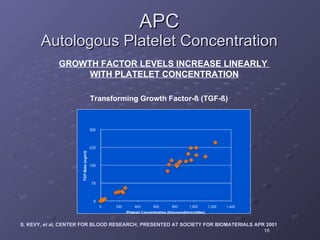
APC Autologous Platelet Concentration S. KEVY, et al, CENTER FOR BLOOD RESEARCH; PRESENTED AT SOCIETY FOR BIOMATERIALS APR 2001 GROWTH FACTOR LEVELS INCREASE LINEARLY  WITH PLATELET CONCENTRATION Transforming Growth Factor-ß (TGF-ß)
GROWTH FACTOR LEVELS INCREASE LINEARLY with APC + Platelet-Derived Growth Factor (PDGF) Transforming Growth Factor-ß (TGF-ß) S. KEVY, et al, CENTER FOR BLOOD RESEARCH; PRESENTED AT SOCIETY FOR BIOMATERIALS APR 2001 R 2 = 0.9815 0 75 150 225 300 0 200 400 600 800 1000 1200 1400 Platelet Concentration (thousand/microliter) TGF-Beta (ng/ml)
Paques P, Chastan C, et al; “Effect of Autologous Platelet Concentrate in Surgery for Idiopathic Macular Hole: Results of a Multicenter, Double-Masked, Randomized Trial”,  Opthalmology, 106:932-938 , 1999 110 patient double-masked randomized prospective  macular hole  study to evaluate the safety  and efficacy of PRP – Injection of PRP significantly improved the anatomic success rate of  surgery for idiopathic macular holes of less than 3 years duration. PRP and Injection Therapy  Barrett S, Erredge S; “Growth Factors for Chronic Plantar Fasciitis”,  Podiatry Today,  37-42, 2004 9 patients with  hypoechoic and thickened plantar fascia  were injected with PRP to evaluate  the efficacy of PRP with 1 week, 2 week and 1, 3, 6, and 12 month follow-up –  All patients had  improvement that was noted on diagnostic ultrasound and 6 patients had complete  resolution after 2 months.  At 1 year, 7 of 9 patients were completely healed. Mishra A, Pafelko T, Coetzee; “Treatment of Chronic Severe Elbow Tendinosis with PRP”,  American Journal of Sports Medicine,  Preview, May 30, 2006 20 patients that failed non-operative treatment for  chronic epicondylar pain  were randomized to  evaluate effectiveness of PRP –  At 1,2, and 6 months all PRP patients had lower pain and  greater ROM than control (bupivicaine).  Treatment of chronic epicondylar pain with PRP should  be considered prior to surgical intervention.
Treatment of Chronic Severe Elbow Tendinosis with PRP Mishra, A., Pafelko, T., Coetzee, 2005 AAOS Podium Presentation Aim:  Elbow epicondylar tendinosis is a common problem for patients whose work or activities require strong gripping or repetitive wrist movements.  140 patients with elbow epicondylar pain were evaluated in this study.  Twenty of these patients met the strict chronic, severe inclusion criteria.  All of the patients had failed non-operative treatment and were considering surgical treatment.  A single percutaneous application of platelet rich plasma (PRP, active group) or bupivicaine (control group) was used to treat these twenty patients.
Treatment of Chronic Severe Elbow Tendinosis with PRP Mishra, A., Pafelko, T., Coetzee, 2005 AAOS Podium Presentation Results:   Four weeks  - PRP patients noted a 46% improvement in their visual analog pain scores versus a 17% improvement in control patients (p = 0.028).  Eight weeks  - PRP patients noted a 60% improvement in their visual analog pain scores versus a 16% improvement control patients (p = 0001).  After eight weeks, 60% of the control patients either formally withdrew from the study or sought other treatments.  Only the PRP patients were available for further evaluation.  Six months  - PRP patients noted an 81% improvement in their visual analog pain scores (p = 0.0001).  These PRP patients at the same follow-up period noted a 72% improvement in their Mayo elbow scores (p = 0.0001).
 
 
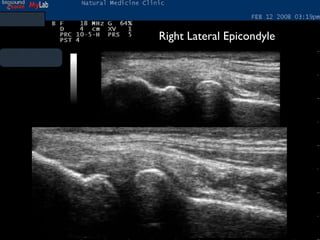
Text Right Lateral Epicondyle

Prp Matrix Grafts

  • 1.
    Rick Marinelli, ND,DAAPM Clinical Professor, NCNM President, Board of Directors, AAPM Introduction to Platelet Autografting
  • 2.
  • 3.
  • 4.
  • 5.
  • 6.
  • 7.
    Tendinopathy ResultsWhen Normal Healing Fails
  • 8.
    DELIVERING A CONCENTRATIONOF AUTOLOGOUS PROTEINS TO THE SURGICAL SITE MAY IMPROVE THE HEALING RATE Hemostatic Barrier Inflammation Debridement Tissue Regeneration Tissue Remodeling Body’s Response to Tissue Injury [Time] Application of proteins from a platelet concentrate may dramatically improve the early phases of the Healing Cascade
  • 9.
    SURGICAL PROCEDURES TISSUE AND CELLULAR INJURY BODY’S NATURAL RESPONSE HEALING CASCADE . COMPLETE HEALING NATURAL HEALING CASCADE CLOT / BARRIER CLOT / BARRIER INFLAMMATION TISSUE REGENERATION (Cell Proliferation) TISSUE REMODELING THE PROTEINS THAT CONTROL THE FIRST THREE STAGES OF THE HEALING CASCADE ARE FOUND IN SPECIFIC BLOOD COMPONENTS: PLASMA WHITE BLOOD CELLS PLATELETS INJURY
  • 10.
    THE ROLE OFAUTOLOGOUS PROTEINS IN THE HEALING CASCADE Initial Response to Tissue Injury Autologous Proteins Controlling the Healing Cascade Clotting / Sealing Inflammation (Remove Debris) Tissue Regeneration (New Cell Growth) Autologous Proteins Fibrinogen  Fibrin Strands Activated Platelet Membrane Autologous Proteins Platelet Signaling Proteins WBC Signaling Proteins Autologous Proteins Platelet Growth Factors (PDGF; TGF-ß; EGF) WBC Growth Factor (VEGF) Plasma Growth Factors (IGF) Adhesion Molecules (Fibronectin; SC Factor; Victronectin;Vascular Cell Adhesion Factor 1 2 3
  • 11.
    Platelet Rich Plasma(PRP) Scaffold Signal Proteins and Adhesion Molecules Undifferentiated Cells
  • 12.
    Growth Factors GrowthFactors Receptor Signaling Molecules Transcription Factors
  • 13.
    Application of AutologousPlatelet Gel: Usable throughout surgical site Creates an intricate network of fibrin polymers working to that seal the wound, provide hemostasis, and contract the wound Provides a release of concentrated wound growth factors Stabilizes bone and soft tissue graft materials Optimizes wound site for healing Autologous Growth Factors Provide: Enhanced healing Enhanced angiogenesis Improved bone regeneration Hastened bone maturity Increased collagen content Enhanced wound strength Bactericidal effect at wound site “ Leading to hastened and improved healing.” Benefits of Platelet Gel (Physiologic Perspective)
  • 14.
    Dose-Dependent Mitogenic Effectsof Platelet Releasate on hMSC’s Mitogenic Stimulation of Human Mesenchymal Stem Cells by Platelet Releasate Suggests a Mechanism for Enhancement of Bone Repair by Platelet Concentrate, Poster AAOS Meeting 2002 Haynesworth, SE; Kadiyala, S; Liang, L; Bruder, SP; DePuy AcroMed, DePuy Orthopedics, and Case Western Reserve University. QTY of hMSC’s Conclusions: Platelet Concentrate and VEGF stimulate chemotactic migration of hMSC’s in a dose-dependent manner. Platelet Concentrate stimulates proliferation of hMSC’s in a dose- dependent manner How Many Platelets Is Enough? ---- Platelet Concentrates--- 227 % INCREASE IN CELL POPULATION WITH 5 TIMES INCREASE IN PLATELETS
  • 15.
    RESEARCH STUDIES RELATEDTO THE EFFECT OF PLATELET CONCENTRATE ON CELL PROLIFERATION OSTEOBLASTS “… platelet-supplemented medium stimulates proliferation and maintains the differentiated function of human osteoblast-like cells. Platelets may play an important role in early healing of fractures and also may be useful as a cheap autologous source of multiple growth factors to enhance osteoblast proliferation” M. Slater et al; Involvement of Platelets in Stimulating Osteogenic Activity Journal of Orthopedic Research, Nov 1994 FIBROBLASTS “ The results of this study demonstrate the efficacy of activated platelets bound on fibrinogen in the mitosis of fibroblasts , which is a response to growth factors secreted by platelets. Platelets without binding to fibrinogen showed no secretion of growth factors and had no effect on cell mitosis. These events may Contribute to wound healing and could be the first important step in this process” R. Gfatter, et al; The mitosis of fibroblasts in cell cell culture is enhanced by Bibding GP IIb-IIa of activated platelets on fibrinogen Platelets, Vol 1, 2000
  • 16.
    APC Autologous PlateletConcentration S. KEVY, et al, CENTER FOR BLOOD RESEARCH; PRESENTED AT SOCIETY FOR BIOMATERIALS APR 2001 GROWTH FACTOR LEVELS INCREASE LINEARLY WITH PLATELET CONCENTRATION Transforming Growth Factor-ß (TGF-ß)
  • 17.
    GROWTH FACTOR LEVELSINCREASE LINEARLY with APC + Platelet-Derived Growth Factor (PDGF) Transforming Growth Factor-ß (TGF-ß) S. KEVY, et al, CENTER FOR BLOOD RESEARCH; PRESENTED AT SOCIETY FOR BIOMATERIALS APR 2001 R 2 = 0.9815 0 75 150 225 300 0 200 400 600 800 1000 1200 1400 Platelet Concentration (thousand/microliter) TGF-Beta (ng/ml)
  • 18.
    Paques P, ChastanC, et al; “Effect of Autologous Platelet Concentrate in Surgery for Idiopathic Macular Hole: Results of a Multicenter, Double-Masked, Randomized Trial”, Opthalmology, 106:932-938 , 1999 110 patient double-masked randomized prospective macular hole study to evaluate the safety and efficacy of PRP – Injection of PRP significantly improved the anatomic success rate of surgery for idiopathic macular holes of less than 3 years duration. PRP and Injection Therapy Barrett S, Erredge S; “Growth Factors for Chronic Plantar Fasciitis”, Podiatry Today, 37-42, 2004 9 patients with hypoechoic and thickened plantar fascia were injected with PRP to evaluate the efficacy of PRP with 1 week, 2 week and 1, 3, 6, and 12 month follow-up – All patients had improvement that was noted on diagnostic ultrasound and 6 patients had complete resolution after 2 months. At 1 year, 7 of 9 patients were completely healed. Mishra A, Pafelko T, Coetzee; “Treatment of Chronic Severe Elbow Tendinosis with PRP”, American Journal of Sports Medicine, Preview, May 30, 2006 20 patients that failed non-operative treatment for chronic epicondylar pain were randomized to evaluate effectiveness of PRP – At 1,2, and 6 months all PRP patients had lower pain and greater ROM than control (bupivicaine). Treatment of chronic epicondylar pain with PRP should be considered prior to surgical intervention.
  • 19.
    Treatment of ChronicSevere Elbow Tendinosis with PRP Mishra, A., Pafelko, T., Coetzee, 2005 AAOS Podium Presentation Aim: Elbow epicondylar tendinosis is a common problem for patients whose work or activities require strong gripping or repetitive wrist movements. 140 patients with elbow epicondylar pain were evaluated in this study. Twenty of these patients met the strict chronic, severe inclusion criteria. All of the patients had failed non-operative treatment and were considering surgical treatment. A single percutaneous application of platelet rich plasma (PRP, active group) or bupivicaine (control group) was used to treat these twenty patients.
  • 20.
    Treatment of ChronicSevere Elbow Tendinosis with PRP Mishra, A., Pafelko, T., Coetzee, 2005 AAOS Podium Presentation Results: Four weeks - PRP patients noted a 46% improvement in their visual analog pain scores versus a 17% improvement in control patients (p = 0.028). Eight weeks - PRP patients noted a 60% improvement in their visual analog pain scores versus a 16% improvement control patients (p = 0001). After eight weeks, 60% of the control patients either formally withdrew from the study or sought other treatments. Only the PRP patients were available for further evaluation. Six months - PRP patients noted an 81% improvement in their visual analog pain scores (p = 0.0001). These PRP patients at the same follow-up period noted a 72% improvement in their Mayo elbow scores (p = 0.0001).
  • 21.
  • 22.
  • 23.
  • 24.