Learning Outcomes
 Acknowledge the customer using standard phrases
    within policy procedures
   Identify the nature of the customer inquiry
   Use an attentive manner in dealing with customer
   Terminate calls using standard phrases ,within policy
    procedures and phrases
   Confirm customer identity and details with customer
    records, if appropriate
Learning Outcomes
 Establish rapport using active listening and empathy
    techniques
   Identify customer requirements using active listening
    and empathy.
   Obtain agreement on course of action
   Refer the customer to other agent as appropriate
   Notify the customer and agent and agent of relevant
    details
Provide Quality Customer Service

      Who is a
    Customer????
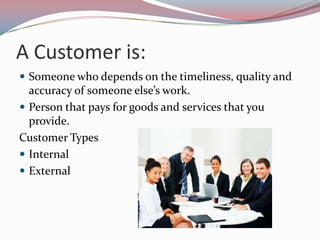
A Customer is:
 Someone who depends on the timeliness, quality and
  accuracy of someone else’s work.
 Person that pays for goods and services that you
  provide.
Customer Types
 Internal
 External
Internal Customer
 People working in different department
 People working in different branches
External Customers
 Individuals of different needs
 Individuals of different cultures
 Business people
 Groups
What is Quality Customer Service
Definition:
 The aim of quality customer service is to provide a
  consistently high level of service to customers that
  meet or exceeds international standards.
 Identifying ,understanding, anticipating and
  fulfilling the needs of your customers (tailoring of
  services, but standardized)
 Managing your service environment.
In terms of customer service management
skills we tend to be……..
 Argumentative & Defensive
 Judgmental
 Fail to Apologize
 Will not give her name
 Have to let you know when you are wrong
 Enticed by social status-(so service is inconsistent)
 Have to let the world know when we are vex
Customer Expectations
They will have differing needs, wants, choices but have
  common expectations:
 To be respected
 Appreciated
 Understood
 Satisfied
Identifying customers inquiry
 Listen actively and carefully
 Ask Questions where clarification is necessary
 Analyze what the customer has said
Reasons for inquiries
 Billing Discrepancies
 Non –Delivery
 Late Delivery
 Quality Issues
 Other


 Nb: Some organizations use inquiry forms to track the
 reasons for customers’ inquiries. All customer
 inquiries must be dealt with promptly.
We See Over The Phone
Telephone Tips :
 Every caller is to be treated as a welcome guest

 Monitor your voice ; irritation, preoccupation, hurrying , being
 judgmental
Over the phone your voice is all you have going for you. Always sit
 up your voice picks up. Smile so that your tone is softened.

   Always be patient
   Never rush the customer
   Give your undivided attention
   Never interrupt the customer
We See Over The Phone
Telephone Tips :
 Every caller is to be treated as a welcome guest

 Monitor your voice ; irritation, preoccupation, hurrying , being
 judgmental
Over the phone your voice is all you have going for you. Always sit
 up your voice picks up. Smile so that your tone is softened.

   Always be patient
   Never rush the customer
   Give your undivided attention
   Never interrupt the customer
Steps In Responding Incoming calls
 Answer promptly
 Greet the caller pleasantly
 Identify the organization /department
 Take messages accurately
 Speak in a natural tone
 Say “thank you” and “you’re welcome”
 Listen attentively
 Use customers name
 Speak directly in the transmitter
Steps In Responding Incoming calls
 Answer promptly
 Greet the caller pleasantly
 Identify the organization /department
 Take messages accurately
 Speak in a natural tone
 Say “thank you” and “you’re welcome”
 Listen attentively
 Use customers name
 Speak directly in the transmitter
Steps In Responding To Incoming Calls
 Apologize for mistakes
 End the call Properly
Place the caller on hold:
 Only if you must
 Ask permission
 Wait for an answer (if they didn’t respond…..”will that
  be ok?”
 Never say “Hang on” or “Hold on”
 Check back every 25-30 seconds
Steps In Responding To Incoming Calls
 Apologize for mistakes
 End the call Properly
Place the caller on hold:
 Only if you must
 Ask permission
 Wait for an answer (if they didn’t respond…..”will that
  be ok?”
 Never say “Hang on” or “Hold on”
 Check back every 25-30 seconds
Terminate Calls
 When terminating or closing a call you should do the
    following:
   Start making statements in the past tense
   Repeat/summarize information you have already
    conveyed
   Thank the customer for his/her, name and end the call
   Use standard farewell of the organization you
    represent
Terminate Calls
Always allow the customer to hang up first
Examples of standard closures/termination:

 “Thank you for taking the time to call. Goodbye.
 Mr. Brown, Thank you for calling. Goodbye.
Make an outbound contact
 This is a contact call made by an agent or a customer
  service representative from a call centre to
  promote/sell goods and services.(telemarketing)
 These calls are usually made to existing customers but
  sometimes calls are made to new customers.
  Outbound calls are made for a variety of reasons
  including:
Make an outbound call
 To market new products and services
 To confirm that customers have received their orders
 To follow up on services provided
 To follow up on overdue accounts
 To carry out market research
Nb. Assess the customers availability
Establish a relationship with the
customer
 Confirm the customers identity and details
 Establish rapport
 Demonstrate active listening skills
 Demonstrate empathy
 Letting your responses acknowledge and validate the
 customers point of view
Discussion


Why is it important for you to know the
organizations policy regarding greeting?

•What role does listening play in
determining the nature of an inquiry?

Discuss 4 qualities/Traits an agent should
display when dealing with a customer?
Determine Customers Requirement
 Identify customers requirement by listening actively
 Seek clarifications where necessary
Tip: If you are unable to identify the requirements of the
  customer correctly, you will take the wrong action.
  This may result in time wasting and frustration.
Activity
Duration : 5minutes.
Determine Customers
Requirements
 During an interaction with your client provide options
  to satisfy customers needs
 Communicate clearly and be articulate when
  communicating your course of action to your client
 When explaining a course of action you should do so
  breaking down the information into action into
  actionable steps
Determine Customers
Requirements
 Separating each step and pause between each
 Asking the customer if he/she understands
 Repeating/ Paraphrasing
 Asking the customer what you have said
Customer Options
 Delivery
 Payment Method
 Redress
 Products
 Services
Respond to Customer Request
 Promptly respond to, and discuss requests
 Identify and recommend options
 Commit to meet customer requests. committing
  simply means keeping the promises you have made to
  the customer regarding: When you will supply the
  product/service
 How will you supply
Respond to Customer Requests
 Any cost associated with the delivery
 Any special needs of the customer
 Nb. Your credibility is important.
Activity
 Select a team mate and role play responding to
 customer request. Incorporate what you have learnt.

Provide quality customer service

  • 2.
    Learning Outcomes  Acknowledgethe customer using standard phrases within policy procedures  Identify the nature of the customer inquiry  Use an attentive manner in dealing with customer  Terminate calls using standard phrases ,within policy procedures and phrases  Confirm customer identity and details with customer records, if appropriate
  • 3.
    Learning Outcomes  Establishrapport using active listening and empathy techniques  Identify customer requirements using active listening and empathy.  Obtain agreement on course of action  Refer the customer to other agent as appropriate  Notify the customer and agent and agent of relevant details
  • 4.
    Provide Quality CustomerService Who is a Customer????
  • 5.
    A Customer is: Someone who depends on the timeliness, quality and accuracy of someone else’s work.  Person that pays for goods and services that you provide. Customer Types  Internal  External
  • 6.
    Internal Customer  Peopleworking in different department  People working in different branches
  • 7.
    External Customers  Individualsof different needs  Individuals of different cultures  Business people  Groups
  • 8.
    What is QualityCustomer Service Definition:  The aim of quality customer service is to provide a consistently high level of service to customers that meet or exceeds international standards.  Identifying ,understanding, anticipating and fulfilling the needs of your customers (tailoring of services, but standardized)  Managing your service environment.
  • 9.
    In terms ofcustomer service management skills we tend to be……..  Argumentative & Defensive  Judgmental  Fail to Apologize  Will not give her name  Have to let you know when you are wrong  Enticed by social status-(so service is inconsistent)  Have to let the world know when we are vex
  • 10.
    Customer Expectations They willhave differing needs, wants, choices but have common expectations:  To be respected  Appreciated  Understood  Satisfied
  • 11.
    Identifying customers inquiry Listen actively and carefully  Ask Questions where clarification is necessary  Analyze what the customer has said
  • 12.
    Reasons for inquiries Billing Discrepancies  Non –Delivery  Late Delivery  Quality Issues  Other  Nb: Some organizations use inquiry forms to track the reasons for customers’ inquiries. All customer inquiries must be dealt with promptly.
  • 13.
    We See OverThe Phone Telephone Tips :  Every caller is to be treated as a welcome guest  Monitor your voice ; irritation, preoccupation, hurrying , being judgmental Over the phone your voice is all you have going for you. Always sit up your voice picks up. Smile so that your tone is softened.  Always be patient  Never rush the customer  Give your undivided attention  Never interrupt the customer
  • 14.
    We See OverThe Phone Telephone Tips :  Every caller is to be treated as a welcome guest  Monitor your voice ; irritation, preoccupation, hurrying , being judgmental Over the phone your voice is all you have going for you. Always sit up your voice picks up. Smile so that your tone is softened.  Always be patient  Never rush the customer  Give your undivided attention  Never interrupt the customer
  • 15.
    Steps In RespondingIncoming calls  Answer promptly  Greet the caller pleasantly  Identify the organization /department  Take messages accurately  Speak in a natural tone  Say “thank you” and “you’re welcome”  Listen attentively  Use customers name  Speak directly in the transmitter
  • 16.
    Steps In RespondingIncoming calls  Answer promptly  Greet the caller pleasantly  Identify the organization /department  Take messages accurately  Speak in a natural tone  Say “thank you” and “you’re welcome”  Listen attentively  Use customers name  Speak directly in the transmitter
  • 17.
    Steps In RespondingTo Incoming Calls  Apologize for mistakes  End the call Properly Place the caller on hold:  Only if you must  Ask permission  Wait for an answer (if they didn’t respond…..”will that be ok?”  Never say “Hang on” or “Hold on”  Check back every 25-30 seconds
  • 18.
    Steps In RespondingTo Incoming Calls  Apologize for mistakes  End the call Properly Place the caller on hold:  Only if you must  Ask permission  Wait for an answer (if they didn’t respond…..”will that be ok?”  Never say “Hang on” or “Hold on”  Check back every 25-30 seconds
  • 19.
    Terminate Calls  Whenterminating or closing a call you should do the following:  Start making statements in the past tense  Repeat/summarize information you have already conveyed  Thank the customer for his/her, name and end the call  Use standard farewell of the organization you represent
  • 20.
    Terminate Calls Always allowthe customer to hang up first Examples of standard closures/termination:  “Thank you for taking the time to call. Goodbye.  Mr. Brown, Thank you for calling. Goodbye.
  • 21.
    Make an outboundcontact  This is a contact call made by an agent or a customer service representative from a call centre to promote/sell goods and services.(telemarketing)  These calls are usually made to existing customers but sometimes calls are made to new customers. Outbound calls are made for a variety of reasons including:
  • 22.
    Make an outboundcall  To market new products and services  To confirm that customers have received their orders  To follow up on services provided  To follow up on overdue accounts  To carry out market research Nb. Assess the customers availability
  • 23.
    Establish a relationshipwith the customer  Confirm the customers identity and details  Establish rapport  Demonstrate active listening skills  Demonstrate empathy  Letting your responses acknowledge and validate the customers point of view
  • 24.
    Discussion Why is itimportant for you to know the organizations policy regarding greeting? •What role does listening play in determining the nature of an inquiry? Discuss 4 qualities/Traits an agent should display when dealing with a customer?
  • 25.
    Determine Customers Requirement Identify customers requirement by listening actively  Seek clarifications where necessary Tip: If you are unable to identify the requirements of the customer correctly, you will take the wrong action. This may result in time wasting and frustration.
  • 26.
  • 27.
    Determine Customers Requirements  Duringan interaction with your client provide options to satisfy customers needs  Communicate clearly and be articulate when communicating your course of action to your client  When explaining a course of action you should do so breaking down the information into action into actionable steps
  • 28.
    Determine Customers Requirements  Separatingeach step and pause between each  Asking the customer if he/she understands  Repeating/ Paraphrasing  Asking the customer what you have said
  • 29.
    Customer Options  Delivery Payment Method  Redress  Products  Services
  • 30.
    Respond to CustomerRequest  Promptly respond to, and discuss requests  Identify and recommend options  Commit to meet customer requests. committing simply means keeping the promises you have made to the customer regarding: When you will supply the product/service  How will you supply
  • 31.
    Respond to CustomerRequests  Any cost associated with the delivery  Any special needs of the customer  Nb. Your credibility is important.
  • 32.
    Activity  Select ateam mate and role play responding to customer request. Incorporate what you have learnt.

Editor's Notes

  • #6 Customer service is a central issue in every business. It is an absolute necessity if your business is to remain competitive.
  • #9 Safety on premises, comfort and appearance on premises ,parking, knowledgeable & courteous guidance from service provider. Quality customer service is meeting and exceeding customer expectations every time. Discuss the term consistency