Fintech 2.0 - Promises, Protocols & Power
University of Strathclyde
Chris Cook
6 November 2018
About Me – Legal Designer & Developer
Forensic accounting – insolvency & fraud investigation
Regulation – markets & enterprises
Market & enterprise development
Networked market development
Research into resilience – institutions & instruments
Context
Reality-based economy

Location (3D Space)

Energy

Intellect
Market 3.0 - evolution of markets

Market 1.0 - decentralised but disconnected

Market 2.0 - centralised but connected

Market 3.0 – decentralised but connected
Trend to Services

Energy Intensity

Capital intensity
Institutions & Instruments
Property & Money as Relationships
Rights & Obligations
Institutions as risk/cost/surplus/data/knowledge sharing
protocols
Instruments as transactable objects
Fintech 1.0 - Blockchain & Coins
Blockchain as Agreement
- collective machine protocol for encrypted transaction database
- authenticates electronic transactions – no 'double spend'
- But entire database is encrypted & replicated for every new
transaction
Coins as Instruments
- Proof of past value creation (eg Proof of Work/Stake)
- Subjective exchange value but no objective utility
Fintech 1.0
Machine-centric, Transaction-centric & Time-less
Blockchain as Institution: Coin as Instrument
Dissociated from Reality
New protocols aim to link coins to the real economy
Smart contracts: Mattereum, Holochain, ChamaPesa
Fintech Case Study - Venezuela and El Petro
Petro is based on oil
- acceptability of currency is based on utility
- many different types & qualities of oil
- consumers use gas, oil products, energy services not oil
Petro is a Proof not a Promise
- Proof of payment 'backed' by oil reserves
- No obligation to deliver either oil or money
- Petro cannot be used instead of Dollar to pay for Venezuelan oil
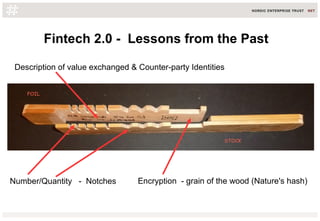
Fintech 2.0 - Lessons from the Past
Number/Quantity - Notches
Description of value exchanged & Counter-party Identities
Encryption - grain of the wood (Nature's hash)
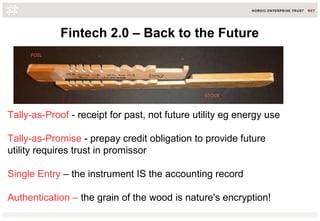
Fintech 2.0 – Back to the Future
Tally-as-Proof - receipt for past, not future utility eg energy use
Tally-as-Promise - prepay credit obligation to provide future
utility requires trust in promissor
Single Entry – the instrument IS the accounting record
Authentication – the grain of the wood is nature's encryption!
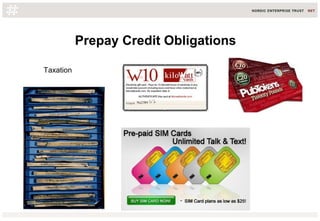
Prepay Credit Obligations
Taxation
Credit Obligation– What it is & How it Works
Credit returnable in payment for goods & services
Issued by supplier in exchange for value received
Issuer obligation is to accept credit if & when presented
in payment for goods & services
Rate of Return - rate over time at which credit
returnable to issuer in payment for services
Rate not fixed - depends on existence & amount of flow
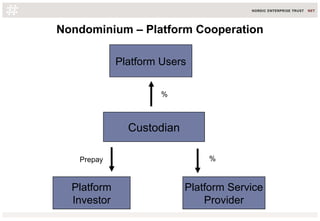
Custodian
%
Platform
Investor
Platform Service
Provider
%
Platform Users
Prepay
Nondominium – Platform Cooperation
Nondominium – How it Works
Production shares allocated to users & service providers
Balance of production allocated to Investor returns
No stakeholder has dominant rights, but each has veto
rights over matters which concern them
Custodian has right of final veto
Energy Fintech - Resource Resilience
Since 1973 Denmark's GDP has doubled, energy use has been
stable and carbon fuel use declined
How?
Mandate - minimum carbon fuel input for a given output of
electricity, heat or power (Energy as Service)
Least energy cost policy; not Least DK (or €, $, £) Cost
Massive investment in renewables, heat, energy efficiency,
transport
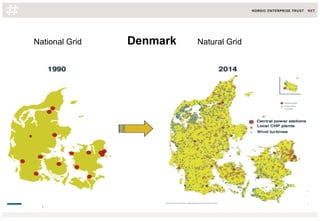
Outcome – decentralisation – trend to a Natural Grid
National Grid Denmark Natural Grid
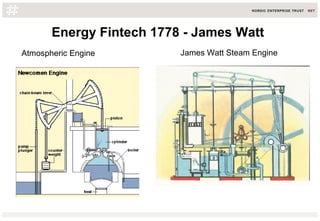
Energy Fintech 1778 - James Watt
Atmospheric Engine James Watt Steam Engine
Energy Fintech - Pumping as a Service
James Watt steam engine much more efficient at pumping
water than Newcomen Atmospheric Engine
In exchange for use of the pump, miners agreed a share of
one third of coal savings
Smart Swap – Intellectual value exchanged for value of
carbon fuel savings at the retail price
Not pumps-as-a-commodity - Pumping-as-a-Service
Energy Fintech – Energy Credit Obligation (ECO)
ECO is
- Returnable in payment for energy supply
- Issued energy service provider (not bank) vs value received
ECO is not
- Debt - no right to demand money
- Derivative – no right to demand energy delivery
- Equity – no ownership right in respect of energy assets
ECO issuance, exchanged, cleared within Nondominium
Energy Fintech – Energy Loans
Producer
- sells energy forward and locks in price
- interest-free energy loan until credit returned vs supply
Consumer
- prepays for energy and locks in price
Investor
- energy-linked return on investment
Energy Fintech - Outcomes
Independent of location/state denominated in energy, not £, $, €
Energy return (no interest/discount rate)
Banks cannot issue ECO, but provide banking-as-a-service eg
risk management & investment banking
Energy economics replaces dollar economics
Natural Grid replaces National Grids
Community Fintech
Mobilising capacity - people & place
People - P2P £ credit obligations based on capacity to provide
goods & services
Place - Peer2Here £ credit obligations based on productive
capacity of land/location
Social Credit – community 'loyalty point' tokens voluntarily
accepted in payment
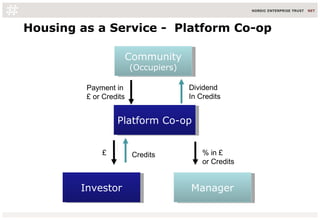
Housing as a Service - Platform Co-op
InvestorInvestor
Community
(Occupiers)
Community
(Occupiers)
£ % in £
or Credits
Dividend
In Credits
ManagerManager
Payment in
£ or Credits
Credits
Platform Co-opPlatform Co-op
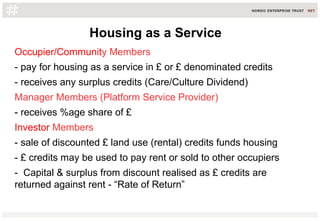
Housing as a Service
Occupier/Community Members
- pay for housing as a service in £ or £ denominated credits
- receives any surplus credits (Care/Culture Dividend)
Manager Members (Platform Service Provider)
- receives %age share of £
Investor Members
- sale of discounted £ land use (rental) credits funds housing
- £ credits may be used to pay rent or sold to other occupiers
- Capital & surplus from discount realised as £ credits are
returned against rent - “Rate of Return”
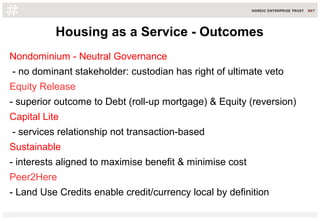
Housing as a Service - Outcomes
Nondominium - Neutral Governance
- no dominant stakeholder: custodian has right of ultimate veto
Equity Release
- superior outcome to Debt (roll-up mortgage) & Equity (reversion)
Capital Lite
- services relationship not transaction-based
Sustainable
- interests aligned to maximise benefit & minimise cost
Peer2Here
- Land Use Credits enable credit/currency local by definition
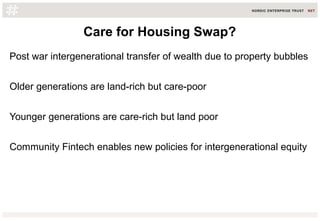
Care for Housing Swap?
Post war intergenerational transfer of wealth due to property bubbles
Older generations are land-rich but care-poor
Younger generations are care-rich but land poor
Community Fintech enables new policies for intergenerational equity
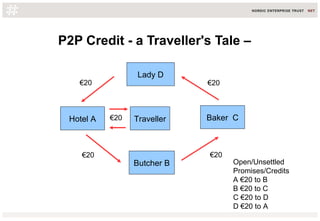
P2P Credit - a Traveller's Tale –
Hotel A
Lady D
Butcher B
Baker C
€20
€20 €20
€20
Traveller€20
Open/Unsettled
Promises/Credits
A €20 to B
B €20 to C
C €20 to D
D €20 to A
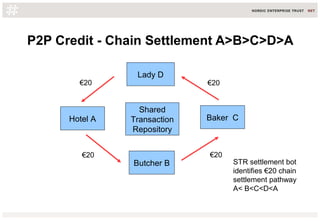
P2P Credit - Chain Settlement A>B>C>D>A
Hotel A
Lady D
Butcher B
Baker C
€20
€20 €20
€20
Shared
Transaction
Repository
STR settlement bot
identifies €20 chain
settlement pathway
A< B<C<D<A
Mutual Assurance – Risk Sharing by P&I Clubs
For 150 years, Protection & Indemnity (P&I) Clubs have
mutually guaranteed shipping risk Lloyds won't cover
For 130 years P&I Clubs have been managed by
Thomas Miller as platform service provider
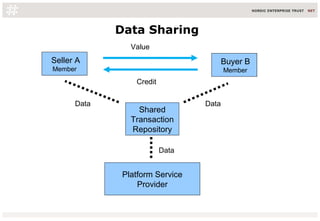
Data Sharing
Seller A
Member
Credit
Value
Platform Service
Provider
Shared
Transaction
Repository
Buyer B
Member
Data
Data
Data
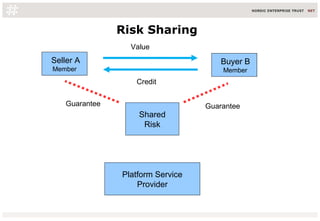
Risk Sharing
Seller A
Member
Credit
Value
Platform Service
Provider
Shared
Risk
Buyer B
Member
Guarantee Guarantee
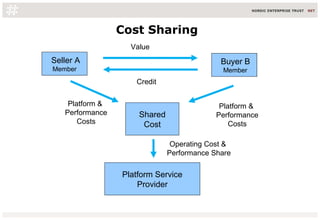
Cost Sharing
Seller A
Member
Credit
Value
Platform Service
Provider
Shared
Cost
Buyer B
Member
Platform &
Performance
Costs
Platform &
Performance
Costs
Operating Cost &
Performance Share
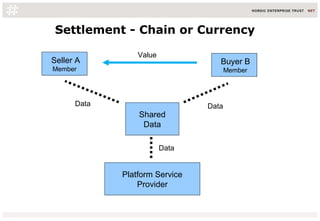
Settlement - Chain or Currency
Seller A
Member
Value
Platform Service
Provider
Shared
Data
Buyer B
Member
Data Data
Data
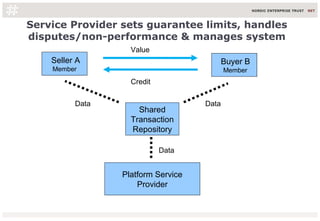
Service Provider sets guarantee limits, handles
disputes/non-performance & manages system
Seller A
Member
Credit
Value
Platform Service
Provider
Shared
Transaction
Repository
Buyer B
Member
Data
Data
Data
Community Credit Clearing – Banking as a Service
Mutually assured bilateral P2P credit
Merchants & Consumers share system costs and non-
performance
Manager allocates guarantee limits, manages platform, ensures
transparency, handles non-performance
£ denominated credit obligations may be settled
- by conventional £ bank credit
- by A>B>C>D>A chains
- by £ denominated land use credits
- by energy credit obligation – ECO
- voluntarily by social credit or donation
Community Fintech - Development
Scottish Universities Insight Institute Call for Proposals
Theme “Co-operation & Interdependence”
Exploration, Research & Development of Community Fintech
Four archetype locations
Six months duration – March/August 2019
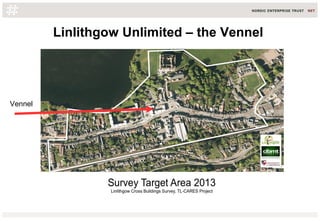
Linlithgow Unlimited – the Vennel
Vennel
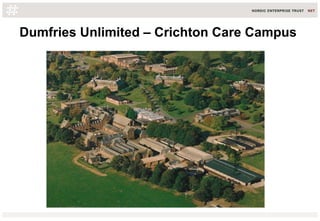
Dumfries Unlimited – Crichton Care Campus
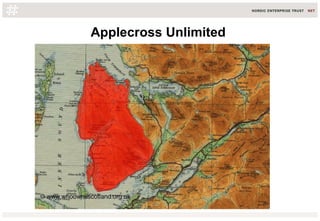
Applecross Unlimited
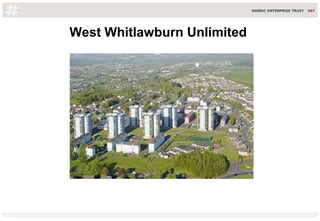
West Whitlawburn Unlimited
Community Fintech – Proposal Plan
Initial stakeholder meetings to determine optimal spatial use
Location-specific development teams research & develop
complementary Community Fintech project funding plan
Specification and development of alpha version Fintech with
Stirling University Fintech Masters cohort
Final presentation to communities of developed projects (and
Fintech demonstration)

Protocols, Promises & Power _06_11_18

  • 1.
    Fintech 2.0 -Promises, Protocols & Power University of Strathclyde Chris Cook 6 November 2018
  • 2.
    About Me –Legal Designer & Developer Forensic accounting – insolvency & fraud investigation Regulation – markets & enterprises Market & enterprise development Networked market development Research into resilience – institutions & instruments
  • 3.
    Context Reality-based economy  Location (3DSpace)  Energy  Intellect Market 3.0 - evolution of markets  Market 1.0 - decentralised but disconnected  Market 2.0 - centralised but connected  Market 3.0 – decentralised but connected Trend to Services  Energy Intensity  Capital intensity
  • 4.
    Institutions & Instruments Property& Money as Relationships Rights & Obligations Institutions as risk/cost/surplus/data/knowledge sharing protocols Instruments as transactable objects
  • 5.
    Fintech 1.0 -Blockchain & Coins Blockchain as Agreement - collective machine protocol for encrypted transaction database - authenticates electronic transactions – no 'double spend' - But entire database is encrypted & replicated for every new transaction Coins as Instruments - Proof of past value creation (eg Proof of Work/Stake) - Subjective exchange value but no objective utility
  • 6.
    Fintech 1.0 Machine-centric, Transaction-centric& Time-less Blockchain as Institution: Coin as Instrument Dissociated from Reality New protocols aim to link coins to the real economy Smart contracts: Mattereum, Holochain, ChamaPesa
  • 7.
    Fintech Case Study- Venezuela and El Petro Petro is based on oil - acceptability of currency is based on utility - many different types & qualities of oil - consumers use gas, oil products, energy services not oil Petro is a Proof not a Promise - Proof of payment 'backed' by oil reserves - No obligation to deliver either oil or money - Petro cannot be used instead of Dollar to pay for Venezuelan oil
  • 8.
    Fintech 2.0 -Lessons from the Past Number/Quantity - Notches Description of value exchanged & Counter-party Identities Encryption - grain of the wood (Nature's hash)
  • 9.
    Fintech 2.0 –Back to the Future Tally-as-Proof - receipt for past, not future utility eg energy use Tally-as-Promise - prepay credit obligation to provide future utility requires trust in promissor Single Entry – the instrument IS the accounting record Authentication – the grain of the wood is nature's encryption!
  • 10.
  • 11.
    Credit Obligation– Whatit is & How it Works Credit returnable in payment for goods & services Issued by supplier in exchange for value received Issuer obligation is to accept credit if & when presented in payment for goods & services Rate of Return - rate over time at which credit returnable to issuer in payment for services Rate not fixed - depends on existence & amount of flow
  • 12.
  • 13.
    Nondominium – Howit Works Production shares allocated to users & service providers Balance of production allocated to Investor returns No stakeholder has dominant rights, but each has veto rights over matters which concern them Custodian has right of final veto
  • 14.
    Energy Fintech -Resource Resilience Since 1973 Denmark's GDP has doubled, energy use has been stable and carbon fuel use declined How? Mandate - minimum carbon fuel input for a given output of electricity, heat or power (Energy as Service) Least energy cost policy; not Least DK (or €, $, £) Cost Massive investment in renewables, heat, energy efficiency, transport Outcome – decentralisation – trend to a Natural Grid
  • 15.
  • 16.
    Energy Fintech 1778- James Watt Atmospheric Engine James Watt Steam Engine
  • 17.
    Energy Fintech -Pumping as a Service James Watt steam engine much more efficient at pumping water than Newcomen Atmospheric Engine In exchange for use of the pump, miners agreed a share of one third of coal savings Smart Swap – Intellectual value exchanged for value of carbon fuel savings at the retail price Not pumps-as-a-commodity - Pumping-as-a-Service
  • 18.
    Energy Fintech –Energy Credit Obligation (ECO) ECO is - Returnable in payment for energy supply - Issued energy service provider (not bank) vs value received ECO is not - Debt - no right to demand money - Derivative – no right to demand energy delivery - Equity – no ownership right in respect of energy assets ECO issuance, exchanged, cleared within Nondominium
  • 19.
    Energy Fintech –Energy Loans Producer - sells energy forward and locks in price - interest-free energy loan until credit returned vs supply Consumer - prepays for energy and locks in price Investor - energy-linked return on investment
  • 20.
    Energy Fintech -Outcomes Independent of location/state denominated in energy, not £, $, € Energy return (no interest/discount rate) Banks cannot issue ECO, but provide banking-as-a-service eg risk management & investment banking Energy economics replaces dollar economics Natural Grid replaces National Grids
  • 21.
    Community Fintech Mobilising capacity- people & place People - P2P £ credit obligations based on capacity to provide goods & services Place - Peer2Here £ credit obligations based on productive capacity of land/location Social Credit – community 'loyalty point' tokens voluntarily accepted in payment
  • 22.
    Housing as aService - Platform Co-op InvestorInvestor Community (Occupiers) Community (Occupiers) £ % in £ or Credits Dividend In Credits ManagerManager Payment in £ or Credits Credits Platform Co-opPlatform Co-op
  • 23.
    Housing as aService Occupier/Community Members - pay for housing as a service in £ or £ denominated credits - receives any surplus credits (Care/Culture Dividend) Manager Members (Platform Service Provider) - receives %age share of £ Investor Members - sale of discounted £ land use (rental) credits funds housing - £ credits may be used to pay rent or sold to other occupiers - Capital & surplus from discount realised as £ credits are returned against rent - “Rate of Return”
  • 24.
    Housing as aService - Outcomes Nondominium - Neutral Governance - no dominant stakeholder: custodian has right of ultimate veto Equity Release - superior outcome to Debt (roll-up mortgage) & Equity (reversion) Capital Lite - services relationship not transaction-based Sustainable - interests aligned to maximise benefit & minimise cost Peer2Here - Land Use Credits enable credit/currency local by definition
  • 25.
    Care for HousingSwap? Post war intergenerational transfer of wealth due to property bubbles Older generations are land-rich but care-poor Younger generations are care-rich but land poor Community Fintech enables new policies for intergenerational equity
  • 26.
    P2P Credit -a Traveller's Tale – Hotel A Lady D Butcher B Baker C €20 €20 €20 €20 Traveller€20 Open/Unsettled Promises/Credits A €20 to B B €20 to C C €20 to D D €20 to A
  • 27.
    P2P Credit -Chain Settlement A>B>C>D>A Hotel A Lady D Butcher B Baker C €20 €20 €20 €20 Shared Transaction Repository STR settlement bot identifies €20 chain settlement pathway A< B<C<D<A
  • 28.
    Mutual Assurance –Risk Sharing by P&I Clubs For 150 years, Protection & Indemnity (P&I) Clubs have mutually guaranteed shipping risk Lloyds won't cover For 130 years P&I Clubs have been managed by Thomas Miller as platform service provider
  • 29.
    Data Sharing Seller A Member Credit Value PlatformService Provider Shared Transaction Repository Buyer B Member Data Data Data
  • 30.
    Risk Sharing Seller A Member Credit Value PlatformService Provider Shared Risk Buyer B Member Guarantee Guarantee
  • 31.
    Cost Sharing Seller A Member Credit Value PlatformService Provider Shared Cost Buyer B Member Platform & Performance Costs Platform & Performance Costs Operating Cost & Performance Share
  • 32.
    Settlement - Chainor Currency Seller A Member Value Platform Service Provider Shared Data Buyer B Member Data Data Data
  • 33.
    Service Provider setsguarantee limits, handles disputes/non-performance & manages system Seller A Member Credit Value Platform Service Provider Shared Transaction Repository Buyer B Member Data Data Data
  • 34.
    Community Credit Clearing– Banking as a Service Mutually assured bilateral P2P credit Merchants & Consumers share system costs and non- performance Manager allocates guarantee limits, manages platform, ensures transparency, handles non-performance £ denominated credit obligations may be settled - by conventional £ bank credit - by A>B>C>D>A chains - by £ denominated land use credits - by energy credit obligation – ECO - voluntarily by social credit or donation
  • 35.
    Community Fintech -Development Scottish Universities Insight Institute Call for Proposals Theme “Co-operation & Interdependence” Exploration, Research & Development of Community Fintech Four archetype locations Six months duration – March/August 2019
  • 36.
    Linlithgow Unlimited –the Vennel Vennel
  • 37.
    Dumfries Unlimited –Crichton Care Campus
  • 38.
  • 39.
  • 40.
    Community Fintech –Proposal Plan Initial stakeholder meetings to determine optimal spatial use Location-specific development teams research & develop complementary Community Fintech project funding plan Specification and development of alpha version Fintech with Stirling University Fintech Masters cohort Final presentation to communities of developed projects (and Fintech demonstration)