Let the trust evolve itselfin a decentralized network of inter-connected systems….
“We” & Trust” - in our day to day life
• We trust our family because we know they will be with us whenever we need
• We trust banks because we know our money is safe with them
• We trust our doctor because we know he cares about our health & suggest the
right medicine for us
• We trust commodity brands because we believe they are made of good quality
• We trust govt. and pay tax because we believe our tax money will be utilizing
for society welfare and country growth.
But what if
• Someone breach our trust
• Someone makes fraud and cheat us
• Someone steal our hard work and we are not get paid for our own creativity
• Charge huge premium just for the sake of trust
Its painful… really painful….
If not everything, but most of our day to day
life, we have to Trust “someone” for
managing our needs and providing services…
• Investments
• Savings
• Retirement planning
• Land registration
• Notary services
• Buying & Selling
• And lots more….
Trusted
Third Parties
Let’s talk about transactions, role of intermediaries &
The existence of “Trust”
Transfer Money
Option 1: Peer to Peer Cash transactions
Considerations:
- Any one to any one means locally distributed
- Mutual Trust for the value of transactions
- Anonymous & Private
- No middleman required
- Quick and Fast
- Not Scaled (many to many)
- Self risk management
- Not feasible in today’s world at scale.
Let’s talk about transactions, role of intermediaries &
The existence of “Trust”
Transfer Money
Option 2: Electronic transactions
Considerations:
- Requires 3rd party to bring trust
- The more complex flow, the more 3rd party involvement
- Costly as every party may charge some fees
- Slow Speed
- Examples: Paypal or Banks
- Confidentiality is with 3rd parties database
Trusted 3rd parties
as Intermediary
Services
Centralized | Closed | Private | Isolated
“Trusted Third Parties” and “Trust”
“As standards for trustability continue to rise, the
companies, brands, and organizations shown to lack
trustability will be punished more and more severely.”
https://hbr.org/2012/07/trust-in-the-age-of-transparency
“Untrustable business models thrive in our economic system today largely
because being untrustable can be highly profitable—in the short term
anyway—and many businesses are managed almost entirely for short-
term results.”
2009 was the year of
financial crisis when..
People lost Trust
in Trusted Third Parties
(like banks, govt. fin.
institutions etc.)
And that also leads us to do retrospective at a larger scale…
https://upload.wikimedia.org/wikipedia/commons/e/e1/Crowd_outside_nyse.jpg
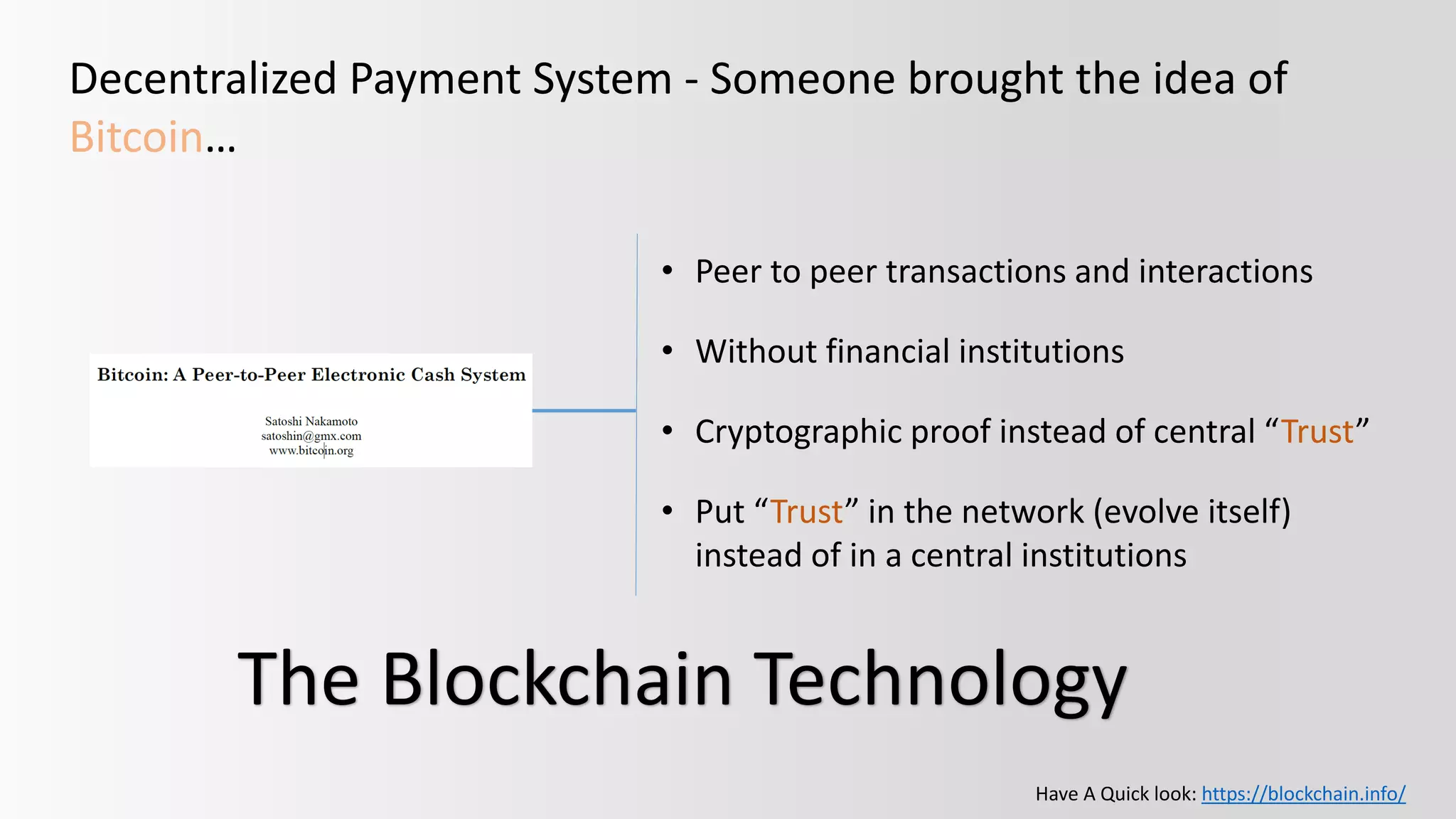
Decentralized Payment System - Someone brought the idea of
Bitcoin…
• Peer to peer transactions and interactions
• Without financial institutions
• Cryptographic proof instead of central “Trust”
• Put “Trust” in the network (evolve itself)
instead of in a central institutions
The Blockchain Technology
Have A Quick look: https://blockchain.info/
Courtesy & Picture Source: http://cdn.americanbanker.com/media/ui/how-bit-works-big.jpg
Taxonomy:
- Wallet
- Private Key
- Public Key
- Minors
- nonce
- Cryptocurrency
- Hash
- Block
- Ledger
Under the hood.. It’s all about Blockchain…
Tx1
Tx2
Tx3
…
#890
Tx1
Tx2
Tx3
#456
Tx1
Tx2
Tx3
#234
Tx1
Tx2
Tx3
#123
Tx1
Tx2
Tx3
Block is a group of multiple
transactions
Blocks are created by nodes over the network also
called ‘Minors’ and attached to previous blocks
Like in any distributed systems, sometimes participants
may disagree on the state of the ledger and may have
different version of transactions
The conflict is resolved and consensus is
formed on a single version of the ledger
Reference to
previous block
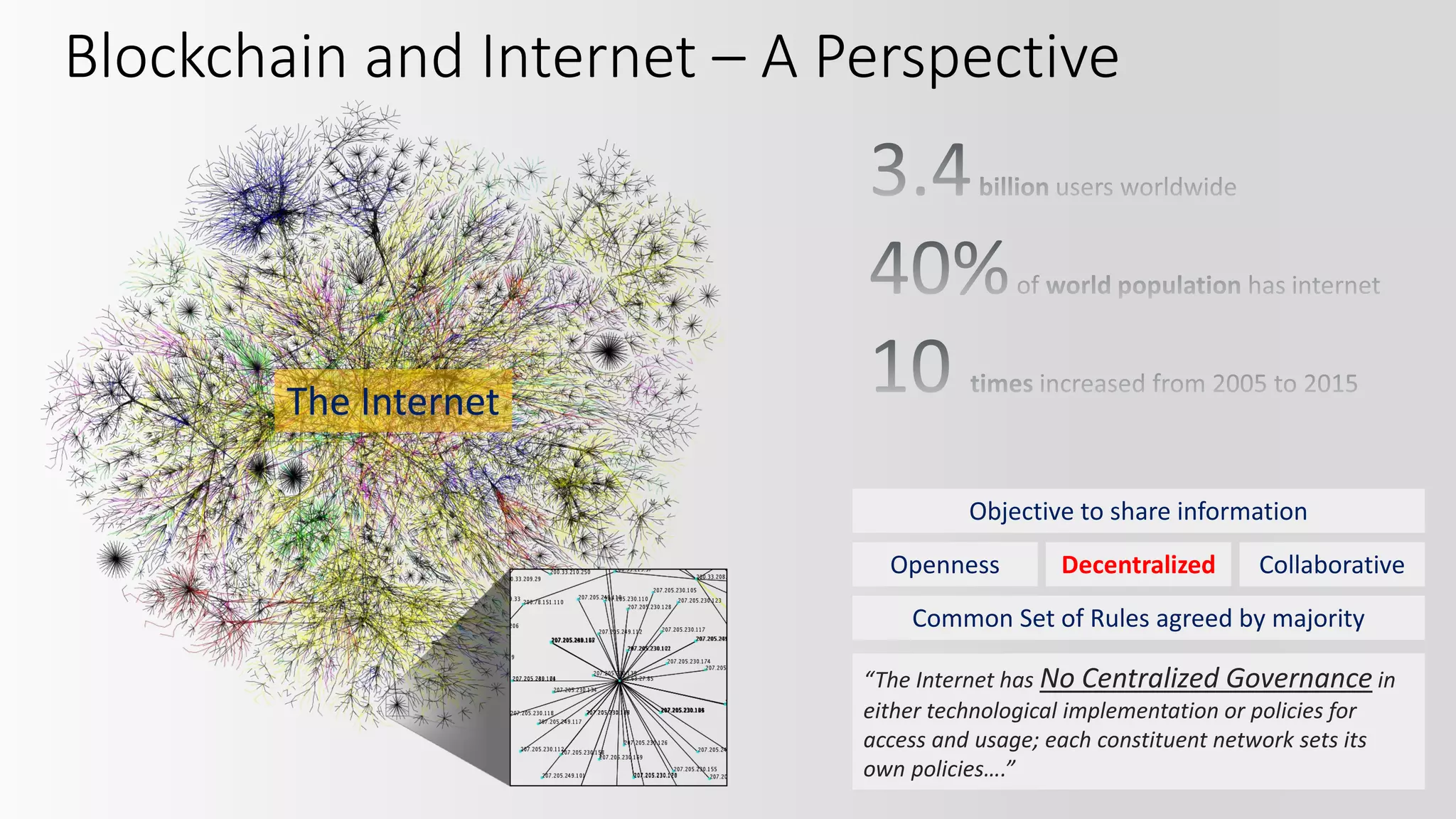
The Internet
“The Internet has No Centralized Governance in
either technological implementation or policies for
access and usage; each constituent network sets its
own policies….”
Openness Decentralized Collaborative
Common Set of Rules agreed by majority
Objective to share information
Blockchain and Internet – A Perspective
INTERNET NETWORKS
PUBLIC | PRIVATE | HYBIRD
WORLD WIDE WEB
WEB APPS
BLOCKCHAIN
BLOCKCHAIN NATIVE APPS
BLOCKCHAIN HYBRID APPS
• Trust in a trustless network
• Open Network Secure Access
• Open Source
• No SPOF / Redundancy
• Disruptive
• Speed / Real Time
• WORM Compliant /Safekeeping
• Decentralized
• Anonymity
Blockchain SDK / APIs
From “Internet of Information” to “Internet of Value”
Blockchain – Some core concepts
• Nodes
• Consensus Mechanisms
• Proof of Work (PoW)
• Proof of Stake (PoS)
• Zero Knowledge Proof (ZKP)
• Practical Byzantine Fault Tolerance (PBFT)
• Permission-less (Public) Vs Permissioned (Private or Consortium)
Blockchain – how it is progressing..
Blockchain1.0
• Currency
Blockchain2.0
• Smart
Contracts
Blockchain3.0
• Decentralized
Apps
Major focus is on
cash/payment transfer;
e.g. Bitcoin and lot more…
Brining the business logic into
Blockchain
Already implemented by large
Financial hubs using beyond
cash transactions
Completely new paradigm to
build the complete ecosystem
and build Apps on top of
blockchain platform
e.g. Etherum looks promising
2012 2016
and beyond
https://en.wikipedia.org/wiki/List_of_bitcoin_companies
Etherum – Next Gen platform for Decentralized Applications
Picture courtesy:
http://c.fastcompany.net/multisite_files/fastcompany/imagecache/inline-large/inline/2015/06/3047462-inline-i-1-a-
diagram-of-the-ethereum-network.png
See it live: https://ethstats.net/
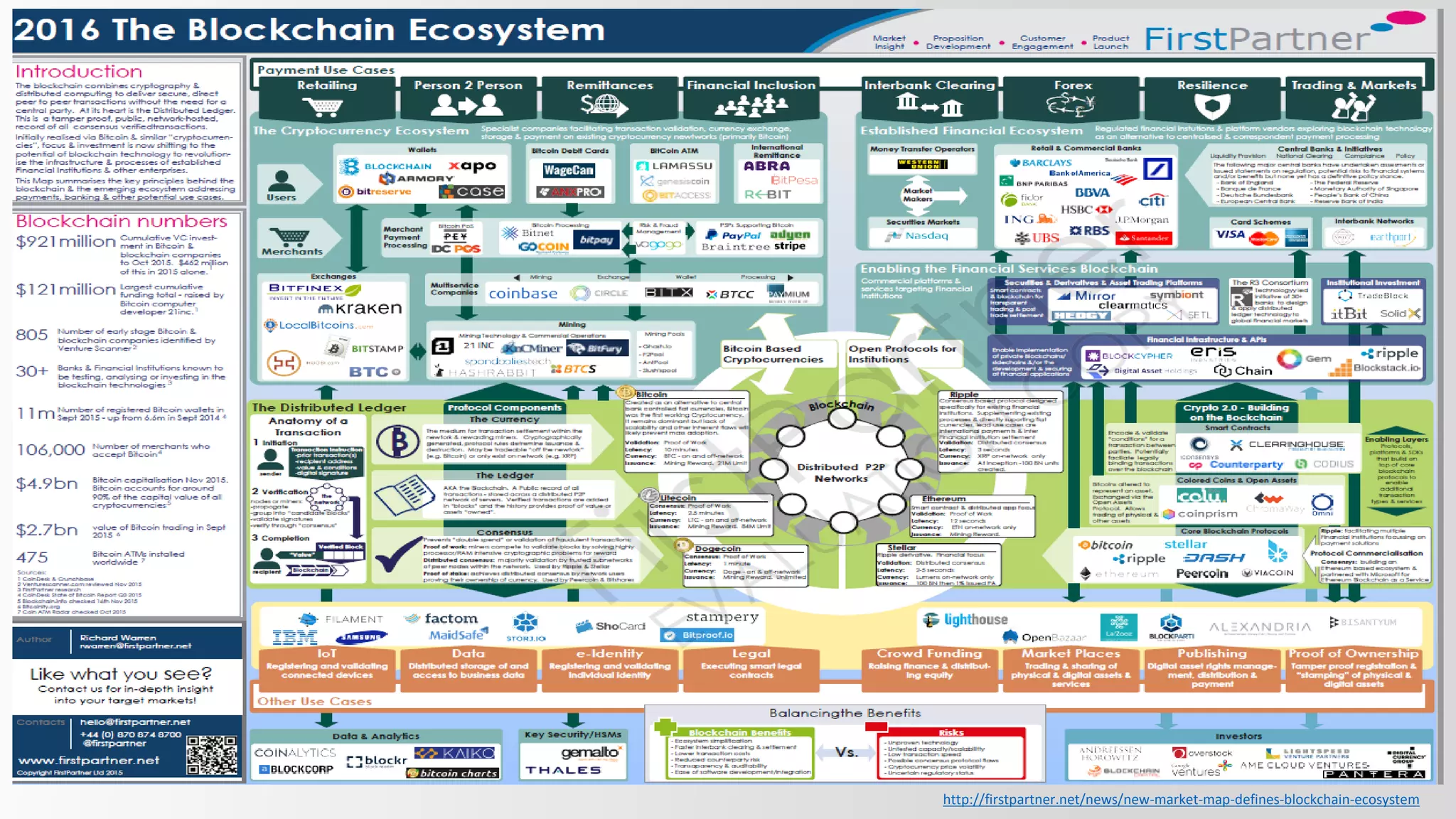
http://firstpartner.net/news/new-market-map-defines-blockchain-ecosystem
Blockchain – SWOT Analysis
• Decentralized Approach
• Speed
• Trust in trustless network
• High quality and foolproof data
• Business process efficiency and productivity
• Robustness (No SPOF)
• Transparency
• Scalability
• Integration with Legacy systems
• Change Management
• Technology Maturity
• Lack of standards
• New Intermediaries
• Innovation in all most every industry especially
Banking
• Opportunities in IoT
• Business process optimization
• Hype
• Privacy and Security
• Legal / Regulatory & Compliance
• Govt. willingness to adopt
ThreatsOpportunities
Strengths Weaknesses
Ripple - Near real time settlement platform for banking…
Receiving Bank
Receiver’s account
is credited
Sending
Bank
Correspondent or Central Bank
Receiving
Bank
Sending Bank
Business or consumer
sender initiates transfer
Receiving Bank
Receiver’s account
is credited
Sending Bank
Business or consumer
sender initiates transfer
Sending
Bank
Market
Marker A
Market
Maker A
Receiving
Bank
Market Maker A
FX Cost $
Market Maker B
FX Cost $$$
Settlement in second; processing 24 hours a day, 365 days a yearSettlement in 1-3 days; processing during business days only
No intermediary to charge processing fees; competitive
marketplace for FX resulting in lower FX spread
Intermediary charges processing fees;
single FX provider resulting in higher FX spread
Counterparty risk eliminated by straight through, instant processingCounterparty risk due to intermediaries and long processing time
Full visibility, allowing automatic reconciliation
and lower compliance costs
Limited visibility, requiring manual reconciliation
and higher compliance costs
Market Maker provides liquidityBank reserves provides liquidity
Correspondent Bank Model
Ripple Interbank Model
Ripple
Architecture
Source: https://ripple.com
• Decentralized Architecture
• Consensus based settlement
process
• 3-6 seconds per transaction
• 86 mn. transactions per day
Q & A
Sanjeev Azad
- Architect by Chance
- Learner by Heart
- Human by Nature
+91. 9810688604
sanjeev.azad@gmail.com
https://www.linkedin.com/in/sanjeevazad

Let the trust evolve itself

  • 1.
    Let the trustevolve itselfin a decentralized network of inter-connected systems….
  • 2.
    “We” & Trust”- in our day to day life • We trust our family because we know they will be with us whenever we need • We trust banks because we know our money is safe with them • We trust our doctor because we know he cares about our health & suggest the right medicine for us • We trust commodity brands because we believe they are made of good quality • We trust govt. and pay tax because we believe our tax money will be utilizing for society welfare and country growth.
  • 3.
    But what if •Someone breach our trust • Someone makes fraud and cheat us • Someone steal our hard work and we are not get paid for our own creativity • Charge huge premium just for the sake of trust Its painful… really painful….
  • 4.
    If not everything,but most of our day to day life, we have to Trust “someone” for managing our needs and providing services… • Investments • Savings • Retirement planning • Land registration • Notary services • Buying & Selling • And lots more…. Trusted Third Parties
  • 5.
    Let’s talk abouttransactions, role of intermediaries & The existence of “Trust” Transfer Money Option 1: Peer to Peer Cash transactions Considerations: - Any one to any one means locally distributed - Mutual Trust for the value of transactions - Anonymous & Private - No middleman required - Quick and Fast - Not Scaled (many to many) - Self risk management - Not feasible in today’s world at scale.
  • 6.
    Let’s talk abouttransactions, role of intermediaries & The existence of “Trust” Transfer Money Option 2: Electronic transactions Considerations: - Requires 3rd party to bring trust - The more complex flow, the more 3rd party involvement - Costly as every party may charge some fees - Slow Speed - Examples: Paypal or Banks - Confidentiality is with 3rd parties database Trusted 3rd parties as Intermediary Services Centralized | Closed | Private | Isolated
  • 7.
    “Trusted Third Parties”and “Trust” “As standards for trustability continue to rise, the companies, brands, and organizations shown to lack trustability will be punished more and more severely.” https://hbr.org/2012/07/trust-in-the-age-of-transparency “Untrustable business models thrive in our economic system today largely because being untrustable can be highly profitable—in the short term anyway—and many businesses are managed almost entirely for short- term results.”
  • 8.
    2009 was theyear of financial crisis when.. People lost Trust in Trusted Third Parties (like banks, govt. fin. institutions etc.) And that also leads us to do retrospective at a larger scale… https://upload.wikimedia.org/wikipedia/commons/e/e1/Crowd_outside_nyse.jpg
  • 9.
    Decentralized Payment System- Someone brought the idea of Bitcoin… • Peer to peer transactions and interactions • Without financial institutions • Cryptographic proof instead of central “Trust” • Put “Trust” in the network (evolve itself) instead of in a central institutions The Blockchain Technology Have A Quick look: https://blockchain.info/
  • 10.
    Courtesy & PictureSource: http://cdn.americanbanker.com/media/ui/how-bit-works-big.jpg Taxonomy: - Wallet - Private Key - Public Key - Minors - nonce - Cryptocurrency - Hash - Block - Ledger
  • 11.
    Under the hood..It’s all about Blockchain… Tx1 Tx2 Tx3 … #890 Tx1 Tx2 Tx3 #456 Tx1 Tx2 Tx3 #234 Tx1 Tx2 Tx3 #123 Tx1 Tx2 Tx3 Block is a group of multiple transactions Blocks are created by nodes over the network also called ‘Minors’ and attached to previous blocks Like in any distributed systems, sometimes participants may disagree on the state of the ledger and may have different version of transactions The conflict is resolved and consensus is formed on a single version of the ledger Reference to previous block
  • 12.
    The Internet “The Internethas No Centralized Governance in either technological implementation or policies for access and usage; each constituent network sets its own policies….” Openness Decentralized Collaborative Common Set of Rules agreed by majority Objective to share information Blockchain and Internet – A Perspective
  • 13.
    Blockchain and Internet– A Perspective INTERNET NETWORKS PUBLIC | PRIVATE | HYBIRD WORLD WIDE WEB WEB APPS BLOCKCHAIN BLOCKCHAIN NATIVE APPS BLOCKCHAIN HYBRID APPS • Trust in a trustless network • Open Network Secure Access • Open Source • No SPOF / Redundancy • Disruptive • Speed / Real Time • WORM Compliant /Safekeeping • Decentralized • Anonymity Blockchain SDK / APIs From “Internet of Information” to “Internet of Value”
  • 14.
    Blockchain – Somecore concepts • Nodes • Consensus Mechanisms • Proof of Work (PoW) • Proof of Stake (PoS) • Zero Knowledge Proof (ZKP) • Practical Byzantine Fault Tolerance (PBFT) • Permission-less (Public) Vs Permissioned (Private or Consortium)
  • 15.
    Blockchain – howit is progressing.. Blockchain1.0 • Currency Blockchain2.0 • Smart Contracts Blockchain3.0 • Decentralized Apps Major focus is on cash/payment transfer; e.g. Bitcoin and lot more… Brining the business logic into Blockchain Already implemented by large Financial hubs using beyond cash transactions Completely new paradigm to build the complete ecosystem and build Apps on top of blockchain platform e.g. Etherum looks promising 2012 2016 and beyond
  • 16.
  • 17.
    Etherum – NextGen platform for Decentralized Applications Picture courtesy: http://c.fastcompany.net/multisite_files/fastcompany/imagecache/inline-large/inline/2015/06/3047462-inline-i-1-a- diagram-of-the-ethereum-network.png See it live: https://ethstats.net/
  • 18.
  • 19.
    Blockchain – SWOTAnalysis • Decentralized Approach • Speed • Trust in trustless network • High quality and foolproof data • Business process efficiency and productivity • Robustness (No SPOF) • Transparency • Scalability • Integration with Legacy systems • Change Management • Technology Maturity • Lack of standards • New Intermediaries • Innovation in all most every industry especially Banking • Opportunities in IoT • Business process optimization • Hype • Privacy and Security • Legal / Regulatory & Compliance • Govt. willingness to adopt ThreatsOpportunities Strengths Weaknesses
  • 20.
    Ripple - Nearreal time settlement platform for banking… Receiving Bank Receiver’s account is credited Sending Bank Correspondent or Central Bank Receiving Bank Sending Bank Business or consumer sender initiates transfer Receiving Bank Receiver’s account is credited Sending Bank Business or consumer sender initiates transfer Sending Bank Market Marker A Market Maker A Receiving Bank Market Maker A FX Cost $ Market Maker B FX Cost $$$ Settlement in second; processing 24 hours a day, 365 days a yearSettlement in 1-3 days; processing during business days only No intermediary to charge processing fees; competitive marketplace for FX resulting in lower FX spread Intermediary charges processing fees; single FX provider resulting in higher FX spread Counterparty risk eliminated by straight through, instant processingCounterparty risk due to intermediaries and long processing time Full visibility, allowing automatic reconciliation and lower compliance costs Limited visibility, requiring manual reconciliation and higher compliance costs Market Maker provides liquidityBank reserves provides liquidity Correspondent Bank Model Ripple Interbank Model
  • 21.
    Ripple Architecture Source: https://ripple.com • DecentralizedArchitecture • Consensus based settlement process • 3-6 seconds per transaction • 86 mn. transactions per day
  • 22.
    Q & A SanjeevAzad - Architect by Chance - Learner by Heart - Human by Nature +91. 9810688604 sanjeev.azad@gmail.com https://www.linkedin.com/in/sanjeevazad