Beyond Cities
Community Action for Transition to
Sustainable Living
Chris Cook
Glasgow 23rd April 2015
“21st
Century questions do not have 20th
Century answers”
Introduction - Resilience
Resilience - the enduring power of a body or bodies for
transformation, renewal and recovery through the flux of
interactions and flow of events
Resource Resilience – keeping the lights on
Human Resilience – building capacity & capability
Financial Resilience – financial system which does not
come two hours away from collapse
Introduction – 21st
Century Questions
What are the operating principles of a sustainable
society?
What are the protocols & frameworks within which
these principles may be made manifest?
What instruments are necessary within such
frameworks?
Introduction – Research Methodology
Review of current global policy to identify successful
operating principles, protocols and instruments
Review of historic protocols and instruments
Action-based research:
Micro - proof of concept at community level
Macro – eg Caspian Energy Grid initiative
Systems Thinking - if resilient Micro is networked
outcome should be resilient Macro
Resource Resilience – Case of Denmark
Since 1980 Denmark's GDP rose 78%
Energy use has been stable
Carbon fuel use has declined significantly
How did Denmark achieve this?
Resource Resilience
Least Carbon Fuel Cost principle
- minimum carbon fuel input for a given output of
electricity, heat or power
- investment in renewables, heat, transport, energy
efficiency
- distinct from least DK cost (or least $, € or £ cost)
Emerging Outcome - Natural Grid
- decentralised/distributed energy
- knowledge & knowhow base: Vestas the biggest
global wind turbine company in country of 6m people
- trend to energy security and energy independence
- not forgetting........reduction in carbon use
Linlithgow Natural Grid (LNG) – Phase 1
Aim: Linlithgow to become independent in energy
Means: application of least carbon fuel cost principle
Catalyst
- Mainstreaming Innovation academic input
- CARES funded study carried out by Dr Mohammed
Imbabi of Aberdeen University
Linlithgow Natural Grid - Initial Study
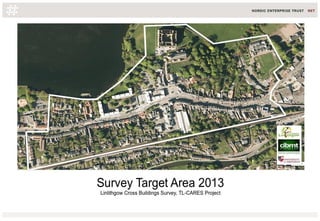
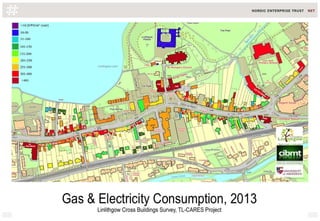
Objective 1 – map energy use in Linlithgow Cross
Objective 2 – identify & prioritise viable least carbon
fuel cost interventions leading to energy descent
Systemic Funding Problem
Denmark's fiscally robust local government guaranteed
finance of renewables & funded heat infrastructure
UK intermediated 'for £ profit' market economy
- renewables compete with profitable marginal energy
- energy efficiency reduces energy sales
So if private sector won't & public sector can't, how can
renewables & energy savings be funded?
Linlithgow Natural Grid – Phase 2
Edinburgh Centre for Carbon Innovation (ECCI) Smart
Accelerator programme
Development of community-based instruments &
protocols to accelerate community energy projects
Instruments - Prepay Energy Credit
Protocols - Energy Partnership & Energy Pool
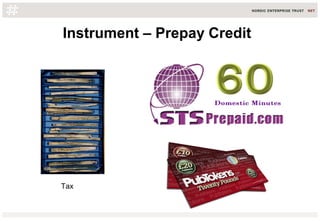
Instrument – Prepay Credit
Tax
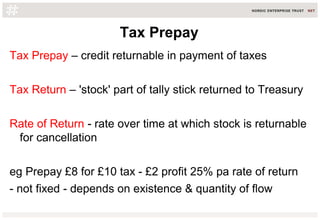
Tax Prepay
Tax Prepay – credit returnable in payment of taxes
Tax Return – 'stock' part of tally stick returned to Treasury
Rate of Return - rate over time at which stock is returnable
for cancellation
eg Prepay £8 for £10 tax - £2 profit 25% pa rate of return
- not fixed - depends on existence & quantity of flow
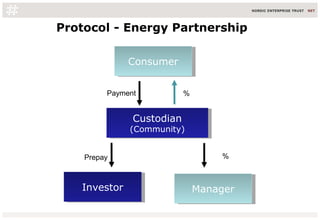
Protocol - Energy Partnership
Custodian
(Community)
Custodian
(Community)
InvestorInvestor
ConsumerConsumer
Prepay %
%
ManagerManager
Payment
Energy Partnership – Energy as a Service
Social Contract - relationship-based not transaction-based;
costs transformed to revenue shares
Neutrality – removes ego and politics
Collaborative - stakeholder interests aligned
Sustainable - all have interest in minimising cost over time
Energy Prepay – the Value Proposition
Community
- sells value of future energy production or savings
- interest-free energy loan until credit cancelled by
return vs supply or repurchase from energy savings
Consumer
- prepays for energy and locks in price
Energy Prepay – the Value Proposition
Investor
- Energy Loan investment directly “Peer to Asset”
- Consumers buy credits from Investors at best price
below physical energy price & return against supply
Manager
- shares in gross revenues or production
- interests aligned with Investor
- no 'Principal/Agency' problem
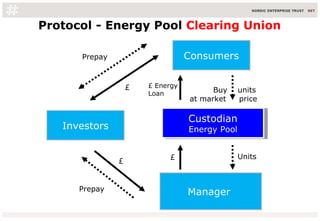
Protocol - Energy Pool Clearing Union
Custodian
Energy Pool
Custodian
Energy PoolInvestors
Consumers
Manager
£ Energy
Loan
Buy units
at market price
£
Prepay
Prepay
Units
£
£
Q1: Based on your current research or practice, what
potential future research in your area and/or
multidisciplinary research should follow?
A. Implementation of protocols and instruments in two
Linlithgow proof of concept locations:
- Linlithgow Energy Park – business oriented
- Vennel Energy – community oriented
Next StepsNext Steps
Q2: How the outputs of your research and/or practice
could support social innovation, i.e. engagement of
community groups or individuals in applying the
research or practice outputs to contribute to more
sustainable living?
A. Subscription of the community to the aims of
Linlithgow Natural Grid via subscription to the protocols
NB. More expensive carbon fuel becomes, the more £
profit there is in saving it – reduced CO2 use follows
Next StepsNext Steps
Q3: What dissemination routes would enable faster
understanding and application of new knowledge not
only by businesses and industry, but also by
communities and entrepreneurial individuals?
A. Cascading local community engagement for older
generations plus social media for younger generations
Suitably crafted documentaries and reality TV
Community level events & engagement
Next StepsNext Steps
Q4: Who might be potential enablers of knowledge
dissemination to the population – government and its
agencies, local authorities, community groups, media,
online knowledge platforms, etc. ?
A. Cadre of local & neighbourhood energy developers
to lead development & disseminate best practice
Developer Guild approach: apprentice, journeyman,
master ?
Paid out of energy production & reduction
Next StepsNext Steps
Q5: What governance frameworks and partnerships
should be developed to support social innovation?
A. Collective risk sharing – Guarantee Society
Associative production sharing – Capital Partnership
Nondominium governance
No stakeholder has dominant rights: stakeholders have
veto rights on matters which concern them
Next StepsNext Steps
Q6: What ‘big data’ do communities and innovators
need to enable development of innovative solutions in
your area of research or practice?
A. Energy production & use data.
Geospatial data.
Resource data – especially water
Transport use data
Next StepsNext Steps
Q7: What tools should be developed for different users
to enable the application of a systems approach in
decision-making on governance, planning,
infrastructure systems and development of innovative
solutions?
A. Innovative use of graphic design & 3D
representations
Online decision making tools - liquid democracy
Social engagement
Next StepsNext Steps
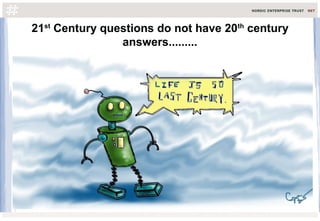
21st
Century questions do not have 20th
century
answers.........
…....21st
century answers pre-date modern finance

Sustainability & resilience 23 04_15

  • 1.
    Beyond Cities Community Actionfor Transition to Sustainable Living Chris Cook Glasgow 23rd April 2015
  • 2.
    “21st Century questions donot have 20th Century answers”
  • 3.
    Introduction - Resilience Resilience- the enduring power of a body or bodies for transformation, renewal and recovery through the flux of interactions and flow of events Resource Resilience – keeping the lights on Human Resilience – building capacity & capability Financial Resilience – financial system which does not come two hours away from collapse
  • 4.
    Introduction – 21st CenturyQuestions What are the operating principles of a sustainable society? What are the protocols & frameworks within which these principles may be made manifest? What instruments are necessary within such frameworks?
  • 5.
    Introduction – ResearchMethodology Review of current global policy to identify successful operating principles, protocols and instruments Review of historic protocols and instruments Action-based research: Micro - proof of concept at community level Macro – eg Caspian Energy Grid initiative Systems Thinking - if resilient Micro is networked outcome should be resilient Macro
  • 6.
    Resource Resilience –Case of Denmark Since 1980 Denmark's GDP rose 78% Energy use has been stable Carbon fuel use has declined significantly How did Denmark achieve this?
  • 7.
    Resource Resilience Least CarbonFuel Cost principle - minimum carbon fuel input for a given output of electricity, heat or power - investment in renewables, heat, transport, energy efficiency - distinct from least DK cost (or least $, € or £ cost)
  • 8.
    Emerging Outcome -Natural Grid - decentralised/distributed energy - knowledge & knowhow base: Vestas the biggest global wind turbine company in country of 6m people - trend to energy security and energy independence - not forgetting........reduction in carbon use
  • 9.
    Linlithgow Natural Grid(LNG) – Phase 1 Aim: Linlithgow to become independent in energy Means: application of least carbon fuel cost principle Catalyst - Mainstreaming Innovation academic input - CARES funded study carried out by Dr Mohammed Imbabi of Aberdeen University
  • 10.
    Linlithgow Natural Grid- Initial Study Objective 1 – map energy use in Linlithgow Cross Objective 2 – identify & prioritise viable least carbon fuel cost interventions leading to energy descent
  • 13.
    Systemic Funding Problem Denmark'sfiscally robust local government guaranteed finance of renewables & funded heat infrastructure UK intermediated 'for £ profit' market economy - renewables compete with profitable marginal energy - energy efficiency reduces energy sales So if private sector won't & public sector can't, how can renewables & energy savings be funded?
  • 14.
    Linlithgow Natural Grid– Phase 2 Edinburgh Centre for Carbon Innovation (ECCI) Smart Accelerator programme Development of community-based instruments & protocols to accelerate community energy projects Instruments - Prepay Energy Credit Protocols - Energy Partnership & Energy Pool
  • 15.
  • 16.
    Tax Prepay Tax Prepay– credit returnable in payment of taxes Tax Return – 'stock' part of tally stick returned to Treasury Rate of Return - rate over time at which stock is returnable for cancellation eg Prepay £8 for £10 tax - £2 profit 25% pa rate of return - not fixed - depends on existence & quantity of flow
  • 17.
    Protocol - EnergyPartnership Custodian (Community) Custodian (Community) InvestorInvestor ConsumerConsumer Prepay % % ManagerManager Payment
  • 18.
    Energy Partnership –Energy as a Service Social Contract - relationship-based not transaction-based; costs transformed to revenue shares Neutrality – removes ego and politics Collaborative - stakeholder interests aligned Sustainable - all have interest in minimising cost over time
  • 19.
    Energy Prepay –the Value Proposition Community - sells value of future energy production or savings - interest-free energy loan until credit cancelled by return vs supply or repurchase from energy savings Consumer - prepays for energy and locks in price
  • 20.
    Energy Prepay –the Value Proposition Investor - Energy Loan investment directly “Peer to Asset” - Consumers buy credits from Investors at best price below physical energy price & return against supply Manager - shares in gross revenues or production - interests aligned with Investor - no 'Principal/Agency' problem
  • 21.
    Protocol - EnergyPool Clearing Union Custodian Energy Pool Custodian Energy PoolInvestors Consumers Manager £ Energy Loan Buy units at market price £ Prepay Prepay Units £ £
  • 22.
    Q1: Based onyour current research or practice, what potential future research in your area and/or multidisciplinary research should follow? A. Implementation of protocols and instruments in two Linlithgow proof of concept locations: - Linlithgow Energy Park – business oriented - Vennel Energy – community oriented Next StepsNext Steps
  • 23.
    Q2: How theoutputs of your research and/or practice could support social innovation, i.e. engagement of community groups or individuals in applying the research or practice outputs to contribute to more sustainable living? A. Subscription of the community to the aims of Linlithgow Natural Grid via subscription to the protocols NB. More expensive carbon fuel becomes, the more £ profit there is in saving it – reduced CO2 use follows Next StepsNext Steps
  • 24.
    Q3: What disseminationroutes would enable faster understanding and application of new knowledge not only by businesses and industry, but also by communities and entrepreneurial individuals? A. Cascading local community engagement for older generations plus social media for younger generations Suitably crafted documentaries and reality TV Community level events & engagement Next StepsNext Steps
  • 25.
    Q4: Who mightbe potential enablers of knowledge dissemination to the population – government and its agencies, local authorities, community groups, media, online knowledge platforms, etc. ? A. Cadre of local & neighbourhood energy developers to lead development & disseminate best practice Developer Guild approach: apprentice, journeyman, master ? Paid out of energy production & reduction Next StepsNext Steps
  • 26.
    Q5: What governanceframeworks and partnerships should be developed to support social innovation? A. Collective risk sharing – Guarantee Society Associative production sharing – Capital Partnership Nondominium governance No stakeholder has dominant rights: stakeholders have veto rights on matters which concern them Next StepsNext Steps
  • 27.
    Q6: What ‘bigdata’ do communities and innovators need to enable development of innovative solutions in your area of research or practice? A. Energy production & use data. Geospatial data. Resource data – especially water Transport use data Next StepsNext Steps
  • 28.
    Q7: What toolsshould be developed for different users to enable the application of a systems approach in decision-making on governance, planning, infrastructure systems and development of innovative solutions? A. Innovative use of graphic design & 3D representations Online decision making tools - liquid democracy Social engagement Next StepsNext Steps
  • 29.
    21st Century questions donot have 20th century answers.........
  • 30.