Protecting sources
A constitutional clash — with
the media on the losing end
An old dilemma
• In 1848, John Nugent of the New York
Herald was held for refusing to identify a
source to the Senate
An old dilemma
• In 1848, John Nugent of the New York
Herald was held for refusing to identify a
source to the Senate
• The Herald gave Nugent a raise
An old dilemma
• In 1848, John Nugent of the New York
Herald was held for refusing to identify a
source to the Senate
• The Herald gave Nugent a raise
• After a month, the Senate gave up
Another clash over the Sixth
• “[T]he accused shall enjoy the right … to
have compulsory process for obtaining
witnesses in his favor”
Another clash over the Sixth
• “[T]he accused shall enjoy the right … to
have compulsory process for obtaining
witnesses in his favor”
• All must testify before the grand jury
Another clash over the Sixth
• “[T]he accused shall enjoy the right … to
have compulsory process for obtaining
witnesses in his favor”
• All must testify before the grand jury
• The First Amendment belongs to everyone,
not just the press
Another clash over the Sixth
• “[T]he accused shall enjoy the right … to
have compulsory process for obtaining
witnesses in his favor”
• All must testify before the grand jury
• The First Amendment belongs to everyone,
not just the press
• In practice, demands for sources generally
come from the government
Journalist’s or
reporter’s privilege
• As with free press/fair trial, a balancing test
Journalist’s or
reporter’s privilege
• As with free press/fair trial, a balancing test
• Courts decide on a case-by-case basis
Journalist’s or
reporter’s privilege
• As with free press/fair trial, a balancing test
• Courts decide on a case-by-case basis
• Guidelines have shifted over time
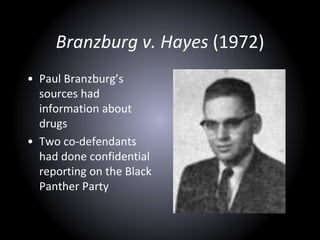
Branzburg v. Hayes (1972)
• Paul Branzburg’s
sources had
information about
drugs
• Two co-defendants
had done confidential
reporting on the Black
Panther Party
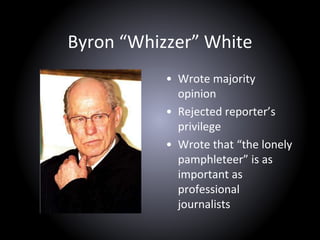
Byron “Whizzer” White
• Wrote majority
opinion
• Rejected reporter’s
privilege
• Wrote that “the lonely
pamphleteer” is as
important as
professional
journalists
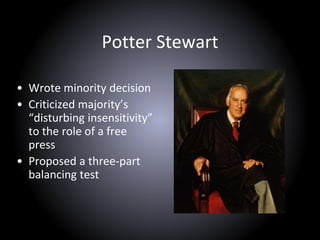
Potter Stewart
• Wrote minority decision
• Criticized majority’s
“disturbing insensitivity”
to the role of a free
press
• Proposed a three-part
balancing test
The Stewart test
• Does the journalist possess “clearly relevant”
information?
The Stewart test
• Does the journalist possess “clearly relevant”
information?
• Is there no way of obtaining the information by
“less destructive” means?
The Stewart test
• Does the journalist possess “clearly relevant”
information?
• Is there no way of obtaining the information by
“less destructive” means?
• Is there a “compelling and overriding need” for
the information?
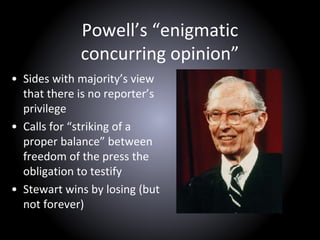
Powell’s “enigmatic
concurring opinion”
• Sides with majority’s view
that there is no reporter’s
privilege
• Calls for “striking of a
proper balance” between
freedom of the press the
obligation to testify
• Stewart wins by losing (but
not forever)
The balancing test in practice
• Relevance and importance of information
The balancing test in practice
• Relevance and importance of information
• Availability through alternative means
The balancing test in practice
• Relevance and importance of information
• Availability through alternative means
• Type of controversy
– Reporter’s privilege is weaker in a criminal case
than a civil case
The balancing test in practice
• Relevance and importance of information
• Availability through alternative means
• Type of controversy
• How information was gathered
– Confidential sources are more privileged than
first-hand observation
Shield laws
• About 30 states have them
– A shield law is being considered in
Massachusetts
Shield laws
• About 30 states have them
• Except for Wyoming, remaining states have
judicial opinions granting some degree of
journalistic privilege
Shield laws
• About 30 states have them
• Except for Wyoming, remaining states have
judicial opinions granting some degree of
journalistic privilege
• None is absolute — more like the Stewart
balancing test
Shield laws
• About 30 states have them
• Except for Wyoming, remaining states have
judicial opinions granting some degree of
journalistic privilege
• None is absolute — more like the Stewart
balancing test
• No federal shield law
What should be protected?
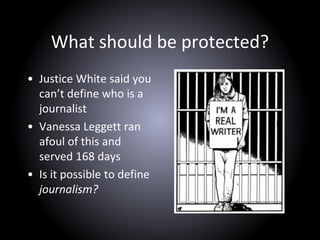
• Justice White said you
can’t define who is a
journalist
• Vanessa Leggett ran
afoul of this and
served 168 days
• Is it possible to define
journalism?
Cohen v. Cowles
Media Co. (1991)
• Damned if you do, damned if you don’t
Cohen v. Cowles
Media Co. (1991)
• Damned if you do, damned if you don’t
• Based on the doctrine of promissory estoppel
– A false promise that leads someone to engage in
damaging behavior
– Similar to contract law
Cohen v. Cowles
Media Co. (1991)
• Damned if you do, damned if you don’t
• Based on the doctrine of promissory estoppel
– A false promise that leads someone to engage in
damaging behavior
– Similar to contract law
• Justice White: “generally applicable laws” do
not violate First Amendment
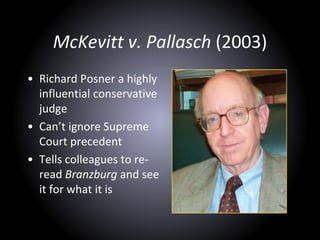
McKevitt v. Pallasch (2003)
• Richard Posner a highly
influential conservative
judge
• Can’t ignore Supreme
Court precedent
• Tells colleagues to re-
read Branzburg and see
it for what it is
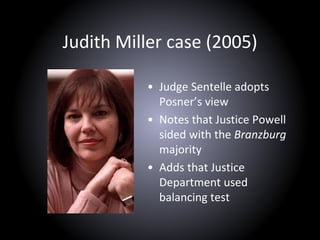
Judith Miller case (2005)
• Judge Sentelle adopts
Posner’s view
• Notes that Justice Powell
sided with the Branzburg
majority
• Adds that Justice
Department used
balancing test
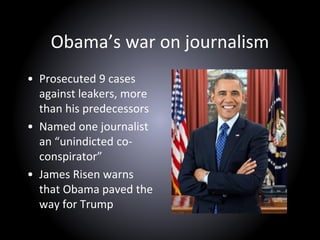
Obama’s war on journalism
• Prosecuted 9 cases
against leakers, more
than his predecessors
• Named one journalist
an “unindicted co-
conspirator”
• James Risen warns
that Obama paved the
way for Trump
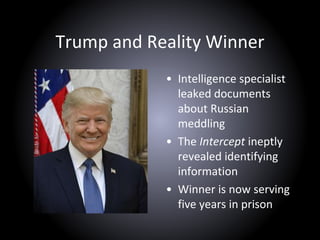
Trump and Reality Winner
• Intelligence specialist
leaked documents
about Russian
meddling
• The Intercept ineptly
revealed identifying
information
• Winner is now serving
five years in prison

Protecting Sources

  • 1.
    Protecting sources A constitutionalclash — with the media on the losing end
  • 2.
    An old dilemma •In 1848, John Nugent of the New York Herald was held for refusing to identify a source to the Senate
  • 3.
    An old dilemma •In 1848, John Nugent of the New York Herald was held for refusing to identify a source to the Senate • The Herald gave Nugent a raise
  • 4.
    An old dilemma •In 1848, John Nugent of the New York Herald was held for refusing to identify a source to the Senate • The Herald gave Nugent a raise • After a month, the Senate gave up
  • 5.
    Another clash overthe Sixth • “[T]he accused shall enjoy the right … to have compulsory process for obtaining witnesses in his favor”
  • 6.
    Another clash overthe Sixth • “[T]he accused shall enjoy the right … to have compulsory process for obtaining witnesses in his favor” • All must testify before the grand jury
  • 7.
    Another clash overthe Sixth • “[T]he accused shall enjoy the right … to have compulsory process for obtaining witnesses in his favor” • All must testify before the grand jury • The First Amendment belongs to everyone, not just the press
  • 8.
    Another clash overthe Sixth • “[T]he accused shall enjoy the right … to have compulsory process for obtaining witnesses in his favor” • All must testify before the grand jury • The First Amendment belongs to everyone, not just the press • In practice, demands for sources generally come from the government
  • 9.
    Journalist’s or reporter’s privilege •As with free press/fair trial, a balancing test
  • 10.
    Journalist’s or reporter’s privilege •As with free press/fair trial, a balancing test • Courts decide on a case-by-case basis
  • 11.
    Journalist’s or reporter’s privilege •As with free press/fair trial, a balancing test • Courts decide on a case-by-case basis • Guidelines have shifted over time
  • 12.
    Branzburg v. Hayes(1972) • Paul Branzburg’s sources had information about drugs • Two co-defendants had done confidential reporting on the Black Panther Party
  • 13.
    Byron “Whizzer” White •Wrote majority opinion • Rejected reporter’s privilege • Wrote that “the lonely pamphleteer” is as important as professional journalists
  • 14.
    Potter Stewart • Wroteminority decision • Criticized majority’s “disturbing insensitivity” to the role of a free press • Proposed a three-part balancing test
  • 15.
    The Stewart test •Does the journalist possess “clearly relevant” information?
  • 16.
    The Stewart test •Does the journalist possess “clearly relevant” information? • Is there no way of obtaining the information by “less destructive” means?
  • 17.
    The Stewart test •Does the journalist possess “clearly relevant” information? • Is there no way of obtaining the information by “less destructive” means? • Is there a “compelling and overriding need” for the information?
  • 18.
    Powell’s “enigmatic concurring opinion” •Sides with majority’s view that there is no reporter’s privilege • Calls for “striking of a proper balance” between freedom of the press the obligation to testify • Stewart wins by losing (but not forever)
  • 19.
    The balancing testin practice • Relevance and importance of information
  • 20.
    The balancing testin practice • Relevance and importance of information • Availability through alternative means
  • 21.
    The balancing testin practice • Relevance and importance of information • Availability through alternative means • Type of controversy – Reporter’s privilege is weaker in a criminal case than a civil case
  • 22.
    The balancing testin practice • Relevance and importance of information • Availability through alternative means • Type of controversy • How information was gathered – Confidential sources are more privileged than first-hand observation
  • 23.
    Shield laws • About30 states have them – A shield law is being considered in Massachusetts
  • 24.
    Shield laws • About30 states have them • Except for Wyoming, remaining states have judicial opinions granting some degree of journalistic privilege
  • 25.
    Shield laws • About30 states have them • Except for Wyoming, remaining states have judicial opinions granting some degree of journalistic privilege • None is absolute — more like the Stewart balancing test
  • 26.
    Shield laws • About30 states have them • Except for Wyoming, remaining states have judicial opinions granting some degree of journalistic privilege • None is absolute — more like the Stewart balancing test • No federal shield law
  • 27.
    What should beprotected? • Justice White said you can’t define who is a journalist • Vanessa Leggett ran afoul of this and served 168 days • Is it possible to define journalism?
  • 28.
    Cohen v. Cowles MediaCo. (1991) • Damned if you do, damned if you don’t
  • 29.
    Cohen v. Cowles MediaCo. (1991) • Damned if you do, damned if you don’t • Based on the doctrine of promissory estoppel – A false promise that leads someone to engage in damaging behavior – Similar to contract law
  • 30.
    Cohen v. Cowles MediaCo. (1991) • Damned if you do, damned if you don’t • Based on the doctrine of promissory estoppel – A false promise that leads someone to engage in damaging behavior – Similar to contract law • Justice White: “generally applicable laws” do not violate First Amendment
  • 31.
    McKevitt v. Pallasch(2003) • Richard Posner a highly influential conservative judge • Can’t ignore Supreme Court precedent • Tells colleagues to re- read Branzburg and see it for what it is
  • 32.
    Judith Miller case(2005) • Judge Sentelle adopts Posner’s view • Notes that Justice Powell sided with the Branzburg majority • Adds that Justice Department used balancing test
  • 33.
    Obama’s war onjournalism • Prosecuted 9 cases against leakers, more than his predecessors • Named one journalist an “unindicted co- conspirator” • James Risen warns that Obama paved the way for Trump
  • 34.
    Trump and RealityWinner • Intelligence specialist leaked documents about Russian meddling • The Intercept ineptly revealed identifying information • Winner is now serving five years in prison