William O. Douglas
ASSOCIATE JUSTICE
6/16/2014Dan Lewis 1
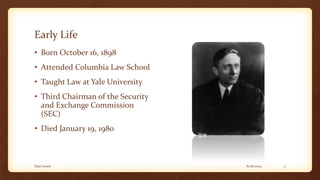
Early Life
• Born October 16, 1898
• Attended Columbia Law School
• Taught Law at Yale University
• Third Chairman of the Security
and Exchange Commission
(SEC)
• Died January 19, 1980
6/16/2014Dan Lewis 2
Supreme Court
6/16/2014Dan Lewis 3
Associate Justice
• 79th Person to Serve on the Court
• Nominated by Franklin Roosevelt
• Replaced Louis Brandies
• Served From April 19th, 1939 – November 12th, 1975
• His term of 36 years and 209 days is the longest of any Justice on the
Supreme Court
• Was succeeded by John Paul Stevens
6/16/2014Dan Lewis 4
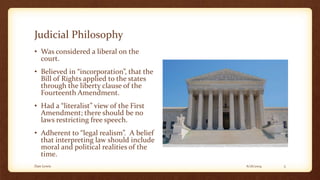
Judicial Philosophy
• Was considered a liberal on the
court.
• Believed in “incorporation”, that the
Bill of Rights applied to the states
through the liberty clause of the
Fourteenth Amendment.
• Had a “literalist” view of the First
Amendment; there should be no
laws restricting free speech.
• Adherent to “legal realism”. A belief
that interpreting law should include
moral and political realities of the
time.
6/16/2014Dan Lewis 5
Landmark Cases
6/16/2014Dan Lewis 6
Terminiello v. Chicago (1949)
• Arthur Terminiello, a Catholic Priest, violated a “breach of peace”
ordinance in Chicago
• Douglas wrote the majority opinion in the 5-4 decision overturning
Terminiello’s conviction.
6/16/2014Dan Lewis 7
Yates v. United States (1957)
• Involved the prosecution of 14 low level Communist Party members under the
Smith Act
• The Smith Act (Alien Registration Act of 1940) was passed to punish individuals who
would overthrow the government.
• Douglas concurred with Hugo Black in the 6-1 decision overturning the 14
party members convictions
• The ruling changed the way the Smith Act was enforced
• Before the ruling members of any party that at one time advocated overthrowing the
government could be imprisoned.
• After the ruling violating the Smith Act required encouraging or inciting an overthrow
of the government.
• Along with the case Watkins V United States, Yates effectively ended the
second red scare.
6/16/2014Dan Lewis 8
Mapp v. Ohio (1961)
• First case in which the Warren Court applied the Bill of Rights in a
criminal case to the individual states through the Fourteenth
Amendment.
• Dollree Mapp was arrested after police officers used a fake warrant to
search her house and found obscene material and arrester her.
• The court decision overturned her conviction by applying the Fourth
Amendment to the states through the Fourteenth Amendment
• The ruling also prohibited the use of evidence in state courts that was
obtained in violation of the Fourth Amendment.
6/16/2014Dan Lewis 9
Griswold v. Connecticut (1965)
• Case concerning a Connecticut law banning contraception
• The ruling contained multiple opinions overturning the Connecticut
law.
• Douglas’ majority opinion was one of his most controversial. In his
opinion Douglas stated that while there was no explicit right to privacy
in the Constitution the first nine amendments implied a right to
privacy from the government.
• This case was later cited in the Roe v. Wade opinions.
6/16/2014Dan Lewis 10
Other Information
6/16/2014Dan Lewis 11
Impeachment Attempts
• Two attempts to impeach William Douglass
• The first involved the Rosenberg case in 1953
• Julius and Ethel Rosenberg were sentenced to death for trading state secrets to the
Soviet Union.
• Douglas granted a stay of execution because the Rosenbergs were sentenced
without a trial
• The outrage during the second Red Scare lead to a resolution of impeachment by
Represenative William Wheeler of Georgia
• The second impeachment attempt happened in 1970 and involved
Douglas’ financial ties to a private foundation.
6/16/2014Dan Lewis 12
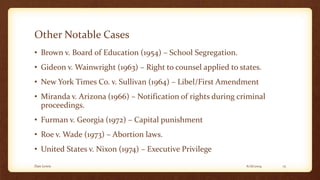
Other Notable Cases
• Brown v. Board of Education (1954) – School Segregation.
• Gideon v. Wainwright (1963) – Right to counsel applied to states.
• New York Times Co. v. Sullivan (1964) – Libel/First Amendment
• Miranda v. Arizona (1966) – Notification of rights during criminal
proceedings.
• Furman v. Georgia (1972) – Capital punishment
• Roe v. Wade (1973) – Abortion laws.
• United States v. Nixon (1974) – Executive Privilege
6/16/2014Dan Lewis 13
The End
6/16/2014Dan Lewis 14

William douglas

  • 1.
    William O. Douglas ASSOCIATEJUSTICE 6/16/2014Dan Lewis 1
  • 2.
    Early Life • BornOctober 16, 1898 • Attended Columbia Law School • Taught Law at Yale University • Third Chairman of the Security and Exchange Commission (SEC) • Died January 19, 1980 6/16/2014Dan Lewis 2
  • 3.
  • 4.
    Associate Justice • 79thPerson to Serve on the Court • Nominated by Franklin Roosevelt • Replaced Louis Brandies • Served From April 19th, 1939 – November 12th, 1975 • His term of 36 years and 209 days is the longest of any Justice on the Supreme Court • Was succeeded by John Paul Stevens 6/16/2014Dan Lewis 4
  • 5.
    Judicial Philosophy • Wasconsidered a liberal on the court. • Believed in “incorporation”, that the Bill of Rights applied to the states through the liberty clause of the Fourteenth Amendment. • Had a “literalist” view of the First Amendment; there should be no laws restricting free speech. • Adherent to “legal realism”. A belief that interpreting law should include moral and political realities of the time. 6/16/2014Dan Lewis 5
  • 6.
  • 7.
    Terminiello v. Chicago(1949) • Arthur Terminiello, a Catholic Priest, violated a “breach of peace” ordinance in Chicago • Douglas wrote the majority opinion in the 5-4 decision overturning Terminiello’s conviction. 6/16/2014Dan Lewis 7
  • 8.
    Yates v. UnitedStates (1957) • Involved the prosecution of 14 low level Communist Party members under the Smith Act • The Smith Act (Alien Registration Act of 1940) was passed to punish individuals who would overthrow the government. • Douglas concurred with Hugo Black in the 6-1 decision overturning the 14 party members convictions • The ruling changed the way the Smith Act was enforced • Before the ruling members of any party that at one time advocated overthrowing the government could be imprisoned. • After the ruling violating the Smith Act required encouraging or inciting an overthrow of the government. • Along with the case Watkins V United States, Yates effectively ended the second red scare. 6/16/2014Dan Lewis 8
  • 9.
    Mapp v. Ohio(1961) • First case in which the Warren Court applied the Bill of Rights in a criminal case to the individual states through the Fourteenth Amendment. • Dollree Mapp was arrested after police officers used a fake warrant to search her house and found obscene material and arrester her. • The court decision overturned her conviction by applying the Fourth Amendment to the states through the Fourteenth Amendment • The ruling also prohibited the use of evidence in state courts that was obtained in violation of the Fourth Amendment. 6/16/2014Dan Lewis 9
  • 10.
    Griswold v. Connecticut(1965) • Case concerning a Connecticut law banning contraception • The ruling contained multiple opinions overturning the Connecticut law. • Douglas’ majority opinion was one of his most controversial. In his opinion Douglas stated that while there was no explicit right to privacy in the Constitution the first nine amendments implied a right to privacy from the government. • This case was later cited in the Roe v. Wade opinions. 6/16/2014Dan Lewis 10
  • 11.
  • 12.
    Impeachment Attempts • Twoattempts to impeach William Douglass • The first involved the Rosenberg case in 1953 • Julius and Ethel Rosenberg were sentenced to death for trading state secrets to the Soviet Union. • Douglas granted a stay of execution because the Rosenbergs were sentenced without a trial • The outrage during the second Red Scare lead to a resolution of impeachment by Represenative William Wheeler of Georgia • The second impeachment attempt happened in 1970 and involved Douglas’ financial ties to a private foundation. 6/16/2014Dan Lewis 12
  • 13.
    Other Notable Cases •Brown v. Board of Education (1954) – School Segregation. • Gideon v. Wainwright (1963) – Right to counsel applied to states. • New York Times Co. v. Sullivan (1964) – Libel/First Amendment • Miranda v. Arizona (1966) – Notification of rights during criminal proceedings. • Furman v. Georgia (1972) – Capital punishment • Roe v. Wade (1973) – Abortion laws. • United States v. Nixon (1974) – Executive Privilege 6/16/2014Dan Lewis 13
  • 14.