950 to 710 BC
Two artificial toes attributed
to Ancient Egyptian noblewoman.
Currently the oldest known
functional prosthetics
300 BC
Artificial leg fashioned from
bronze and wood excavated
from a grave in Capua, Italy
218 to 201 BC
Roman General Marcus Sergius
wears artificial iron hand to hold
his shield during the Punic War
History of
Prosthetics
500 to 1500 (The Dark Ages)
Scientific development stagnates. Prosthesis
limited to hook hands and peg legs for most.
Mortality rate for amputees high due to infection
1564
Ambroise Paré publishes
Dix livres de la chirurgie.
Prosthetics with articulated joints,
adjustable harness and knee lock
control all feature
1861
Hanger Orthopedic Group founded by
the first amputee of the American Civil War
as a local company specializing in prosthetics
Rubber hand is invented. Could be
slipped from the socket and replaced
with various tools (ie. eating utensils)
1898
Giulano Vanghetti introduces
upper-limb prostheses powered
by muscle contractions
1863
Dubois L Parmelee improves artificial limbs
by utilizing suction to attach limbs to sockets.
Also introduces the multi-articulated foot
1945
National Academy of Sciences
establishes artificial limb program in
response to WWII veteran amputees.
Rapid progress in prosthetics arise
1980s
CAT-CAM socket is invented.
Improves general patient
rehabilitation as shown in
clinical trials
1980s
Myoelectric prostheses gain
popularity. Offers benefits
such as proportional control
through the use of sensors
2006
DARPA launches the
Revolutionizing Prosthetics
program. Aims to advance
upper-limb technology
2012
Quadripalegic woman
Jan Scheuerman
manipulates a robotic
arm through thought
2009
Muscle reinnervation (TMR)
prosthesis invented. Able to
control prosthesis by
thought + sensory feedback
2012
Zac Vawter uses his
TMR Myoelectric leg
to climb 103 steps of
Chicago’s Willis Tower
http://evolutionaryprosthetics.wordpress.com/
By Basim Al-Baker
20
90
M
ilitary-funded advancements in prosthetics stagnate
2100s Prosthetics and Augmentation industries disrupted by Flexi-Hologram
2100s+ Scientists unlock the key to
cell
2017
DARPA breakthrough in wireless 2018 3D scanners and printers 2020 Amazon begins prin
ting
2015
Prosthetics offer an energy output and input
203
0s
Prosthetics split into two fields
2030s Prosthetics go the way of plastic surgery 2035 Prosthetics & Augmentation Regulatory Board
as warfare is largely unmanned
technology. Fully usable holographic artificial limbs are a reality
regeneration. Prosthetics
implant transmitting signals make individualised limbs
customised prosthetic
s
approaching those of the human counterpart
functional- realistic and
with unlicensed and licensed clinics.
(PARB) founded to regulate enhancements.
are no longer required
to prosthetics
for amputees
for home delivery
super-enhanced
Introduction of voluntary prosthesis
More than two super-enhancements illegal
http://evolutionaryprosthetics.wordpress.com/
Future of
Prosthetics
By Basim Al-Baker

Prosthetics Industry Infographic

  • 1.
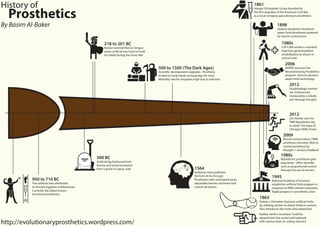
    950 to 710BC Two artificial toes attributed to Ancient Egyptian noblewoman. Currently the oldest known functional prosthetics 300 BC Artificial leg fashioned from bronze and wood excavated from a grave in Capua, Italy 218 to 201 BC Roman General Marcus Sergius wears artificial iron hand to hold his shield during the Punic War History of Prosthetics 500 to 1500 (The Dark Ages) Scientific development stagnates. Prosthesis limited to hook hands and peg legs for most. Mortality rate for amputees high due to infection 1564 Ambroise Paré publishes Dix livres de la chirurgie. Prosthetics with articulated joints, adjustable harness and knee lock control all feature 1861 Hanger Orthopedic Group founded by the first amputee of the American Civil War as a local company specializing in prosthetics Rubber hand is invented. Could be slipped from the socket and replaced with various tools (ie. eating utensils) 1898 Giulano Vanghetti introduces upper-limb prostheses powered by muscle contractions 1863 Dubois L Parmelee improves artificial limbs by utilizing suction to attach limbs to sockets. Also introduces the multi-articulated foot 1945 National Academy of Sciences establishes artificial limb program in response to WWII veteran amputees. Rapid progress in prosthetics arise 1980s CAT-CAM socket is invented. Improves general patient rehabilitation as shown in clinical trials 1980s Myoelectric prostheses gain popularity. Offers benefits such as proportional control through the use of sensors 2006 DARPA launches the Revolutionizing Prosthetics program. Aims to advance upper-limb technology 2012 Quadripalegic woman Jan Scheuerman manipulates a robotic arm through thought 2009 Muscle reinnervation (TMR) prosthesis invented. Able to control prosthesis by thought + sensory feedback 2012 Zac Vawter uses his TMR Myoelectric leg to climb 103 steps of Chicago’s Willis Tower http://evolutionaryprosthetics.wordpress.com/ By Basim Al-Baker
  • 2.
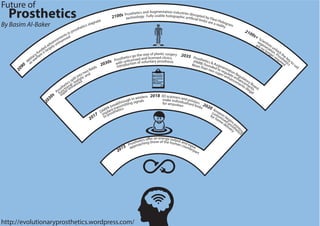
    20 90 M ilitary-funded advancements inprosthetics stagnate 2100s Prosthetics and Augmentation industries disrupted by Flexi-Hologram 2100s+ Scientists unlock the key to cell 2017 DARPA breakthrough in wireless 2018 3D scanners and printers 2020 Amazon begins prin ting 2015 Prosthetics offer an energy output and input 203 0s Prosthetics split into two fields 2030s Prosthetics go the way of plastic surgery 2035 Prosthetics & Augmentation Regulatory Board as warfare is largely unmanned technology. Fully usable holographic artificial limbs are a reality regeneration. Prosthetics implant transmitting signals make individualised limbs customised prosthetic s approaching those of the human counterpart functional- realistic and with unlicensed and licensed clinics. (PARB) founded to regulate enhancements. are no longer required to prosthetics for amputees for home delivery super-enhanced Introduction of voluntary prosthesis More than two super-enhancements illegal http://evolutionaryprosthetics.wordpress.com/ Future of Prosthetics By Basim Al-Baker