Bionics 4
Bionics 4
Kevin Warwick
Kevin Warwick
Artificial Limbs
Artificial Limbs
• An
An artificial limb
artificial limb usually replaces a
usually replaces a
missing limb, such as an arm or leg.
• The type of artificial limb used is
The type of artificial limb used is
determined largely by the extent of
amputation of the missing extremity –
each one is a little different.
• Reasons include disease, accidents, and
Reasons include disease, accidents, and
congenital (birth) defects.
Geography
Geography
• Likely reasons for an amputation
Likely reasons for an amputation
depend on location.
depend on location.
• In USA & Europe circulatory disease,
In USA & Europe circulatory disease,
cancer and infection are the leading
causes.
causes.
• In Africa the most likely causes are
In Africa the most likely causes are
industrial, vehicular, or a war related
accidents – again infection is a problem.
This Presentation
This Presentation
• More interested in the legs and arms
More interested in the legs and arms
themselves
themselves
• Neuroprosthetics & Enhancements etc
Neuroprosthetics & Enhancements etc
are mostly a separate lecture
History
History
• Two artificial toes have been found on
Two artificial toes have been found on
Egyptian mummies – these date back to
1,000BC. However it is not known if they were
actually used in life.
• The first artificial leg, from archaeology, is the
The first artificial leg, from archaeology, is the
Roman Capua Leg. This was found in a tomb
in Capua, Italy, and dates back to 300BC. It
was made of wood and copper.
• In the 15th century artificial limbs were often
In the 15th century artificial limbs were often
made out of iron for soldiers and sailors.
However wood came to be used much more,
simply because of its weight.
Wooden Legs
Wooden Legs
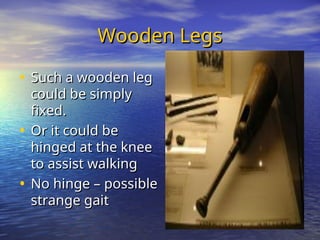
• Such a wooden leg
Such a wooden leg
could be simply
could be simply
fixed.
fixed.
• Or it could be
Or it could be
hinged at the knee
hinged at the knee
to assist walking
to assist walking
• No hinge – possible
No hinge – possible
strange gait
strange gait
Developments
Developments
• In the 19th century, artificial limbs became more
In the 19th century, artificial limbs became more
widespread due to the large number of amputees from
wars.
wars.
• Helped by the discovery of anesthetics.
Helped by the discovery of anesthetics.
• In the 20
In the 20th
th
century scientific research and commercial
possibilities opened the field further.
• In recent years, a great deal of emphasis has been
In recent years, a great deal of emphasis has been
placed on developing artificial limbs that look and
move more like actual human limbs.
• General new technology (plastics, CAD, manufacturing,
General new technology (plastics, CAD, manufacturing,
medicine) have all improved the end results.
Types of Prosthetic
Types of Prosthetic
• Transtibial Prosthesis
Transtibial Prosthesis replaces a leg missing below the knee. Such
replaces a leg missing below the knee. Such
amputees can regain normal movement more readily than those
with a transfemoral amputation - retaining the knee allows for easier
movement.
movement.
• Transfemoral Prostheses
Transfemoral Prostheses replaces a leg missing above the knee.
replaces a leg missing above the knee.
Such amputees can have a very difficult time regaining normal
movement. A transfemoral amputee must use approximately 80%
more energy to walk than a person with two whole legs.
• Transradial Prostheses
Transradial Prostheses replaces an arm missing below the elbow.
replaces an arm missing below the elbow.
Two main types of prosthetics are available. Cable operated limbs
work by attaching a harness and cable around the opposite shoulder
of the damaged arm. Alternative is myoelectric arms – muscle
sensing.
sensing.
• Transhumeral Prosthesis
Transhumeral Prosthesis replaces an arm missing above the
replaces an arm missing above the
elbow. Such amputees experience some of the same problems as
transfemoral amputees, due to the similar complexities associated
Recent Developments
Recent Developments
• New plastics and other materials, such as
New plastics and other materials, such as
carbon fibre, have allowed artificial limbs to be
stronger and lighter, limiting the amount of
extra energy necessary to operate the limb.
This is especially important for transfemoral
amputees.
amputees.
• Other synthetic materials have allowed artificial
Other synthetic materials have allowed artificial
limbs to look much more realistic, which is
important to transradial and transhumeral
amputees because they are more likely to have
the artificial limb exposed.
Artificial Legs
Artificial Legs
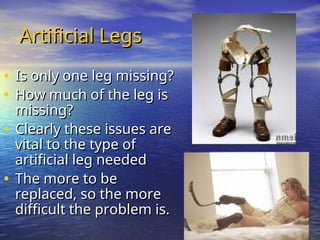
• Is only one leg missing?
Is only one leg missing?
• How much of the leg is
How much of the leg is
missing?
missing?
• Clearly these issues are
Clearly these issues are
vital to the type of
artificial leg needed
• The more to be
The more to be
replaced, so the more
difficult the problem is.
C-Leg
C-Leg
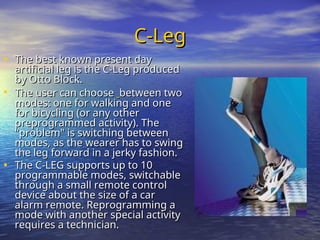
• The best known present day
The best known present day
artificial leg is the C-Leg produced
by Otto Block.
by Otto Block.
• The user can choose
The user can choose between two
between two
modes: one for walking and one
for bicycling (or any other
preprogrammed activity). The
"problem" is switching between
modes, as the wearer has to swing
the leg forward in a jerky fashion.
• The C-LEG supports up to 10
The C-LEG supports up to 10
programmable modes, switchable
through a small remote control
device about the size of a car
alarm remote. Reprogramming a
mode with another special activity
requires a technician.
C-Leg
C-Leg
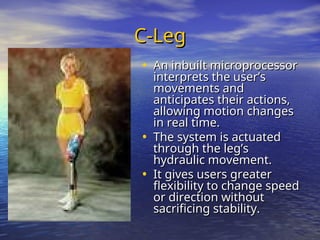
• An inbuilt microprocessor
An inbuilt microprocessor
interprets the user’s
movements and
movements and
anticipates their actions,
allowing motion changes
in real time.
in real time.
• The system is actuated
The system is actuated
through the leg’s
through the leg’s
hydraulic movement.
hydraulic movement.
• It gives users greater
It gives users greater
flexibility to change speed
or direction without
sacrificing stability.
C-Leg
C-Leg
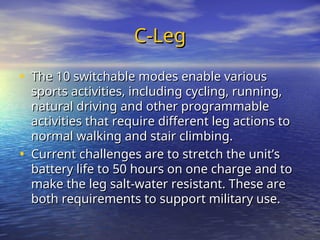
• The 10 switchable modes enable various
The 10 switchable modes enable various
sports activities, including cycling, running,
natural driving and other programmable
activities that require different leg actions to
normal walking and stair climbing.
• Current challenges are to stretch the unit’s
Current challenges are to stretch the unit’s
battery life to 50 hours on one charge and to
make the leg salt-water resistant. These are
both requirements to support military use.
Heather Mills
Heather Mills
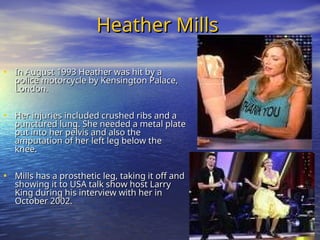
• In August 1993 Heather was hit by a
In August 1993 Heather was hit by a
police motorcycle by Kensington Palace,
London.
London.
• Her injuries included crushed ribs and a
Her injuries included crushed ribs and a
punctured lung. She needed a metal plate
put into her pelvis and also the
amputation of her left leg below the
knee.
knee.
• Mills has a prosthetic leg, taking it off and
Mills has a prosthetic leg, taking it off and
showing it to USA talk show host Larry
King during his interview with her in
October 2002.
October 2002.
Feet
Feet
• With artificial legs usually the knee joint
With artificial legs usually the knee joint
is critical
is critical
• Feet tend to be either non-existent, e.g.
Feet tend to be either non-existent, e.g.
Aimee Mullins, or are more for cosmetic
purposes – they are not functional
• Stability is important but not dexterity
Stability is important but not dexterity
• Tend to be purpose directed – what is
Tend to be purpose directed – what is
the leg for?
the leg for?
Artificial arms and hands
• Stability and power carrying are not big
Stability and power carrying are not big
issues here
issues here
• Elbow joints clearly are important
Elbow joints clearly are important
• But most critical are hand movements –
But most critical are hand movements –
what will the hand have to do? – how is it
to be controlled? – what will it look like?
• Functionality is important – but cosmetics
Functionality is important – but cosmetics
are also very important
Artificial Arms and Hands
• Important if one or both have been lost
Important if one or both have been lost
• It is possible to do many activities with one
It is possible to do many activities with one
hand or using a residual limb(s).
• Many arm amputees do not use any
Many arm amputees do not use any
prostheses or special tools. It is easy and
possible to get dressed/write/type with one
hand.
hand.
• Some continue their work with a special
Some continue their work with a special
attachment only e.g. carpentry, car driving.
• Nevertheless, having a prosthesis can be a big
Nevertheless, having a prosthesis can be a big
help, especially for manual labour.
Prosthesis
Prosthesis
• Learning to use a prosthesis takes hard work
Learning to use a prosthesis takes hard work
and practice. It is only worth the effort if it
improves a person’s ability to hold and use
things.
things.
• An arm-hand prosthesis has three basic parts:
An arm-hand prosthesis has three basic parts:
the socket, which fits over the residual limb; the
arm section, which may or may not include an
elbow joint; and the hand/tool, which can be
like a hand, a hook, or some other shape to
allow the person to hold and use things.
• Often a hook is preferred as it is extremely
Often a hook is preferred as it is extremely
functional
functional
Body-powered prostheses
• Some prosthetics clinics make available body-
Some prosthetics clinics make available body-
powered arm prostheses.
• These have straps or cables that attach to
These have straps or cables that attach to
other parts of the body, so that by moving a
shoulder, the person can make the hand close
or bend the elbow of the prosthesis.
• Body-powered prostheses often have metal
Body-powered prostheses often have metal
hooks instead of fingers. The hooks are better
than artificial fingers for hard work and can
pick up smaller things.
Electric-powered prostheses
• Electrical prostheses are available in some
Electrical prostheses are available in some
countries, but they are relatively expensive.
• Perhaps not available where they are needed
Perhaps not available where they are needed
- most (countries at war/strife).
• Muscles in the arm operate electric motors,
Muscles in the arm operate electric motors,
which close and open the hand.
• Electrical prostheses look more like real arms,
Electrical prostheses look more like real arms,
but they are not as strong and they break
more easily.
more easily.
Cosmetic prostheses
Cosmetic prostheses
• Cosmetic arms look like real arms but the
Cosmetic arms look like real arms but the
hands either do not move at all or can be
pulled (by another hand) into a fixed position.
• They can help a little (for example, the
They can help a little (for example, the
cosmetic arm can hold down a paper while
the other hand writes on it), but the real
purpose of a cosmetic arm is to look natural.
• Very useful for someone in the public eye.
Very useful for someone in the public eye.
• Useful if only one hand has been lost.
Useful if only one hand has been lost.
Krukenberg surgery
Krukenberg surgery
• Some people missing both hands choose to
Some people missing both hands choose to
have surgery, called the Krukenberg surgery.
• This separates the two bones of the forearm
This separates the two bones of the forearm
to make a new kind of “hand.”
• The bones can be used like two fingers, and
The bones can be used like two fingers, and
because the skin and bones are real, the
person can feel what they are doing.
• This greatly benefits amputees who are blind.
This greatly benefits amputees who are blind.
• It is still possible to wear a prosthesis over the
It is still possible to wear a prosthesis over the
residual limb even after the surgery.
The i-LIMB Hand
The i-LIMB Hand
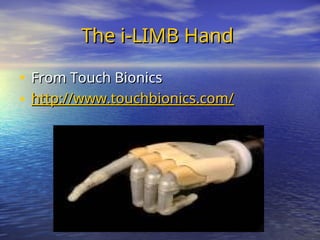
• From Touch Bionics
From Touch Bionics
• http://www.touchbionics.com/
http://www.touchbionics.com/
The i-LIMB Hand
The i-LIMB Hand
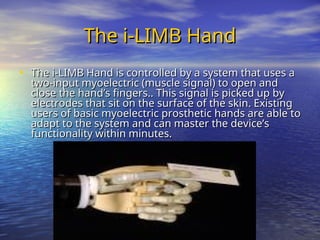
• The i-LIMB Hand is controlled by a system that uses a
The i-LIMB Hand is controlled by a system that uses a
two-input myoelectric (muscle signal) to open and
close the hand’s fingers.. This signal is picked up by
electrodes that sit on the surface of the skin. Existing
users of basic myoelectric prosthetic hands are able to
adapt to the system and can master the device’s
functionality within minutes.
Bionic Arm
Bionic Arm
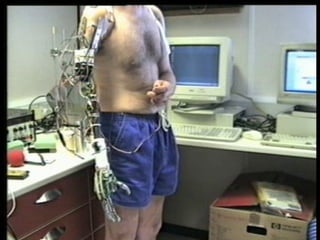
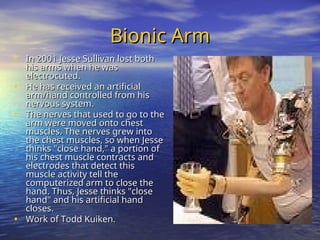
• In 2001 Jesse Sullivan lost both
In 2001 Jesse Sullivan lost both
his arms when he was
electrocuted.
electrocuted.
• He has received an artificial
He has received an artificial
arm/hand controlled from his
nervous system.
nervous system.
• The nerves that used to go to the
The nerves that used to go to the
arm were moved onto chest
muscles. The nerves grew into
the chest muscles, so when Jesse
thinks "close hand," a portion of
his chest muscle contracts and
electrodes that detect this
muscle activity tell the
computerized arm to close the
hand. Thus, Jesse thinks "close
hand" and his artificial hand
closes.
closes.
• Work of Todd Kuiken.
Work of Todd Kuiken.
Claudia Mitchell
Claudia Mitchell
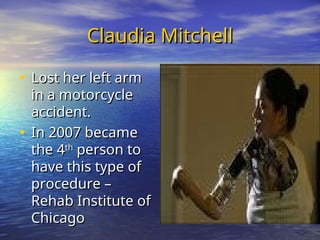
• Lost her left arm
Lost her left arm
in a motorcycle
in a motorcycle
accident.
accident.
• In 2007 became
In 2007 became
the 4
the 4th
th
person to
person to
have this type of
have this type of
procedure –
procedure –
Rehab Institute of
Rehab Institute of
Chicago
Chicago
Next Lecture
Next Lecture
• Deep Brain Stimulation
Deep Brain Stimulation

Bionic Prosthesis Bionic Prosthesis Bionic Prosthesis Bionic Prosthesis

  • 1.
    Bionics 4 Bionics 4 KevinWarwick Kevin Warwick
  • 2.
    Artificial Limbs Artificial Limbs •An An artificial limb artificial limb usually replaces a usually replaces a missing limb, such as an arm or leg. missing limb, such as an arm or leg. • The type of artificial limb used is The type of artificial limb used is determined largely by the extent of determined largely by the extent of amputation of the missing extremity – amputation of the missing extremity – each one is a little different. each one is a little different. • Reasons include disease, accidents, and Reasons include disease, accidents, and congenital (birth) defects. congenital (birth) defects.
  • 3.
    Geography Geography • Likely reasonsfor an amputation Likely reasons for an amputation depend on location. depend on location. • In USA & Europe circulatory disease, In USA & Europe circulatory disease, cancer and infection are the leading cancer and infection are the leading causes. causes. • In Africa the most likely causes are In Africa the most likely causes are industrial, vehicular, or a war related industrial, vehicular, or a war related accidents – again infection is a problem. accidents – again infection is a problem.
  • 4.
    This Presentation This Presentation •More interested in the legs and arms More interested in the legs and arms themselves themselves • Neuroprosthetics & Enhancements etc Neuroprosthetics & Enhancements etc are mostly a separate lecture are mostly a separate lecture
  • 5.
    History History • Two artificialtoes have been found on Two artificial toes have been found on Egyptian mummies – these date back to Egyptian mummies – these date back to 1,000BC. However it is not known if they were 1,000BC. However it is not known if they were actually used in life. actually used in life. • The first artificial leg, from archaeology, is the The first artificial leg, from archaeology, is the Roman Capua Leg. This was found in a tomb Roman Capua Leg. This was found in a tomb in Capua, Italy, and dates back to 300BC. It in Capua, Italy, and dates back to 300BC. It was made of wood and copper. was made of wood and copper. • In the 15th century artificial limbs were often In the 15th century artificial limbs were often made out of iron for soldiers and sailors. made out of iron for soldiers and sailors. However wood came to be used much more, However wood came to be used much more, simply because of its weight. simply because of its weight.
  • 6.
    Wooden Legs Wooden Legs •Such a wooden leg Such a wooden leg could be simply could be simply fixed. fixed. • Or it could be Or it could be hinged at the knee hinged at the knee to assist walking to assist walking • No hinge – possible No hinge – possible strange gait strange gait
  • 7.
    Developments Developments • In the19th century, artificial limbs became more In the 19th century, artificial limbs became more widespread due to the large number of amputees from widespread due to the large number of amputees from wars. wars. • Helped by the discovery of anesthetics. Helped by the discovery of anesthetics. • In the 20 In the 20th th century scientific research and commercial century scientific research and commercial possibilities opened the field further. possibilities opened the field further. • In recent years, a great deal of emphasis has been In recent years, a great deal of emphasis has been placed on developing artificial limbs that look and placed on developing artificial limbs that look and move more like actual human limbs. move more like actual human limbs. • General new technology (plastics, CAD, manufacturing, General new technology (plastics, CAD, manufacturing, medicine) have all improved the end results. medicine) have all improved the end results.
  • 8.
    Types of Prosthetic Typesof Prosthetic • Transtibial Prosthesis Transtibial Prosthesis replaces a leg missing below the knee. Such replaces a leg missing below the knee. Such amputees can regain normal movement more readily than those amputees can regain normal movement more readily than those with a transfemoral amputation - retaining the knee allows for easier with a transfemoral amputation - retaining the knee allows for easier movement. movement. • Transfemoral Prostheses Transfemoral Prostheses replaces a leg missing above the knee. replaces a leg missing above the knee. Such amputees can have a very difficult time regaining normal Such amputees can have a very difficult time regaining normal movement. A transfemoral amputee must use approximately 80% movement. A transfemoral amputee must use approximately 80% more energy to walk than a person with two whole legs. more energy to walk than a person with two whole legs. • Transradial Prostheses Transradial Prostheses replaces an arm missing below the elbow. replaces an arm missing below the elbow. Two main types of prosthetics are available. Cable operated limbs Two main types of prosthetics are available. Cable operated limbs work by attaching a harness and cable around the opposite shoulder work by attaching a harness and cable around the opposite shoulder of the damaged arm. Alternative is myoelectric arms – muscle of the damaged arm. Alternative is myoelectric arms – muscle sensing. sensing. • Transhumeral Prosthesis Transhumeral Prosthesis replaces an arm missing above the replaces an arm missing above the elbow. Such amputees experience some of the same problems as elbow. Such amputees experience some of the same problems as transfemoral amputees, due to the similar complexities associated transfemoral amputees, due to the similar complexities associated
  • 9.
    Recent Developments Recent Developments •New plastics and other materials, such as New plastics and other materials, such as carbon fibre, have allowed artificial limbs to be carbon fibre, have allowed artificial limbs to be stronger and lighter, limiting the amount of stronger and lighter, limiting the amount of extra energy necessary to operate the limb. extra energy necessary to operate the limb. This is especially important for transfemoral This is especially important for transfemoral amputees. amputees. • Other synthetic materials have allowed artificial Other synthetic materials have allowed artificial limbs to look much more realistic, which is limbs to look much more realistic, which is important to transradial and transhumeral important to transradial and transhumeral amputees because they are more likely to have amputees because they are more likely to have the artificial limb exposed. the artificial limb exposed.
  • 10.
    Artificial Legs Artificial Legs •Is only one leg missing? Is only one leg missing? • How much of the leg is How much of the leg is missing? missing? • Clearly these issues are Clearly these issues are vital to the type of vital to the type of artificial leg needed artificial leg needed • The more to be The more to be replaced, so the more replaced, so the more difficult the problem is. difficult the problem is.
  • 11.
    C-Leg C-Leg • The bestknown present day The best known present day artificial leg is the C-Leg produced artificial leg is the C-Leg produced by Otto Block. by Otto Block. • The user can choose The user can choose between two between two modes: one for walking and one modes: one for walking and one for bicycling (or any other for bicycling (or any other preprogrammed activity). The preprogrammed activity). The "problem" is switching between "problem" is switching between modes, as the wearer has to swing modes, as the wearer has to swing the leg forward in a jerky fashion. the leg forward in a jerky fashion. • The C-LEG supports up to 10 The C-LEG supports up to 10 programmable modes, switchable programmable modes, switchable through a small remote control through a small remote control device about the size of a car device about the size of a car alarm remote. Reprogramming a alarm remote. Reprogramming a mode with another special activity mode with another special activity requires a technician. requires a technician.
  • 12.
    C-Leg C-Leg • An inbuiltmicroprocessor An inbuilt microprocessor interprets the user’s interprets the user’s movements and movements and anticipates their actions, anticipates their actions, allowing motion changes allowing motion changes in real time. in real time. • The system is actuated The system is actuated through the leg’s through the leg’s hydraulic movement. hydraulic movement. • It gives users greater It gives users greater flexibility to change speed flexibility to change speed or direction without or direction without sacrificing stability. sacrificing stability.
  • 13.
    C-Leg C-Leg • The 10switchable modes enable various The 10 switchable modes enable various sports activities, including cycling, running, sports activities, including cycling, running, natural driving and other programmable natural driving and other programmable activities that require different leg actions to activities that require different leg actions to normal walking and stair climbing. normal walking and stair climbing. • Current challenges are to stretch the unit’s Current challenges are to stretch the unit’s battery life to 50 hours on one charge and to battery life to 50 hours on one charge and to make the leg salt-water resistant. These are make the leg salt-water resistant. These are both requirements to support military use. both requirements to support military use.
  • 14.
    Heather Mills Heather Mills •In August 1993 Heather was hit by a In August 1993 Heather was hit by a police motorcycle by Kensington Palace, police motorcycle by Kensington Palace, London. London. • Her injuries included crushed ribs and a Her injuries included crushed ribs and a punctured lung. She needed a metal plate punctured lung. She needed a metal plate put into her pelvis and also the put into her pelvis and also the amputation of her left leg below the amputation of her left leg below the knee. knee. • Mills has a prosthetic leg, taking it off and Mills has a prosthetic leg, taking it off and showing it to USA talk show host Larry showing it to USA talk show host Larry King during his interview with her in King during his interview with her in October 2002. October 2002.
  • 16.
    Feet Feet • With artificiallegs usually the knee joint With artificial legs usually the knee joint is critical is critical • Feet tend to be either non-existent, e.g. Feet tend to be either non-existent, e.g. Aimee Mullins, or are more for cosmetic Aimee Mullins, or are more for cosmetic purposes – they are not functional purposes – they are not functional • Stability is important but not dexterity Stability is important but not dexterity • Tend to be purpose directed – what is Tend to be purpose directed – what is the leg for? the leg for?
  • 17.
    Artificial arms andhands Artificial arms and hands • Stability and power carrying are not big Stability and power carrying are not big issues here issues here • Elbow joints clearly are important Elbow joints clearly are important • But most critical are hand movements – But most critical are hand movements – what will the hand have to do? – how is it what will the hand have to do? – how is it to be controlled? – what will it look like? to be controlled? – what will it look like? • Functionality is important – but cosmetics Functionality is important – but cosmetics are also very important are also very important
  • 18.
    Artificial Arms andHands Artificial Arms and Hands • Important if one or both have been lost Important if one or both have been lost • It is possible to do many activities with one It is possible to do many activities with one hand or using a residual limb(s). hand or using a residual limb(s). • Many arm amputees do not use any Many arm amputees do not use any prostheses or special tools. It is easy and prostheses or special tools. It is easy and possible to get dressed/write/type with one possible to get dressed/write/type with one hand. hand. • Some continue their work with a special Some continue their work with a special attachment only e.g. carpentry, car driving. attachment only e.g. carpentry, car driving. • Nevertheless, having a prosthesis can be a big Nevertheless, having a prosthesis can be a big help, especially for manual labour. help, especially for manual labour.
  • 19.
    Prosthesis Prosthesis • Learning touse a prosthesis takes hard work Learning to use a prosthesis takes hard work and practice. It is only worth the effort if it and practice. It is only worth the effort if it improves a person’s ability to hold and use improves a person’s ability to hold and use things. things. • An arm-hand prosthesis has three basic parts: An arm-hand prosthesis has three basic parts: the socket, which fits over the residual limb; the the socket, which fits over the residual limb; the arm section, which may or may not include an arm section, which may or may not include an elbow joint; and the hand/tool, which can be elbow joint; and the hand/tool, which can be like a hand, a hook, or some other shape to like a hand, a hook, or some other shape to allow the person to hold and use things. allow the person to hold and use things. • Often a hook is preferred as it is extremely Often a hook is preferred as it is extremely functional functional
  • 20.
    Body-powered prostheses Body-powered prostheses •Some prosthetics clinics make available body- Some prosthetics clinics make available body- powered arm prostheses. powered arm prostheses. • These have straps or cables that attach to These have straps or cables that attach to other parts of the body, so that by moving a other parts of the body, so that by moving a shoulder, the person can make the hand close shoulder, the person can make the hand close or bend the elbow of the prosthesis. or bend the elbow of the prosthesis. • Body-powered prostheses often have metal Body-powered prostheses often have metal hooks instead of fingers. The hooks are better hooks instead of fingers. The hooks are better than artificial fingers for hard work and can than artificial fingers for hard work and can pick up smaller things. pick up smaller things.
  • 21.
    Electric-powered prostheses Electric-powered prostheses •Electrical prostheses are available in some Electrical prostheses are available in some countries, but they are relatively expensive. countries, but they are relatively expensive. • Perhaps not available where they are needed Perhaps not available where they are needed - most (countries at war/strife). - most (countries at war/strife). • Muscles in the arm operate electric motors, Muscles in the arm operate electric motors, which close and open the hand. which close and open the hand. • Electrical prostheses look more like real arms, Electrical prostheses look more like real arms, but they are not as strong and they break but they are not as strong and they break more easily. more easily.
  • 23.
    Cosmetic prostheses Cosmetic prostheses •Cosmetic arms look like real arms but the Cosmetic arms look like real arms but the hands either do not move at all or can be hands either do not move at all or can be pulled (by another hand) into a fixed position. pulled (by another hand) into a fixed position. • They can help a little (for example, the They can help a little (for example, the cosmetic arm can hold down a paper while cosmetic arm can hold down a paper while the other hand writes on it), but the real the other hand writes on it), but the real purpose of a cosmetic arm is to look natural. purpose of a cosmetic arm is to look natural. • Very useful for someone in the public eye. Very useful for someone in the public eye. • Useful if only one hand has been lost. Useful if only one hand has been lost.
  • 24.
    Krukenberg surgery Krukenberg surgery •Some people missing both hands choose to Some people missing both hands choose to have surgery, called the Krukenberg surgery. have surgery, called the Krukenberg surgery. • This separates the two bones of the forearm This separates the two bones of the forearm to make a new kind of “hand.” to make a new kind of “hand.” • The bones can be used like two fingers, and The bones can be used like two fingers, and because the skin and bones are real, the because the skin and bones are real, the person can feel what they are doing. person can feel what they are doing. • This greatly benefits amputees who are blind. This greatly benefits amputees who are blind. • It is still possible to wear a prosthesis over the It is still possible to wear a prosthesis over the residual limb even after the surgery. residual limb even after the surgery.
  • 25.
    The i-LIMB Hand Thei-LIMB Hand • From Touch Bionics From Touch Bionics • http://www.touchbionics.com/ http://www.touchbionics.com/
  • 26.
    The i-LIMB Hand Thei-LIMB Hand • The i-LIMB Hand is controlled by a system that uses a The i-LIMB Hand is controlled by a system that uses a two-input myoelectric (muscle signal) to open and two-input myoelectric (muscle signal) to open and close the hand’s fingers.. This signal is picked up by close the hand’s fingers.. This signal is picked up by electrodes that sit on the surface of the skin. Existing electrodes that sit on the surface of the skin. Existing users of basic myoelectric prosthetic hands are able to users of basic myoelectric prosthetic hands are able to adapt to the system and can master the device’s adapt to the system and can master the device’s functionality within minutes. functionality within minutes.
  • 27.
    Bionic Arm Bionic Arm •In 2001 Jesse Sullivan lost both In 2001 Jesse Sullivan lost both his arms when he was his arms when he was electrocuted. electrocuted. • He has received an artificial He has received an artificial arm/hand controlled from his arm/hand controlled from his nervous system. nervous system. • The nerves that used to go to the The nerves that used to go to the arm were moved onto chest arm were moved onto chest muscles. The nerves grew into muscles. The nerves grew into the chest muscles, so when Jesse the chest muscles, so when Jesse thinks "close hand," a portion of thinks "close hand," a portion of his chest muscle contracts and his chest muscle contracts and electrodes that detect this electrodes that detect this muscle activity tell the muscle activity tell the computerized arm to close the computerized arm to close the hand. Thus, Jesse thinks "close hand. Thus, Jesse thinks "close hand" and his artificial hand hand" and his artificial hand closes. closes. • Work of Todd Kuiken. Work of Todd Kuiken.
  • 28.
    Claudia Mitchell Claudia Mitchell •Lost her left arm Lost her left arm in a motorcycle in a motorcycle accident. accident. • In 2007 became In 2007 became the 4 the 4th th person to person to have this type of have this type of procedure – procedure – Rehab Institute of Rehab Institute of Chicago Chicago
  • 29.
    Next Lecture Next Lecture •Deep Brain Stimulation Deep Brain Stimulation