To a Training Session on
Proposal Drafting & Designing
2
Why Do
Organizations
Raise Funds
Survival
Expansion &
Development
Building a
constituency
Creating a
viable &
sustainable
institution
Reducing
dependency
Why raise funds?
3
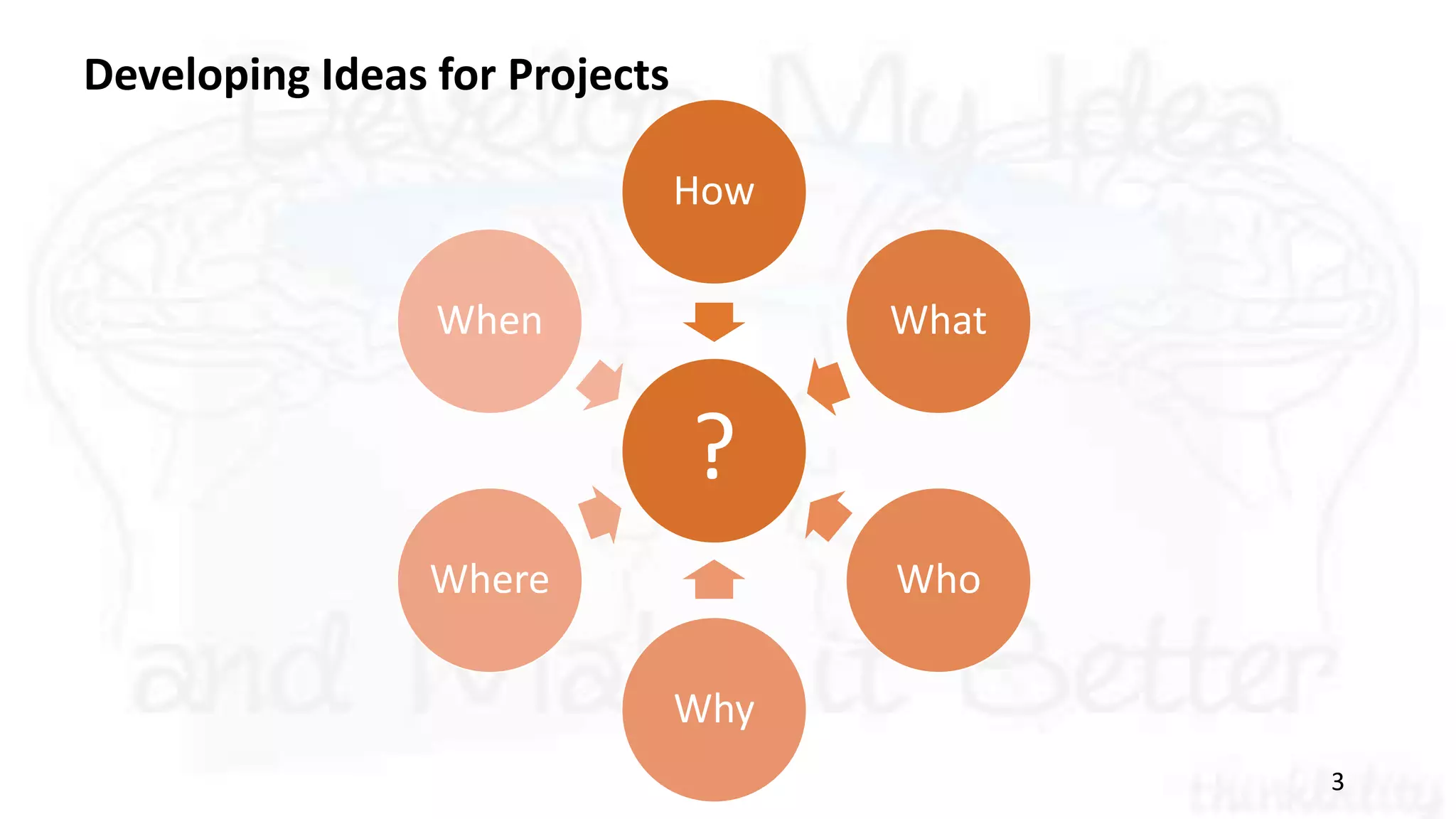
?
How
What
Who
Why
Where
When
Developing Ideas for Projects
4
Community Support
5
Exploring funding sources
• Identify Grant Making agencies, foundations & organizations
• Analyze their vision and mission
• Go through their Requirements & instructions/guidelines
• Develop an idea
• Organize for action
• Establishing contact with a funding source
• Ask for further clarifications if required
• Write a proposal and following up
6
Cover letter
• Properly written and duly signed
• Should address the person at Funding source dealing with your organization
• Should demonstrate a familiarity with the mission of the grant making agency or
foundation
• Emphasize the ways in which this project contributes to the achievement of shared goals
• Use the 7 Cs while writing a cover letter:
• Clear
• Concise
• Concrete
• Correct
• Coherent
• Complete
• Courteous
7
Writing an effective grant proposalConsider
Before writing the
full proposal
• Is there a problem or need of significant magnitude that you propose to solve?
• Does your organization have the means & the imagination to solve the problem or
meet the need?
Letter of
Transmittal /
Interest / Concept
Note / Call for
proposal
• Funder's name, title, and address
• A brief overview of your organization and its purpose (Vision/Mission/Objective/Goals)
• The reason for the funding request
• The amount of funding requested
• The need the project intends to meet (including target population, location, statistics)
• A brief description of the project
• Does not exceed two pages (one page is recommended)
• Includes name and phone number of contact at the organization
• Is signed by the person who can speak with authority on behalf of the organization
Covering following
areas in the
complete / full
proposal
• Organization’s C.V.
• Problem Statement or Needs Assessment
• Project / Program Goals and Objectives
• Methodology
• Evaluation
• Sustainability / Future Funding / Off Shoots’
• Budget
• Appendices / Annexures
8
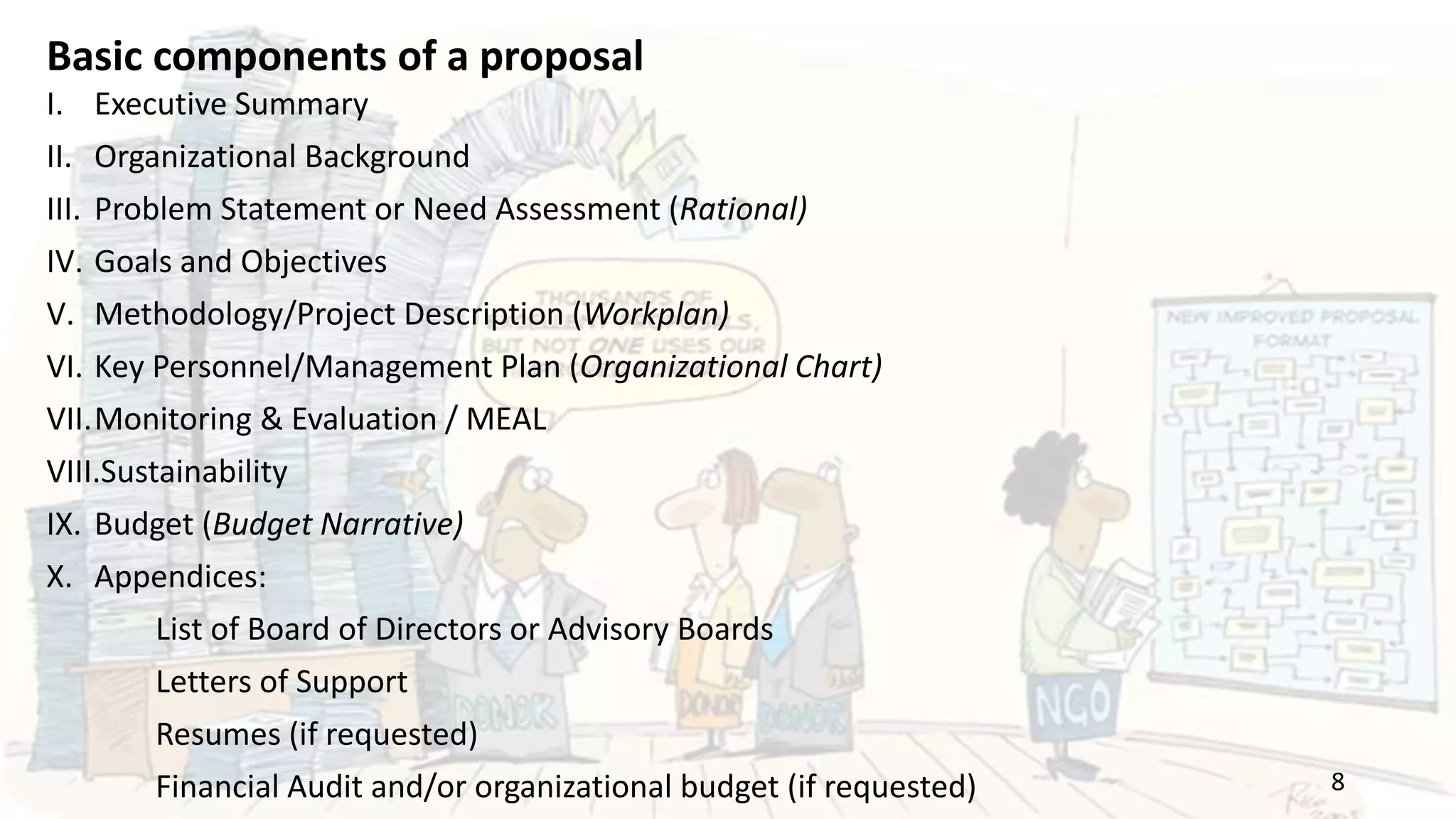
Basic components of a proposal
I. Executive Summary
II. Organizational Background
III. Problem Statement or Need Assessment (Rational)
IV. Goals and Objectives
V. Methodology/Project Description (Workplan)
VI. Key Personnel/Management Plan (Organizational Chart)
VII.Monitoring & Evaluation / MEAL
VIII.Sustainability
IX. Budget (Budget Narrative)
X. Appendices:
List of Board of Directors or Advisory Boards
Letters of Support
Resumes (if requested)
Financial Audit and/or organizational budget (if requested)
9
Problem Statement or Need Assessment
The Problem Statement
What should be happening?
What is actually happening?
Structure
of a
Problem
Statement
What is
wrong?
Where it
happened?
When it
occurred?
To what
extent?
I know that
because……
10
Project Objectives: Goals and Desired Outcome
Gender Inclusive
Specific
Measurable
Attainable / Achievable
Realistic
Time Bound
11
Methodology/Project Description
I. Inputs
II. Throughputs
III. Outputs
IV. Outcomes
12
Monitoring & Evaluation / MEAL
Plan
Implement
Monitor
Evaluate
Reflect
Learning
Impact /
Outcome
Accountability
F
i
n
e
t
u
n
e
R
e
d
e
s
i
g
n
13
Developing a Budget and its requirements
• It should be justified with the narrative section
• Realistic
• Reasonable
• Accurate estimation
• Must consider the local laws and organizational policies
• Reflect GAAP (Generally Accepted Accounting Practices) or IFRS (International Financial
Reporting Standards)
14
What is GAAP?
GAAP stands for generally accepted accounting principles and is a collection of commonly-
followed accounting rules and standards for financial reporting. GAAP specifications include
definitions of concepts and principles, as well as industry-specific rules.
What is IFRS?
IFRS stands for international financial reporting standards and is a set of accounting
standards developed by an independent, not-for-profit organization called the International
Accounting Standards Board (IASB)
What is the difference between GAAP & IFRS?
The primary difference between the two systems is that GAAP is rules-based and IFRS
is principles-based.
GAAP is practiced in United States while IFRS is standard in the European Union (EU) and
many countries in Asia and South America
Program Projects
It is a collective set of multiple projects
Well-defined set of specific activities. Usually represents a
single objective
It has series of projects mostly inter-linked with each other It goes single-handedly
The components of programs are projects; it’s the main
activity
The components of projects are smaller tasks/activities; part
of the main activity
It has a bigger team to look at things holistically Small group of people working together
It tends to be of longer duration for years It is comparatively smaller/shorter in duration
It is planned to be accomplished in different stages It produces outputs within a defined time frame
Comparatively less strict in context to time
Strictness in duration of start and end of the project and has
definite time frame
Objectives may not be crystal clear and some of the
objectives may vary in due course of time
Objectives are crystal clear and are well-defined at all levels
It is based on broad vision and mission Based on certain goals and objectives
It has multiple stakeholders of diverse field Limited number of stakeholders
Complexity and variation in the availability of resources Easy to identify the resources needed
Programs has more strategic planning Projects may not require strategic planning
Top level staffs and higher officials are involved in designing
the programs
Projects are designed by the mid-level staffs
15
16
Program Projects
It has several functional units Has single functional unit
Involves high level of complexity and uncertainty Less complex and lower uncertainty
Runs on the basis of organization calendar and timeline It has its own timeline
It has more financial complications and hectic budgetary
processes
It has fixed budget. Thus, less financial complications
It is vulnerable to major changes in the market and country
policies
Less vulnerable to market changes and country policies
Program is the head of the projects which makes sure that
projects are running as per the plan of the head (program)
Project is the base for programs
Program runs/gives rise to project Project can be part of the program
Success of the program is determined by the ability to fulfill
the needs of the beneficiaries
Success of project is determined by its quality, time and
resource management
It is less organized compared to projects Highly organized in all aspects
Less certain outcomes More certain outcomes
Proactively uses Change through Change Management Controls Change through Change management
Multiple projects, longer duration and produces outcomes Single, shorter and produces outputs
It is a group of projects, managed in a coordinated way to
obtain certain benefits not available from managing them
individually
It is an individual activity
17

Proposal drafting and designing

  • 1.
    To a TrainingSession on Proposal Drafting & Designing
  • 2.
    2 Why Do Organizations Raise Funds Survival Expansion& Development Building a constituency Creating a viable & sustainable institution Reducing dependency Why raise funds?
  • 3.
  • 4.
  • 5.
    5 Exploring funding sources •Identify Grant Making agencies, foundations & organizations • Analyze their vision and mission • Go through their Requirements & instructions/guidelines • Develop an idea • Organize for action • Establishing contact with a funding source • Ask for further clarifications if required • Write a proposal and following up
  • 6.
    6 Cover letter • Properlywritten and duly signed • Should address the person at Funding source dealing with your organization • Should demonstrate a familiarity with the mission of the grant making agency or foundation • Emphasize the ways in which this project contributes to the achievement of shared goals • Use the 7 Cs while writing a cover letter: • Clear • Concise • Concrete • Correct • Coherent • Complete • Courteous
  • 7.
    7 Writing an effectivegrant proposalConsider Before writing the full proposal • Is there a problem or need of significant magnitude that you propose to solve? • Does your organization have the means & the imagination to solve the problem or meet the need? Letter of Transmittal / Interest / Concept Note / Call for proposal • Funder's name, title, and address • A brief overview of your organization and its purpose (Vision/Mission/Objective/Goals) • The reason for the funding request • The amount of funding requested • The need the project intends to meet (including target population, location, statistics) • A brief description of the project • Does not exceed two pages (one page is recommended) • Includes name and phone number of contact at the organization • Is signed by the person who can speak with authority on behalf of the organization Covering following areas in the complete / full proposal • Organization’s C.V. • Problem Statement or Needs Assessment • Project / Program Goals and Objectives • Methodology • Evaluation • Sustainability / Future Funding / Off Shoots’ • Budget • Appendices / Annexures
  • 8.
    8 Basic components ofa proposal I. Executive Summary II. Organizational Background III. Problem Statement or Need Assessment (Rational) IV. Goals and Objectives V. Methodology/Project Description (Workplan) VI. Key Personnel/Management Plan (Organizational Chart) VII.Monitoring & Evaluation / MEAL VIII.Sustainability IX. Budget (Budget Narrative) X. Appendices: List of Board of Directors or Advisory Boards Letters of Support Resumes (if requested) Financial Audit and/or organizational budget (if requested)
  • 9.
    9 Problem Statement orNeed Assessment The Problem Statement What should be happening? What is actually happening? Structure of a Problem Statement What is wrong? Where it happened? When it occurred? To what extent? I know that because……
  • 10.
    10 Project Objectives: Goalsand Desired Outcome Gender Inclusive Specific Measurable Attainable / Achievable Realistic Time Bound
  • 11.
    11 Methodology/Project Description I. Inputs II.Throughputs III. Outputs IV. Outcomes
  • 12.
    12 Monitoring & Evaluation/ MEAL Plan Implement Monitor Evaluate Reflect Learning Impact / Outcome Accountability F i n e t u n e R e d e s i g n
  • 13.
    13 Developing a Budgetand its requirements • It should be justified with the narrative section • Realistic • Reasonable • Accurate estimation • Must consider the local laws and organizational policies • Reflect GAAP (Generally Accepted Accounting Practices) or IFRS (International Financial Reporting Standards)
  • 14.
    14 What is GAAP? GAAPstands for generally accepted accounting principles and is a collection of commonly- followed accounting rules and standards for financial reporting. GAAP specifications include definitions of concepts and principles, as well as industry-specific rules. What is IFRS? IFRS stands for international financial reporting standards and is a set of accounting standards developed by an independent, not-for-profit organization called the International Accounting Standards Board (IASB) What is the difference between GAAP & IFRS? The primary difference between the two systems is that GAAP is rules-based and IFRS is principles-based. GAAP is practiced in United States while IFRS is standard in the European Union (EU) and many countries in Asia and South America
  • 15.
    Program Projects It isa collective set of multiple projects Well-defined set of specific activities. Usually represents a single objective It has series of projects mostly inter-linked with each other It goes single-handedly The components of programs are projects; it’s the main activity The components of projects are smaller tasks/activities; part of the main activity It has a bigger team to look at things holistically Small group of people working together It tends to be of longer duration for years It is comparatively smaller/shorter in duration It is planned to be accomplished in different stages It produces outputs within a defined time frame Comparatively less strict in context to time Strictness in duration of start and end of the project and has definite time frame Objectives may not be crystal clear and some of the objectives may vary in due course of time Objectives are crystal clear and are well-defined at all levels It is based on broad vision and mission Based on certain goals and objectives It has multiple stakeholders of diverse field Limited number of stakeholders Complexity and variation in the availability of resources Easy to identify the resources needed Programs has more strategic planning Projects may not require strategic planning Top level staffs and higher officials are involved in designing the programs Projects are designed by the mid-level staffs 15
  • 16.
    16 Program Projects It hasseveral functional units Has single functional unit Involves high level of complexity and uncertainty Less complex and lower uncertainty Runs on the basis of organization calendar and timeline It has its own timeline It has more financial complications and hectic budgetary processes It has fixed budget. Thus, less financial complications It is vulnerable to major changes in the market and country policies Less vulnerable to market changes and country policies Program is the head of the projects which makes sure that projects are running as per the plan of the head (program) Project is the base for programs Program runs/gives rise to project Project can be part of the program Success of the program is determined by the ability to fulfill the needs of the beneficiaries Success of project is determined by its quality, time and resource management It is less organized compared to projects Highly organized in all aspects Less certain outcomes More certain outcomes Proactively uses Change through Change Management Controls Change through Change management Multiple projects, longer duration and produces outcomes Single, shorter and produces outputs It is a group of projects, managed in a coordinated way to obtain certain benefits not available from managing them individually It is an individual activity
  • 17.