Elastics(elastomeric
materials)
Ahmad Zaghloul
Mennah Salah
Supervised by : Dr Mohammed Hassan
Elasticity:
It is the property of a material to return to its original form after being stretched.
Elastic limit:
The maximum stress a material can withstand without Permanent deformation.
Elastic Modulus or Modulus of Elasticity:
When a material is stressed it is usually found that the stress is usually proportional to
the strain, so their ratio is constant. In other words the material deforms linearly and
elastically.This can be represented by the expression : E stress/strain.
Relaxation:
It is defined as decrease in force value carried or transmitted over time with the element
maintained in a fixed activated state of constant strain.
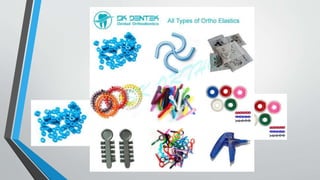
Elastomeric materials:
latex
polyurethane
Die - stamped Injection molded natural
synthetic
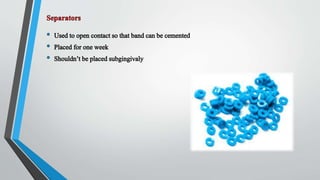
Separators
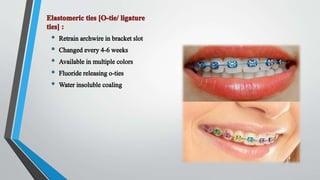
ligatures bands
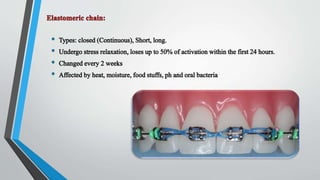
chains
Elastomeric materials:
Properties:
Visco elasticity
Creep [stress – relaxation]
Hysteresis
Hysteresis loss
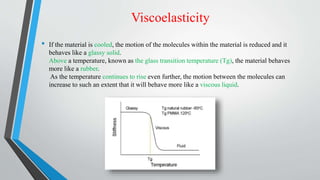
Viscoelasticity
• If the material is cooled, the motion of the molecules within the material is reduced and it
behaves like a glassy solid.
Above a temperature, known as the glass transition temperature (Tg), the material behaves
more like a rubber.
As the temperature continues to rise even further, the motion between the molecules can
increase to such an extent that it will behave more like a viscous liquid.
Creep [stress – relaxation]
• This is the time dependant permanent deformation that occurs when the
material is subjected to a constant load.
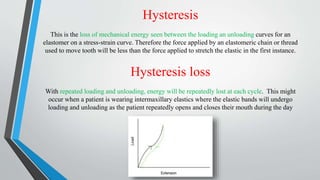
Hysteresis
This is the loss of mechanical energy seen between the loading an unloading curves for an
elastomer on a stress-strain curve. Therefore the force applied by an elastomeric chain or thread
used to move tooth will be less than the force applied to stretch the elastic in the first instance.
Hysteresis loss
With repeated loading and unloading, energy will be repeatedly lost at each cycle. This might
occur when a patient is wearing intermaxillary elastics where the elastic bands will undergo
loading and unloading as the patient repeatedly opens and closes their mouth during the day
PRESENTATION OF ORTHODONTIC
ELASTICS
• Orthodontic elastics can be designated as:
Intraoral
Extraoral
For a long time rubber elastics have been offered to the Orthodontic community in:
- different sizes
- different shape forces giving a precise applied force.
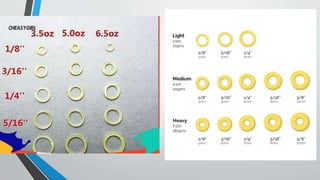
They are presented in a plastic bag decorated with various symbols to help patients recognize
which elastic was received for the last prescription
1 oz. (ounce) = 28.4 grams
1 inch = 25.4 mm
What forces do I need?
• This depends on the clinical situation:
• En-mass movement (non extraction) -– class 2 / 3 elastics = 5-6 ounces 142-170g
• En-mass movement (extraction) – class 2 / 3 elastics = 4-5 ounces / 113-142g
• Anterior elastics – box elastic for anterior openbite = 1-2 ounces / 28-57g
• Posterior box elastics = 6 ounces / 170g
• Early short elastics = 2-2.5 ounces / 57-71g
1/4” / 6.4mm and 3/16 / 4.8mm fulfil most clinical situations, except for box elastics
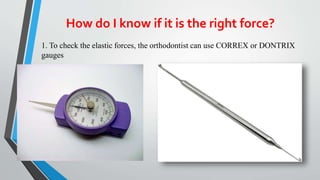
How do I know if it is the right force?
1. To check the elastic forces, the orthodontist can use CORREX or DONTRIX
gauges
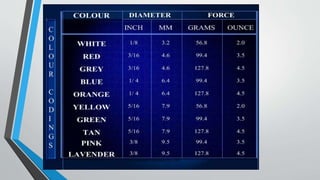
• 2. Measuring the distance elastics are planned to be used intraorally, and
using the table below selecting the appropriate size elastic.
Analysis of elastic force
• Force produced by elastics on a tooth or teeth depends on its magnitude.
• The stress produced depends on:
1. The site of application,
2. distribution through the periodontal ligament
3. direction, length, diameter and contour of root,
4. alveolar process,
5. tooth rotation and health, age
6. and above all the co-operation of the patient
Clinical scenarios
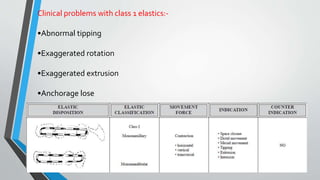
• CL I elastics, horizontal elastics, intramaxillary elastics, intra-arch elastics:-
•These extend with in each arch.
•This is used for the space closure.
• It is placed from the molar tube to the intramaxillary hook of canine of the same
side of the same arch.
•CL I elastic traction is judiciously combined with strong anchor bend.
The force recommended is 1½ to 2½ oz for non extraction cases and 2 to 4 oz. in
extraction cases.
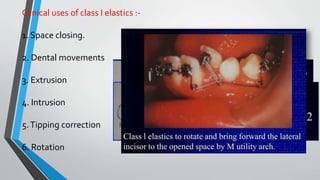
Clinical uses of class I elastics :-
1. Space closing.
2. Dental movements
3. Extrusion
4. Intrusion
5.Tipping correction
6. Rotation
Clinical problems with class 1 elastics:-
•Abnormal tipping
•Exaggerated rotation
•Exaggerated extrusion
•Anchorage lose
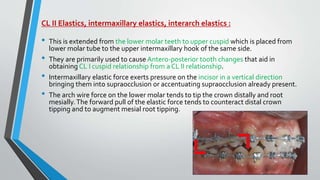
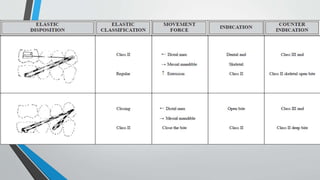
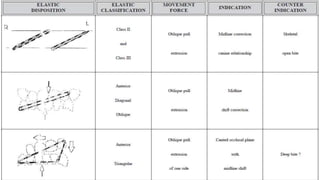
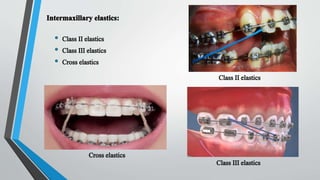
CL II Elastics, intermaxillary elastics, interarch elastics :
• This is extended from the lower molar teeth to upper cuspid which is placed from
lower molar tube to the upper intermaxillary hook of the same side.
• They are primarily used to cause Antero-posterior tooth changes that aid in
obtaining CL I cuspid relationship from a CL II relationship.
• Intermaxillary elastic force exerts pressure on the incisor in a vertical direction
bringing them into supraocclusion or accentuating supraocclusion already present.
• The arch wire force on the lower molar tends to tip the crown distally and root
mesially.The forward pull of the elastic force tends to counteract distal crown
tipping and to augment mesial root tipping.
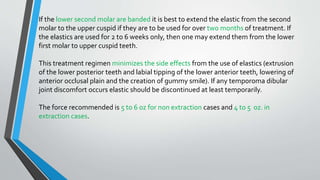
If the lower second molar are banded it is best to extend the elastic from the second
molar to the upper cuspid if they are to be used for over two months of treatment. If
the elastics are used for 2 to 6 weeks only, then one may extend them from the lower
first molar to upper cuspid teeth.
This treatment regimen minimizes the side effects from the use of elastics (extrusion
of the lower posterior teeth and labial tipping of the lower anterior teeth, lowering of
anterior occlusal plain and the creation of gummy smile). If any temporoma dibular
joint discomfort occurs elastic should be discontinued at least temporarily.
The force recommended is 5 to 6 oz for non extraction cases and 4 to 5 oz. in
extraction cases.
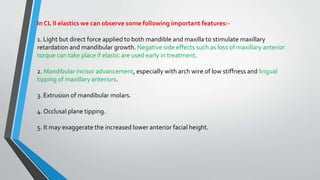
In CL II elastics we can observe some following important features:-
1. Light but direct force applied to both mandible and maxilla to stimulate maxillary
retardation and mandibular growth. Negative side effects such as loss of maxillary anterior
torque can take place if elastic are used early in treatment.
2. Mandibular incisor advancement, especially with arch wire of low stiffness and lingual
tipping of maxillary anteriors.
3. Extrusion of mandibular molars.
4. Occlusal plane tipping.
5. It may exaggerate the increased lower anterior facial height.
Class ll elastic effects with continuous archwires
Effects upon the maxillary arch
⚫backward movement of the upper arch
⚫ extrusion and downward movement of anterior occlusal plane
⚫ upper incisors are more vertical
⚫all teeth are distallized.
Effects upon the mandibular arch
⚫ entire mandibular arch is brought forward
⚫the lower molar can be extruded
⚫buccal tipping of lower incisors.
Effects upon occlusal plane
⚫ sagittal correction of Class II relationship
⚫ downward tilting of the anterior occlusal plane.
Effects upon facial pattern
⚫the mandible is brought forward with a posterior rotation
⚫chin goes forward
⚫the lower facial height is increased according to the amount of elastic force used and wearing time.
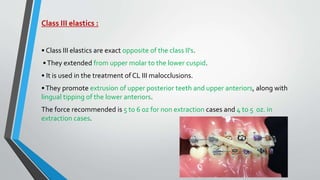
Class III elastics :
• Class III elastics are exact opposite of the class II's.
•They extended from upper molar to the lower cuspid.
• It is used in the treatment of CL III malocclusions.
•They promote extrusion of upper posterior teeth and upper anteriors, along with
lingual tipping of the lower anteriors.
The force recommended is 5 to 6 oz for non extraction cases and 4 to 5 oz. in
extraction cases.
Indications:
1.To avoid advance maxillary dentition and or retract the mandibular
dentition.
2.To correct anterior cross bite.
3. Mandibular crowding in a non extraction case in which it is desired to
eliminate the crowding without advancing the mandibular incisor appreciably.
4. In deep bite, low angle, crowded case early use of c1 III elastics will allow the
bite open.
Class lll elastic effects with continuous archwires:
Effects upon maxillary arch
forward mesial tipping and extrusion of the first molar
light maxillary advancement
buccal tipping of upper incisors.
Effects upon mandibular arch
lower incisors extrusion
lower lingual tipping of lower incisors
lower arch distalization.
Effects upon occlusal plane
sagittal correction of occlusal relationship
upward tilting of lower anterior occlusal plane
Effects upon facial type
backward rotation of the mandible
the chin goes downward and backward
the lower facial height is increased.
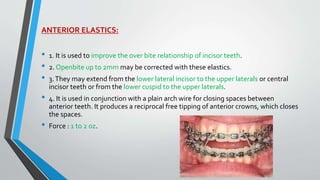
ANTERIOR ELASTICS:
• 1. It is used to improve the over bite relationship of incisor teeth.
• 2. Openbite up to 2mm may be corrected with these elastics.
• 3.They may extend from the lower lateral incisor to the upper laterals or central
incisor teeth or from the lower cuspid to the upper laterals.
• 4. It is used in conjunction with a plain arch wire for closing spaces between
anterior teeth. It produces a reciprocal free tipping of anterior crowns, which closes
the spaces.
• Force : 1 to 2 oz.
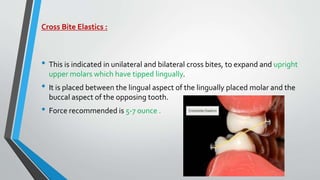
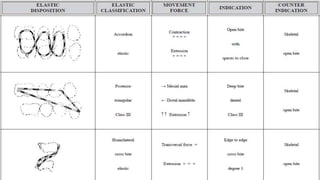
Cross Bite Elastics :
• This is indicated in unilateral and bilateral cross bites, to expand and upright
upper molars which have tipped lingually.
• It is placed between the lingual aspect of the lingually placed molar and the
buccal aspect of the opposing tooth.
• Force recommended is 5-7 ounce .
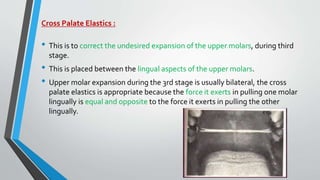
Cross Palate Elastics :
• This is to correct the undesired expansion of the upper molars, during third
stage.
• This is placed between the lingual aspects of the upper molars.
• Upper molar expansion during the 3rd stage is usually bilateral, the cross
palate elastics is appropriate because the force it exerts in pulling one molar
lingually is equal and opposite to the force it exerts in pulling the other
lingually.
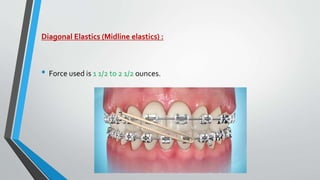
Diagonal Elastics (Midline elastics) :
• Force used is 1 1/2 to 2 1/2 ounces.
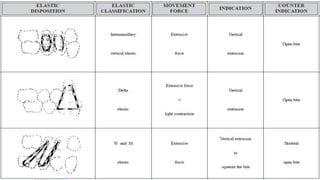
Box elastics :
• Box elastics have a box shape configuration and can be used in variety of situations
to promote tooth extrusion and improve intercuspation.
• Most commonly, they include the upper cuspid and lateral incisor to the lower first
bicuspid and cuspid(CL II vector) or to the lower cuspid and lateral incisors(CL III
vector). All bicuspid teeth of one side can be extruded
• as well.
• These are used to correct the open bite or to decrease the anterior open bite.
• Force : 6 oz.
Triangular elastics:
• Triangular elastics aid in the improvement of CL I cuspid intercuspation and
increase the over bite relationship anteriorly by closing open bite in the
range of 0.5 to 1.5 mm.
• They extended from upper cuspid to the lower cuspid and first bicuspid
teeth.
• It is used for similar reasons of box elastics, but including only 3 teeth .
• Elastics of 1/8" 3 ½ oz is used.
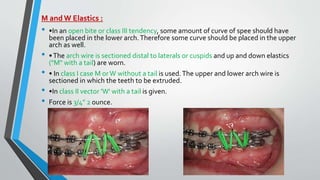
M and W Elastics :
• •In an open bite or class III tendency, some amount of curve of spee should have
been placed in the lower arch.Therefore some curve should be placed in the upper
arch as well.
• •The arch wire is sectioned distal to laterals or cuspids and up and down elastics
("M" with a tail) are worn.
• • In class I case M orW without a tail is used.The upper and lower arch wire is
sectioned in which the teeth to be extruded.
• •In class II vector 'W' with a tail is given.
• Force is 3/4" 2 ounce.
Sling Shot Elastics( Molar distalizing) :

• Two hook on buccal and lingual side of the molar to be incorporated in the
acrylic plate to hold the elastic.The elastic is stretched at the mesial aspect
of molar to distalize it.
Finishing elastics:
Are used at the end of the treatment for final posterior settling.
Force recommended 2 oz
Asymmetrical elastics:
They are usually CL II on one side and CL III on other side.
They are used to correct dental asymmetries. If a significant dental midline
deviation is present (2mm or more), an anterior elastic from upper lateral to
the lower contralateral lateral incisor should also be used.
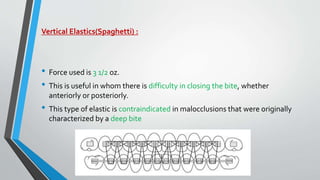
Vertical Elastics(Spaghetti) :
• Force used is 3 1/2 oz.
• This is useful in whom there is difficulty in closing the bite, whether
anteriorly or posteriorly.
• This type of elastic is contraindicated in malocclusions that were originally
characterized by a deep bite
Force degradation
• The force decay under constant force application to latex elastic, polymer chains and tied
loops showed that the greatest amount of force decay occurred during the first three hours
in water bath.
• The force remained relatively the same throughout the rest of the period. After an
exhaustive review of the literature regarding elastomeric chain, it can be said that most
marketed elastomeric chains generally loses 50% to 70% of their initial force during the first
day of load application.At the end of three weeks they retained only 30 to 40% of original
force
Any elastic worn in mouth is affected by:
PH of oral environment foods and drinks dental plaque
saliva Time
• pH :
Oral pH almost certainly has a significant influence on the decay rate of orthodontic
polyurethane chain elastics.
All the test products yielded a significantly greater force-decay rate in the basic (pH 7.26)
solution than in the acidic (pH 4.95) solution over 4 weeks.
A hypothesis is presented that the decay rate of orthodontic polyurethane chain elastics is
inversely proportional to the oral pH, with a corollary that basic pH levels (above neutral)
are most hostile to polyurethane chain elastics, thus increasing their force-decay rates.
Mastication :
The forces of mastication and the intraoral environment cause natural rubber to break
down by formation of knotty tearing mechanisms.
Daily diet :
At the various levels of simulated daily dietary challenge/patient compliance, the latex
elastics maintain their applied force over a day of wear.
No differences were found between daily diet/patient compliance levels. Except for band
breakage or recommended reasons of oral hygiene, beyond the once-per-day experience,
there may be no need to change elastics during the day.
•
Oral cavity :
comparison of force decay of chains extended and stored in air, water, and in vivo reported
that chains exposed to an in vivo environment exhibited significantly more force decay after
30 minutes than those kept in air.
No difference was noted between the chains maintained in water and those in vivo until 1
week. However, after 3 weeks, the chains stored in vivo had a greater force loss than those
stored in water.
the effects of mastication, oral hygiene, salivary enzymes, and temperature variations within
the mouth influenced the degradation rates of in vivo chains.
In the oral cavity, elastics absorb water and saliva, which cause a breakdown of the internal
bonds and permanent deformation of the material. In addition, the elastics swell and stain due
to the filling of the voids in the rubber matrix by fluids and bacterial debris ,These lead to a loss
in force delivered to the tooth.
They too experience a rapid loss of force as a result of stress relaxation.
Water :
the load decay associated with elastomeric chains for 1 and 7 days of water storage may be
the result of water sorption and the concurrent formation of hydrogen bonds between the
water molecules and macromolecules of the elastomers.
Fluoride:
The physical properties and fluoride releasing capabilities of a recently introduced fluoride-
containing elastomeric chain (Fluor-I-Chain) have been evaluated and compared to those of a
standard gray elastomeric chain. Fluor-I-chain was found to require increased distraction to
achieve 150g and 300g forces when immersed in liquid media.
The initial force levels of Fluor-I-Chain and gray chain when stretched by 100% their original
length were 316g and 280g respectively.
After 1 week, Fluor-I-Chain's force level had degraded to 43 g or 14% of its original force.This
force level would not be adequate to retract a canine.
Gray chain at one week had a force level of 107 g which remained fairly constant through the
remaining 2 weeks.
Thermal-cycle :
thermal-cycled chains displayed significantly less force loss after 3 weeks. Starting with an
initial force level of 300 to 400 gm, this difference, however, was only 7 to 10 gm. and reported
some minor improvement in the retention of force after 3 weeks.
Air :
Exposure of latex to air was found to cause a loss of force.
Ozone :
The most significant limitation of natural latex is its enormous sensitivity to the effects of ozone or other
free radical generating systems such as sunlight or ultraviolet light that produces cracks.The ozone
breaks down the unsaturated double bonds at the molecular level as the water molecule is absorbed.
This weakens the latex polymer chain.The swelling and staining is due to the filling of the voids in the
rubber matrix by fluids and bacteria debris. In clinical use the latex elastics are replaced before this stage
is reached. Antiozone and antioxidant agents are added at the time of manufacture of the latex tubing.
However, when it is chopped into individual latex bands, the surface area is increased and ozone can
diffuse more rapidly into the bands.This sharply limits the shelf life of the latex elastics. Out-of-date
elastics may break after a few elongation-relaxation cycles. Usually, this type of break is due to crack-
propagation which occurs somewhere in the elastics due to ozone effects.
Disinfection and sterilization :
Disinfection (short-term exposure) and/or sterilization (long-term exposure) may become a common
procedure for elastomeric chains .
The use of alkaline gluteraldehyde solutions for this purpose may have no significant deleterious effects
when the clinical use of the elastomeric chains is considered.
Separators
ligatures bands
chains
Elastomeric materials:
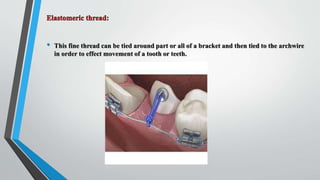
• This fine thread can be tied around part or all of a bracket and then tied to the archwire
in order to effect movement of a tooth or teeth.
• Elastomeric tube is used in the same circumstances as elastomeric thread. In both cases
the orthodontist ties one or more knots in the thread/ tube during placement. Tubes are
thought to offer more resistance to the knot coming undone than thread.
Proper _ Elastics _ in _ orthontics .pptx

Proper _ Elastics _ in _ orthontics .pptx

  • 1.
  • 2.
    Elasticity: It is theproperty of a material to return to its original form after being stretched. Elastic limit: The maximum stress a material can withstand without Permanent deformation. Elastic Modulus or Modulus of Elasticity: When a material is stressed it is usually found that the stress is usually proportional to the strain, so their ratio is constant. In other words the material deforms linearly and elastically.This can be represented by the expression : E stress/strain. Relaxation: It is defined as decrease in force value carried or transmitted over time with the element maintained in a fixed activated state of constant strain.
  • 3.
    Elastomeric materials: latex polyurethane Die -stamped Injection molded natural synthetic
  • 4.
  • 5.
    Properties: Visco elasticity Creep [stress– relaxation] Hysteresis Hysteresis loss
  • 6.
    Viscoelasticity • If thematerial is cooled, the motion of the molecules within the material is reduced and it behaves like a glassy solid. Above a temperature, known as the glass transition temperature (Tg), the material behaves more like a rubber. As the temperature continues to rise even further, the motion between the molecules can increase to such an extent that it will behave more like a viscous liquid.
  • 7.
    Creep [stress –relaxation] • This is the time dependant permanent deformation that occurs when the material is subjected to a constant load.
  • 8.
    Hysteresis This is theloss of mechanical energy seen between the loading an unloading curves for an elastomer on a stress-strain curve. Therefore the force applied by an elastomeric chain or thread used to move tooth will be less than the force applied to stretch the elastic in the first instance. Hysteresis loss With repeated loading and unloading, energy will be repeatedly lost at each cycle. This might occur when a patient is wearing intermaxillary elastics where the elastic bands will undergo loading and unloading as the patient repeatedly opens and closes their mouth during the day
  • 9.
    PRESENTATION OF ORTHODONTIC ELASTICS •Orthodontic elastics can be designated as: Intraoral Extraoral For a long time rubber elastics have been offered to the Orthodontic community in: - different sizes - different shape forces giving a precise applied force. They are presented in a plastic bag decorated with various symbols to help patients recognize which elastic was received for the last prescription
  • 10.
    1 oz. (ounce)= 28.4 grams 1 inch = 25.4 mm
  • 14.
    What forces doI need? • This depends on the clinical situation: • En-mass movement (non extraction) -– class 2 / 3 elastics = 5-6 ounces 142-170g • En-mass movement (extraction) – class 2 / 3 elastics = 4-5 ounces / 113-142g • Anterior elastics – box elastic for anterior openbite = 1-2 ounces / 28-57g • Posterior box elastics = 6 ounces / 170g • Early short elastics = 2-2.5 ounces / 57-71g 1/4” / 6.4mm and 3/16 / 4.8mm fulfil most clinical situations, except for box elastics
  • 15.
    How do Iknow if it is the right force? 1. To check the elastic forces, the orthodontist can use CORREX or DONTRIX gauges
  • 16.
    • 2. Measuringthe distance elastics are planned to be used intraorally, and using the table below selecting the appropriate size elastic.
  • 17.
    Analysis of elasticforce • Force produced by elastics on a tooth or teeth depends on its magnitude. • The stress produced depends on: 1. The site of application, 2. distribution through the periodontal ligament 3. direction, length, diameter and contour of root, 4. alveolar process, 5. tooth rotation and health, age 6. and above all the co-operation of the patient
  • 18.
    Clinical scenarios • CLI elastics, horizontal elastics, intramaxillary elastics, intra-arch elastics:- •These extend with in each arch. •This is used for the space closure. • It is placed from the molar tube to the intramaxillary hook of canine of the same side of the same arch. •CL I elastic traction is judiciously combined with strong anchor bend. The force recommended is 1½ to 2½ oz for non extraction cases and 2 to 4 oz. in extraction cases.
  • 19.
    Clinical uses ofclass I elastics :- 1. Space closing. 2. Dental movements 3. Extrusion 4. Intrusion 5.Tipping correction 6. Rotation
  • 20.
    Clinical problems withclass 1 elastics:- •Abnormal tipping •Exaggerated rotation •Exaggerated extrusion •Anchorage lose
  • 21.
    CL II Elastics,intermaxillary elastics, interarch elastics : • This is extended from the lower molar teeth to upper cuspid which is placed from lower molar tube to the upper intermaxillary hook of the same side. • They are primarily used to cause Antero-posterior tooth changes that aid in obtaining CL I cuspid relationship from a CL II relationship. • Intermaxillary elastic force exerts pressure on the incisor in a vertical direction bringing them into supraocclusion or accentuating supraocclusion already present. • The arch wire force on the lower molar tends to tip the crown distally and root mesially.The forward pull of the elastic force tends to counteract distal crown tipping and to augment mesial root tipping.
  • 22.
    If the lowersecond molar are banded it is best to extend the elastic from the second molar to the upper cuspid if they are to be used for over two months of treatment. If the elastics are used for 2 to 6 weeks only, then one may extend them from the lower first molar to upper cuspid teeth. This treatment regimen minimizes the side effects from the use of elastics (extrusion of the lower posterior teeth and labial tipping of the lower anterior teeth, lowering of anterior occlusal plain and the creation of gummy smile). If any temporoma dibular joint discomfort occurs elastic should be discontinued at least temporarily. The force recommended is 5 to 6 oz for non extraction cases and 4 to 5 oz. in extraction cases.
  • 23.
    In CL IIelastics we can observe some following important features:- 1. Light but direct force applied to both mandible and maxilla to stimulate maxillary retardation and mandibular growth. Negative side effects such as loss of maxillary anterior torque can take place if elastic are used early in treatment. 2. Mandibular incisor advancement, especially with arch wire of low stiffness and lingual tipping of maxillary anteriors. 3. Extrusion of mandibular molars. 4. Occlusal plane tipping. 5. It may exaggerate the increased lower anterior facial height.
  • 24.
    Class ll elasticeffects with continuous archwires Effects upon the maxillary arch ⚫backward movement of the upper arch ⚫ extrusion and downward movement of anterior occlusal plane ⚫ upper incisors are more vertical ⚫all teeth are distallized. Effects upon the mandibular arch ⚫ entire mandibular arch is brought forward ⚫the lower molar can be extruded ⚫buccal tipping of lower incisors. Effects upon occlusal plane ⚫ sagittal correction of Class II relationship ⚫ downward tilting of the anterior occlusal plane. Effects upon facial pattern ⚫the mandible is brought forward with a posterior rotation ⚫chin goes forward ⚫the lower facial height is increased according to the amount of elastic force used and wearing time.
  • 26.
    Class III elastics: • Class III elastics are exact opposite of the class II's. •They extended from upper molar to the lower cuspid. • It is used in the treatment of CL III malocclusions. •They promote extrusion of upper posterior teeth and upper anteriors, along with lingual tipping of the lower anteriors. The force recommended is 5 to 6 oz for non extraction cases and 4 to 5 oz. in extraction cases.
  • 27.
    Indications: 1.To avoid advancemaxillary dentition and or retract the mandibular dentition. 2.To correct anterior cross bite. 3. Mandibular crowding in a non extraction case in which it is desired to eliminate the crowding without advancing the mandibular incisor appreciably. 4. In deep bite, low angle, crowded case early use of c1 III elastics will allow the bite open.
  • 28.
    Class lll elasticeffects with continuous archwires: Effects upon maxillary arch forward mesial tipping and extrusion of the first molar light maxillary advancement buccal tipping of upper incisors. Effects upon mandibular arch lower incisors extrusion lower lingual tipping of lower incisors lower arch distalization. Effects upon occlusal plane sagittal correction of occlusal relationship upward tilting of lower anterior occlusal plane Effects upon facial type backward rotation of the mandible the chin goes downward and backward the lower facial height is increased.
  • 30.
    ANTERIOR ELASTICS: • 1.It is used to improve the over bite relationship of incisor teeth. • 2. Openbite up to 2mm may be corrected with these elastics. • 3.They may extend from the lower lateral incisor to the upper laterals or central incisor teeth or from the lower cuspid to the upper laterals. • 4. It is used in conjunction with a plain arch wire for closing spaces between anterior teeth. It produces a reciprocal free tipping of anterior crowns, which closes the spaces. • Force : 1 to 2 oz.
  • 31.
    Cross Bite Elastics: • This is indicated in unilateral and bilateral cross bites, to expand and upright upper molars which have tipped lingually. • It is placed between the lingual aspect of the lingually placed molar and the buccal aspect of the opposing tooth. • Force recommended is 5-7 ounce .
  • 32.
    Cross Palate Elastics: • This is to correct the undesired expansion of the upper molars, during third stage. • This is placed between the lingual aspects of the upper molars. • Upper molar expansion during the 3rd stage is usually bilateral, the cross palate elastics is appropriate because the force it exerts in pulling one molar lingually is equal and opposite to the force it exerts in pulling the other lingually.
  • 33.
    Diagonal Elastics (Midlineelastics) : • Force used is 1 1/2 to 2 1/2 ounces.
  • 34.
    Box elastics : •Box elastics have a box shape configuration and can be used in variety of situations to promote tooth extrusion and improve intercuspation. • Most commonly, they include the upper cuspid and lateral incisor to the lower first bicuspid and cuspid(CL II vector) or to the lower cuspid and lateral incisors(CL III vector). All bicuspid teeth of one side can be extruded • as well. • These are used to correct the open bite or to decrease the anterior open bite. • Force : 6 oz.
  • 35.
    Triangular elastics: • Triangularelastics aid in the improvement of CL I cuspid intercuspation and increase the over bite relationship anteriorly by closing open bite in the range of 0.5 to 1.5 mm. • They extended from upper cuspid to the lower cuspid and first bicuspid teeth. • It is used for similar reasons of box elastics, but including only 3 teeth . • Elastics of 1/8" 3 ½ oz is used.
  • 36.
    M and WElastics : • •In an open bite or class III tendency, some amount of curve of spee should have been placed in the lower arch.Therefore some curve should be placed in the upper arch as well. • •The arch wire is sectioned distal to laterals or cuspids and up and down elastics ("M" with a tail) are worn. • • In class I case M orW without a tail is used.The upper and lower arch wire is sectioned in which the teeth to be extruded. • •In class II vector 'W' with a tail is given. • Force is 3/4" 2 ounce.
  • 37.
    Sling Shot Elastics(Molar distalizing) : • Two hook on buccal and lingual side of the molar to be incorporated in the acrylic plate to hold the elastic.The elastic is stretched at the mesial aspect of molar to distalize it.
  • 38.
    Finishing elastics: Are usedat the end of the treatment for final posterior settling. Force recommended 2 oz Asymmetrical elastics: They are usually CL II on one side and CL III on other side. They are used to correct dental asymmetries. If a significant dental midline deviation is present (2mm or more), an anterior elastic from upper lateral to the lower contralateral lateral incisor should also be used.
  • 44.
    Vertical Elastics(Spaghetti) : •Force used is 3 1/2 oz. • This is useful in whom there is difficulty in closing the bite, whether anteriorly or posteriorly. • This type of elastic is contraindicated in malocclusions that were originally characterized by a deep bite
  • 45.
    Force degradation • Theforce decay under constant force application to latex elastic, polymer chains and tied loops showed that the greatest amount of force decay occurred during the first three hours in water bath. • The force remained relatively the same throughout the rest of the period. After an exhaustive review of the literature regarding elastomeric chain, it can be said that most marketed elastomeric chains generally loses 50% to 70% of their initial force during the first day of load application.At the end of three weeks they retained only 30 to 40% of original force
  • 46.
    Any elastic wornin mouth is affected by: PH of oral environment foods and drinks dental plaque saliva Time • pH : Oral pH almost certainly has a significant influence on the decay rate of orthodontic polyurethane chain elastics. All the test products yielded a significantly greater force-decay rate in the basic (pH 7.26) solution than in the acidic (pH 4.95) solution over 4 weeks. A hypothesis is presented that the decay rate of orthodontic polyurethane chain elastics is inversely proportional to the oral pH, with a corollary that basic pH levels (above neutral) are most hostile to polyurethane chain elastics, thus increasing their force-decay rates. Mastication : The forces of mastication and the intraoral environment cause natural rubber to break down by formation of knotty tearing mechanisms. Daily diet : At the various levels of simulated daily dietary challenge/patient compliance, the latex elastics maintain their applied force over a day of wear. No differences were found between daily diet/patient compliance levels. Except for band breakage or recommended reasons of oral hygiene, beyond the once-per-day experience, there may be no need to change elastics during the day. •
  • 47.
    Oral cavity : comparisonof force decay of chains extended and stored in air, water, and in vivo reported that chains exposed to an in vivo environment exhibited significantly more force decay after 30 minutes than those kept in air. No difference was noted between the chains maintained in water and those in vivo until 1 week. However, after 3 weeks, the chains stored in vivo had a greater force loss than those stored in water. the effects of mastication, oral hygiene, salivary enzymes, and temperature variations within the mouth influenced the degradation rates of in vivo chains. In the oral cavity, elastics absorb water and saliva, which cause a breakdown of the internal bonds and permanent deformation of the material. In addition, the elastics swell and stain due to the filling of the voids in the rubber matrix by fluids and bacterial debris ,These lead to a loss in force delivered to the tooth. They too experience a rapid loss of force as a result of stress relaxation. Water : the load decay associated with elastomeric chains for 1 and 7 days of water storage may be the result of water sorption and the concurrent formation of hydrogen bonds between the water molecules and macromolecules of the elastomers.
  • 48.
    Fluoride: The physical propertiesand fluoride releasing capabilities of a recently introduced fluoride- containing elastomeric chain (Fluor-I-Chain) have been evaluated and compared to those of a standard gray elastomeric chain. Fluor-I-chain was found to require increased distraction to achieve 150g and 300g forces when immersed in liquid media. The initial force levels of Fluor-I-Chain and gray chain when stretched by 100% their original length were 316g and 280g respectively. After 1 week, Fluor-I-Chain's force level had degraded to 43 g or 14% of its original force.This force level would not be adequate to retract a canine. Gray chain at one week had a force level of 107 g which remained fairly constant through the remaining 2 weeks. Thermal-cycle : thermal-cycled chains displayed significantly less force loss after 3 weeks. Starting with an initial force level of 300 to 400 gm, this difference, however, was only 7 to 10 gm. and reported some minor improvement in the retention of force after 3 weeks.
  • 49.
    Air : Exposure oflatex to air was found to cause a loss of force. Ozone : The most significant limitation of natural latex is its enormous sensitivity to the effects of ozone or other free radical generating systems such as sunlight or ultraviolet light that produces cracks.The ozone breaks down the unsaturated double bonds at the molecular level as the water molecule is absorbed. This weakens the latex polymer chain.The swelling and staining is due to the filling of the voids in the rubber matrix by fluids and bacteria debris. In clinical use the latex elastics are replaced before this stage is reached. Antiozone and antioxidant agents are added at the time of manufacture of the latex tubing. However, when it is chopped into individual latex bands, the surface area is increased and ozone can diffuse more rapidly into the bands.This sharply limits the shelf life of the latex elastics. Out-of-date elastics may break after a few elongation-relaxation cycles. Usually, this type of break is due to crack- propagation which occurs somewhere in the elastics due to ozone effects. Disinfection and sterilization : Disinfection (short-term exposure) and/or sterilization (long-term exposure) may become a common procedure for elastomeric chains . The use of alkaline gluteraldehyde solutions for this purpose may have no significant deleterious effects when the clinical use of the elastomeric chains is considered.
  • 50.
  • 54.
    • This finethread can be tied around part or all of a bracket and then tied to the archwire in order to effect movement of a tooth or teeth.
  • 55.
    • Elastomeric tubeis used in the same circumstances as elastomeric thread. In both cases the orthodontist ties one or more knots in the thread/ tube during placement. Tubes are thought to offer more resistance to the knot coming undone than thread.