PECK AND PECK ANALYSIS
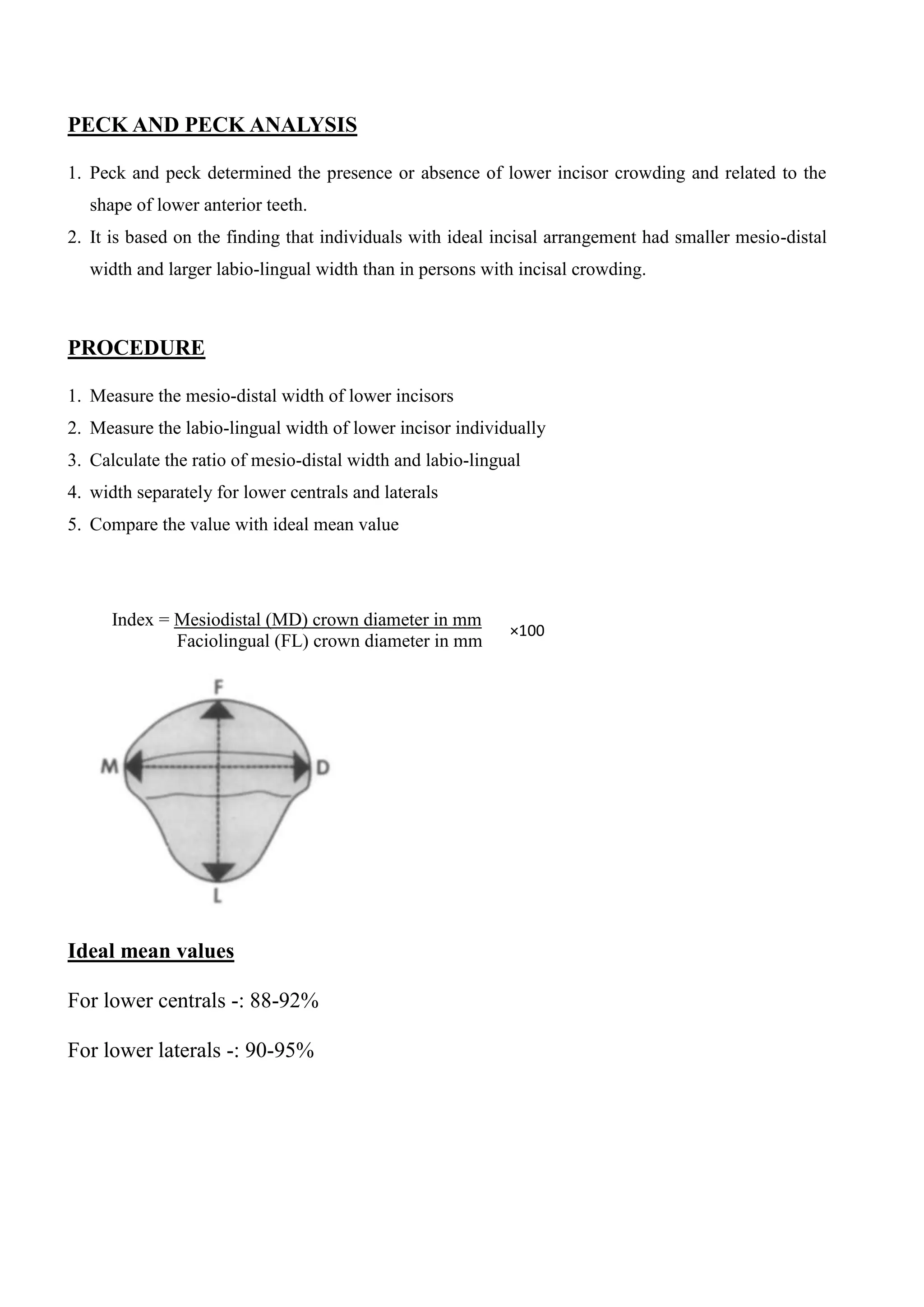
1. Peck and peck determined the presence or absence of lower incisor crowding and related to the
shape of lower anterior teeth.
2. It is based on the finding that individuals with ideal incisal arrangement had smaller mesio-distal
width and larger labio-lingual width than in persons with incisal crowding.
PROCEDURE
1. Measure the mesio-distal width of lower incisors
2. Measure the labio-lingual width of lower incisor individually
3. Calculate the ratio of mesio-distal width and labio-lingual
4. width separately for lower centrals and laterals
5. Compare the value with ideal mean value
Index = Mesiodistal (MD) crown diameter in mm
Faciolingual (FL) crown diameter in mm
Ideal mean values
For lower centrals -: 88-92%
For lower laterals -: 90-95%
×100
TOOTH MESIODISTAL
(MD)
FACIOLINGUAL
(FL)
MD/FL
INDEX
MD/FL
INDEX
STANDARDS
42 90-95
41 88-92
31 88-92
32 90-95
MOYERS ANALYSIS
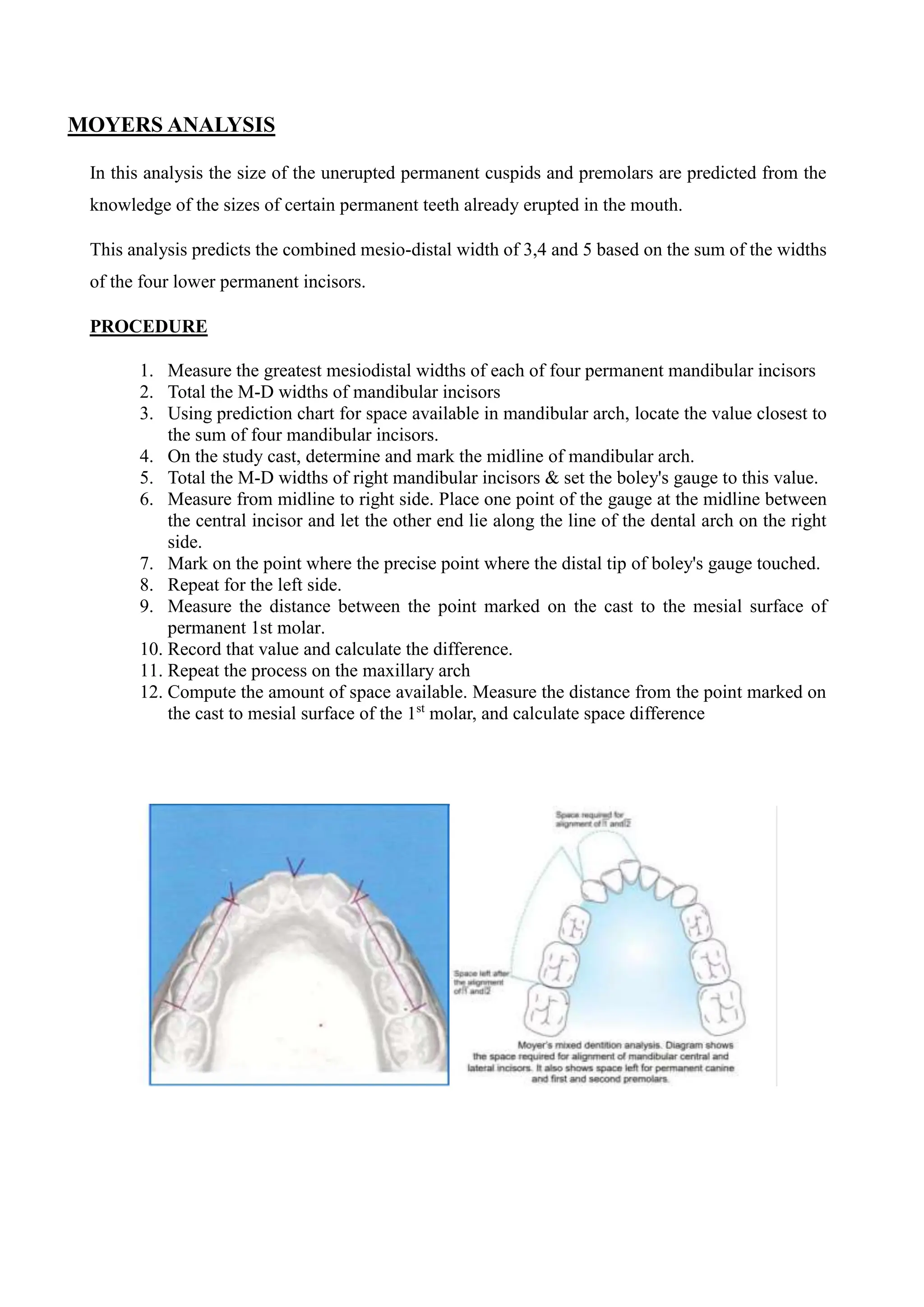
In this analysis the size of the unerupted permanent cuspids and premolars are predicted from the
knowledge of the sizes of certain permanent teeth already erupted in the mouth.
This analysis predicts the combined mesio-distal width of 3,4 and 5 based on the sum of the widths
of the four lower permanent incisors.
PROCEDURE
1. Measure the greatest mesiodistal widths of each of four permanent mandibular incisors
2. Total the M-D widths of mandibular incisors
3. Using prediction chart for space available in mandibular arch, locate the value closest to
the sum of four mandibular incisors.
4. On the study cast, determine and mark the midline of mandibular arch.
5. Total the M-D widths of right mandibular incisors & set the boley's gauge to this value.
6. Measure from midline to right side. Place one point of the gauge at the midline between
the central incisor and let the other end lie along the line of the dental arch on the right
side.
7. Mark on the point where the precise point where the distal tip of boley's gauge touched.
8. Repeat for the left side.
9. Measure the distance between the point marked on the cast to the mesial surface of
permanent 1st molar.
10. Record that value and calculate the difference.
11. Repeat the process on the maxillary arch
12. Compute the amount of space available. Measure the distance from the point marked on
the cast to mesial surface of the 1st
molar, and calculate space difference
LUNDSTROM SEGMENTALANALYSIS
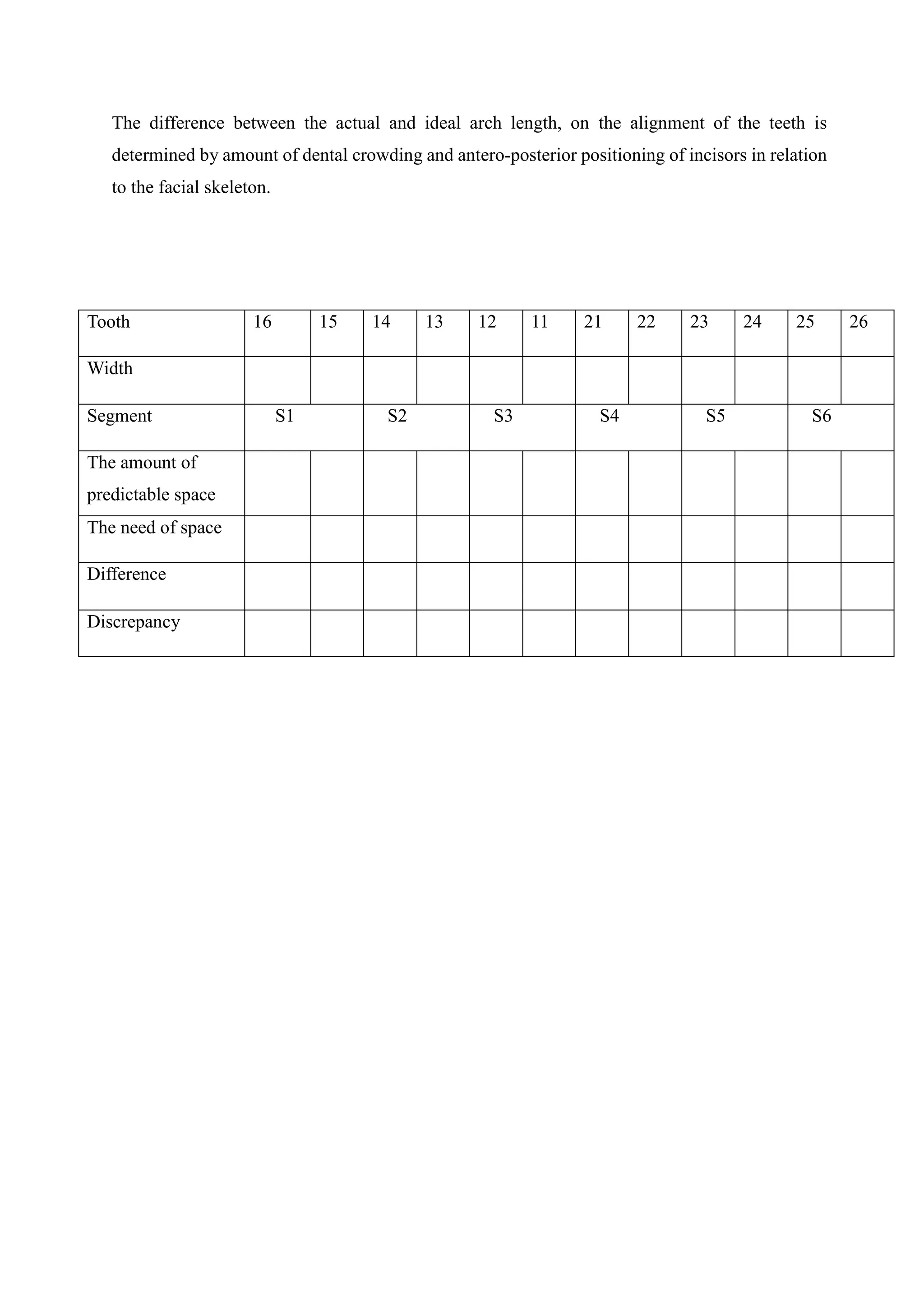
Lundstrom segmental analysis (1960) is used to perform the indirect assessment of the arch
perimeter segmentally on both arches. The dental arch is divided into six straight line segments,
including two teeth per segment, starting from the distal aspect of the permanent first molar till
the contralateral permanent first molar. The mesiodistal width of all teeth till the permanent first
molar is recorded on both sides of the arch. Individual tooth width of each segment is added
(space required), and the available mesiodistal space separately for each segment is noted.
Finally, the difference between the space required and the space available in each segment
determines the positioning of teeth. The negative value indicates crowding.
The difference between the actual and ideal arch length, on the alignment of the teeth is
determined by amount of dental crowding and antero-posterior positioning of incisors in relation
to the facial skeleton.
Tooth 16 15 14 13 12 11 21 22 23 24 25 26
Width
Segment S1 S2 S3 S4 S5 S6
The amount of
predictable space
The need of space
Difference
Discrepancy

PECK AND PECK moyers analysis......docx

  • 1.
    PECK AND PECKANALYSIS 1. Peck and peck determined the presence or absence of lower incisor crowding and related to the shape of lower anterior teeth. 2. It is based on the finding that individuals with ideal incisal arrangement had smaller mesio-distal width and larger labio-lingual width than in persons with incisal crowding. PROCEDURE 1. Measure the mesio-distal width of lower incisors 2. Measure the labio-lingual width of lower incisor individually 3. Calculate the ratio of mesio-distal width and labio-lingual 4. width separately for lower centrals and laterals 5. Compare the value with ideal mean value Index = Mesiodistal (MD) crown diameter in mm Faciolingual (FL) crown diameter in mm Ideal mean values For lower centrals -: 88-92% For lower laterals -: 90-95% ×100
  • 2.
  • 3.
    MOYERS ANALYSIS In thisanalysis the size of the unerupted permanent cuspids and premolars are predicted from the knowledge of the sizes of certain permanent teeth already erupted in the mouth. This analysis predicts the combined mesio-distal width of 3,4 and 5 based on the sum of the widths of the four lower permanent incisors. PROCEDURE 1. Measure the greatest mesiodistal widths of each of four permanent mandibular incisors 2. Total the M-D widths of mandibular incisors 3. Using prediction chart for space available in mandibular arch, locate the value closest to the sum of four mandibular incisors. 4. On the study cast, determine and mark the midline of mandibular arch. 5. Total the M-D widths of right mandibular incisors & set the boley's gauge to this value. 6. Measure from midline to right side. Place one point of the gauge at the midline between the central incisor and let the other end lie along the line of the dental arch on the right side. 7. Mark on the point where the precise point where the distal tip of boley's gauge touched. 8. Repeat for the left side. 9. Measure the distance between the point marked on the cast to the mesial surface of permanent 1st molar. 10. Record that value and calculate the difference. 11. Repeat the process on the maxillary arch 12. Compute the amount of space available. Measure the distance from the point marked on the cast to mesial surface of the 1st molar, and calculate space difference
  • 5.
    LUNDSTROM SEGMENTALANALYSIS Lundstrom segmentalanalysis (1960) is used to perform the indirect assessment of the arch perimeter segmentally on both arches. The dental arch is divided into six straight line segments, including two teeth per segment, starting from the distal aspect of the permanent first molar till the contralateral permanent first molar. The mesiodistal width of all teeth till the permanent first molar is recorded on both sides of the arch. Individual tooth width of each segment is added (space required), and the available mesiodistal space separately for each segment is noted. Finally, the difference between the space required and the space available in each segment determines the positioning of teeth. The negative value indicates crowding.
  • 6.
    The difference betweenthe actual and ideal arch length, on the alignment of the teeth is determined by amount of dental crowding and antero-posterior positioning of incisors in relation to the facial skeleton. Tooth 16 15 14 13 12 11 21 22 23 24 25 26 Width Segment S1 S2 S3 S4 S5 S6 The amount of predictable space The need of space Difference Discrepancy