Objectives: Why should you study
craniofacial growth and development ?
1- To distinguish abnormal dental or
skeletal pattern from normal.
2- To manipulate developmental problems
in children through growth modifications.
3-To assess skeletal age (Maturation indicies).
4-Clinical applications of CFG knowledges in Ottt
5-To predict CF growth pattern & its effect on ttt
planning & Stability of Orthodontic Corrections.
6-To interelate types of cranial patterns ,
mandibular condylar growth , mandibular
rotations , skeletal patterns and malocclusions.
PHD topics
• Stem cells.
• Distraction osteogenesis.
• Obstructive sleep apnea.
• Best Timing of growth modification.
• Growth changes and gender differences
(dental, skeletal and soft tissue).
• Management of syndromatic problems.
“Doing Orthopedic Treatment without ‘Growth’
knowledge , is like sailing a boat without knowing the
water current direction nor it’s intensity”
References:
* Ranly (A synopsis of craniofacial growth)
* Proffit (Contemporary Orthodontics)
* Singh,2007 (textbook of orthodontics)
* Enlow (Handbook of Facial Growth)
* Phulari.2017 (Orthodontics Principles and Practices)
* Foster
*Premkumar: (Craniofacial Growth )
* Mao and Nah : Growth and development:
Heridity and mechanical modulations , AJO
,2004, 125:
*Carlson : Theories of craniofacial growth in
postgenomic era ,Seminars in Orth.,2005.
COURSE OUTLINE:
❑Some definitions (growth-development-growth
center , site & Spurt- displacement–drift-
❑Prenatal growth (developmental periods ,
Embryonic layers,Stages of embryonic development ,
Neural crest cells and facial anomalies and clefts.
❑Types of growth (Scammon’s growth curves)
❑Mechanisms of Osteogenesis .
❑Growth changes of the human skull features and
sexual diff.
❑3D Postnatal growth of the skull .
❑Theories of craniofacial growth .
❑ Variables affecting bone growth , Heridity and
modulation ,Growth disorders & craniosynostosis
❑ Methods of studying physical growth .
❑Clinical applications of growth:
I – Normal growth changes of dental arches and
jaws and their clinical significances.
II – The effect of growth on orthodontic treatment.
(tooth movements and timing of treatment)
III – The effect of orthodontic treatment on growth.
(Restrain , enhance or redirect growth)
IV – Growth prediction
❑Assessment of pubertal growth spurt:
I –Accurate methods II–Questionable methods
❑The effect of growth on mandibular rotation:
I-Types of mandibular rotation .
II-Clinical variations between long and short face.
III-Clinical significances of mandibular rotation.
NB:Growth may be passive when the organ shrinks
by time as lymphoid tissues (tonsils and adenoids).
Development Is all the normal sequential series
of events between fertilization of the ovum and the
adult stage or maturation (progress towards
maturity by specialization and loss of potential).
Development = growth + differentiation + translocation.
Differential growth Differences in growth rate
and time between the various organs of the
organism.
Growth spurts Is the sudden increase in growth
rate during the age of the organism .
Timing variations of growth spurts (infantile,
juvenile and pubertal) between males and females
Differential growth spurts not only between
males and females but also between sutures,
cartilage and height
Prenatal Development
It could be classified into three periods:
1- The period of the ovum: from fertilization to the end
of the 2nd week IUL(only cell divisions & ends with 1.5
mm ovum).
2- The period of the embryo: from the end of 2nd week to
about the end of 8 weeks IUL (14th day-56th day) with
18 mm embryo The human face develops between 3 - 7
or 4 - 8 W IUL.
3- The period of the fetus : from 3rd month IUL (20mm
tube) – birth. An increase in size and change in
proportion except the last month
Human Embryogenesis
5 pairs of pharyngeal arches :
The first 2 pairs give rise
to the,bones,musceles
and nerves of the ear ,
jaws and upper neck
while the last 3 pairs
of arches give rise to
the bones,muscles ,
nerves of the neck. ,
glands (thymus and
thyroid ) and the out
flow tract of the heart
A mid sagittal section of 3 cm embryo (3 w IUL)
,Oral groove and forgut still separated.
It starts as a single cell zygote (fertilized ovum) which
possesses half the DNA of each of its two parents. and then
divides several times to form blastomere then morula (16
cell stage ). Further cellular division is accompanied by the
formation of a small cavity between the cells. This stage is
called a blastocyst. (day 1.5–3 of fert) The blastocyst
contains only a thin rim of trophoblast cells and a clump of
cells at one end known as the "embryonic pole" which
include embryonic stem cells.
. Up to this point there is no growth in the overall size of
the embryo, as it is confined within a glycoprotein shell,
known as the zona pellucida. Instead, each division
produces successively smaller cells.
The blastocyst reaches the uterus at roughly the fifth day
after fertilization. It is here that lysis of the zona pellucida
occurs. This process is analogous to zona hatching.
. Embryo implants 8 to 10 days after ovulation where the
trophectoderm cells of the blastocyst come into contact with,, the
endometrial cells of the uterus. The trophectoderm will eventually
give rise to extra-embryonic structures, such as the placenta and the
membranes.
During this critical period , first trimester , the developing embryo
is susceptible to toxic exposures, such as:
Alcohol, certain drugs, and other toxins that cause birth defects,
such as Fetal alcohol syndrome
Infection (such as rubella or cytomegalovirus)
Radiation from x-rays or radiation therapy
Nutritional deficiencies such as lack of folate which contributes to
spina bifida
Drugs: Anti pyretics, AntiConvulsants (epiliptic druges) &
Antihistaminics.
Smoking
The embryonic period begins with the tiny embryo of
closed tube . Its wall consists of 3 embryonic layers:
1-Ectoderm: from which the following tissues are derived:
a-Epithelial covering or skin.
b-Enamel of the teeth.
C- Nervous system.
2-Mesoderm: from which the following tissues are derived:
a-Skeletal system and muscles.
b-Blood, lymph cells and vessels.
c-Kidneys.
d-Dentine, cementum and dental pulp.
3-Endoderm: from which the following tissues are derived:
Epithelial linning of the pharynx, stomach , intestines
and lungs
Neural crest cells
The mamalian skull is derived from both,
trigeminal neural crest cells and mesenchymal
tissues. The neural crest cells are a group of cells
derived from ectoderm .
They are positioned on the top of the neural fold.
Once the neural tube is formed , the cells form a
group of cells resting on the top of the neural tube.
These cells migrate dorsolateral into the 1st
pharyngeal arch where they proliferate and
differentiate into the various components of the
face(cartilage ,bone ,cranial neurons, glia and CT
of the face), Gillert, 2000 .
If their migration or proliferation is blocked
(eg drug-induced impairment), facial and oral
abnormalities develop.
In mandibulofacial dysostosis or Treacher Collins
syndrom,both maxilla and mandible are
underdeveloped as a result of generalized lack of
mesenchymal tissue .It is evidenced that the
problem arises because of excessive cell death
(unknown cause) in the trigeminal ganglion, which
secondarily affects the neural crest-derived cells.
Related syndromes
Time
(post-fertilization)
Stages
Fetal Alcohol
syndrome(FAS).
Day 17
Germ layer formation and
initial organization of
structures.
1
Anecephaly
Days 18-23.
Neural tube formatiom.
2
*Hemifacial microsomia.
*Mandibulofacial dysostosis
(Treacher`s Collins
syndrome)
*Limb abnormalities.
Days 19-28.
Migration and interaction of
cell population.
3
Cleft lip and / or palate
,facial clefts and cleft palate.
Days 28-38.
Days 42-55.
Formation of organ system.
Primary palate.
Secondary palate.
4
*Achondroplasia .
*Synostosis syndromes
(Crouzon`s-Apert`s)
Day 50- birth
Final differentiation of
tissues.
5
Stages of Embryonic craniofacial development
Microcephaly ,thin &Short stature ,longe upper lip
&Short palbebral fissure
*Hemifacial
microsomia.
(reacher`s
Collins
Crouzon`s
Scammon’s Growth curves
Somatic Growth
It is the increase in overall body size,
which continues throughout the
growth period.
• It is rapid prenatal.
• Slows a little in the last few weeks
before birth.
• It accelerates reaching a peak ,11-13
yrs in girls, 13-15 yrs in boys
(pubertal growth spurt).
• It declines again to zero by about 20
yrs.
• Tissues showing this type of growth
are those of skeletal bone: maxilla
mandible, cartilage, muscles and
other supporting C.T.
Neural Growth
• The central nervous system
grows rapidly during
prenatal & early postnatal
life .
• The human brain attains
more than 90% of its full
adult size by 6 yrs however,
its functional maturation
continues for much longer.
• There is no pubertal spurt.
Lymphatic Growth
The lymphatic tissues grow
rapidly in early life &
reach their maximum at
11-14 yrs, after which
they decline.
Genital Growth
• 1ry & 2ry sexual organs
remain small until
puberty then grow to
adult size.
Hard Vs. Soft tissue Growth
Three phenomena are important in craniofacial growth:
1) Hyperplasia (increase in cell number).
2) Hypertrophy(increase in cell size).
3) Secretion of extracellular material (which calcifies
into bone),
Soft tissue grows by interstitial growth (means inside the
tissue):
(hyperplasia + hypertrophy + soft extracellular material)
Hard tissue as bones ,teeth & sometimes cartilages
grow also by interstitial growth but with calcification
of the extracellular substance . Most cartilages behave
like soft tissues.
For the end of fetal life ,the cartilage models of
many bones are replaced by bone except the
epiphyseal plate cartilage , which is a major
growth centre that are responsible about increasing
their lengths , while intramembranous growth of
the periostium that cover all bones, add to their
thickness only. The calcified portions of bone are
unable to contribute to growth.
Six - years old Knee
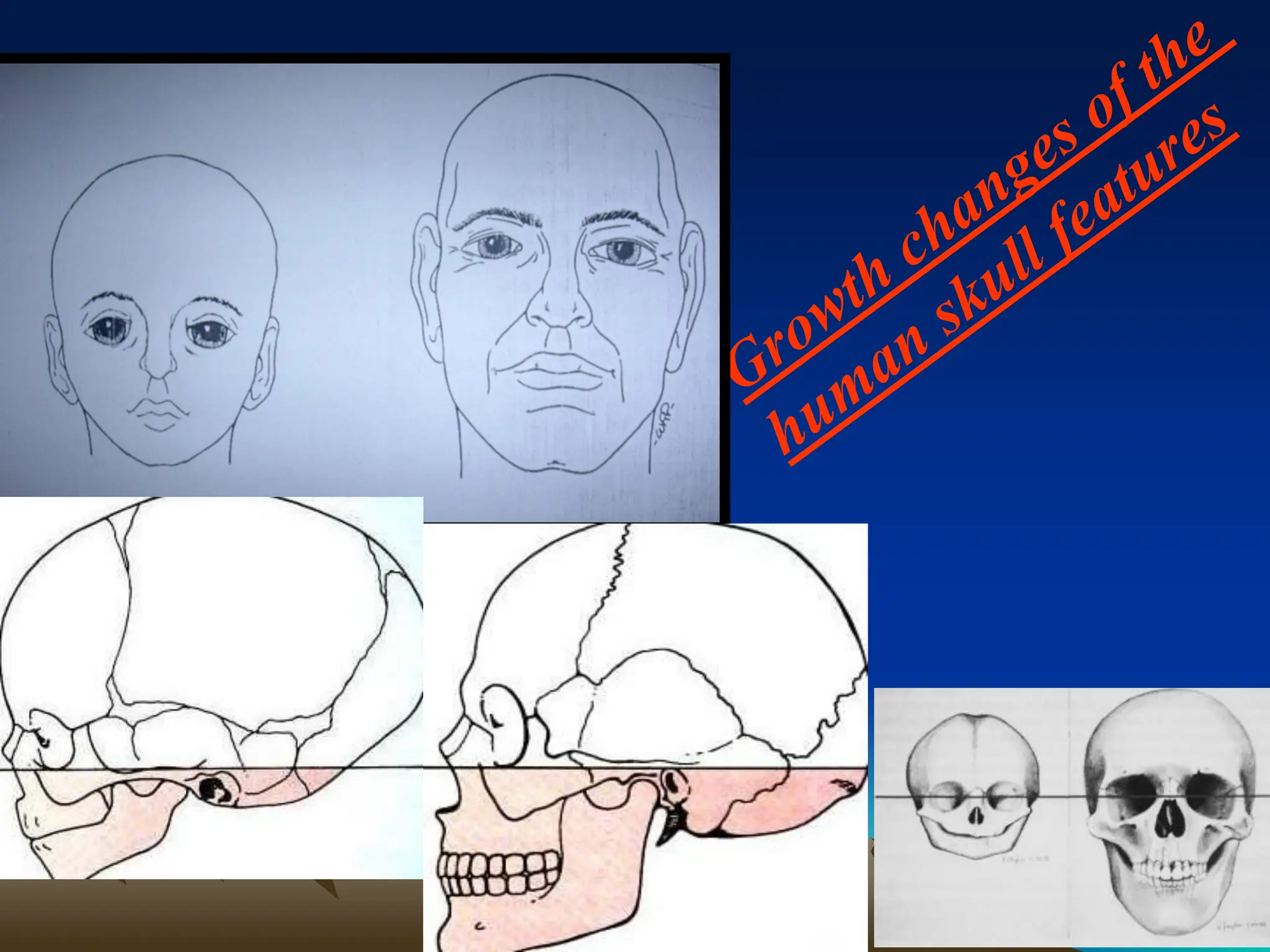
Growth changes of the human skull features.
The infant skull is formed of about 45 bony elements
separated by cartilage or connective tissue. These are
reduced in adult skull into 22 bones by growth (8 in the
cranium and 14 in the face) .
1) At birth, the face is only 1/8th the
size of the skull , while at adulthood
it is ½ its size.
Proportions:
Cephalocaudal gradient of growth:
The axis of increased growth extends from the head to the
feet. With the early growth of the brain, on comparing
skull of newly borne with that of adult, the cranium grows
more rapid than the face at early age, then the face grows
more later . Also maxilla grows more earlier than mandible
which continue to grew later until midtwenties
2) By time , growth of the trunk and lower limbs has reduced the
head from 1/4th the body height , (at birth) to 1/8th , (in adults) .
Proportion Changes (cephalocaudal gradient)
:
Growth changes of the human skull features
In newborn In adult Due to
Eyes are larger and
near each other
Smaller, distant
From each
other
By age lateral nasal & jaw
growth are faster than
orbital
Ears appear to be low
{at neck level}
Higher {on the
sides of the
face}
Ears move downwards,
face enlarges inferiorly
even more
Bulbous forehead . Reduced &
slanted
*Expansion of
supraorbital ridges
*elevation of nasal bridge.
*elongation of nose.
*alveolar growth of
mandibular & maxillary
In newborn In adult Due to
Cheek area is
more flat
More prominent Increase in lateral
bizygomatic width
Nose Longer, wider, more
vertical size, and more
prominent nasal
bridge
Diminutive
mandible
with obtuse
angle.
Larger and Squared Deposition of bone to the
posterior ramal border
Receeded More prominent Deposition of bone to the
In newborn In adult Due to
Face is 1/8 the
skull size.
1/2 the skull size
Deeper
vertically
Ramus growth, downward
growth of nose & maxilla (2ry
displacement & alveolar
growth).
Deeper antro-
posteriorly
* Forward elongation of the
nose.
* Forward 2dry displacement.
* Posterior movement of the
zygoma.
* Posterior extension of the
dental arches accompanied
by anterior thrust of upper &
lower jaws.
Mechanisms of Osteogenesis
Bone grows by one of two mechanisms:
II- Intramembranous Osteogenesis: Occurs in
membranes (pressure tension) e.g: Periosteum ,
endosteum , Sutures and periodontium .
I- Endochondral Osteogenesis: Occures in
cartilage or pressure tolerant tissue areas subjected to
direct compression e.g. Synchondrosis , Nasal
cartilage, Condylar cartilage and symphyseal cartilage.
Condylar cartilage
• Bone formation occurs utilizing a precursor of cartilage
,chondrocytes, which deposit bone :
* Cartilage cells hypertrophy
* Cartilage cells hyperplasia
* Their matrix becomes calcified
* Cells degenerate
* Osteogenic tissue invades the
dying & disintegrated cartilage
& replaces it by both :
appositional and interstitial
(expansion activity)
cartilagenous growth sites:
A- Epiphysial cartilage.
B- Synchondrosis.
C- Mandibular condyle & Symphysis
Bidirectional growth of the synchondrosis
M.Condylar cartilage
Epiphysial cartilage
Growth site.
Growth center.
1
Chondrocytes are radially arranged
and covered by fibrous capsule.
Chondrocytes are arranged in columns
and not covered by fibrous capsule.
2
Grows by interstitial and appositional
Grows by interstitial growth .
3
After maturation ,it doesn't change
completely into bone.
After maturation ,it disappeared and
Changed completely into bone.
4
Less sensitive to hormone and
vitamin deficiency.
More sensitive to hormone and
vitamin deficiency.(cretin).
5
More responsive to mechanical stimuli
(pressure diminishes cell activity while
its relief stimulates growth).
Less responsive to mechanical stimuli
6
Posses different antigenic potential.
( Distinct than that of ep. plate and
Posses antigenic potential similar
to that of nasal cartilage and distinct
7
Synchondrosis
Are areas of growing
cartilage (double
epiphyseal plates)
between two pieces of
bones They appear in
the cranial base and
grow by replacement
of cartilage as in a
typical long bone.
Cranial base Synchondrosis.
1-the spheno-ethmoidal synchondrosis
*It exists between the sphenoid bone and the ethmoid
bone *It closes at about 5-7years
2-the intersphenoidal synchondrosis:
*It is present in the midle cranial base between
the anterior and posterior parts of the body of
the sphenoid * It closes just before birth .
3-spheno-occipital synchondrosis:
*It exists in the middle cranial base between the
occipital and sphenoid bones. *It persists to 18-20
years of age closing a few years earlier in girls than
in boys.
4- Intra-occipital synchondrosis:
*It is present inside the occipital bone.
*It closes at 3-5 years.
Intramembranous Bone Formation
• This is where bone is formed in memebrane:
-The undifferentiated mesynchymal cells of the
membranous C.T. change to osteoblasts that
elaborate Osteoid matrix then the entrapped
osteoblast changed into osteocytes .
-The matrix or intercellular substance becomes
calcified by the osteocytes enzymatic activity and
BONE results. This growth is additive or
Growth by surface deposition
1- Occurs in all skull bones associated with resorption of
previously formed bone.
2- More significant in the later periods of skull growth.
3- The balance between bone
deposition and resorption is
an important factor in changing
the form of individual bony
elements of the skull.
Suture:
The suture is an inward
reflection of the periosteal
membrane between the
edges of adjacent bones.
At a growing suture there are 5 layers of tissues:
*Cellular osteogenic layer of the periosteum associated
with each of the 2 bones bounding the sutures.
*Fibrous layer of the periosteum associated with each of
the 2 bony units bounding the cellular osteogenic layer.
*Intermediate layer between the adjacent fibrous layers
containing connecting fibers & blood vessels.
Two theories regarding sutur growth:
1 - The classical sicher`s theory:
The proliferation of the soft tissues in the suture
separate the bone bounding it, (build in). Suture
is considered as growth centre.
2 - The functional matrix Moss theory:
Separation of bones at sutures is produced by growth
of another organ e.g. the brain , eyeballs, cartilage at
the synchondrosis or the nasal cartilage.
Thus, the suture is a tension adapted growth region
responding to forces of enlarging soft tissues
associated with them (fill in).
According to Baume :
A growth center (growth initiator) is where endochondral
ossification with tissue separating force occurs (build in),
e.g synchondrosis.
A growth site (growth adjuster) is where periosteal or
sutural bone is formed in adaptation to environmental
influences (fill in).
* This was evidenced through
experimental transplantation
of sutural cells & growth plate
cells in subcutaneous site; the
plate cells grew while the
suture cells didn’t.
Growth movements
Drift:
Movement of bone in the same direction of its own
growth by deposition of bone on one side of the cortical
plate & resorption on the opposite side.
E.g : posterior drift of
mandibular ramus and
maxillary tuberosity.
Post. drift
Ant. displacement
Displacement
Is the movement of bone as a one unit by either of :
1- Primary displacement: Movement of bone in
opposite direction of its own growth; this is to
maintain the relationship of bones to each other
as they are carried away from their articulation
with each other.
2- Secondary Displacement:The movement of
bone in the same direction of growth of other
adjacent or distant bone; in relation to
enlargement of other organs.
Primary Displacement
• The anterior displacement of maxillary and
mandibular arches in response to their posterior
drift (maxillary tuberosity and posterior border
of mandibular ramus) are examples.
1- Maxillary primary displacement
2- Mandibular primary displacement
Secondary Displacement
1- Maxillary Secondary Displacement : The forward and
downward displacement of nasomaxilla in response to brain
expansion ,nasal cartilage , cranial base growth & growth of
circum maxillary sutures , is an example.
2- Mandibular Secondary Displacement : The forward and
downward displacement of the mandible in response to brain
expansion & cranial base growth will stimulate condylar growth.
Remodeling
It is the change in size &
shape of bone as a result
of differential resorption
& deposition of the inner
& outer surfaces.
Growth of maxillary sinus and
mandibular condyle are examples
Postnatal growth of the skull
A-Middle face
B-Mandible
I) Growth of
the cranium
II) Growth of
the face
A-Cranial vault
B- Cranial base
A-Growth of the cranial vault:
It is accelerated during infancy and grows by :
1- Sutural growth .
2- Selective resorption of the inner surface of the
cranial bones to help flatten them out as they
expand.
*Appositional growth on the internal & external
surfaces as they become thicker
NB :The cranial superstructures grow in response to certain
mechanical influences e.g. supraorbital & mastoid
structures which are more marked in males than females.
Growth in width :
The newborn has his frontal bone separated by the
metopic suture with no frontal sinus. The developing
sinus gradually replaces spongy bone between
external plates and the metopic suture closes by the
2nd year .Also the increase in width occurs by filling
in the interparital, parito-sphenoidal &
paritotemporal sutures .
Growth in length : Occurs due to sutural
growth at the coronal & lambdoidal sutures
in response to growth of the cranial base and
brain expansion.
NB: Cranial sutures except the metopic remain
patent until the third decade.
Cranial fontanels (soft spots):
Are six in number:
Two along the midline of the cranial vault top
(anterior and posterior) and two on each side of the
cranial vault (sphenoid and mastoid).
The lateral fontanels close soon after birth ,the
posterior one closes several months later while the
anterior remains open up to 2-3 years. Their date of
closure is affected by genetic and nutritional
factors. In Cleidocranial dysostosis and Rickets ,
their closure is delayed.
B-Growth of the cranial base
• It grows by cartilagenous growth in its synchondrosis
which act as a double epiphyseal plates.
• These synchondrosis share in adjusting the cranial base to
the need of the growing brain & upper respiratory areas.
• When the cranial base grows antro-posteriorly , it brings
the maxillary complex forward and downward by 2ry
displacement; which leaves
a space for the oropharynx.
• This increase in length gives a
chance for the growth of the
naso-maxillary complex &
alveolar region to grow vertically.
A. The Cranial Base angle is the angle formed where the anterior
and posterior cranial base come together (NSAr^).
B. As the cranial base angle becomes more acute (small brain), the
mandibular posterior teeth are more anteriorly positioned and the
maxillary posterior teeth are more posteriorly positioned(class III).
C. As the cranial base angle becomes more obtuse (expanded brain),
the mandibular posterior teeth are more posteriorly positioned and
the maxillary posterior teeth are more anteriorly positioned(class II)
D. Dolichocephalic people have more obtuse cranial base angles and
brachycephalic people have more acute cranial base angles.
E-The increase in length of cranial base gives a chance for the naso-
maxillary complex and alveolar region to grow vertically.
In short face :
Short wide brain –
ubright(closed) cranial
base – nasomaxilla is
more posteriorly
&upward displaced –
mandible is more
upward & forward
displaced. (prognathic
profile and class III
molar tendency –
associated with
individuales with
erected head and neck
In long face :
Long narrow brain –
flate cranial base –
nasomaxilla is more
anteriorly &downward
displaced – mandible is
more downward &
backward displaced.
(retrognathic profile
and class II molar
tendency – associated
with individuales with
anterior inclination of
head and neck
II) Growth of the face
A-Middle face
* It consists of : orbits,
nasal cavity, maxillary
sinuses, upper alveolar
process & palate.
* It follows the neural
growth curve at birth,
and later it follows the
somatic growth curve.
Growth in width:
a-) Before Seven years :
i) Secondary displacement to brain and cranial base growth.
ii) Separation of the median palatine suture.
skull is divided into 2 halves by the sagittal suture .
( its ext. suture system : metopic, inter nasal , middle palatine
and mandibular symphysis ) allow lateral displacement growth
iii) During the 1st y the metopic suture & the symphysis close
iiii) By 7 years the orbital and nasal lateral growth by displacement
cease .
b-) After seven years :
The neural growth ceases &
further growth occurs by
bone drift (bone apposition
to the zygoma ,zygomatic
arches and lateral maxillary surfaces).
Growth in height :
During the 1st seven yrs : half of the growth occurs by
2ry displacement to the anterior cranial base & nasal
cartilage ( due to increase in respiratory demand;
functional matrix theory).
The other half of the growth occurs by drift; resorption on
the nasal floor & deposition on the palate & the alveolar
process. The nasal floor becomes at a lower position than
the orbital floor due to more resorption on the nasal floor
(Vprinciple).
Frontonasal - Frontomaxillary
Zygomatico maxillary -
Zygomatico temporal
& Pterygo palatine .
Growth in Depth:
a –) Before seven years : By secondary displacement to
cranial base , nasal cartilage & sutural growth.
The nasomaxillary complex is united to the cranial base
through a group of sutures :
These sutures are aligned in
such a way so that their growth
causes anterior and forward
displacement of the middle face
.
B-) After seven years: by posterior drift and 1ry
displacement The ant. mx. and zygomatic
surfaces are resorptive while the post. zygomatic
surfaces and mx. tuberosity are depository giving
chamber for eruption of 6 ,7 & 8 teeth together
with ant. primary displacement.
B- Mandible
At birth :
The mandible appears as a curved bar of bone, body
is ill defined , no alveolar process , rami are short ,
condyles are not yet well developed , and its angle
is 175 degrees .
Growth in width:
a-) Befor seven years:
* during the 1st yr of life it occurs through
symphyseal cartilage growth.
* Increase in inter ramal width by resorption of its
outer surfaces and deposition to its inner surfaces
(V principle) in response to lateral brain and
cranial base growth.
Adult
5y
The Moss“V “ principle – vertical expansion:
Bone is deposited on the inner surface of the “V” shaped
bone and resorbed on the outer surface. Thus the “V”
moves away from its narrow end and enlarges in overall
size.
* Mandibular Condyles grow in a posterior ,superior &
lateral directions by endochondral bone formation.
The Moss“V “ principle – horizontal expansion:
The mandible viewed from above including a horizontal
section through the base of the coronoid process . Bone is
deposited on the lingual side of the mandibular structures
up to the ramal surface Thus the coronoid processes move
in a backward direction and the posterior part widens
B-) After seven years :
Deposition of bone to the lateral body surfaces and
lateral growth of the alveolar process add to its
lateral growth.
Growth in length :
b-) After seven years:
*Alveolar bone growth along the superior border
of the mandibular body in the vertical dimension
* Bone is deposited along the entire inferior surface
of the mandibular body except for the antigonial .
a-) Before seven years:
The mandible is 2ndry displaced
in a downward and forward directions secondary
to the brain and cranial base growth . The
mandibular condyle grows in upward ,lateral and
posterior directions with 1ry displacement of the
mandible in the opposite directions.
Growth in Depth :
a-) Before seven years:
The mandible is 2ndry displaced in a downward
and forward directions secondary to the brain and
cranial base growth . The mandibular condylar
growth in upward ,lateral and posterior directions
will 1ry displace the mandible in the opposite
directions.
b-) After seven years: By primary displacement,
*The posterior border of the ramus grows backward
by posterior bone deposition while the anterior is
resorptive to give room for the developing posterior
teeth. The mandible is displaced at the same time in
a forward direction increasing its depth. *The
condylar growth continue to displace the mandible.
*The angle of the mandible decreases to 115 degrees
due to bone addition to the posterior border of the
ramus.
.
* The chin is depository at the periosteal bone and
resorptive just above the mental protubernce
protruding chin.
* The mental foramen early in life is under the
mesial cusp of the 1st deciduous molar, in adult it is
below & between the 1st & 2nd premolars. Due to
the backward and outward inclination of the canal,
as bone is added on the outer surface of the body of
the mandible, the foramen is carried backwards.
Evolution of theories of
craniofacial growth
• Remodeling theory
• (Brash 1930)
• Sutural theory
• ( Sicher 1940)
• Cartilagenous theory
• Scott 1950)
• Functional matrix theory
(Moss 1960)
• Van Limborg’s
• Modern composite theory
• Servo system
Genomic paradigm
(1920-1960)
Functional paradigm
paradigm (1960)
Remodelling theory (Brash,1930):
He postulated that the craniofacial skeleton
growth occurs exclusively by bone remodelling –
selective addition and resorption of bone at its
surfaces . Sutures and cartilages have little or no
role . Jaws growth occure by deposition of bone at
their posterior surfaces while calvarial growth
occurs via ectocranial deposition and endocranial
resorption .
Sutural theory , Sicher ,1940 .
Sutures and cartilages of the craniofacial skeleton are
growth centers and genetically controlled (inherited
immutable pattern) . Accordingly the CT cells of the
cranial and circum maxillary suture system and the
chondrocytes proliferation is under genetic control and
results in cranial vault expansion , midfacial anterior and
downward growth and cranial base growth . He
considered the mandibular condyle equivalent to the
epiphyseal plate whose growth forces the mandible
downward and forward . Evidence: Familial, racial, and
monozygous similarities. Evidence against:
1- Subcutaneous transplantation of suture fails to grew .
2- suture is tenton adaptive &respond to pressure by rorp. not dep
Nasal cartilage theory , Scott,1950.
He stated that Cartilage is the primary
determinant (growth center) of bone growth while
sutures are secondary .
Evidence: I- Transplantation of :
1- epiphyseal cartilage grew.
2- Nasal cartilage sometimes grew.
3- Mand. condylar cartilage does not grew.
II- Absence of nasal cartilage (achondroplacia -
nasal trauma) results in deficient maxilla.
*A chondroplastic Dwarf is characterized
by mid face deficiency, normal
mandible, short legs and arms .
*Absence of nasal structures including nasal
cartilage results in sever mid facial deficiency .
*A man with deficient mid face
. A history of an accident that
results in removal of his nasal
septum since 7 y of age.
Functional matrix theory , Moss,1960.
He denies any entrinsic genetic factor in controlling
chondro or desmocranial bone growth . Growth of
cranium and face occur in response to functional
demand and is mediated by soft tissue adjacent to
skeletal units i.e. soft tissue adjacent to bone is the
primary determinant while sutures and cartilages
are secondary . He defined two types of functional
matrices: the periosteal matrix corresponding to
the local muscles, blood vessels and nerves, the
capsular matrix corresponding to the organs as the
brain and eye globes as well as the spaces of oro
and nasopharynx.
Evidence :I- Size of the brain controls the size of cranium
(Anecephaly. microcephaly and hydrocephaly).
II- Size of the eye controls the size of the orbit.
Anecephaly
NB: Hydrocephaly: Results from accumulation of cerebral fluids in
the brain which increases the intracranial pressure & the cranial size
, at the same time it decreases the brain development resulting in
mental retardation.
Bilateral ankylosis,
restricts Md growth
Befor condylectomy After condylectomy
III-Fractured mandibular condyle, in 75%,
regenerates and mandible continue to grow.
IV - Mandibular growth is impeded by ankylosis
V – experimental cutting of temporalise muscle results
in deficient coronoid process .
VI – Alveolar bone resorbes after extraction of teeth .
Latham Theory
He combined the ideas of Scott , Sicher and Moss
He believed that the maxillary sutures began as
sliding joints adapting to initiating growth forces
else where, but later manifest increasing
osteogenesis, contributing to the main displacing
force at the free surfaces.
Chondrocranial Growth
Desmocranial Growth
Intrinsic Genetic
Local epigenetic
Local environmental
The compromise theory of Van Limborgh
Direct action
Local epigenetic factors(capsular FM) : as adjacent
structures and spaces including brain and eyes . General
epigenetic factors: as sex and growth hormones . Local
environmental factors(Periosteal functional matrix): as
muscle forces. General environmental factors: as food
,oxygen ,vitamin defeciency .
Van Limborg`s view He summarized all the previous
theories in essential six elements to which he added a seventh point
for description of mandibular condylar growth :
1-Chondrocranial growth is primarily affected by intrinsic genetic
factor.
2-Skull cartilages are growth centers.
3-Desmocranial growth is controlled by few genetic factor.
4-Sutural growth is primarily controlled by skull cartilage and
adjacent structures.
5-Periosteal growth is primarily controlled by adjacent structures.
6-Sutural and perioosteal growth are secondarily controlled by local
environmental factors.
. 7-Mandibular condyle is controlled by local environmental factor
(muscles)
Servo system theory Betrovic ,1970 .
He focused on the mandibular condylar growth.
He summarized the servo system as follows:
1-Anterior and downward growth of the nasomaxilla
under influence of cartilaginous nasal cartilage and cranial
base synchondrosis mediated by endocrin system.
2-Dyscrepancy between maxillary and mandibular
dentitions results.
3- The mandibular protractor muscles are activated by the
proprioceptors in the periodontium and TMJ.
4- The mandibular cartilage growth is activated directly by
the protractor muscles and indirectly by the TMJ vascular
supply. Finally , the effect of muscle function and the
responsivness of condylar cartilage are influenced directly
and indirectly by hormonal factors
E
Hormonal
factors
D
Muscle (MP)
function
F
Condylar
growth
A
Maxillary
growth
B
Occlusal
descrepancy
CNS
Proprioceptors in
Periodontium &
TMJ
C
direct action
Servo system
molecular biology , 1980 ; By combining the
principals of transmission genetics (Mendel
principle of inheritance before 1920) with the
concepts in embryology , Wadington and others
developed hypothesis about how genes might act to
influence development of specific traits
Since 1980 , a revolution in the developmental
molecular biology began. Discoveries related to the
role of the neural crest cells. The actual outcome of
growth depends on the interaction between the
genetic potential and environmental influences
The epigenetic factors (trauma , mechanical forces
and function) activate expression of regulatory
DEVELOPMENTAL CRANIOFACIAL ANOMALIES
AND SYNDROMES
Anomaly: “is a medical term meaning "irregularity" or
"different from normal“.
Congenital anomalies (CA): that occur during
intrauterine life and can be identified
prenatally, at birth or later in life.”
Syndromes: “a group of signs and symptoms that occur
together and characterize a particular
abnormality or condition”
I- OROFACIAL CLEFTING SYNDROMES:
1- Cleft lip and Palate.
2- Pierre Robine Syndrome
II-BRANCHIAL ARCH DISORDERS:
1- Digeorge Syndrome
2- Hemifacial Microsomia
3- Treacher Collins Syndrome
III-SYNDROMES AFFECTING BONE AND CARTILAGE:
1- Achondroplasia.
2- Cleido-Cranial Dysplasia
IV-CRANIOSYNOSTOSIS:
1-Cruzon`s Syndrome
2- Apert`s Syndrome
V- ENDOCRINAL DISTURBANCES:
1- Hyperpituitrism
2- Hypopituitrism
3- Cretinism
VI- VITAMIN DEFICIENCY:
Rickets
CRANIOFAIAL ANOMALIES
1- SKELETAL DISORDERS:
A- ANTERO-POSTERIOR B- VERTICAL C- TRANSVERSE
2- NEOROMUSCULAR DISORDERS:
A- SPEECH B- RESPIRATION C- SWALLOWING
D- TMDs E- HABITS
3- SOFT TISSUE DISORDERS
A- LIPS: UPPER LIP ….LOWER LIP
B- TONGUE C- ABNORMAL FRENUM
4- DENTALANOMALIES:
A- ANOMALIES IN THE NUMBER OF TEETH
B - ANOMALIES IN THE TEETH FORM
SKELETAL DISORDERS
A- ANTERO-POSTERIOR PLANE:
MAXILLA : 1- PROGNATHISM 2 - HYPOPLASIA
MANDIBLE:1- PROGNATHISM 2- RETROGNATHIA OR
MICROGNATHIA (WITH or WITHOUT DENTO-
ALVEOLAR COMPENSATION)
B- VERTICAL PLANE:
INCREASED ANT FACIAL HT
DECREASED ANT FACIAL HT
C- TRANSVERSE PLANE:
1- MISMATCH IN SIZE BETWEEN MAXILLA AND
MANDIBLE
2- FUNCTIONAL MANDIBULAR SHIFT (LAT.& FRONT.).
NEUROMUSCULAR DISORDERS
1- SPEECH 2- RESPIRATION
3- SWALLOWING 4- TMDs :
4- TMJ ARTICULAR DISORDERS
1- Disc displacement disorders 2- Dislocation
3- Inflammatory disorders 4- Osteoarthritis
5- Ankylosis : bony and fibrous 6- Fracture
7- Cong. or dev. disorders
5- MASTICATORY MUSCLE DISORDERS
1- Myofacial pain 2- Myositis
3- Myospasm 4- Myofibrotic contracture
5- Local myalgia 6- Neoplasm
6- Habits: (Thumb sucking and Tongue thrusting)
SOFT TISSUE DISORDERS:
1- UPPER LIP: -( THIN - THICK - SHORT)
2- LOWER LIP: (THIN - THICK - EVERTED
- ENTRAPPED BET UPPER AND LOWER CENTRALS)
3- UPPER AND LOWER LIPS TOGETHER:
- LIP INCOMPETENCE
- MUSCLE ACTIVITY: FLACID (BIMAX. PROCLINATION) .
STRAP-LIKE (BIMAX. RETROCLINATION) .
- LIP LINE: HIGH LIP LINE (CLASS II DIV 2) .
LOW LIP LINE (CLASS II DIV 1) .
4- TONGUE:
- SIZE OF THE TONGUE (LARGE TONGUE)
- TONGUE THRUSTING and ABNORMAL TONGUE POSTURE
5- ABNORMAL FRENUM:
- UPPER LABIAL FRENUM
-LINGUAL FRENUM
DENTAL ANOMALIES:
I- ANOMALIES IN THE NUMBER OF TEETH:
1- DEV. ABSENT TEETH (HYPODONTIA)
2- EXTRA TEETH: SUPERNUMERARIES ,CONICAL, SUPPLEMETAL ,
TUBERCULATE AND ODONTOME
3- EARLY LOSS OF DEC. TEETH
4- RETAINED DEC TEETH
5- UNSCHEDULED LOSS OF PERMANENT TEETH
II- ANOMALIES IN THE TOOTH FORM:
1- MEGADONT
2- PEG-SHAPED
3- DENSE-IN-DENTE (INVAGINATED ODONTOME)
4- TALON CUSP
III- ANOMLAIES IN TOOTH POSITION:
TRANSVERSION: WRONG SEQUENTIAL ORDER.
AXIVERSION: WRONG TIP … WRONG TORQUE .
TORSIVERSION :ROTATED ON ITS LONG AXIS
LABIOVERSION/ LIGUOVERSION - SUPRVERSION / INFRAVERSION
MESIOVERSION/ DISTOVERSION– INVERSION – CROSS AND SCISSR
BITE AND IMPACTED TEETH.
IV- ANOMALIES IN TOOTH STRUCTURE:
ABNORMALITIES IN ENAMEL AND DENTINE
V- TSALDs: CROWDINGS / SPACINGS
VI- PATHOLOGY RELATED TO THE DENTITION:
1- PERIODONTITIS: - CHRONIC AND JUVENILE
2- CYSTS / TUMOURS
3- ANKYLOSIS
Facial and Oral clefts
The human face develops between 3-7 w (IUL)
where fusion between various facial and oral
processes occur. Failure of fusion results in cleft .
It is one of the most commonly
knowen CF A allover the world
. Prevelance is 1 every 700 live
births
ETIOLOOGY:
1- Genetic.
2- Folic acid deficiency.
3- Maternal smoking.
4- Teratogenicity.
5- Alcohol.
CLASSIFICATION:
cleft lip : Results from failure of fusion between
globular or medial nasal and Maxillary processes
.It may be : Unilateral or Bilateral , Partial or
Complete or midline cleft lip (split within the
medial nasal) in rare cases .
Isolated cleft
hard palate
Bifid Uvula
Cleft palate : Results from failure of fusion of
the 2 palatine processes of the maxillary
processes together with the premaxilla in a Y
shaped pattern.
It may be: partial or complete , unilateral or
bilateral . Closure of secondary palate follows
that of primary palate by nearly 2 weaks .
Nasoalveolar moulding
2) Failure of fusion between , maxillary
and lateral nasal process results in ,
Oblique facial cleft
3) Failure of fusion between , maxillary
process & mandibular arch results in
Macrostomia
Pierre Robin Syndrome , is characterized by:
1- Cleft palate. 2- Retrognathic mandible.
3- Glossoptosis. 4- Rrespiratory distress.
5-Some “ catch up”growth achieved.
Etiology: Is not knowen ,do not run into families ,it
may be malpositioning of the fetus
Craniosynostosis
Terminology:
Closed Suture Name Skull Shape
Boat Skull
Scaphocephaly
Sagittal
Triangular Skull
Trigonocephaly
Metopic
Asymmetric Skull
Plagiocephaly
Unilateral
Coronal
Short Skull
Brachycephaly
Bicoronal
Asymmetric Skull
Plagiocephaly
Lambdoid
Craniosynostosis
Definition: Premature closure of one or more of
the cranial sutures . Incidence : 1 : 1000
Midsagittal suture synostosis
(Scaphocephaly):
Long narrow skull , protruded from front and
pointed from the back with palpated ridge along
the suture.
Before & After ttt
Metopic suture synostosis
(Trigonocephaly or triangular skull) :
The forhead is slanted with midline ridge &the eyes
are closer (hypotelorism)
Before & After ttt
Coronal suture synostosis
( Brachycephaly or short skull):
Receded flat forehead , proptosed & elevated eyes.
Before & After ttt
Crouzon`s Syndrome : Characterized by prenatal
fusion of maxillary and cranial sutures (craniosynostosis Of
lambdoid ,coronal and sagittal ),and so preventing forward
displacement of mid face ,class III, hyper telorism
(separation of eyes) & eye ptoptosis w` may be due to under
development of mid face or increased intracranial pressure
following synostosis .It is characterized also by short skull in
front and back and flat cheek and nose, high arched palate
& cleft palate 3%) .
. Incidence ,15 : 1,000,000
Dental anomalies: narrow/high-arched palate,
posterior bilateral crossbite, hypodontia (missing
some teeth), and increased spacing between teeth.
Due to maxillary hypoplasia, Crouzon patients
generally have a considerable permanent openbite
and subsequently cannot chew using their incisors.
A child with Crouzon
syndrome wearing a
corrective cranial band,
post surgical release of
synostosed sutures.
It appears at birth and worsen by age . Surgical
release of sutures at early age (4-8 M) is indicated.
Apert`s syndrome:
Incidence: rare……1: 100,000 – 160000
Characterized by :
craniosynostosis of lambdoid and coronoid sutures
resulting in Short head in front and back but
pointed at the top .
Widely spaced (hypertelorism) and protruded eyes
with antimongoloidal slant,.
Midface hypoplasia, high arched palate, class III
malocc., cleft palate , delayed eruption ,dental
crowding .
Hyper mobile joints ,and fused fingers and
toes (Syndactyly).
Lambdoidal suture synostosis
(Plagiocephaly or Asymmetric skull ):
Flate back skull , the least common type.
Before ttt 5 m after ttt
Hemifacial microsomia
Is a 1st and 2nd branchial arches syndrome.It is due to
early loss of neural crest cells. Owing to its long path, it
affects the lateral and lower part of the face causing under
development of the eye, cheekbone, lower jaw, facial nerve
and muscles on one side of the face. Both external ear and
the mandibular ramus are deficient or absent on the
affected side .Its etiology is unknown or hereditary .
Incidence: 1 in 3500 to 4500
An Egyptian
girle 2.5 y
having
hemifacial
dysostosis
Treacher collins syndrome (md.facial
dysostosis) is due to unknown cell death in the
trigeminal ganglion,that affects the neural crest cells
causing deficiency of both jaws , receded chin, hypoplastic
condyle ,deficient zygoma, cleft palat in 35 % ,
antimongoloid slant of the eyes ,ptosis of upper eyelids ,
coloboma of lower eyelids and its mesial cilia absent ,lack
of middle ear and auricle development w` results in loss of
hearing.It is extremely rare.
DiGeorge Syndrome
1- High arched palate .
2- Cleft palate .
3- Cardiovascular anomalies .
4- Hypoplasia of parathyroid .
5- Short stature .
6- Low muscle tone.
7. Neonatal hypocalcemia,
8-Immunodeficiency
22q11.2- presents several features,
some of these may include:
• congenital heart
defect (CHD),
• CHD is present in 75%
of patients with Del22.
The most frequently
seen cardiac
malformations :
tetralogy of Fallot (TF),
Cleidocranial dysostosis (dysplasia)
Inherited and due to defecetive development of
intramembranous ossification .
Is characterized by uni or bilateral
complete or partial absence of
clavicle , delayed cranial
and frontal suture closure ,
mx. retrusion and md. Protrusion .
Retarded eruption of permanent ,no cementum and
retained deciduous teeth up to late thirties,
supernumeraries and may be impactions.
A female 16 y e` retained
full deciduous dentition
except md. incisors
Management:
Hyperpituitrism:
Befor puberty ( Giantism) :Proportional over
growth of the whole skeleton including size of the
jaws. Since dental size is not affected ,spacing and
acceleration in eruption are the features of
malocclusion.
After puberty ( Acromegaly):may be caused by
anterior pituitary tumor :It is characterized by
Over growth of the independent parts of the body
as extremeties (hands and feet with blunt finger
tips ), and mandibe leading to class III
malocclusion with protruding tongue and dental
spaces
Egyptian child with acromegaly due
to tumer pituitary
Hypopituitrism:
Before puberty : Dwarfism is characterized
by proportionate, slow in growth, with
childish faces , micrognathia and normal
dental size resulting in crowding , retardation
in eruption and delayed closure of fontanel.
Cretinism : Hypothyroidism before 4 years
disproportionate dwarfism (limbs are shorter than
trunk) ,mental retardation , stunted growth
,delayed endochondral bone formation than
intramembranous ,shorter cranial base than vault
resulting in forehead ptosis , short fingers
depressed nasal bridge , small jaws , big lips , large
protruding tongue ,protruded, spaced & carious
teeth .
Signs and symptoms:
• Disproportionate dwarfism
• Shortening of the proximal
limbs
• Short fingers and toes with
trident or star fish hands
• Large head with prominent
forehead frontal bossing
Achondroplasia
Rickets :Due to deficiency of vit. D and calcium. It is
characterized by , bulging of the forehead due to deficient maxilla ,
bowing of the long bones , narrow high vault maxillary arch with
deficient premaxilla and wide mandibular arch resulting in
posterior cross bite .Lengthening of the mandible and flat gonial
angle due to hyper irretable medial ptrygoid and masseter muscles
pulling the ramus in upward and backward directions while the
digastric and geniohyoid muscles pulling its corpus in anterior and
downward directions. Enamel hypoplasia , defecient alveolar bone
with lingual dental tipping delayed eruption of both dentitions ,early
deciduous shedding ,skeletal open bite, tongue thrust and tendency
to class III
Down’s syndrom:Inherited ,incidence of 1:600-
1:700
Clinically :Brachycephaly ,short stature ,mental
retardation , mongoloidal slant of palpebral
fissures ,anodontia , flat facial profile , enamel
hypoplasia , peg laterals , macroglossia , flat nasal
bridge & relative mand. Prog week musceles
.heart & chest affection, one palmer crease &
widly separated 1st and 2nd toes.
Extra copy (TRISOMY)
oF chromosome 21
What is the gene and chromosome?
chromosomes are thread-like structures
on which the genes are located.
They are 46 in number, 23 received from mother
& 23 received from father, present in all body cells
,while the eggs or sperm cells ,each have 23 only .
22 out of them are auotosomes (non sex ch.) while
the remaining is sex chromose (determine gender).
Sex chromosome in females is XX transmitting X to
off springs ,while in males it is XY transmitting X
or Y .So the gender of the offspringes is determind
by the father`s sperm & not the mother`s egg.
Anomalies in teeth number
Ectodermal dysplasia
(Anodontia + peg or conical teet)
Supernumerary
Dens evaginatus of
Incisor (Talon cusp )
Dens evaginatus
of bicuspid
Dens invaginatus of lateral
Incisor(dense in dent)
Anomalies in tooth shape
Dilacerated teeth
Gemination of No 1
(incomplete division with
single pulp)
Microdontia ( peg tooth) as
in Down’s and ectodermal
dysplasia
Fusion of B & C
Anomalies in tooth size
Anomalies associated with eruption:
Ectopic eruption
Ankylosed tooth
Eruption hematoma & cyst
Amelogenesis imperfecta
Hypoplastic E (deficient
matrix ,thin sensitive E)
E hypomaturation
(normal thickness ,soft ,ships
from dentin &whitch
discoloration)
E hypocalcification
(normal thickness ,soft ,easily los
by attrition & honey colored)
Localized E hypoplasia
Distinctive grooves in
enamel hypoplasia
Osteogenesis imperfecta (brittle bone disease)
where the bone is thin , curved , of low desnity and
easily fractured .It is a genetic mutation affecting
the quality and quantity of collagen production. A
hallmark finding in patients with osteogenesis
imperfecta is an abnormally fragile skeleton
susceptible to fracture with minimal trauma.
Dentinogenesis imperfecta:
Disorder in dentin formation of genitic origin
characterized by eary calcification pulp chamber ,
marked attrition and may be associated with
Discolored teeth in dentinogenesis imperfecta
NEOROMUSCULAR DISORDERS
Abnormal breathing
Abnormal swallowing
Thumb & toungue
thrusting habits.
Scalloped T Fissured T Geographic T
Tongue anomalies
Tongue tie Tongue thrust
SOFT TISSUE DISORDERS
Idiopathic heriditary
gingival fibromatosis
Mouth breathing
gingivitis
Diabetic Gingivitis
Dilantin gingival hyperplasia
Scurvy gingivitis (Vitamin C deficiency )
SOFT TISSUE DISORDERS
Gingival anomalies
Dilantin (drug induced) gingival hyperplasia:
Enlargement of interdental and marginal gingiva causing
submerged teeth noticed 3 months after the onset of drug
use , enhanced by poor oral hygiene and accompanied with
bleeding and pain .
spongy bleeding gums
Idiopathic heriditary gingival fibromatosis:
Painless enlargement of the gingiva ,partial or full
covering ,one quadrant or four quadrants depending on
pt’s oral hygiene
Scurvy gingivitis (Vitamin C deficiency )
Hemangiomas
Abnormal labial frenum
Factores affecting CF growth:
1 - Genetic Factor :
Genes affects: size, shape, rate & timming of bone
growth :for example , onset of menarche , dental &
skeletal ages height, sex differences and
chromosomal anomalies. The actual outcome of
growth depends on the interaction between the
genetic potential and environmental influences.
Hereditary Factor
Racial
Adult Physique
Genetic control, is directly through osteogenesis
(old theory ) or indirectly through the
surrounding soft tissues (modern theory).
Evidence: Similarities between monozygous
twins. Differences between monozygous twins
are not genetic
Facial hemi hypertrophy :
Hypertrophy of one half of the head causing
facial asymmetry
Each of the 44 autochromosomes have two alleles
representing different codes(dominant allele or
character represented with capittal letters,BB,while
recessive one represented with small letters,aa-
bb)Genotypes are either :
1-Homogenous having two identical alleles as,BB
or bb
2-Heterogenous having different alleles as, Bb
Example:Blue eyed child of brown eyed parents.If
both parents had the heterogenous alleles Bb (a
dominant brown and a recessive blue ),there is then
25% chance that the child inherent both parent`s
recessive genes , for a bb genotype and a blue eyed
phenotype."
Genotype" is an organism's full hereditary
information. "Phenotype" is an organism's actual
observed properties, such as morphology,
development, or behavior (dependant on
interaction between genes and their environment,ie
mutation). Identical twins can be distinguished by
their fingerprints, which are never completely
identical
Growth and development is the net result of
environmental modulation of genetic inheritance
Turner syndrome"Gonadal dysgenesis"It is a
chromosomal abnormality in which all or part of
one of the sex chromosomes is absent . Girls with
Turner syndrome have short stature, swelling,
broad chest, low hairline, low-set ears, and webbed
necks.[typically experience gonadal dysfunction
(non-working ovaries), which results in
amenorrhea (absence of menstrual cycle) and
sterility. - congenital heart disease, hypothyroidism
The Y chromosome have a delaying action on
growth, Individuals with Turner's syndrome,
having only one X chromosome, develop with a
female pattern of growth becoming more like a
female at adulthood. Those having XXY
chromosom pattern are long legged (Klinefelter's
syndrome,infertile hypogonadism taller, less
muscular males)and those having XYY,are very tall
(6 feet or more)
Mendel`s Law of
inheritance
Mesenchymal cells differentiate into
chondrogenic, osteogenic, and fibrogenic
cells: responsible for endochondral and
sutural growth. These cells are influenced by
genes and environmental cues to migrate,
proliferate, differentiate, and synthesize
extracellular matrix in specific directions and
magnitudes, ultimately resulting in
macroscopic shapes such as the nose and the
chin.
Genes involved in regulating bone and cartilage
development can be divided into:
Marker genes :bone-matrix and cartilage-matrix
proteins
Regulatory genes :regulating cellular or other gene
activities . They include:
A- Transcription factors and
B- Genes encoding growth factors / receptors.
Transcription factors bind to regulatory DNA sequences
and modulate the expression of target genes. Growth
factors typically reside in the extracellular differentiation
signals to target cells via receptors on cell membrane
The actual outcome of growth depends on the
interaction between the genetic potential and
How environmental cues such as mechanical forces
regulate genes involved in skeletal growth?
Male Versus Female Facial Features
The overall body size of the male tends to be larger
than that of the female. More sizable lungs and
airways, beginning with the nose and nasopharynx
with more massive muscles and body organs.
The male nose , tends to be more protrusive, longer
,wider, more fleshy, and tends
to have larger and more flar
-ing nostrils. Its tip is often
more pointed and has a
greater tendency to turn
downward, while females
nose is somewhat more
round and often tips upward.
Therefore, the male forehead tends to be more
sloping, in contrast to a more bulbous, upright
female forehead. Therefore ,males eyes appear
more deep-set , while in females the eyes appear to
be more proptotic and "closer to the front" of the
face. Female cheekbones also "look" much more
prominent for the same reason; that is, the malar
protuberances seem more apparent. Indeed, "high
cheekbones" are a classic feature of femininity.
Growth hormone functions
Growth hormone is produced in a daily rhythmic
secretion, its amount is varying inversely with cortisone
secretion. The peak of daily secretion of growth hormone
is in the early stages of sleep
1- Maintains the normal rate of protein synthesis
2- Inhibit the synthesis of fat and the oxidation of
carbohydrate
3-It is necessary for the proliferation of cartilage cells
thus it has a great effect on bone growth and,
consequently, height growth
4-Control the actions of many other endocrine glands
*2- Neural Control :
The main neural control center is the
hypothalamus , It sends messages to the pituitary
gland (Suspended from the hypothalamus by a thin
stalk ) which, in turn, releases hormones that
regulate body functions through its control on the
endocrine glands The peripheral nervous system
plays a part in growth control. If a somatic muscle
is denervated, it atrophies. It is suggested that the
peripheral nerve fibers exert a nutritive or trophic
effect on the structures they innervate.
* 3- Hormonal Control:
Endocrine glands are commonly referred to as
ductless glands, since they secrete chemical
substances ( hormones ) directly into the blood
stream . Hormones are regarded as growth
promoting substance. The growth hormone or
somatotropin, is secreted by the anterior lob of the
pituitary and is considered as the most important
hormone in controlling growth from birth up to
adolescence During adolescence a new phase of
growth occurs under the control of steroid
hormones secreted by the adrenals and gonads.
Gonads
Gonadotrophins secreted by pituitary are
responsible for the growth of the ovaries and tests
The gonads of both sexes secrete estrogens in small
quantities from the time of birth onwards.
At puberty the estrogen level rise, sharply in girls
and to a much more limited extent in boys.
Testosterone produced by the testicle, is important
in stimulating growth and it is responsible for the
greater growth of muscle . Bone and dental growth
from birth to the adolescent spurt are under
thyroid control. At adolescence, bones fall under
increasing influence of the gonadal hormones.
The cortex secretes glucocorticoids such as cortisol,
mineralocorticoids, and small amounts of
androgens and estrogens responsible for some
secondary sex characteristics.The androgens play a
major role during adolescent growth in both sexes.
.
3 - Psychological stresses and illness:
Children with psychological stresses or sever debilitating
disease suffer from inhibition of growth hormone
secretion and growth is delayed . Later on when stress is
over , growth hormone is released again and "catch-up“
growth is seen
4 - Climate and seasonal effects:
There are seasonal variations in the growth rates of
children and in the weights of newborn babies.
There is a general tendency for those living in cold
climates to have a greater proportion of adipose tissue.
Growth in height is faster in the spring than in the
autumn. On the contrary, weight growth proceeds
faster in the autumn than in the spring. Also, growth in height
and eruption of teeth is greater at night than in the daytime.
This may be due to fluctuations in hormone release
* 4 - Nutrition:
*Qualitative deficiency (course fibrous food stimulates
bone growth more than refined soft sticky food).
* Malnutrition (quantitative deficiency of special minerals
and vitamins) delays growth , it affects size proportions
,chemistry and texture of bone and teeth
adequate supply of calcium, phosphorus and other
inorganic constituents such as magnesium and
manganese.
Quality & quantity of food may be adequate but its
utilization is defective due to diseases, as malabsorption
& maldigestion.
• Vitamin A :controls the activities of osteoblasts.
• vitamin C deficiency causes deficiency of the
intercellular substance of bone and scurvey .
• Vitamin D deficiency causes rickets.
* Daily requirements of vitamins are:
Vit. A 3000-4000 I.U.
Vit. C 600-1000 I.U. (30-50mgm)
Vit. D 500 I.U.
*Normal daily req. of Ca++ is 8 gm at 6 m - 1.9 gm
at 16 y
The optimum calcium : phosphorous ratio is
1:1 to 1:1. 5
Zinc plays a part in protein synthesis and is a
constituent of certain enzymes; a deficiency of zinc
causes stunting, interference with sexual
development and falling out of hair .
Iodine is needed for the manufacture of the thyroid
hormones.
*5 - Function:
Local effects:
*Use & disuse determine to some extent the thickness of
the cortical plate of bone.
*The histologic picture of bone under properly functioning
muscles is totally different than bone under lazy muscles.
*Feeding with hard food showed localized thickening of
bone in areas of muscle attachment.
*Studies showed that removal of temporalis muscle in
experimental animals results in loss or degradation of
coronoid process.
*Alveolar process appears only with eruption of teeth and
then is lost after teeth extraction.
Mandibular ankylosis
The cause of ankylosis was primarily traumatic or
congenital. Our operative protocol included excision of the
involved ankylotic structures through a coronal and
Risdon incision, followed by immediate costochondral
grafting. Fixation with miniplates and screws allowed for
early mobilization. use of distraction osteogenesis in
mandibular hypoplasia associated with ankylosis and to
present our experience with a new therapeutic option for
the treatment of mandibular hypoplasia with unilateral
ankylosis in the childhood consisting of the association of
arthroplasty to treat the ankylosis and mandibular
distraction to correct the facial asymmetry, both
accomplished in the same surgical procedure.
In metabolically normal individuals .Bone scan is the most
direct way to determine whether asymmetric growth is
still continuing. It can be treated favorably by unilateral
ramus osteotomy of the affected side.combined with a Le
Fort I osteotomy of the maxilla, in restoring occlusal
canting and facial symmetry in dentally compensated
cases.
Proper mouth opening exercise instituted in the
immediate postoperative period continued for at least 6 to
8 months. Hybrid functional appliance can be used
postsurgery to improve the maxillary cant by blocking
further eruption of teeth on the affected side
hemimandibular hyperplasia
costochondral grafting. Fixation
with miniplates and screws
distraction osteogenesis osteotomy cuts
mouth opening exercise
The intraoral vertico-sagittal ramus
osteotomy can be used to reduce high
condylar process fractures and recontour
hyperplastic condyles while simultaneously
correcting the malocclusion.
Intra-articular
hydrocortisone
and high
condylectomy in
condylar
hyperplasia
(Osteocondroma)
Reconstruction in Nongrowing Patients
The mandible was advanced in a
counterclockwise direction with the
ramus rotated downward and forward
and the occlusal plane transversely
leveled and fixed in position with quick-
cure acrylic. The “wax-up” depicts the
size and shape of the cranial bone
grafts to be harvested and placed on the
lateral and medial sides of the ramus in
a “sandwich” design. TMJ Concepts
manufactured a patient-fitted
prosthesis to accommodate the patient's
specific anatomicrequirements, which
included cranial bone grafts to
reconstruct the left ramus.
Mouth breathing:
It is a detrimental malfunction to the facial growth.
It is called long face or Adenoid face syndrome
The mouth breather is characterized by:
a- Narrower nasopharyngeal passage.
b- High arched palate.
c- Maxillary dentoalveolar protrusion.
d- Steep mandibular plane.
e- Flaccid lips & lower tongue posture.
* It is imp. to control this condition to
promote proper growth & development
of the face.
7 - Adult Physique: Physique refers to an
individual’s body form. Tall women mature later,
than short women ,thus there is correlation
between physique and earlier development.
6 - Race:
Racial differences are due to climatic ,
nutritional or socioeconomic differences
However ,gene pool differences account
for the fact that North American blacks are ahead
of whites in skeletal and dental maturity by 1 year.
* 8- Socioeconomic factors:
Children with high or favorable socioeconomic
level tend to display different types of growth
(height-weight ratios) and timing of
growth,better nutrition , home ,habits of regular
meals, sleep, exercise and general organization
than those disadvantaged children.
A +ve relationships of growth are associated with
socioeconomic class and not family income .
* 9 - Secular trends :
Size and maturational changes occur with time e.g.
Today , children are growing faster than they
grew in the past (15 years old boys are 5``taller
than 15 y old boys 50 y ago, which may be due to
decreased illness and improved health . Menarche
becomes earlier . Also taller and narrower skull
proportions which may be environmental ( softer
diet & less function). Early in the 20th century men
reached their final height at 25 years of age. Now
final height is reached at about 20 years.
*10-Family Size and Birth Order
In large families, children tend to get less nutrition
,care and attention ,as a result the growth is
affected.
First-born children tend to weight less at birth and
ultimately achieve less stature and a higher I.Q.
*11 – Exercises:
Exercises are essential for a healthy body, and
increases muscle mass while have not been
associated with more favorable growth.
Study of physical growth
Craniofacial measurement techniques:
(craniometry , anthropometry , cephalometry and
3D imaging)
Methods of data collection:
(longitudinal , cross sectional & semi longitudinal)
Experimental marker techniques:
(Vital staining , Autoradiology & Implant
radiology)
Data collection for growth study may be
through :
I – Longitudinal study : where the same subjects are studied
over time . Disadvantages: It is slow , expensive and by time the
interest is lost and the sample size is decreased . Advantages : It
requires smaller number of subjects and highlights individual
pattern variations
II- Cross sectional study : where groups at different ages are
used . Disadvantages: It requires larger sample size and not
highlights individual variations. Advantages: It is quick, less
expensive and easily repeatable.
III- Overlapping data: Combination of cross sectional and
longitudinal study to seek the advantages of each .
Crainiofacial measurement techniques:
I – Craniometry
II – Anthropometry
III –Cephalometry
IV – 3 D imaging
Experimental marker techniques:
1) Vital staining
2) Autoradiology
3) Implant radiology
I-Craniometry ; Is the measurements of dried skulls .It is
accurate for cross sectional studies but does not allow
longitudinal studies.
II- Anthropometry : Is the measurements of living
individuals . Due to variation in soft tissue thickness it is
less accurate but it allows longitudinal studies.
III- 2 D Cephalometric radiography:
Advantages: It has the advantages of both Craniometry
(accuracy) and Anthropometry (allows longitudinal
studies).
Disadvantages:
I-Errors of projections:
1) Image distortion(2 D image for 3 D object ).
2) Divergence X ray beams, causes a dual image
for bilateral landmarks. 3)Magnification factor.
4) Exposure time & film processing variables.
5) Misalignment of cephalostat.
6) Rotations of patient‘s head in V & H directions.
2 D cephalometric superimposition (Ricketts)
II- Errors of points identification:
1) Poor film quality.
2) Lack of precision in points identification.
3) Reproducibility of the used points.
III-Errors in reading & registration.
IV- 3 D imaging & 3D Cephalometrics :
C.T : Allows 3D reconstruction of the cranium and face
and applied to plan surgical treatment for patient
with facial deformities
C T images of Hemifacial microsomia and cleft lip and palate
patient
3D superimposition of mandibles
,newborn ,6y and adult 3D
transparent CT hard surface
3D superimposition
of human skulls of
newborn and adult
CBCT: Cone beam reduces the radiation dose
(closer to cephalogram dose) . Recent methods to
overcome the difficulty of 3 D superimposition is
developing
. MRI : No radiation exposure, it is applied to
study growth changes produced with
functional appliances.
Vital staining :
Hunter found that ALIZARIN reacts strongly with
calcium at sites where bone calcification is occurring and
therefore marks the locations of active growth. Area from
w` bone is being removed is identified by the absence of the
dye material from this area.
Condylar process of a rat that
had 4 Alizarin injections.
Bone formed between injections
is colored red, blue , red then blue.
Tetrasycline staining
Autoradiography
Radioactively labeled substances (Tritium-labeled) are
injected , tissue specimens are prepared .When
photographic film is exposed by placing it over the tissue
specimen in the dark, the location of radioactive material
is revealed by silver grains in the film. It detects area of
localized growth problem rather than growth pattern
study
IMPLANT RADIOGRAPHY : A girl with
Tantalum or Titanium implants placed through the soft
tissue mucosa into the bone using small spring loaded
devise after anesthetizing the mucosa .It is a simple and
painless procedure by which the surgical changes can be
followed precisely.
NATURAL MARKERS:
The persistence of certain developmental
features of bone has led to their use as
natural markers. By means of serial
radiography, trabeculae, nutrient canals, and
lines of arrested growth can be used for
reference to study deposition, response and
remodelling
Clinical Applications of Growth
The relation between orthodontic treatment and
growth can be studied from four points of views:
I – Normal growth changes of dental arches and
jaws and their clinical significances.
II – The effect of growth on orthodontic treatment.
(tooth movements , timing of treatment & mandibular
rotations and orthodontic treatment.)
III – The effect of orthodontic treatment on growth.
(Restrain , enhance or redirect growth)
IV – Growth prediction.
(prediction of direction ,magnitude & spurt)-
(Johnston , Enlow & Moyers ,Tweed`s , Holdaway & Ricketts VTO)
IIV_ Clinical applications of Stem Cells.
I – Normal growth changes of dental arches
and jaws and their clinical significance.
Stages of dental arch growth:
1 – Gum bades to full primary dentition
2– First intertransitional period (3-6 y) .
3 – First transitional period (6-8 y).
4- Second intertransitional period (8-10 y).
5- Second transitional period (10-12 y).
6- Adult dentition (12 y onward).
Gum bades at birth
Full primary dentition at 3 y
Full deep bite
Flush terminal plane
Primate spaces
Occlusion at 6 y
Ugly duckling and incisor liability at 8-9 y
10 - 12 y
Adult occlusion
at 15 y
Lee way space
Changes in dental arch relation
A-Growth changes in the dental arch dimensions :
1- Length is first decreased during deciduous dentition
due to closure of primate spaces with eruption of
deciduous molars. Second, increased during incisor
replacement then decreased once more during
molars replacement and continuous dental medial
drift.
2-Perimeter follows the changes in length ,i.e.
decreased (DD), increased (early M D) and then
decreased once more (late M D). Lee way space =
2 × . 9 =1. 8 mm (↑) and 2 × 1 .7=3.4 mm ( ↓) .
3-Width is increased during early mixed dentition
only by 5mm (↑) and 2-3 mm ( ↓) . The
mandibular inter canine width is completed
earlier ( 9 y in ♀ and 10 y in ♂ ) than maxillary.
Incisor liability : It is the the difference between the total sum of
mesiodistal widths of the permanent incisors and that of primary
incisors (6-7.6 mm).
Mechanisms of incisor liability adjustment:
❑Intercanine arch growth ( 3 to 4 mm ).
❑Interdental (primat ) spacing ( 2 to 3 mm ).
❑Increase in the labial tipping of the incisors.
B- Normal dental arch relations:
1-Anteroposterior relation :
Class II or flush terminal plane molar relation ,
corrected by mandibular forward growth and
replacement of C`s , D`s & E`s .
2- Vertical arch relation:
At birth ,gum bades are separated by the
protruded tongue contacting only in D`s areas.
At 3 y full deep bite decreased gradually to edge to
edge bite at 5-6 y then increased (1/2 bite) with
incisor replacement and decreased once more
(1/3 bite) with eruption of 7`s .
Growth in depth , length
and width of the dental
arches with eruption of 6
,7 & 8 molars
Clinical significance:
1-Some orthodontic problems are transient in nature or
corrected spontaneously by normal growth as :
a- Physiologic diastima during ugly duckling stage ,its
closure may shorten their roots ( widely opened apices)
or displace the canines , except when 2`s are palatally
displaced and 3`s are in contact with 1`s where
physiologic force is indicated.
b- Excessive overbite in mixed dentition.
c- Angl`s class II relation in mixed dentition stage.
d- Mild convexity of the profile w` straightens by age.
2- Because the increase in the mandibular inter canine width
ceases very early (9 y) , relief of incisor crowding is not
expected by growth , do not wait ,deal with crowding according
the degree of discrepancy (incisor axial inclination, Lee way
space & curve of spee). Consequently , treatment varies from
ant. expansion , stripping ,utilization of Lee way space to serial
extraction. SE is indicated in cases with discrepancy more than
10mm , class I occlusion , average : profile , over jet & over bite
and with full set of teeth. In class II Nance holding or EOF is
added to relieve crowding without extraction. In deep bite cases
, ant. bite plane is added to stimulate post. alveolar growth .In
collapsed arches ,expansion will relieve crowding.
3-Normal occlusion should be maintained during infancy and
juvenile periods by application of preventive and interceptive
measures:
Instructions for pregnant women to take folic acid , avoid possible
causes of congenital defects (teratogenic factores), as
antihistaminics , antipyretics , anticonvulsants , smoking and
radiations. Instructions for mothers for proper nursing , breast
feeding and to keep her infant away from developing bade habits
and consequently malocclusion.
Restoration of carious teeth ,maintenance of time table, occlusal
equilibration , space maintainers and breaking of bad habits.
Interceptive measures , including extraction of supernumeraries
,serial extraction , space regainers and occlusale equilibrations
will help in avoiding or decreasing the severity of developing
malocclusions.
II – The effect of growth on orthodontic treatment:
1- Timing of orthodontic treatment : It is best
related to various growth spurts rather than being related
to chronological or dental ages. Bjork classifies the growth
period into infantile , juvenile , pubertal and post
pubertal. He suggests infantile period for preventive
measures , juvenile period for interceptive measures ,
pubertal period for growth modifications using orthopedic
measures and post pubertal period for orthodontic
treatment where growth slows and finally ceases.
2- Tooth movement : In general it is more rapid and
stable during growth period than after cessation of growth
specially when it is in the same growth direction.
Driftodontic principle of Justus (correction of
abnormal path of eruption e.g. max. canines ,
premolars and incisors through extraction of c`s
&headgear , extraction of retained E`s and serial
extraction sequentially.
Correction of rotated partially erupted tooth is
much more rapid and stable (utilizing
periodontal fiber organization) while if fully
erupted relapse may occur if precision or
overcorrection is not performed
Individual tooth movement:
Tooth rotation ,tipping , Displacement ,
extrusion or intrusion during growth is
much more easier rapider and stable.
Serial extraction
3`s are excessively mesially tipped
HG + extraction C`s
Retained E due to
distally erupting 5
SM + Extraction
E
Correction of dental arch relations
a – In the vertical direction : Deep bite is corrected during
growth period by relative intrusion (ant. bit plane) utilizing
differential alveolar growth which give stable results while
beyond growth the intrusive arch corrects it by over eruption of
posterior teeth which undergoes relapse. So deep bite cases
beyond growth should be corrected by true anterior intrusion
techniques (Burston technique) to avoid post. extrusion .Tooth
with delayed eruption (dental openbite) is much rapidly extruded
& more stable during growth period than with skeletal openbite
C- In the lateral direction:
Lateral jaw expansion in mixed dentition period is
much more easier and stable than beyond growth (the
mid palatal suture closes at 15y) where it will be
surgically assisted and relapse is possible. .
3- Mandibular rotations and orthodontic
treatment: mentioned later.
b – In anteroposterior direction :
Dental class II or III could be corrected during growth
period by relative tooth movement without extraction, for
example, restricting maxillary downward and forward
dentition movement by headgear and allowing forward
and downward mandibular dentition movement to correct
discrepancy. On the other hand after growth the
anteroposterior discrepancy is corrected by differential
tooth movement into the extraction sites.
The effect of orthodontic treatment on
growth (Growth modifications)
(Through restraining ,Stimulation or redirection of
mandibular and/or maxillary growth )
1- The application of extraoral force : has its orthopedic
effect during growth (retract , restrain , redirect , or
stimulate jaws growth) . On the other hand if E O F is
applied beyond growth, only dentoalveolar effect is
achieved as molar distalization , reinforcement of
anchorage or protrusion of alveolar arch. Chin cup with
high pull head gear restrains mandibular growth and
rotate it clockwise and hence, in long face ,vertical pull is
indicated .
2 – Intraoral orthopedic functional appliances:
restrain growth on one jaw and allow growth on
the other . Some suggest their stimulating effect for
mandibular condylar growth.
Frankle appliance affects growth through:
A-Screening principle by relieving the circumoral
muscle forces on the jaws .Lip and cheek pads and
screens keep the cheeks and lips away from the jaws
and arches and so helping transverse and sagittal
growth .Also their apical extension stretch the
mucoperiosteum stimulating bone growth .
B – Activator principle :
The forced forward mandibular posture will create space
above and behind the mandibular condyle which stimulates its
condylar growth and forward and downward movements .
Also this induced movement will stimulate the mandibular
retractor muscles that will induce a backward pull to the
upper alveolar arch and a reciprocal pull to the lower arch.
The occlusal plane will be leveled by post. alveolar growth in
low mandibular plan angle cases (post. releif) or by post.
alveolar impaction in high angle cases (post. bite blocks).
A - Restraining maxillary growth by face bow
Headgear(in Skeletal Class II maxillary excess and favorable
mandibular growth)
B - Stimulating maxillary sutural growth by
Facemask reversed headgear(in Skeletal class III
maxillary deficiency during juvenile growth spurt) but
If with long face ,post. bite plane is adedd to counteract
its clockwise rotation)
C- Restraining mandibular growth by Chin cup
high pull in ( Skeletal Class III mandibular excess
with horizontal or favorable growth, but if
with longe face ,post. bite plane is
adedded to counteract the cloukwise
rotation)
D – Redirection of mandibular growth by
Chin cup vertical pull headgear or posterior
bite plane (In skeletal open bite).
E- Stimulating mandibular growth by functional
appliances ,as Activator ,Frankle II or Twinblock
(in Skeletal Class II mandibular retrognathia or deficiency)
After cessation of growth ,no way for growth
modification, only :
A- Camouflage Treatment
or
B – Orthognathic Surgery
In mild skeletal class II or III, open or deep bite cases
In sever skeletal class II or III, open or deep bite cases
Assessment of developmental age
I –Accurate maturation indicator methods:
1- Hand wrist radiograph (SMI) and MP3.
2- Cervical Vertebrae Maturation indicators
(CVMI)
3-Concentration of growth hormon (insulin like factor 1)
II–Questionable maturation indicator
methods (Individual variation) :
1 - Chronological Age is a poor indicator.
2 - Body height and weight 3 - Growth Velocity
4 - Dental Development (Nolla`s stages) .
5 – Ultrasonography of the hip bone.
6-Midpalatal suture stages. 7-Frontal sinus ratio.
8-Alkaline phosphatase concertration.
Developmental age assessment .
Methods of skeletal age assessment
Radiographic
methods
Non
Radiographic
methods
1.Hand wrist radiograph
2.MP3 method
3.Cervical vertebral maturation index
4.Frontal sinus
5. Midpalatal suture ossifiycation and density
1- Hand wrist radiograph (SMI)
Identify certain ossification events in the
hand, wrist and fingers
for assessment of growth status using standard
tables and the atlas of Greulich and Pyle(1959).
Newborn
3 m 6m 9m 15m
2y 4y 10y 15y 19y
(SMI ) : 9 developmental stages are assessed by Bjork
1972 & modified by Grave & Brown ,1976 .
Ossification events are
localized in phalanges ,
carpal bones and
Radius. Growth stages
are assessed according
to the relation of
epiphysis to diaphysis.
1st stage (PP2) :
Proximal Phalange of index showing
equal width of epiphysis and diaphysis.
3 years before peak (10.6 y in males &
8.1 y in females)
2nd stage (MP3) :
Epiphysis and diaphysis of middle Phalanx
of middle finger show equal width ( 12 y in
males & 8.1 y in females).
3rd stage (Pisi , H1 and R 3rd stage) :
Three distinct ossification areas ( Pisiforme ,
Hamular process and Radius epiphysis equals
diaphysis) . They show individual variations .
(12.6 in males & 9.6 in females)
The Hamular
process of Hammate
exhibits calcification
Pisiform
Ossification
4th stage (S and H2 stage) :
S: Sesamoid bone mineralization
H2: Progressive ossification of
the hamular process reached
shortly before or at the beginning
of the pubertal growth spurt ( 13 y
in males and 10.6 y in females).
5th stage (Mp3cap, Pp1cap and R cap ) :
This stage marks the peak of pubertal
growth spurt ( 14 y in males & 11 y in
females).
.
sixth stage (Dp3 union) :
Union of epiphysis and diaphysis at Dp3.
It indicates the end pubertal growth.
(15 y in males & 13 y in females).
Seventh stage (Pp3 union):
union of epiphysis and diaphysis at Pp3.
( 15.9 y in males & 13.3 y in females).
Eight stage (Mp3 union) :
Union of epiphysis and diaphysis at Mp3.
(15.9 y in males &13.9 y in females).
Ninth stage (R union) :
Complete union of epiphysis and
diaphysis of the radius.
Skeletal growth is finished.
(18.5 y in males & 16 y in females).
Chnracteristic
Stage
absence of pisiform &hook of the hamate
and epiphysis of proximal phalanx of 2nd finger narrower than
its diaphysis
One (early):
initial ossification of hook of the hamate & pisiform
and proximal phalanx of 2nd finger being equal to its epiphysis.
Two
(prepubertal)
beginning of calcification of ulnar sesamoid,
increased width of epiphysis of proximal phalanx of the 2nd
finger and increased calcification of hook of hamate and
pisiform.
Three
(pubertal
onset)
calcified ulnar sesamoid and
capping of the diaphysis of middle phalanx of 3rd finger by its
epiphysis.
Four
(pubertal)
calcified ulnar sesamoid,
fusion of epiphysis of distal phalanx of 3rd finger with its
shafts, and epiphysis of radius and ulna not fully fused with
respective shafts
Five (pubertal
deceleration):
No remaining sites seen
Six (growth
completion)
Singer’s Method 1980
First, look at the adductor sessamoid of the thumb
in the patient`s hand –wrist radiograph .If it is not
ossified look at the width of the epiphysis of the
middle phalanx of the third finger (MP3) , if it is
equal or less than the diaphysis width , the patient
has not yet reached puberty . If the sesamoid is
ossified and capping of the MP3 is seen (epiphysis
is wider than diaphysis), the patient has just
reached puberty .After this stage and within 2years
,fusion of MP3 will occur indicating little growth
remaining . Finally if fusion of radius is seen ,
growth of this pt is complete .
Fishman,s 11 adolescent
skeletal maturity
(SMI,s) ,82.
2.MP3 method
3- Cervical Vertebrae Maturation
indicators (CVMI) as described by Lamparski
and modified by Hassel and Farman.
It is simple ,
reliable and
economical.
1- Initiation (CS1) :
The lower borders of 2nd,3rd & 4th cervical vertebrae are
flat.
The 3rd &4th vertebrae are wedge-shaped (tapered from
back to front).
100% of pubertal growth remains .
2-Acceleration (CS 2) :
The lower borders of the 2nd & 3rd vertebrae begin to be
concave while of the 4th still flat.
3rd &4th vertebral bodies are nearly rectangular .
65-85% of pubertal growth remains.
3- Transition (CS 3) :
Distinct concavities of the 2nd & 3rd lower borders while
that of the 4th begin to be concave.
3rd &4th vertebral bodies are rectangular .
25-65% of pubertal growth remains.
4- Deceleration (CS 4) :
Distinct concavities of the lower borders of the 2nd ,3rd &
4th vertebrae.
Vertebral bodies of the 3rd & 4th begin to be square .
10- 25% of pubertal growth remains .
5- Maturation (CS5) :
Marked concavities of the lower borders of the 2nd ,3rd &
4th vertebrae.
Vertebral bodies of the 3rd & 4th are almost square .
5 - 10% of pubertal growth remains .
6 – Completion (CS 6) :
Deep concavities of the lower borders of the 2nd ,3rd & 4th
vertebrae.
Vertebral bodies of the 3rd & 4th are longer vertically
than horizontally.
Pubertal growth has been completed .
SMI CVMS % Pub Growth Remaining
1-2 Initiation 85-100
3-4 Acceleration 65-85
5-6 Transition 25-65
7-8 Deceleration 10-25
9-10 Maturation 5-10
11 Completion 0
Correlation of SMI & CVMS
Maxillary expansion and protraction is effective in
the maxilla only when it is performed before the
peak (CS1 or CS2), while if pubertal or post
pubertal ,it entails more dento alveolar effects.
Orthopedic treatment of increased anterior facial
height(maxillary posterior impaction) and
maxillary retraction is performed at the peak of
mandibular growth (CS3).
Restraining and stimulation of the mandibular
growth are effective during both pre pubertal and
pubertal stages.
Modified Median Phalanx Index (MP3)
Rajagobal and Kansal (2002)
correlated with Cervical Vertebrae Index
(CVMI) Hassel and Farman
MP3-F stage ( Initiation , CS1):
* Epiphysis is as wide as metaphysis.
* Ends of epiphysis are tapered.
* Metaphysis shows no undulation.
•Wide Radiolucent gap.
* 100% of pubertal growth
remains .
* (♂ 12.o1Y) – ( ♀ Y)
MP3-FG stage (Acceleration (CS 2) :
* Epiphysis is as wide as metaphysis.
* Distinct medial and/or lateral border
of epiphysis.
* Metaphysis shows slight undulation.
* Wide Radiolucent gap.
* 65-85% of pubertal growth remains.
* (♂ 12.85 Y) – ( ♀ Y)
MP3-G stage (Transition (CS 3) :
*Sides of epiphysis have thickened
and cap its metaphysis.
*Marked undulation in metaphysis
(Cuspid Bow apperance).
•Radiolucent gap is moderate.
* 25-65% of pubertal growth
remains.
•(♂ 13.57 Y) – ( ♀ Y)
MP3-H stage (Deceleration (CS4):
•Fusion of epiphysis and
metaphysis begins.
* Epiphysis is beginning to narrow.
* Slight convexity is seen under
central part of metaphysis.
•Radiolucent gap is narrower.
•10- 25% of pubertal growth
remains .
• (♂ 14.61 Y) – ( ♀ Y)
MP3-HI stage (Maturation,CS5):
* Epiphysis shows smooth concavity.
* Metaphysis shows smooth convexity
•No undulation in metaphysis.
•Radiolucent gap is insignificant.
•5 - 10% of pubertal growth
remains.
* (♂ 15.03 Y) – ( ♀ Y)
MP3- I stage (Completion,CS6):
•Fusion of epiphysis and
metaphysis is complete.
* No radiolucent gap between
metaphysis and epiphysis.
*Pubertal growth is completed .
(15.38 y ♂ - ♀)
Sp coincided with
MP3 G stage
Frontal sinus as a
developmental indicator
Growth continued up
to the age of 16 in
girls and 18 in boys
2010
2013
Stage A.
Straight high
density
sutural line
along maxilla
and palate
without
interdigitation
A B C
D E
The hip bone assessment (Risser sign)
Is used to grade skeletal maturity based on the
level of ossification and fusion of the iliac crest
apophasis.
• Grade 1: Apophysis is under 25% of the iliac crest
it corresponds to prepuberty or early puberty
• Grade 2 : Apophysis is 25% - 50% of the iliac crest
it corresponds to the stage growth spurt.
• Grade 3 : Apophysis is 50% - 75% of the iliac crest
it corresponds to the slowing of growth.
• Grade 4 : Apophysis is over 75% of the iliac crest
it corresponds to an almost cessation of growth.
• Grade 5 : complete ossification and fusion of the iliac
apophysis
MPSD ratio = GD s – G D sp / GD ppm – G D sp
= 0 - 1
GD s :Grey density of 6mm width & distance
from distal to incisive papilla to 1st molars length.
GD ppm : Grey density of palatal process 4 x 4 mm
G D sp : Grey density of soft palate 4 x 4 mm
Lower Values: near soft palate density
Higher Values: near
palatal process density
Midpalatal suture density ratio: A novel predictor
of skeletal response to rapid maxillary expansion.
Larson CE , 2017.
Pattern of IGF-I in relation to the stages of the cervical
vertebral maturation index
Insulin - like growth factor 1 as maturity indicator
GCF ALP is a good
indicator for skeletal
maturation unlike
GCF proteins
58
51
74
46
50
CS3 CS4 CS5 CS6
Max
Mand
Alkaline
phosphatas
e
Protein
content
Serial height and weight
records using standard
growth chart:
• A child who is between 3rd
and 97th percentiles is
considered normal ,while
outside that range,
abnormality must be
suspected. It is useful also
for determining whether
the subject is likely to
experience mandibular
growth.
Morphologic Age
Nolla `s 10 stages of
tooth movement,1952.
Dental Age
IV – Growth prediction :
Significance:
Prediction of facial growth is helpful in :
1-Treatment planning and anchorage design ,along
the short range prediction (2-3 y).
2- Evaluation of future esthetic and stability along
the long range prediction.
The human face has already achieved 75% of its
adult size by the age of 2 y and approximately, 85%
of its adult size by the age of 9 y, so the orthodontist
try to use the residual 15% of growth in improving
the dysplasia.
Example :Class II D1 case .
1) Treatment planning, varies, according to the amount
and direction of mandibular growth, between :
a-Retraction of maxilla with face bow head gear.
b-Stoppage of maxillary growth & allowing mandibular
growth.
c-Distalization of maxillary teeth .
d-Protraction of mandibular teeth.
e- Combination.
2) Anchorage preparation ,in vertical type of growth and
its preservation in horizontal one.
3) Future esthetic :Patient with Class II and horizontal
growth require restraining and not retraction of maxilla,
otherwise, flattening of profile will occur .
4) Stability of the case : Prediction will give an idea
about the effect of growth on the abnormality ,whether
,improve, maintain or aggravate it .In unfavorable vertical
growth ,class II should be retained until growth ceases .
Also in unfavorable horizontal type of growth class III
should be retained otherwise relapse will occur.
5) Prediction of space available for wisdom eruption ,by
calculating the distance between Xi and 7 distal surface
and between PTv and 6 distal surface . It should be
equal or more than 25mm to allow proper eruption.
(Xi-M2i) = (PTV-M1)
=25 mm
ERM/M3Ø = 1
Impaction of the lower third molar was associated with
reduced retromolar space width, increased β angle, and
reduced third molar angulation in all A-P skeletal patterns.
Growth prediction techniques
I- Prediction of growth direction: Whether average ,
vertical , or horizontal pattern (Some of posterior angles of
Bjork , Down`s Y axis angle , Jaraback ratio and facial
axis angle of Ricketts.
II- Prediction of growth magnitude : Through the
addition of annual increments that vary in amount and
direction for each point (Johnston ) ,Enlow and Moyers
,Tweeds , Holdaway and Ricketts VTO.
Jonston`s grids for
growth predictions
Rickett`s Growth prediction
Gnomonic growth of a nautilus , in which the
shell enlarges while maintaining the same
configuration or shape
Ricketts arcial analysis is based on Moss`s
Gnomonic growth ,1971 of rectilinear figures (Shell
,Cone , Triangle & pyramid ) that increase in size without
change in shape) , and his neurotrophism (nerve
nourishement) that stated that any amputated part having
intact nerve can grows again. Rickitts suggested a number
of Gnomonic growth curves related to the three branches
of trigeminal nerve ,ophthalmic, maxillary and inferior
alveolar nerve (orbital G C , nasal G C , and oral G C ).He
found that the three foramens ,oval ,mandibuar foramen
and mental foramen are aligned along the pathway of the
inferior alveolar nerve which is a logarithmic spiral . He
developed three arcs to represent the mandibular growth
The Eva Pm is the best in its represntation.
V1 ,V2 and V3 are branches
of the trigeminal nerve
(ophthalmic, maxillary and
mandibular) as viewed from
their foramina in the x ray.
The facial gnomonic figures , The
orbit angle has its vertex at V1
the lower border the superior
orbital fissure . The nasal angle
has its vertex at V2 ( foramen
rotandum). The oral angle has its
vertex at V3 (mandibular
foramen).
Point Eva localization : a line from Sigmoid notch (R3) to Xi is
bisected and a parallel point (RR) is constructed on the anterior
ramal border .Eva bisects Rr – R3 line
Tr (true radius) represents the intersection of two arcs with
their radii equal to Eva –Pm . Mu is the intersection of the
mandibular arc with the sigmoid notch.
Eva is the confluence of
stress lines on the medial
surface of the ramus
The three possible mandibular growth curves :
Curve A (Dc Xi Pm) too obtuse mandible.
Curve C (Eva Pm) the best to represent it .
Curve B ( tip of coronoid – RR) excessively bent mandible .
Steps of How the Third Arc is Implemented in Growth
Prediction
The Effect Of Growth on Mandibular
Rotation (BJORK`s classifications ,1969)
1- Forward Rotation :
A- Type I
B- Type II
C- Type III
2- Backward Rotation:
A- Type I
B- Type II
Forward RotationType I:
❑ Rotates at the joints .
❑ Due to occlusal imbalance
due to teeth loss or strong
muscular pressure .
❑ AFH is decreased.
❑ Occurs at any age and no
Prominent chin .
Forward RotationType II:
❑ Rotates at the mand. Incisal
edges.
❑ Due to increased ramus
length or lowering of midle
cranial base (overgrowth).
❑ PFH is increased.
❑ Prominent chin.
Types of mandibular Forward Rotations
Forward Rotation Type III:
❑ Rotates at the premolars
❑ In increased mandibular or
maxillary overjet.
❑ PFH is increased and AFH is
decreased
❑ Prominent chin.
Types of Backward Mandibular Rotations
Backward Rotation Type II:
Rotates at the most distal molars.
In condylar hypoplasia or aplasia
(flate saddle angle &def.middle C
fossa)
❑Inter molar and inter premolar
angles are small.
❑Double Chin.
Backward Rotation Type I:
❑ Rotates at the joints.
❑ Due to opening of bite by ortho
app. Causing increased AFH
and decreased PFH
❑ Flate sadle angle or raising of
middle cranial fossa or its
incomplete development as
oxycephaly(craniosynostosis of
Internal rotation :
Rotation that occur in the core i.e rotation of
mandibular core relative to cranial base.
External rotation :
Rotation of mandibular plane relative to core of
mandible and it is produced by surface changes
Internal rotation is masked by surface changes &
alternation in the rate of tooth eruption.
Total mandibular rotation (TR) from age 4 to puberty
(TR) = Internal rotation (IR) 15^ - External rotation (ER)
11-12^ = 3-4 ^
Overall change in the orientation of each jaw is
judged by Palatal plane & mandibular plane .
It results from combination of internal & external
rotation .
The rotation of either jaw is considered.
Forward –ve: more growth posteriorly than
anteriorly .
Backward +ve: more anteriorly than posteriorly
bringing chin downward & backward .
The mandible consists of: a core of bone surrounding the
inferior alveolar neuromuscular bundel and a series of
functional processes: alveolar (mastication) , muscular
(muscle attachments) and condylar(articulation) .
A- Internal rotation: ( rotation of the core relative
to the cranial base ) has two components according
to Bjork :
A-Matrix rotation : around its condyle.
B- Intramatrix rotation :centered within the body
of mandible .
B- External rotation
Caused by:
Resorption on nasal side, apposition on palatal side
also varying amount of eruption of incisors and
molars
In most people EXTERNAL and INTERNAL
rotations are equal in magnitude and opposite in
direction & so they cancel each other
Mutual Relationship of Rotating Jaws Bases
Convergent rotation of both jaws
Divergent rotation of both jaws
Cranial rotation of both jaws Caudal rotation of both jaws
1. Mandibular inclination (PFH/AFH)
2. Intermolar angle (MOLs-MOLi)
3. Inclination of symphesis (CTL-NSL)
Variables used by Skeiller,AmeBjork and Lind Hansen.
Symphyseal height
Symphyseal depth
Symphyseal ratio
Symphyseal angle
Variables
associated with:
Anterior
Rotations
Posterior
Rotations
Small
Large
Large
Small
Small
Small
Large
Large
Sympheseal dimentions
Clinical Aspects
❖The more extreme the rotation of the mandible during
growth, the greater the clinical problems that persist.
It is important to predict such rotation at early stage
(whether malocclusion developed or not).
❖In case of pronounced backward rotation, there is
difficulty to secure anchorage in case of extraction.
Because the direction of eruption of the lower incisors is
more vertical, with additional potential for retroclination
of these teeth, there is a strong tendency toward late lower
crowding.
Therefore, long-term stabilization of the lower anterior
teeth is absolutely necessary.
❖In patients in which forward rotation is to be expected
the goal of orthodontic treatment is to establish and
maintain normal overbite and overjet relationships by
creating a solid fulcrum point at the incisors.
In case of pronounced forward rotation, if the fulcrum
point is lost, as a result of dysfunction of the lips or-
tongue or because of oral habits , a skeletal deep bite
will normally develope (which can be prevented by bite
plane before puberty & retention until the growth is
completed).
Clinical Variations
Short face :
Characterized by short anterior face height due to
excessive forward rotation of mandible during growth
resulting from :
Increase internal rotation & decrease in external rotation
This results in :
1.Horizontal palatal plane
2.Square type jaw
3.Low mandibular plane angle
4.Square gonial angle
5.Deep bite & crowded incisors accompany this type of
rotation .
6. Increased intermolar & interpremolar angles
(uprighted)
Cranial base superimposition in an individual with
(short face) pattern .
Longe face :
Characterized by increased anterior facial height
due to excessive backward rotation
1. posterior rotation of the palatal plane.
2. Obtuse gonial angle and steep mandibular plane
3. High mandibular plane angle
4. Open bite & crowded uprighted incisors
5. Decreased intermolar & interpremolar angles
(mesial inclination of molars) .
6.Receeded Chin & may be doubled
7. Deficient midle cranial fossa & flate sadle angle
and condylar hypoplasia as in oxycephaly.
lack of normal forward rotation or even backward
Longe face
Short face
Cranial base superimposition in an individual with
(long face) pattern .
Longitudinal method of determination of mandibular
rotation angle between SN lines at A and B stages. The
natural reference structures 1,2,3 & 4 are used in
superimposition of the two films.
1) If cellular proliferation is
near the posterior surface of the
head of the condyle, the
mandible rotates in a backward
(clockwise) direction.
2) If cellular proliferation is near
the anterior surface of the head
of the condyle, the mandible
rotates in a forward direction
(counter- clockwise).
3) forward rotators are referred to as strong muscled patients,
and backward rotators are called weak muscled patients. Strong
muscled patients resist extrusive component of force while not
resisted by weak muscled patients .
According to Bjork interpretations:
The Japanese, having mostly a brachycephalic
head form, have a greater tendency toward Class
III malocclusion and a prognathic profile
Some Caucasian groups have a tendency for a
dolichocephalic head form, with a corresponding
tendency toward Class II malocclusion and a
retrognathic profile.
Thank
you!
‫الرحيم‬ ‫الرحمن‬ ‫هللا‬ ‫بسم‬
‫علقة‬ ‫النطفة‬ ‫خلقنا‬ ‫ثم‬
‫مضغة‬ ‫العلقة‬ ‫فخلقنا‬
‫عظاما‬ ‫المضغة‬ ‫فخلقنا‬
‫ثم‬ ‫لحما‬ ‫العظام‬ ‫فكسونا‬
‫فتبارك‬ ‫ءاخر‬ ‫خلقآ‬ ‫أنشئناه‬
‫الخالقين‬ ‫أحسن‬ ‫هللا‬
(
‫ءايه‬ ‫المؤمنون‬ ‫سورة‬
14
)
Clinical Applications of Growth
I.Dental arch dimension and relation changes:
1-Some orthodontic problems are transient in
nature or corrected spontaneously by normal
growth as : Physiologic diastima - Excessive overbite
- Angl`s class II relation and Mild convexity in mixed
dentition stage.
2- Because the increase in the mandibular inter canine
width ceases very early (9 y) , relief of incisor crowding is
not expected by growth , do not wait ,deal with crowding
according to the degree of discrepancy, inclination & bite
3-Normal occlusion should be maintained during infancy
and juvenile periods by application of preventive and
interceptive measures:
II – The effect of growth on orthodontic treatment:
1- Timing of orthodontic treatment; Bjork classifies
the growth period into infantile , juvenile , pubertal and
post pubertal & suggests infantile period for preventive
measures , juvenile period for interceptive measures ,
pubertal period for growth modifications using orthopedic
measures and post pubertal period for orthodontic
treatment where growth slows and finally ceases.
Orthopedic treatment of increased anterior facial
height(maxillary posterior impaction) and maxillary
retraction is performed just befor the peak of mandibular
cartilagenous growth (CS3).
Restraining of the mandibular growth is performed once
Maxillary expansion and protraction is performed before
the sutural peak (CS1 or CS2),
Assessment of developmental age
I –Accurate maturation indicator methods:
1- Hand wrist radiograph (SMI) and MP3.
2- Cervical Vertebrae Maturation indicators (CVMI)
3-Concentration of growth hormon (insulin like factor 1)
II–Questionable maturation indicator methods
(Individual variation) :
1 - Chronological Age is a poor indicator.
2 - Body height and weight 3 - Growth Velocity
4 - Dental Development (Nolla`s stages) .
5 – Ultrasonography of the hip bone.
6-Midpalatal suture stages. 7-Frontal sinus ratio.
8-Alkaline phosphatase concertration.
2- Tooth movement : In general it is more rapid
and stable during growth period
Individual tooth movement: Correction of partially
erupted tooth (Justus Principle) – Correction of
abnormal jaw relations.
Jaw Growth can be modified Through
restraining ,Stimulation or redirection of
mandibular and/or maxillary growth using thr
EHG or Functional appliances/
IV – Growth prediction :
Prediction of facial growth is helpful in :
1-Treatment planning and anchorage design ,along
the short range prediction (2-3 y).
2- Evaluation of future esthetic and stability along
the long range prediction.
The Effect Of Growth on Mandibular Rotation
(BJORK`s classifications ,1969)
1-Forward Rotation: Type I . Type II & Type III
2- Backward Rotation :Type I & Type II
❖In case of pronounced backward rotation, there
is difficulty to secure anchorage in case of
extraction.
There is a strong tendency toward late lower
crowding, because the direction of eruption of the
lower incisors is more vertical, with additional
potential for retroclination of these teeth There is
a strong tendency toward late lower crowding.
Therefore, long-term stabilization of the lower
❖In patients in which forward rotation is to be
expected the goal of orthodontic treatment is to
establish and maintain normal overbite and overjet
relationships by creating a solid fulcrum point at the
incisors.
In case of pronounced forward rotation, if the
fulcrum point is lost, as a result of dysfunction of
the lips or- tongue or because of oral habits , a
skeletal deep bite will normally develope (which
can be prevented by bite plane before puberty &
retention until the growth is completed).
Clinical applications of Stem cells in orthodontics :
* Acceleration of tooth movement .
* Periodontial regeneration through
trasplantation of adult human adult periodontal
stem sells in vivo (rats).
*Decrease the incidence of root resorption through
cementoblasts differentiated from mesenchymal
cells injected befor or after root resorption.
*Alveolar bone grafting instead of illiac crest bone
grafting through injecting a composition of bone
marrow stem cells (BMSCs) and fibrin glue (FG)
to allow eruption of canine and lateral incisor at
9y..
*To decrease ischemia during distraction
osteogenesis.
* Regeneration of TMJ.
*Tissue engineering for reconstructing
craniofacial defects instead of autogenous bone
grafts, allogeneic materials, or prosthetic
compounds such as metals and plastics.
The inverted L-osteotomies are full thickness
osteotomies of the rami. Indicated for:
*posterior mandibular repositioning,
*mandibular rotations
*shortening and lengthening of the posterior ramus
*large mandibular advancements (with bone
grafting).
•
‫الخلوي‬ ‫والتمايز‬
‫للجنين‬
‫األ‬ ‫المراحل‬ ‫أثناء‬ ‫تحدث‬ ‫التي‬
‫ولى‬
‫للنمو‬
.
‫بلغة‬
‫األحياء‬ ‫علم‬
‫ف‬ ‫يستمر‬ ‫البشري‬ ‫النمو‬ ‫فإن‬
‫التطور‬ ‫ي‬
‫مرحلة‬ ‫من‬
‫الالقحة‬
‫إلى‬ ‫الواحدة‬ ‫الخلية‬ ‫ذات‬
‫اإلنسان‬
‫الناض‬
‫ج‬
.
‫والتخصيب‬
‫خلية‬ ‫تنجح‬ ‫عندما‬ ‫يحدث‬
‫المنوي‬ ‫الحيوان‬
‫ف‬
‫ي‬
‫خلية‬ ‫مع‬ ‫واالندماج‬ ‫إلى‬ ‫الدخول‬
‫البويضة‬
‫وتجتمع‬ ،
‫المادة‬
‫الوراثية‬
‫و‬ ‫خلية‬ ‫تشكل‬ ‫كي‬ ‫والبويضة‬ ‫المنوي‬ ‫للحيوان‬
‫احدة‬
‫الجرثومية‬ ‫المرحلة‬ ‫تبدأ‬ ‫ثم‬ ‫ومن‬ ،‫الالقحة‬ ‫تسمى‬
Germinal stage
‫للوالدة‬ ‫السابق‬ ‫للنماء‬
.
[
1
]
‫ومراحل‬
‫أول‬ ‫تغطي‬ ‫الجنين‬ ‫تطور‬
8
‫بداية‬ ‫وفي‬ ،‫النمو‬ ‫من‬ ‫أسابيع‬
‫الجرثومي‬ ‫الجنين‬ ‫هذا‬ ‫على‬ ‫يطلق‬ ‫التاسع‬ ‫األسبوع‬
Embryo
‫اسم‬
‫الحي‬ ‫الجنين‬
Fetus.
•
‫أما‬
‫البشرية‬ ‫األجنة‬ ‫علم‬
‫أثناء‬ ‫التطور‬ ‫هذا‬ ‫دراسة‬ ‫فهو‬
‫بين‬ ً‫ة‬‫خاص‬ ،‫األخرى‬ ‫أوالفصائل‬
‫الحبليات‬
.
8
‫التخصيب‬ ‫بعد‬ ‫أسابيع‬
.
‫هي‬ ‫للحمل‬ ‫الطبيعية‬ ‫والفترة‬
9
‫أو‬ ‫شهور‬
38
‫أسبوع‬
.
‫تطور‬ ‫وحتى‬ ‫التخصيب‬ ‫منذ‬ ‫الزمن‬ ‫إلى‬ ‫الجرثومية‬ ‫المرحلة‬ ‫وتشير‬
‫يكتمل‬ ‫حتى‬ ‫الجنين‬
‫انغراسه‬
‫في‬
‫الرحم‬
.
‫الجرثوم‬ ‫المرحلة‬ ‫وتستغرق‬
‫ية‬
‫حوالي‬
10
‫أيام‬
.
[
2
]
‫الالقحة‬ ‫تبدأ‬ ‫الفترة‬ ‫هذه‬ ‫أثناء‬
-
‫بأنه‬ ‫ف‬ّ‫تعر‬ ‫التي‬
‫ا‬
‫الوراثية‬ ‫للمواد‬ ‫الكاملة‬ ‫المجموعة‬ ‫تحوي‬ ‫ألنها‬ ‫جنين‬
-
‫ف‬ ‫االنقسام‬ ‫في‬
‫ي‬
‫تسمى‬ ‫عملية‬
‫االنقسام‬
.
‫تتشكل‬ ‫ثم‬
‫األريمية‬ ‫الكيسة‬
‫في‬ ‫وتنغرس‬
‫ا‬
‫لرحم‬
.
‫وهي‬ ‫التالية‬ ‫المرحلة‬ ‫إلى‬ ‫الجنين‬ ‫تطور‬ ‫مراحل‬ ‫وتستمر‬
‫المعيدة‬
‫عندم‬
‫ا‬
‫تتشكل‬
‫التبرعم‬ ‫طبقات‬
‫تسمى‬ ‫عملية‬ ‫في‬ ‫للجنين‬ ‫الثالث‬
‫ا‬ ‫تكون‬
‫ألنسجة‬
،
‫عمليات‬ ‫يتبعها‬ ‫ثم‬
‫العصيبة‬ ‫تكون‬
‫األعضاء‬ ‫وتخلق‬
.
‫الج‬ ‫على‬ ‫يطلق‬
‫نين‬
‫ف‬ ‫ذلك‬ ‫يكون‬ ً‫ة‬‫وعاد‬ ،‫للوالدة‬ ‫السابق‬ ‫النماء‬ ‫في‬ ‫الحي‬ ‫الجنين‬ ‫وقتها‬
‫ي‬
‫التاسع‬ ‫األسبوع‬ ‫بداية‬
.
‫ال‬ ‫الجنين‬ ‫فإن‬ ‫الجرثومي‬ ‫بالجنين‬ ً‫ومقارنة‬
‫له‬ ‫حي‬
‫النامي‬ ‫األعضاء‬ ‫من‬ ً‫ال‬‫اكتما‬ ‫أكثر‬ ‫وطقم‬ ‫تمييزها‬ ‫يمكن‬ ‫خارجية‬ ‫مالمح‬
‫ة‬
.
‫ف‬ ‫مكانية‬ ‫مؤقتة‬ ‫تغييرات‬ ‫بأكملها‬ ‫الجنيني‬ ‫التطور‬ ‫عملية‬ ‫وتتضمن‬
‫ي‬

Craniofacial Growth and development 2020.pdf

  • 2.
    Objectives: Why shouldyou study craniofacial growth and development ? 1- To distinguish abnormal dental or skeletal pattern from normal. 2- To manipulate developmental problems in children through growth modifications. 3-To assess skeletal age (Maturation indicies). 4-Clinical applications of CFG knowledges in Ottt 5-To predict CF growth pattern & its effect on ttt planning & Stability of Orthodontic Corrections. 6-To interelate types of cranial patterns , mandibular condylar growth , mandibular rotations , skeletal patterns and malocclusions.
  • 3.
    PHD topics • Stemcells. • Distraction osteogenesis. • Obstructive sleep apnea. • Best Timing of growth modification. • Growth changes and gender differences (dental, skeletal and soft tissue). • Management of syndromatic problems.
  • 4.
    “Doing Orthopedic Treatmentwithout ‘Growth’ knowledge , is like sailing a boat without knowing the water current direction nor it’s intensity”
  • 5.
    References: * Ranly (Asynopsis of craniofacial growth) * Proffit (Contemporary Orthodontics) * Singh,2007 (textbook of orthodontics) * Enlow (Handbook of Facial Growth) * Phulari.2017 (Orthodontics Principles and Practices) * Foster *Premkumar: (Craniofacial Growth ) * Mao and Nah : Growth and development: Heridity and mechanical modulations , AJO ,2004, 125: *Carlson : Theories of craniofacial growth in postgenomic era ,Seminars in Orth.,2005.
  • 6.
    COURSE OUTLINE: ❑Some definitions(growth-development-growth center , site & Spurt- displacement–drift- ❑Prenatal growth (developmental periods , Embryonic layers,Stages of embryonic development , Neural crest cells and facial anomalies and clefts. ❑Types of growth (Scammon’s growth curves) ❑Mechanisms of Osteogenesis . ❑Growth changes of the human skull features and sexual diff. ❑3D Postnatal growth of the skull . ❑Theories of craniofacial growth . ❑ Variables affecting bone growth , Heridity and modulation ,Growth disorders & craniosynostosis
  • 7.
    ❑ Methods ofstudying physical growth . ❑Clinical applications of growth: I – Normal growth changes of dental arches and jaws and their clinical significances. II – The effect of growth on orthodontic treatment. (tooth movements and timing of treatment) III – The effect of orthodontic treatment on growth. (Restrain , enhance or redirect growth) IV – Growth prediction ❑Assessment of pubertal growth spurt: I –Accurate methods II–Questionable methods ❑The effect of growth on mandibular rotation: I-Types of mandibular rotation . II-Clinical variations between long and short face. III-Clinical significances of mandibular rotation.
  • 8.
    NB:Growth may bepassive when the organ shrinks by time as lymphoid tissues (tonsils and adenoids).
  • 9.
    Development Is allthe normal sequential series of events between fertilization of the ovum and the adult stage or maturation (progress towards maturity by specialization and loss of potential). Development = growth + differentiation + translocation. Differential growth Differences in growth rate and time between the various organs of the organism.
  • 10.
    Growth spurts Isthe sudden increase in growth rate during the age of the organism . Timing variations of growth spurts (infantile, juvenile and pubertal) between males and females
  • 11.
    Differential growth spurtsnot only between males and females but also between sutures, cartilage and height
  • 12.
    Prenatal Development It couldbe classified into three periods: 1- The period of the ovum: from fertilization to the end of the 2nd week IUL(only cell divisions & ends with 1.5 mm ovum). 2- The period of the embryo: from the end of 2nd week to about the end of 8 weeks IUL (14th day-56th day) with 18 mm embryo The human face develops between 3 - 7 or 4 - 8 W IUL. 3- The period of the fetus : from 3rd month IUL (20mm tube) – birth. An increase in size and change in proportion except the last month
  • 14.
  • 18.
    5 pairs ofpharyngeal arches : The first 2 pairs give rise to the,bones,musceles and nerves of the ear , jaws and upper neck while the last 3 pairs of arches give rise to the bones,muscles , nerves of the neck. , glands (thymus and thyroid ) and the out flow tract of the heart
  • 19.
    A mid sagittalsection of 3 cm embryo (3 w IUL) ,Oral groove and forgut still separated.
  • 21.
    It starts asa single cell zygote (fertilized ovum) which possesses half the DNA of each of its two parents. and then divides several times to form blastomere then morula (16 cell stage ). Further cellular division is accompanied by the formation of a small cavity between the cells. This stage is called a blastocyst. (day 1.5–3 of fert) The blastocyst contains only a thin rim of trophoblast cells and a clump of cells at one end known as the "embryonic pole" which include embryonic stem cells. . Up to this point there is no growth in the overall size of the embryo, as it is confined within a glycoprotein shell, known as the zona pellucida. Instead, each division produces successively smaller cells. The blastocyst reaches the uterus at roughly the fifth day after fertilization. It is here that lysis of the zona pellucida occurs. This process is analogous to zona hatching.
  • 22.
    . Embryo implants8 to 10 days after ovulation where the trophectoderm cells of the blastocyst come into contact with,, the endometrial cells of the uterus. The trophectoderm will eventually give rise to extra-embryonic structures, such as the placenta and the membranes. During this critical period , first trimester , the developing embryo is susceptible to toxic exposures, such as: Alcohol, certain drugs, and other toxins that cause birth defects, such as Fetal alcohol syndrome Infection (such as rubella or cytomegalovirus) Radiation from x-rays or radiation therapy Nutritional deficiencies such as lack of folate which contributes to spina bifida Drugs: Anti pyretics, AntiConvulsants (epiliptic druges) & Antihistaminics. Smoking
  • 23.
    The embryonic periodbegins with the tiny embryo of closed tube . Its wall consists of 3 embryonic layers: 1-Ectoderm: from which the following tissues are derived: a-Epithelial covering or skin. b-Enamel of the teeth. C- Nervous system. 2-Mesoderm: from which the following tissues are derived: a-Skeletal system and muscles. b-Blood, lymph cells and vessels. c-Kidneys. d-Dentine, cementum and dental pulp. 3-Endoderm: from which the following tissues are derived: Epithelial linning of the pharynx, stomach , intestines and lungs
  • 24.
    Neural crest cells Themamalian skull is derived from both, trigeminal neural crest cells and mesenchymal tissues. The neural crest cells are a group of cells derived from ectoderm . They are positioned on the top of the neural fold. Once the neural tube is formed , the cells form a group of cells resting on the top of the neural tube. These cells migrate dorsolateral into the 1st pharyngeal arch where they proliferate and differentiate into the various components of the face(cartilage ,bone ,cranial neurons, glia and CT of the face), Gillert, 2000 .
  • 25.
    If their migrationor proliferation is blocked (eg drug-induced impairment), facial and oral abnormalities develop. In mandibulofacial dysostosis or Treacher Collins syndrom,both maxilla and mandible are underdeveloped as a result of generalized lack of mesenchymal tissue .It is evidenced that the problem arises because of excessive cell death (unknown cause) in the trigeminal ganglion, which secondarily affects the neural crest-derived cells.
  • 28.
    Related syndromes Time (post-fertilization) Stages Fetal Alcohol syndrome(FAS). Day17 Germ layer formation and initial organization of structures. 1 Anecephaly Days 18-23. Neural tube formatiom. 2 *Hemifacial microsomia. *Mandibulofacial dysostosis (Treacher`s Collins syndrome) *Limb abnormalities. Days 19-28. Migration and interaction of cell population. 3 Cleft lip and / or palate ,facial clefts and cleft palate. Days 28-38. Days 42-55. Formation of organ system. Primary palate. Secondary palate. 4 *Achondroplasia . *Synostosis syndromes (Crouzon`s-Apert`s) Day 50- birth Final differentiation of tissues. 5 Stages of Embryonic craniofacial development
  • 30.
    Microcephaly ,thin &Shortstature ,longe upper lip &Short palbebral fissure *Hemifacial microsomia. (reacher`s Collins Crouzon`s
  • 32.
    Scammon’s Growth curves SomaticGrowth It is the increase in overall body size, which continues throughout the growth period. • It is rapid prenatal. • Slows a little in the last few weeks before birth. • It accelerates reaching a peak ,11-13 yrs in girls, 13-15 yrs in boys (pubertal growth spurt). • It declines again to zero by about 20 yrs. • Tissues showing this type of growth are those of skeletal bone: maxilla mandible, cartilage, muscles and other supporting C.T.
  • 33.
    Neural Growth • Thecentral nervous system grows rapidly during prenatal & early postnatal life . • The human brain attains more than 90% of its full adult size by 6 yrs however, its functional maturation continues for much longer. • There is no pubertal spurt.
  • 34.
    Lymphatic Growth The lymphatictissues grow rapidly in early life & reach their maximum at 11-14 yrs, after which they decline.
  • 35.
    Genital Growth • 1ry& 2ry sexual organs remain small until puberty then grow to adult size.
  • 36.
    Hard Vs. Softtissue Growth Three phenomena are important in craniofacial growth: 1) Hyperplasia (increase in cell number). 2) Hypertrophy(increase in cell size). 3) Secretion of extracellular material (which calcifies into bone), Soft tissue grows by interstitial growth (means inside the tissue): (hyperplasia + hypertrophy + soft extracellular material) Hard tissue as bones ,teeth & sometimes cartilages grow also by interstitial growth but with calcification of the extracellular substance . Most cartilages behave like soft tissues.
  • 37.
    For the endof fetal life ,the cartilage models of many bones are replaced by bone except the epiphyseal plate cartilage , which is a major growth centre that are responsible about increasing their lengths , while intramembranous growth of the periostium that cover all bones, add to their thickness only. The calcified portions of bone are unable to contribute to growth. Six - years old Knee
  • 38.
    Growth changes ofthe human skull features. The infant skull is formed of about 45 bony elements separated by cartilage or connective tissue. These are reduced in adult skull into 22 bones by growth (8 in the cranium and 14 in the face) . 1) At birth, the face is only 1/8th the size of the skull , while at adulthood it is ½ its size. Proportions:
  • 39.
    Cephalocaudal gradient ofgrowth: The axis of increased growth extends from the head to the feet. With the early growth of the brain, on comparing skull of newly borne with that of adult, the cranium grows more rapid than the face at early age, then the face grows more later . Also maxilla grows more earlier than mandible which continue to grew later until midtwenties
  • 40.
    2) By time, growth of the trunk and lower limbs has reduced the head from 1/4th the body height , (at birth) to 1/8th , (in adults) . Proportion Changes (cephalocaudal gradient) :
  • 42.
    Growth changes ofthe human skull features In newborn In adult Due to Eyes are larger and near each other Smaller, distant From each other By age lateral nasal & jaw growth are faster than orbital Ears appear to be low {at neck level} Higher {on the sides of the face} Ears move downwards, face enlarges inferiorly even more Bulbous forehead . Reduced & slanted *Expansion of supraorbital ridges *elevation of nasal bridge. *elongation of nose. *alveolar growth of mandibular & maxillary
  • 43.
    In newborn Inadult Due to Cheek area is more flat More prominent Increase in lateral bizygomatic width Nose Longer, wider, more vertical size, and more prominent nasal bridge Diminutive mandible with obtuse angle. Larger and Squared Deposition of bone to the posterior ramal border Receeded More prominent Deposition of bone to the
  • 44.
    In newborn Inadult Due to Face is 1/8 the skull size. 1/2 the skull size Deeper vertically Ramus growth, downward growth of nose & maxilla (2ry displacement & alveolar growth). Deeper antro- posteriorly * Forward elongation of the nose. * Forward 2dry displacement. * Posterior movement of the zygoma. * Posterior extension of the dental arches accompanied by anterior thrust of upper & lower jaws.
  • 45.
    Mechanisms of Osteogenesis Bonegrows by one of two mechanisms: II- Intramembranous Osteogenesis: Occurs in membranes (pressure tension) e.g: Periosteum , endosteum , Sutures and periodontium . I- Endochondral Osteogenesis: Occures in cartilage or pressure tolerant tissue areas subjected to direct compression e.g. Synchondrosis , Nasal cartilage, Condylar cartilage and symphyseal cartilage.
  • 46.
    Condylar cartilage • Boneformation occurs utilizing a precursor of cartilage ,chondrocytes, which deposit bone : * Cartilage cells hypertrophy * Cartilage cells hyperplasia * Their matrix becomes calcified * Cells degenerate * Osteogenic tissue invades the dying & disintegrated cartilage & replaces it by both : appositional and interstitial (expansion activity) cartilagenous growth sites: A- Epiphysial cartilage. B- Synchondrosis. C- Mandibular condyle & Symphysis
  • 47.
    Bidirectional growth ofthe synchondrosis
  • 49.
    M.Condylar cartilage Epiphysial cartilage Growthsite. Growth center. 1 Chondrocytes are radially arranged and covered by fibrous capsule. Chondrocytes are arranged in columns and not covered by fibrous capsule. 2 Grows by interstitial and appositional Grows by interstitial growth . 3 After maturation ,it doesn't change completely into bone. After maturation ,it disappeared and Changed completely into bone. 4 Less sensitive to hormone and vitamin deficiency. More sensitive to hormone and vitamin deficiency.(cretin). 5 More responsive to mechanical stimuli (pressure diminishes cell activity while its relief stimulates growth). Less responsive to mechanical stimuli 6 Posses different antigenic potential. ( Distinct than that of ep. plate and Posses antigenic potential similar to that of nasal cartilage and distinct 7
  • 50.
    Synchondrosis Are areas ofgrowing cartilage (double epiphyseal plates) between two pieces of bones They appear in the cranial base and grow by replacement of cartilage as in a typical long bone. Cranial base Synchondrosis.
  • 51.
    1-the spheno-ethmoidal synchondrosis *Itexists between the sphenoid bone and the ethmoid bone *It closes at about 5-7years 2-the intersphenoidal synchondrosis: *It is present in the midle cranial base between the anterior and posterior parts of the body of the sphenoid * It closes just before birth . 3-spheno-occipital synchondrosis: *It exists in the middle cranial base between the occipital and sphenoid bones. *It persists to 18-20 years of age closing a few years earlier in girls than in boys. 4- Intra-occipital synchondrosis: *It is present inside the occipital bone. *It closes at 3-5 years.
  • 52.
    Intramembranous Bone Formation •This is where bone is formed in memebrane: -The undifferentiated mesynchymal cells of the membranous C.T. change to osteoblasts that elaborate Osteoid matrix then the entrapped osteoblast changed into osteocytes . -The matrix or intercellular substance becomes calcified by the osteocytes enzymatic activity and BONE results. This growth is additive or
  • 53.
    Growth by surfacedeposition 1- Occurs in all skull bones associated with resorption of previously formed bone. 2- More significant in the later periods of skull growth. 3- The balance between bone deposition and resorption is an important factor in changing the form of individual bony elements of the skull.
  • 54.
    Suture: The suture isan inward reflection of the periosteal membrane between the edges of adjacent bones.
  • 55.
    At a growingsuture there are 5 layers of tissues: *Cellular osteogenic layer of the periosteum associated with each of the 2 bones bounding the sutures. *Fibrous layer of the periosteum associated with each of the 2 bony units bounding the cellular osteogenic layer. *Intermediate layer between the adjacent fibrous layers containing connecting fibers & blood vessels.
  • 56.
    Two theories regardingsutur growth: 1 - The classical sicher`s theory: The proliferation of the soft tissues in the suture separate the bone bounding it, (build in). Suture is considered as growth centre. 2 - The functional matrix Moss theory: Separation of bones at sutures is produced by growth of another organ e.g. the brain , eyeballs, cartilage at the synchondrosis or the nasal cartilage. Thus, the suture is a tension adapted growth region responding to forces of enlarging soft tissues associated with them (fill in).
  • 57.
    According to Baume: A growth center (growth initiator) is where endochondral ossification with tissue separating force occurs (build in), e.g synchondrosis. A growth site (growth adjuster) is where periosteal or sutural bone is formed in adaptation to environmental influences (fill in). * This was evidenced through experimental transplantation of sutural cells & growth plate cells in subcutaneous site; the plate cells grew while the suture cells didn’t.
  • 58.
    Growth movements Drift: Movement ofbone in the same direction of its own growth by deposition of bone on one side of the cortical plate & resorption on the opposite side. E.g : posterior drift of mandibular ramus and maxillary tuberosity. Post. drift Ant. displacement
  • 59.
    Displacement Is the movementof bone as a one unit by either of : 1- Primary displacement: Movement of bone in opposite direction of its own growth; this is to maintain the relationship of bones to each other as they are carried away from their articulation with each other. 2- Secondary Displacement:The movement of bone in the same direction of growth of other adjacent or distant bone; in relation to enlargement of other organs.
  • 60.
    Primary Displacement • Theanterior displacement of maxillary and mandibular arches in response to their posterior drift (maxillary tuberosity and posterior border of mandibular ramus) are examples.
  • 61.
    1- Maxillary primarydisplacement 2- Mandibular primary displacement
  • 62.
    Secondary Displacement 1- MaxillarySecondary Displacement : The forward and downward displacement of nasomaxilla in response to brain expansion ,nasal cartilage , cranial base growth & growth of circum maxillary sutures , is an example. 2- Mandibular Secondary Displacement : The forward and downward displacement of the mandible in response to brain expansion & cranial base growth will stimulate condylar growth.
  • 63.
    Remodeling It is thechange in size & shape of bone as a result of differential resorption & deposition of the inner & outer surfaces. Growth of maxillary sinus and mandibular condyle are examples
  • 64.
    Postnatal growth ofthe skull A-Middle face B-Mandible I) Growth of the cranium II) Growth of the face A-Cranial vault B- Cranial base
  • 67.
    A-Growth of thecranial vault: It is accelerated during infancy and grows by : 1- Sutural growth . 2- Selective resorption of the inner surface of the cranial bones to help flatten them out as they expand. *Appositional growth on the internal & external surfaces as they become thicker NB :The cranial superstructures grow in response to certain mechanical influences e.g. supraorbital & mastoid structures which are more marked in males than females.
  • 68.
    Growth in width: The newborn has his frontal bone separated by the metopic suture with no frontal sinus. The developing sinus gradually replaces spongy bone between external plates and the metopic suture closes by the 2nd year .Also the increase in width occurs by filling in the interparital, parito-sphenoidal & paritotemporal sutures . Growth in length : Occurs due to sutural growth at the coronal & lambdoidal sutures in response to growth of the cranial base and brain expansion. NB: Cranial sutures except the metopic remain patent until the third decade.
  • 69.
    Cranial fontanels (softspots): Are six in number: Two along the midline of the cranial vault top (anterior and posterior) and two on each side of the cranial vault (sphenoid and mastoid). The lateral fontanels close soon after birth ,the posterior one closes several months later while the anterior remains open up to 2-3 years. Their date of closure is affected by genetic and nutritional factors. In Cleidocranial dysostosis and Rickets , their closure is delayed.
  • 70.
    B-Growth of thecranial base • It grows by cartilagenous growth in its synchondrosis which act as a double epiphyseal plates. • These synchondrosis share in adjusting the cranial base to the need of the growing brain & upper respiratory areas. • When the cranial base grows antro-posteriorly , it brings the maxillary complex forward and downward by 2ry displacement; which leaves a space for the oropharynx. • This increase in length gives a chance for the growth of the naso-maxillary complex & alveolar region to grow vertically.
  • 71.
    A. The CranialBase angle is the angle formed where the anterior and posterior cranial base come together (NSAr^). B. As the cranial base angle becomes more acute (small brain), the mandibular posterior teeth are more anteriorly positioned and the maxillary posterior teeth are more posteriorly positioned(class III). C. As the cranial base angle becomes more obtuse (expanded brain), the mandibular posterior teeth are more posteriorly positioned and the maxillary posterior teeth are more anteriorly positioned(class II) D. Dolichocephalic people have more obtuse cranial base angles and brachycephalic people have more acute cranial base angles. E-The increase in length of cranial base gives a chance for the naso- maxillary complex and alveolar region to grow vertically.
  • 72.
    In short face: Short wide brain – ubright(closed) cranial base – nasomaxilla is more posteriorly &upward displaced – mandible is more upward & forward displaced. (prognathic profile and class III molar tendency – associated with individuales with erected head and neck
  • 73.
    In long face: Long narrow brain – flate cranial base – nasomaxilla is more anteriorly &downward displaced – mandible is more downward & backward displaced. (retrognathic profile and class II molar tendency – associated with individuales with anterior inclination of head and neck
  • 74.
    II) Growth ofthe face A-Middle face * It consists of : orbits, nasal cavity, maxillary sinuses, upper alveolar process & palate. * It follows the neural growth curve at birth, and later it follows the somatic growth curve.
  • 75.
    Growth in width: a-)Before Seven years : i) Secondary displacement to brain and cranial base growth. ii) Separation of the median palatine suture. skull is divided into 2 halves by the sagittal suture . ( its ext. suture system : metopic, inter nasal , middle palatine and mandibular symphysis ) allow lateral displacement growth iii) During the 1st y the metopic suture & the symphysis close iiii) By 7 years the orbital and nasal lateral growth by displacement cease . b-) After seven years : The neural growth ceases & further growth occurs by bone drift (bone apposition to the zygoma ,zygomatic arches and lateral maxillary surfaces).
  • 76.
    Growth in height: During the 1st seven yrs : half of the growth occurs by 2ry displacement to the anterior cranial base & nasal cartilage ( due to increase in respiratory demand; functional matrix theory). The other half of the growth occurs by drift; resorption on the nasal floor & deposition on the palate & the alveolar process. The nasal floor becomes at a lower position than the orbital floor due to more resorption on the nasal floor (Vprinciple).
  • 77.
    Frontonasal - Frontomaxillary Zygomaticomaxillary - Zygomatico temporal & Pterygo palatine . Growth in Depth: a –) Before seven years : By secondary displacement to cranial base , nasal cartilage & sutural growth. The nasomaxillary complex is united to the cranial base through a group of sutures : These sutures are aligned in such a way so that their growth causes anterior and forward displacement of the middle face .
  • 78.
    B-) After sevenyears: by posterior drift and 1ry displacement The ant. mx. and zygomatic surfaces are resorptive while the post. zygomatic surfaces and mx. tuberosity are depository giving chamber for eruption of 6 ,7 & 8 teeth together with ant. primary displacement.
  • 79.
    B- Mandible At birth: The mandible appears as a curved bar of bone, body is ill defined , no alveolar process , rami are short , condyles are not yet well developed , and its angle is 175 degrees .
  • 80.
    Growth in width: a-)Befor seven years: * during the 1st yr of life it occurs through symphyseal cartilage growth. * Increase in inter ramal width by resorption of its outer surfaces and deposition to its inner surfaces (V principle) in response to lateral brain and cranial base growth. Adult 5y
  • 81.
    The Moss“V “principle – vertical expansion: Bone is deposited on the inner surface of the “V” shaped bone and resorbed on the outer surface. Thus the “V” moves away from its narrow end and enlarges in overall size. * Mandibular Condyles grow in a posterior ,superior & lateral directions by endochondral bone formation.
  • 82.
    The Moss“V “principle – horizontal expansion: The mandible viewed from above including a horizontal section through the base of the coronoid process . Bone is deposited on the lingual side of the mandibular structures up to the ramal surface Thus the coronoid processes move in a backward direction and the posterior part widens
  • 83.
    B-) After sevenyears : Deposition of bone to the lateral body surfaces and lateral growth of the alveolar process add to its lateral growth.
  • 84.
    Growth in length: b-) After seven years: *Alveolar bone growth along the superior border of the mandibular body in the vertical dimension * Bone is deposited along the entire inferior surface of the mandibular body except for the antigonial . a-) Before seven years: The mandible is 2ndry displaced in a downward and forward directions secondary to the brain and cranial base growth . The mandibular condyle grows in upward ,lateral and posterior directions with 1ry displacement of the mandible in the opposite directions.
  • 85.
    Growth in Depth: a-) Before seven years: The mandible is 2ndry displaced in a downward and forward directions secondary to the brain and cranial base growth . The mandibular condylar growth in upward ,lateral and posterior directions will 1ry displace the mandible in the opposite directions. b-) After seven years: By primary displacement, *The posterior border of the ramus grows backward by posterior bone deposition while the anterior is resorptive to give room for the developing posterior teeth. The mandible is displaced at the same time in a forward direction increasing its depth. *The condylar growth continue to displace the mandible.
  • 86.
    *The angle ofthe mandible decreases to 115 degrees due to bone addition to the posterior border of the ramus. .
  • 87.
    * The chinis depository at the periosteal bone and resorptive just above the mental protubernce protruding chin. * The mental foramen early in life is under the mesial cusp of the 1st deciduous molar, in adult it is below & between the 1st & 2nd premolars. Due to the backward and outward inclination of the canal, as bone is added on the outer surface of the body of the mandible, the foramen is carried backwards.
  • 88.
    Evolution of theoriesof craniofacial growth • Remodeling theory • (Brash 1930) • Sutural theory • ( Sicher 1940) • Cartilagenous theory • Scott 1950) • Functional matrix theory (Moss 1960) • Van Limborg’s • Modern composite theory • Servo system Genomic paradigm (1920-1960) Functional paradigm paradigm (1960)
  • 89.
    Remodelling theory (Brash,1930): Hepostulated that the craniofacial skeleton growth occurs exclusively by bone remodelling – selective addition and resorption of bone at its surfaces . Sutures and cartilages have little or no role . Jaws growth occure by deposition of bone at their posterior surfaces while calvarial growth occurs via ectocranial deposition and endocranial resorption .
  • 90.
    Sutural theory ,Sicher ,1940 . Sutures and cartilages of the craniofacial skeleton are growth centers and genetically controlled (inherited immutable pattern) . Accordingly the CT cells of the cranial and circum maxillary suture system and the chondrocytes proliferation is under genetic control and results in cranial vault expansion , midfacial anterior and downward growth and cranial base growth . He considered the mandibular condyle equivalent to the epiphyseal plate whose growth forces the mandible downward and forward . Evidence: Familial, racial, and monozygous similarities. Evidence against: 1- Subcutaneous transplantation of suture fails to grew . 2- suture is tenton adaptive &respond to pressure by rorp. not dep
  • 91.
    Nasal cartilage theory, Scott,1950. He stated that Cartilage is the primary determinant (growth center) of bone growth while sutures are secondary . Evidence: I- Transplantation of : 1- epiphyseal cartilage grew. 2- Nasal cartilage sometimes grew. 3- Mand. condylar cartilage does not grew. II- Absence of nasal cartilage (achondroplacia - nasal trauma) results in deficient maxilla.
  • 92.
    *A chondroplastic Dwarfis characterized by mid face deficiency, normal mandible, short legs and arms . *Absence of nasal structures including nasal cartilage results in sever mid facial deficiency . *A man with deficient mid face . A history of an accident that results in removal of his nasal septum since 7 y of age.
  • 93.
    Functional matrix theory, Moss,1960. He denies any entrinsic genetic factor in controlling chondro or desmocranial bone growth . Growth of cranium and face occur in response to functional demand and is mediated by soft tissue adjacent to skeletal units i.e. soft tissue adjacent to bone is the primary determinant while sutures and cartilages are secondary . He defined two types of functional matrices: the periosteal matrix corresponding to the local muscles, blood vessels and nerves, the capsular matrix corresponding to the organs as the brain and eye globes as well as the spaces of oro and nasopharynx.
  • 94.
    Evidence :I- Sizeof the brain controls the size of cranium (Anecephaly. microcephaly and hydrocephaly). II- Size of the eye controls the size of the orbit. Anecephaly NB: Hydrocephaly: Results from accumulation of cerebral fluids in the brain which increases the intracranial pressure & the cranial size , at the same time it decreases the brain development resulting in mental retardation.
  • 95.
    Bilateral ankylosis, restricts Mdgrowth Befor condylectomy After condylectomy III-Fractured mandibular condyle, in 75%, regenerates and mandible continue to grow. IV - Mandibular growth is impeded by ankylosis V – experimental cutting of temporalise muscle results in deficient coronoid process . VI – Alveolar bone resorbes after extraction of teeth .
  • 98.
    Latham Theory He combinedthe ideas of Scott , Sicher and Moss He believed that the maxillary sutures began as sliding joints adapting to initiating growth forces else where, but later manifest increasing osteogenesis, contributing to the main displacing force at the free surfaces.
  • 99.
    Chondrocranial Growth Desmocranial Growth IntrinsicGenetic Local epigenetic Local environmental The compromise theory of Van Limborgh Direct action Local epigenetic factors(capsular FM) : as adjacent structures and spaces including brain and eyes . General epigenetic factors: as sex and growth hormones . Local environmental factors(Periosteal functional matrix): as muscle forces. General environmental factors: as food ,oxygen ,vitamin defeciency .
  • 100.
    Van Limborg`s viewHe summarized all the previous theories in essential six elements to which he added a seventh point for description of mandibular condylar growth : 1-Chondrocranial growth is primarily affected by intrinsic genetic factor. 2-Skull cartilages are growth centers. 3-Desmocranial growth is controlled by few genetic factor. 4-Sutural growth is primarily controlled by skull cartilage and adjacent structures. 5-Periosteal growth is primarily controlled by adjacent structures. 6-Sutural and perioosteal growth are secondarily controlled by local environmental factors. . 7-Mandibular condyle is controlled by local environmental factor (muscles)
  • 101.
    Servo system theoryBetrovic ,1970 . He focused on the mandibular condylar growth. He summarized the servo system as follows: 1-Anterior and downward growth of the nasomaxilla under influence of cartilaginous nasal cartilage and cranial base synchondrosis mediated by endocrin system. 2-Dyscrepancy between maxillary and mandibular dentitions results. 3- The mandibular protractor muscles are activated by the proprioceptors in the periodontium and TMJ. 4- The mandibular cartilage growth is activated directly by the protractor muscles and indirectly by the TMJ vascular supply. Finally , the effect of muscle function and the responsivness of condylar cartilage are influenced directly and indirectly by hormonal factors
  • 102.
  • 103.
    molecular biology ,1980 ; By combining the principals of transmission genetics (Mendel principle of inheritance before 1920) with the concepts in embryology , Wadington and others developed hypothesis about how genes might act to influence development of specific traits Since 1980 , a revolution in the developmental molecular biology began. Discoveries related to the role of the neural crest cells. The actual outcome of growth depends on the interaction between the genetic potential and environmental influences The epigenetic factors (trauma , mechanical forces and function) activate expression of regulatory
  • 107.
    DEVELOPMENTAL CRANIOFACIAL ANOMALIES ANDSYNDROMES Anomaly: “is a medical term meaning "irregularity" or "different from normal“. Congenital anomalies (CA): that occur during intrauterine life and can be identified prenatally, at birth or later in life.” Syndromes: “a group of signs and symptoms that occur together and characterize a particular abnormality or condition”
  • 108.
    I- OROFACIAL CLEFTINGSYNDROMES: 1- Cleft lip and Palate. 2- Pierre Robine Syndrome II-BRANCHIAL ARCH DISORDERS: 1- Digeorge Syndrome 2- Hemifacial Microsomia 3- Treacher Collins Syndrome III-SYNDROMES AFFECTING BONE AND CARTILAGE: 1- Achondroplasia. 2- Cleido-Cranial Dysplasia
  • 109.
    IV-CRANIOSYNOSTOSIS: 1-Cruzon`s Syndrome 2- Apert`sSyndrome V- ENDOCRINAL DISTURBANCES: 1- Hyperpituitrism 2- Hypopituitrism 3- Cretinism VI- VITAMIN DEFICIENCY: Rickets
  • 110.
    CRANIOFAIAL ANOMALIES 1- SKELETALDISORDERS: A- ANTERO-POSTERIOR B- VERTICAL C- TRANSVERSE 2- NEOROMUSCULAR DISORDERS: A- SPEECH B- RESPIRATION C- SWALLOWING D- TMDs E- HABITS 3- SOFT TISSUE DISORDERS A- LIPS: UPPER LIP ….LOWER LIP B- TONGUE C- ABNORMAL FRENUM 4- DENTALANOMALIES: A- ANOMALIES IN THE NUMBER OF TEETH B - ANOMALIES IN THE TEETH FORM
  • 111.
    SKELETAL DISORDERS A- ANTERO-POSTERIORPLANE: MAXILLA : 1- PROGNATHISM 2 - HYPOPLASIA MANDIBLE:1- PROGNATHISM 2- RETROGNATHIA OR MICROGNATHIA (WITH or WITHOUT DENTO- ALVEOLAR COMPENSATION) B- VERTICAL PLANE: INCREASED ANT FACIAL HT DECREASED ANT FACIAL HT C- TRANSVERSE PLANE: 1- MISMATCH IN SIZE BETWEEN MAXILLA AND MANDIBLE 2- FUNCTIONAL MANDIBULAR SHIFT (LAT.& FRONT.).
  • 112.
    NEUROMUSCULAR DISORDERS 1- SPEECH2- RESPIRATION 3- SWALLOWING 4- TMDs : 4- TMJ ARTICULAR DISORDERS 1- Disc displacement disorders 2- Dislocation 3- Inflammatory disorders 4- Osteoarthritis 5- Ankylosis : bony and fibrous 6- Fracture 7- Cong. or dev. disorders 5- MASTICATORY MUSCLE DISORDERS 1- Myofacial pain 2- Myositis 3- Myospasm 4- Myofibrotic contracture 5- Local myalgia 6- Neoplasm 6- Habits: (Thumb sucking and Tongue thrusting)
  • 113.
    SOFT TISSUE DISORDERS: 1-UPPER LIP: -( THIN - THICK - SHORT) 2- LOWER LIP: (THIN - THICK - EVERTED - ENTRAPPED BET UPPER AND LOWER CENTRALS) 3- UPPER AND LOWER LIPS TOGETHER: - LIP INCOMPETENCE - MUSCLE ACTIVITY: FLACID (BIMAX. PROCLINATION) . STRAP-LIKE (BIMAX. RETROCLINATION) . - LIP LINE: HIGH LIP LINE (CLASS II DIV 2) . LOW LIP LINE (CLASS II DIV 1) . 4- TONGUE: - SIZE OF THE TONGUE (LARGE TONGUE) - TONGUE THRUSTING and ABNORMAL TONGUE POSTURE
  • 114.
    5- ABNORMAL FRENUM: -UPPER LABIAL FRENUM -LINGUAL FRENUM DENTAL ANOMALIES: I- ANOMALIES IN THE NUMBER OF TEETH: 1- DEV. ABSENT TEETH (HYPODONTIA) 2- EXTRA TEETH: SUPERNUMERARIES ,CONICAL, SUPPLEMETAL , TUBERCULATE AND ODONTOME 3- EARLY LOSS OF DEC. TEETH 4- RETAINED DEC TEETH 5- UNSCHEDULED LOSS OF PERMANENT TEETH
  • 115.
    II- ANOMALIES INTHE TOOTH FORM: 1- MEGADONT 2- PEG-SHAPED 3- DENSE-IN-DENTE (INVAGINATED ODONTOME) 4- TALON CUSP III- ANOMLAIES IN TOOTH POSITION: TRANSVERSION: WRONG SEQUENTIAL ORDER. AXIVERSION: WRONG TIP … WRONG TORQUE . TORSIVERSION :ROTATED ON ITS LONG AXIS LABIOVERSION/ LIGUOVERSION - SUPRVERSION / INFRAVERSION MESIOVERSION/ DISTOVERSION– INVERSION – CROSS AND SCISSR BITE AND IMPACTED TEETH.
  • 116.
    IV- ANOMALIES INTOOTH STRUCTURE: ABNORMALITIES IN ENAMEL AND DENTINE V- TSALDs: CROWDINGS / SPACINGS VI- PATHOLOGY RELATED TO THE DENTITION: 1- PERIODONTITIS: - CHRONIC AND JUVENILE 2- CYSTS / TUMOURS 3- ANKYLOSIS
  • 117.
    Facial and Oralclefts The human face develops between 3-7 w (IUL) where fusion between various facial and oral processes occur. Failure of fusion results in cleft . It is one of the most commonly knowen CF A allover the world . Prevelance is 1 every 700 live births
  • 118.
    ETIOLOOGY: 1- Genetic. 2- Folicacid deficiency. 3- Maternal smoking. 4- Teratogenicity. 5- Alcohol. CLASSIFICATION: cleft lip : Results from failure of fusion between globular or medial nasal and Maxillary processes .It may be : Unilateral or Bilateral , Partial or Complete or midline cleft lip (split within the medial nasal) in rare cases .
  • 120.
  • 121.
    Cleft palate :Results from failure of fusion of the 2 palatine processes of the maxillary processes together with the premaxilla in a Y shaped pattern. It may be: partial or complete , unilateral or bilateral . Closure of secondary palate follows that of primary palate by nearly 2 weaks . Nasoalveolar moulding
  • 122.
    2) Failure offusion between , maxillary and lateral nasal process results in , Oblique facial cleft 3) Failure of fusion between , maxillary process & mandibular arch results in Macrostomia
  • 124.
    Pierre Robin Syndrome, is characterized by: 1- Cleft palate. 2- Retrognathic mandible. 3- Glossoptosis. 4- Rrespiratory distress. 5-Some “ catch up”growth achieved. Etiology: Is not knowen ,do not run into families ,it may be malpositioning of the fetus
  • 125.
    Craniosynostosis Terminology: Closed Suture NameSkull Shape Boat Skull Scaphocephaly Sagittal Triangular Skull Trigonocephaly Metopic Asymmetric Skull Plagiocephaly Unilateral Coronal Short Skull Brachycephaly Bicoronal Asymmetric Skull Plagiocephaly Lambdoid
  • 126.
    Craniosynostosis Definition: Premature closureof one or more of the cranial sutures . Incidence : 1 : 1000
  • 127.
    Midsagittal suture synostosis (Scaphocephaly): Longnarrow skull , protruded from front and pointed from the back with palpated ridge along the suture. Before & After ttt
  • 128.
    Metopic suture synostosis (Trigonocephalyor triangular skull) : The forhead is slanted with midline ridge &the eyes are closer (hypotelorism) Before & After ttt
  • 129.
    Coronal suture synostosis (Brachycephaly or short skull): Receded flat forehead , proptosed & elevated eyes. Before & After ttt
  • 130.
    Crouzon`s Syndrome :Characterized by prenatal fusion of maxillary and cranial sutures (craniosynostosis Of lambdoid ,coronal and sagittal ),and so preventing forward displacement of mid face ,class III, hyper telorism (separation of eyes) & eye ptoptosis w` may be due to under development of mid face or increased intracranial pressure following synostosis .It is characterized also by short skull in front and back and flat cheek and nose, high arched palate & cleft palate 3%) .
  • 131.
    . Incidence ,15: 1,000,000 Dental anomalies: narrow/high-arched palate, posterior bilateral crossbite, hypodontia (missing some teeth), and increased spacing between teeth. Due to maxillary hypoplasia, Crouzon patients generally have a considerable permanent openbite and subsequently cannot chew using their incisors. A child with Crouzon syndrome wearing a corrective cranial band, post surgical release of synostosed sutures. It appears at birth and worsen by age . Surgical release of sutures at early age (4-8 M) is indicated.
  • 132.
    Apert`s syndrome: Incidence: rare……1:100,000 – 160000 Characterized by : craniosynostosis of lambdoid and coronoid sutures resulting in Short head in front and back but pointed at the top . Widely spaced (hypertelorism) and protruded eyes with antimongoloidal slant,. Midface hypoplasia, high arched palate, class III malocc., cleft palate , delayed eruption ,dental crowding .
  • 133.
    Hyper mobile joints,and fused fingers and toes (Syndactyly).
  • 135.
    Lambdoidal suture synostosis (Plagiocephalyor Asymmetric skull ): Flate back skull , the least common type. Before ttt 5 m after ttt
  • 136.
    Hemifacial microsomia Is a1st and 2nd branchial arches syndrome.It is due to early loss of neural crest cells. Owing to its long path, it affects the lateral and lower part of the face causing under development of the eye, cheekbone, lower jaw, facial nerve and muscles on one side of the face. Both external ear and the mandibular ramus are deficient or absent on the affected side .Its etiology is unknown or hereditary . Incidence: 1 in 3500 to 4500
  • 137.
    An Egyptian girle 2.5y having hemifacial dysostosis
  • 138.
    Treacher collins syndrome(md.facial dysostosis) is due to unknown cell death in the trigeminal ganglion,that affects the neural crest cells causing deficiency of both jaws , receded chin, hypoplastic condyle ,deficient zygoma, cleft palat in 35 % , antimongoloid slant of the eyes ,ptosis of upper eyelids , coloboma of lower eyelids and its mesial cilia absent ,lack of middle ear and auricle development w` results in loss of hearing.It is extremely rare.
  • 139.
    DiGeorge Syndrome 1- Higharched palate . 2- Cleft palate . 3- Cardiovascular anomalies . 4- Hypoplasia of parathyroid . 5- Short stature . 6- Low muscle tone. 7. Neonatal hypocalcemia, 8-Immunodeficiency 22q11.2- presents several features, some of these may include:
  • 140.
    • congenital heart defect(CHD), • CHD is present in 75% of patients with Del22. The most frequently seen cardiac malformations : tetralogy of Fallot (TF),
  • 141.
    Cleidocranial dysostosis (dysplasia) Inheritedand due to defecetive development of intramembranous ossification . Is characterized by uni or bilateral complete or partial absence of clavicle , delayed cranial and frontal suture closure , mx. retrusion and md. Protrusion .
  • 142.
    Retarded eruption ofpermanent ,no cementum and retained deciduous teeth up to late thirties, supernumeraries and may be impactions. A female 16 y e` retained full deciduous dentition except md. incisors
  • 143.
  • 144.
    Hyperpituitrism: Befor puberty (Giantism) :Proportional over growth of the whole skeleton including size of the jaws. Since dental size is not affected ,spacing and acceleration in eruption are the features of malocclusion.
  • 145.
    After puberty (Acromegaly):may be caused by anterior pituitary tumor :It is characterized by Over growth of the independent parts of the body as extremeties (hands and feet with blunt finger tips ), and mandibe leading to class III malocclusion with protruding tongue and dental spaces
  • 146.
    Egyptian child withacromegaly due to tumer pituitary
  • 147.
    Hypopituitrism: Before puberty :Dwarfism is characterized by proportionate, slow in growth, with childish faces , micrognathia and normal dental size resulting in crowding , retardation in eruption and delayed closure of fontanel.
  • 148.
    Cretinism : Hypothyroidismbefore 4 years disproportionate dwarfism (limbs are shorter than trunk) ,mental retardation , stunted growth ,delayed endochondral bone formation than intramembranous ,shorter cranial base than vault resulting in forehead ptosis , short fingers depressed nasal bridge , small jaws , big lips , large protruding tongue ,protruded, spaced & carious teeth .
  • 149.
    Signs and symptoms: •Disproportionate dwarfism • Shortening of the proximal limbs • Short fingers and toes with trident or star fish hands • Large head with prominent forehead frontal bossing Achondroplasia
  • 151.
    Rickets :Due todeficiency of vit. D and calcium. It is characterized by , bulging of the forehead due to deficient maxilla , bowing of the long bones , narrow high vault maxillary arch with deficient premaxilla and wide mandibular arch resulting in posterior cross bite .Lengthening of the mandible and flat gonial angle due to hyper irretable medial ptrygoid and masseter muscles pulling the ramus in upward and backward directions while the digastric and geniohyoid muscles pulling its corpus in anterior and downward directions. Enamel hypoplasia , defecient alveolar bone with lingual dental tipping delayed eruption of both dentitions ,early deciduous shedding ,skeletal open bite, tongue thrust and tendency to class III
  • 152.
    Down’s syndrom:Inherited ,incidenceof 1:600- 1:700 Clinically :Brachycephaly ,short stature ,mental retardation , mongoloidal slant of palpebral fissures ,anodontia , flat facial profile , enamel hypoplasia , peg laterals , macroglossia , flat nasal bridge & relative mand. Prog week musceles .heart & chest affection, one palmer crease & widly separated 1st and 2nd toes.
  • 153.
  • 154.
    What is thegene and chromosome? chromosomes are thread-like structures on which the genes are located. They are 46 in number, 23 received from mother & 23 received from father, present in all body cells ,while the eggs or sperm cells ,each have 23 only . 22 out of them are auotosomes (non sex ch.) while the remaining is sex chromose (determine gender). Sex chromosome in females is XX transmitting X to off springs ,while in males it is XY transmitting X or Y .So the gender of the offspringes is determind by the father`s sperm & not the mother`s egg.
  • 155.
    Anomalies in teethnumber Ectodermal dysplasia (Anodontia + peg or conical teet) Supernumerary
  • 156.
    Dens evaginatus of Incisor(Talon cusp ) Dens evaginatus of bicuspid Dens invaginatus of lateral Incisor(dense in dent) Anomalies in tooth shape Dilacerated teeth
  • 157.
    Gemination of No1 (incomplete division with single pulp) Microdontia ( peg tooth) as in Down’s and ectodermal dysplasia Fusion of B & C Anomalies in tooth size
  • 158.
    Anomalies associated witheruption: Ectopic eruption Ankylosed tooth Eruption hematoma & cyst
  • 159.
    Amelogenesis imperfecta Hypoplastic E(deficient matrix ,thin sensitive E) E hypomaturation (normal thickness ,soft ,ships from dentin &whitch discoloration) E hypocalcification (normal thickness ,soft ,easily los by attrition & honey colored) Localized E hypoplasia Distinctive grooves in enamel hypoplasia
  • 160.
    Osteogenesis imperfecta (brittlebone disease) where the bone is thin , curved , of low desnity and easily fractured .It is a genetic mutation affecting the quality and quantity of collagen production. A hallmark finding in patients with osteogenesis imperfecta is an abnormally fragile skeleton susceptible to fracture with minimal trauma.
  • 161.
    Dentinogenesis imperfecta: Disorder indentin formation of genitic origin characterized by eary calcification pulp chamber , marked attrition and may be associated with Discolored teeth in dentinogenesis imperfecta
  • 162.
    NEOROMUSCULAR DISORDERS Abnormal breathing Abnormalswallowing Thumb & toungue thrusting habits.
  • 163.
    Scalloped T FissuredT Geographic T Tongue anomalies Tongue tie Tongue thrust SOFT TISSUE DISORDERS
  • 164.
    Idiopathic heriditary gingival fibromatosis Mouthbreathing gingivitis Diabetic Gingivitis Dilantin gingival hyperplasia Scurvy gingivitis (Vitamin C deficiency ) SOFT TISSUE DISORDERS Gingival anomalies
  • 165.
    Dilantin (drug induced)gingival hyperplasia: Enlargement of interdental and marginal gingiva causing submerged teeth noticed 3 months after the onset of drug use , enhanced by poor oral hygiene and accompanied with bleeding and pain . spongy bleeding gums Idiopathic heriditary gingival fibromatosis: Painless enlargement of the gingiva ,partial or full covering ,one quadrant or four quadrants depending on pt’s oral hygiene Scurvy gingivitis (Vitamin C deficiency )
  • 166.
  • 167.
    Factores affecting CFgrowth: 1 - Genetic Factor : Genes affects: size, shape, rate & timming of bone growth :for example , onset of menarche , dental & skeletal ages height, sex differences and chromosomal anomalies. The actual outcome of growth depends on the interaction between the genetic potential and environmental influences.
  • 168.
    Hereditary Factor Racial Adult Physique Geneticcontrol, is directly through osteogenesis (old theory ) or indirectly through the surrounding soft tissues (modern theory). Evidence: Similarities between monozygous twins. Differences between monozygous twins are not genetic
  • 169.
    Facial hemi hypertrophy: Hypertrophy of one half of the head causing facial asymmetry
  • 170.
    Each of the44 autochromosomes have two alleles representing different codes(dominant allele or character represented with capittal letters,BB,while recessive one represented with small letters,aa- bb)Genotypes are either : 1-Homogenous having two identical alleles as,BB or bb 2-Heterogenous having different alleles as, Bb Example:Blue eyed child of brown eyed parents.If both parents had the heterogenous alleles Bb (a dominant brown and a recessive blue ),there is then 25% chance that the child inherent both parent`s recessive genes , for a bb genotype and a blue eyed phenotype."
  • 171.
    Genotype" is anorganism's full hereditary information. "Phenotype" is an organism's actual observed properties, such as morphology, development, or behavior (dependant on interaction between genes and their environment,ie mutation). Identical twins can be distinguished by their fingerprints, which are never completely identical Growth and development is the net result of environmental modulation of genetic inheritance
  • 172.
    Turner syndrome"Gonadal dysgenesis"Itis a chromosomal abnormality in which all or part of one of the sex chromosomes is absent . Girls with Turner syndrome have short stature, swelling, broad chest, low hairline, low-set ears, and webbed necks.[typically experience gonadal dysfunction (non-working ovaries), which results in amenorrhea (absence of menstrual cycle) and sterility. - congenital heart disease, hypothyroidism
  • 173.
    The Y chromosomehave a delaying action on growth, Individuals with Turner's syndrome, having only one X chromosome, develop with a female pattern of growth becoming more like a female at adulthood. Those having XXY chromosom pattern are long legged (Klinefelter's syndrome,infertile hypogonadism taller, less muscular males)and those having XYY,are very tall (6 feet or more) Mendel`s Law of inheritance
  • 174.
    Mesenchymal cells differentiateinto chondrogenic, osteogenic, and fibrogenic cells: responsible for endochondral and sutural growth. These cells are influenced by genes and environmental cues to migrate, proliferate, differentiate, and synthesize extracellular matrix in specific directions and magnitudes, ultimately resulting in macroscopic shapes such as the nose and the chin.
  • 175.
    Genes involved inregulating bone and cartilage development can be divided into: Marker genes :bone-matrix and cartilage-matrix proteins Regulatory genes :regulating cellular or other gene activities . They include: A- Transcription factors and B- Genes encoding growth factors / receptors. Transcription factors bind to regulatory DNA sequences and modulate the expression of target genes. Growth factors typically reside in the extracellular differentiation signals to target cells via receptors on cell membrane The actual outcome of growth depends on the interaction between the genetic potential and
  • 176.
    How environmental cuessuch as mechanical forces regulate genes involved in skeletal growth?
  • 177.
    Male Versus FemaleFacial Features The overall body size of the male tends to be larger than that of the female. More sizable lungs and airways, beginning with the nose and nasopharynx with more massive muscles and body organs. The male nose , tends to be more protrusive, longer ,wider, more fleshy, and tends to have larger and more flar -ing nostrils. Its tip is often more pointed and has a greater tendency to turn downward, while females nose is somewhat more round and often tips upward.
  • 178.
    Therefore, the maleforehead tends to be more sloping, in contrast to a more bulbous, upright female forehead. Therefore ,males eyes appear more deep-set , while in females the eyes appear to be more proptotic and "closer to the front" of the face. Female cheekbones also "look" much more prominent for the same reason; that is, the malar protuberances seem more apparent. Indeed, "high cheekbones" are a classic feature of femininity.
  • 179.
    Growth hormone functions Growthhormone is produced in a daily rhythmic secretion, its amount is varying inversely with cortisone secretion. The peak of daily secretion of growth hormone is in the early stages of sleep 1- Maintains the normal rate of protein synthesis 2- Inhibit the synthesis of fat and the oxidation of carbohydrate 3-It is necessary for the proliferation of cartilage cells thus it has a great effect on bone growth and, consequently, height growth 4-Control the actions of many other endocrine glands
  • 180.
    *2- Neural Control: The main neural control center is the hypothalamus , It sends messages to the pituitary gland (Suspended from the hypothalamus by a thin stalk ) which, in turn, releases hormones that regulate body functions through its control on the endocrine glands The peripheral nervous system plays a part in growth control. If a somatic muscle is denervated, it atrophies. It is suggested that the peripheral nerve fibers exert a nutritive or trophic effect on the structures they innervate.
  • 182.
    * 3- HormonalControl: Endocrine glands are commonly referred to as ductless glands, since they secrete chemical substances ( hormones ) directly into the blood stream . Hormones are regarded as growth promoting substance. The growth hormone or somatotropin, is secreted by the anterior lob of the pituitary and is considered as the most important hormone in controlling growth from birth up to adolescence During adolescence a new phase of growth occurs under the control of steroid hormones secreted by the adrenals and gonads.
  • 183.
  • 184.
    Gonadotrophins secreted bypituitary are responsible for the growth of the ovaries and tests The gonads of both sexes secrete estrogens in small quantities from the time of birth onwards. At puberty the estrogen level rise, sharply in girls and to a much more limited extent in boys. Testosterone produced by the testicle, is important in stimulating growth and it is responsible for the greater growth of muscle . Bone and dental growth from birth to the adolescent spurt are under thyroid control. At adolescence, bones fall under increasing influence of the gonadal hormones.
  • 185.
    The cortex secretesglucocorticoids such as cortisol, mineralocorticoids, and small amounts of androgens and estrogens responsible for some secondary sex characteristics.The androgens play a major role during adolescent growth in both sexes. .
  • 186.
    3 - Psychologicalstresses and illness: Children with psychological stresses or sever debilitating disease suffer from inhibition of growth hormone secretion and growth is delayed . Later on when stress is over , growth hormone is released again and "catch-up“ growth is seen 4 - Climate and seasonal effects: There are seasonal variations in the growth rates of children and in the weights of newborn babies. There is a general tendency for those living in cold climates to have a greater proportion of adipose tissue. Growth in height is faster in the spring than in the autumn. On the contrary, weight growth proceeds faster in the autumn than in the spring. Also, growth in height and eruption of teeth is greater at night than in the daytime. This may be due to fluctuations in hormone release
  • 187.
    * 4 -Nutrition:
  • 188.
    *Qualitative deficiency (coursefibrous food stimulates bone growth more than refined soft sticky food). * Malnutrition (quantitative deficiency of special minerals and vitamins) delays growth , it affects size proportions ,chemistry and texture of bone and teeth adequate supply of calcium, phosphorus and other inorganic constituents such as magnesium and manganese. Quality & quantity of food may be adequate but its utilization is defective due to diseases, as malabsorption & maldigestion. • Vitamin A :controls the activities of osteoblasts. • vitamin C deficiency causes deficiency of the intercellular substance of bone and scurvey . • Vitamin D deficiency causes rickets.
  • 189.
    * Daily requirementsof vitamins are: Vit. A 3000-4000 I.U. Vit. C 600-1000 I.U. (30-50mgm) Vit. D 500 I.U. *Normal daily req. of Ca++ is 8 gm at 6 m - 1.9 gm at 16 y The optimum calcium : phosphorous ratio is 1:1 to 1:1. 5 Zinc plays a part in protein synthesis and is a constituent of certain enzymes; a deficiency of zinc causes stunting, interference with sexual development and falling out of hair . Iodine is needed for the manufacture of the thyroid hormones.
  • 190.
    *5 - Function: Localeffects: *Use & disuse determine to some extent the thickness of the cortical plate of bone. *The histologic picture of bone under properly functioning muscles is totally different than bone under lazy muscles. *Feeding with hard food showed localized thickening of bone in areas of muscle attachment. *Studies showed that removal of temporalis muscle in experimental animals results in loss or degradation of coronoid process. *Alveolar process appears only with eruption of teeth and then is lost after teeth extraction.
  • 191.
  • 192.
    The cause ofankylosis was primarily traumatic or congenital. Our operative protocol included excision of the involved ankylotic structures through a coronal and Risdon incision, followed by immediate costochondral grafting. Fixation with miniplates and screws allowed for early mobilization. use of distraction osteogenesis in mandibular hypoplasia associated with ankylosis and to present our experience with a new therapeutic option for the treatment of mandibular hypoplasia with unilateral ankylosis in the childhood consisting of the association of arthroplasty to treat the ankylosis and mandibular distraction to correct the facial asymmetry, both accomplished in the same surgical procedure.
  • 193.
    In metabolically normalindividuals .Bone scan is the most direct way to determine whether asymmetric growth is still continuing. It can be treated favorably by unilateral ramus osteotomy of the affected side.combined with a Le Fort I osteotomy of the maxilla, in restoring occlusal canting and facial symmetry in dentally compensated cases. Proper mouth opening exercise instituted in the immediate postoperative period continued for at least 6 to 8 months. Hybrid functional appliance can be used postsurgery to improve the maxillary cant by blocking further eruption of teeth on the affected side hemimandibular hyperplasia
  • 194.
    costochondral grafting. Fixation withminiplates and screws distraction osteogenesis osteotomy cuts mouth opening exercise
  • 195.
    The intraoral vertico-sagittalramus osteotomy can be used to reduce high condylar process fractures and recontour hyperplastic condyles while simultaneously correcting the malocclusion.
  • 196.
  • 197.
    Reconstruction in NongrowingPatients The mandible was advanced in a counterclockwise direction with the ramus rotated downward and forward and the occlusal plane transversely leveled and fixed in position with quick- cure acrylic. The “wax-up” depicts the size and shape of the cranial bone grafts to be harvested and placed on the lateral and medial sides of the ramus in a “sandwich” design. TMJ Concepts manufactured a patient-fitted prosthesis to accommodate the patient's specific anatomicrequirements, which included cranial bone grafts to reconstruct the left ramus.
  • 198.
    Mouth breathing: It isa detrimental malfunction to the facial growth. It is called long face or Adenoid face syndrome The mouth breather is characterized by: a- Narrower nasopharyngeal passage. b- High arched palate. c- Maxillary dentoalveolar protrusion. d- Steep mandibular plane. e- Flaccid lips & lower tongue posture. * It is imp. to control this condition to promote proper growth & development of the face.
  • 199.
    7 - AdultPhysique: Physique refers to an individual’s body form. Tall women mature later, than short women ,thus there is correlation between physique and earlier development. 6 - Race: Racial differences are due to climatic , nutritional or socioeconomic differences However ,gene pool differences account for the fact that North American blacks are ahead of whites in skeletal and dental maturity by 1 year.
  • 200.
    * 8- Socioeconomicfactors: Children with high or favorable socioeconomic level tend to display different types of growth (height-weight ratios) and timing of growth,better nutrition , home ,habits of regular meals, sleep, exercise and general organization than those disadvantaged children. A +ve relationships of growth are associated with socioeconomic class and not family income .
  • 201.
    * 9 -Secular trends : Size and maturational changes occur with time e.g. Today , children are growing faster than they grew in the past (15 years old boys are 5``taller than 15 y old boys 50 y ago, which may be due to decreased illness and improved health . Menarche becomes earlier . Also taller and narrower skull proportions which may be environmental ( softer diet & less function). Early in the 20th century men reached their final height at 25 years of age. Now final height is reached at about 20 years.
  • 202.
    *10-Family Size andBirth Order In large families, children tend to get less nutrition ,care and attention ,as a result the growth is affected. First-born children tend to weight less at birth and ultimately achieve less stature and a higher I.Q. *11 – Exercises: Exercises are essential for a healthy body, and increases muscle mass while have not been associated with more favorable growth.
  • 203.
    Study of physicalgrowth Craniofacial measurement techniques: (craniometry , anthropometry , cephalometry and 3D imaging) Methods of data collection: (longitudinal , cross sectional & semi longitudinal) Experimental marker techniques: (Vital staining , Autoradiology & Implant radiology)
  • 204.
    Data collection forgrowth study may be through : I – Longitudinal study : where the same subjects are studied over time . Disadvantages: It is slow , expensive and by time the interest is lost and the sample size is decreased . Advantages : It requires smaller number of subjects and highlights individual pattern variations II- Cross sectional study : where groups at different ages are used . Disadvantages: It requires larger sample size and not highlights individual variations. Advantages: It is quick, less expensive and easily repeatable. III- Overlapping data: Combination of cross sectional and longitudinal study to seek the advantages of each .
  • 205.
    Crainiofacial measurement techniques: I– Craniometry II – Anthropometry III –Cephalometry IV – 3 D imaging Experimental marker techniques: 1) Vital staining 2) Autoradiology 3) Implant radiology
  • 206.
    I-Craniometry ; Isthe measurements of dried skulls .It is accurate for cross sectional studies but does not allow longitudinal studies. II- Anthropometry : Is the measurements of living individuals . Due to variation in soft tissue thickness it is less accurate but it allows longitudinal studies.
  • 207.
    III- 2 DCephalometric radiography: Advantages: It has the advantages of both Craniometry (accuracy) and Anthropometry (allows longitudinal studies). Disadvantages: I-Errors of projections: 1) Image distortion(2 D image for 3 D object ). 2) Divergence X ray beams, causes a dual image for bilateral landmarks. 3)Magnification factor. 4) Exposure time & film processing variables. 5) Misalignment of cephalostat. 6) Rotations of patient‘s head in V & H directions.
  • 208.
    2 D cephalometricsuperimposition (Ricketts) II- Errors of points identification: 1) Poor film quality. 2) Lack of precision in points identification. 3) Reproducibility of the used points. III-Errors in reading & registration.
  • 209.
    IV- 3 Dimaging & 3D Cephalometrics : C.T : Allows 3D reconstruction of the cranium and face and applied to plan surgical treatment for patient with facial deformities C T images of Hemifacial microsomia and cleft lip and palate patient
  • 210.
    3D superimposition ofmandibles ,newborn ,6y and adult 3D transparent CT hard surface 3D superimposition of human skulls of newborn and adult CBCT: Cone beam reduces the radiation dose (closer to cephalogram dose) . Recent methods to overcome the difficulty of 3 D superimposition is developing
  • 211.
    . MRI :No radiation exposure, it is applied to study growth changes produced with functional appliances.
  • 212.
    Vital staining : Hunterfound that ALIZARIN reacts strongly with calcium at sites where bone calcification is occurring and therefore marks the locations of active growth. Area from w` bone is being removed is identified by the absence of the dye material from this area. Condylar process of a rat that had 4 Alizarin injections. Bone formed between injections is colored red, blue , red then blue. Tetrasycline staining
  • 213.
    Autoradiography Radioactively labeled substances(Tritium-labeled) are injected , tissue specimens are prepared .When photographic film is exposed by placing it over the tissue specimen in the dark, the location of radioactive material is revealed by silver grains in the film. It detects area of localized growth problem rather than growth pattern study
  • 215.
    IMPLANT RADIOGRAPHY :A girl with Tantalum or Titanium implants placed through the soft tissue mucosa into the bone using small spring loaded devise after anesthetizing the mucosa .It is a simple and painless procedure by which the surgical changes can be followed precisely.
  • 216.
    NATURAL MARKERS: The persistenceof certain developmental features of bone has led to their use as natural markers. By means of serial radiography, trabeculae, nutrient canals, and lines of arrested growth can be used for reference to study deposition, response and remodelling
  • 217.
    Clinical Applications ofGrowth The relation between orthodontic treatment and growth can be studied from four points of views: I – Normal growth changes of dental arches and jaws and their clinical significances. II – The effect of growth on orthodontic treatment. (tooth movements , timing of treatment & mandibular rotations and orthodontic treatment.) III – The effect of orthodontic treatment on growth. (Restrain , enhance or redirect growth) IV – Growth prediction. (prediction of direction ,magnitude & spurt)- (Johnston , Enlow & Moyers ,Tweed`s , Holdaway & Ricketts VTO) IIV_ Clinical applications of Stem Cells.
  • 218.
    I – Normalgrowth changes of dental arches and jaws and their clinical significance. Stages of dental arch growth: 1 – Gum bades to full primary dentition 2– First intertransitional period (3-6 y) . 3 – First transitional period (6-8 y). 4- Second intertransitional period (8-10 y). 5- Second transitional period (10-12 y). 6- Adult dentition (12 y onward).
  • 219.
  • 221.
    Full primary dentitionat 3 y Full deep bite Flush terminal plane Primate spaces
  • 222.
  • 223.
    Ugly duckling andincisor liability at 8-9 y
  • 224.
    10 - 12y Adult occlusion at 15 y Lee way space
  • 225.
    Changes in dentalarch relation
  • 226.
    A-Growth changes inthe dental arch dimensions : 1- Length is first decreased during deciduous dentition due to closure of primate spaces with eruption of deciduous molars. Second, increased during incisor replacement then decreased once more during molars replacement and continuous dental medial drift. 2-Perimeter follows the changes in length ,i.e. decreased (DD), increased (early M D) and then decreased once more (late M D). Lee way space = 2 × . 9 =1. 8 mm (↑) and 2 × 1 .7=3.4 mm ( ↓) . 3-Width is increased during early mixed dentition only by 5mm (↑) and 2-3 mm ( ↓) . The mandibular inter canine width is completed earlier ( 9 y in ♀ and 10 y in ♂ ) than maxillary.
  • 227.
    Incisor liability :It is the the difference between the total sum of mesiodistal widths of the permanent incisors and that of primary incisors (6-7.6 mm). Mechanisms of incisor liability adjustment: ❑Intercanine arch growth ( 3 to 4 mm ). ❑Interdental (primat ) spacing ( 2 to 3 mm ). ❑Increase in the labial tipping of the incisors.
  • 228.
    B- Normal dentalarch relations: 1-Anteroposterior relation : Class II or flush terminal plane molar relation , corrected by mandibular forward growth and replacement of C`s , D`s & E`s . 2- Vertical arch relation: At birth ,gum bades are separated by the protruded tongue contacting only in D`s areas. At 3 y full deep bite decreased gradually to edge to edge bite at 5-6 y then increased (1/2 bite) with incisor replacement and decreased once more (1/3 bite) with eruption of 7`s .
  • 229.
    Growth in depth, length and width of the dental arches with eruption of 6 ,7 & 8 molars
  • 230.
    Clinical significance: 1-Some orthodonticproblems are transient in nature or corrected spontaneously by normal growth as : a- Physiologic diastima during ugly duckling stage ,its closure may shorten their roots ( widely opened apices) or displace the canines , except when 2`s are palatally displaced and 3`s are in contact with 1`s where physiologic force is indicated. b- Excessive overbite in mixed dentition. c- Angl`s class II relation in mixed dentition stage. d- Mild convexity of the profile w` straightens by age.
  • 231.
    2- Because theincrease in the mandibular inter canine width ceases very early (9 y) , relief of incisor crowding is not expected by growth , do not wait ,deal with crowding according the degree of discrepancy (incisor axial inclination, Lee way space & curve of spee). Consequently , treatment varies from ant. expansion , stripping ,utilization of Lee way space to serial extraction. SE is indicated in cases with discrepancy more than 10mm , class I occlusion , average : profile , over jet & over bite and with full set of teeth. In class II Nance holding or EOF is added to relieve crowding without extraction. In deep bite cases , ant. bite plane is added to stimulate post. alveolar growth .In collapsed arches ,expansion will relieve crowding.
  • 232.
    3-Normal occlusion shouldbe maintained during infancy and juvenile periods by application of preventive and interceptive measures: Instructions for pregnant women to take folic acid , avoid possible causes of congenital defects (teratogenic factores), as antihistaminics , antipyretics , anticonvulsants , smoking and radiations. Instructions for mothers for proper nursing , breast feeding and to keep her infant away from developing bade habits and consequently malocclusion. Restoration of carious teeth ,maintenance of time table, occlusal equilibration , space maintainers and breaking of bad habits. Interceptive measures , including extraction of supernumeraries ,serial extraction , space regainers and occlusale equilibrations will help in avoiding or decreasing the severity of developing malocclusions.
  • 233.
    II – Theeffect of growth on orthodontic treatment: 1- Timing of orthodontic treatment : It is best related to various growth spurts rather than being related to chronological or dental ages. Bjork classifies the growth period into infantile , juvenile , pubertal and post pubertal. He suggests infantile period for preventive measures , juvenile period for interceptive measures , pubertal period for growth modifications using orthopedic measures and post pubertal period for orthodontic treatment where growth slows and finally ceases. 2- Tooth movement : In general it is more rapid and stable during growth period than after cessation of growth specially when it is in the same growth direction.
  • 234.
    Driftodontic principle ofJustus (correction of abnormal path of eruption e.g. max. canines , premolars and incisors through extraction of c`s &headgear , extraction of retained E`s and serial extraction sequentially. Correction of rotated partially erupted tooth is much more rapid and stable (utilizing periodontal fiber organization) while if fully erupted relapse may occur if precision or overcorrection is not performed Individual tooth movement: Tooth rotation ,tipping , Displacement , extrusion or intrusion during growth is much more easier rapider and stable.
  • 235.
    Serial extraction 3`s areexcessively mesially tipped HG + extraction C`s Retained E due to distally erupting 5 SM + Extraction E
  • 236.
    Correction of dentalarch relations a – In the vertical direction : Deep bite is corrected during growth period by relative intrusion (ant. bit plane) utilizing differential alveolar growth which give stable results while beyond growth the intrusive arch corrects it by over eruption of posterior teeth which undergoes relapse. So deep bite cases beyond growth should be corrected by true anterior intrusion techniques (Burston technique) to avoid post. extrusion .Tooth with delayed eruption (dental openbite) is much rapidly extruded & more stable during growth period than with skeletal openbite
  • 237.
    C- In thelateral direction: Lateral jaw expansion in mixed dentition period is much more easier and stable than beyond growth (the mid palatal suture closes at 15y) where it will be surgically assisted and relapse is possible. . 3- Mandibular rotations and orthodontic treatment: mentioned later. b – In anteroposterior direction : Dental class II or III could be corrected during growth period by relative tooth movement without extraction, for example, restricting maxillary downward and forward dentition movement by headgear and allowing forward and downward mandibular dentition movement to correct discrepancy. On the other hand after growth the anteroposterior discrepancy is corrected by differential tooth movement into the extraction sites.
  • 238.
    The effect oforthodontic treatment on growth (Growth modifications) (Through restraining ,Stimulation or redirection of mandibular and/or maxillary growth ) 1- The application of extraoral force : has its orthopedic effect during growth (retract , restrain , redirect , or stimulate jaws growth) . On the other hand if E O F is applied beyond growth, only dentoalveolar effect is achieved as molar distalization , reinforcement of anchorage or protrusion of alveolar arch. Chin cup with high pull head gear restrains mandibular growth and rotate it clockwise and hence, in long face ,vertical pull is indicated .
  • 239.
    2 – Intraoralorthopedic functional appliances: restrain growth on one jaw and allow growth on the other . Some suggest their stimulating effect for mandibular condylar growth. Frankle appliance affects growth through: A-Screening principle by relieving the circumoral muscle forces on the jaws .Lip and cheek pads and screens keep the cheeks and lips away from the jaws and arches and so helping transverse and sagittal growth .Also their apical extension stretch the mucoperiosteum stimulating bone growth .
  • 240.
    B – Activatorprinciple : The forced forward mandibular posture will create space above and behind the mandibular condyle which stimulates its condylar growth and forward and downward movements . Also this induced movement will stimulate the mandibular retractor muscles that will induce a backward pull to the upper alveolar arch and a reciprocal pull to the lower arch. The occlusal plane will be leveled by post. alveolar growth in low mandibular plan angle cases (post. releif) or by post. alveolar impaction in high angle cases (post. bite blocks).
  • 241.
    A - Restrainingmaxillary growth by face bow Headgear(in Skeletal Class II maxillary excess and favorable mandibular growth) B - Stimulating maxillary sutural growth by Facemask reversed headgear(in Skeletal class III maxillary deficiency during juvenile growth spurt) but If with long face ,post. bite plane is adedd to counteract its clockwise rotation)
  • 242.
    C- Restraining mandibulargrowth by Chin cup high pull in ( Skeletal Class III mandibular excess with horizontal or favorable growth, but if with longe face ,post. bite plane is adedded to counteract the cloukwise rotation) D – Redirection of mandibular growth by Chin cup vertical pull headgear or posterior bite plane (In skeletal open bite).
  • 243.
    E- Stimulating mandibulargrowth by functional appliances ,as Activator ,Frankle II or Twinblock (in Skeletal Class II mandibular retrognathia or deficiency)
  • 246.
    After cessation ofgrowth ,no way for growth modification, only : A- Camouflage Treatment or B – Orthognathic Surgery In mild skeletal class II or III, open or deep bite cases In sever skeletal class II or III, open or deep bite cases
  • 247.
    Assessment of developmentalage I –Accurate maturation indicator methods: 1- Hand wrist radiograph (SMI) and MP3. 2- Cervical Vertebrae Maturation indicators (CVMI) 3-Concentration of growth hormon (insulin like factor 1) II–Questionable maturation indicator methods (Individual variation) : 1 - Chronological Age is a poor indicator. 2 - Body height and weight 3 - Growth Velocity 4 - Dental Development (Nolla`s stages) . 5 – Ultrasonography of the hip bone. 6-Midpalatal suture stages. 7-Frontal sinus ratio. 8-Alkaline phosphatase concertration.
  • 248.
  • 249.
    Methods of skeletalage assessment Radiographic methods Non Radiographic methods 1.Hand wrist radiograph 2.MP3 method 3.Cervical vertebral maturation index 4.Frontal sinus 5. Midpalatal suture ossifiycation and density
  • 250.
    1- Hand wristradiograph (SMI) Identify certain ossification events in the hand, wrist and fingers for assessment of growth status using standard tables and the atlas of Greulich and Pyle(1959).
  • 251.
    Newborn 3 m 6m9m 15m 2y 4y 10y 15y 19y
  • 252.
    (SMI ) :9 developmental stages are assessed by Bjork 1972 & modified by Grave & Brown ,1976 . Ossification events are localized in phalanges , carpal bones and Radius. Growth stages are assessed according to the relation of epiphysis to diaphysis.
  • 253.
    1st stage (PP2): Proximal Phalange of index showing equal width of epiphysis and diaphysis. 3 years before peak (10.6 y in males & 8.1 y in females) 2nd stage (MP3) : Epiphysis and diaphysis of middle Phalanx of middle finger show equal width ( 12 y in males & 8.1 y in females).
  • 254.
    3rd stage (Pisi, H1 and R 3rd stage) : Three distinct ossification areas ( Pisiforme , Hamular process and Radius epiphysis equals diaphysis) . They show individual variations . (12.6 in males & 9.6 in females) The Hamular process of Hammate exhibits calcification Pisiform Ossification
  • 255.
    4th stage (Sand H2 stage) : S: Sesamoid bone mineralization H2: Progressive ossification of the hamular process reached shortly before or at the beginning of the pubertal growth spurt ( 13 y in males and 10.6 y in females). 5th stage (Mp3cap, Pp1cap and R cap ) : This stage marks the peak of pubertal growth spurt ( 14 y in males & 11 y in females). .
  • 256.
    sixth stage (Dp3union) : Union of epiphysis and diaphysis at Dp3. It indicates the end pubertal growth. (15 y in males & 13 y in females). Seventh stage (Pp3 union): union of epiphysis and diaphysis at Pp3. ( 15.9 y in males & 13.3 y in females).
  • 257.
    Eight stage (Mp3union) : Union of epiphysis and diaphysis at Mp3. (15.9 y in males &13.9 y in females). Ninth stage (R union) : Complete union of epiphysis and diaphysis of the radius. Skeletal growth is finished. (18.5 y in males & 16 y in females).
  • 258.
    Chnracteristic Stage absence of pisiform&hook of the hamate and epiphysis of proximal phalanx of 2nd finger narrower than its diaphysis One (early): initial ossification of hook of the hamate & pisiform and proximal phalanx of 2nd finger being equal to its epiphysis. Two (prepubertal) beginning of calcification of ulnar sesamoid, increased width of epiphysis of proximal phalanx of the 2nd finger and increased calcification of hook of hamate and pisiform. Three (pubertal onset) calcified ulnar sesamoid and capping of the diaphysis of middle phalanx of 3rd finger by its epiphysis. Four (pubertal) calcified ulnar sesamoid, fusion of epiphysis of distal phalanx of 3rd finger with its shafts, and epiphysis of radius and ulna not fully fused with respective shafts Five (pubertal deceleration): No remaining sites seen Six (growth completion) Singer’s Method 1980
  • 259.
    First, look atthe adductor sessamoid of the thumb in the patient`s hand –wrist radiograph .If it is not ossified look at the width of the epiphysis of the middle phalanx of the third finger (MP3) , if it is equal or less than the diaphysis width , the patient has not yet reached puberty . If the sesamoid is ossified and capping of the MP3 is seen (epiphysis is wider than diaphysis), the patient has just reached puberty .After this stage and within 2years ,fusion of MP3 will occur indicating little growth remaining . Finally if fusion of radius is seen , growth of this pt is complete .
  • 260.
    Fishman,s 11 adolescent skeletalmaturity (SMI,s) ,82.
  • 261.
  • 262.
    3- Cervical VertebraeMaturation indicators (CVMI) as described by Lamparski and modified by Hassel and Farman. It is simple , reliable and economical.
  • 263.
    1- Initiation (CS1): The lower borders of 2nd,3rd & 4th cervical vertebrae are flat. The 3rd &4th vertebrae are wedge-shaped (tapered from back to front). 100% of pubertal growth remains .
  • 264.
    2-Acceleration (CS 2): The lower borders of the 2nd & 3rd vertebrae begin to be concave while of the 4th still flat. 3rd &4th vertebral bodies are nearly rectangular . 65-85% of pubertal growth remains.
  • 265.
    3- Transition (CS3) : Distinct concavities of the 2nd & 3rd lower borders while that of the 4th begin to be concave. 3rd &4th vertebral bodies are rectangular . 25-65% of pubertal growth remains.
  • 266.
    4- Deceleration (CS4) : Distinct concavities of the lower borders of the 2nd ,3rd & 4th vertebrae. Vertebral bodies of the 3rd & 4th begin to be square . 10- 25% of pubertal growth remains .
  • 267.
    5- Maturation (CS5): Marked concavities of the lower borders of the 2nd ,3rd & 4th vertebrae. Vertebral bodies of the 3rd & 4th are almost square . 5 - 10% of pubertal growth remains .
  • 268.
    6 – Completion(CS 6) : Deep concavities of the lower borders of the 2nd ,3rd & 4th vertebrae. Vertebral bodies of the 3rd & 4th are longer vertically than horizontally. Pubertal growth has been completed .
  • 269.
    SMI CVMS %Pub Growth Remaining 1-2 Initiation 85-100 3-4 Acceleration 65-85 5-6 Transition 25-65 7-8 Deceleration 10-25 9-10 Maturation 5-10 11 Completion 0 Correlation of SMI & CVMS
  • 270.
    Maxillary expansion andprotraction is effective in the maxilla only when it is performed before the peak (CS1 or CS2), while if pubertal or post pubertal ,it entails more dento alveolar effects. Orthopedic treatment of increased anterior facial height(maxillary posterior impaction) and maxillary retraction is performed at the peak of mandibular growth (CS3). Restraining and stimulation of the mandibular growth are effective during both pre pubertal and pubertal stages.
  • 271.
    Modified Median PhalanxIndex (MP3) Rajagobal and Kansal (2002) correlated with Cervical Vertebrae Index (CVMI) Hassel and Farman
  • 272.
    MP3-F stage (Initiation , CS1): * Epiphysis is as wide as metaphysis. * Ends of epiphysis are tapered. * Metaphysis shows no undulation. •Wide Radiolucent gap. * 100% of pubertal growth remains . * (♂ 12.o1Y) – ( ♀ Y)
  • 273.
    MP3-FG stage (Acceleration(CS 2) : * Epiphysis is as wide as metaphysis. * Distinct medial and/or lateral border of epiphysis. * Metaphysis shows slight undulation. * Wide Radiolucent gap. * 65-85% of pubertal growth remains. * (♂ 12.85 Y) – ( ♀ Y)
  • 274.
    MP3-G stage (Transition(CS 3) : *Sides of epiphysis have thickened and cap its metaphysis. *Marked undulation in metaphysis (Cuspid Bow apperance). •Radiolucent gap is moderate. * 25-65% of pubertal growth remains. •(♂ 13.57 Y) – ( ♀ Y)
  • 275.
    MP3-H stage (Deceleration(CS4): •Fusion of epiphysis and metaphysis begins. * Epiphysis is beginning to narrow. * Slight convexity is seen under central part of metaphysis. •Radiolucent gap is narrower. •10- 25% of pubertal growth remains . • (♂ 14.61 Y) – ( ♀ Y)
  • 276.
    MP3-HI stage (Maturation,CS5): *Epiphysis shows smooth concavity. * Metaphysis shows smooth convexity •No undulation in metaphysis. •Radiolucent gap is insignificant. •5 - 10% of pubertal growth remains. * (♂ 15.03 Y) – ( ♀ Y)
  • 277.
    MP3- I stage(Completion,CS6): •Fusion of epiphysis and metaphysis is complete. * No radiolucent gap between metaphysis and epiphysis. *Pubertal growth is completed . (15.38 y ♂ - ♀)
  • 278.
    Sp coincided with MP3G stage Frontal sinus as a developmental indicator
  • 279.
    Growth continued up tothe age of 16 in girls and 18 in boys
  • 280.
  • 281.
    2013 Stage A. Straight high density suturalline along maxilla and palate without interdigitation
  • 282.
  • 283.
    The hip boneassessment (Risser sign) Is used to grade skeletal maturity based on the level of ossification and fusion of the iliac crest apophasis.
  • 284.
    • Grade 1:Apophysis is under 25% of the iliac crest it corresponds to prepuberty or early puberty • Grade 2 : Apophysis is 25% - 50% of the iliac crest it corresponds to the stage growth spurt. • Grade 3 : Apophysis is 50% - 75% of the iliac crest it corresponds to the slowing of growth. • Grade 4 : Apophysis is over 75% of the iliac crest it corresponds to an almost cessation of growth. • Grade 5 : complete ossification and fusion of the iliac apophysis
  • 285.
    MPSD ratio =GD s – G D sp / GD ppm – G D sp = 0 - 1 GD s :Grey density of 6mm width & distance from distal to incisive papilla to 1st molars length. GD ppm : Grey density of palatal process 4 x 4 mm G D sp : Grey density of soft palate 4 x 4 mm Lower Values: near soft palate density Higher Values: near palatal process density Midpalatal suture density ratio: A novel predictor of skeletal response to rapid maxillary expansion. Larson CE , 2017.
  • 286.
    Pattern of IGF-Iin relation to the stages of the cervical vertebral maturation index Insulin - like growth factor 1 as maturity indicator
  • 288.
    GCF ALP isa good indicator for skeletal maturation unlike GCF proteins
  • 289.
    58 51 74 46 50 CS3 CS4 CS5CS6 Max Mand Alkaline phosphatas e Protein content
  • 290.
    Serial height andweight records using standard growth chart: • A child who is between 3rd and 97th percentiles is considered normal ,while outside that range, abnormality must be suspected. It is useful also for determining whether the subject is likely to experience mandibular growth. Morphologic Age
  • 291.
    Nolla `s 10stages of tooth movement,1952. Dental Age
  • 292.
    IV – Growthprediction : Significance: Prediction of facial growth is helpful in : 1-Treatment planning and anchorage design ,along the short range prediction (2-3 y). 2- Evaluation of future esthetic and stability along the long range prediction. The human face has already achieved 75% of its adult size by the age of 2 y and approximately, 85% of its adult size by the age of 9 y, so the orthodontist try to use the residual 15% of growth in improving the dysplasia.
  • 293.
    Example :Class IID1 case . 1) Treatment planning, varies, according to the amount and direction of mandibular growth, between : a-Retraction of maxilla with face bow head gear. b-Stoppage of maxillary growth & allowing mandibular growth. c-Distalization of maxillary teeth . d-Protraction of mandibular teeth. e- Combination. 2) Anchorage preparation ,in vertical type of growth and its preservation in horizontal one.
  • 294.
    3) Future esthetic:Patient with Class II and horizontal growth require restraining and not retraction of maxilla, otherwise, flattening of profile will occur . 4) Stability of the case : Prediction will give an idea about the effect of growth on the abnormality ,whether ,improve, maintain or aggravate it .In unfavorable vertical growth ,class II should be retained until growth ceases . Also in unfavorable horizontal type of growth class III should be retained otherwise relapse will occur. 5) Prediction of space available for wisdom eruption ,by calculating the distance between Xi and 7 distal surface and between PTv and 6 distal surface . It should be equal or more than 25mm to allow proper eruption.
  • 295.
    (Xi-M2i) = (PTV-M1) =25mm ERM/M3Ø = 1
  • 296.
    Impaction of thelower third molar was associated with reduced retromolar space width, increased β angle, and reduced third molar angulation in all A-P skeletal patterns.
  • 298.
    Growth prediction techniques I-Prediction of growth direction: Whether average , vertical , or horizontal pattern (Some of posterior angles of Bjork , Down`s Y axis angle , Jaraback ratio and facial axis angle of Ricketts. II- Prediction of growth magnitude : Through the addition of annual increments that vary in amount and direction for each point (Johnston ) ,Enlow and Moyers ,Tweeds , Holdaway and Ricketts VTO.
  • 299.
  • 300.
  • 301.
    Gnomonic growth ofa nautilus , in which the shell enlarges while maintaining the same configuration or shape
  • 302.
    Ricketts arcial analysisis based on Moss`s Gnomonic growth ,1971 of rectilinear figures (Shell ,Cone , Triangle & pyramid ) that increase in size without change in shape) , and his neurotrophism (nerve nourishement) that stated that any amputated part having intact nerve can grows again. Rickitts suggested a number of Gnomonic growth curves related to the three branches of trigeminal nerve ,ophthalmic, maxillary and inferior alveolar nerve (orbital G C , nasal G C , and oral G C ).He found that the three foramens ,oval ,mandibuar foramen and mental foramen are aligned along the pathway of the inferior alveolar nerve which is a logarithmic spiral . He developed three arcs to represent the mandibular growth The Eva Pm is the best in its represntation.
  • 303.
    V1 ,V2 andV3 are branches of the trigeminal nerve (ophthalmic, maxillary and mandibular) as viewed from their foramina in the x ray. The facial gnomonic figures , The orbit angle has its vertex at V1 the lower border the superior orbital fissure . The nasal angle has its vertex at V2 ( foramen rotandum). The oral angle has its vertex at V3 (mandibular foramen).
  • 304.
    Point Eva localization: a line from Sigmoid notch (R3) to Xi is bisected and a parallel point (RR) is constructed on the anterior ramal border .Eva bisects Rr – R3 line Tr (true radius) represents the intersection of two arcs with their radii equal to Eva –Pm . Mu is the intersection of the mandibular arc with the sigmoid notch. Eva is the confluence of stress lines on the medial surface of the ramus
  • 305.
    The three possiblemandibular growth curves : Curve A (Dc Xi Pm) too obtuse mandible. Curve C (Eva Pm) the best to represent it . Curve B ( tip of coronoid – RR) excessively bent mandible .
  • 306.
    Steps of Howthe Third Arc is Implemented in Growth Prediction
  • 307.
    The Effect OfGrowth on Mandibular Rotation (BJORK`s classifications ,1969) 1- Forward Rotation : A- Type I B- Type II C- Type III 2- Backward Rotation: A- Type I B- Type II
  • 309.
    Forward RotationType I: ❑Rotates at the joints . ❑ Due to occlusal imbalance due to teeth loss or strong muscular pressure . ❑ AFH is decreased. ❑ Occurs at any age and no Prominent chin . Forward RotationType II: ❑ Rotates at the mand. Incisal edges. ❑ Due to increased ramus length or lowering of midle cranial base (overgrowth). ❑ PFH is increased. ❑ Prominent chin. Types of mandibular Forward Rotations
  • 310.
    Forward Rotation TypeIII: ❑ Rotates at the premolars ❑ In increased mandibular or maxillary overjet. ❑ PFH is increased and AFH is decreased ❑ Prominent chin.
  • 311.
    Types of BackwardMandibular Rotations Backward Rotation Type II: Rotates at the most distal molars. In condylar hypoplasia or aplasia (flate saddle angle &def.middle C fossa) ❑Inter molar and inter premolar angles are small. ❑Double Chin. Backward Rotation Type I: ❑ Rotates at the joints. ❑ Due to opening of bite by ortho app. Causing increased AFH and decreased PFH ❑ Flate sadle angle or raising of middle cranial fossa or its incomplete development as oxycephaly(craniosynostosis of
  • 312.
    Internal rotation : Rotationthat occur in the core i.e rotation of mandibular core relative to cranial base. External rotation : Rotation of mandibular plane relative to core of mandible and it is produced by surface changes Internal rotation is masked by surface changes & alternation in the rate of tooth eruption. Total mandibular rotation (TR) from age 4 to puberty (TR) = Internal rotation (IR) 15^ - External rotation (ER) 11-12^ = 3-4 ^
  • 313.
    Overall change inthe orientation of each jaw is judged by Palatal plane & mandibular plane . It results from combination of internal & external rotation . The rotation of either jaw is considered. Forward –ve: more growth posteriorly than anteriorly . Backward +ve: more anteriorly than posteriorly bringing chin downward & backward .
  • 314.
    The mandible consistsof: a core of bone surrounding the inferior alveolar neuromuscular bundel and a series of functional processes: alveolar (mastication) , muscular (muscle attachments) and condylar(articulation) .
  • 315.
    A- Internal rotation:( rotation of the core relative to the cranial base ) has two components according to Bjork : A-Matrix rotation : around its condyle. B- Intramatrix rotation :centered within the body of mandible .
  • 316.
    B- External rotation Causedby: Resorption on nasal side, apposition on palatal side also varying amount of eruption of incisors and molars In most people EXTERNAL and INTERNAL rotations are equal in magnitude and opposite in direction & so they cancel each other
  • 317.
    Mutual Relationship ofRotating Jaws Bases Convergent rotation of both jaws Divergent rotation of both jaws Cranial rotation of both jaws Caudal rotation of both jaws
  • 318.
    1. Mandibular inclination(PFH/AFH) 2. Intermolar angle (MOLs-MOLi) 3. Inclination of symphesis (CTL-NSL) Variables used by Skeiller,AmeBjork and Lind Hansen.
  • 319.
    Symphyseal height Symphyseal depth Symphysealratio Symphyseal angle Variables associated with: Anterior Rotations Posterior Rotations Small Large Large Small Small Small Large Large Sympheseal dimentions
  • 322.
    Clinical Aspects ❖The moreextreme the rotation of the mandible during growth, the greater the clinical problems that persist. It is important to predict such rotation at early stage (whether malocclusion developed or not). ❖In case of pronounced backward rotation, there is difficulty to secure anchorage in case of extraction. Because the direction of eruption of the lower incisors is more vertical, with additional potential for retroclination of these teeth, there is a strong tendency toward late lower crowding. Therefore, long-term stabilization of the lower anterior teeth is absolutely necessary.
  • 323.
    ❖In patients inwhich forward rotation is to be expected the goal of orthodontic treatment is to establish and maintain normal overbite and overjet relationships by creating a solid fulcrum point at the incisors. In case of pronounced forward rotation, if the fulcrum point is lost, as a result of dysfunction of the lips or- tongue or because of oral habits , a skeletal deep bite will normally develope (which can be prevented by bite plane before puberty & retention until the growth is completed).
  • 324.
    Clinical Variations Short face: Characterized by short anterior face height due to excessive forward rotation of mandible during growth resulting from : Increase internal rotation & decrease in external rotation This results in : 1.Horizontal palatal plane 2.Square type jaw 3.Low mandibular plane angle 4.Square gonial angle 5.Deep bite & crowded incisors accompany this type of rotation . 6. Increased intermolar & interpremolar angles (uprighted)
  • 325.
    Cranial base superimpositionin an individual with (short face) pattern .
  • 326.
    Longe face : Characterizedby increased anterior facial height due to excessive backward rotation 1. posterior rotation of the palatal plane. 2. Obtuse gonial angle and steep mandibular plane 3. High mandibular plane angle 4. Open bite & crowded uprighted incisors 5. Decreased intermolar & interpremolar angles (mesial inclination of molars) . 6.Receeded Chin & may be doubled 7. Deficient midle cranial fossa & flate sadle angle and condylar hypoplasia as in oxycephaly. lack of normal forward rotation or even backward
  • 327.
  • 328.
    Cranial base superimpositionin an individual with (long face) pattern .
  • 332.
    Longitudinal method ofdetermination of mandibular rotation angle between SN lines at A and B stages. The natural reference structures 1,2,3 & 4 are used in superimposition of the two films.
  • 333.
    1) If cellularproliferation is near the posterior surface of the head of the condyle, the mandible rotates in a backward (clockwise) direction. 2) If cellular proliferation is near the anterior surface of the head of the condyle, the mandible rotates in a forward direction (counter- clockwise). 3) forward rotators are referred to as strong muscled patients, and backward rotators are called weak muscled patients. Strong muscled patients resist extrusive component of force while not resisted by weak muscled patients . According to Bjork interpretations:
  • 334.
    The Japanese, havingmostly a brachycephalic head form, have a greater tendency toward Class III malocclusion and a prognathic profile Some Caucasian groups have a tendency for a dolichocephalic head form, with a corresponding tendency toward Class II malocclusion and a retrognathic profile.
  • 335.
    Thank you! ‫الرحيم‬ ‫الرحمن‬ ‫هللا‬‫بسم‬ ‫علقة‬ ‫النطفة‬ ‫خلقنا‬ ‫ثم‬ ‫مضغة‬ ‫العلقة‬ ‫فخلقنا‬ ‫عظاما‬ ‫المضغة‬ ‫فخلقنا‬ ‫ثم‬ ‫لحما‬ ‫العظام‬ ‫فكسونا‬ ‫فتبارك‬ ‫ءاخر‬ ‫خلقآ‬ ‫أنشئناه‬ ‫الخالقين‬ ‫أحسن‬ ‫هللا‬ ( ‫ءايه‬ ‫المؤمنون‬ ‫سورة‬ 14 )
  • 336.
    Clinical Applications ofGrowth I.Dental arch dimension and relation changes: 1-Some orthodontic problems are transient in nature or corrected spontaneously by normal growth as : Physiologic diastima - Excessive overbite - Angl`s class II relation and Mild convexity in mixed dentition stage. 2- Because the increase in the mandibular inter canine width ceases very early (9 y) , relief of incisor crowding is not expected by growth , do not wait ,deal with crowding according to the degree of discrepancy, inclination & bite 3-Normal occlusion should be maintained during infancy and juvenile periods by application of preventive and interceptive measures:
  • 337.
    II – Theeffect of growth on orthodontic treatment: 1- Timing of orthodontic treatment; Bjork classifies the growth period into infantile , juvenile , pubertal and post pubertal & suggests infantile period for preventive measures , juvenile period for interceptive measures , pubertal period for growth modifications using orthopedic measures and post pubertal period for orthodontic treatment where growth slows and finally ceases. Orthopedic treatment of increased anterior facial height(maxillary posterior impaction) and maxillary retraction is performed just befor the peak of mandibular cartilagenous growth (CS3). Restraining of the mandibular growth is performed once Maxillary expansion and protraction is performed before the sutural peak (CS1 or CS2),
  • 338.
    Assessment of developmentalage I –Accurate maturation indicator methods: 1- Hand wrist radiograph (SMI) and MP3. 2- Cervical Vertebrae Maturation indicators (CVMI) 3-Concentration of growth hormon (insulin like factor 1) II–Questionable maturation indicator methods (Individual variation) : 1 - Chronological Age is a poor indicator. 2 - Body height and weight 3 - Growth Velocity 4 - Dental Development (Nolla`s stages) . 5 – Ultrasonography of the hip bone. 6-Midpalatal suture stages. 7-Frontal sinus ratio. 8-Alkaline phosphatase concertration.
  • 339.
    2- Tooth movement: In general it is more rapid and stable during growth period Individual tooth movement: Correction of partially erupted tooth (Justus Principle) – Correction of abnormal jaw relations.
  • 340.
    Jaw Growth canbe modified Through restraining ,Stimulation or redirection of mandibular and/or maxillary growth using thr EHG or Functional appliances/ IV – Growth prediction : Prediction of facial growth is helpful in : 1-Treatment planning and anchorage design ,along the short range prediction (2-3 y). 2- Evaluation of future esthetic and stability along the long range prediction.
  • 341.
    The Effect OfGrowth on Mandibular Rotation (BJORK`s classifications ,1969) 1-Forward Rotation: Type I . Type II & Type III 2- Backward Rotation :Type I & Type II ❖In case of pronounced backward rotation, there is difficulty to secure anchorage in case of extraction. There is a strong tendency toward late lower crowding, because the direction of eruption of the lower incisors is more vertical, with additional potential for retroclination of these teeth There is a strong tendency toward late lower crowding. Therefore, long-term stabilization of the lower
  • 342.
    ❖In patients inwhich forward rotation is to be expected the goal of orthodontic treatment is to establish and maintain normal overbite and overjet relationships by creating a solid fulcrum point at the incisors. In case of pronounced forward rotation, if the fulcrum point is lost, as a result of dysfunction of the lips or- tongue or because of oral habits , a skeletal deep bite will normally develope (which can be prevented by bite plane before puberty & retention until the growth is completed).
  • 343.
    Clinical applications ofStem cells in orthodontics : * Acceleration of tooth movement . * Periodontial regeneration through trasplantation of adult human adult periodontal stem sells in vivo (rats). *Decrease the incidence of root resorption through cementoblasts differentiated from mesenchymal cells injected befor or after root resorption. *Alveolar bone grafting instead of illiac crest bone grafting through injecting a composition of bone marrow stem cells (BMSCs) and fibrin glue (FG) to allow eruption of canine and lateral incisor at 9y..
  • 344.
    *To decrease ischemiaduring distraction osteogenesis. * Regeneration of TMJ. *Tissue engineering for reconstructing craniofacial defects instead of autogenous bone grafts, allogeneic materials, or prosthetic compounds such as metals and plastics.
  • 345.
    The inverted L-osteotomiesare full thickness osteotomies of the rami. Indicated for: *posterior mandibular repositioning, *mandibular rotations *shortening and lengthening of the posterior ramus *large mandibular advancements (with bone grafting).
  • 346.
    • ‫الخلوي‬ ‫والتمايز‬ ‫للجنين‬ ‫األ‬ ‫المراحل‬‫أثناء‬ ‫تحدث‬ ‫التي‬ ‫ولى‬ ‫للنمو‬ . ‫بلغة‬ ‫األحياء‬ ‫علم‬ ‫ف‬ ‫يستمر‬ ‫البشري‬ ‫النمو‬ ‫فإن‬ ‫التطور‬ ‫ي‬ ‫مرحلة‬ ‫من‬ ‫الالقحة‬ ‫إلى‬ ‫الواحدة‬ ‫الخلية‬ ‫ذات‬ ‫اإلنسان‬ ‫الناض‬ ‫ج‬ . ‫والتخصيب‬ ‫خلية‬ ‫تنجح‬ ‫عندما‬ ‫يحدث‬ ‫المنوي‬ ‫الحيوان‬ ‫ف‬ ‫ي‬ ‫خلية‬ ‫مع‬ ‫واالندماج‬ ‫إلى‬ ‫الدخول‬ ‫البويضة‬ ‫وتجتمع‬ ، ‫المادة‬ ‫الوراثية‬ ‫و‬ ‫خلية‬ ‫تشكل‬ ‫كي‬ ‫والبويضة‬ ‫المنوي‬ ‫للحيوان‬ ‫احدة‬ ‫الجرثومية‬ ‫المرحلة‬ ‫تبدأ‬ ‫ثم‬ ‫ومن‬ ،‫الالقحة‬ ‫تسمى‬ Germinal stage ‫للوالدة‬ ‫السابق‬ ‫للنماء‬ . [ 1 ] ‫ومراحل‬ ‫أول‬ ‫تغطي‬ ‫الجنين‬ ‫تطور‬ 8 ‫بداية‬ ‫وفي‬ ،‫النمو‬ ‫من‬ ‫أسابيع‬ ‫الجرثومي‬ ‫الجنين‬ ‫هذا‬ ‫على‬ ‫يطلق‬ ‫التاسع‬ ‫األسبوع‬ Embryo ‫اسم‬ ‫الحي‬ ‫الجنين‬ Fetus. • ‫أما‬ ‫البشرية‬ ‫األجنة‬ ‫علم‬ ‫أثناء‬ ‫التطور‬ ‫هذا‬ ‫دراسة‬ ‫فهو‬ ‫بين‬ ً‫ة‬‫خاص‬ ،‫األخرى‬ ‫أوالفصائل‬ ‫الحبليات‬ .
  • 347.
    8 ‫التخصيب‬ ‫بعد‬ ‫أسابيع‬ . ‫هي‬‫للحمل‬ ‫الطبيعية‬ ‫والفترة‬ 9 ‫أو‬ ‫شهور‬ 38 ‫أسبوع‬ . ‫تطور‬ ‫وحتى‬ ‫التخصيب‬ ‫منذ‬ ‫الزمن‬ ‫إلى‬ ‫الجرثومية‬ ‫المرحلة‬ ‫وتشير‬ ‫يكتمل‬ ‫حتى‬ ‫الجنين‬ ‫انغراسه‬ ‫في‬ ‫الرحم‬ . ‫الجرثوم‬ ‫المرحلة‬ ‫وتستغرق‬ ‫ية‬ ‫حوالي‬ 10 ‫أيام‬ . [ 2 ] ‫الالقحة‬ ‫تبدأ‬ ‫الفترة‬ ‫هذه‬ ‫أثناء‬ - ‫بأنه‬ ‫ف‬ّ‫تعر‬ ‫التي‬ ‫ا‬ ‫الوراثية‬ ‫للمواد‬ ‫الكاملة‬ ‫المجموعة‬ ‫تحوي‬ ‫ألنها‬ ‫جنين‬ - ‫ف‬ ‫االنقسام‬ ‫في‬ ‫ي‬ ‫تسمى‬ ‫عملية‬ ‫االنقسام‬ . ‫تتشكل‬ ‫ثم‬ ‫األريمية‬ ‫الكيسة‬ ‫في‬ ‫وتنغرس‬ ‫ا‬ ‫لرحم‬ . ‫وهي‬ ‫التالية‬ ‫المرحلة‬ ‫إلى‬ ‫الجنين‬ ‫تطور‬ ‫مراحل‬ ‫وتستمر‬ ‫المعيدة‬ ‫عندم‬ ‫ا‬ ‫تتشكل‬ ‫التبرعم‬ ‫طبقات‬ ‫تسمى‬ ‫عملية‬ ‫في‬ ‫للجنين‬ ‫الثالث‬ ‫ا‬ ‫تكون‬ ‫ألنسجة‬ ، ‫عمليات‬ ‫يتبعها‬ ‫ثم‬ ‫العصيبة‬ ‫تكون‬ ‫األعضاء‬ ‫وتخلق‬ . ‫الج‬ ‫على‬ ‫يطلق‬ ‫نين‬ ‫ف‬ ‫ذلك‬ ‫يكون‬ ً‫ة‬‫وعاد‬ ،‫للوالدة‬ ‫السابق‬ ‫النماء‬ ‫في‬ ‫الحي‬ ‫الجنين‬ ‫وقتها‬ ‫ي‬ ‫التاسع‬ ‫األسبوع‬ ‫بداية‬ . ‫ال‬ ‫الجنين‬ ‫فإن‬ ‫الجرثومي‬ ‫بالجنين‬ ً‫ومقارنة‬ ‫له‬ ‫حي‬ ‫النامي‬ ‫األعضاء‬ ‫من‬ ً‫ال‬‫اكتما‬ ‫أكثر‬ ‫وطقم‬ ‫تمييزها‬ ‫يمكن‬ ‫خارجية‬ ‫مالمح‬ ‫ة‬ . ‫ف‬ ‫مكانية‬ ‫مؤقتة‬ ‫تغييرات‬ ‫بأكملها‬ ‫الجنيني‬ ‫التطور‬ ‫عملية‬ ‫وتتضمن‬ ‫ي‬