METAL CONDUIT
PREPARED BY: Ma’am Mae
RIGID
Rigid Metal Conduit
serves the same purpose as with
electrical metallic tubing. It is designed
to protect the electrical wiring of
building from electrical hazard due to
faulty wiring It is usually installed
burying it in concrete wall floor and
ceiling, in masonry and similar
materials. It is also used for expose and
concealed work; it provides protection
when there is mechanical damage.
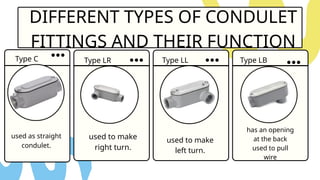
Type C
DIFFERENT TYPES OF CONDULET
FITTINGS AND THEIR FUNCTION
used as straight
condulet.
Type LR
used to make
right turn.
Type LL
used to make
left turn.
Type LB
has an opening
at the back
used to pull
wire
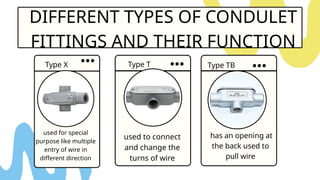
Type X
used for special
purpose like multiple
entry of wire in
different direction
Type T
used to connect
and change the
turns of wire
has an opening at
the back used to
pull wire
Type TB
DIFFERENT TYPES OF CONDULET
FITTINGS AND THEIR FUNCTION
METAL CONDUIT
PROCESSSES AND TOOLS
RIGID
Rigid metal conduit can also
be bent using hickey or
conduit bender. It follows the
same procedure bending
electrical metallic tubing.
BENDS
TYPES OF BENDS
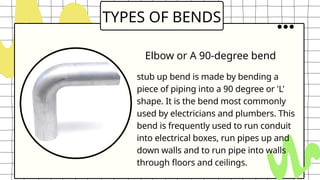
stub up bend is made by bending a
piece of piping into a 90 degree or 'L'
shape. It is the bend most commonly
used by electricians and plumbers. This
bend is frequently used to run conduit
into electrical boxes, run pipes up and
down walls and to run pipe into walls
through floors and ceilings.
Elbow or A 90-degree bend
TYPES OF BENDS
is less than 90 degree, it is used when
the conduit crosses an obstacle or
when the conduit is entering an
electrical box.
Offset bend
TYPES OF BENDS
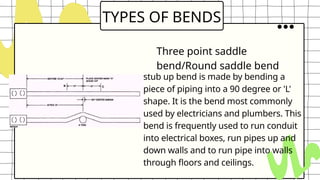
stub up bend is made by bending a
piece of piping into a 90 degree or 'L'
shape. It is the bend most commonly
used by electricians and plumbers. This
bend is frequently used to run conduit
into electrical boxes, run pipes up and
down walls and to run pipe into walls
through floors and ceilings.
Three point saddle
bend/Round saddle bend
TYPES OF BENDS
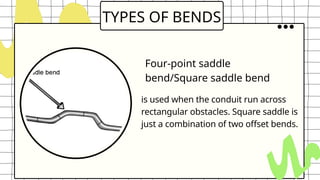
is used when the conduit run across
rectangular obstacles. Square saddle is
just a combination of two offset bends.
Four-point saddle
bend/Square saddle bend
TOOLS USED IN BENDING
RIGID METAL CONDUIT
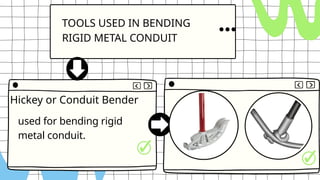
used for bending rigid
metal conduit.
Hickey or Conduit Bender
TOOLS USED IN BENDING
RIGID METAL CONDUIT
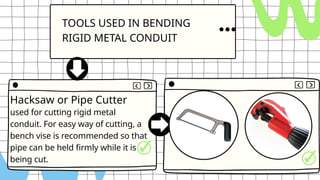
used for cutting rigid metal
conduit. For easy way of cutting, a
bench vise is recommended so that
pipe can be held firmly while it is
being cut.
Hacksaw or Pipe Cutter
TOOLS USED IN BENDING
RIGID METAL CONDUIT
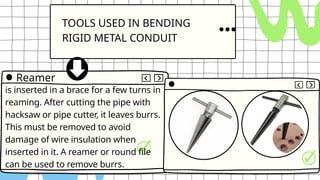
is inserted in a brace for a few turns in
reaming. After cutting the pipe with
hacksaw or pipe cutter, it leaves burrs.
This must be removed to avoid
damage of wire insulation when
inserted in it. A reamer or round file
can be used to remove burrs.
Reamer
TOOLS USED IN BENDING
RIGID METAL CONDUIT
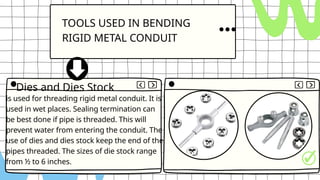
is used for threading rigid metal conduit. It is
used in wet places. Sealing termination can
be best done if pipe is threaded. This will
prevent water from entering the conduit. The
use of dies and dies stock keep the end of the
pipes threaded. The sizes of die stock range
from ½ to 6 inches.
Dies and Dies Stock
Thank you

RIGID METAL CONDUIT.pptx THIS IS FOR ELECTRICAL ENGINEERING

  • 1.
    METAL CONDUIT PREPARED BY:Ma’am Mae RIGID
  • 2.
    Rigid Metal Conduit servesthe same purpose as with electrical metallic tubing. It is designed to protect the electrical wiring of building from electrical hazard due to faulty wiring It is usually installed burying it in concrete wall floor and ceiling, in masonry and similar materials. It is also used for expose and concealed work; it provides protection when there is mechanical damage.
  • 3.
    Type C DIFFERENT TYPESOF CONDULET FITTINGS AND THEIR FUNCTION used as straight condulet. Type LR used to make right turn. Type LL used to make left turn. Type LB has an opening at the back used to pull wire
  • 4.
    Type X used forspecial purpose like multiple entry of wire in different direction Type T used to connect and change the turns of wire has an opening at the back used to pull wire Type TB DIFFERENT TYPES OF CONDULET FITTINGS AND THEIR FUNCTION
  • 5.
  • 6.
    Rigid metal conduitcan also be bent using hickey or conduit bender. It follows the same procedure bending electrical metallic tubing. BENDS
  • 7.
    TYPES OF BENDS stubup bend is made by bending a piece of piping into a 90 degree or 'L' shape. It is the bend most commonly used by electricians and plumbers. This bend is frequently used to run conduit into electrical boxes, run pipes up and down walls and to run pipe into walls through floors and ceilings. Elbow or A 90-degree bend
  • 8.
    TYPES OF BENDS isless than 90 degree, it is used when the conduit crosses an obstacle or when the conduit is entering an electrical box. Offset bend
  • 9.
    TYPES OF BENDS stubup bend is made by bending a piece of piping into a 90 degree or 'L' shape. It is the bend most commonly used by electricians and plumbers. This bend is frequently used to run conduit into electrical boxes, run pipes up and down walls and to run pipe into walls through floors and ceilings. Three point saddle bend/Round saddle bend
  • 10.
    TYPES OF BENDS isused when the conduit run across rectangular obstacles. Square saddle is just a combination of two offset bends. Four-point saddle bend/Square saddle bend
  • 11.
    TOOLS USED INBENDING RIGID METAL CONDUIT used for bending rigid metal conduit. Hickey or Conduit Bender
  • 12.
    TOOLS USED INBENDING RIGID METAL CONDUIT used for cutting rigid metal conduit. For easy way of cutting, a bench vise is recommended so that pipe can be held firmly while it is being cut. Hacksaw or Pipe Cutter
  • 13.
    TOOLS USED INBENDING RIGID METAL CONDUIT is inserted in a brace for a few turns in reaming. After cutting the pipe with hacksaw or pipe cutter, it leaves burrs. This must be removed to avoid damage of wire insulation when inserted in it. A reamer or round file can be used to remove burrs. Reamer
  • 14.
    TOOLS USED INBENDING RIGID METAL CONDUIT is used for threading rigid metal conduit. It is used in wet places. Sealing termination can be best done if pipe is threaded. This will prevent water from entering the conduit. The use of dies and dies stock keep the end of the pipes threaded. The sizes of die stock range from ½ to 6 inches. Dies and Dies Stock
  • 15.