Unit 0: Prologue       The Nature of Science          Note Packet #1
 
Name:____________________________ Period:_____ Date:_________

1. An observation is:
__________________________________________________________________
____________________________________________________________

When you observe, you use your ____________ to take in everything that is happening
around you, paying close attention to detail.


Examples:                                                                                               
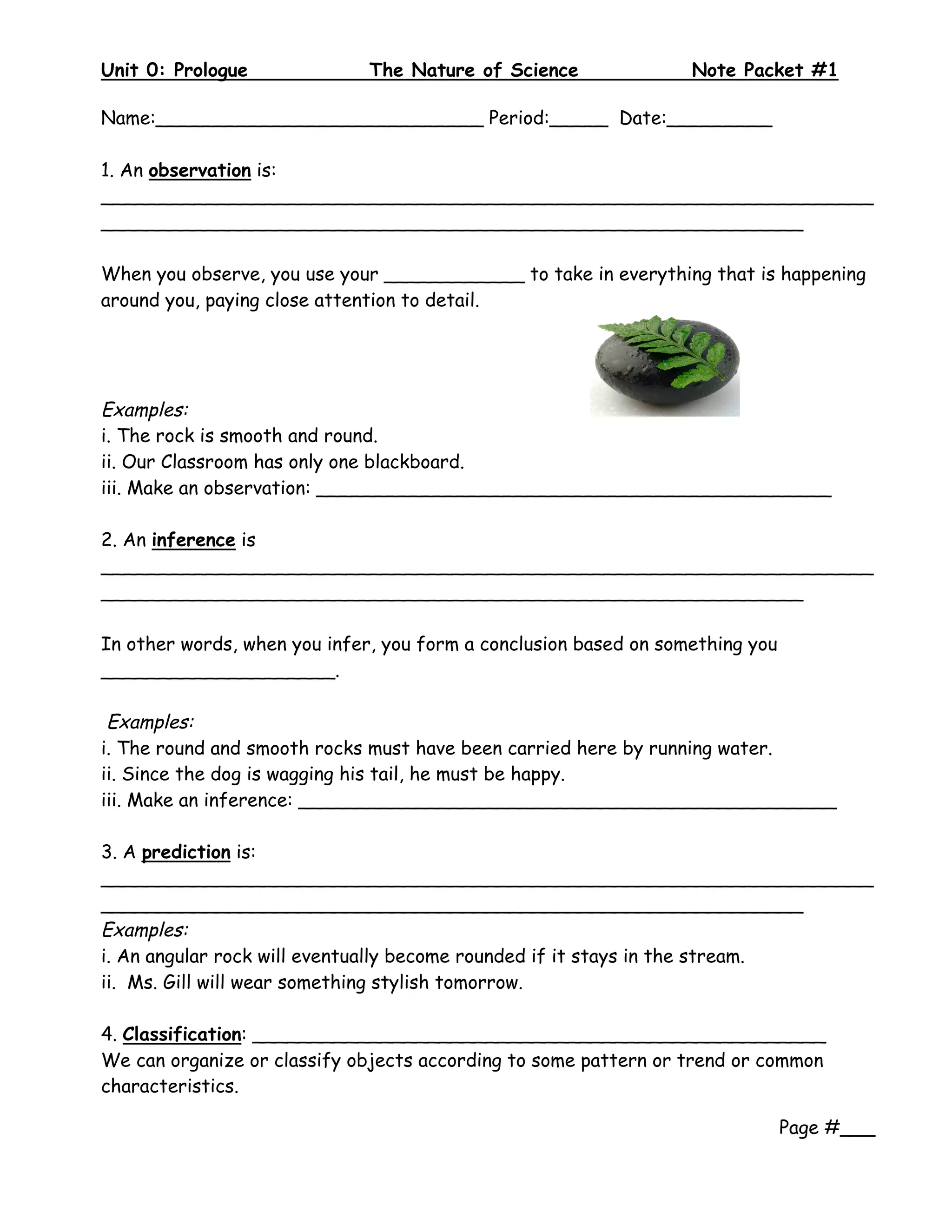
i. The rock is smooth and round.
ii. Our Classroom has only one blackboard.                                           
iii. Make an observation: ____________________________________________

2. An inference is
__________________________________________________________________
____________________________________________________________

In other words, when you infer, you form a conclusion based on something you
____________________.

 Examples:
i. The round and smooth rocks must have been carried here by running water.
ii. Since the dog is wagging his tail, he must be happy.
iii. Make an inference: ______________________________________________

3. A prediction is:
__________________________________________________________________
____________________________________________________________
Examples:
i. An angular rock will eventually become rounded if it stays in the stream.
ii. Ms. Gill will wear something stylish tomorrow.

4. Classification: _________________________________________________
We can organize or classify objects according to some pattern or trend or common
characteristics.

                                                                                                Page #___
Unit 0: Prologue               The Nature of Science                Note Packet #1
 
5. Measurements: The purpose of this guide is to guide you through converting units
                                  in the metric system!


a. What are some measurable properties?
__________________        __________________              __________________
__________________        __________________              __________________

b. How do we make measurements?
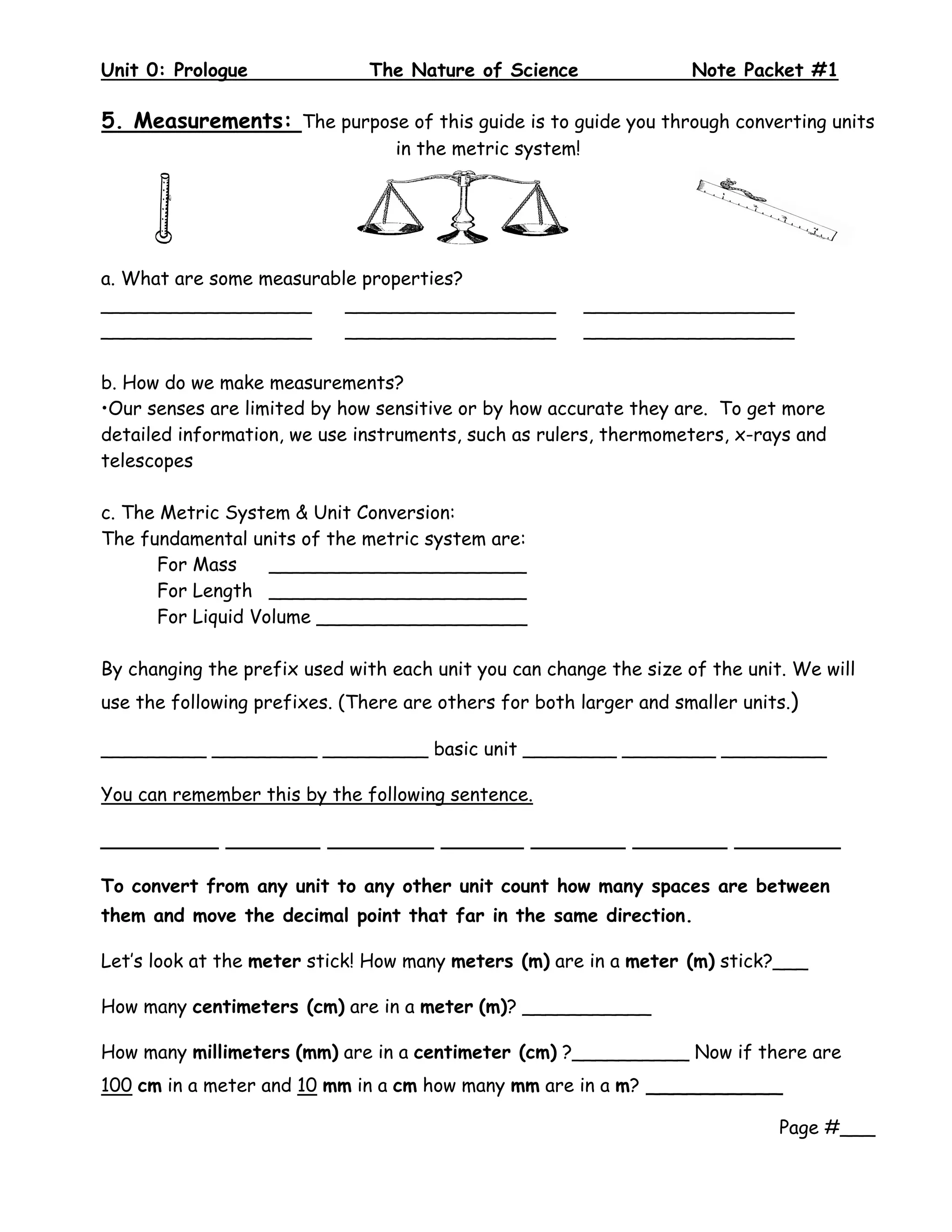
•Our senses are limited by how sensitive or by how accurate they are. To get more
detailed information, we use instruments, such as rulers, thermometers, x-rays and
telescopes

c. The Metric System & Unit Conversion:
The fundamental units of the metric system are:
      For Mass     ______________________
      For Length ______________________
      For Liquid Volume __________________

By changing the prefix used with each unit you can change the size of the unit. We will
use the following prefixes. (There are others for both larger and smaller units.)

_________ _________ _________ basic unit ________ ________ _________

You can remember this by the following sentence.

__________ ________ _________ _______ ________ ________ _________

To convert from any unit to any other unit count how many spaces are between
them and move the decimal point that far in the same direction.

Let’s look at the meter stick! How many meters (m) are in a meter (m) stick?___

How many centimeters (cm) are in a meter (m)? ___________

How many millimeters (mm) are in a centimeter (cm) ?__________ Now if there are
100 cm in a meter and 10 mm in a cm how many mm are in a m? __________

                                                                              Page #___
Unit 0: Prologue             The Nature of Science                Note Packet #1
  
 Decimals are used because they are easier to convert than fractions! In the metric
 system we use abbreviations! Let’s fill them in below!

 Length                           Mass                               Liquid Volume
 meter__________                  gram__________                 liter__________
 millimeter_______                milligram______                milliliter______
 centimeter______                 --------------                 -------------
 kilometer_______                 kilogram_______                kiloliter________

 Let’s practice some unit conversions now! Convert the following!

 1.     10 mm =      ________________ cm           2. 1 km =         ________________ m
 3.     1000 ml =    ________________ L            4. 12 g   =       ________________ kg

 5.     3.9 kg =     _________________ mg          6. 89.3 cm =      _______________ mm


 6. Rounding: The first step in rounding is figuring out what place to round to and where
 that place is located. You must remember these place values:

             2 , 6 4 3 , 9 7 5 , 8 6 4 . 9 3 1

                                    Rounding Procedure:
Step 1: Find the location of place that you are asked to round to. Lets call it: Sparky.
Step 2: Look at the number to the right of this place lets call it the Boss.
Step 4: If the boss is a 4 or lower, leave Sparky alone. If the Boss is 5 or higher, round
the Sparky up one value.
                          Here is a rhyme to help you remember:
                 “Four and below, let it go. Five and above give it a shove”
               For Example: Round 7.289 to the nearest tenth: Answer: 7.3
 

           Practice:                 Round to the nearest            Round to the nearest
 Round to the nearest tenth:              hundredth:                         ones:
1) 29.45: _______                 4) 0.745: ________              7) 30.19: __________
2) 711.319: ________              5) 1.67234: _______             8) 8,799.99: ________
3) 9.999: _________               6) 10.4637: _______             9) 2.94: __________ 


                                                                                    Page #___
Unit 0: Prologue                The Nature of Science                  Note Packet #1
 
                             7. Mass :
__________________________________________________________________
   ____________________________________________________________

•It is how much “stuff” the object is made of, the number of atoms in it.

a. How do we measure mass? Can we count the atoms one by one?
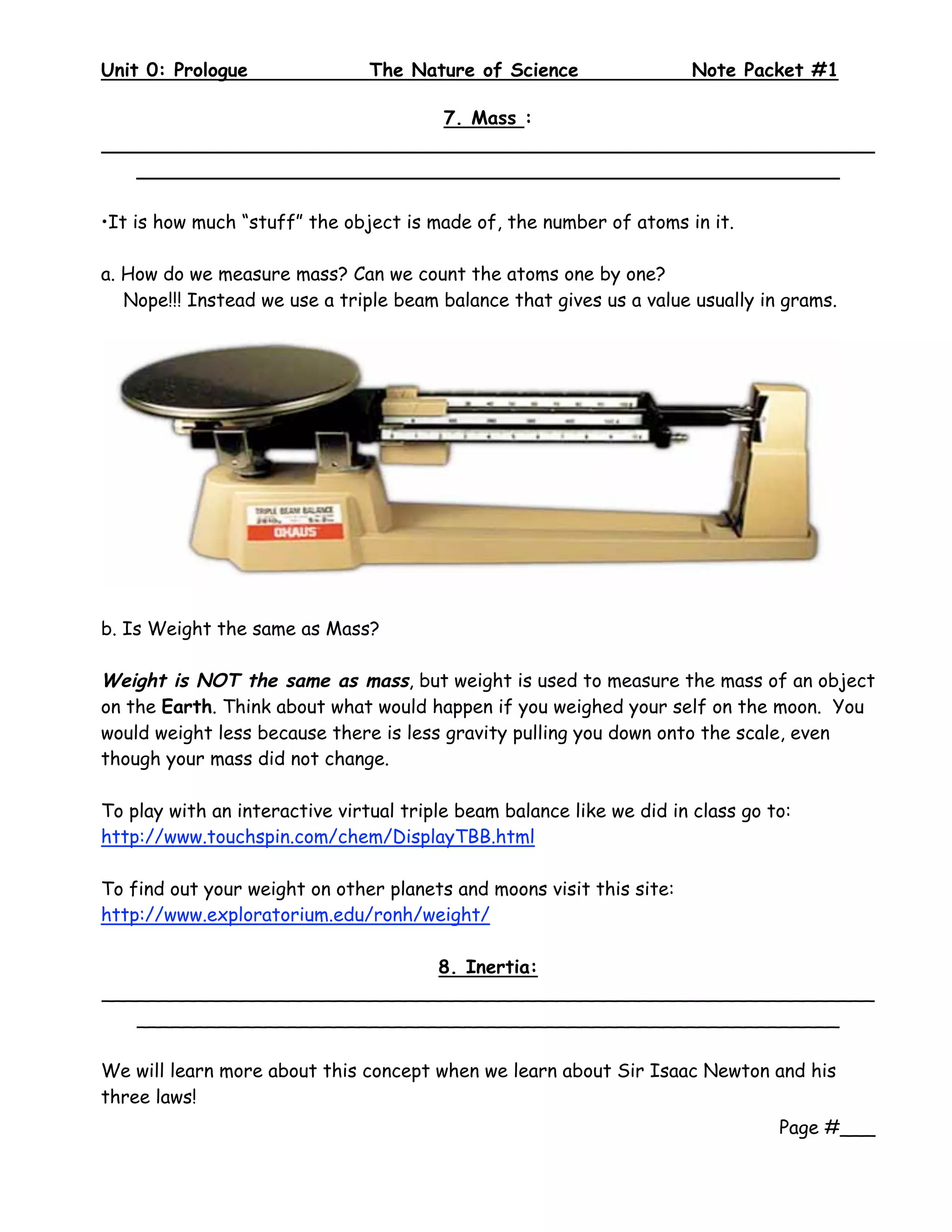
   Nope!!! Instead we use a triple beam balance that gives us a value usually in grams.


b. Is Weight the same as Mass?

Weight is NOT the same as mass, but weight is used to measure the mass of an object
on the Earth. Think about what would happen if you weighed your self on the moon. You
would weight less because there is less gravity pulling you down onto the scale, even
though your mass did not change.

To play with an interactive virtual triple beam balance like we did in class go to:
http://www.touchspin.com/chem/DisplayTBB.html

To find out your weight on other planets and moons visit this site:
http://www.exploratorium.edu/ronh/weight/

                             8. Inertia:
__________________________________________________________________
   ____________________________________________________________

We will learn more about this concept when we learn about Sir Isaac Newton and his
three laws!
                                                                                 Page #___
Unit 0: Prologue             The Nature of Science                 Note Packet #1
 
                           9. Temperature:
__________________________________________________________________
   ____________________________________________________________

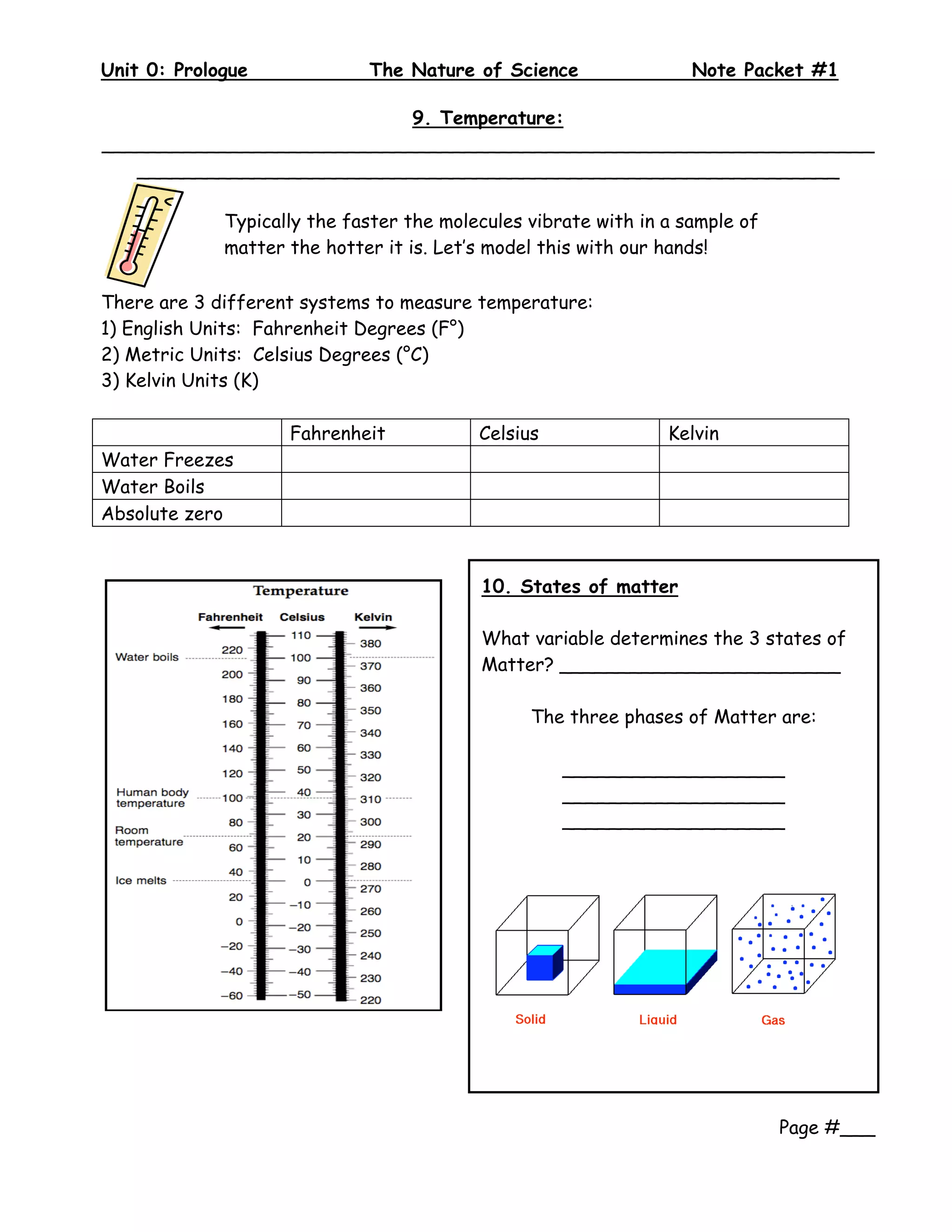
             Typically the faster the molecules vibrate with in a sample of
             matter the hotter it is. Let’s model this with our hands!
              
There are 3 different systems to measure temperature:
1) English Units: Fahrenheit Degrees (F°)
2) Metric Units: Celsius Degrees (°C)
3) Kelvin Units (K)

                    Fahrenheit            Celsius               Kelvin
Water Freezes
Water Boils
Absolute zero


                                          10. States of matter

                                          What variable determines the 3 states of
                                          Matter? ________________________

                                                The three phases of Matter are:

                                                    ___________________
                                                    ___________________
                                                    ___________________


                                                                              Page #___
Unit 0: Prologue              The Nature of Science                Note Packet #1
 
                             11. Area:
__________________________________________________________________
__________________________________________________________________

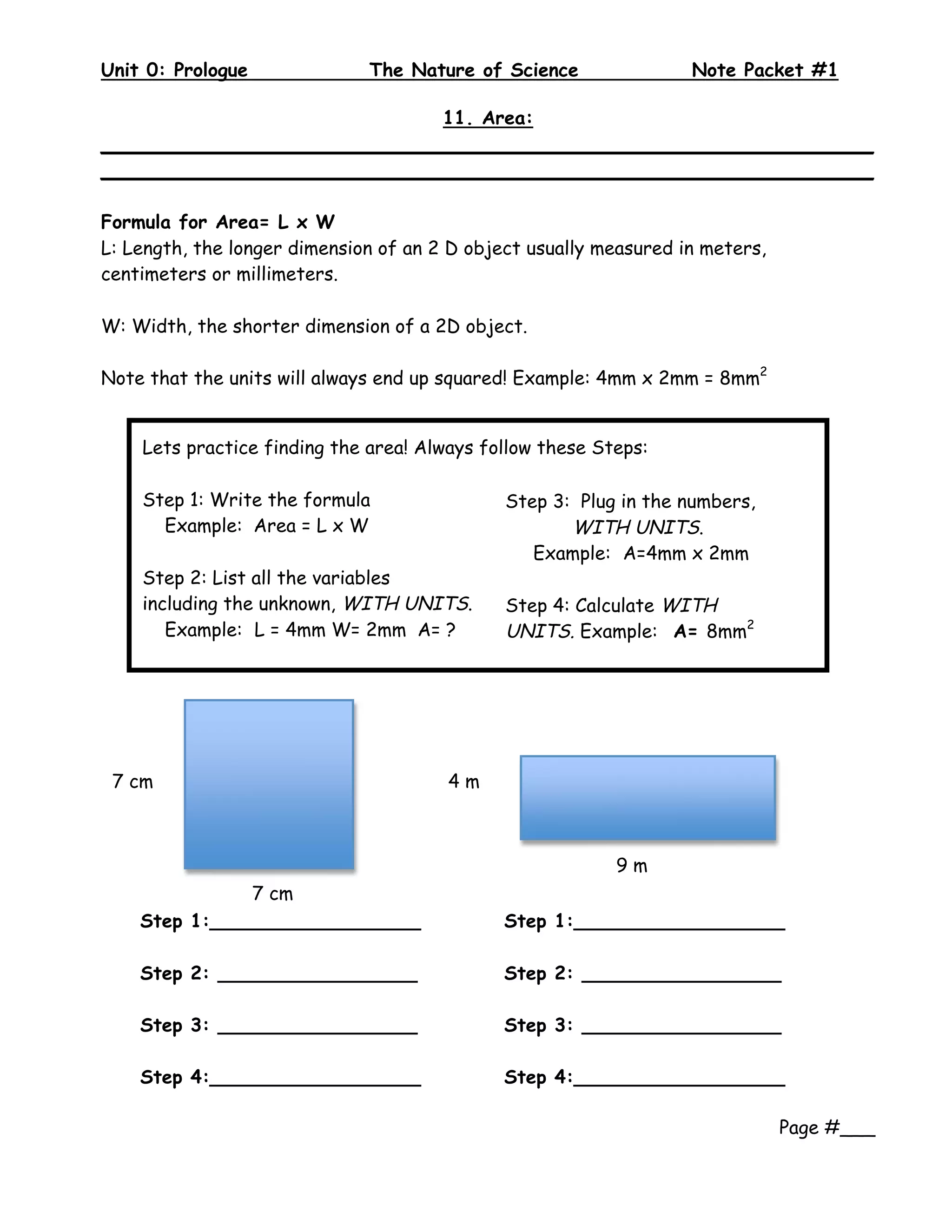
Formula for Area= L x W
L: Length, the longer dimension of an 2 D object usually measured in meters,
centimeters or millimeters.

W: Width, the shorter dimension of a 2D object.

Note that the units will always end up squared! Example: 4mm x 2mm = 8mm2


    Lets practice finding the area! Always follow these Steps:

    Step 1: Write the formula                 Step 3: Plug in the numbers,
      Example: Area = L x W                          WITH UNITS.
                                                 Example: A=4mm x 2mm
    Step 2: List all the variables
    including the unknown, WITH UNITS.        Step 4: Calculate WITH
       Example: L = 4mm W= 2mm A= ?           UNITS. Example: A= 8mm2


 7 cm                                  4m


                                                          9m
               7 cm                                        
                
    Step 1:__________________                 Step 1:__________________

    Step 2: _________________                 Step 2: _________________

    Step 3: _________________                 Step 3: _________________

    Step 4:__________________                 Step 4:__________________
                                               
                                                                       Page #___
Unit 0: Prologue                The Nature of Science                Note Packet #1
  
                                        12. Volume:

 -The amount of _______ a 3D object takes up!
 -For solid cubes and boxes Volume is equal to: ____________________.
 -Note that, depending on the size of the object the units may be either cm3 or m3
 either way the its expressed in cubic units.
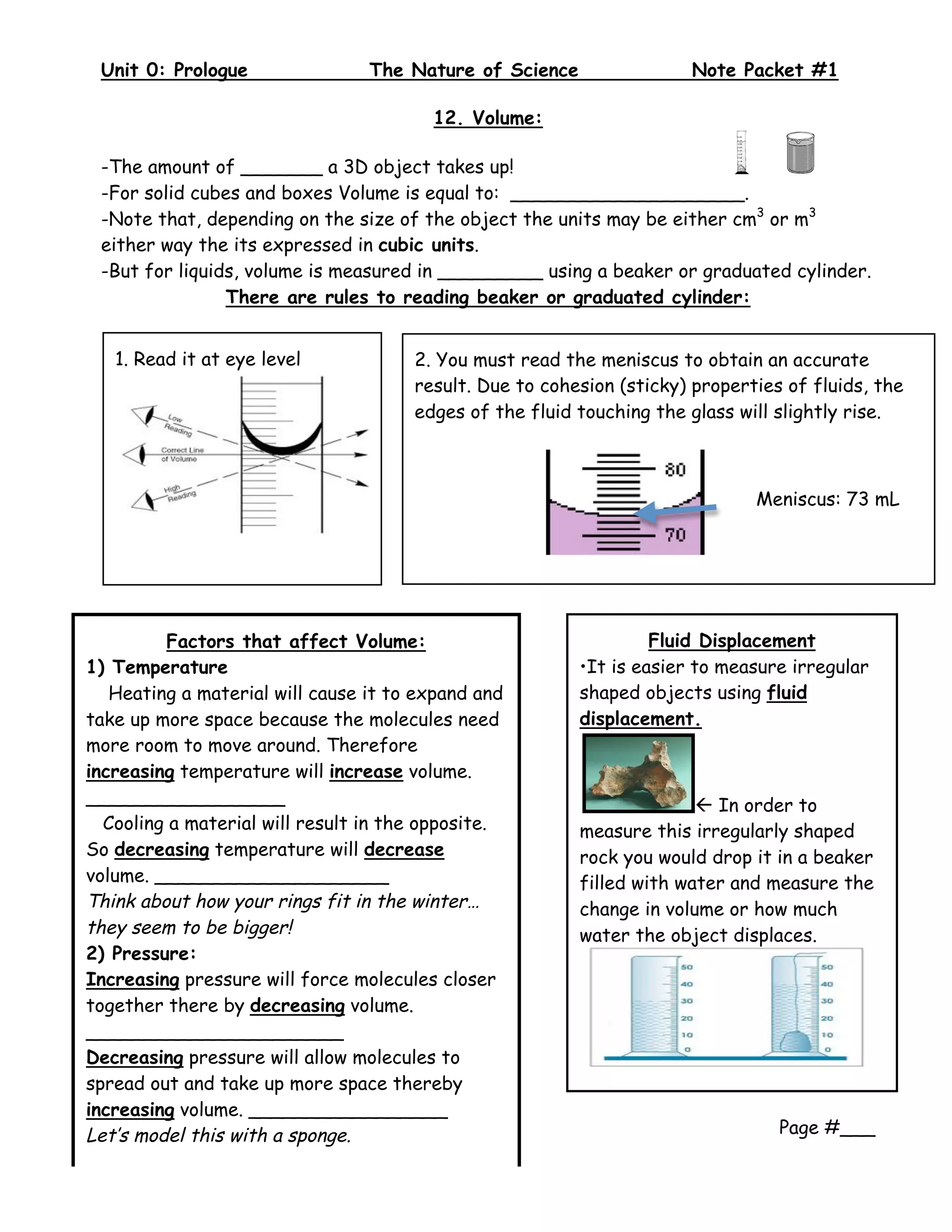
 -But for liquids, volume is measured in _________ using a beaker or graduated cylinder.
                There are rules to reading beaker or graduated cylinder:


   1. Read it at eye level            2. You must read the meniscus to obtain an accurate
                                      result. Due to cohesion (sticky) properties of fluids, the
                                      edges of the fluid touching the glass will slightly rise.


                                                                              Meniscus: 73 mL


         Factors that affect Volume:                              Fluid Displacement
1) Temperature                                           •It is easier to measure irregular
   Heating a material will cause it to expand and        shaped objects using fluid
take up more space because the molecules need            displacement.
more room to move around. Therefore
increasing temperature will increase volume.
_________________                                                       In order to
  Cooling a material will result in the opposite.        measure this irregularly shaped
So decreasing temperature will decrease                  rock you would drop it in a beaker
volume. ____________________                             filled with water and measure the
Think about how your rings fit in the winter…            change in volume or how much
they seem to be bigger!                                  water the object displaces.
2) Pressure:
Increasing pressure will force molecules closer
together there by decreasing volume.
______________________
Decreasing pressure will allow molecules to
spread out and take up more space thereby
increasing volume. _________________
Let’s model this with a sponge.                                                  Page #___
Unit 0: Prologue               The Nature of Science                Note Packet #1
 
                            13. Density:
__________________________________________________________________
   ____________________________________________________________

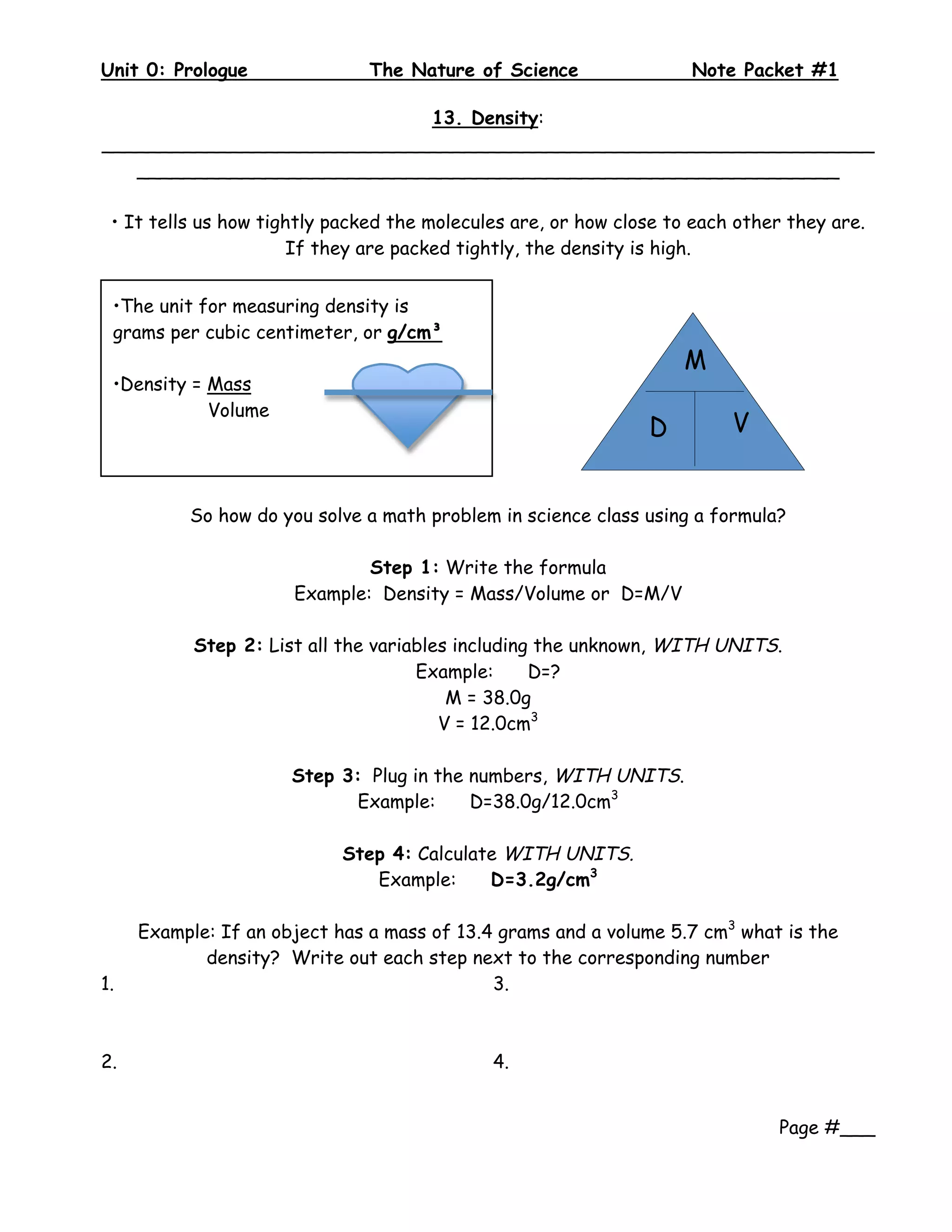
 • It tells us how tightly packed the molecules are, or how close to each other they are.
                      If they are packed tightly, the density is high.


 •The unit for measuring density is
 grams per cubic centimeter, or g/cm³

 •Density = Mass
            Volume


          So how do you solve a math problem in science class using a formula?

                              Step 1: Write the formula
                      Example: Density = Mass/Volume or D=M/V

           Step 2: List all the variables including the unknown, WITH UNITS.
                                     Example:      D=?
                                         M = 38.0g
                                        V = 12.0cm3

                      Step 3: Plug in the numbers, WITH UNITS.
                             Example:     D=38.0g/12.0cm3

                            Step 4: Calculate WITH UNITS.
                               Example:     D=3.2g/cm3

     Example: If an object has a mass of 13.4 grams and a volume 5.7 cm3 what is the
            density? Write out each step next to the corresponding number
1.                                           3.


2.                                           4.


                                                                              Page #___
Unit 0: Prologue                     The Nature of Science               Note Packet #1
 
                                        14. More on Density:

•Each pure substance has its own particular density and it can be used to help identify
                           that material at room temperature.
  •For example, liquid water has a density of 1g/cm³ because 1cm³ of water weighs 1
                       gram. One cm³ of water also occupies 1ml.
   •solid quartz has a density of 2.7 g/cm³ Mixtures do not have a precise density.
-Fluids tend to layer based on their density, with less dense fluid on top of more dense
      fluid. Can you think of any examples? ____________________________

                             Let’s check out this video:
•http://www.eram.k12.ny.us/education/components/docmgr/default.php?sectiondetailid=
                         17500&fileitem=4738&catfilter=445

 13.Factors that affect Density
 A. Temperature:                                          Why does density matter?
 •Cooling a material causes its                    If a warm gust of wind meets cold air,
 molecules to move closer together,                will the warm air go above or below the
 making its volume decrease and                    cold air?
 causing its density to increase.                  •Since hot air is less dense it will rise!
 ___________________                               •And Cold air sinks because it is denser
 •Heating a material causes its                    than warm air
 molecules to move apart making its                •A similar process happens when
 volume increase and causing the                       you boil water 
 density to decrease.
 ___________________
 •Note that Mass is staying the same!!!

 B. Pressure:
 •Increasing the pressure (squeeze) on
 a material causes its molecules to get
 pushed closer together, decreasing
                                                   This rising and sinking of fluids due to
 the volume, making the density
                                                   density and temperature differences is
 increase. __________________
                                                   called _________________________.
 •Decreasing the pressure causes the
                                                   We will touch upon this concept many
 opposite effect, since molecules move
                                                   times through out the year.
 further apart, it becomes less dense.
 •Again, note mass remains the same!
 ______________________________________________ 
                                                                                    Page #___
Unit 0: Prologue              The Nature of Science                 Note Packet #1
     
                              15. Density at Different Phases

                   •As a material is heated, it changes from solid to liquid.

    • More heat changes the liquid to gas. The molecules move farther apart, so the volume
                         increases, causing the density to decrease.

            General Rule of Thumb: Solids are most dense, gases are least dense


   The ONLY exception to this rule is water!!!
•As water cools, its volume decreases until it
reaches 4° C.

• As it cools from 4° C to 0° C, its volume actually
increases, so it becomes less dense again.

•Water is most dense at 4°C, but is still a liquid.

•This is due to my buddy Mr. Hydrogen Bond, you
will meet him in Chemistry

•Water at 0°C is solid ice, but is less dense than
water, so ice floats!!

•Water is the only material whose solid form will
float in its liquid form.

•This is why the top of a puddle, or a lake freezes
first.


     16. Does size affect density of an object?
     •You can NEVER change the density of a material by cutting it into pieces.
     •Since change both volume and mass, the ratio will remain the same, therefore
     each small piece will have the same density as the original large one.
      
 
                                                                                Page #___
Unit 0: Prologue                  The Nature of Science                                   Note Packet #1


17. Let review some crucial relationships!!!

•Temp.       Volume            Density     l       •Pressure                         Volume       Density
                                           l
                                           l
•Temp.       Volume            Density     l       •Pressure                         Volume       Density

                  You must understand and know these by heart!!!


                                         18. Graphing:
                                   
•Direct Relationship:                               •Inverse Relationship: Variables “move
both variables “move in the same                    in opposite directions”. One variable
direction” They both increase or both               goes up and the other goes down.
decrease.


•Constant Variable:                                                •Parabola:
One variable changes, but the other remains                        As one variable increases, the
the same.                                                          other increases and then
                                                                   decreases.


                                                                                                         Page #___
Unit 0: Prologue     The Nature of Science          Note Packet #1
 
                   19. More on charts and Graphs:


                                                            Page #___
Unit 0: Prologue               The Nature of Science              Note Packet #1
 
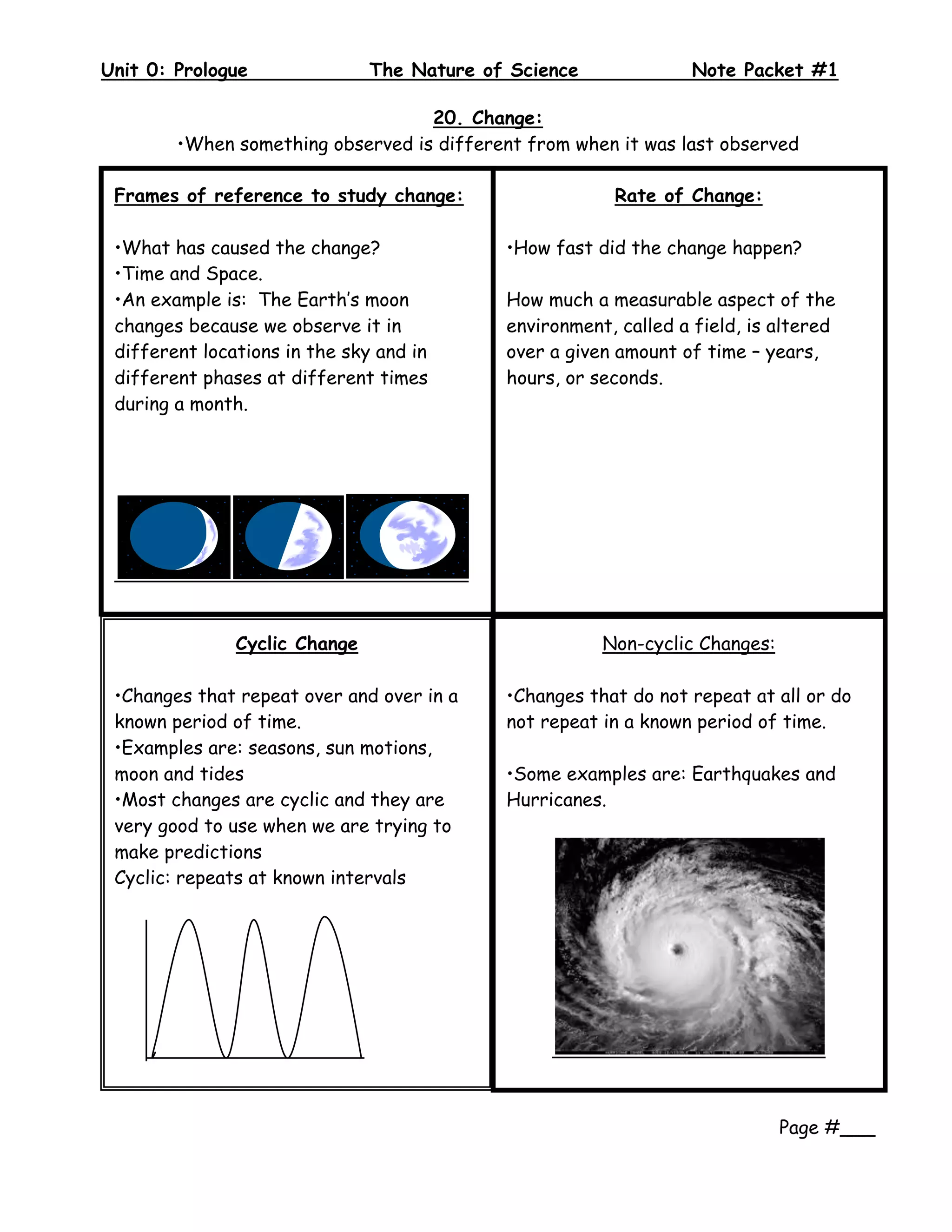
                                   20. Change:
        •When something observed is different from when it was last observed

 Frames of reference to study change:                   Rate of Change:

 •What has caused the change?               •How fast did the change happen?
 •Time and Space.
 •An example is: The Earth’s moon           How much a measurable aspect of the
 changes because we observe it in           environment, called a field, is altered
 different locations in the sky and in      over a given amount of time – years,
 different phases at different times        hours, or seconds.
 during a month.


               Cyclic Change                           Non-cyclic Changes:

 •Changes that repeat over and over in a    •Changes that do not repeat at all or do
 known period of time.                      not repeat in a known period of time.
 •Examples are: seasons, sun motions,
 moon and tides                             •Some examples are: Earthquakes and
 •Most changes are cyclic and they are      Hurricanes.
 very good to use when we are trying to
 make predictions
 Cyclic: repeats at known intervals


                                                                             Page #___
Unit 0: Prologue               The Nature of Science            Note Packet #1
 
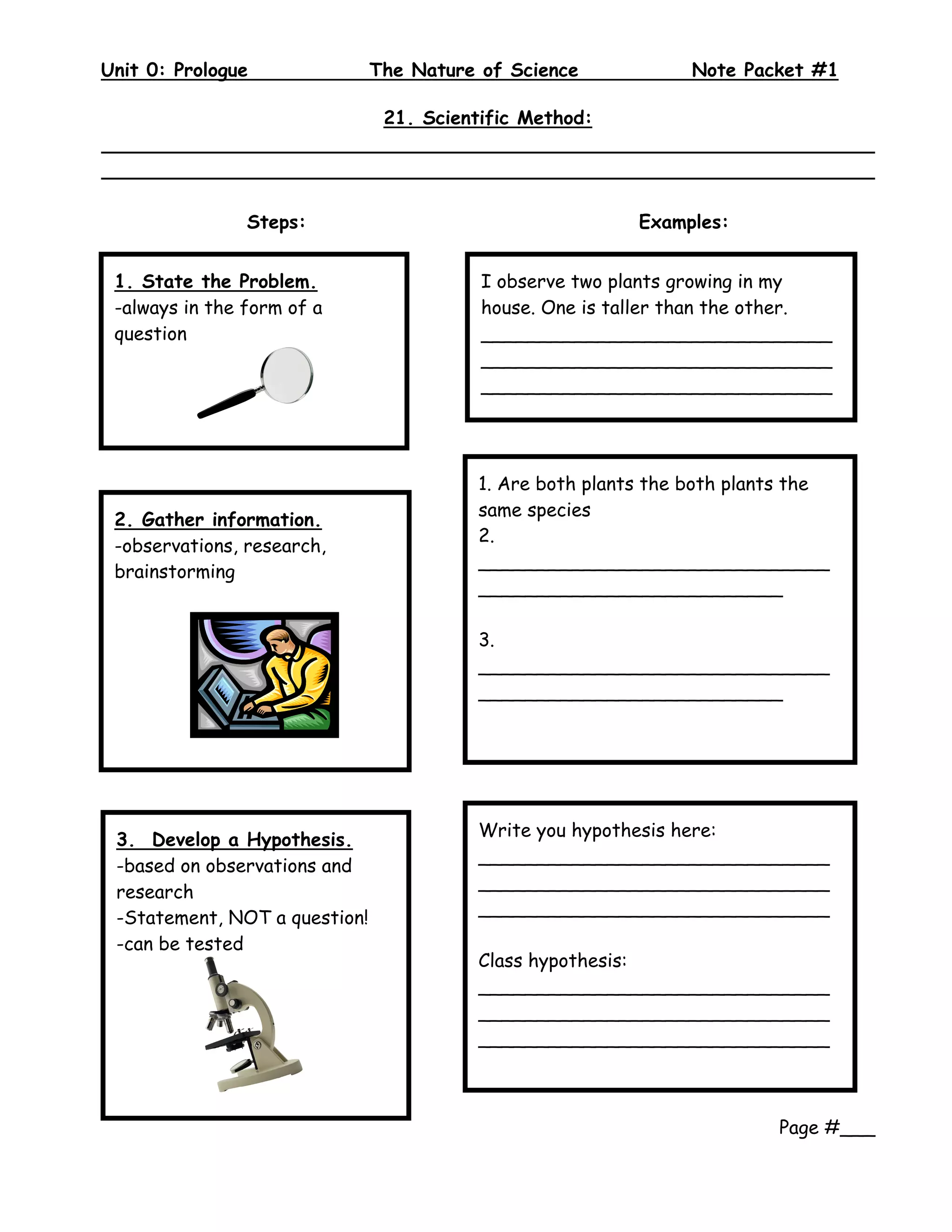
                        21. Scientific Method:
__________________________________________________________________
__________________________________________________________________

                Steps:                                    Examples:


 1. State the Problem.                    I observe two plants growing in my
 -always in the form of a                 house. One is taller than the other.
 question                                 ______________________________
                                          ______________________________
                                          ______________________________


                                         1. Are both plants the both plants the
                                         same species
 2. Gather information.
                                         2.
 -observations, research,
                                         ______________________________
 brainstorming
                                         __________________________

                                         3.
                                         ______________________________
                                         __________________________


 3. Develop a Hypothesis.                Write you hypothesis here:
 -based on observations and              ______________________________
 research                                ______________________________
 -Statement, NOT a question!             ______________________________
 -can be tested
                                         Class hypothesis:
                                         ______________________________
                                         ______________________________
                                         ______________________________


                                                                         Page #___
Unit 0: Prologue              The Nature of Science        Note Packet #1


 4. Test your Hypothesis                      ______________________________
 -design an experiment                        ______________________________
 -make sure your experiment test your         ______________________________
 hypothesis.                                  ______________________________
                                              ______________________________
                                              ______________________________
                                              ______________________________
                                              ______________________________
                                              ______________________________
                                              ______________________________
                                              _


  5. Observe & Record Data
  Use tables and note to record
  observations and measurements.


  6. Analyze & Interpret Results
  -Use graphs or charts to see trends in
  data.


  7. Conclusion                               ______________________________
  -based on observations and results.         ______________________________
                                              ______________________________
                                              ______________________________
                                              ______________________________
                                              ______________________________


                                                                   Page #___
Unit 0: Prologue              The Nature of Science                Note Packet #1
 
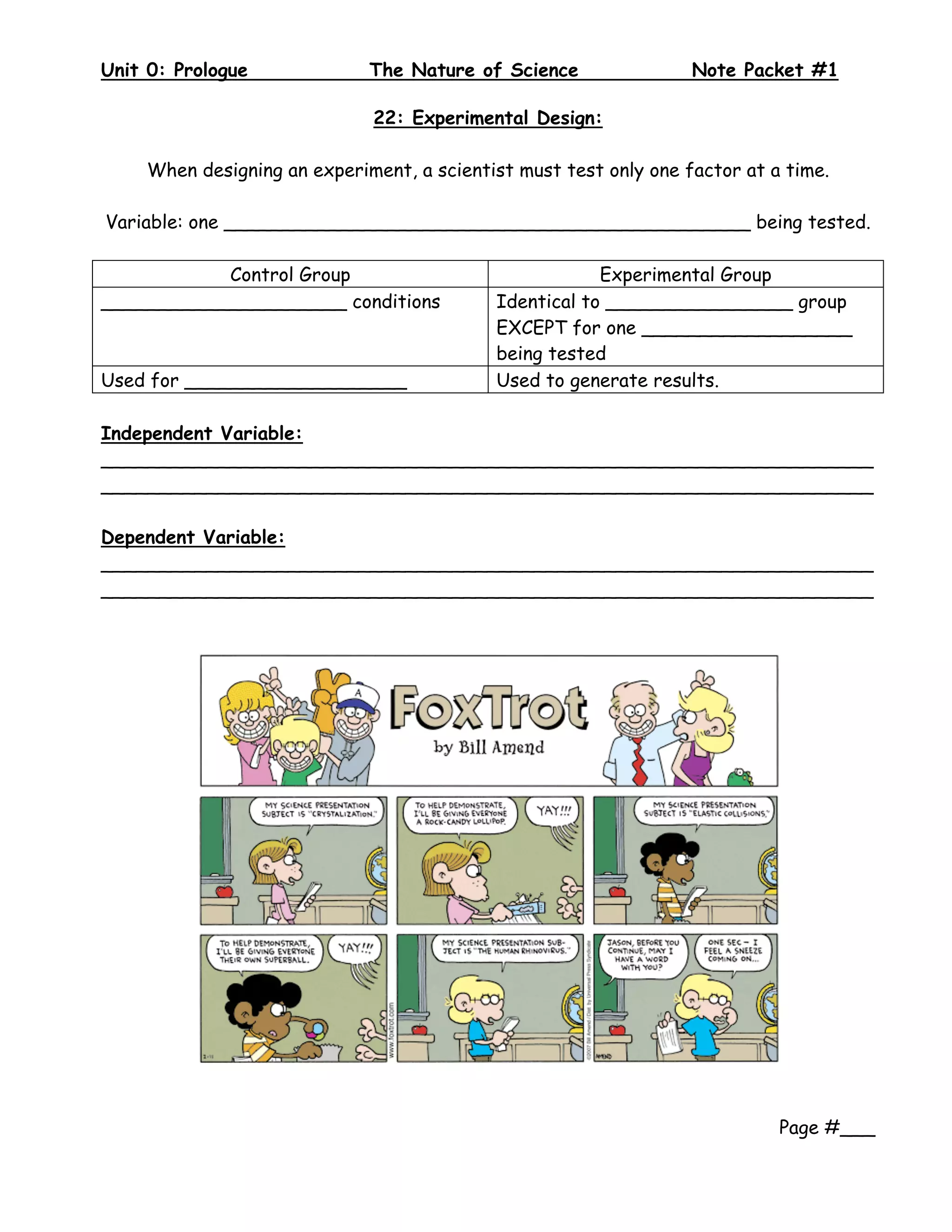
                              22: Experimental Design:

     When designing an experiment, a scientist must test only one factor at a time.

Variable: one _____________________________________________ being tested.

           Control Group                                Experimental Group
_____________________ conditions            Identical to ________________ group
                                            EXCEPT for one __________________
                                            being tested
Used for ___________________                Used to generate results.

Independent Variable:
__________________________________________________________________
__________________________________________________________________

Dependent Variable:
__________________________________________________________________
__________________________________________________________________


                                                                             Page #___
Unit 0: Prologue               The Nature of Science                  Note Packet #1
 
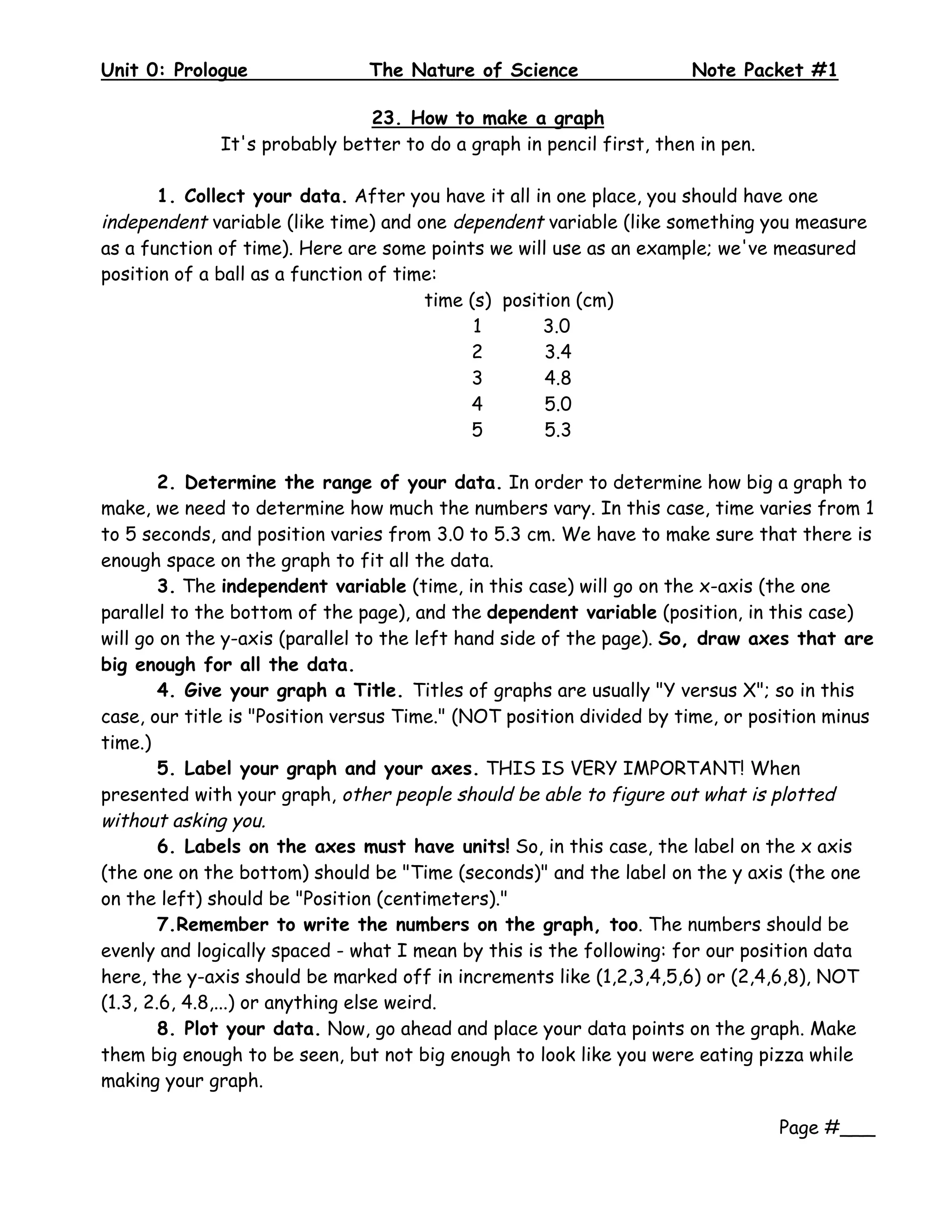
                               23. How to make a graph
              It's probably better to do a graph in pencil first, then in pen.

       1. Collect your data. After you have it all in one place, you should have one
independent variable (like time) and one dependent variable (like something you measure
as a function of time). Here are some points we will use as an example; we've measured
position of a ball as a function of time:
                                       time (s) position (cm)
                                             1       3.0
                                            2        3.4
                                            3        4.8
                                            4        5.0
                                            5        5.3

        2. Determine the range of your data. In order to determine how big a graph to
make, we need to determine how much the numbers vary. In this case, time varies from 1
to 5 seconds, and position varies from 3.0 to 5.3 cm. We have to make sure that there is
enough space on the graph to fit all the data.
        3. The independent variable (time, in this case) will go on the x-axis (the one
parallel to the bottom of the page), and the dependent variable (position, in this case)
will go on the y-axis (parallel to the left hand side of the page). So, draw axes that are
big enough for all the data.
        4. Give your graph a Title. Titles of graphs are usually "Y versus X"; so in this
case, our title is "Position versus Time." (NOT position divided by time, or position minus
time.)
        5. Label your graph and your axes. THIS IS VERY IMPORTANT! When
presented with your graph, other people should be able to figure out what is plotted
without asking you.
        6. Labels on the axes must have units! So, in this case, the label on the x axis
(the one on the bottom) should be "Time (seconds)" and the label on the y axis (the one
on the left) should be "Position (centimeters)."
        7.Remember to write the numbers on the graph, too. The numbers should be
evenly and logically spaced - what I mean by this is the following: for our position data
here, the y-axis should be marked off in increments like (1,2,3,4,5,6) or (2,4,6,8), NOT
(1.3, 2.6, 4.8,...) or anything else weird.
        8. Plot your data. Now, go ahead and place your data points on the graph. Make
them big enough to be seen, but not big enough to look like you were eating pizza while
making your graph.

                                                                                 Page #___
Unit 0: Prologue                 The Nature of Science                  Note Packet #1
 
        9. Draw a "line of best fit." THIS DOES NOT MEAN CONNECT THE DOTS!
Only rarely will a graph need to have the data points connected by a jagged line. Usually,
it is best to guess at a (straight) line that goes as near as possible to as many points as
possible. (See example.) THE ORIGIN IS NOT ALWAYS INCLUDED AS A POINT! And,
sometimes there will be a LOT of scatter and it might not be clear where a line should
go. Now you're done with your graph, but you're not finished yet.
        10. Think about what your graph means. What type of relationship do the
variables have?


             F ree P lain G raph P aper from http://incom petech.com /graphpaper/plain/


                                                                                          Page #___

Prologue np1

  • 1.
    Unit 0: Prologue The Nature of Science Note Packet #1   Name:____________________________ Period:_____ Date:_________ 1. An observation is: __________________________________________________________________ ____________________________________________________________ When you observe, you use your ____________ to take in everything that is happening around you, paying close attention to detail. Examples:                                                                                           i. The rock is smooth and round. ii. Our Classroom has only one blackboard.   iii. Make an observation: ____________________________________________ 2. An inference is __________________________________________________________________ ____________________________________________________________ In other words, when you infer, you form a conclusion based on something you ____________________. Examples: i. The round and smooth rocks must have been carried here by running water. ii. Since the dog is wagging his tail, he must be happy. iii. Make an inference: ______________________________________________ 3. A prediction is: __________________________________________________________________ ____________________________________________________________ Examples: i. An angular rock will eventually become rounded if it stays in the stream. ii. Ms. Gill will wear something stylish tomorrow. 4. Classification: _________________________________________________ We can organize or classify objects according to some pattern or trend or common characteristics. Page #___
  • 2.
    Unit 0: Prologue The Nature of Science Note Packet #1   5. Measurements: The purpose of this guide is to guide you through converting units in the metric system! a. What are some measurable properties? __________________ __________________ __________________ __________________ __________________ __________________ b. How do we make measurements? •Our senses are limited by how sensitive or by how accurate they are. To get more detailed information, we use instruments, such as rulers, thermometers, x-rays and telescopes c. The Metric System & Unit Conversion: The fundamental units of the metric system are: For Mass ______________________ For Length ______________________ For Liquid Volume __________________ By changing the prefix used with each unit you can change the size of the unit. We will use the following prefixes. (There are others for both larger and smaller units.) _________ _________ _________ basic unit ________ ________ _________ You can remember this by the following sentence. __________ ________ _________ _______ ________ ________ _________ To convert from any unit to any other unit count how many spaces are between them and move the decimal point that far in the same direction. Let’s look at the meter stick! How many meters (m) are in a meter (m) stick?___ How many centimeters (cm) are in a meter (m)? ___________ How many millimeters (mm) are in a centimeter (cm) ?__________ Now if there are 100 cm in a meter and 10 mm in a cm how many mm are in a m? __________ Page #___
  • 3.
    Unit 0: Prologue The Nature of Science Note Packet #1   Decimals are used because they are easier to convert than fractions! In the metric system we use abbreviations! Let’s fill them in below! Length Mass Liquid Volume meter__________ gram__________ liter__________ millimeter_______ milligram______ milliliter______ centimeter______ -------------- ------------- kilometer_______ kilogram_______ kiloliter________ Let’s practice some unit conversions now! Convert the following! 1. 10 mm = ________________ cm 2. 1 km = ________________ m 3. 1000 ml = ________________ L 4. 12 g = ________________ kg 5. 3.9 kg = _________________ mg 6. 89.3 cm = _______________ mm 6. Rounding: The first step in rounding is figuring out what place to round to and where that place is located. You must remember these place values: 2 , 6 4 3 , 9 7 5 , 8 6 4 . 9 3 1 Rounding Procedure: Step 1: Find the location of place that you are asked to round to. Lets call it: Sparky. Step 2: Look at the number to the right of this place lets call it the Boss. Step 4: If the boss is a 4 or lower, leave Sparky alone. If the Boss is 5 or higher, round the Sparky up one value. Here is a rhyme to help you remember: “Four and below, let it go. Five and above give it a shove” For Example: Round 7.289 to the nearest tenth: Answer: 7.3   Practice: Round to the nearest Round to the nearest Round to the nearest tenth: hundredth: ones: 1) 29.45: _______ 4) 0.745: ________ 7) 30.19: __________ 2) 711.319: ________ 5) 1.67234: _______ 8) 8,799.99: ________ 3) 9.999: _________ 6) 10.4637: _______   9) 2.94: __________  Page #___
  • 4.
    Unit 0: Prologue The Nature of Science Note Packet #1   7. Mass : __________________________________________________________________ ____________________________________________________________ •It is how much “stuff” the object is made of, the number of atoms in it. a. How do we measure mass? Can we count the atoms one by one? Nope!!! Instead we use a triple beam balance that gives us a value usually in grams. b. Is Weight the same as Mass? Weight is NOT the same as mass, but weight is used to measure the mass of an object on the Earth. Think about what would happen if you weighed your self on the moon. You would weight less because there is less gravity pulling you down onto the scale, even though your mass did not change. To play with an interactive virtual triple beam balance like we did in class go to: http://www.touchspin.com/chem/DisplayTBB.html To find out your weight on other planets and moons visit this site: http://www.exploratorium.edu/ronh/weight/ 8. Inertia: __________________________________________________________________ ____________________________________________________________ We will learn more about this concept when we learn about Sir Isaac Newton and his three laws! Page #___
  • 5.
    Unit 0: Prologue The Nature of Science Note Packet #1   9. Temperature: __________________________________________________________________ ____________________________________________________________ Typically the faster the molecules vibrate with in a sample of matter the hotter it is. Let’s model this with our hands!   There are 3 different systems to measure temperature: 1) English Units: Fahrenheit Degrees (F°) 2) Metric Units: Celsius Degrees (°C) 3) Kelvin Units (K) Fahrenheit Celsius Kelvin Water Freezes Water Boils Absolute zero 10. States of matter What variable determines the 3 states of Matter? ________________________ The three phases of Matter are: ___________________ ___________________ ___________________ Page #___
  • 6.
    Unit 0: Prologue The Nature of Science Note Packet #1   11. Area: __________________________________________________________________ __________________________________________________________________ Formula for Area= L x W L: Length, the longer dimension of an 2 D object usually measured in meters, centimeters or millimeters. W: Width, the shorter dimension of a 2D object. Note that the units will always end up squared! Example: 4mm x 2mm = 8mm2 Lets practice finding the area! Always follow these Steps: Step 1: Write the formula Step 3: Plug in the numbers, Example: Area = L x W WITH UNITS. Example: A=4mm x 2mm Step 2: List all the variables including the unknown, WITH UNITS. Step 4: Calculate WITH Example: L = 4mm W= 2mm A= ? UNITS. Example: A= 8mm2     7 cm 4m     9m 7 cm     Step 1:__________________ Step 1:__________________ Step 2: _________________ Step 2: _________________ Step 3: _________________ Step 3: _________________ Step 4:__________________ Step 4:__________________     Page #___
  • 7.
    Unit 0: Prologue The Nature of Science Note Packet #1   12. Volume: -The amount of _______ a 3D object takes up! -For solid cubes and boxes Volume is equal to: ____________________. -Note that, depending on the size of the object the units may be either cm3 or m3 either way the its expressed in cubic units. -But for liquids, volume is measured in _________ using a beaker or graduated cylinder. There are rules to reading beaker or graduated cylinder: 1. Read it at eye level 2. You must read the meniscus to obtain an accurate result. Due to cohesion (sticky) properties of fluids, the edges of the fluid touching the glass will slightly rise. Meniscus: 73 mL Factors that affect Volume: Fluid Displacement 1) Temperature •It is easier to measure irregular Heating a material will cause it to expand and shaped objects using fluid take up more space because the molecules need displacement. more room to move around. Therefore increasing temperature will increase volume. _________________  In order to Cooling a material will result in the opposite. measure this irregularly shaped So decreasing temperature will decrease rock you would drop it in a beaker volume. ____________________ filled with water and measure the Think about how your rings fit in the winter… change in volume or how much they seem to be bigger! water the object displaces. 2) Pressure: Increasing pressure will force molecules closer together there by decreasing volume. ______________________ Decreasing pressure will allow molecules to spread out and take up more space thereby increasing volume. _________________ Let’s model this with a sponge. Page #___
  • 8.
    Unit 0: Prologue The Nature of Science Note Packet #1   13. Density: __________________________________________________________________ ____________________________________________________________ • It tells us how tightly packed the molecules are, or how close to each other they are. If they are packed tightly, the density is high. •The unit for measuring density is grams per cubic centimeter, or g/cm³ •Density = Mass Volume   So how do you solve a math problem in science class using a formula? Step 1: Write the formula Example: Density = Mass/Volume or D=M/V Step 2: List all the variables including the unknown, WITH UNITS. Example: D=? M = 38.0g V = 12.0cm3 Step 3: Plug in the numbers, WITH UNITS. Example: D=38.0g/12.0cm3 Step 4: Calculate WITH UNITS. Example: D=3.2g/cm3 Example: If an object has a mass of 13.4 grams and a volume 5.7 cm3 what is the density? Write out each step next to the corresponding number 1. 3. 2. 4. Page #___
  • 9.
    Unit 0: Prologue The Nature of Science Note Packet #1   14. More on Density: •Each pure substance has its own particular density and it can be used to help identify that material at room temperature. •For example, liquid water has a density of 1g/cm³ because 1cm³ of water weighs 1 gram. One cm³ of water also occupies 1ml. •solid quartz has a density of 2.7 g/cm³ Mixtures do not have a precise density. -Fluids tend to layer based on their density, with less dense fluid on top of more dense fluid. Can you think of any examples? ____________________________ Let’s check out this video: •http://www.eram.k12.ny.us/education/components/docmgr/default.php?sectiondetailid= 17500&fileitem=4738&catfilter=445 13.Factors that affect Density A. Temperature: Why does density matter? •Cooling a material causes its If a warm gust of wind meets cold air, molecules to move closer together, will the warm air go above or below the making its volume decrease and cold air? causing its density to increase. •Since hot air is less dense it will rise! ___________________ •And Cold air sinks because it is denser •Heating a material causes its than warm air molecules to move apart making its •A similar process happens when volume increase and causing the you boil water  density to decrease. ___________________ •Note that Mass is staying the same!!! B. Pressure: •Increasing the pressure (squeeze) on a material causes its molecules to get pushed closer together, decreasing This rising and sinking of fluids due to the volume, making the density density and temperature differences is increase. __________________ called _________________________. •Decreasing the pressure causes the We will touch upon this concept many opposite effect, since molecules move times through out the year. further apart, it becomes less dense. •Again, note mass remains the same! ______________________________________________  Page #___
  • 10.
    Unit 0: Prologue The Nature of Science Note Packet #1   15. Density at Different Phases •As a material is heated, it changes from solid to liquid. • More heat changes the liquid to gas. The molecules move farther apart, so the volume increases, causing the density to decrease. General Rule of Thumb: Solids are most dense, gases are least dense The ONLY exception to this rule is water!!! •As water cools, its volume decreases until it reaches 4° C. • As it cools from 4° C to 0° C, its volume actually increases, so it becomes less dense again. •Water is most dense at 4°C, but is still a liquid. •This is due to my buddy Mr. Hydrogen Bond, you will meet him in Chemistry •Water at 0°C is solid ice, but is less dense than water, so ice floats!! •Water is the only material whose solid form will float in its liquid form. •This is why the top of a puddle, or a lake freezes first. 16. Does size affect density of an object? •You can NEVER change the density of a material by cutting it into pieces. •Since change both volume and mass, the ratio will remain the same, therefore each small piece will have the same density as the original large one.     Page #___
  • 11.
    Unit 0: Prologue The Nature of Science Note Packet #1   17. Let review some crucial relationships!!! •Temp. Volume Density l •Pressure Volume Density l l •Temp. Volume Density l •Pressure Volume Density You must understand and know these by heart!!!   18. Graphing:   •Direct Relationship: •Inverse Relationship: Variables “move both variables “move in the same in opposite directions”. One variable direction” They both increase or both goes up and the other goes down. decrease.                         •Constant Variable: •Parabola: One variable changes, but the other remains As one variable increases, the the same. other increases and then decreases.                               Page #___
  • 12.
    Unit 0: Prologue The Nature of Science Note Packet #1   19. More on charts and Graphs: Page #___
  • 13.
    Unit 0: Prologue The Nature of Science Note Packet #1   20. Change: •When something observed is different from when it was last observed Frames of reference to study change: Rate of Change: •What has caused the change? •How fast did the change happen? •Time and Space. •An example is: The Earth’s moon How much a measurable aspect of the changes because we observe it in environment, called a field, is altered different locations in the sky and in over a given amount of time – years, different phases at different times hours, or seconds. during a month. Cyclic Change Non-cyclic Changes: •Changes that repeat over and over in a •Changes that do not repeat at all or do known period of time. not repeat in a known period of time. •Examples are: seasons, sun motions, moon and tides •Some examples are: Earthquakes and •Most changes are cyclic and they are Hurricanes. very good to use when we are trying to make predictions Cyclic: repeats at known intervals Page #___
  • 14.
    Unit 0: Prologue The Nature of Science Note Packet #1   21. Scientific Method: __________________________________________________________________ __________________________________________________________________ Steps: Examples: 1. State the Problem. I observe two plants growing in my -always in the form of a house. One is taller than the other. question ______________________________ ______________________________ ______________________________ 1. Are both plants the both plants the same species 2. Gather information. 2. -observations, research, ______________________________ brainstorming __________________________ 3. ______________________________ __________________________ 3. Develop a Hypothesis. Write you hypothesis here: -based on observations and ______________________________ research ______________________________ -Statement, NOT a question! ______________________________ -can be tested Class hypothesis: ______________________________ ______________________________ ______________________________ Page #___
  • 15.
    Unit 0: Prologue The Nature of Science Note Packet #1   4. Test your Hypothesis ______________________________ -design an experiment ______________________________ -make sure your experiment test your ______________________________ hypothesis. ______________________________ ______________________________ ______________________________ ______________________________ ______________________________ ______________________________ ______________________________ _ 5. Observe & Record Data Use tables and note to record observations and measurements. 6. Analyze & Interpret Results -Use graphs or charts to see trends in data. 7. Conclusion ______________________________ -based on observations and results. ______________________________ ______________________________ ______________________________ ______________________________ ______________________________ Page #___
  • 16.
    Unit 0: Prologue The Nature of Science Note Packet #1   22: Experimental Design: When designing an experiment, a scientist must test only one factor at a time. Variable: one _____________________________________________ being tested. Control Group Experimental Group _____________________ conditions Identical to ________________ group EXCEPT for one __________________ being tested Used for ___________________ Used to generate results. Independent Variable: __________________________________________________________________ __________________________________________________________________ Dependent Variable: __________________________________________________________________ __________________________________________________________________ Page #___
  • 17.
    Unit 0: Prologue The Nature of Science Note Packet #1   23. How to make a graph It's probably better to do a graph in pencil first, then in pen. 1. Collect your data. After you have it all in one place, you should have one independent variable (like time) and one dependent variable (like something you measure as a function of time). Here are some points we will use as an example; we've measured position of a ball as a function of time: time (s) position (cm) 1 3.0 2 3.4 3 4.8 4 5.0 5 5.3 2. Determine the range of your data. In order to determine how big a graph to make, we need to determine how much the numbers vary. In this case, time varies from 1 to 5 seconds, and position varies from 3.0 to 5.3 cm. We have to make sure that there is enough space on the graph to fit all the data. 3. The independent variable (time, in this case) will go on the x-axis (the one parallel to the bottom of the page), and the dependent variable (position, in this case) will go on the y-axis (parallel to the left hand side of the page). So, draw axes that are big enough for all the data. 4. Give your graph a Title. Titles of graphs are usually "Y versus X"; so in this case, our title is "Position versus Time." (NOT position divided by time, or position minus time.) 5. Label your graph and your axes. THIS IS VERY IMPORTANT! When presented with your graph, other people should be able to figure out what is plotted without asking you. 6. Labels on the axes must have units! So, in this case, the label on the x axis (the one on the bottom) should be "Time (seconds)" and the label on the y axis (the one on the left) should be "Position (centimeters)." 7.Remember to write the numbers on the graph, too. The numbers should be evenly and logically spaced - what I mean by this is the following: for our position data here, the y-axis should be marked off in increments like (1,2,3,4,5,6) or (2,4,6,8), NOT (1.3, 2.6, 4.8,...) or anything else weird. 8. Plot your data. Now, go ahead and place your data points on the graph. Make them big enough to be seen, but not big enough to look like you were eating pizza while making your graph. Page #___
  • 18.
    Unit 0: Prologue The Nature of Science Note Packet #1   9. Draw a "line of best fit." THIS DOES NOT MEAN CONNECT THE DOTS! Only rarely will a graph need to have the data points connected by a jagged line. Usually, it is best to guess at a (straight) line that goes as near as possible to as many points as possible. (See example.) THE ORIGIN IS NOT ALWAYS INCLUDED AS A POINT! And, sometimes there will be a LOT of scatter and it might not be clear where a line should go. Now you're done with your graph, but you're not finished yet. 10. Think about what your graph means. What type of relationship do the variables have? F ree P lain G raph P aper from http://incom petech.com /graphpaper/plain/ Page #___