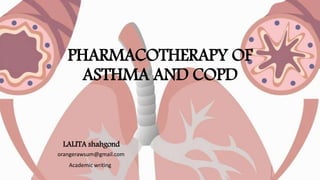
PHARMACOTHERAPY OF
ASTHMA AND COPD
LALITA shahgond
orangerawsum@gmail.com
Academic writing
Bronchial asthma
• Asthma is defined as recurrent reversible airway
obstruction, with attacks of wheeze, shortness of breath
and often nocturnal cough.
• Severe attacks cause hypoxaemia and are life-
threatening
• Essential features include: –
- airways inflammation, which causes
- bronchial hyper-responsiveness, which in turn results in
- recurrent reversible airway obstruction.
• Pathogenesis involves exposure of genetically disposed
individuals to allergens; activation of Th2 lymphocytes and
cytokine generation promote:
–differentiation and activation of eosinophils
–IgE production and release
–expression of IgE receptors on mast cells and eosinophils.
• Important mediators include leukotriene B4 and cysteinyl
leukotrienes (C4 and D4); interleukins IL-4, IL-5, IL-13; and
tissue-damaging eosinophil proteins.
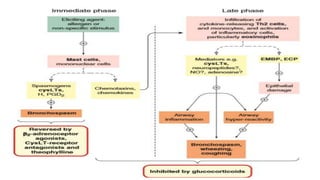
Immediate phase
• In allergic asthma the immediate phase (i.e.
the initial response to allergen provocation)
occurs abruptly and is mainly caused by
spasm of the bronchial smooth muscle.
• Allergen interaction with mast cell-fixed IgE
causes release of histamine, leukotriene B4
and prostaglandin (PG)D2.
• Other mediators released include IL-4, IL-5, IL-
13, macrophage inflammatory protein-1α and
tumour necrosis factor (TNF)-α.
• Various chemotaxins and chemokines attract
leukocytes
– particularly eosinophils and mononuclear cells
– setting the stage for the late phase
Late phase
• The late phase or delayed response may be
nocturnal.
• It is, in essence, a progressing inflammatory
reaction, initiation of which occurred during
the first phase, the influx of Th2
lymphocytes being of particular importance.
• The inflammatory cells include activated
eosinophils.
• These release cysteinyl leukotrienes, interleukins
IL-3, IL-5 and IL-8, and the toxic proteins
eosinophil cationic protein, major basic protein and
eosinophil-derived neurotoxin.
• These play an important part in the events
of the late phase, the toxic proteins causing
damage and loss of epithelium.
• Other putative mediators of the inflammatory
process in the delayed phase are adenosine
(acting on the A1 receptor), induced NO and
neuropeptides.
• Growth factors released from inflammatory cells
act on smooth muscle cells, causing
hypertrophy and hyperplasia, and the smooth
muscle can itself release proinflammatory
mediators and growth factors.
• A variety of trigger factors (infection, irritants, pollution,
exercise, exposure to cold air, psychogenic) may be
involved:
- Extrinsic asthma: It is mostly episodic, less prone to
status asthmaticus.
- Intrinsic asthma: It tends to be perennial, status
asthmaticus is more common.
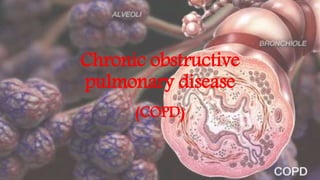
Chronic obstructive
pulmonary disease
(COPD)
•An inflammatory disease of the lungs characterized
by progressive emphysema (alveolar destruction)
and bronchiolar fibrosis in variable proportions.
•Loss of bronchiolar elasticity leads to closure of
smaller air tubes during expiration.
• The airway obstruction is prominent during
exercise causing shortness of breath.
• The expiratory airflow limitation does not fluctuate
markedly over long periods of time, but there are
exacerbations precipitated by respiratory
infections, pollutants, etc.
• Cigarette smoking is the main cause, and is
increasing in the developing world.
• Air pollution, also aetiologically important, is
also increasing, and there is a huge unmet
need for effective drugs.
• Despite this, COPD has received much less
attention than asthma.
APPROACHES TO
TREATMENT
• Prevention of AG:AB reaction
—avoidance of antigen, hyposensitization
—possible in extrinsic asthma and if antigen can be identified.
• Neutralization of IgE (reaginic antibody)
— Omalizumab.
• Suppression of inflammation and bronchial hyperreactivity
—corticosteroids.
• Prevention of release of mediators
—mast cell stabilizers.
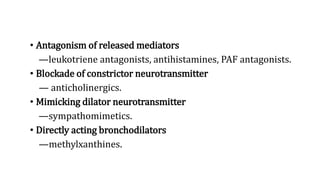
• Antagonism of released mediators
—leukotriene antagonists, antihistamines, PAF antagonists.
• Blockade of constrictor neurotransmitter
— anticholinergics.
• Mimicking dilator neurotransmitter
—sympathomimetics.
• Directly acting bronchodilators
—methylxanthines.
CLASSIFICATION
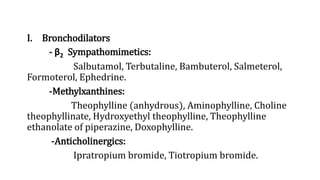
I. Bronchodilators
- β2 Sympathomimetics:
Salbutamol, Terbutaline, Bambuterol, Salmeterol,
Formoterol, Ephedrine.
-Methylxanthines:
Theophylline (anhydrous), Aminophylline, Choline
theophyllinate, Hydroxyethyl theophylline, Theophylline
ethanolate of piperazine, Doxophylline.
-Anticholinergics:
Ipratropium bromide, Tiotropium bromide.
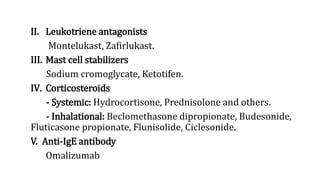
II. Leukotriene antagonists
Montelukast, Zafirlukast.
III. Mast cell stabilizers
Sodium cromoglycate, Ketotifen.
IV. Corticosteroids
- Systemic: Hydrocortisone, Prednisolone and others.
- Inhalational: Beclomethasone dipropionate, Budesonide,
Fluticasone propionate, Flunisolide, Ciclesonide.
V. Anti-IgE antibody
Omalizumab
SYMPATHOMIMETICS
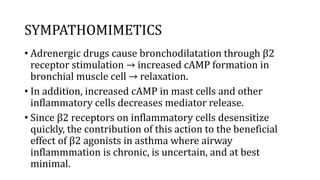
• Adrenergic drugs cause bronchodilatation through β2
receptor stimulation → increased cAMP formation in
bronchial muscle cell → relaxation.
• In addition, increased cAMP in mast cells and other
inflammatory cells decreases mediator release.
• Since β2 receptors on inflammatory cells desensitize
quickly, the contribution of this action to the beneficial
effect of β2 agonists in asthma where airway
inflammmation is chronic, is uncertain, and at best
minimal.
• Adrenergic drugs are the mainstay of treatment of
revobstruction, but should be used cautiously in
hypertensives, ischaemic heart disease patients and in
those receiving digitalis.
• They are the most effective and fastest acting
bronchodilators when inhaled.
• Though adrenaline (β1+β2+α receptor agonist) and
isoprenaline (β1+β2 agonist) are effective
bronchodilators, it is the selective β2 agonists that are
now used in asthma to minimize cardiac side effects.
Salbutamol (Albuterol)
• selective β2 agonist
• cardiac side effects are less prominent.
• Selectivity is further increased by inhaling the drug.
• Inhaled salbutamol delivered mostly from
pressurized metered dose inhaler (pMDI) produces
bronchodilatation within 5 min and the action lasts
for 2–4 hours.
• It is, therefore, used to abort and terminate attacks
of asthma, but is not suitable for round-the-clock
prophylaxis.
• Muscle tremors are the dose related side effect.
• Palpitation, restlessness, nervousness, throat
irritation and ankle edema can also occur.
• Hypokalaemia is a possible complication.
•Salbutamol undergoes presystemic metabolism in
the gut wall, oral bioavailability is 50%.
•Oral salbutamol acts for 4–6 hours, is longer acting
and safer than isoprenaline, but not superior in
bronchodilator efficacy.
•Because of more frequent side effects, oral β2
agonist therapy is reserved for patients who cannot
correctly use inhalers or as alternative/ adjuvant
drugs in severe asthma.
• Dose: 2–4 mg oral, 0.25–0.5 mg i.m./s.c., 100–200 µg by
inhalation.
• ASTHALIN 2, 4 mg tab., 8 mg SR tab., 2 mg/5 ml syrup,
100 µg metered dose inhaler; 5 mg/ml respirator soln.,
200 µg rota caps;
• CROYSAL 0.5 mg/ml inj,
• SALOL 2.5 mg/3 ml inj; DERIHALER 100 μg metered dose
inhaler.
Methyl xanthines
• Theophylline and its compounds have been
extensively used in asthma, but are not considered
first line drugs any more.
• They are used more often in COPD.
• Theophylline is one of the three naturally occurring
methylated xanthine alkaloids caffeine,
theophylline and theobromine
MOA
• Three distinct cellular actions of methylxanthines
have been defined—
(a)Release of Ca2+ from sarcoplasmic reticulum,
especially in skeletal and cardiac muscle.
(b)Inhibition of phosphodiesterase (PDE) which
degrades cyclic nucleotides intracellularly.
The concentration of cyclic nucleotides is increased.
Bronchodilatation, cardiac stimulation and
vasodilatation occur when cAMP level rises in the
concerned cells.
Theophylline is a subtype nonselective and weak
PDE inhibitor, but PDE4 inhibition is mainly
responsible for bronchodilatation.
(c) Blockade of adenosine receptors: adenosine acts as a
local mediator in CNS, CVS and other organs—contracts
smooth muscles, especially bronchial; dilates cerebral
blood vessels, depresses cardiac pacemaker and inhibits
gastric secretion.
• Methylxanthines produce opposite effects.
• Action (a) is exerted only at concentrations much higher
than therapeutic plasma concentrations of caffeine and
theophylline (ranging from 5–20 µg/ml).
• Action (b) and action (c) are exerted at concentrations in
the therapeutic range and appear to contribute to
bronchodilatation.
• Raised cAMP levels in inflammatory cells may attenuate
mediator release and promote eosinophil apoptosis
adding to the therapeutic effect of theophylline in asthma.
• Adenosine A1 receptor antagonism is considered
responsible for cardiac arrhythmias and seizures
occurring in theophylline toxicity.
PREPARATIONS AND DOSE
• Theophylline (Anhydrous) Poorly water soluble, cannot be
injected. 100–300 mg TDS (15 mg/kg/day)
THEOLONG 100, 200 mg SR cap., DURALYN-CR 400 mg continuous
release cap, UNICONTIN 400 mg, 600 mg CR tabs, THEOBID 200 mg,
300 mg SR tabs.
• Aminophylline (Theophylline-ethylenediamine; 85%
theophylline) water soluble, can be injected i.v. but not i.m. or
s.c.—highly irritating. 250–500 mg oral or slow i.v. injection;
children 7.5 mg/kg i.v.; AMINOPHYLLINE 100 mg tab, 250 mg/10
ml inj.
ANTICHOLINERGICS
• Atropinic drugs cause bronchodilatation by blocking M3 receptor
mediated cholinergic constrictor tone; act primarily in the larger
airways which receive vagal innervation.
• However, some recent evidence points to presence of M3 receptors
on peripheral bronchiolar muscles as well, though they are not
vagally innervated.
• Ipratropium bromide is a short acting (duration 4–6 hours)
inhaled anticholinergic bronchodilator, while tiotropium bromide
is long acting (duration 24 hours).
• Both are less efficacious than inhaled β2 sympathomimetics in
bronchial asthma.
• Tiotropium is rated more effective than ipratropium in
COPD; more suitable for severe cases (FEV1<50% of
predicted).
• No decline in its clinical efficacy has been noted over a
period of 4 years.
• The inhaled anticholinergics produce slower response
than inhaled β2 sympathomimetics and are better suited
for regular prophylactic use (ipratropium 2–4 puffs 6
hourly or tiotropium 1 rotacap OD) than for quick relief of
breathlessness.
• Combination of inhaled ipratropium with β2 agonist
produces more marked and longer lasting
bronchodilatation; since their effects are additive.
LEUKOTRIENE ANTAGONISTS
• Since it was realized that cystenyl leukotrienes (LT-
C4/D4) are important mediators of bronchial asthma,
efforts were made to develop their antagonists and
synthesis inhibitors.
• Two cysLT1 receptor antagonists montelukast and
zafirlukast are available.
Montelukast and Zafirlukast
• Both have simlar actions and clinical utility.
• They competitively antagonize cysLT1 receptor mediated
bronchoconstriction, airway mucus secretion, increased
vascular permeability and recruitment of eosinophils.
• Bronchodilatation, reduced sputum eosinophil count,
suppression of bronchial inflammation, mucus and
hyperreactivity are noted in asthma patients.
•Parameters of lung function show variable
improvement. Some studies have found that certain
patients are ‘responders’ while others are
‘nonresponders’ to anti-LT therapy.
•This may reflect differing extent of involvement of
LTs as asthma mediators.
•Montelukast and zafirlukast are indicated for
prophylactic therapy of mild-to-moderate asthma as
alternatives to inhaled glucocorticoids.
• Though efficacy is low, they may obviate need for inhaled
steroids, and may be more acceptable in children.
• In severe asthma, they have additive effect with inhaled
steroids, may permit reduction in steroid dose and need
for rescue β2 agonist inhalations, but the additive effect of
long-acting β2 agonists is greater.
• They are not to be used for terminating asthma episodes.
cysLT1 antagonists are modestly effective in aspirin-
induced asthma and exercise induced asthma, but are of
no value in COPD.
refrence
• Rang and dale
• Kd tripathi