Dr Fayaz A. Malla
Assistant Professor, Environmental Sciences
GDC Tral
Higher Education Department, Govt. of J&K
Email: ismifayaz@gmail.com
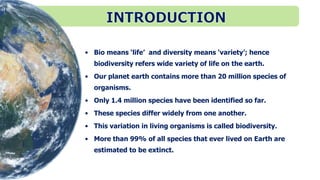
• Bio means ‘life’ and diversity means ‘variety’; hence
biodiversity refers wide variety of life on the earth.
• Our planet earth contains more than 20 million species of
organisms.
• Only 1.4 million species have been identified so far.
• These species differ widely from one another.
• This variation in living organisms is called biodiversity.
• More than 99% of all species that ever lived on Earth are
estimated to be extinct.
• Diversification in the species is influenced by various physical and climatic
factors, resulting in the production of new sub-species.
• Estimates on the number of Earth's current species range from 2 million to 1
trillion, of which about 1.74 million have been databased thus far.
• The species which are unable to adjust with the new environment gradually
become extinct.
• Biodiversity is defined as “the variety and variability among all the groups of
living organisms and the ecosystem in which they occur.”
• “Biological diversity" was first coined in 1985 by Walter Rosen
• 1980 – Thomas Lovejoy introduced the term biological diversity to the
scientific community in a book.
• Biodiversity is the term popularized by the socio-biologist Edward Wilson,
1988, to describe the combined diversity at all the levels of biological
organization.
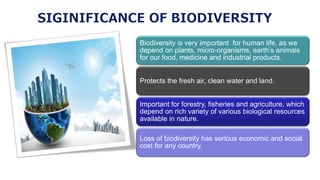
Biodiversity is very important for human life, as we
depend on plants, micro-organisms, earth’s animals
for our food, medicine and industrial products.
Protects the fresh air, clean water and land.
Important for forestry, fisheries and agriculture, which
depend on rich variety of various biological resources
available in nature.
Loss of biodiversity has serious economic and social
cost for any country.
• Economic—Biodiversity provides humans with raw materials for consumption and production. Many
livelihoods, such as those of farmers, fishers and timber workers, are dependent on biodiversity.
• Ecological life support—Biodiversity provides functioning ecosystems that supply oxygen, clean air
and water, pollination of plants, pest control, wastewater treatment and many ecosystem services.
• Recreation—Many recreational pursuits rely on our unique biodiversity, such as birdwatching, hiking,
camping and fishing. Our tourism industry also depends on biodiversity.
• Cultural—Indian culture is closely connected to biodiversity through the expression of identity, through
spirituality and through aesthetic appreciation. Indians have strong connections and obligations to
biodiversity arising from spiritual beliefs about animals and plants.
• Scientific—Biodiversity represents a wealth of systematic ecological data that help us to understand the
natural world and its origins.
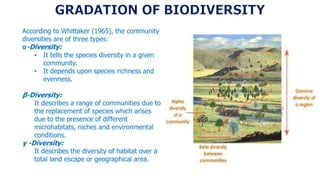
According to Whittaker (1965), the community
diversities are of three types:
α-Diversity:
• It tells the species diversity in a given
community.
• It depends upon species richness and
evenness.
β-Diversity:
It describes a range of communities due to
the replacement of species which arises
due to the presence of different
microhabitats, niches and environmental
conditions.
γ -Diversity:
It describes the diversity of habitat over a
total land escape or geographical area.
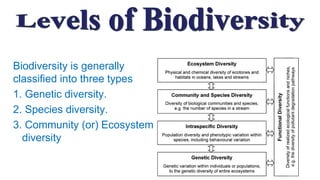
Biodiversity is generally
classified into three types
1. Genetic diversity.
2. Species diversity.
3. Community (or) Ecosystem
diversity
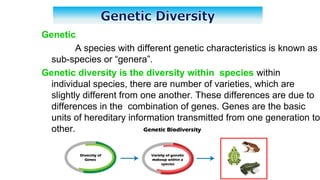
Genetic
A species with different genetic characteristics is known as
sub-species or “genera”.
Genetic diversity is the diversity within species within
individual species, there are number of varieties, which are
slightly different from one another. These differences are due to
differences in the combination of genes. Genes are the basic
units of hereditary information transmitted from one generation to
other.
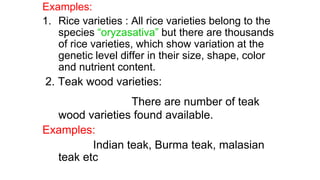
Examples:
1. Rice varieties : All rice varieties belong to the
species “oryzasativa” but there are thousands
of rice varieties, which show variation at the
genetic level differ in their size, shape, color
and nutrient content.
2. Teak wood varieties:
There are number of teak
wood varieties found available.
Examples:
Indian teak, Burma teak, malasian
teak etc
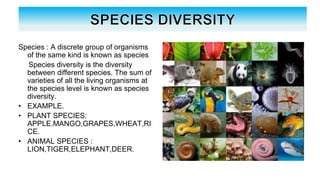
Species : A discrete group of organisms
of the same kind is known as species
Species diversity is the diversity
between different species. The sum of
varieties of all the living organisms at
the species level is known as species
diversity.
• EXAMPLE.
• PLANT SPECIES:
APPLE.MANGO,GRAPES,WHEAT,RI
CE.
• ANIMAL SPECIES :
LION,TIGER,ELEPHANT,DEER.
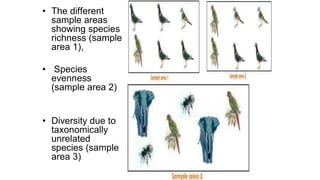
• The different
sample areas
showing species
richness (sample
area 1),
• Species
evenness
(sample area 2)
• Diversity due to
taxonomically
unrelated
species (sample
area 3)
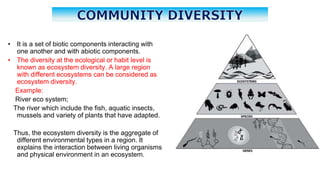
• It is a set of biotic components interacting with
one another and with abiotic components.
• The diversity at the ecological or habit level is
known as ecosystem diversity. A large region
with different ecosystems can be considered as
ecosystem diversity.
Example:
River eco system;
The river which include the fish, aquatic insects,
mussels and variety of plants that have adapted.
Thus, the ecosystem diversity is the aggregate of
different environmental types in a region. It
explains the interaction between living organisms
and physical environment in an ecosystem.
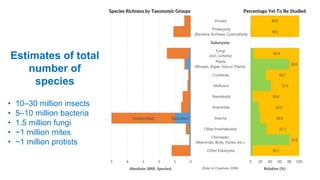
Estimates of total
number of
species
• 10–30 million insects
• 5–10 million bacteria
• 1.5 million fungi
• ~1 million mites
• ~1 million protists
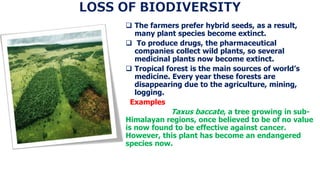
 The farmers prefer hybrid seeds, as a result,
many plant species become extinct.
 To produce drugs, the pharmaceutical
companies collect wild plants, so several
medicinal plants now become extinct.
 Tropical forest is the main sources of world’s
medicine. Every year these forests are
disappearing due to the agriculture, mining,
logging.
Examples
Taxus baccate, a tree growing in sub-
Himalayan regions, once believed to be of no value
is now found to be effective against cancer.
However, this plant has become an endangered
species now.
• Biosphere is a life supporting system to the
human beings. It is the combination of different
organisms. Each organisms in the biosphere has
its own significance.
• Biodiversity is vital for healthy biosphere
• Biodiversity is must for the stability and proper
functioning of the biosphere .
• CONSUMPTIVE USE VALUE
• PRODUCTIVE USE VALUE
• SOCIAL VALUES
• ETHICAL VALUES
• AESTHETIC VALUES
• OPTION VALUES
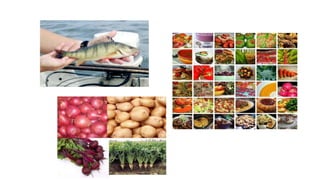
These are direct use values, where the biodiversity products
are harvested and consumed directly.
EXAMPLES; FOOD ,DRUG ,FUEL, etc.
Many wild plants are consumed by human beings as food. About 80,000 edible plant
species have been reported from the wild.
EXAMPLES
Cerepogia bulbosa: Central India and western ghats.
Codonopsis: Himalayan region
Cicer microphyllum: Kashmir
Insects: molluscs, spiders, and wild herbivores are consumed by many tribal and non-
tribal communities in India.
Around 70% of modern medicines are derived from plant and plant
extracts.
20,000 plant species are believed to be used medicinally, particularly in
the system of Unani, Ayurvedha and Sidha.
Examples:
Germany; 2,500 species of plants for medicine in Homeopathy
India ; 3,000 species of plants for medicine in Ayurvedha, Homeopathy
and Unani
Primary health care; 85% of global community plants
Arthritis; bee-sting venom for latest medicinal science.
Life saving drugs like quinine (malaria), reserpine (hypertension), penicillin
(antibiotic) and Morphine pain kill) are all of plant origin.
Peepal tree leaves, trunk and roots: curing fever, cough, stomach and skin
disease
Neem tree: 30 medicines prepared and very effective for stomach
ointments, eye irritations, skin eruptions and diabetics.
Maxican yarn has been proved as a versatile to produce birth control in
human beings.
ALOE VERA
Extremely easy to grow, aloe vera is India's most favorite and a succulent plant that is low-on-maintenance and easy-to-grow!
The plant is a trusted remedy for Indians to treat skin inflammation, breakouts, and burns. Its juice is well-known to boost a
weak immune system. It is believed to be full of oxidants, which help the body to fight free radicals and stay fit as well as young!
TULSI / BASIL
Tulsi or Holy Basil is called ‘Elixir of Life’ in Ayurveda in India and well-known medicinal plant. It has been proved that Tulsi clears
away the pollutants within the ten miles of its radius. Besides, Tulsi tea in India is very effective in treating common cold and flu.
CORIANDER
The young leaves can be plucked to put in curd, raita or vegetables to enhance the flavor as well as to utilize the benefit. Indian
Dhania leaves are refreshing and treat digestive issues.
MINT
Mint tea helps you stay calm and if you are insomniac, mint tea can help you feel composed and have a sound sleep. Its fragrance
is believed to keep the mosquitoes away. It is very beneficial in treating cold, cough, and diarrhea.
LEMONGRASS
Lemongrass’ therapeutic effect is widely known. Drink lemongrass tea to relieve a sore throat and menstrual pain. If you have
trouble sleeping, drinking lemongrass tea before sleeping can help you get rid of insomnia and stress. Lemongrass is also helpful
in pain management and has anti-pyretic properties.
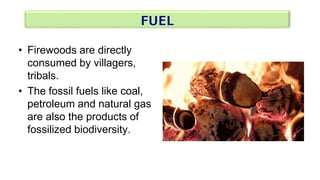
• Firewoods are directly
consumed by villagers,
tribals.
• The fossil fuels like coal,
petroleum and natural gas
are also the products of
fossilized biodiversity.
• Biodiversity products have obtained a commercial value.
• These products are marketed and sold.
• These products may be derived from the animals and plants.
ANIMAL PRODUCTS
• SILK- SILK WORM
• WOOL- SHEEP
• MUSK- MUSKDEER
• TUSK – ELEPHANTS
• LEATHER- ALL ANIMALS
• FOOD- FISH AND ANIMALS
PLANT PRODUCTS
• WOOD- PAPER, PLYWOOD, PULP, RAILWAYSLEEPER INDUSTRY.
• COTTON- TEXTILE INDUSTRY
• FRUITS,VEGETABLES- FOOD INDUSTRY.
• LEATHER- LEATHER INDUSTRY
• IVORY- IVORY WORKS
• PEARL- PEARLS INDUSTRY.
• Rice accounts for 22% of the cropped area and
• cereals accounts for 39% of the cropped area
• Oil seed production also helped in saving large amount of foreign
exchange spent on importing edible oils.
• Social value of the biodiversity refers to the manner in which
the bio-resources are used to the society.
• These values are associated with the social life, religion and
spiritual aspects of the people.
Examples:
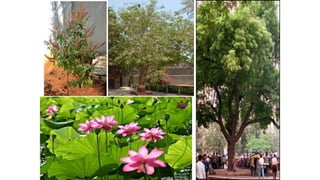
• HOLY PLANTS- TULSI, PEEPAL, LOTUS.
• HOLY ANIMALS- COW ,SNAKE, BULL, PEACOCK,RAT.
• It involves ethical issues like “all life must be preserved”
• In India and in other countries biodiversity is considered to have great
value on religious and cultural basis.
• Our rich heritage teaches us to worship plats, animals, rivers and
mountains.
• It is existence in nature gives as pleasure.
Examples:
• The river ganga is holy river.
• Vembu, tulsi, vengai are worshipped by tamilians
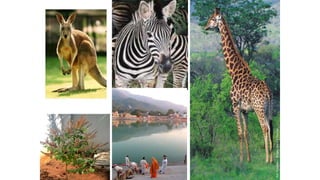
• Kangaroo,zebra,giraffe exist in nature.
• The beautiful nature of plants and animals insist us to protect the
biodiversity.
• The most important aesthetic value of biodiversity is eco-tourism.
Examples:
1.Eco-tourism: people from far place spent a lot of time and money to
visit the beautiful areas, where they can enjoy the aesthetic value of
biodiversity. This type of tourism is called eco-tourism.
2. The pleasant music of wild birds
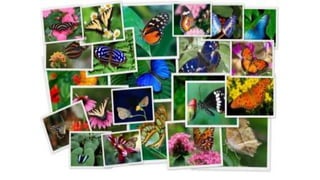
colour of butterfly
colour of flowers
colour of peacocks. Are very important aesthetic value.
• The option values are the potentials of biodiversity that are presently
unknown and need to be known.
• The optional values of biodiversity suggests that any species may be proved
to be a valuable species after someday.
Examples:
• The growing biotechnology field is searching a species for causing the
disease of cancer and AIDS.
• Medicinal plants and herbs play a very important role in our Indian economic
growth.
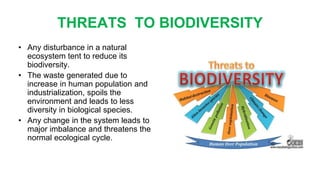
THREATS TO BIODIVERSITY
• Any disturbance in a natural
ecosystem tent to reduce its
biodiversity.
• The waste generated due to
increase in human population and
industrialization, spoils the
environment and leads to less
diversity in biological species.
• Any change in the system leads to
major imbalance and threatens the
normal ecological cycle.
VARIOUS THREATS TO INDIAN BIODIVERSITY
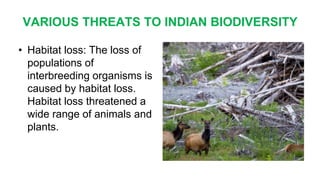
• Habitat loss: The loss of
populations of
interbreeding organisms is
caused by habitat loss.
Habitat loss threatened a
wide range of animals and
plants.
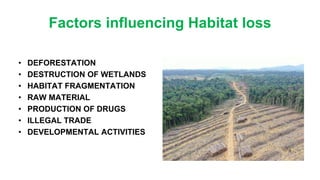
Factors influencing Habitat loss
• DEFORESTATION
• DESTRUCTION OF WETLANDS
• HABITAT FRAGMENTATION
• RAW MATERIAL
• PRODUCTION OF DRUGS
• ILLEGAL TRADE
• DEVELOPMENTAL ACTIVITIES
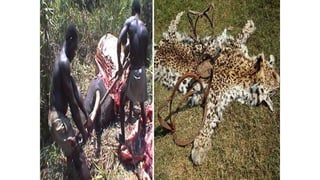
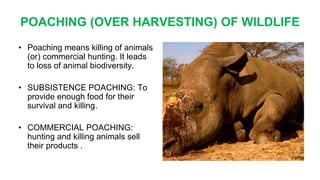
POACHING (OVER HARVESTING) OF WILDLIFE
• Poaching means killing of animals
(or) commercial hunting. It leads
to loss of animal biodiversity.
• SUBSISTENCE POACHING: To
provide enough food for their
survival and killing.
• COMMERCIAL POACHING:
hunting and killing animals sell
their products .
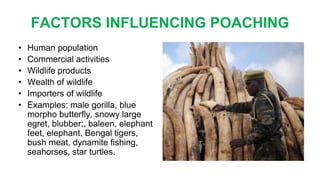
FACTORS INFLUENCING POACHING
• Human population
• Commercial activities
• Wildlife products
• Wealth of wildlife
• Importers of wildlife
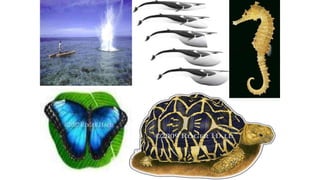
• Examples: male gorilla, blue
morpho butterfly, snowy large
egret, blubber;, baleen, elephant
feet, elephant, Bengal tigers,
bush meat, dynamite fishing,
seahorses, star turtles.
REMEDY MEASURES
Illegal hunting and trade of animals and animal
products should be stopped immediately.
We should not purchase furcoat, purse or bag
or items made of crocodile skin or python skin.
Bio-diversity laws should be strengthened.
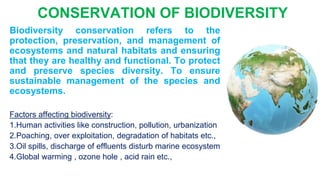
Biodiversity conservation refers to the
protection, preservation, and management of
ecosystems and natural habitats and ensuring
that they are healthy and functional. To protect
and preserve species diversity. To ensure
sustainable management of the species and
ecosystems.
Factors affecting biodiversity:
1.Human activities like construction, pollution, urbanization
2.Poaching, over exploitation, degradation of habitats etc.,
3.Oil spills, discharge of effluents disturb marine ecosystem
4.Global warming , ozone hole , acid rain etc.,
CONSERVATION OF BIODIVERSITY
• Immediate benefit like recreation and tourism
• Drugs, herbs, food, raw materials derived easily
• Preserve genetic diversity of plants and animals
• Ensures sustainable utilization
• Conserve ecological diversity and life supporting
systems
• To prevent environmental deterioration
NEED FOR BIODIVERSITY CONSERVATION
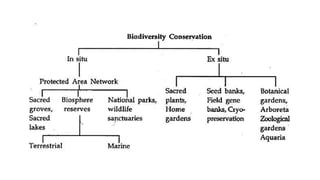
IN – SITU CONSERVATION
• It involves protection of fauna and flora within its natural
habitat, where the species normally occurs
• The natural habitats or ecosystems maintained under in – situ
conservation are called protected areas.
• Biosphere reserves, national parks, wildlife sanctuaries, gene
sanctuary etc., are some of in – situ conservation
• 4% geographical area of a country used for this
• It is best method for long term conservation
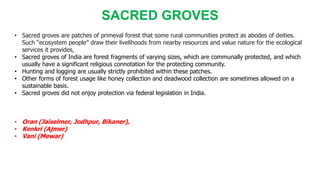
• Sacred groves are patches of primeval forest that some rural communities protect as abodes of deities.
Such “ecosystem people” draw their livelihoods from nearby resources and value nature for the ecological
services it provides,
• Sacred groves of India are forest fragments of varying sizes, which are communally protected, and which
usually have a significant religious connotation for the protecting community.
• Hunting and logging are usually strictly prohibited within these patches.
• Other forms of forest usage like honey collection and deadwood collection are sometimes allowed on a
sustainable basis.
• Sacred groves did not enjoy protection via federal legislation in India.
• Oran (Jaiselmer, Jodhpur, Bikaner),
• Kenkri (Ajmer)
• Vani (Mewar)
SACRED GROVES
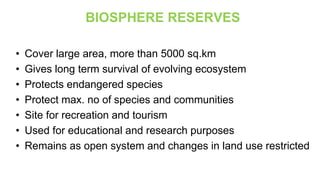
BIOSPHERE RESERVES
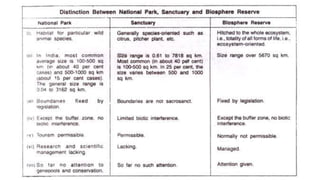
• Cover large area, more than 5000 sq.km
• Gives long term survival of evolving ecosystem
• Protects endangered species
• Protect max. no of species and communities
• Site for recreation and tourism
• Used for educational and research purposes
• Remains as open system and changes in land use restricted
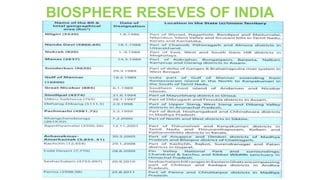
BIOSPHERE RESEVES OF INDIA
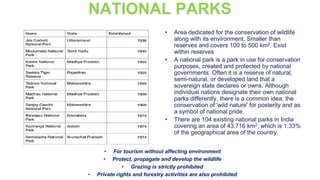
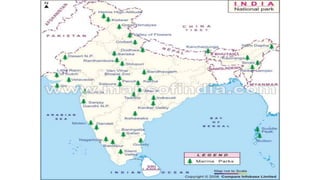
NATIONAL PARKS
• Area dedicated for the conservation of wildlife
along with its environment. Smaller than
reserves and covers 100 to 500 km2. Exist
within reserves
• A national park is a park in use for conservation
purposes, created and protected by national
governments. Often it is a reserve of natural,
semi-natural, or developed land that a
sovereign state declares or owns. Although
individual nations designate their own national
parks differently, there is a common idea: the
conservation of 'wild nature' for posterity and as
a symbol of national pride.
• There are 104 existing national parks in India
covering an area of 43,716 km2, which is 1.33%
of the geographical area of the country.
• For tourism without affecting environment
• Protect, propagate and develop the wildlife
• Grazing is strictly prohibited
• Private rights and forestry activities are also prohibited
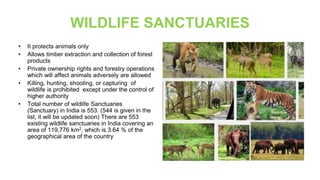
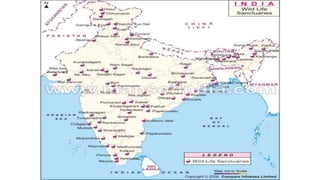
WILDLIFE SANCTUARIES
• It protects animals only
• Allows timber extraction and collection of forest
products
• Private ownership rights and forestry operations
which will affect animals adversely are allowed
• Killing, hunting, shooting, or capturing of
wildlife is prohibited except under the control of
higher authority
• Total number of wildlife Sanctuaries
(Sanctuary) in India is 553. (544 is given in the
list, it will be updated soon) There are 553
existing wildlife sanctuaries in India covering an
area of 119,776 km2, which is 3.64 % of the
geographical area of the country
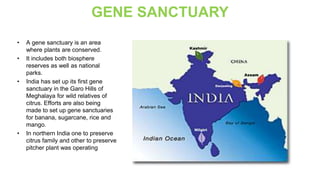
• A gene sanctuary is an area
where plants are conserved.
• It includes both biosphere
reserves as well as national
parks.
• India has set up its first gene
sanctuary in the Garo Hills of
Meghalaya for wild relatives of
citrus. Efforts are also being
made to set up gene sanctuaries
for banana, sugarcane, rice and
mango.
• In northern India one to preserve
citrus family and other to preserve
pitcher plant was operating
GENE SANCTUARY
• Project Tiger: Project Tiger is a tiger conservation programme launched in April 1973 by the
Government of India during Prime Minister Indira Gandhi's tenure.
• Gir lion Project: Gir Lion Sanctuary was established in 1965 in Gujarat, which cover an
area of 1452 square km. The Gir Lion Sanctuary Project was started in 1972. It is running by state and
central government.
• Crocodile Breeding Project: In response to declining crocodilian populations, in
co-operation with the Government of India and State Governments, a crocodile conservation programme,
the UNDP/FAO Crocodile Breeding and Management Project, was launched in 1975.
• Project Elephant: Project Elephant was launched in 1992 by the Government of India
Ministry of Environment and Forests to provide financial and technical support to wildlife management
efforts by states for their free-ranging populations of wild Asian Elephants.
OTHER PROJECTS FOR CONSERVATION OF
ANIMALS
Merits of in – situ conservation:
• Cheap and convenient method
• Species adjusted to natural
disasters
Demerits of in – situ conservation:
• Large area needed
• Maintenance is not proper hence
cause pollution
EX – SITU CONSERVATION
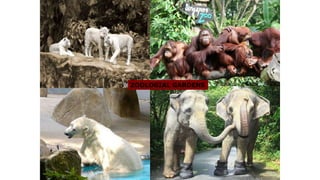
• It involves the protection of fauna and flora outside the natural
habitats
• It involves maintenance and breeding of endangered species in
controlled conditions
• It identify the species under risk of extinction
• It prefers species of more important for mankind in near future
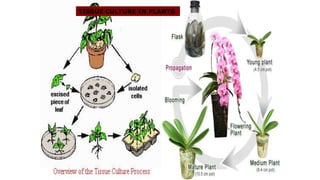
• Botanical gardens seed banks microbial culture collections tissue
and cell cultures museums zoological gardens are the places
where it is carried out
BOTANICAL GARDENS
ZOOLOGIAL GARDENS
MUSEUM
METHODS OF EX – SITU CONSERVATION
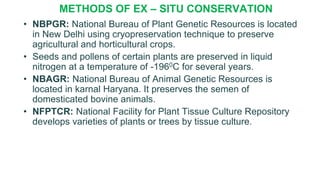
• NBPGR: National Bureau of Plant Genetic Resources is located
in New Delhi using cryopreservation technique to preserve
agricultural and horticultural crops.
• Seeds and pollens of certain plants are preserved in liquid
nitrogen at a temperature of -1960C for several years.
• NBAGR: National Bureau of Animal Genetic Resources is
located in karnal Haryana. It preserves the semen of
domesticated bovine animals.
• NFPTCR: National Facility for Plant Tissue Culture Repository
develops varieties of plants or trees by tissue culture.
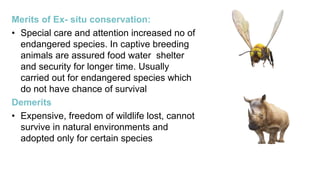
Merits of Ex- situ conservation:
• Special care and attention increased no of
endangered species. In captive breeding
animals are assured food water shelter
and security for longer time. Usually
carried out for endangered species which
do not have chance of survival
Demerits
• Expensive, freedom of wildlife lost, cannot
survive in natural environments and
adopted only for certain species
TISSUE CULTURE IN PLANTS
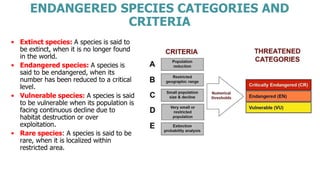
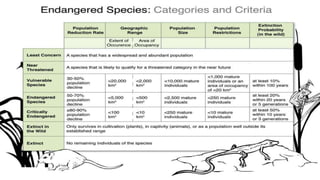
ENDANGERED SPECIES CATEGORIES AND
CRITERIA
• Extinct species: A species is said to
be extinct, when it is no longer found
in the world.
• Endangered species: A species is
said to be endangered, when its
number has been reduced to a critical
level.
• Vulnerable species: A species is said
to be vulnerable when its population is
facing continuous decline due to
habitat destruction or over
exploitation.
• Rare species: A species is said to be
rare, when it is localized within
restricted area.
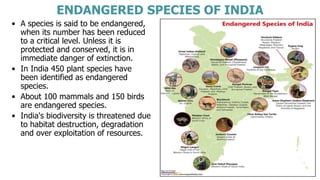
ENDANGERED SPECIES OF INDIA
• A species is said to be endangered,
when its number has been reduced
to a critical level. Unless it is
protected and conserved, it is in
immediate danger of extinction.
• In India 450 plant species have
been identified as endangered
species.
• About 100 mammals and 150 birds
are endangered species.
• India's biodiversity is threatened due
to habitat destruction, degradation
and over exploitation of resources.
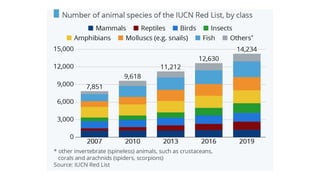
RED-DATA BOOK
Red book is a catalogue of taxa facing risk of extinction.
The purpose of preparation of red list is to
• Provide awareness to the degree of threat to biodiversity.
• Provide global index on decline of biodiversity.
• Identification of species at high risk.
• Help in conservation action.
• Information about international agreements.
• Red Data Books on Plants in 1978 and for Animals in 1988.
• India's biodiversity is threatened due to habitat destruction,
degradation, fragmentation and over exploitation of
resources.
• According to ‘RED’ data book 44 plant species are critically
endangered, 54 endangered,143 are vulnerable.
• India ranks 2nd interms of the number of threatened mammals
and 6th among the countries with the most threatened birds.
• Examples:
• 1.pitcher plant has become endemic in eastern Himalayas.
• 2.taxus wallichina has become under red data category due
to its over exploitation.
IMPORTANT ENDANGERED SPECIES
• REPTILES-TORTOISE,GREEN SEA TURTTLE,PYTHON
• BIRDS-PEACOCK, PELICAN,INDIAN BUSTARD
• MAMMALS-INDIAN WOLF,RED FOX,TIGER,INDIAN LION
GOLDEN CAT,DESERT CAT
• PRIMATES-HOOLOCK GIBBON,CAPPED
MONKEY,GOLDEN MONKEY
• PLANTS-SANDAL WOOD,MEDICINAL PLANTS
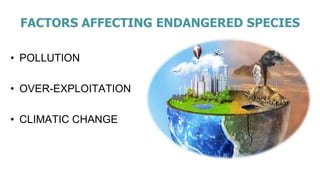
FACTORS AFFECTING ENDANGERED SPECIES
• POLLUTION
• OVER-EXPLOITATION
• CLIMATIC CHANGE
REMEDIAL MESURES
International treaties on endangered species {ITES}
The Convention on International Trade in Endangered
Species of Wild Fauna and Flora (CITES) is an
international treaty to prevent species from becoming
endangered or extinct because of international trade--
signed by 160 countries
It list 900 species –cannot be traded
It restricts international trade of 2900 other species
ENDEMISM
• The concept was laid down by A. P. Condolle in 1813.
• Endemism is a situation in which a given species has a
restricted region of distribution.
• The species which are found only in a particular region are
known as endemic species
• About 33% of the flowering plants, 53% of freshwater fishes, 60% amphibians
, 36% reptiles and 10% mammalian are endemic species.
• Plant diversity: 5000 flowering plants and 166 crop plant species
have their origin in India.
• Marine diversity: More than 340 coral species of the world are
found here. Mangrove and sea grasses are also found in our
country.
• Agro-diversity: There are 167 crop species and wild
relatives. India is the center of origin of 30,000 to 50,000
varieties of rice, mango, turmeric, ginger, sugarcane etc.
• Animal biodiversity: There are 75,000 animal species
including 5,000 insects. India is a home to about nearly
2,00,000 living organisms.
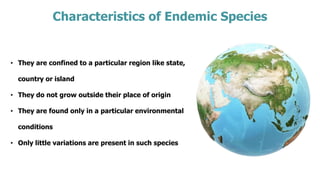
Characteristics of Endemic Species
• They are confined to a particular region like state,
country or island
• They do not grow outside their place of origin
• They are found only in a particular environmental
conditions
• Only little variations are present in such species
Types of Endemics
(a) Neo-endemism:
A taxon is evolutionarily young and not yet spread over the new area e.g.,
Senecia combrensis.
(b) Palaeo-endemism:
The taxon is restricted now but once it was widely distributed. The restriction
of species in a pocket is due to physical barrier like deserts mountain, sea, etc.
or change in climate or soil type etc.
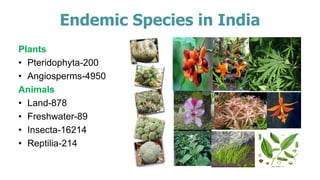
Endemic Species in India
Plants
• Pteridophyta-200
• Angiosperms-4950
Animals
• Land-878
• Freshwater-89
• Insecta-16214
• Reptilia-214
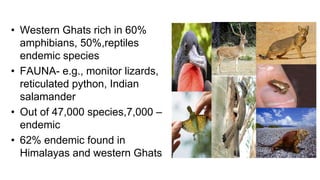
• Western Ghats rich in 60%
amphibians, 50%,reptiles
endemic species
• FAUNA- e.g., monitor lizards,
reticulated python, Indian
salamander
• Out of 47,000 species,7,000 –
endemic
• 62% endemic found in
Himalayas and western Ghats
HOT-SPOTS OF BIODIVERSITY
• The concept of Hot Spots was developed by Norman
Myers in 1988.
• The most remarkable and threatened areas, many of
them have been reduced to less than 10% of their
original vegetation. These areas are called hot-spots of
biodiversity.
• The hot spots are defined as the richest and the most
threatened reservoirs of plant and animal life on earth.
• The Richness of endemic species is the primary
criterion for recognizing hot spots.
• Number of endemic species i.e., the species which are
not found any where else (must have over 1500
endemic plant species)
• Degree of threat, which is measure in terms of habitat
loss (must have lost over 70% of original habitat).
34 Hot spots all over the globe cover 1.4% of earth’s
land area and support 20% of human population.
CRITERIA FOR RECOGNISING HOT SPOT
Area of Hot Spot
• These hot spots covering less than 1.4 to 2% of the worlds
land are found to contain 50,000 endemic species.
• According to Myers et al (2000), an area is designated as a
hot spot when it contains at least 0.5% of the endemic plant
species.
• About 40% of terrestrial plants and 25% of vertebrate species
are endemic and are found in these hot spots.
• These are the areas of high diversity, endemism and are also
threatened by many human activities.
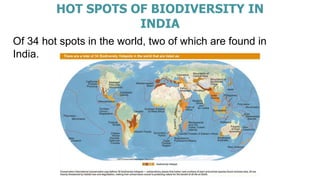
HOT SPOTS OF BIODIVERSITY IN
INDIA
Of 34 hot spots in the world, two of which are found in
India.
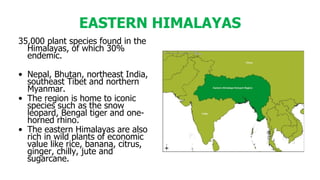
EASTERN HIMALAYAS
35,000 plant species found in the
Himalayas, of which 30%
endemic.
• Nepal, Bhutan, northeast India,
southeast Tibet and northern
Myanmar.
• The region is home to iconic
species such as the snow
leopard, Bengal tiger and one-
horned rhino.
• The eastern Himalayas are also
rich in wild plants of economic
value like rice, banana, citrus,
ginger, chilly, jute and
sugarcane.
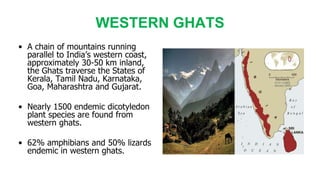
WESTERN GHATS
• A chain of mountains running
parallel to India’s western coast,
approximately 30-50 km inland,
the Ghats traverse the States of
Kerala, Tamil Nadu, Karnataka,
Goa, Maharashtra and Gujarat.
• Nearly 1500 endemic dicotyledon
plant species are found from
western ghats.
• 62% amphibians and 50% lizards
endemic in western ghats.

Biodiversity

  • 1.
    Dr Fayaz A.Malla Assistant Professor, Environmental Sciences GDC Tral Higher Education Department, Govt. of J&K Email: ismifayaz@gmail.com
  • 2.
    • Bio means‘life’ and diversity means ‘variety’; hence biodiversity refers wide variety of life on the earth. • Our planet earth contains more than 20 million species of organisms. • Only 1.4 million species have been identified so far. • These species differ widely from one another. • This variation in living organisms is called biodiversity. • More than 99% of all species that ever lived on Earth are estimated to be extinct.
  • 3.
    • Diversification inthe species is influenced by various physical and climatic factors, resulting in the production of new sub-species. • Estimates on the number of Earth's current species range from 2 million to 1 trillion, of which about 1.74 million have been databased thus far. • The species which are unable to adjust with the new environment gradually become extinct. • Biodiversity is defined as “the variety and variability among all the groups of living organisms and the ecosystem in which they occur.”
  • 4.
    • “Biological diversity"was first coined in 1985 by Walter Rosen • 1980 – Thomas Lovejoy introduced the term biological diversity to the scientific community in a book. • Biodiversity is the term popularized by the socio-biologist Edward Wilson, 1988, to describe the combined diversity at all the levels of biological organization.
  • 5.
    Biodiversity is veryimportant for human life, as we depend on plants, micro-organisms, earth’s animals for our food, medicine and industrial products. Protects the fresh air, clean water and land. Important for forestry, fisheries and agriculture, which depend on rich variety of various biological resources available in nature. Loss of biodiversity has serious economic and social cost for any country.
  • 6.
    • Economic—Biodiversity provideshumans with raw materials for consumption and production. Many livelihoods, such as those of farmers, fishers and timber workers, are dependent on biodiversity. • Ecological life support—Biodiversity provides functioning ecosystems that supply oxygen, clean air and water, pollination of plants, pest control, wastewater treatment and many ecosystem services. • Recreation—Many recreational pursuits rely on our unique biodiversity, such as birdwatching, hiking, camping and fishing. Our tourism industry also depends on biodiversity. • Cultural—Indian culture is closely connected to biodiversity through the expression of identity, through spirituality and through aesthetic appreciation. Indians have strong connections and obligations to biodiversity arising from spiritual beliefs about animals and plants. • Scientific—Biodiversity represents a wealth of systematic ecological data that help us to understand the natural world and its origins.
  • 7.
    According to Whittaker(1965), the community diversities are of three types: α-Diversity: • It tells the species diversity in a given community. • It depends upon species richness and evenness. β-Diversity: It describes a range of communities due to the replacement of species which arises due to the presence of different microhabitats, niches and environmental conditions. γ -Diversity: It describes the diversity of habitat over a total land escape or geographical area.
  • 8.
    Biodiversity is generally classifiedinto three types 1. Genetic diversity. 2. Species diversity. 3. Community (or) Ecosystem diversity
  • 9.
    Genetic A species withdifferent genetic characteristics is known as sub-species or “genera”. Genetic diversity is the diversity within species within individual species, there are number of varieties, which are slightly different from one another. These differences are due to differences in the combination of genes. Genes are the basic units of hereditary information transmitted from one generation to other.
  • 10.
    Examples: 1. Rice varieties: All rice varieties belong to the species “oryzasativa” but there are thousands of rice varieties, which show variation at the genetic level differ in their size, shape, color and nutrient content. 2. Teak wood varieties: There are number of teak wood varieties found available. Examples: Indian teak, Burma teak, malasian teak etc
  • 11.
    Species : Adiscrete group of organisms of the same kind is known as species Species diversity is the diversity between different species. The sum of varieties of all the living organisms at the species level is known as species diversity. • EXAMPLE. • PLANT SPECIES: APPLE.MANGO,GRAPES,WHEAT,RI CE. • ANIMAL SPECIES : LION,TIGER,ELEPHANT,DEER.
  • 12.
    • The different sampleareas showing species richness (sample area 1), • Species evenness (sample area 2) • Diversity due to taxonomically unrelated species (sample area 3)
  • 13.
    • It isa set of biotic components interacting with one another and with abiotic components. • The diversity at the ecological or habit level is known as ecosystem diversity. A large region with different ecosystems can be considered as ecosystem diversity. Example: River eco system; The river which include the fish, aquatic insects, mussels and variety of plants that have adapted. Thus, the ecosystem diversity is the aggregate of different environmental types in a region. It explains the interaction between living organisms and physical environment in an ecosystem.
  • 14.
    Estimates of total numberof species • 10–30 million insects • 5–10 million bacteria • 1.5 million fungi • ~1 million mites • ~1 million protists
  • 15.
     The farmersprefer hybrid seeds, as a result, many plant species become extinct.  To produce drugs, the pharmaceutical companies collect wild plants, so several medicinal plants now become extinct.  Tropical forest is the main sources of world’s medicine. Every year these forests are disappearing due to the agriculture, mining, logging. Examples Taxus baccate, a tree growing in sub- Himalayan regions, once believed to be of no value is now found to be effective against cancer. However, this plant has become an endangered species now.
  • 16.
    • Biosphere isa life supporting system to the human beings. It is the combination of different organisms. Each organisms in the biosphere has its own significance. • Biodiversity is vital for healthy biosphere • Biodiversity is must for the stability and proper functioning of the biosphere .
  • 17.
    • CONSUMPTIVE USEVALUE • PRODUCTIVE USE VALUE • SOCIAL VALUES • ETHICAL VALUES • AESTHETIC VALUES • OPTION VALUES
  • 18.
    These are directuse values, where the biodiversity products are harvested and consumed directly. EXAMPLES; FOOD ,DRUG ,FUEL, etc. Many wild plants are consumed by human beings as food. About 80,000 edible plant species have been reported from the wild. EXAMPLES Cerepogia bulbosa: Central India and western ghats. Codonopsis: Himalayan region Cicer microphyllum: Kashmir Insects: molluscs, spiders, and wild herbivores are consumed by many tribal and non- tribal communities in India.
  • 20.
    Around 70% ofmodern medicines are derived from plant and plant extracts. 20,000 plant species are believed to be used medicinally, particularly in the system of Unani, Ayurvedha and Sidha. Examples: Germany; 2,500 species of plants for medicine in Homeopathy India ; 3,000 species of plants for medicine in Ayurvedha, Homeopathy and Unani Primary health care; 85% of global community plants
  • 21.
    Arthritis; bee-sting venomfor latest medicinal science. Life saving drugs like quinine (malaria), reserpine (hypertension), penicillin (antibiotic) and Morphine pain kill) are all of plant origin. Peepal tree leaves, trunk and roots: curing fever, cough, stomach and skin disease Neem tree: 30 medicines prepared and very effective for stomach ointments, eye irritations, skin eruptions and diabetics. Maxican yarn has been proved as a versatile to produce birth control in human beings.
  • 22.
    ALOE VERA Extremely easyto grow, aloe vera is India's most favorite and a succulent plant that is low-on-maintenance and easy-to-grow! The plant is a trusted remedy for Indians to treat skin inflammation, breakouts, and burns. Its juice is well-known to boost a weak immune system. It is believed to be full of oxidants, which help the body to fight free radicals and stay fit as well as young! TULSI / BASIL Tulsi or Holy Basil is called ‘Elixir of Life’ in Ayurveda in India and well-known medicinal plant. It has been proved that Tulsi clears away the pollutants within the ten miles of its radius. Besides, Tulsi tea in India is very effective in treating common cold and flu. CORIANDER The young leaves can be plucked to put in curd, raita or vegetables to enhance the flavor as well as to utilize the benefit. Indian Dhania leaves are refreshing and treat digestive issues. MINT Mint tea helps you stay calm and if you are insomniac, mint tea can help you feel composed and have a sound sleep. Its fragrance is believed to keep the mosquitoes away. It is very beneficial in treating cold, cough, and diarrhea. LEMONGRASS Lemongrass’ therapeutic effect is widely known. Drink lemongrass tea to relieve a sore throat and menstrual pain. If you have trouble sleeping, drinking lemongrass tea before sleeping can help you get rid of insomnia and stress. Lemongrass is also helpful in pain management and has anti-pyretic properties.
  • 23.
    • Firewoods aredirectly consumed by villagers, tribals. • The fossil fuels like coal, petroleum and natural gas are also the products of fossilized biodiversity.
  • 24.
    • Biodiversity productshave obtained a commercial value. • These products are marketed and sold. • These products may be derived from the animals and plants. ANIMAL PRODUCTS • SILK- SILK WORM • WOOL- SHEEP • MUSK- MUSKDEER • TUSK – ELEPHANTS • LEATHER- ALL ANIMALS • FOOD- FISH AND ANIMALS
  • 26.
    PLANT PRODUCTS • WOOD-PAPER, PLYWOOD, PULP, RAILWAYSLEEPER INDUSTRY. • COTTON- TEXTILE INDUSTRY • FRUITS,VEGETABLES- FOOD INDUSTRY. • LEATHER- LEATHER INDUSTRY • IVORY- IVORY WORKS • PEARL- PEARLS INDUSTRY. • Rice accounts for 22% of the cropped area and • cereals accounts for 39% of the cropped area • Oil seed production also helped in saving large amount of foreign exchange spent on importing edible oils.
  • 27.
    • Social valueof the biodiversity refers to the manner in which the bio-resources are used to the society. • These values are associated with the social life, religion and spiritual aspects of the people. Examples: • HOLY PLANTS- TULSI, PEEPAL, LOTUS. • HOLY ANIMALS- COW ,SNAKE, BULL, PEACOCK,RAT.
  • 29.
    • It involvesethical issues like “all life must be preserved” • In India and in other countries biodiversity is considered to have great value on religious and cultural basis. • Our rich heritage teaches us to worship plats, animals, rivers and mountains. • It is existence in nature gives as pleasure. Examples: • The river ganga is holy river. • Vembu, tulsi, vengai are worshipped by tamilians • Kangaroo,zebra,giraffe exist in nature.
  • 31.
    • The beautifulnature of plants and animals insist us to protect the biodiversity. • The most important aesthetic value of biodiversity is eco-tourism. Examples: 1.Eco-tourism: people from far place spent a lot of time and money to visit the beautiful areas, where they can enjoy the aesthetic value of biodiversity. This type of tourism is called eco-tourism. 2. The pleasant music of wild birds colour of butterfly colour of flowers colour of peacocks. Are very important aesthetic value.
  • 34.
    • The optionvalues are the potentials of biodiversity that are presently unknown and need to be known. • The optional values of biodiversity suggests that any species may be proved to be a valuable species after someday. Examples: • The growing biotechnology field is searching a species for causing the disease of cancer and AIDS. • Medicinal plants and herbs play a very important role in our Indian economic growth.
  • 35.
    THREATS TO BIODIVERSITY •Any disturbance in a natural ecosystem tent to reduce its biodiversity. • The waste generated due to increase in human population and industrialization, spoils the environment and leads to less diversity in biological species. • Any change in the system leads to major imbalance and threatens the normal ecological cycle.
  • 36.
    VARIOUS THREATS TOINDIAN BIODIVERSITY • Habitat loss: The loss of populations of interbreeding organisms is caused by habitat loss. Habitat loss threatened a wide range of animals and plants.
  • 37.
    Factors influencing Habitatloss • DEFORESTATION • DESTRUCTION OF WETLANDS • HABITAT FRAGMENTATION • RAW MATERIAL • PRODUCTION OF DRUGS • ILLEGAL TRADE • DEVELOPMENTAL ACTIVITIES
  • 38.
    POACHING (OVER HARVESTING)OF WILDLIFE • Poaching means killing of animals (or) commercial hunting. It leads to loss of animal biodiversity. • SUBSISTENCE POACHING: To provide enough food for their survival and killing. • COMMERCIAL POACHING: hunting and killing animals sell their products .
  • 40.
    FACTORS INFLUENCING POACHING •Human population • Commercial activities • Wildlife products • Wealth of wildlife • Importers of wildlife • Examples: male gorilla, blue morpho butterfly, snowy large egret, blubber;, baleen, elephant feet, elephant, Bengal tigers, bush meat, dynamite fishing, seahorses, star turtles.
  • 42.
    REMEDY MEASURES Illegal huntingand trade of animals and animal products should be stopped immediately. We should not purchase furcoat, purse or bag or items made of crocodile skin or python skin. Bio-diversity laws should be strengthened.
  • 43.
    Biodiversity conservation refersto the protection, preservation, and management of ecosystems and natural habitats and ensuring that they are healthy and functional. To protect and preserve species diversity. To ensure sustainable management of the species and ecosystems. Factors affecting biodiversity: 1.Human activities like construction, pollution, urbanization 2.Poaching, over exploitation, degradation of habitats etc., 3.Oil spills, discharge of effluents disturb marine ecosystem 4.Global warming , ozone hole , acid rain etc., CONSERVATION OF BIODIVERSITY
  • 44.
    • Immediate benefitlike recreation and tourism • Drugs, herbs, food, raw materials derived easily • Preserve genetic diversity of plants and animals • Ensures sustainable utilization • Conserve ecological diversity and life supporting systems • To prevent environmental deterioration NEED FOR BIODIVERSITY CONSERVATION
  • 46.
    IN – SITUCONSERVATION • It involves protection of fauna and flora within its natural habitat, where the species normally occurs • The natural habitats or ecosystems maintained under in – situ conservation are called protected areas. • Biosphere reserves, national parks, wildlife sanctuaries, gene sanctuary etc., are some of in – situ conservation • 4% geographical area of a country used for this • It is best method for long term conservation
  • 47.
    • Sacred grovesare patches of primeval forest that some rural communities protect as abodes of deities. Such “ecosystem people” draw their livelihoods from nearby resources and value nature for the ecological services it provides, • Sacred groves of India are forest fragments of varying sizes, which are communally protected, and which usually have a significant religious connotation for the protecting community. • Hunting and logging are usually strictly prohibited within these patches. • Other forms of forest usage like honey collection and deadwood collection are sometimes allowed on a sustainable basis. • Sacred groves did not enjoy protection via federal legislation in India. • Oran (Jaiselmer, Jodhpur, Bikaner), • Kenkri (Ajmer) • Vani (Mewar) SACRED GROVES
  • 48.
    BIOSPHERE RESERVES • Coverlarge area, more than 5000 sq.km • Gives long term survival of evolving ecosystem • Protects endangered species • Protect max. no of species and communities • Site for recreation and tourism • Used for educational and research purposes • Remains as open system and changes in land use restricted
  • 49.
  • 51.
    NATIONAL PARKS • Areadedicated for the conservation of wildlife along with its environment. Smaller than reserves and covers 100 to 500 km2. Exist within reserves • A national park is a park in use for conservation purposes, created and protected by national governments. Often it is a reserve of natural, semi-natural, or developed land that a sovereign state declares or owns. Although individual nations designate their own national parks differently, there is a common idea: the conservation of 'wild nature' for posterity and as a symbol of national pride. • There are 104 existing national parks in India covering an area of 43,716 km2, which is 1.33% of the geographical area of the country. • For tourism without affecting environment • Protect, propagate and develop the wildlife • Grazing is strictly prohibited • Private rights and forestry activities are also prohibited
  • 53.
    WILDLIFE SANCTUARIES • Itprotects animals only • Allows timber extraction and collection of forest products • Private ownership rights and forestry operations which will affect animals adversely are allowed • Killing, hunting, shooting, or capturing of wildlife is prohibited except under the control of higher authority • Total number of wildlife Sanctuaries (Sanctuary) in India is 553. (544 is given in the list, it will be updated soon) There are 553 existing wildlife sanctuaries in India covering an area of 119,776 km2, which is 3.64 % of the geographical area of the country
  • 55.
    • A genesanctuary is an area where plants are conserved. • It includes both biosphere reserves as well as national parks. • India has set up its first gene sanctuary in the Garo Hills of Meghalaya for wild relatives of citrus. Efforts are also being made to set up gene sanctuaries for banana, sugarcane, rice and mango. • In northern India one to preserve citrus family and other to preserve pitcher plant was operating GENE SANCTUARY
  • 56.
    • Project Tiger:Project Tiger is a tiger conservation programme launched in April 1973 by the Government of India during Prime Minister Indira Gandhi's tenure. • Gir lion Project: Gir Lion Sanctuary was established in 1965 in Gujarat, which cover an area of 1452 square km. The Gir Lion Sanctuary Project was started in 1972. It is running by state and central government. • Crocodile Breeding Project: In response to declining crocodilian populations, in co-operation with the Government of India and State Governments, a crocodile conservation programme, the UNDP/FAO Crocodile Breeding and Management Project, was launched in 1975. • Project Elephant: Project Elephant was launched in 1992 by the Government of India Ministry of Environment and Forests to provide financial and technical support to wildlife management efforts by states for their free-ranging populations of wild Asian Elephants. OTHER PROJECTS FOR CONSERVATION OF ANIMALS
  • 58.
    Merits of in– situ conservation: • Cheap and convenient method • Species adjusted to natural disasters Demerits of in – situ conservation: • Large area needed • Maintenance is not proper hence cause pollution
  • 59.
    EX – SITUCONSERVATION • It involves the protection of fauna and flora outside the natural habitats • It involves maintenance and breeding of endangered species in controlled conditions • It identify the species under risk of extinction • It prefers species of more important for mankind in near future • Botanical gardens seed banks microbial culture collections tissue and cell cultures museums zoological gardens are the places where it is carried out
  • 60.
  • 61.
  • 62.
  • 63.
    METHODS OF EX– SITU CONSERVATION • NBPGR: National Bureau of Plant Genetic Resources is located in New Delhi using cryopreservation technique to preserve agricultural and horticultural crops. • Seeds and pollens of certain plants are preserved in liquid nitrogen at a temperature of -1960C for several years. • NBAGR: National Bureau of Animal Genetic Resources is located in karnal Haryana. It preserves the semen of domesticated bovine animals. • NFPTCR: National Facility for Plant Tissue Culture Repository develops varieties of plants or trees by tissue culture.
  • 64.
    Merits of Ex-situ conservation: • Special care and attention increased no of endangered species. In captive breeding animals are assured food water shelter and security for longer time. Usually carried out for endangered species which do not have chance of survival Demerits • Expensive, freedom of wildlife lost, cannot survive in natural environments and adopted only for certain species
  • 65.
  • 66.
    ENDANGERED SPECIES CATEGORIESAND CRITERIA • Extinct species: A species is said to be extinct, when it is no longer found in the world. • Endangered species: A species is said to be endangered, when its number has been reduced to a critical level. • Vulnerable species: A species is said to be vulnerable when its population is facing continuous decline due to habitat destruction or over exploitation. • Rare species: A species is said to be rare, when it is localized within restricted area.
  • 68.
    ENDANGERED SPECIES OFINDIA • A species is said to be endangered, when its number has been reduced to a critical level. Unless it is protected and conserved, it is in immediate danger of extinction. • In India 450 plant species have been identified as endangered species. • About 100 mammals and 150 birds are endangered species. • India's biodiversity is threatened due to habitat destruction, degradation and over exploitation of resources.
  • 70.
    RED-DATA BOOK Red bookis a catalogue of taxa facing risk of extinction. The purpose of preparation of red list is to • Provide awareness to the degree of threat to biodiversity. • Provide global index on decline of biodiversity. • Identification of species at high risk. • Help in conservation action. • Information about international agreements. • Red Data Books on Plants in 1978 and for Animals in 1988.
  • 71.
    • India's biodiversityis threatened due to habitat destruction, degradation, fragmentation and over exploitation of resources. • According to ‘RED’ data book 44 plant species are critically endangered, 54 endangered,143 are vulnerable. • India ranks 2nd interms of the number of threatened mammals and 6th among the countries with the most threatened birds. • Examples: • 1.pitcher plant has become endemic in eastern Himalayas. • 2.taxus wallichina has become under red data category due to its over exploitation.
  • 72.
    IMPORTANT ENDANGERED SPECIES •REPTILES-TORTOISE,GREEN SEA TURTTLE,PYTHON • BIRDS-PEACOCK, PELICAN,INDIAN BUSTARD • MAMMALS-INDIAN WOLF,RED FOX,TIGER,INDIAN LION GOLDEN CAT,DESERT CAT • PRIMATES-HOOLOCK GIBBON,CAPPED MONKEY,GOLDEN MONKEY • PLANTS-SANDAL WOOD,MEDICINAL PLANTS
  • 73.
    FACTORS AFFECTING ENDANGEREDSPECIES • POLLUTION • OVER-EXPLOITATION • CLIMATIC CHANGE
  • 74.
    REMEDIAL MESURES International treatieson endangered species {ITES} The Convention on International Trade in Endangered Species of Wild Fauna and Flora (CITES) is an international treaty to prevent species from becoming endangered or extinct because of international trade-- signed by 160 countries It list 900 species –cannot be traded It restricts international trade of 2900 other species
  • 75.
    ENDEMISM • The conceptwas laid down by A. P. Condolle in 1813. • Endemism is a situation in which a given species has a restricted region of distribution. • The species which are found only in a particular region are known as endemic species • About 33% of the flowering plants, 53% of freshwater fishes, 60% amphibians , 36% reptiles and 10% mammalian are endemic species. • Plant diversity: 5000 flowering plants and 166 crop plant species have their origin in India. • Marine diversity: More than 340 coral species of the world are found here. Mangrove and sea grasses are also found in our country.
  • 76.
    • Agro-diversity: Thereare 167 crop species and wild relatives. India is the center of origin of 30,000 to 50,000 varieties of rice, mango, turmeric, ginger, sugarcane etc. • Animal biodiversity: There are 75,000 animal species including 5,000 insects. India is a home to about nearly 2,00,000 living organisms.
  • 77.
    Characteristics of EndemicSpecies • They are confined to a particular region like state, country or island • They do not grow outside their place of origin • They are found only in a particular environmental conditions • Only little variations are present in such species
  • 78.
    Types of Endemics (a)Neo-endemism: A taxon is evolutionarily young and not yet spread over the new area e.g., Senecia combrensis. (b) Palaeo-endemism: The taxon is restricted now but once it was widely distributed. The restriction of species in a pocket is due to physical barrier like deserts mountain, sea, etc. or change in climate or soil type etc.
  • 79.
    Endemic Species inIndia Plants • Pteridophyta-200 • Angiosperms-4950 Animals • Land-878 • Freshwater-89 • Insecta-16214 • Reptilia-214
  • 80.
    • Western Ghatsrich in 60% amphibians, 50%,reptiles endemic species • FAUNA- e.g., monitor lizards, reticulated python, Indian salamander • Out of 47,000 species,7,000 – endemic • 62% endemic found in Himalayas and western Ghats
  • 81.
    HOT-SPOTS OF BIODIVERSITY •The concept of Hot Spots was developed by Norman Myers in 1988. • The most remarkable and threatened areas, many of them have been reduced to less than 10% of their original vegetation. These areas are called hot-spots of biodiversity. • The hot spots are defined as the richest and the most threatened reservoirs of plant and animal life on earth.
  • 82.
    • The Richnessof endemic species is the primary criterion for recognizing hot spots. • Number of endemic species i.e., the species which are not found any where else (must have over 1500 endemic plant species) • Degree of threat, which is measure in terms of habitat loss (must have lost over 70% of original habitat). 34 Hot spots all over the globe cover 1.4% of earth’s land area and support 20% of human population. CRITERIA FOR RECOGNISING HOT SPOT
  • 83.
    Area of HotSpot • These hot spots covering less than 1.4 to 2% of the worlds land are found to contain 50,000 endemic species. • According to Myers et al (2000), an area is designated as a hot spot when it contains at least 0.5% of the endemic plant species. • About 40% of terrestrial plants and 25% of vertebrate species are endemic and are found in these hot spots. • These are the areas of high diversity, endemism and are also threatened by many human activities.
  • 84.
    HOT SPOTS OFBIODIVERSITY IN INDIA Of 34 hot spots in the world, two of which are found in India.
  • 85.
    EASTERN HIMALAYAS 35,000 plantspecies found in the Himalayas, of which 30% endemic. • Nepal, Bhutan, northeast India, southeast Tibet and northern Myanmar. • The region is home to iconic species such as the snow leopard, Bengal tiger and one- horned rhino. • The eastern Himalayas are also rich in wild plants of economic value like rice, banana, citrus, ginger, chilly, jute and sugarcane.
  • 86.
    WESTERN GHATS • Achain of mountains running parallel to India’s western coast, approximately 30-50 km inland, the Ghats traverse the States of Kerala, Tamil Nadu, Karnataka, Goa, Maharashtra and Gujarat. • Nearly 1500 endemic dicotyledon plant species are found from western ghats. • 62% amphibians and 50% lizards endemic in western ghats.