
Guided by:
Tanmay sir
Rinkal sir
Harshal sir
Presented by:
Mor Manish
130940109050
1. SECTIONS OF SOLIDS.
2. DEVELOPMENT.
3. INTERSECTIONS.
ENGINEERING APPLICATIONS
OF
THE PRINCIPLES
OF
PROJECTIONS OF SOLIDES.
STUDY CAREFULLY
THE ILLUSTRATIONS GIVEN ON
NEXT SIX PAGES !
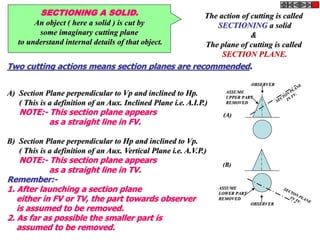
SECTIONING A SOLID.
An object ( here a solid ) is cut by
some imaginary cutting plane
to understand internal details of that object.
The action of cutting is called
SECTIONING a solid
&
The plane of cutting is called
SECTION PLANE.
Two cutting actions means section planes are recommended.
A) Section Plane perpendicular to Vp and inclined to Hp.
( This is a definition of an Aux. Inclined Plane i.e. A.I.P.)
NOTE:- This section plane appears
as a straight line in FV.
B) Section Plane perpendicular to Hp and inclined to Vp.
( This is a definition of an Aux. Vertical Plane i.e. A.V.P.)
NOTE:- This section plane appears
as a straight line in TV.
Remember:-
1. After launching a section plane
either in FV or TV, the part towards observer
is assumed to be removed.
2. As far as possible the smaller part is
assumed to be removed.
OBSERVER
ASSUME
UPPER PART
REMOVED
OBSERVER
ASSUME
LOWER PART
REMOVED
(A)
(B)
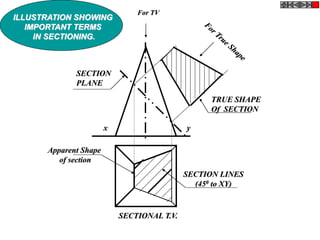
ILLUSTRATION SHOWING
IMPORTANT TERMS
IN SECTIONING.
x y
TRUE SHAPE
Of SECTION
SECTION
PLANE
SECTION LINES
(450 to XY)
Apparent Shape
of section
SECTIONAL T.V.
For TV
Section Plane
Through Apex
Section Plane
Through Generators
Section Plane Parallel
to end generator.
Section Plane
Parallel to Axis.
Triangle Ellipse
Hyperbola
Ellipse
Cylinder through
generators.
Sq. Pyramid through
all slant edges
Trapezium
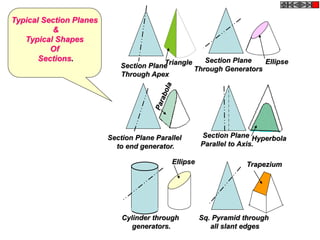
Typical Section Planes
&
Typical Shapes
Of
Sections.
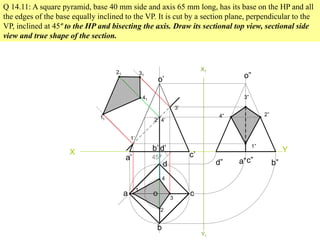
Q 14.11: A square pyramid, base 40 mm side and axis 65 mm long, has its base on the HP and all
the edges of the base equally inclined to the VP. It is cut by a section plane, perpendicular to the
VP, inclined at 45º to the HP and bisecting the axis. Draw its sectional top view, sectional side
view and true shape of the section.
X Y
45º
a
b
c
d
o
a’
b’
c’
d’
o’
1
2
3
4
1’
2’
3’
4’
11
41
21 31
X1
Y1
d” a”c” b”
o”
3”
2”4”
1”
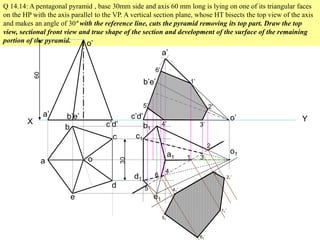
Q 14.14: A pentagonal pyramid , base 30mm side and axis 60 mm long is lying on one of its triangular faces
on the HP with the axis parallel to the VP. A vertical section plane, whose HT bisects the top view of the axis
and makes an angle of 30º with the reference line, cuts the pyramid removing its top part. Draw the top
view, sectional front view and true shape of the section and development of the surface of the remaining
portion of the pyramid.
X Y
a
b
c
d
e
o
a’ b’e’
c’d’
o’
60
30
c’d’ o’
a’
b’e’
a1
b1
c1
d1
e1
o1
1’
2’
3’4’
5’
6’
1
2
3
4
5
6 31’
41’
21’
11’
61’
51’
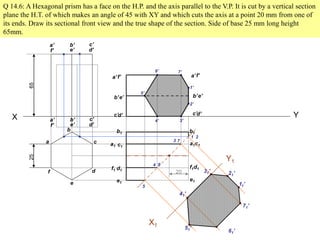
Q 14.6: A Hexagonal prism has a face on the H.P. and the axis parallel to the V.P. It is cut by a vertical section
plane the H.T. of which makes an angle of 45 with XY and which cuts the axis at a point 20 mm from one of
its ends. Draw its sectional front view and the true shape of the section. Side of base 25 mm long height
65mm.
X Y
a
b
c
d
e
f
a’ b’ c’
d’e’f’
2565
a’ b’ c’
d’e’f’
a’
b’
c’d’
e’
f’a’
b’
c’d’
e’
f’
d1
a1
b1
c1
e1
f1d1
a1
b1
c1
e1
f1
20
1’
2’
3’4’
5’
6’ 7’
1 2
3
4
5
6
7
X1
Y1
31’
41’
21’
11’
71’
61’
51’
X Y
1
2
3
4
5
6
7
8
9
10
11
12
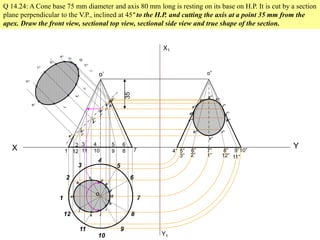
Q 14.24: A Cone base 75 mm diameter and axis 80 mm long is resting on its base on H.P. It is cut by a section
plane perpendicular to the V.P., inclined at 45º to the H.P. and cutting the axis at a point 35 mm from the
apex. Draw the front view, sectional top view, sectional side view and true shape of the section.
1
2
12
3
11
4
10
5
9
6
8 7
o
o’
35
a
b
k
c
d
l
e
f
g
h
i
j
a’
b’
k’
c’
d’
l’
e’
f’
g’
h’
i’
j’
X1
Y1
4” 5” 6” 7” 8” 9”10”
11”12”1”2”3”
o”
a”
b”
c”
d”
e”
f”
g”
h”
i”
j”
k”
l”
a
b c
d
ef
a’ b’f’ c’e’ d’
o
o’
1
2
3
4
5
6
7
1’7’
2’6’
3’5’
4’
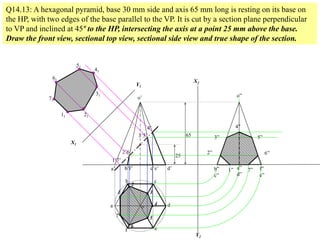
Q14.13: A hexagonal pyramid, base 30 mm side and axis 65 mm long is resting on its base on
the HP, with two edges of the base parallel to the VP. It is cut by a section plane perpendicular
to VP and inclined at 45º to the HP, intersecting the axis at a point 25 mm above the base.
Draw the front view, sectional top view, sectional side view and true shape of the section.
25
65
X1
Y1
11
71
21
61
31
51
41
X2
Y2
b”
c”
a”
d”
f”
e”
o”
1” 7”
2” 6”
3” 5”
4”
Projection of solids

Projection of solids

  • 1.
    Guided by: Tanmay sir Rinkalsir Harshal sir Presented by: Mor Manish 130940109050
  • 2.
    1. SECTIONS OFSOLIDS. 2. DEVELOPMENT. 3. INTERSECTIONS. ENGINEERING APPLICATIONS OF THE PRINCIPLES OF PROJECTIONS OF SOLIDES. STUDY CAREFULLY THE ILLUSTRATIONS GIVEN ON NEXT SIX PAGES !
  • 3.
    SECTIONING A SOLID. Anobject ( here a solid ) is cut by some imaginary cutting plane to understand internal details of that object. The action of cutting is called SECTIONING a solid & The plane of cutting is called SECTION PLANE. Two cutting actions means section planes are recommended. A) Section Plane perpendicular to Vp and inclined to Hp. ( This is a definition of an Aux. Inclined Plane i.e. A.I.P.) NOTE:- This section plane appears as a straight line in FV. B) Section Plane perpendicular to Hp and inclined to Vp. ( This is a definition of an Aux. Vertical Plane i.e. A.V.P.) NOTE:- This section plane appears as a straight line in TV. Remember:- 1. After launching a section plane either in FV or TV, the part towards observer is assumed to be removed. 2. As far as possible the smaller part is assumed to be removed. OBSERVER ASSUME UPPER PART REMOVED OBSERVER ASSUME LOWER PART REMOVED (A) (B)
  • 4.
    ILLUSTRATION SHOWING IMPORTANT TERMS INSECTIONING. x y TRUE SHAPE Of SECTION SECTION PLANE SECTION LINES (450 to XY) Apparent Shape of section SECTIONAL T.V. For TV
  • 5.
    Section Plane Through Apex SectionPlane Through Generators Section Plane Parallel to end generator. Section Plane Parallel to Axis. Triangle Ellipse Hyperbola Ellipse Cylinder through generators. Sq. Pyramid through all slant edges Trapezium Typical Section Planes & Typical Shapes Of Sections.
  • 6.
    Q 14.11: Asquare pyramid, base 40 mm side and axis 65 mm long, has its base on the HP and all the edges of the base equally inclined to the VP. It is cut by a section plane, perpendicular to the VP, inclined at 45º to the HP and bisecting the axis. Draw its sectional top view, sectional side view and true shape of the section. X Y 45º a b c d o a’ b’ c’ d’ o’ 1 2 3 4 1’ 2’ 3’ 4’ 11 41 21 31 X1 Y1 d” a”c” b” o” 3” 2”4” 1”
  • 7.
    Q 14.14: Apentagonal pyramid , base 30mm side and axis 60 mm long is lying on one of its triangular faces on the HP with the axis parallel to the VP. A vertical section plane, whose HT bisects the top view of the axis and makes an angle of 30º with the reference line, cuts the pyramid removing its top part. Draw the top view, sectional front view and true shape of the section and development of the surface of the remaining portion of the pyramid. X Y a b c d e o a’ b’e’ c’d’ o’ 60 30 c’d’ o’ a’ b’e’ a1 b1 c1 d1 e1 o1 1’ 2’ 3’4’ 5’ 6’ 1 2 3 4 5 6 31’ 41’ 21’ 11’ 61’ 51’
  • 8.
    Q 14.6: AHexagonal prism has a face on the H.P. and the axis parallel to the V.P. It is cut by a vertical section plane the H.T. of which makes an angle of 45 with XY and which cuts the axis at a point 20 mm from one of its ends. Draw its sectional front view and the true shape of the section. Side of base 25 mm long height 65mm. X Y a b c d e f a’ b’ c’ d’e’f’ 2565 a’ b’ c’ d’e’f’ a’ b’ c’d’ e’ f’a’ b’ c’d’ e’ f’ d1 a1 b1 c1 e1 f1d1 a1 b1 c1 e1 f1 20 1’ 2’ 3’4’ 5’ 6’ 7’ 1 2 3 4 5 6 7 X1 Y1 31’ 41’ 21’ 11’ 71’ 61’ 51’
  • 9.
    X Y 1 2 3 4 5 6 7 8 9 10 11 12 Q 14.24:A Cone base 75 mm diameter and axis 80 mm long is resting on its base on H.P. It is cut by a section plane perpendicular to the V.P., inclined at 45º to the H.P. and cutting the axis at a point 35 mm from the apex. Draw the front view, sectional top view, sectional side view and true shape of the section. 1 2 12 3 11 4 10 5 9 6 8 7 o o’ 35 a b k c d l e f g h i j a’ b’ k’ c’ d’ l’ e’ f’ g’ h’ i’ j’ X1 Y1 4” 5” 6” 7” 8” 9”10” 11”12”1”2”3” o” a” b” c” d” e” f” g” h” i” j” k” l”
  • 10.
    a b c d ef a’ b’f’c’e’ d’ o o’ 1 2 3 4 5 6 7 1’7’ 2’6’ 3’5’ 4’ Q14.13: A hexagonal pyramid, base 30 mm side and axis 65 mm long is resting on its base on the HP, with two edges of the base parallel to the VP. It is cut by a section plane perpendicular to VP and inclined at 45º to the HP, intersecting the axis at a point 25 mm above the base. Draw the front view, sectional top view, sectional side view and true shape of the section. 25 65 X1 Y1 11 71 21 61 31 51 41 X2 Y2 b” c” a” d” f” e” o” 1” 7” 2” 6” 3” 5” 4”