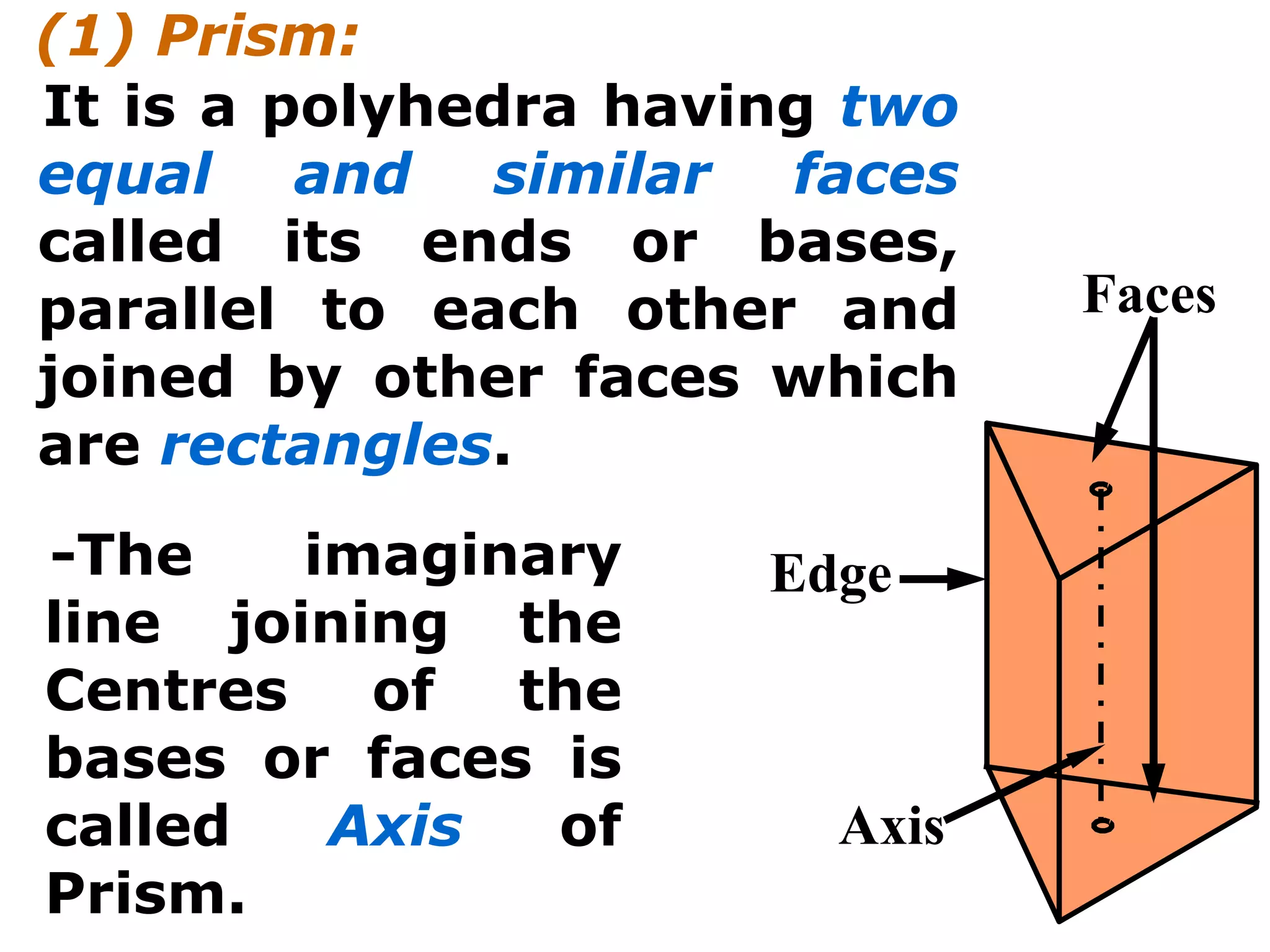
(1) Prism:
It is a polyhedra having two
equal and similar faces
called its ends or bases,
parallel to each other and     Faces
joined by other faces which
are rectangles.
-The    imaginary     Edge
line joining the
Centres of the
bases or faces is
called   Axis  of       Axis
Prism.
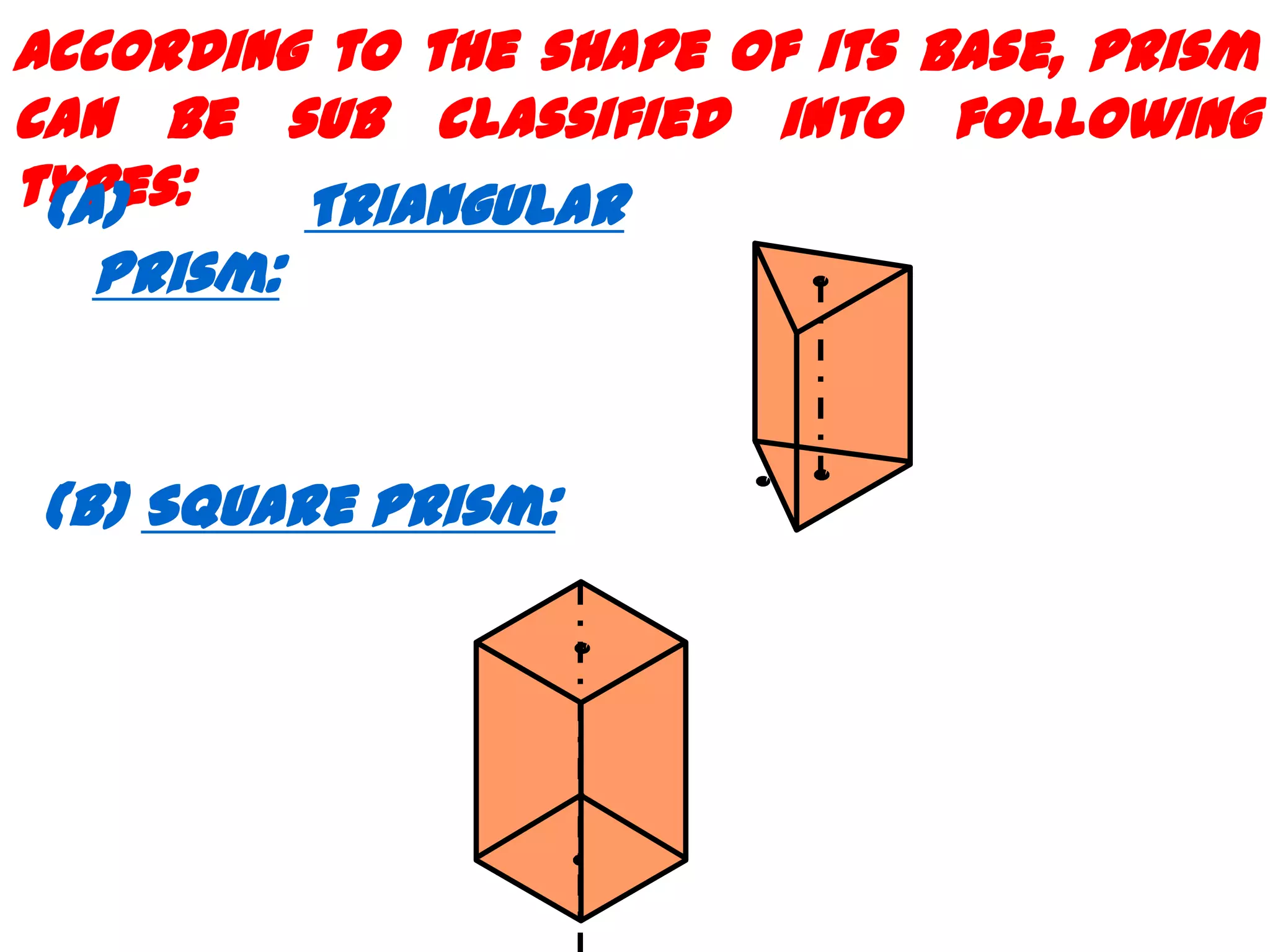
According to the shape of its base, prism
can be sub classified into following
types:
 (a)      Triangular
   Prism:


(b) Square Prism:
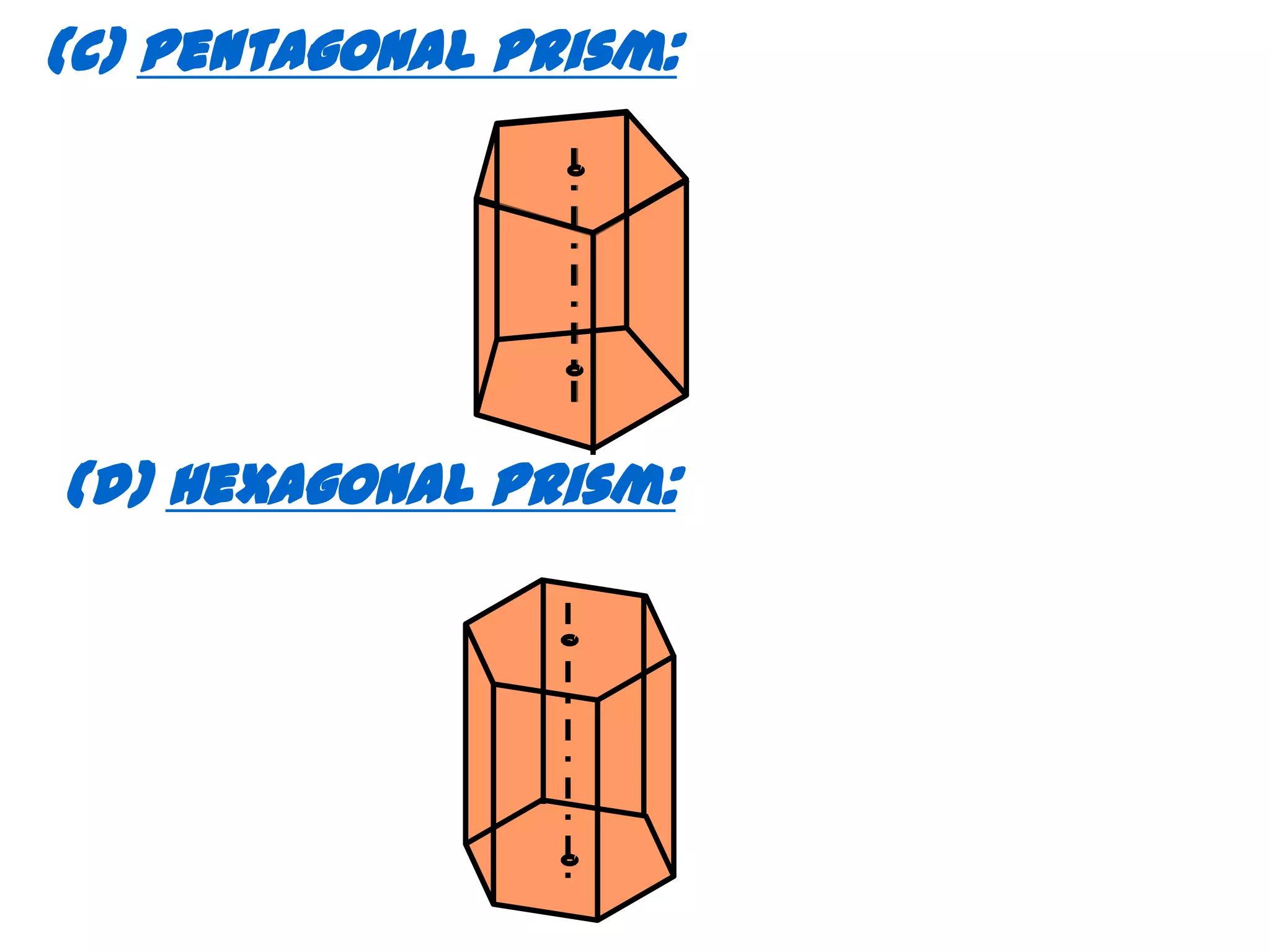
(c) Pentagonal Prism:


(d) Hexagonal Prism:
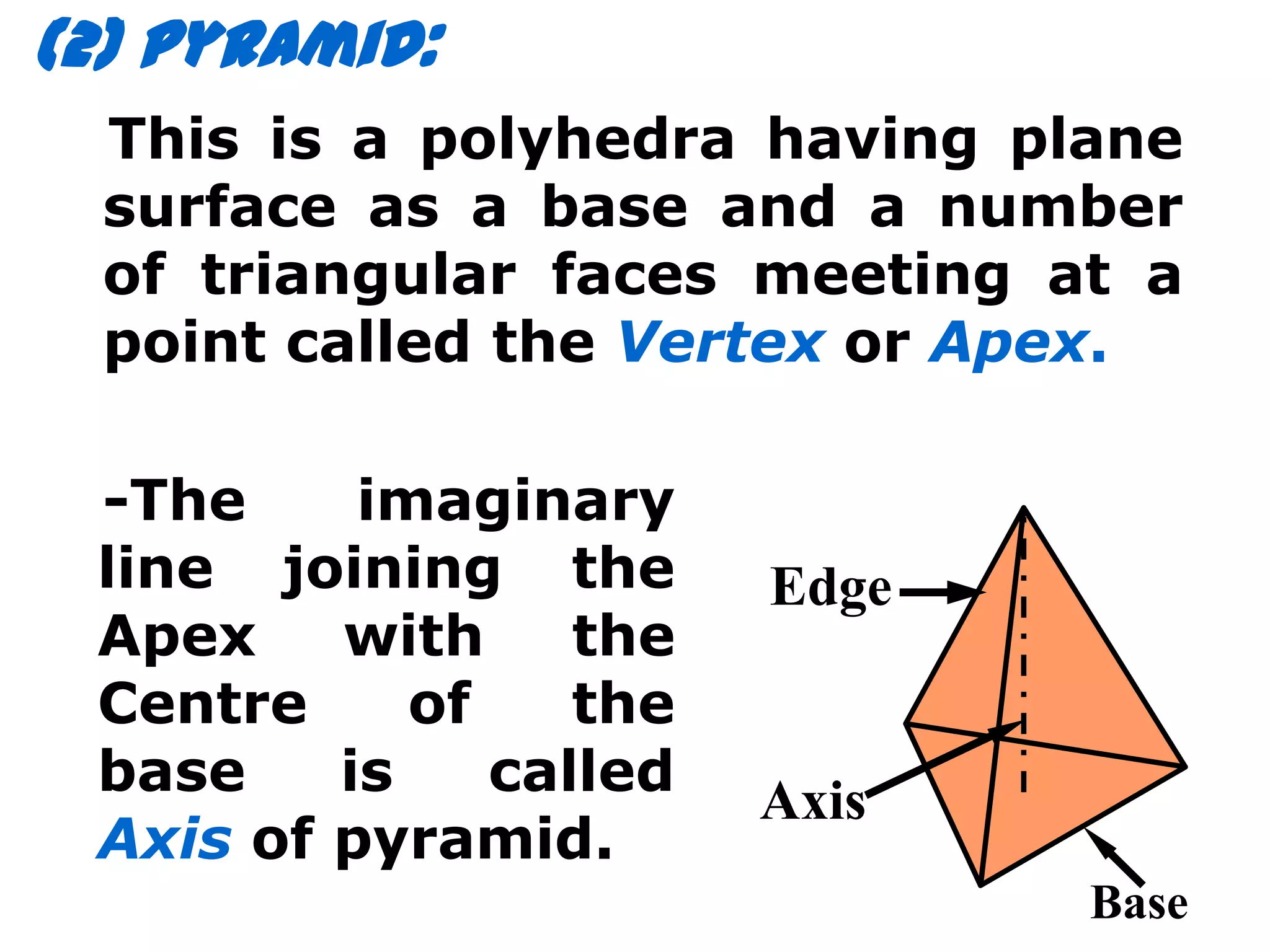
(2) Pyramid:
  This is a polyhedra having plane
  surface as a base and a number
  of triangular faces meeting at a
  point called the Vertex or Apex.

 -The     imaginary
 line joining the       Edge
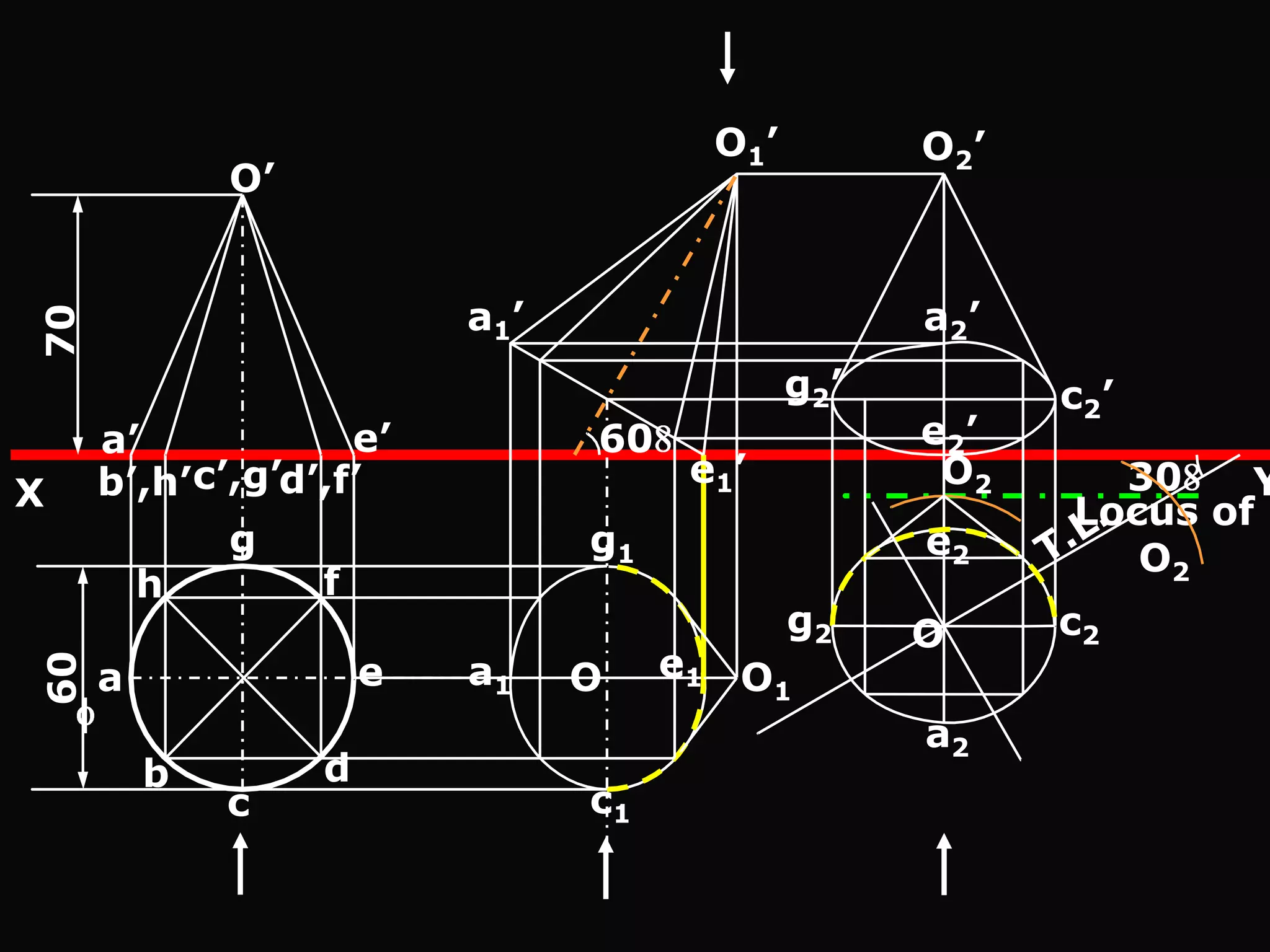
 Apex    with     the
 Centre     of    the
 base    is    called   Axis
 Axis of pyramid.
                               Base
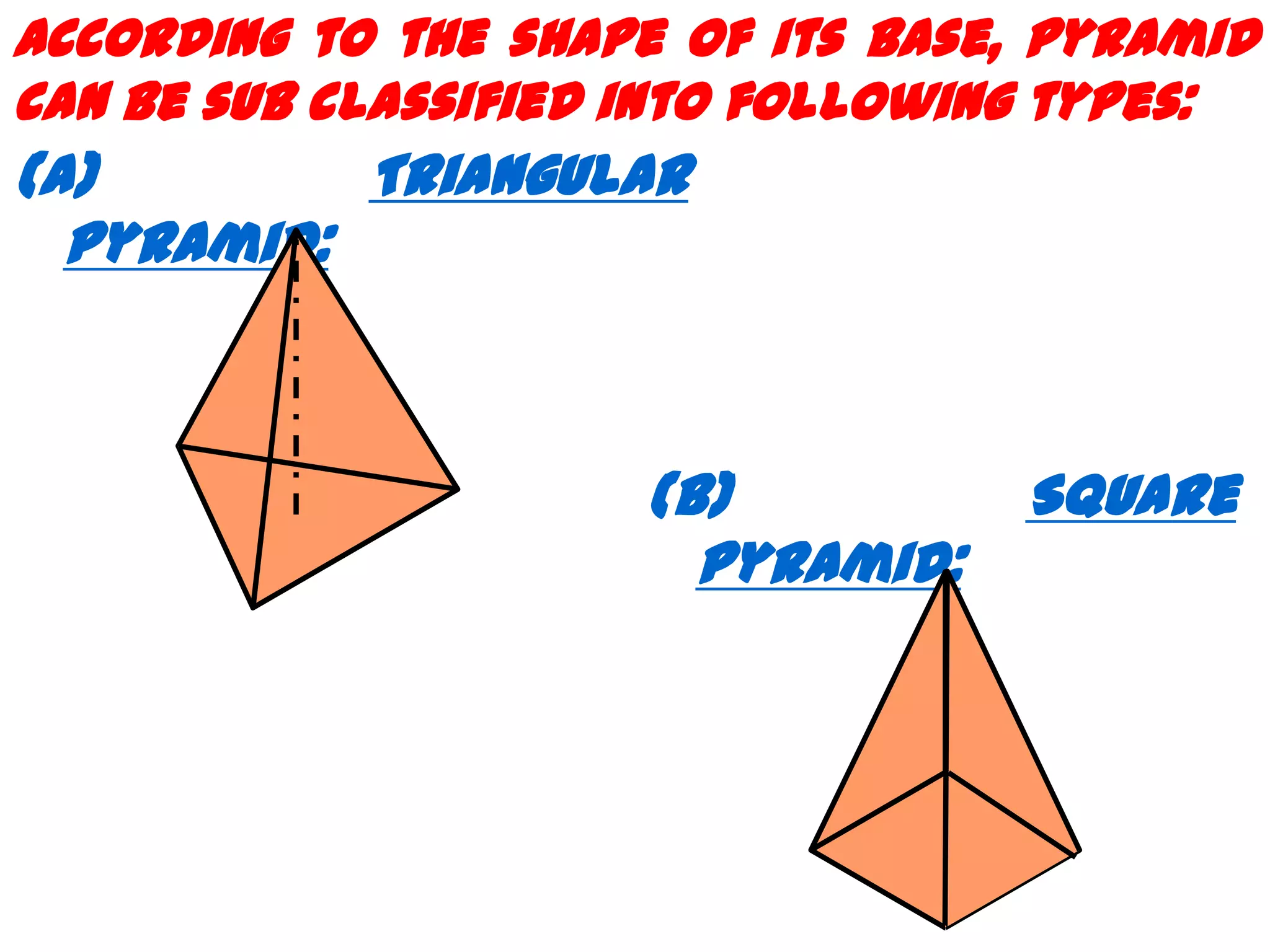
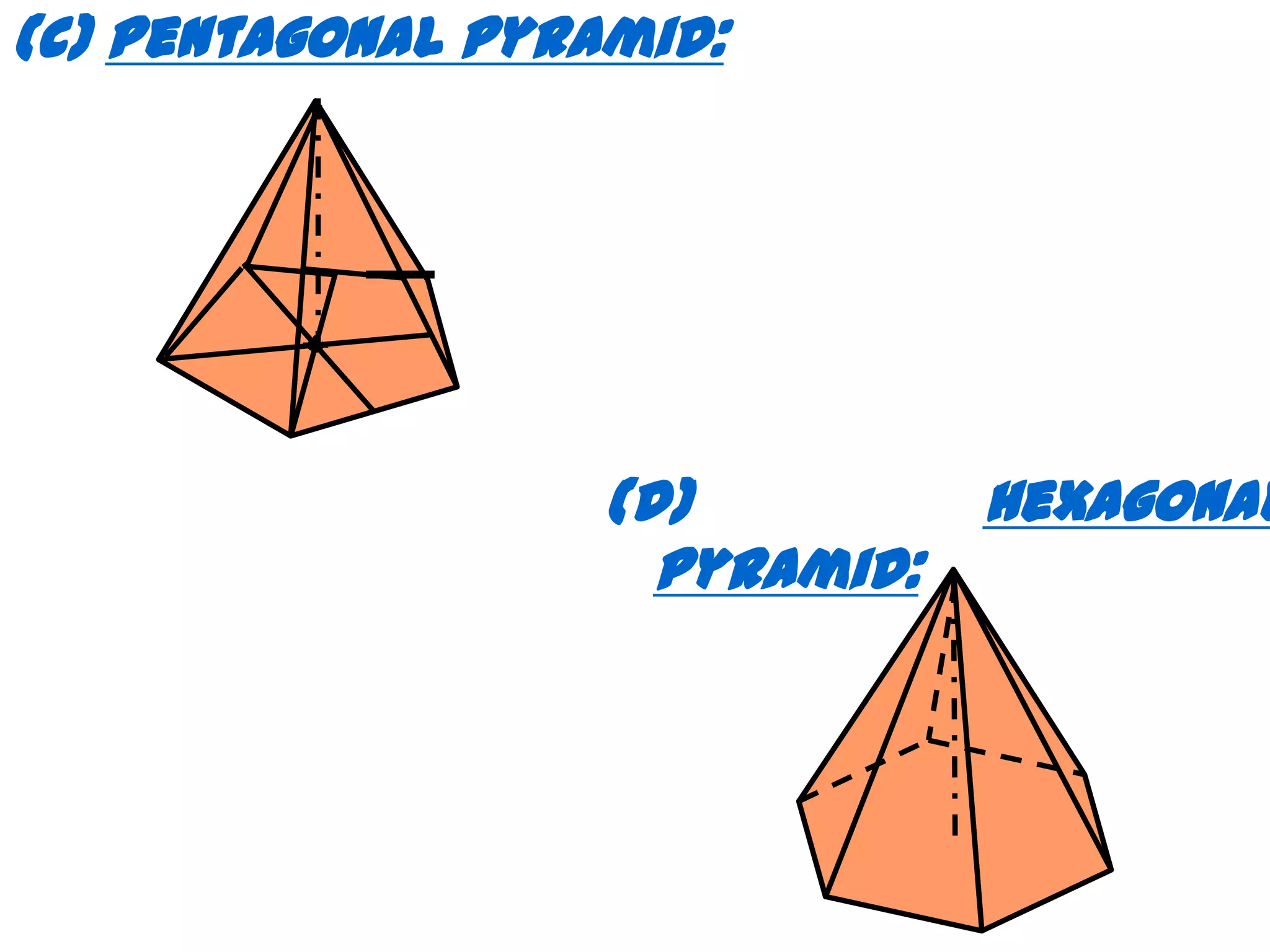
According to the shape of its base, pyramid
can be sub classified into following types:
(a)        Triangular
  Pyramid:


                     (b)          Square
                       Pyramid:
(c) Pentagonal Pyramid:


                   (d)          Hexagonal
                     Pyramid:
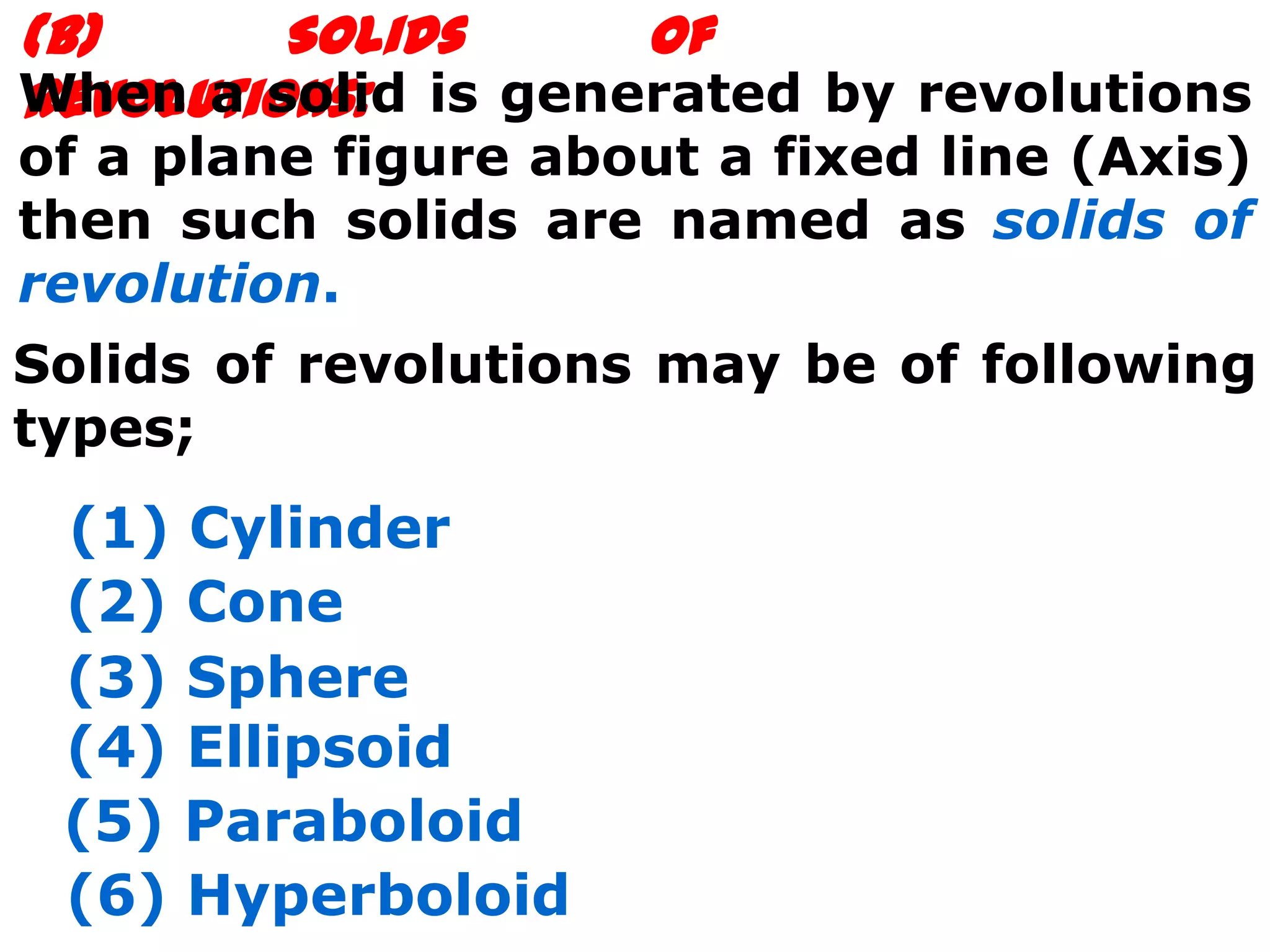
(B)      Solids     of
When a solid is generated by revolutions
Revolutions:
of a plane figure about a fixed line (Axis)
then such solids are named as solids of
revolution.
Solids of revolutions may be of following
types;
 (1) Cylinder
 (2) Cone
 (3) Sphere
 (4) Ellipsoid
 (5) Paraboloid
 (6) Hyperboloid
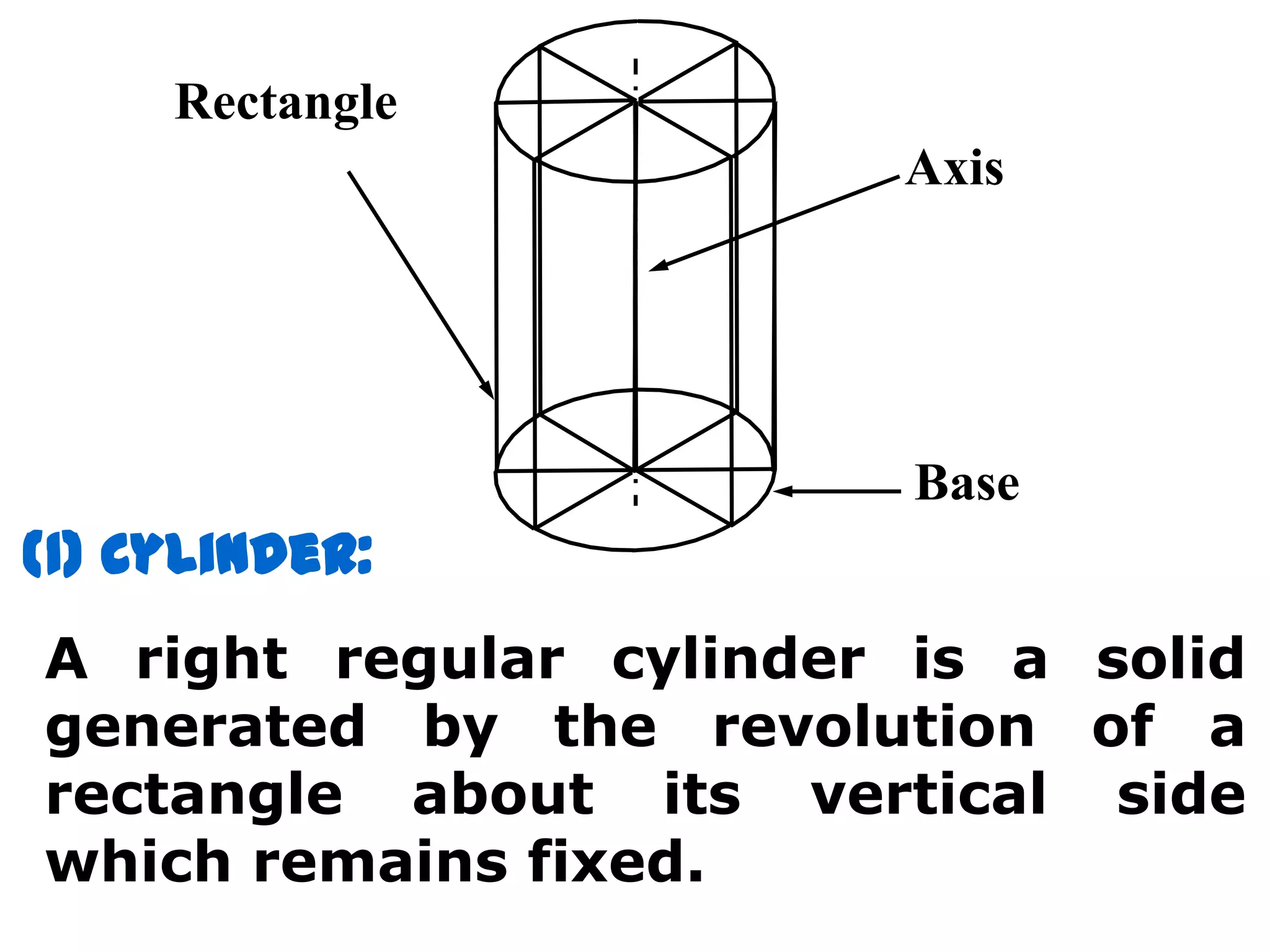
Rectangle
                         Axis


                         Base
(1) Cylinder:
A right regular cylinder is a solid
generated by the revolution of a
rectangle about its vertical side
which remains fixed.
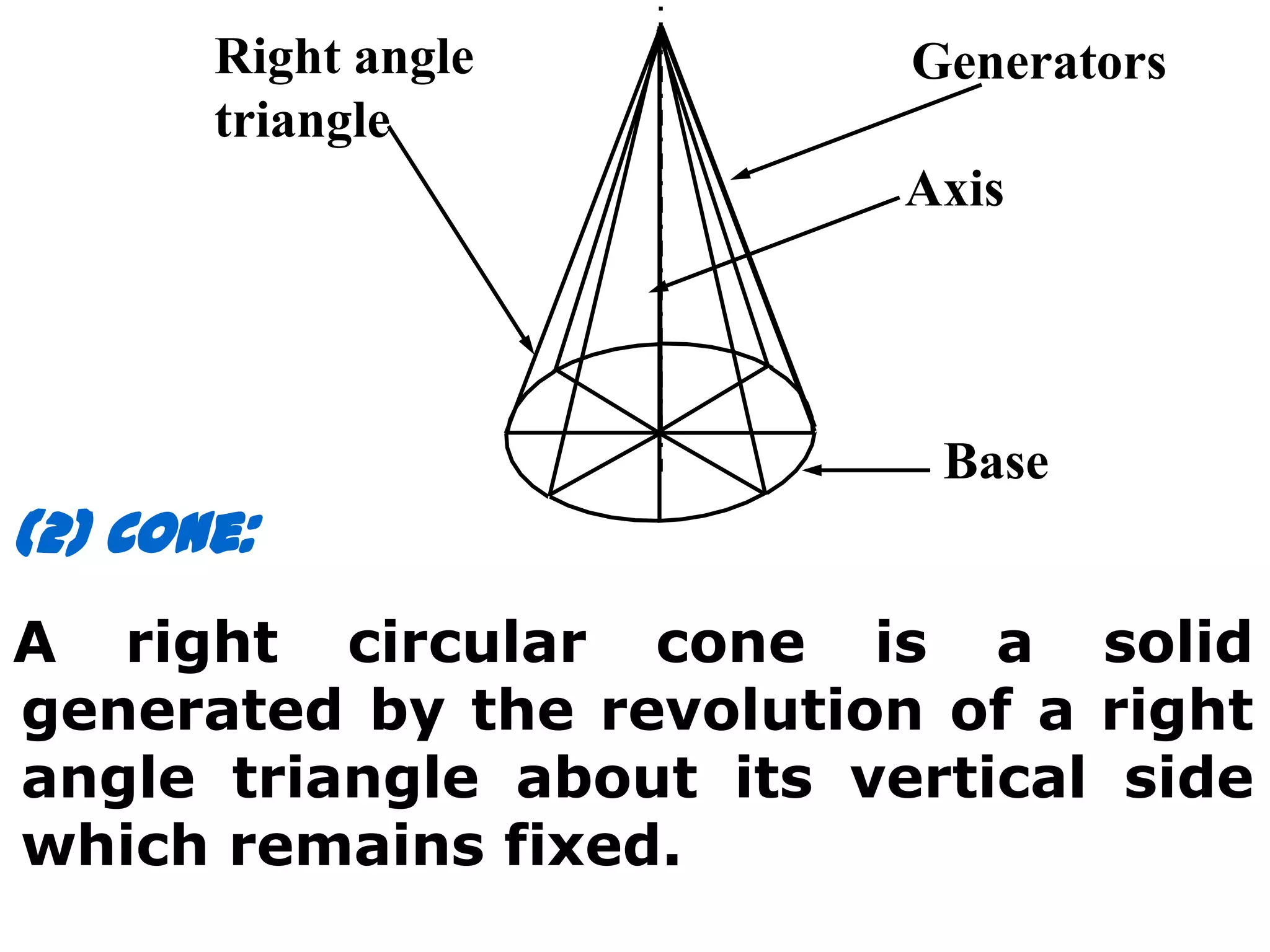
Right angle         Generators
       triangle
                           Axis


                            Base
(2) Cone:
A right circular cone is a solid
generated by the revolution of a right
angle triangle about its vertical side
which remains fixed.
Important Terms Used in Projections of
Solids:
(1)    Edge       or
  generator:
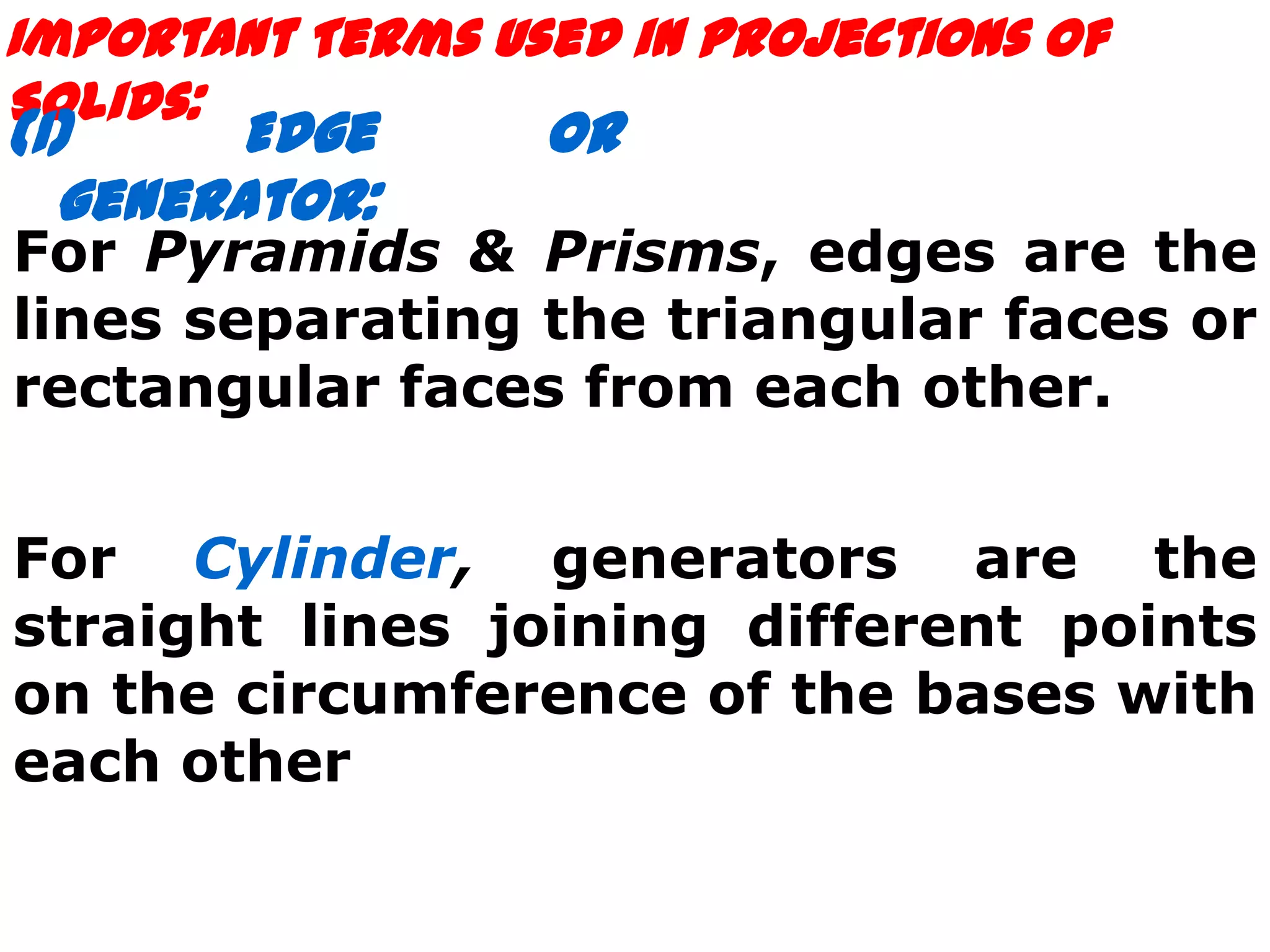
For Pyramids & Prisms, edges are the
lines separating the triangular faces or
rectangular faces from each other.


For Cylinder, generators are the
straight lines joining different points
on the circumference of the bases with
each other
Important Terms Used in Projections of
Solids:
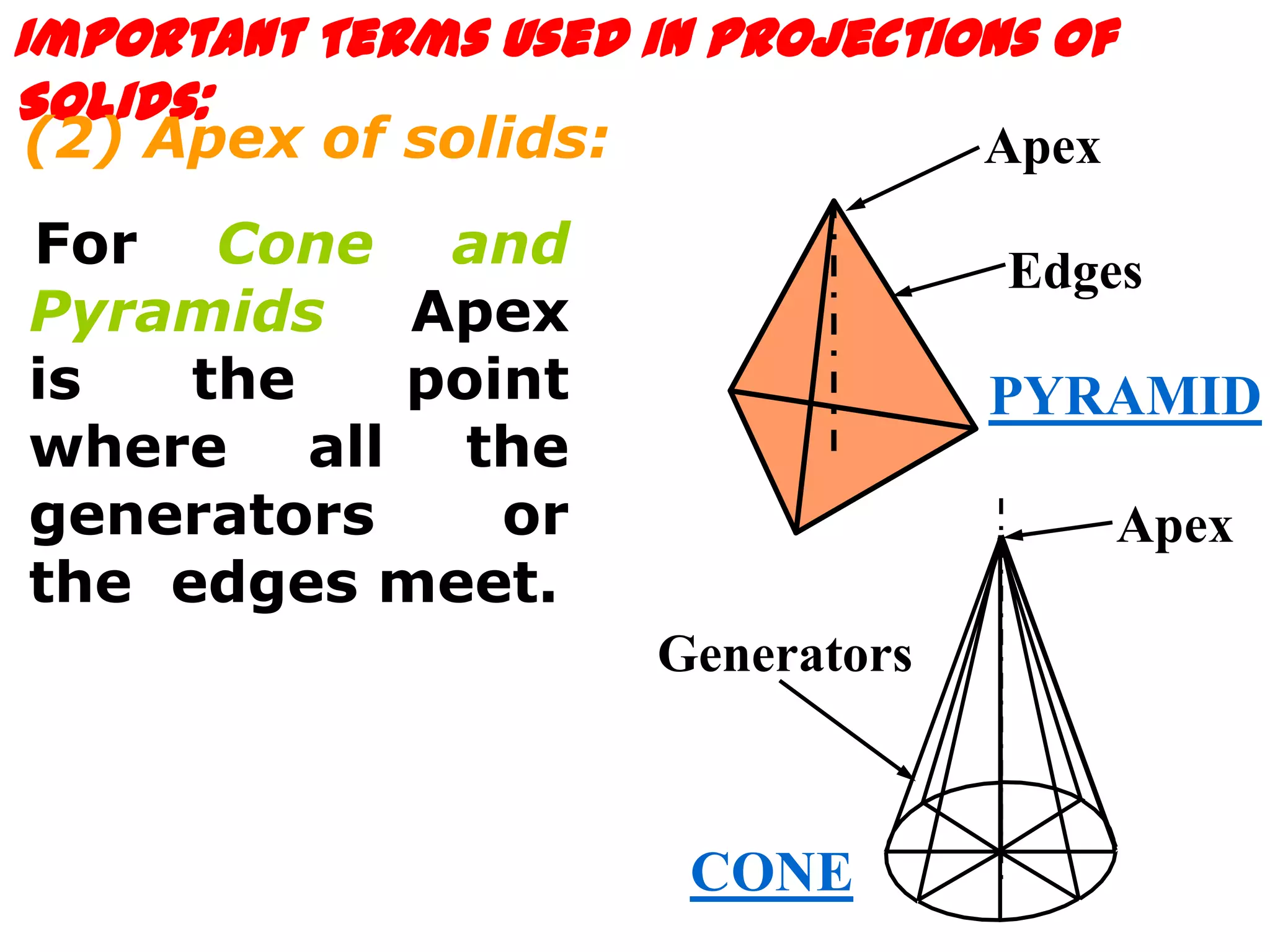
 (2) Apex of solids:             Apex
For Cone and                       Edges
Pyramids, Apex
is   the   point                   PYRAMID
where all the
generators    or                         Apex
the edges meet.
                      Generators


                       CONE
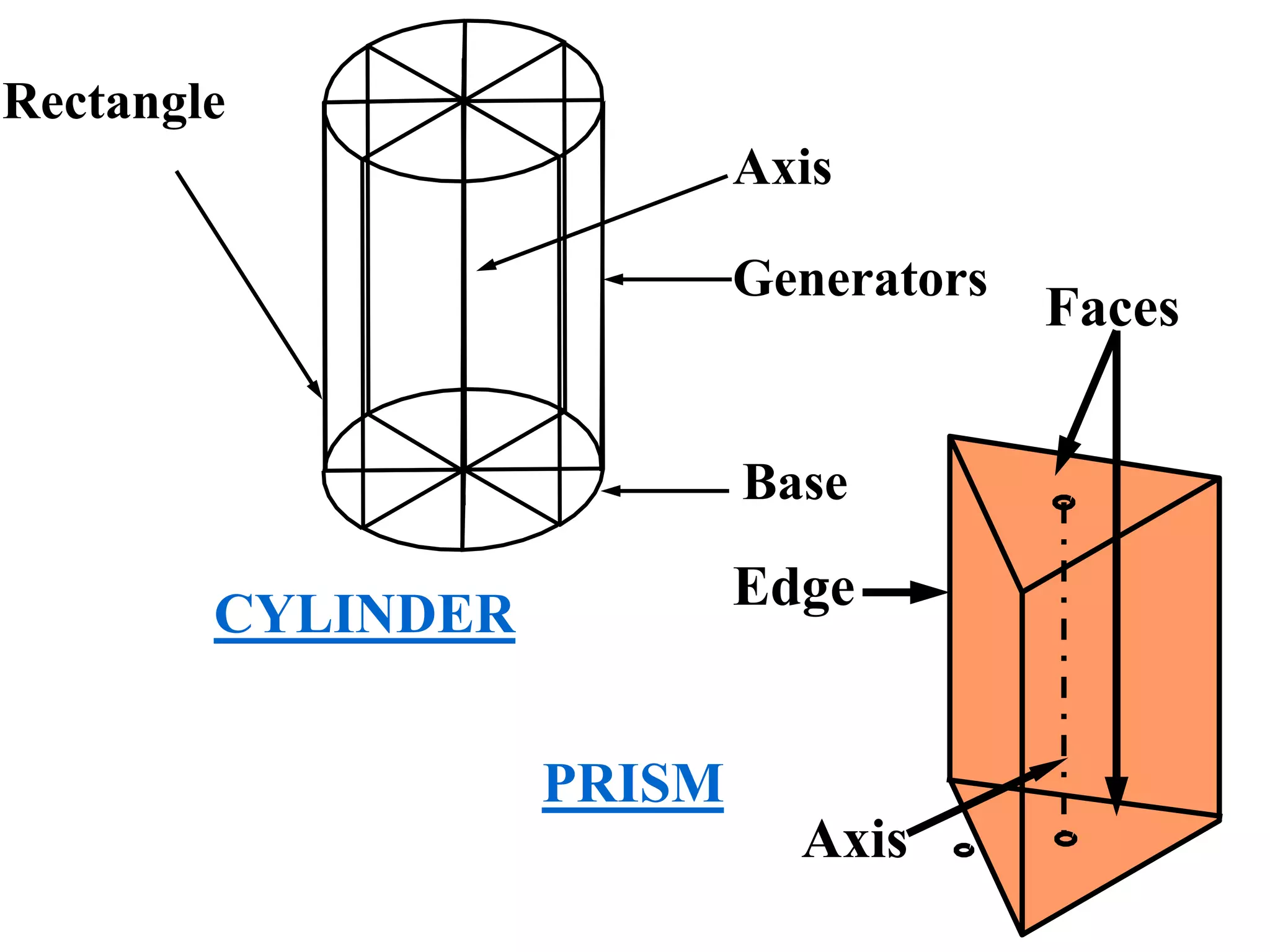
Rectangle
                           Axis

                           Generators
                                        Faces


                           Base

        CYLINDER           Edge


                   PRISM
                             Axis
Important Terms Used in Projections of
Solids:
(3) Axis of Solid:

  For Cone and Pyramids, Axis is an
  imaginary line joining centre of
  the base to the Apex.

  For Cylinder and Prism, Axis is an
  imaginary line joining centres of
  ends or bases.
Important Terms Used in Projections of
Solids:
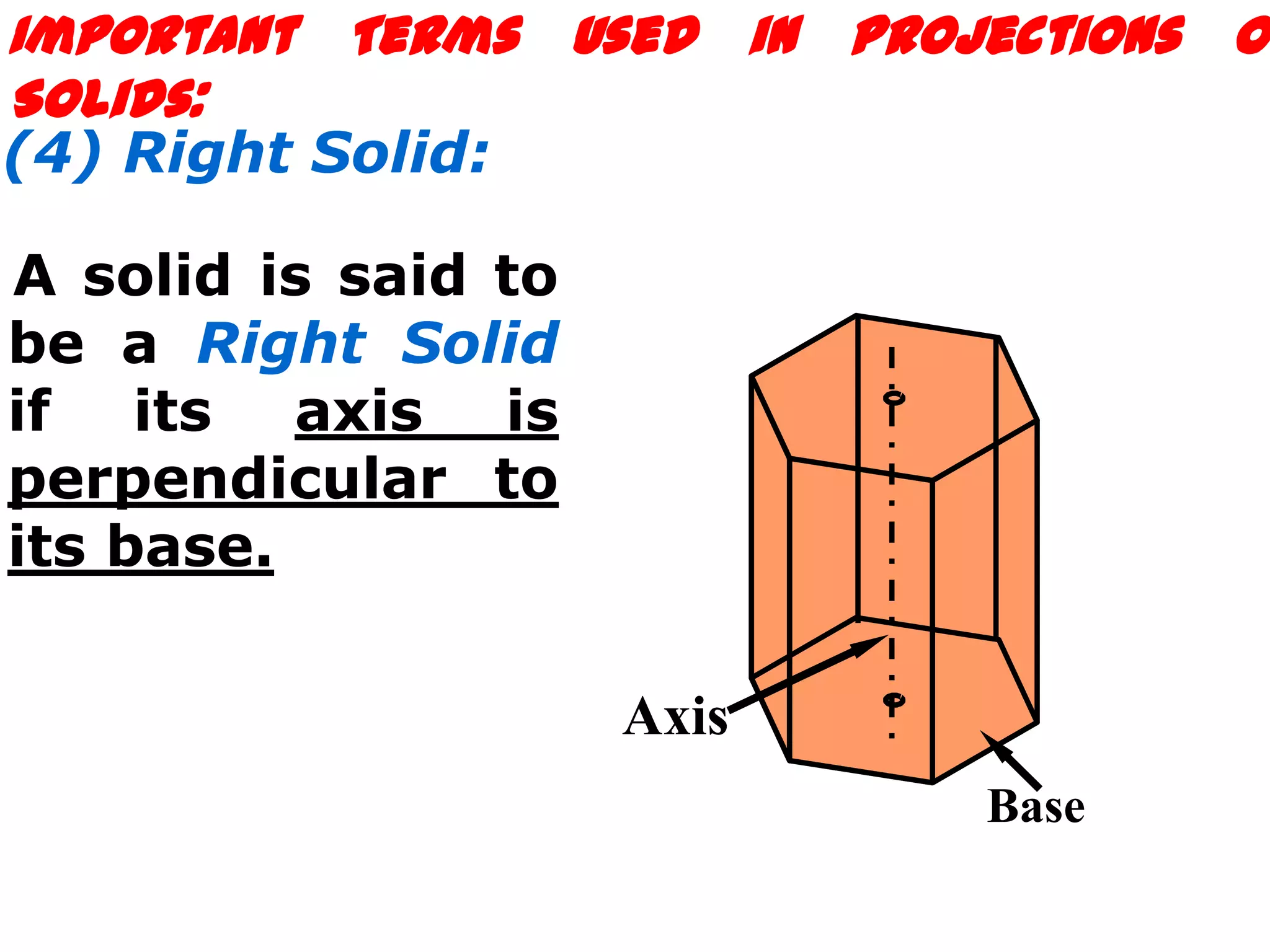
(4) Right Solid:

A solid is said to
be a Right Solid
if its axis is
perpendicular to
its base.

                     Axis
                            Base
Important Terms Used in Projections o
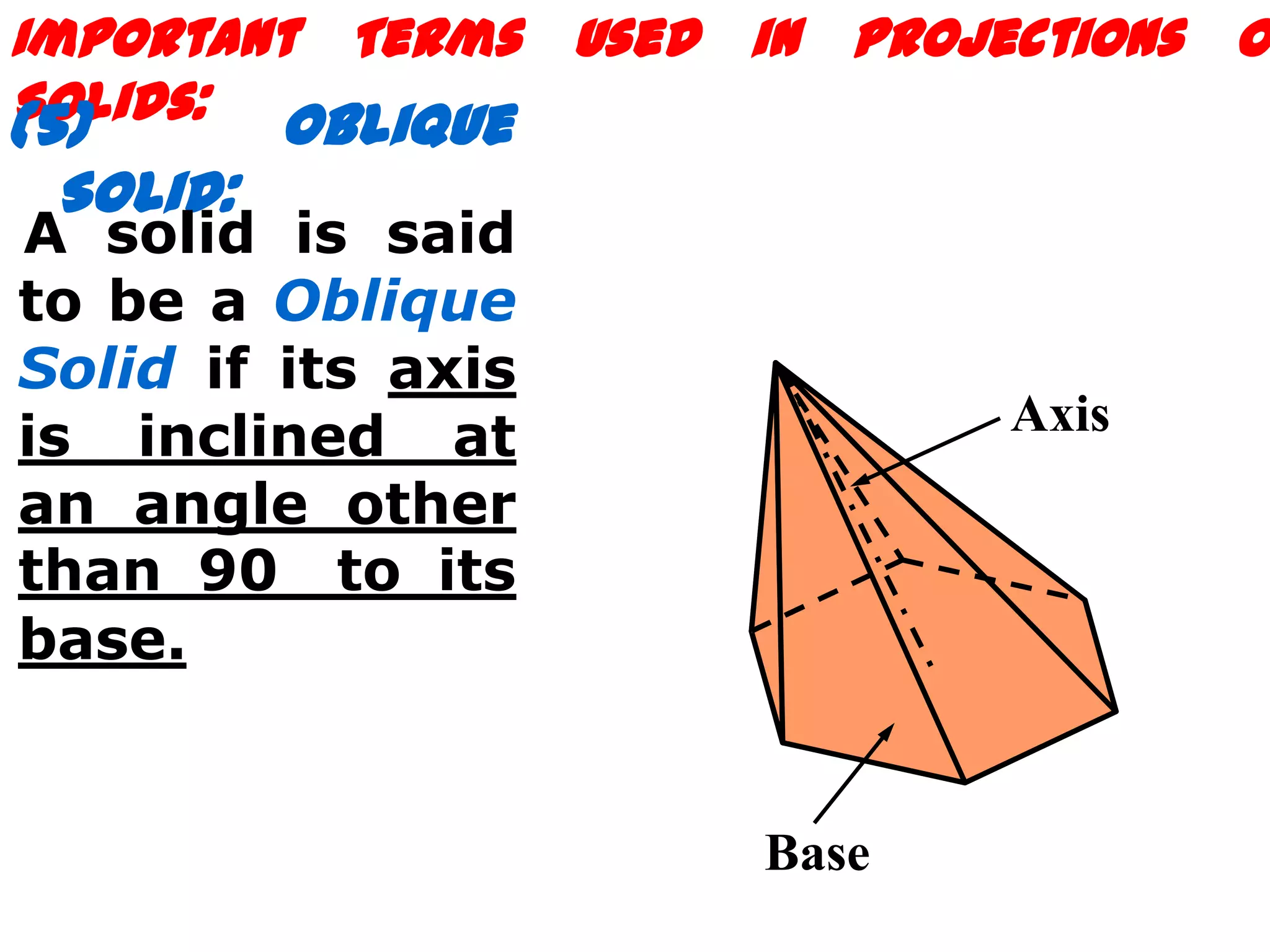
Solids: Oblique
(5)
 Solid:
A solid is said
to be a Oblique
Solid if its axis
is inclined at               Axis
an angle other
than 90 to its
base.


                      Base
Important Terms Used in Projections
of Solids:

(6) Regular Solid:
  A solid is said to be a Regular Solid if
  all the edges of the base or the end
  faces of a solid are equal in length and
  form regular plane figures
Important Terms Used in Projections
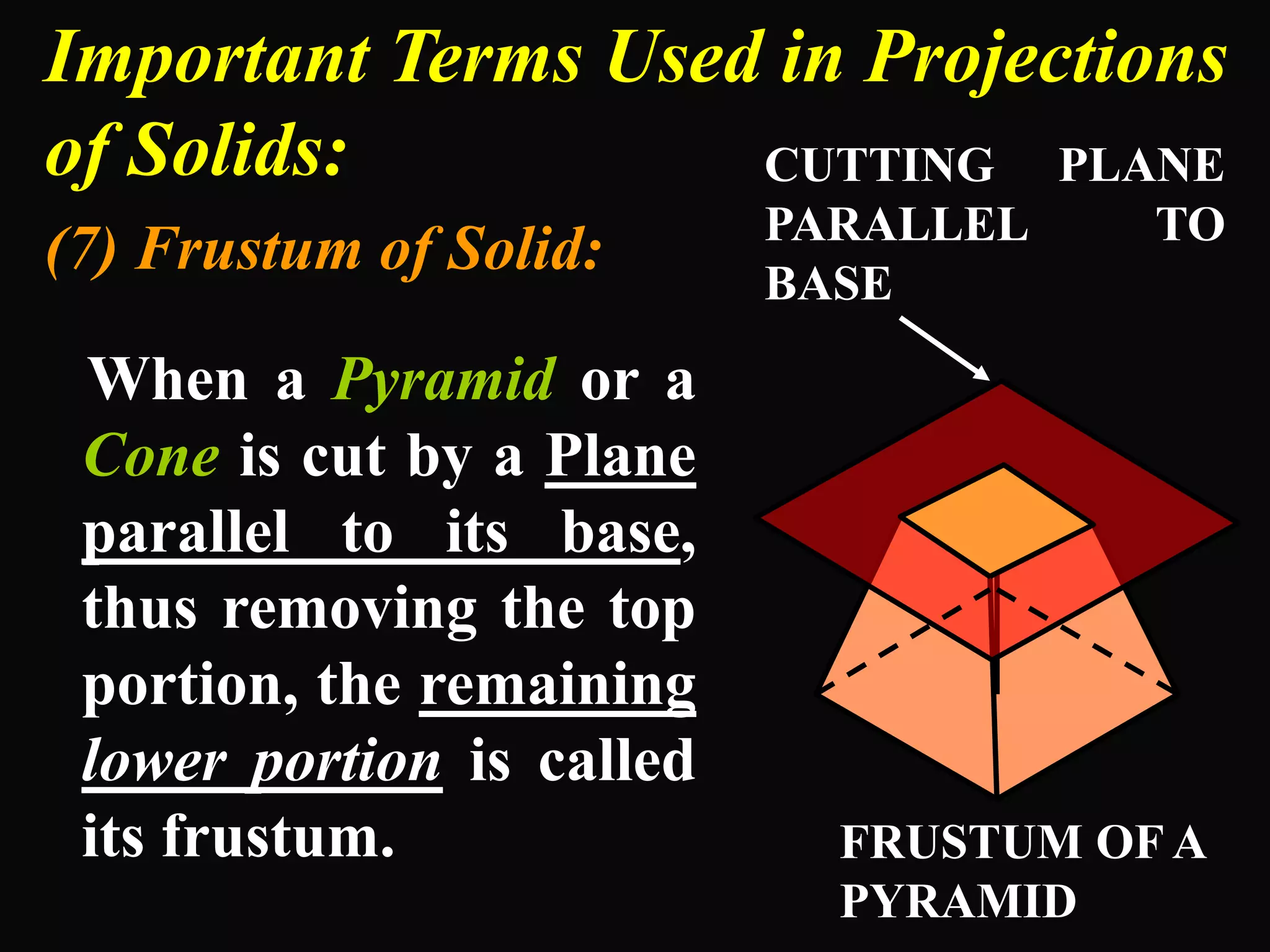
of Solids:          CUTTING PLANE
                           PARALLEL    TO
(7) Frustum of Solid:      BASE

 When a Pyramid or a
 Cone is cut by a Plane
 parallel to its base,
 thus removing the top
 portion, the remaining
 lower portion is called
 its frustum.                FRUSTUM OF A
                             PYRAMID
Important Terms Used in Projections
of Solids:
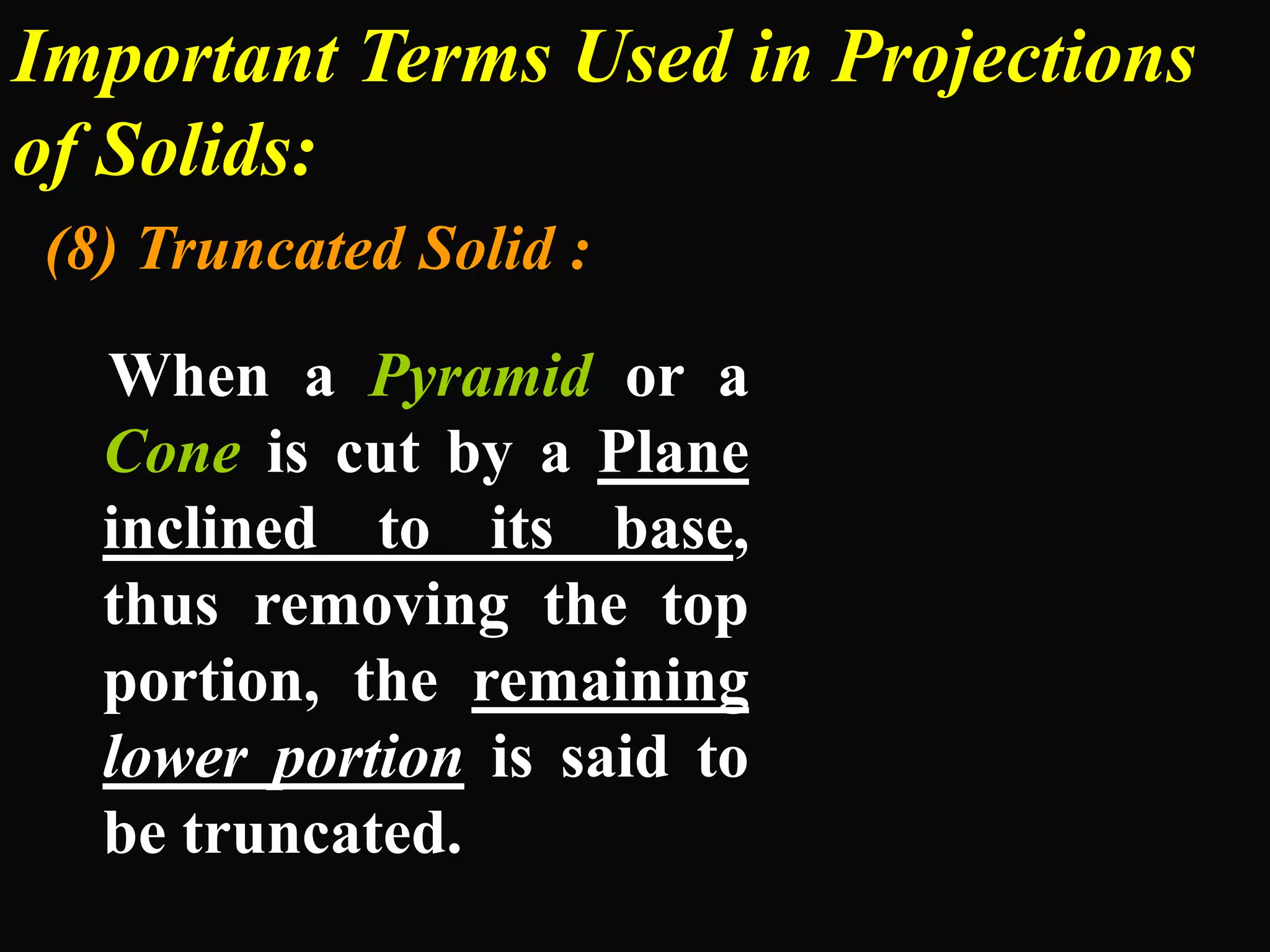
(8) Truncated Solid :

  When a Pyramid or a
  Cone is cut by a Plane
  inclined to its base,
  thus removing the top
  portion, the remaining
  lower portion is said to
  be truncated.
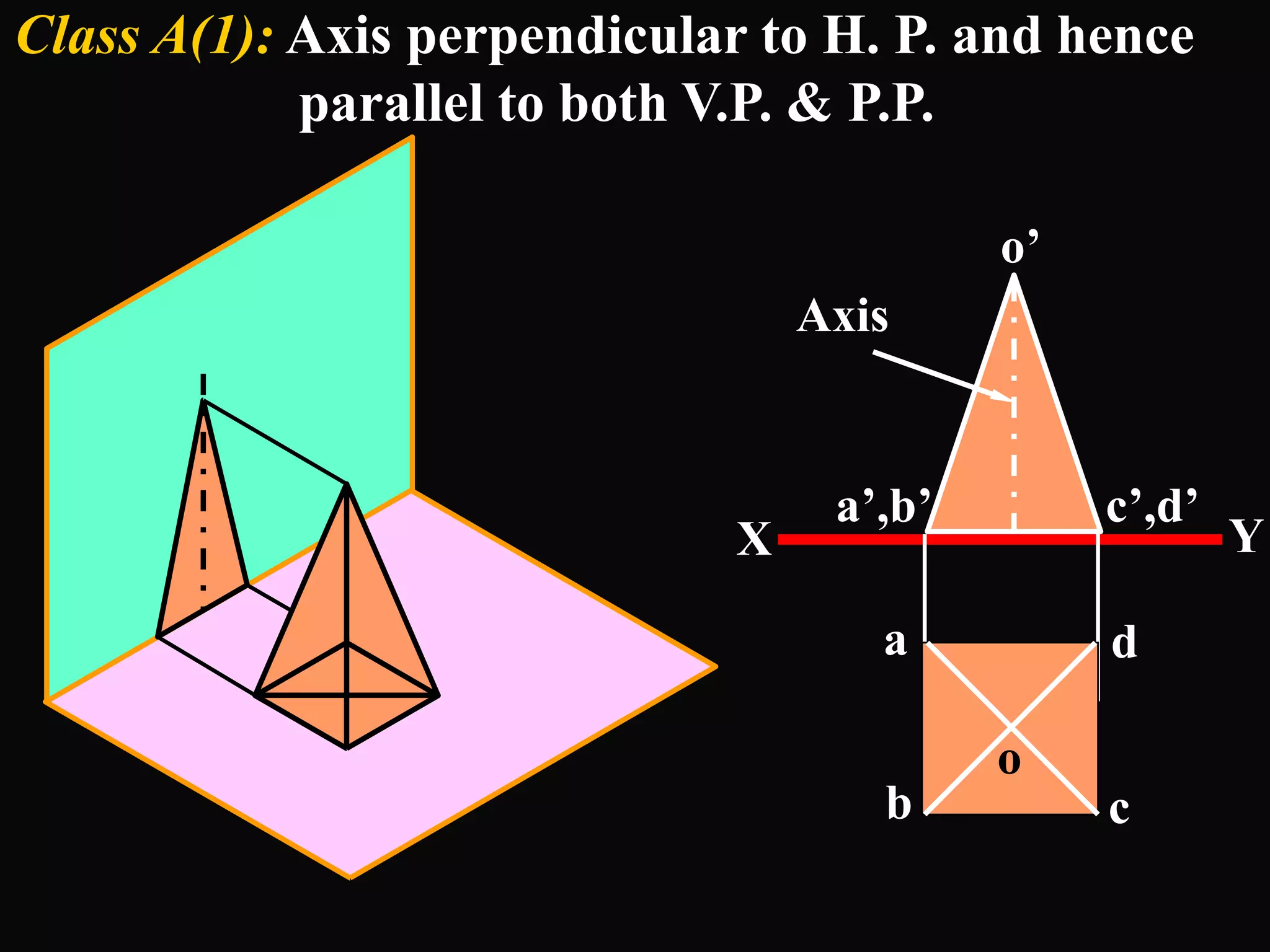
Class A(1): Axis perpendicular to H. P. and hence
            parallel to both V.P. & P.P.

                                          o’
                                 Axis


                                  a’,b’        c’,d’
                             X                         Y

                                    a          d

                                          o
                                    b          c
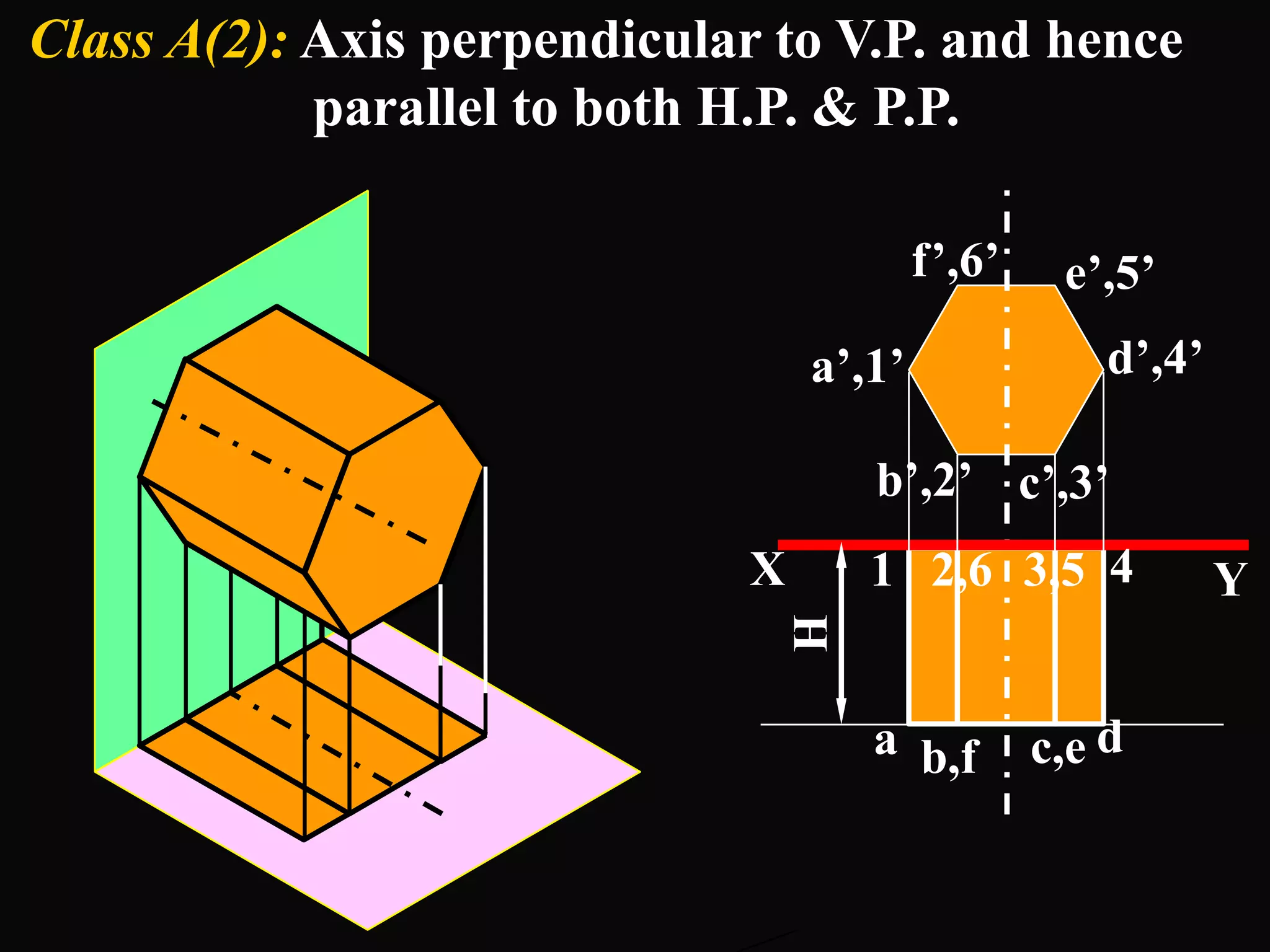
Class A(2): Axis perpendicular to V.P. and hence
            parallel to both H.P. & P.P.

                                         f’,6’    e’,5’
                                 a’,1’               d’,4’

                                     b’,2’ c’,3’
                             X       1 2,6 3,5 4             Y


                                 H
                                     a b,f       c,e d
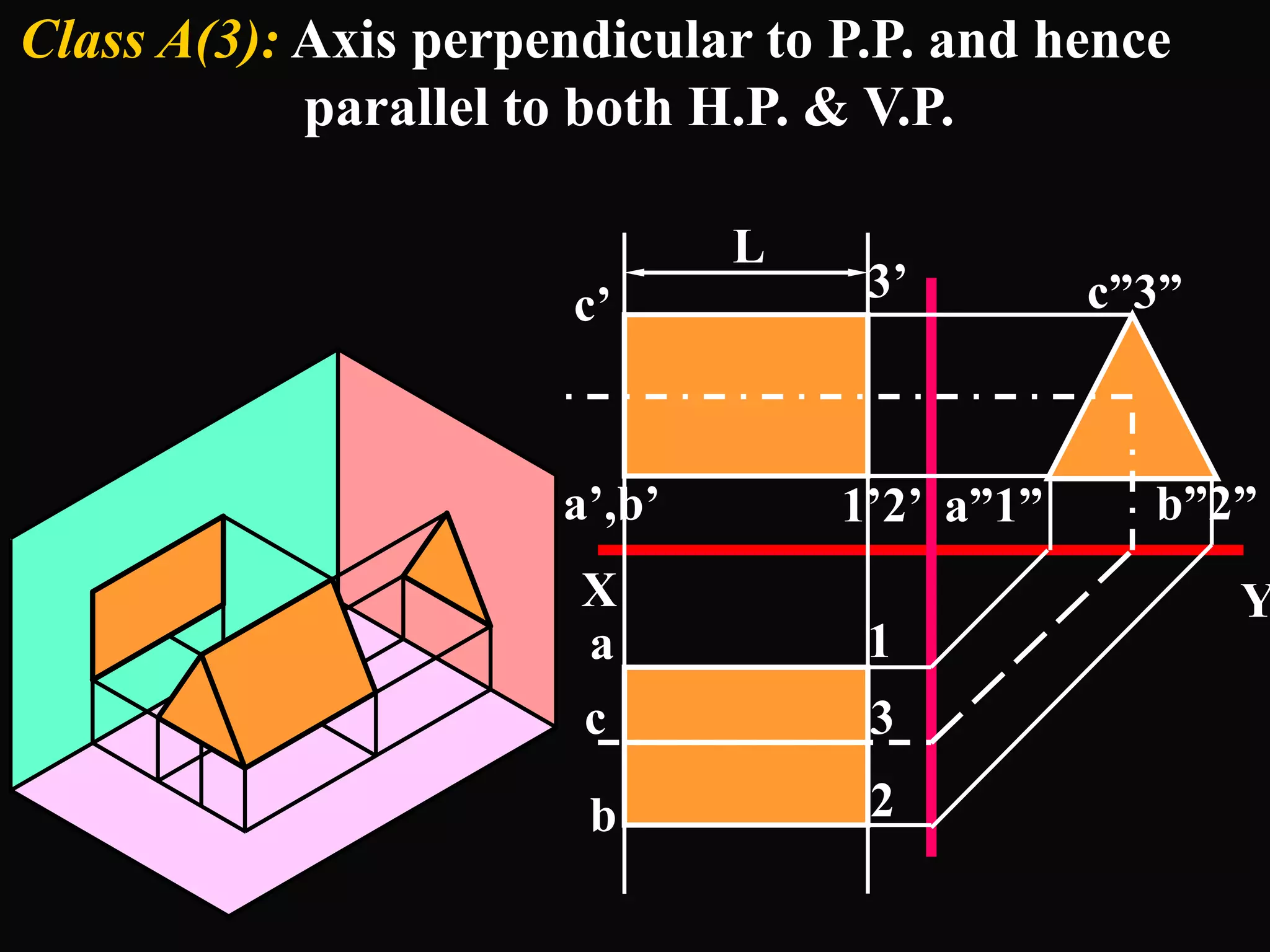
Class A(3): Axis perpendicular to P.P. and hence
            parallel to both H.P. & V.P.

                              L
                       c’          3’         c”3”


                      a’,b’       1’2’ a”1”     b”2”
                       X                             Y
                       a           1
                       c           3
                       b           2
Class B(1): Axis parallel to V.P. and inclined to
            H.P. by θ & also inclined to P.P.
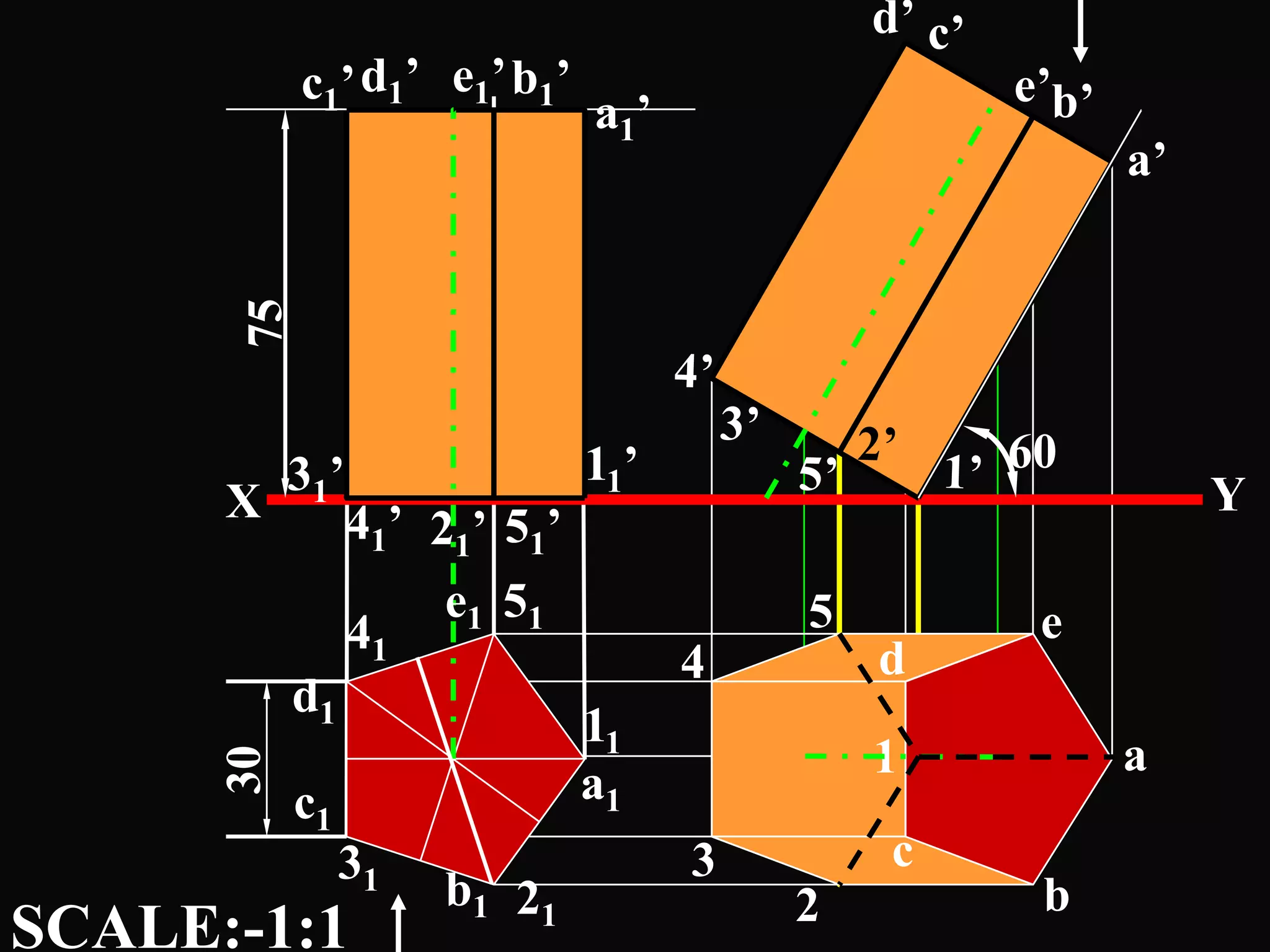
  Exercise 1 :
 A right regular pentagonal prism,
 side of base 30 mm and height of
 axis as 75mm rests on HP on one
 of its base corners such that its
 long edge containing the corner is
 inclined to the HP at 60 . Draw its
 projections.
d’ c’
            c1’ d1’ e1’ b1’                           e’b’
                                a1’
                                                             a’

       75


           3 1’                 11’                   60
      X                                                           Y
                  41’ 21’ 51’
                       e1 51              5            e
                  41
                                      4       d
            d1
                                11
                                              1              a
      30


            c1                  a1
                 31                   3        c
                       b1 2 1             2            b
SCALE:-1:1
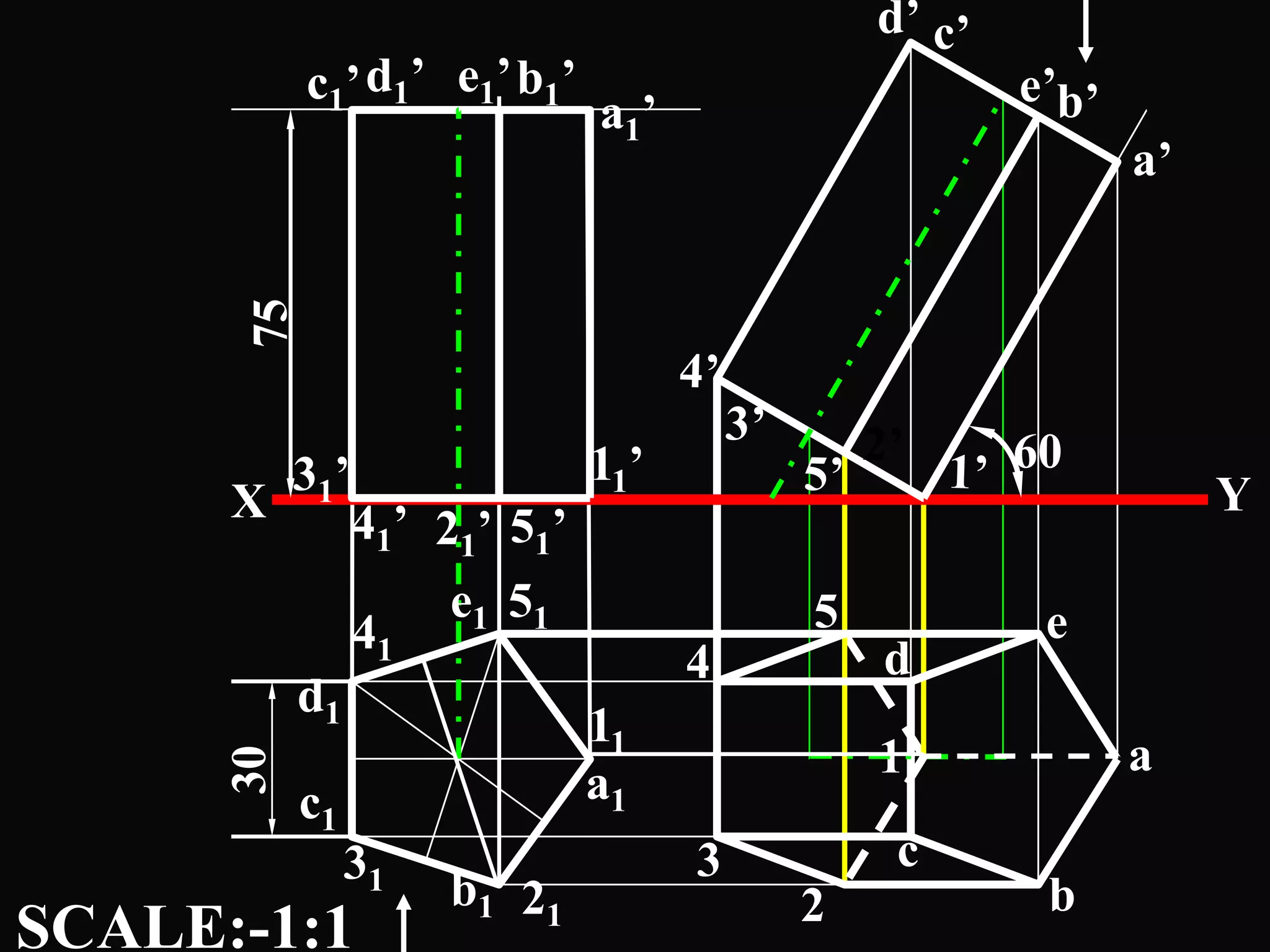
d’ c’
            c1’ d1’ e1’ b1’                           e’b’
                                a1’
                                                             a’

       75


           3 1’                 11’                   60
      X                                                           Y
                  41’ 21’ 51’
                       e1 51              5            e
                  41
                                      4       d
            d1
                                11
                                              1              a
      30


            c1                  a1
                 31                   3        c
                       b1 2 1             2            b
SCALE:-1:1
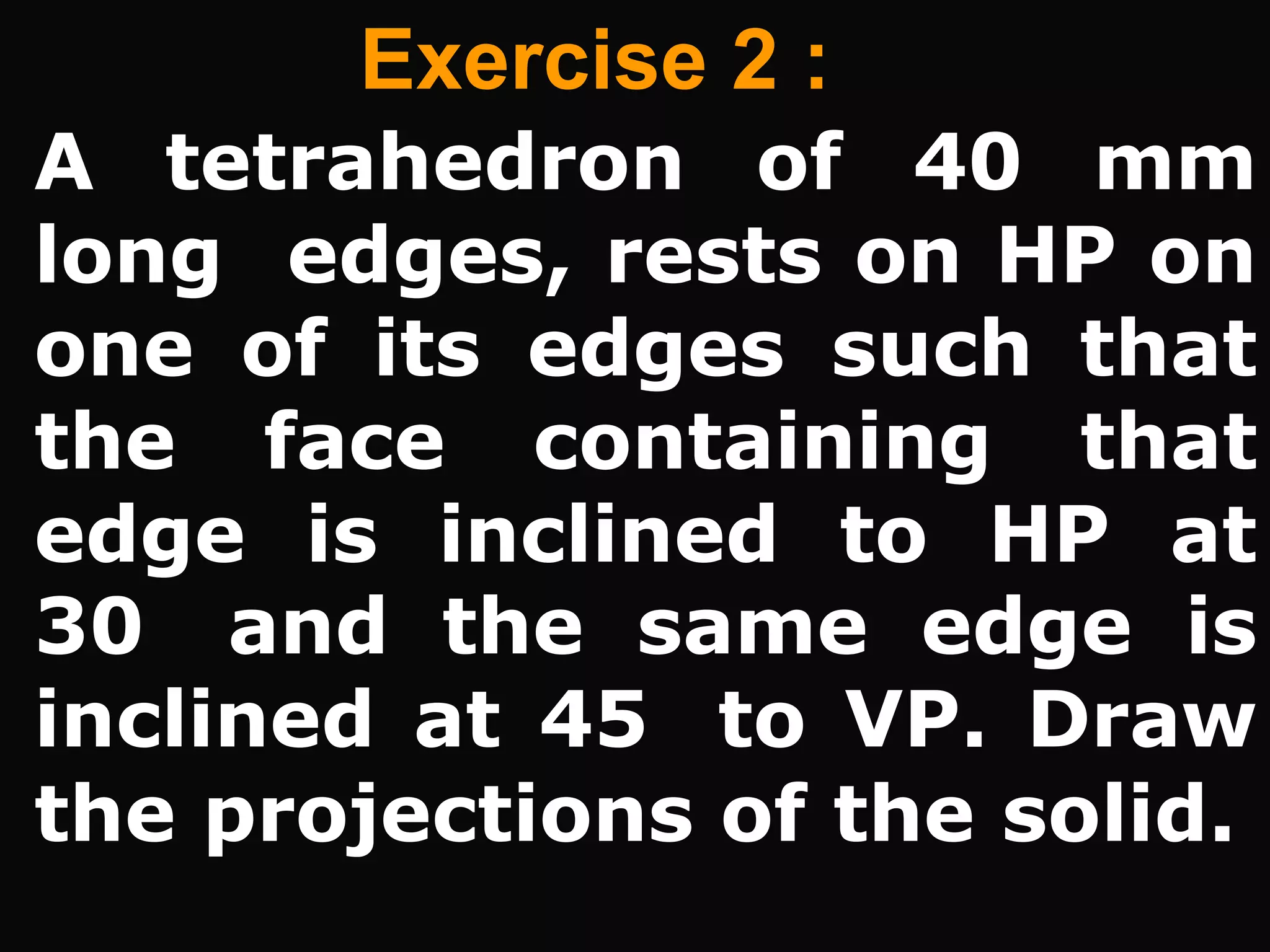
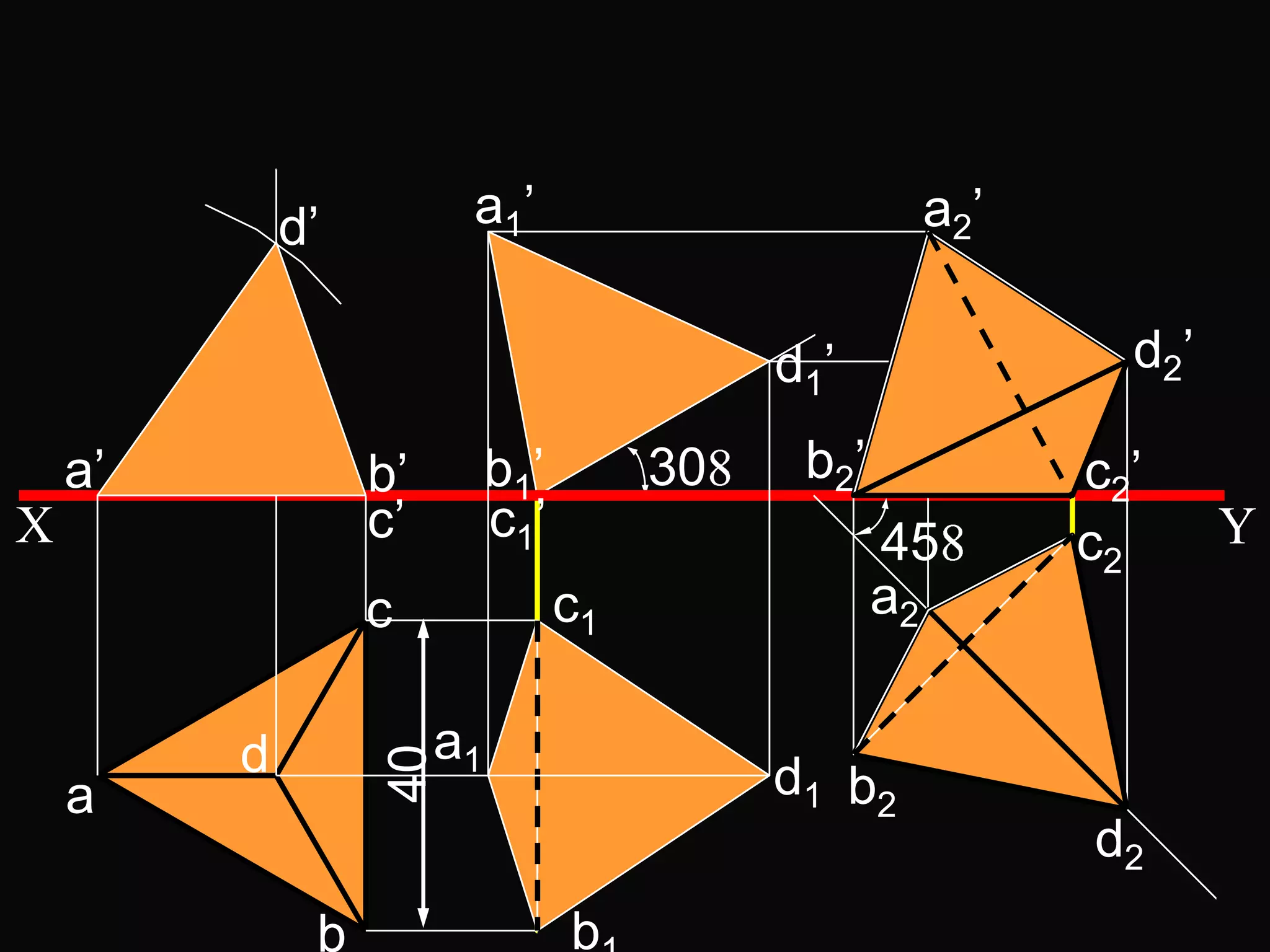
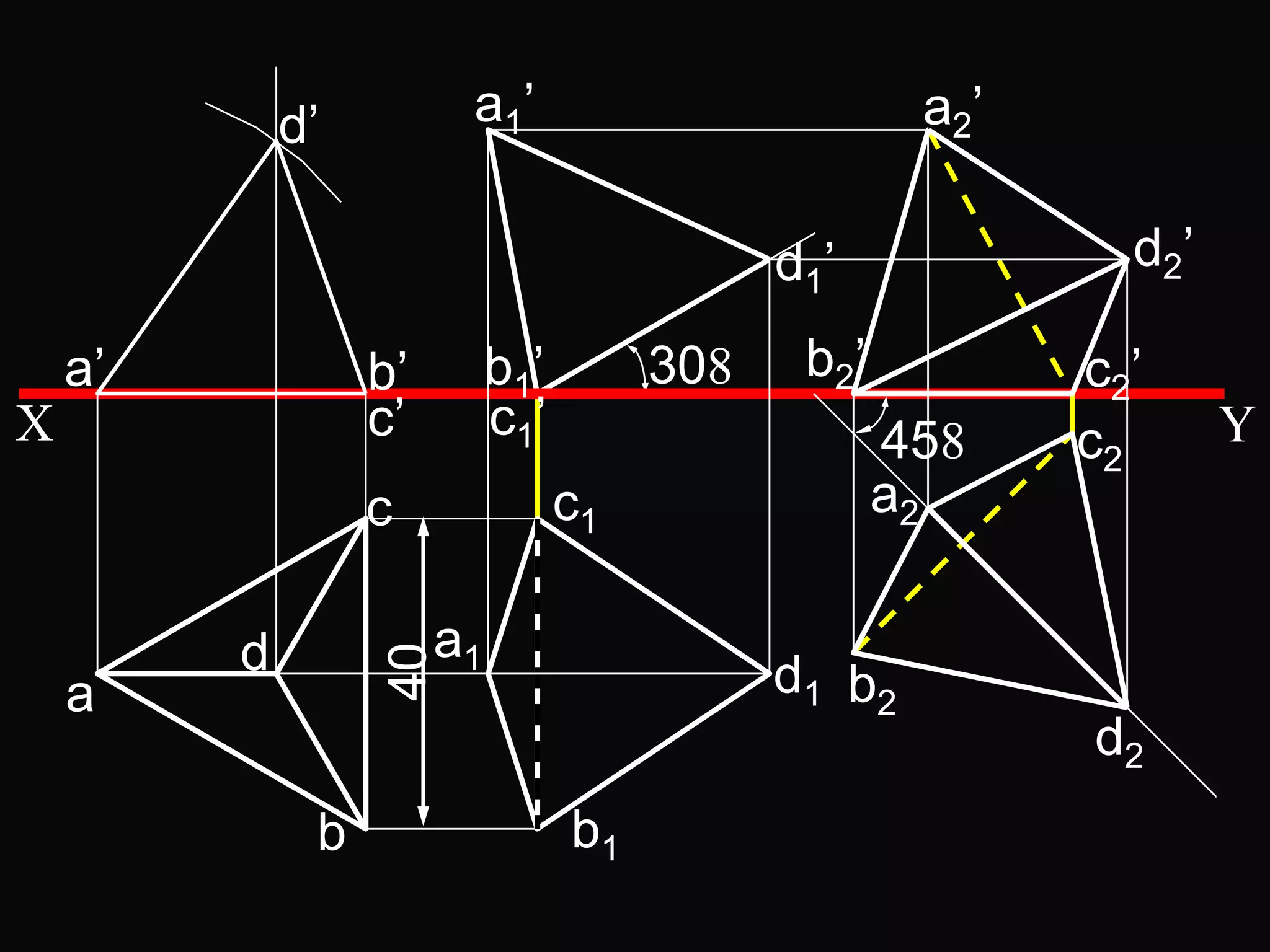
Exercise 2 :
A tetrahedron of 40 mm
long edges, rests on HP on
one of its edges such that
the face containing that
edge is inclined to HP at
30 and the same edge is
inclined at 45 to VP. Draw
the projections of the solid.
d’         a1 ’                        a2’

                                            d1’             d2 ’

    a’            b’        b1’        30    b2’          c2’
X                 c’        c1’                    45     c2       Y
                  c               c1               a2

         d             a1
                  40


    a                                       d1 b2
                                                          d2
              b                   b
d’         a1’                         a2’

                                            d1’             d2’

    a’            b’        b1’        30    b2’          c2’
X                 c’        c1’                    45     c2      Y
                  c               c1               a2

         d             a1
                  40


    a                                       d1 b2
                                                          d2
              b                   b1
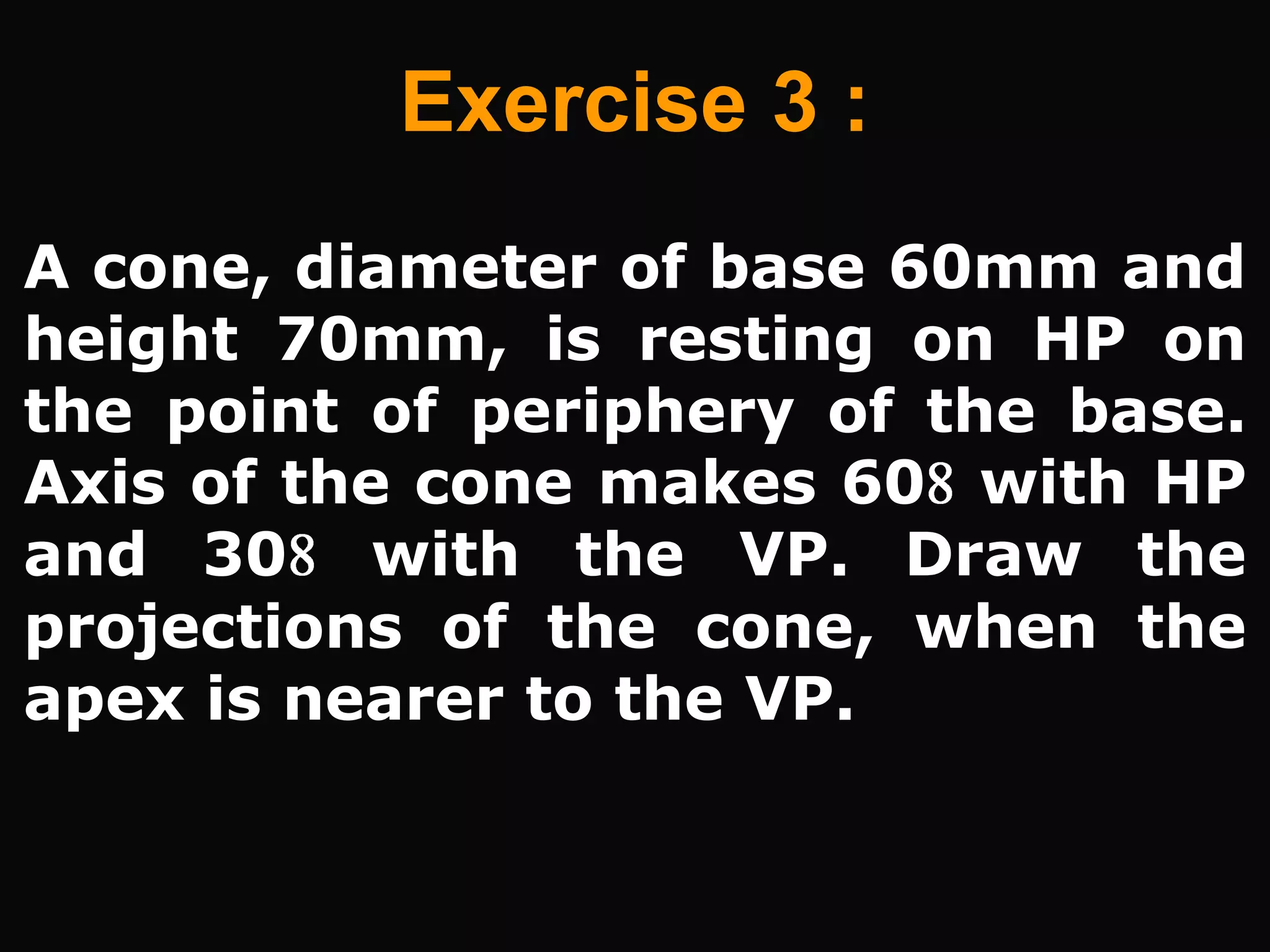
Exercise 3 :
A cone, diameter of base 60mm and
height 70mm, is resting on HP on
the point of periphery of the base.
Axis of the cone makes 60 with HP
and 30 with the VP. Draw the
projections of the cone, when the
apex is nearer to the VP.
O 1’          O 2’
             O’


                          a1’                        a2’
70


                                              g2 ’          c 2’
     a’            e’           60                   e 2’
     b’,h’c’,g’d’,f’                  e 1’            O2       30    Y
X                                                            Locus of
            g                   g1                   e2         O2
       h         f
                                              g2     O      c2
                      e   a1         e1 O
60


     a                          O         1
                                                     a2
         b        d
             c                  c1
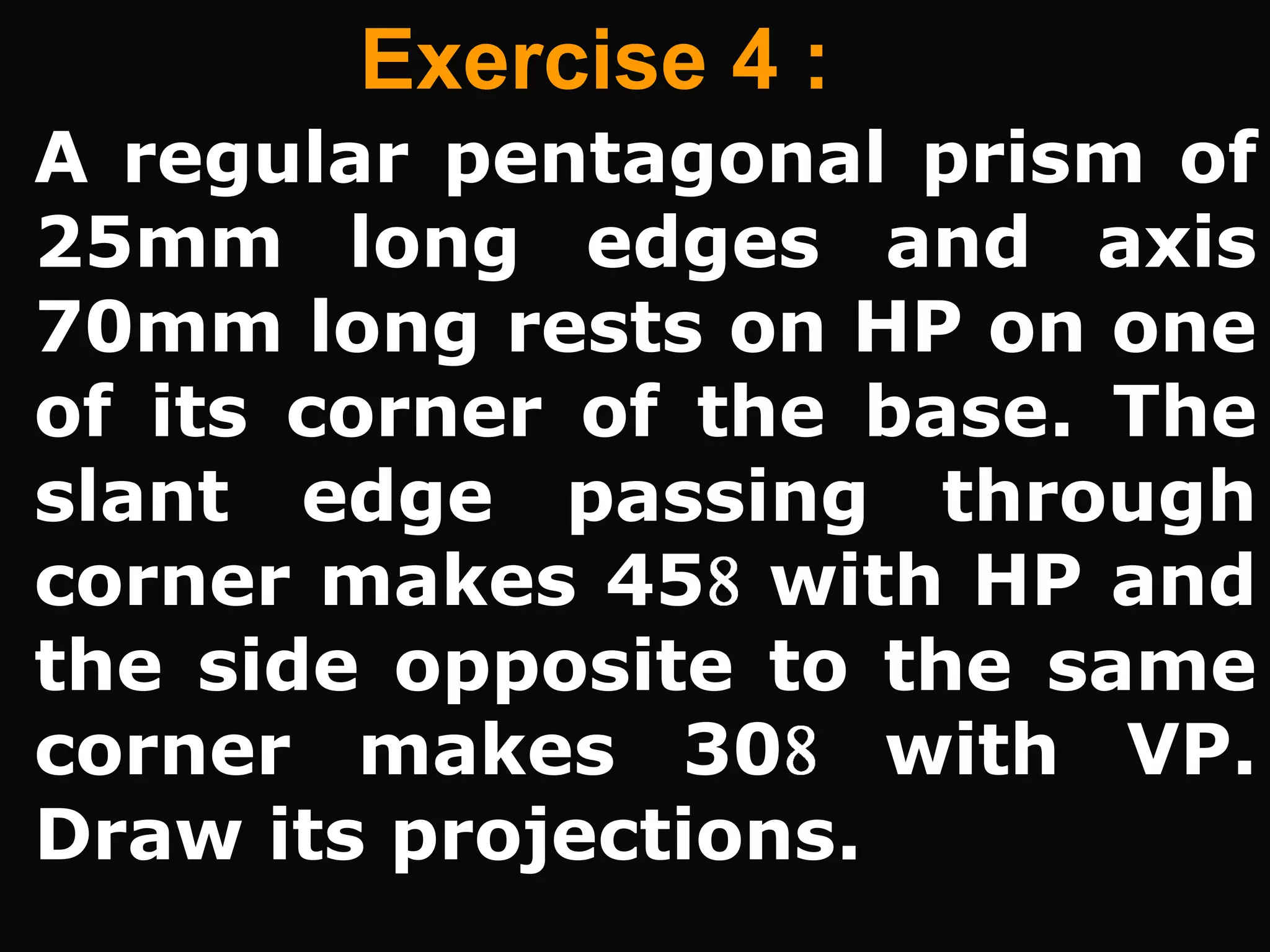
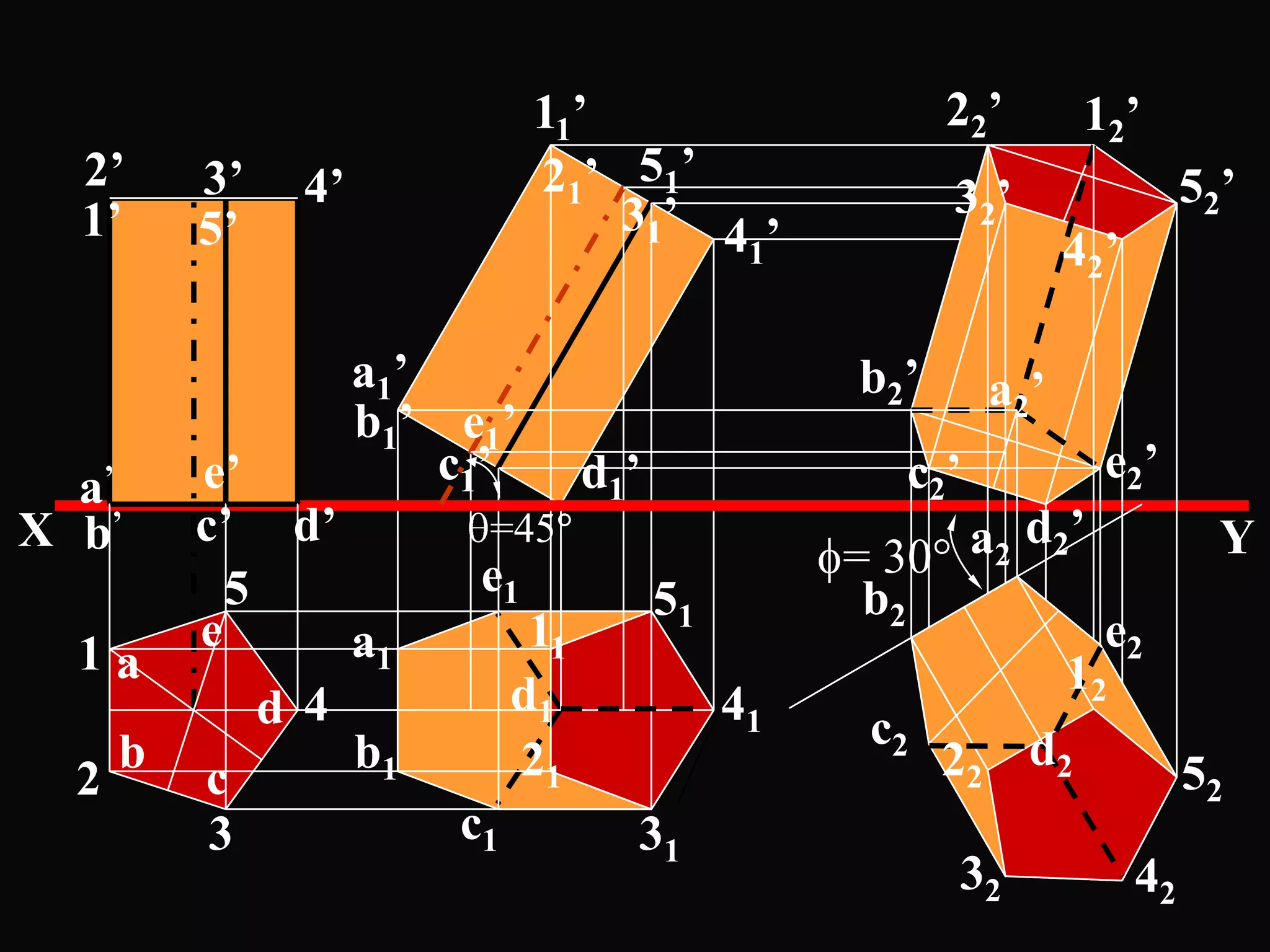
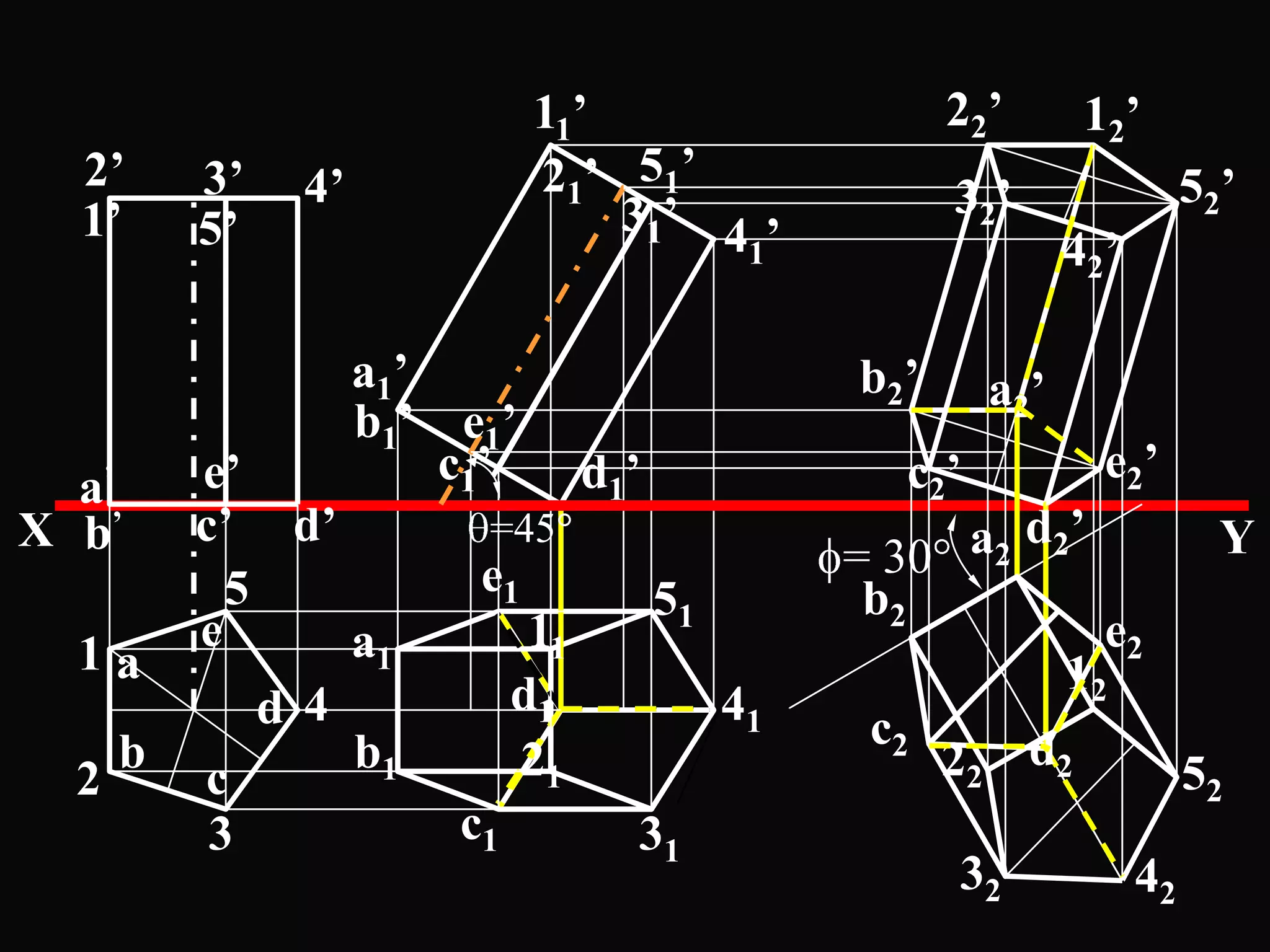
Exercise 4 :
A regular pentagonal prism of
25mm long edges and axis
70mm long rests on HP on one
of its corner of the base. The
slant edge passing through
corner makes 45 with HP and
the side opposite to the same
corner makes 30 with VP.
Draw its projections.
11’                        2 2’      1 2’
    2’      3’   4’             21’ 51’                    3 2’                 5 2’
    1’      5’                      3 1’ 4 ’
                                          1                         4 2’

                      a1’                            b2’     a 2’
                      b1’ e1’
            e’            c1’        d1’               c2’            e2’
    a’
X   b’      c’ d’          =45                            a2 d2’                  Y
                           e1                        = 30
              5                            51         b2
    1a      e       a1          11                                    e2
                               d1                                   12
                d 4                             41    c2
    2
        b
            c
                    b1         21                          22 d2                52
             3            c1           31
                                                           32              42
11’                        2 2’      1 2’
    2’      3’   4’             21’ 51’                    3 2’                 5 2’
    1’      5’                      3 1’ 4 ’
                                          1                         4 2’

                      a1’                            b2’     a 2’
                      b1’ e1’
            e’            c1’        d1’               c2’            e2’
    a’
X   b’      c’ d’          =45                            a2 d2’                  Y
                           e1                        = 30
              5                            51         b2
    1a      e       a1          11                                    e2
                               d1                                   12
                d 4                             41    c2
    2
        b
            c
                    b1         21                          22 d2                52
             3            c1           31
                                                           32              42
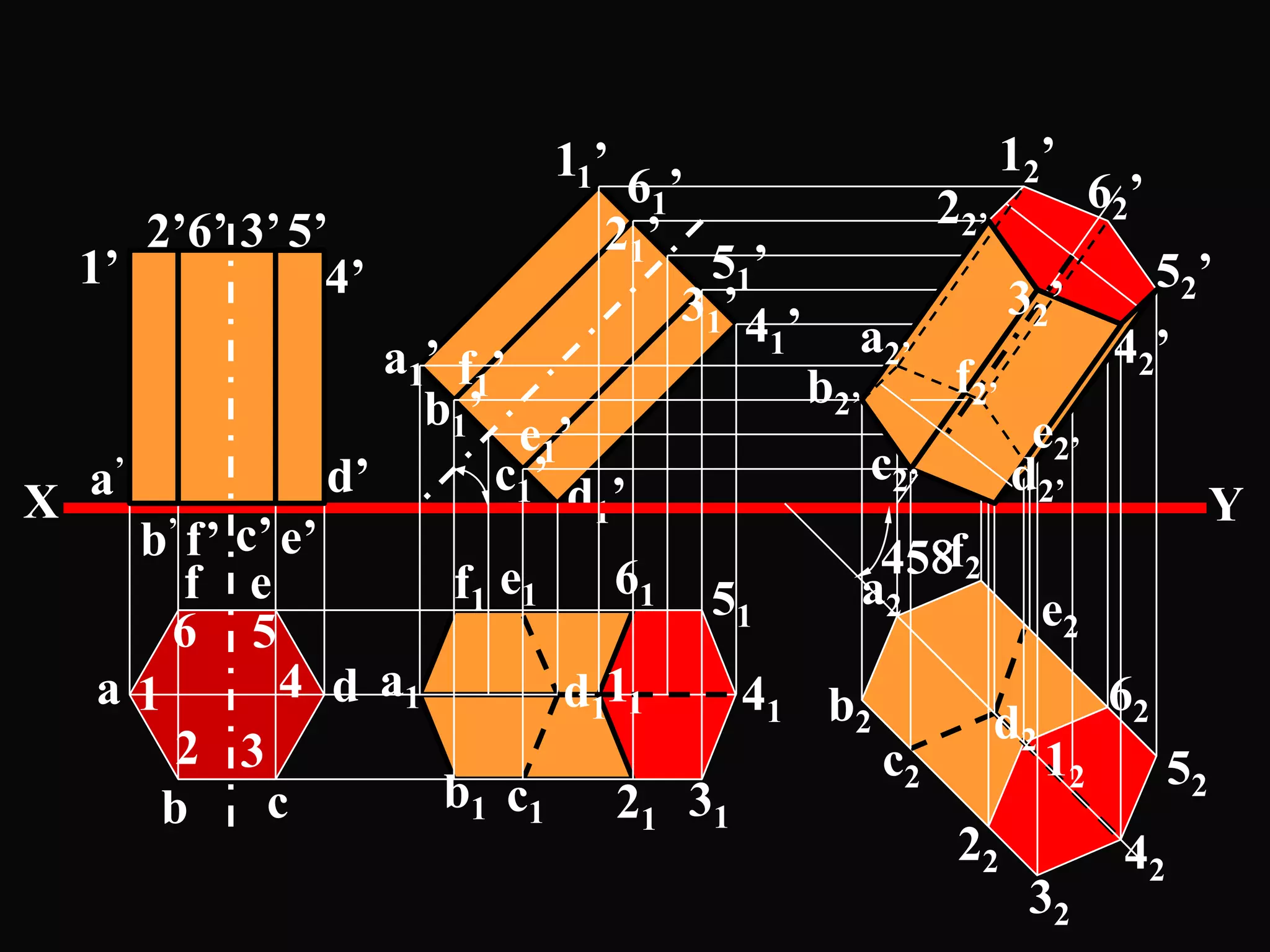
Exercise 5 :
A regular hexagonal prism of
30mm sides and axis 80mm
long is resting on HP on one
of its corners of the base. The
axis makes 30 with HP and
plan of the axis makes 45
with    the   VP.    Draw    its
projections.
11’                                12’
                                  6 1’                      22’           6 2’
     2’6’ 3’ 5’                  2 1’
  1’           4’                      51’                                       5 2’
                                      31’ 4 ’                      3 2’
                      a1’ f1’              1      a2’                      4 2’
                                                b2’          f2’
                        b1’
                              e1’                                   e2’
  a’               d’       c1’ d ’                   c2’          d2’
X                                 1                                                 Y
       b’ f’   c’ e’                        45 f2
        f       e        f1 e1   61 5     a2
        6       5                     1              e2
  a1              4 d a1       d111   41 b2             62
                                                  d2
         2     3                            c2       12     52
        b        c       b1 c1 21 31
                                                22       42
                                                   32

Projection of Solids

  • 1.
    (1) Prism: It isa polyhedra having two equal and similar faces called its ends or bases, parallel to each other and Faces joined by other faces which are rectangles. -The imaginary Edge line joining the Centres of the bases or faces is called Axis of Axis Prism.
  • 2.
    According to theshape of its base, prism can be sub classified into following types: (a) Triangular Prism: (b) Square Prism:
  • 3.
    (c) Pentagonal Prism: (d)Hexagonal Prism:
  • 4.
    (2) Pyramid: This is a polyhedra having plane surface as a base and a number of triangular faces meeting at a point called the Vertex or Apex. -The imaginary line joining the Edge Apex with the Centre of the base is called Axis Axis of pyramid. Base
  • 5.
    According to theshape of its base, pyramid can be sub classified into following types: (a) Triangular Pyramid: (b) Square Pyramid:
  • 6.
    (c) Pentagonal Pyramid: (d) Hexagonal Pyramid:
  • 7.
    (B) Solids of When a solid is generated by revolutions Revolutions: of a plane figure about a fixed line (Axis) then such solids are named as solids of revolution. Solids of revolutions may be of following types; (1) Cylinder (2) Cone (3) Sphere (4) Ellipsoid (5) Paraboloid (6) Hyperboloid
  • 8.
    Rectangle Axis Base (1) Cylinder: A right regular cylinder is a solid generated by the revolution of a rectangle about its vertical side which remains fixed.
  • 9.
    Right angle Generators triangle Axis Base (2) Cone: A right circular cone is a solid generated by the revolution of a right angle triangle about its vertical side which remains fixed.
  • 10.
    Important Terms Usedin Projections of Solids: (1) Edge or generator: For Pyramids & Prisms, edges are the lines separating the triangular faces or rectangular faces from each other. For Cylinder, generators are the straight lines joining different points on the circumference of the bases with each other
  • 11.
    Important Terms Usedin Projections of Solids: (2) Apex of solids: Apex For Cone and Edges Pyramids, Apex is the point PYRAMID where all the generators or Apex the edges meet. Generators CONE
  • 12.
    Rectangle Axis Generators Faces Base CYLINDER Edge PRISM Axis
  • 13.
    Important Terms Usedin Projections of Solids: (3) Axis of Solid: For Cone and Pyramids, Axis is an imaginary line joining centre of the base to the Apex. For Cylinder and Prism, Axis is an imaginary line joining centres of ends or bases.
  • 14.
    Important Terms Usedin Projections of Solids: (4) Right Solid: A solid is said to be a Right Solid if its axis is perpendicular to its base. Axis Base
  • 15.
    Important Terms Usedin Projections o Solids: Oblique (5) Solid: A solid is said to be a Oblique Solid if its axis is inclined at Axis an angle other than 90 to its base. Base
  • 16.
    Important Terms Usedin Projections of Solids: (6) Regular Solid: A solid is said to be a Regular Solid if all the edges of the base or the end faces of a solid are equal in length and form regular plane figures
  • 17.
    Important Terms Usedin Projections of Solids: CUTTING PLANE PARALLEL TO (7) Frustum of Solid: BASE When a Pyramid or a Cone is cut by a Plane parallel to its base, thus removing the top portion, the remaining lower portion is called its frustum. FRUSTUM OF A PYRAMID
  • 18.
    Important Terms Usedin Projections of Solids: (8) Truncated Solid : When a Pyramid or a Cone is cut by a Plane inclined to its base, thus removing the top portion, the remaining lower portion is said to be truncated.
  • 19.
    Class A(1): Axisperpendicular to H. P. and hence parallel to both V.P. & P.P. o’ Axis a’,b’ c’,d’ X Y a d o b c
  • 20.
    Class A(2): Axisperpendicular to V.P. and hence parallel to both H.P. & P.P. f’,6’ e’,5’ a’,1’ d’,4’ b’,2’ c’,3’ X 1 2,6 3,5 4 Y H a b,f c,e d
  • 21.
    Class A(3): Axisperpendicular to P.P. and hence parallel to both H.P. & V.P. L c’ 3’ c”3” a’,b’ 1’2’ a”1” b”2” X Y a 1 c 3 b 2
  • 22.
    Class B(1): Axisparallel to V.P. and inclined to H.P. by θ & also inclined to P.P. Exercise 1 : A right regular pentagonal prism, side of base 30 mm and height of axis as 75mm rests on HP on one of its base corners such that its long edge containing the corner is inclined to the HP at 60 . Draw its projections.
  • 23.
    d’ c’ c1’ d1’ e1’ b1’ e’b’ a1’ a’ 75 3 1’ 11’ 60 X Y 41’ 21’ 51’ e1 51 5 e 41 4 d d1 11 1 a 30 c1 a1 31 3 c b1 2 1 2 b SCALE:-1:1
  • 24.
    d’ c’ c1’ d1’ e1’ b1’ e’b’ a1’ a’ 75 3 1’ 11’ 60 X Y 41’ 21’ 51’ e1 51 5 e 41 4 d d1 11 1 a 30 c1 a1 31 3 c b1 2 1 2 b SCALE:-1:1
  • 25.
    Exercise 2 : Atetrahedron of 40 mm long edges, rests on HP on one of its edges such that the face containing that edge is inclined to HP at 30 and the same edge is inclined at 45 to VP. Draw the projections of the solid.
  • 26.
    d’ a1 ’ a2’ d1’ d2 ’ a’ b’ b1’ 30 b2’ c2’ X c’ c1’ 45 c2 Y c c1 a2 d a1 40 a d1 b2 d2 b b
  • 27.
    d’ a1’ a2’ d1’ d2’ a’ b’ b1’ 30 b2’ c2’ X c’ c1’ 45 c2 Y c c1 a2 d a1 40 a d1 b2 d2 b b1
  • 28.
    Exercise 3 : Acone, diameter of base 60mm and height 70mm, is resting on HP on the point of periphery of the base. Axis of the cone makes 60 with HP and 30 with the VP. Draw the projections of the cone, when the apex is nearer to the VP.
  • 29.
    O 1’ O 2’ O’ a1’ a2’ 70 g2 ’ c 2’ a’ e’ 60 e 2’ b’,h’c’,g’d’,f’ e 1’ O2 30 Y X Locus of g g1 e2 O2 h f g2 O c2 e a1 e1 O 60 a O 1 a2 b d c c1
  • 30.
    Exercise 4 : Aregular pentagonal prism of 25mm long edges and axis 70mm long rests on HP on one of its corner of the base. The slant edge passing through corner makes 45 with HP and the side opposite to the same corner makes 30 with VP. Draw its projections.
  • 31.
    11’ 2 2’ 1 2’ 2’ 3’ 4’ 21’ 51’ 3 2’ 5 2’ 1’ 5’ 3 1’ 4 ’ 1 4 2’ a1’ b2’ a 2’ b1’ e1’ e’ c1’ d1’ c2’ e2’ a’ X b’ c’ d’ =45 a2 d2’ Y e1 = 30 5 51 b2 1a e a1 11 e2 d1 12 d 4 41 c2 2 b c b1 21 22 d2 52 3 c1 31 32 42
  • 32.
    11’ 2 2’ 1 2’ 2’ 3’ 4’ 21’ 51’ 3 2’ 5 2’ 1’ 5’ 3 1’ 4 ’ 1 4 2’ a1’ b2’ a 2’ b1’ e1’ e’ c1’ d1’ c2’ e2’ a’ X b’ c’ d’ =45 a2 d2’ Y e1 = 30 5 51 b2 1a e a1 11 e2 d1 12 d 4 41 c2 2 b c b1 21 22 d2 52 3 c1 31 32 42
  • 33.
    Exercise 5 : Aregular hexagonal prism of 30mm sides and axis 80mm long is resting on HP on one of its corners of the base. The axis makes 30 with HP and plan of the axis makes 45 with the VP. Draw its projections.
  • 34.
    11’ 12’ 6 1’ 22’ 6 2’ 2’6’ 3’ 5’ 2 1’ 1’ 4’ 51’ 5 2’ 31’ 4 ’ 3 2’ a1’ f1’ 1 a2’ 4 2’ b2’ f2’ b1’ e1’ e2’ a’ d’ c1’ d ’ c2’ d2’ X 1 Y b’ f’ c’ e’ 45 f2 f e f1 e1 61 5 a2 6 5 1 e2 a1 4 d a1 d111 41 b2 62 d2 2 3 c2 12 52 b c b1 c1 21 31 22 42 32