Final Year Project Presentation Topic :
MICROCONTROLLER BASED
SOLAR CHARGER
Prepared by-
ECE1, 8th SEM,
ROLL NO. 17,48,50,62
Guide name: Prof. Mukesh Das
Department of Electronics and Communication Engineering
1
 Outlines___________________
 Objective
 Introduction
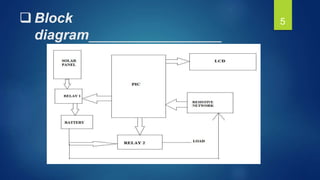
 Block diagram
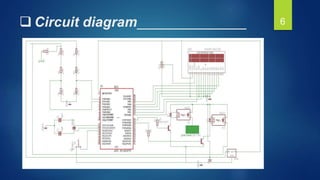
 Circuit diagram
 Component
description
 Central idea
 PIC simulation
 Hardware
implementation and
Real PIC simulation
 LED Blinking
 Complete circuit
 Future scope
 Conclusion
 References
2
 Objective_____________________
To maximize the utility of renewable
energy sources, mainly by using the solar
energy
To charge a battery of 12V having
overcharge and overload protection
ability and displaying the status on LCD
3
 Introduction__________________
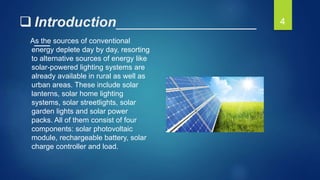
__As the sources of conventional
energy deplete day by day, resorting
to alternative sources of energy like
solar-powered lighting systems are
already available in rural as well as
urban areas. These include solar
lanterns, solar home lighting
systems, solar streetlights, solar
garden lights and solar power
packs. All of them consist of four
components: solar photovoltaic
module, rechargeable battery, solar
charge controller and load.
4
 Block
diagram_________________
5
 Circuit diagram______________ 6
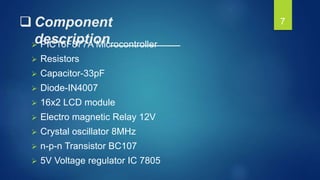
 Component
description_________ PIC16F877A Microcontroller
 Resistors
 Capacitor-33pF
 Diode-IN4007
 16x2 LCD module
 Electro magnetic Relay 12V
 Crystal oscillator 8MHz
 n-p-n Transistor BC107
 5V Voltage regulator IC 7805
7
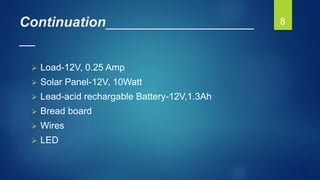
Continuation___________________
__
 Load-12V, 0.25 Amp
 Solar Panel-12V, 10Watt
 Lead-acid rechargable Battery-12V,1.3Ah
 Bread board
 Wires
 LED
8
 Central
Idea____________________ At 1st the PIC microcontroller is being burnt by the
code using MikroC pro and implemented to the bread
board
 Solar panel will be excited by the solar light and
helps the rechargable battery to get charged
 This battery charge helps the circuit to remain
connected and the required operation occurs step by
step and at output LCD shows the desirable results
9
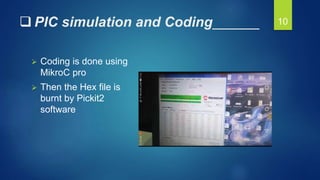
 PIC simulation and Coding______
 Coding is done using
MikroC pro
 Then the Hex file is
burnt by Pickit2
software
10
 Hardware Implementation______
The objectives of the project is done part by part as the
coding is done separately for -
 LCD Display
 Charge control
 Load control
 Voltage regulation
11
 LCD
Display____________________
12
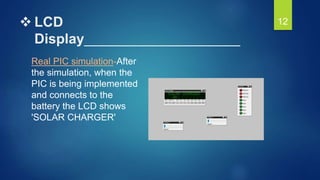
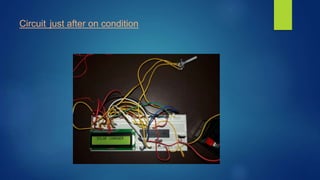
Real PIC simulation-After
the simulation, when the
PIC is being implemented
and connects to the
battery the LCD shows
'SOLAR CHARGER'
Circuit just after on condition
Charge
Control_______________
 Under normal condition it allows the charging
current from the panel to flow into the battery.When
battery is at full charge the charging current
becomes pulsed and RL1 will be energised and
disconnects the solar panel from the battery
 To keep the overall current consumption low,
normally closed contacts of the relay(N/C) are used
and the relay is in de-energsed state
14
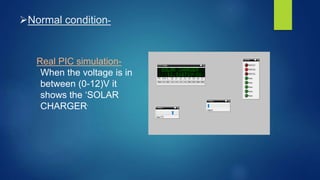
Normal condition-
Real PIC simulation-
When the voltage is in
between (0-12)V it
shows the ‘SOLAR
CHARGER’
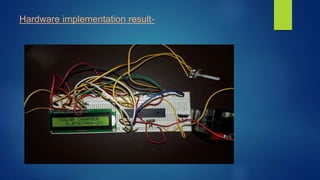
Hardware implementation result-
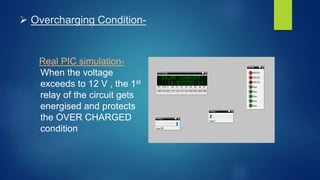
 Overcharging Condition-
Real PIC simulation-
When the voltage
exceeds to 12 V , the 1st
relay of the circuit gets
energised and protects
the OVER CHARGED
condition
Load Control_________________
 The Relay switch RL2 is used to protect the battery
from overload
 When an overload is occured,the Relay switch RL2 is
energised and disconnects load from the battery
 the voltage at the battery is constantly displayed in
LCD using the built-in ADC module in the PIC
16F877A
18
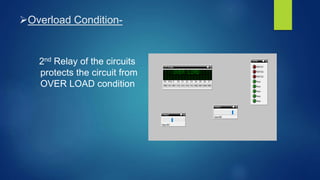
Overload Condition-
2nd Relay of the circuits
protects the circuit from
OVER LOAD condition
Voltage Regulation_______
 It delivers constant 5V to the LCD to prevent it from
damages
 Voltage regulator delivers same voltage to ADC to
read the battery status
 Capable of delivering 1Amp output current
20
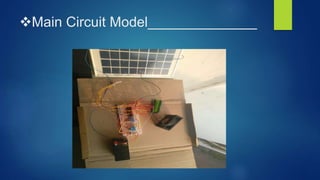
Main Circuit Model______________
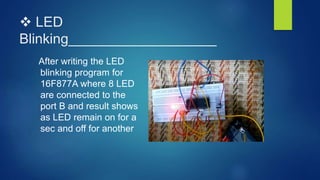
 LED
Blinking___________________
After writing the LED
blinking program for
16F877A where 8 LED
are connected to the
port B and result shows
as LED remain on for a
sec and off for another
 Future
scope____________________
 By introducing a stepper motor to rotate the
solar panel based on the sun.
 By extending the circuit we can give the
electricity which is sufficient to home
requirements.
23
 Conclusion___________________
__
In this project the parts of the programming are
done by-
 LCD pinout setting
 LCD initialization and interfacing
 Displaying ‘SOLAR CHARGER’
 Built-in digital voltmeter logic
 Overcharge protection logic
 Overload protection logic
24
 References___________________
_ S.K. Mandal, Microprocessors and Microcontrollers.
Tata McGraw Education Pvt. Ltd., 2010.
 E-book: PIC microcontroller text by Muhammad Ali
Mazidi
 http://www.electronicsforu.com/
 http://www.stackxchange.com/
 Manual: MikroC PRO for PIC ver 7.1.0-
Mikroelektronika
 http://www.github.com/- lcd library functions for EAGLE
 https://download/mikroe.com- Lcd library
25
Thank You
&
Your Valuable
Suggestion
26

Projectfinal ppt

  • 1.
    Final Year ProjectPresentation Topic : MICROCONTROLLER BASED SOLAR CHARGER Prepared by- ECE1, 8th SEM, ROLL NO. 17,48,50,62 Guide name: Prof. Mukesh Das Department of Electronics and Communication Engineering 1
  • 2.
     Outlines___________________  Objective Introduction  Block diagram  Circuit diagram  Component description  Central idea  PIC simulation  Hardware implementation and Real PIC simulation  LED Blinking  Complete circuit  Future scope  Conclusion  References 2
  • 3.
     Objective_____________________ To maximizethe utility of renewable energy sources, mainly by using the solar energy To charge a battery of 12V having overcharge and overload protection ability and displaying the status on LCD 3
  • 4.
     Introduction__________________ __As thesources of conventional energy deplete day by day, resorting to alternative sources of energy like solar-powered lighting systems are already available in rural as well as urban areas. These include solar lanterns, solar home lighting systems, solar streetlights, solar garden lights and solar power packs. All of them consist of four components: solar photovoltaic module, rechargeable battery, solar charge controller and load. 4
  • 5.
  • 6.
  • 7.
     Component description_________ PIC16F877AMicrocontroller  Resistors  Capacitor-33pF  Diode-IN4007  16x2 LCD module  Electro magnetic Relay 12V  Crystal oscillator 8MHz  n-p-n Transistor BC107  5V Voltage regulator IC 7805 7
  • 8.
    Continuation___________________ __  Load-12V, 0.25Amp  Solar Panel-12V, 10Watt  Lead-acid rechargable Battery-12V,1.3Ah  Bread board  Wires  LED 8
  • 9.
     Central Idea____________________ At1st the PIC microcontroller is being burnt by the code using MikroC pro and implemented to the bread board  Solar panel will be excited by the solar light and helps the rechargable battery to get charged  This battery charge helps the circuit to remain connected and the required operation occurs step by step and at output LCD shows the desirable results 9
  • 10.
     PIC simulationand Coding______  Coding is done using MikroC pro  Then the Hex file is burnt by Pickit2 software 10
  • 11.
     Hardware Implementation______ Theobjectives of the project is done part by part as the coding is done separately for -  LCD Display  Charge control  Load control  Voltage regulation 11
  • 12.
     LCD Display____________________ 12 Real PICsimulation-After the simulation, when the PIC is being implemented and connects to the battery the LCD shows 'SOLAR CHARGER'
  • 13.
    Circuit just afteron condition
  • 14.
    Charge Control_______________  Under normalcondition it allows the charging current from the panel to flow into the battery.When battery is at full charge the charging current becomes pulsed and RL1 will be energised and disconnects the solar panel from the battery  To keep the overall current consumption low, normally closed contacts of the relay(N/C) are used and the relay is in de-energsed state 14
  • 15.
    Normal condition- Real PICsimulation- When the voltage is in between (0-12)V it shows the ‘SOLAR CHARGER’
  • 16.
  • 17.
     Overcharging Condition- RealPIC simulation- When the voltage exceeds to 12 V , the 1st relay of the circuit gets energised and protects the OVER CHARGED condition
  • 18.
    Load Control_________________  TheRelay switch RL2 is used to protect the battery from overload  When an overload is occured,the Relay switch RL2 is energised and disconnects load from the battery  the voltage at the battery is constantly displayed in LCD using the built-in ADC module in the PIC 16F877A 18
  • 19.
    Overload Condition- 2nd Relayof the circuits protects the circuit from OVER LOAD condition
  • 20.
    Voltage Regulation_______  Itdelivers constant 5V to the LCD to prevent it from damages  Voltage regulator delivers same voltage to ADC to read the battery status  Capable of delivering 1Amp output current 20
  • 21.
  • 22.
     LED Blinking___________________ After writingthe LED blinking program for 16F877A where 8 LED are connected to the port B and result shows as LED remain on for a sec and off for another
  • 23.
     Future scope____________________  Byintroducing a stepper motor to rotate the solar panel based on the sun.  By extending the circuit we can give the electricity which is sufficient to home requirements. 23
  • 24.
     Conclusion___________________ __ In thisproject the parts of the programming are done by-  LCD pinout setting  LCD initialization and interfacing  Displaying ‘SOLAR CHARGER’  Built-in digital voltmeter logic  Overcharge protection logic  Overload protection logic 24
  • 25.
     References___________________ _ S.K.Mandal, Microprocessors and Microcontrollers. Tata McGraw Education Pvt. Ltd., 2010.  E-book: PIC microcontroller text by Muhammad Ali Mazidi  http://www.electronicsforu.com/  http://www.stackxchange.com/  Manual: MikroC PRO for PIC ver 7.1.0- Mikroelektronika  http://www.github.com/- lcd library functions for EAGLE  https://download/mikroe.com- Lcd library 25
  • 26.