1
Project report outline
Universal Immunization Program
(UIP)
Comparison of Recent Vs. Old System Based
Data Related To UIP
(October 30, 2016)
Name- Vinay Kumar Sharma
Designation- Project Consultant
Affiliation- Ernst & Young India Advisory,
Mentor’s name-Dr.PreetiNegandhi,
Affiliation--IIPH Delhi, PHFI
Designation- Associate Professor
2
Contents:-
Serial
Number
Topic Page Number
1 Introduction 3
2 Methodology 5
3 Goals and Objectives 5
4 Indicators 6
5 Planning and Implementation 6
6 Lessons learnt 12
7 References 12
3
Comparisonof Recent vs. old Systembaseddatarelated
to Cold Chain as well as Supply Chain Management
under Universal Immunization Program (UIP)
Introduction:-
India conducts one of the largest Universal Immunization Programs
(UIP) in the world Targets ~26 million new-borns and ~30 million
pregnant women each year translating into >300 million doses of
vaccines each year. There are ~27,000 cold chain points in the
country; ~750 (3%) located at district and above while remaining 95%
below the district level (PHC, CHC, Urban Health Facility, Sub-centres).
(1)
District Jhalawar is located in the south east corner of Rajasthan at
the edge of the Malwa plateau. Total population (2016) is 1535224,
total pregnant women 41897, live birth 38088, infants 35689, 1 to 2
year 35104, five year 32279 (2).
Nodal officer for Immunization is Reproductive and Child Health
Officer (RCHO) and has overall responsibility. District vaccine store is
facility at district headquarter level which receive vaccines from
Regional Vaccine Store Kota and distribute vaccines to CHC/
PHC/UHC/last Cold Chain point etc.Cold Chain Points are facilities
which receive vaccines from District Vaccine store and distribute
vaccines to the session sites on a session day using Alternate Vaccine
Delivery System (AVDS). In the immunization supply chain network,
this is the last point having vaccines storage facilityat the district level,
vaccines are stored in dedicated cold storage facilities at Community
health centres / primary health centres. Each cold chain handler packs
the vaccines in vaccine carriers and transports them to different
routine immunization sites in villages and cities. As and when
required, the healthcare worker administers the vaccines to children.
At district headquarter there is 1
4
District Vaccine Store (DVS) which is maintained by the district cold
chain manager (DVSM), who is responsible for distribution of the
vaccines and logistics to Cold Chain Points. There are 43 Cold Chain
Points, maintained by Cold Chain Handlers (CCHs), who distributes
vaccines and logistics to the vaccinators. The CCH is responsible to
maintain the cold chain and supply chain. To maintain cold chain they
are using electrical Cold chain Equipment (CCE) such as Ice lined
refrigerator and deep freezer. Vaccine tracking happens at two points,
once in the morning, before the load is dispatched to the point of
routine immunization, and second on return. Until the electronic
Vaccine Intelligence Network (e-VIN) system was introduced in
Jhalawar, the tracking process was undertaken manually.
Implementing any programme that involves delivering
material to a particular area and administering it to people involves
two things; one is to manage inventory so we know how much is
available and when stocks run low, which helps in decision making.
And the second, is to actually administer this to people. Before the
implementation of electronic Vaccine Intelligence Network(e-VIN), it
was time-consuming to collect data from the field and this in turn
delayed our decision making. So we were not able to plan optimally.
Now we have real time information at our fingertips and so planning
and inventory management has become more effective. (3)
Electronic vaccine intelligence network adopted technology
through smart mobile phone, connected with 2G/3G internet facility.
At the end of each routine immunization session day CCH do the
online entries, so anybody who has access, can see the current status
of the inventory.
5
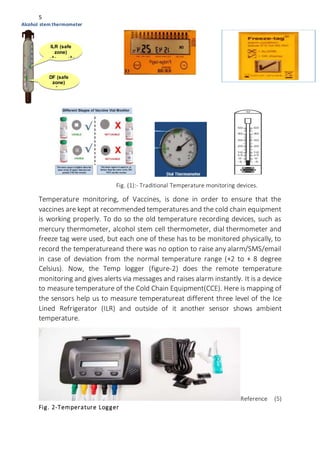
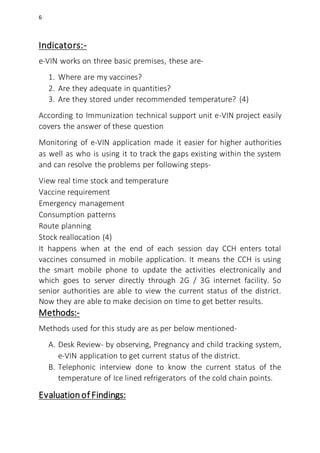
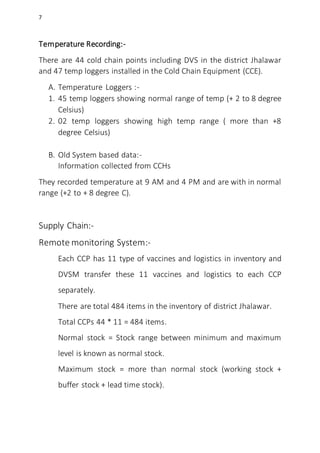
Fig. (1):- Traditional Temperature monitoring devices.
Temperature monitoring, of Vaccines, is done in order to ensure that the
vaccines are kept at recommended temperatures and the cold chain equipment
is working properly. To do so the old temperature recording devices, such as
mercury thermometer, alcohol stem cell thermometer, dial thermometer and
freeze tag were used, but each one of these has to be monitored physically, to
record the temperatureand there was no option to raise any alarm/SMS/email
in case of deviation from the normal temperature range (+2 to + 8 degree
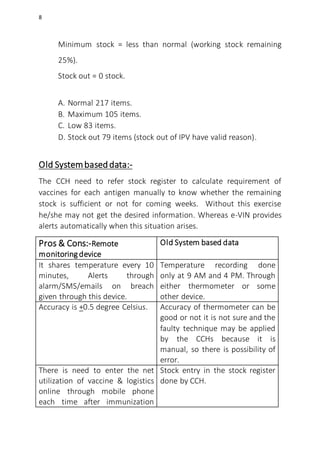
Celsius). Now, the Temp logger (figure-2) does the remote temperature
monitoring and gives alerts via messages and raises alarm instantly. It is a device
to measure temperature of the Cold Chain Equipment(CCE). Here is mapping of
the sensors help us to measure temperatureat different three level of the Ice
Lined Refrigerator (ILR) and outside of it another sensor shows ambient
temperature.
Reference (5)
Fig. 2-Temperature Logger
ILR (safe
zone)
+2
0
C to +8
0
C
DF (safe
zone)
-15
0
C to -
25
0
C
Alcohol stem thermometer
6
Indicators:-
e-VIN works on three basic premises, these are-
1. Where are my vaccines?
2. Are they adequate in quantities?
3. Are they stored under recommended temperature? (4)
According to Immunization technical support unit e-VIN project easily
covers the answer of these question
Monitoring of e-VIN application made it easier for higher authorities
as well as who is using it to track the gaps existing within the system
and can resolve the problems per following steps-
View real time stock and temperature
Vaccine requirement
Emergency management
Consumption patterns
Route planning
Stock reallocation (4)
It happens when at the end of each session day CCH enters total
vaccines consumed in mobile application. It means the CCH is using
the smart mobile phone to update the activities electronically and
which goes to server directly through 2G / 3G internet facility. So
senior authorities are able to view the current status of the district.
Now they are able to make decision on time to get better results.
Methods:-
Methods used for this study are as per below mentioned-
A. Desk Review- by observing, Pregnancy and child tracking system,
e-VIN application to get current status of the district.
B. Telephonic interview done to know the current status of the
temperature of Ice lined refrigerators of the cold chain points.
Evaluationof Findings:
7
Temperature Recording:-
There are 44 cold chain points including DVS in the district Jhalawar
and 47 temp loggers installed in the Cold Chain Equipment (CCE).
A. Temperature Loggers :-
1. 45 temp loggers showing normal range of temp (+ 2 to 8 degree
Celsius)
2. 02 temp loggers showing high temp range ( more than +8
degree Celsius)
B. Old System based data:-
Information collected from CCHs
They recorded temperature at 9 AM and 4 PM and are with in normal
range (+2 to + 8 degree C).
Supply Chain:-
Remote monitoring System:-
Each CCP has 11 type of vaccines and logistics in inventory and
DVSM transfer these 11 vaccines and logistics to each CCP
separately.
There are total 484 items in the inventory of district Jhalawar.
Total CCPs 44 * 11 = 484 items.
Normal stock = Stock range between minimum and maximum
level is known as normal stock.
Maximum stock = more than normal stock (working stock +
buffer stock + lead time stock).
8
Minimum stock = less than normal (working stock remaining
25%).
Stock out = 0 stock.
A. Normal 217 items.
B. Maximum 105 items.
C. Low 83 items.
D. Stock out 79 items (stock out of IPV have valid reason).
Old Systembaseddata:-
The CCH need to refer stock register to calculate requirement of
vaccines for each antigen manually to know whether the remaining
stock is sufficient or not for coming weeks. Without this exercise
he/she may not get the desired information. Whereas e-VIN provides
alerts automatically when this situation arises.
Pros & Cons:-Remote
monitoring device
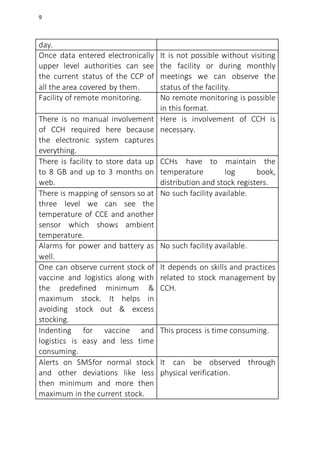
Old System based data
It shares temperature every 10
minutes, Alerts through
alarm/SMS/emails on breach
given through this device.
Temperature recording done
only at 9 AM and 4 PM. Through
either thermometer or some
other device.
Accuracy is +0.5 degree Celsius. Accuracy of thermometer can be
good or not it is not sure and the
faulty technique may be applied
by the CCHs because it is
manual, so there is possibility of
error.
There is need to enter the net
utilization of vaccine & logistics
online through mobile phone
each time after immunization
Stock entry in the stock register
done by CCH.
9
day.
Once data entered electronically
upper level authorities can see
the current status of the CCP of
all the area covered by them.
It is not possible without visiting
the facility or during monthly
meetings we can observe the
status of the facility.
Facility of remote monitoring. No remote monitoring is possible
in this format.
There is no manual involvement
of CCH required here because
the electronic system captures
everything.
Here is involvement of CCH is
necessary.
There is facility to store data up
to 8 GB and up to 3 months on
web.
CCHs have to maintain the
temperature log book,
distribution and stock registers.
There is mapping of sensors so at
three level we can see the
temperature of CCE and another
sensor which shows ambient
temperature.
No such facility available.
Alarms for power and battery as
well.
No such facility available.
One can observe current stock of
vaccine and logistics along with
the predefined minimum &
maximum stock. It helps in
avoiding stock out & excess
stocking.
It depends on skills and practices
related to stock management by
CCH.
Indenting for vaccine and
logistics is easy and less time
consuming.
This process is time consuming.
Alerts on SMSfor normal stock
and other deviations like less
then minimum and more then
maximum in the current stock.
It can be observed through
physical verification.
10
Reporting:-
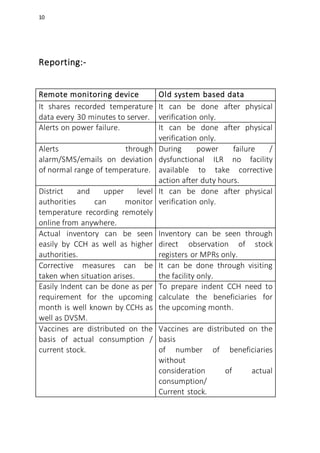
Remote monitoring device Old system based data
It shares recorded temperature
data every 30 minutes to server.
It can be done after physical
verification only.
Alerts on power failure. It can be done after physical
verification only.
Alerts through
alarm/SMS/emails on deviation
of normal range of temperature.
During power failure /
dysfunctional ILR no facility
available to take corrective
action after duty hours.
District and upper level
authorities can monitor
temperature recording remotely
online from anywhere.
It can be done after physical
verification only.
Actual inventory can be seen
easily by CCH as well as higher
authorities.
Inventory can be seen through
direct observation of stock
registers or MPRs only.
Corrective measures can be
taken when situation arises.
It can be done through visiting
the facility only.
Easily Indent can be done as per
requirement for the upcoming
month is well known by CCHs as
well as DVSM.
To prepare indent CCH need to
calculate the beneficiaries for
the upcoming month.
Vaccines are distributed on the
basis of actual consumption /
current stock.
Vaccines are distributed on the
basis
of number of beneficiaries
without
consideration of actual
consumption/
Current stock.
11
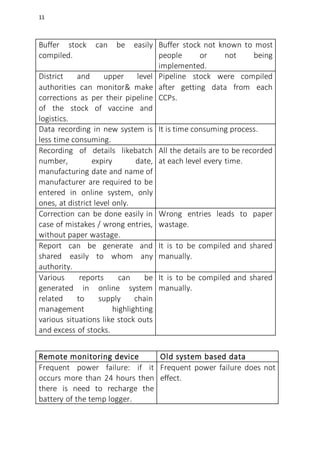
Buffer stock can be easily
compiled.
Buffer stock not known to most
people or not being
implemented.
District and upper level
authorities can monitor& make
corrections as per their pipeline
of the stock of vaccine and
logistics.
Pipeline stock were compiled
after getting data from each
CCPs.
Data recording in new system is
less time consuming.
It is time consuming process.
Recording of details likebatch
number, expiry date,
manufacturing date and name of
manufacturer are required to be
entered in online system, only
ones, at district level only.
All the details are to be recorded
at each level every time.
Correction can be done easily in
case of mistakes / wrong entries,
without paper wastage.
Wrong entries leads to paper
wastage.
Report can be generate and
shared easily to whom any
authority.
It is to be compiled and shared
manually.
Various reports can be
generated in online system
related to supply chain
management highlighting
various situations like stock outs
and excess of stocks.
It is to be compiled and shared
manually.
Remote monitoring device Old system based data
Frequent power failure: if it
occurs more than 24 hours then
there is need to recharge the
battery of the temp logger.
Frequent power failure does not
effect.
12
Unavailability of internet
connection: there is provision
ofanother slot for SIM of other
service provider whose services
can be accessed if such condition
occurs.
Accuracy of traditional
temperature device is not at
optimal level.
Network failure affects
transmission of data from temp
logger to server.
Here is no such condition.
Skilled and trained health worker
needed.
Here is the same condition.
Lessons learnt:
User-friendly technology when linked to human resources with a
defined supportive supervision plan and standardized procedures,
results in high adoption rates and high data quality as evidenced by
the e-VIN in Jhalawar.
References:-
1. Kapuria B. electronic Vaccine Intelligence Network (e-VIN)
[Internet]. Itsu.org.in. 2016 [cited 30October2016]. Available from:
http://www.itsu.org.in/Electronic-Vaccines-Intelligence-Network
2. Jhalawar C. Targets - Medical, Health & Family Welfare
Department, Government of Rajasthan [Internet]. Rajswasthya.nic.in.
2016 [cited 30 October 2016]. Available from:
http://www.rajswasthya.nic.in
3. Somani P. towards Effective Vaccine Logistics in Madhya Pradesh
[Internet]. UNDP in India. 2016 [cited 30October2016]. Available
from:
http://www.in.undp.org/content/india/en/home/ourwork/health/suc
13
cessstories/evin-improves-immunization-rates-in-madhya-pradesh-
.html
4. Kapuria B. electronic Vaccine Intelligence Network (e-VIN)
[Internet]. Itsu.org.in. 2016 [cited 30 October 2016]. Available from:
http://www.itsu.org.in/Electronic-Vaccines-Intelligence-Network
5. Sircar A. Temperature Logger– Nexleaf Analytics [Internet].
Nexleaf.org. 2016 [cited 30October 2016]. Available from:
http://nexleaf.org/about-us/#our-model

Project report on UIP vinay sharma 26_oct16

  • 1.
    1 Project report outline UniversalImmunization Program (UIP) Comparison of Recent Vs. Old System Based Data Related To UIP (October 30, 2016) Name- Vinay Kumar Sharma Designation- Project Consultant Affiliation- Ernst & Young India Advisory, Mentor’s name-Dr.PreetiNegandhi, Affiliation--IIPH Delhi, PHFI Designation- Associate Professor
  • 2.
    2 Contents:- Serial Number Topic Page Number 1Introduction 3 2 Methodology 5 3 Goals and Objectives 5 4 Indicators 6 5 Planning and Implementation 6 6 Lessons learnt 12 7 References 12
  • 3.
    3 Comparisonof Recent vs.old Systembaseddatarelated to Cold Chain as well as Supply Chain Management under Universal Immunization Program (UIP) Introduction:- India conducts one of the largest Universal Immunization Programs (UIP) in the world Targets ~26 million new-borns and ~30 million pregnant women each year translating into >300 million doses of vaccines each year. There are ~27,000 cold chain points in the country; ~750 (3%) located at district and above while remaining 95% below the district level (PHC, CHC, Urban Health Facility, Sub-centres). (1) District Jhalawar is located in the south east corner of Rajasthan at the edge of the Malwa plateau. Total population (2016) is 1535224, total pregnant women 41897, live birth 38088, infants 35689, 1 to 2 year 35104, five year 32279 (2). Nodal officer for Immunization is Reproductive and Child Health Officer (RCHO) and has overall responsibility. District vaccine store is facility at district headquarter level which receive vaccines from Regional Vaccine Store Kota and distribute vaccines to CHC/ PHC/UHC/last Cold Chain point etc.Cold Chain Points are facilities which receive vaccines from District Vaccine store and distribute vaccines to the session sites on a session day using Alternate Vaccine Delivery System (AVDS). In the immunization supply chain network, this is the last point having vaccines storage facilityat the district level, vaccines are stored in dedicated cold storage facilities at Community health centres / primary health centres. Each cold chain handler packs the vaccines in vaccine carriers and transports them to different routine immunization sites in villages and cities. As and when required, the healthcare worker administers the vaccines to children. At district headquarter there is 1
  • 4.
    4 District Vaccine Store(DVS) which is maintained by the district cold chain manager (DVSM), who is responsible for distribution of the vaccines and logistics to Cold Chain Points. There are 43 Cold Chain Points, maintained by Cold Chain Handlers (CCHs), who distributes vaccines and logistics to the vaccinators. The CCH is responsible to maintain the cold chain and supply chain. To maintain cold chain they are using electrical Cold chain Equipment (CCE) such as Ice lined refrigerator and deep freezer. Vaccine tracking happens at two points, once in the morning, before the load is dispatched to the point of routine immunization, and second on return. Until the electronic Vaccine Intelligence Network (e-VIN) system was introduced in Jhalawar, the tracking process was undertaken manually. Implementing any programme that involves delivering material to a particular area and administering it to people involves two things; one is to manage inventory so we know how much is available and when stocks run low, which helps in decision making. And the second, is to actually administer this to people. Before the implementation of electronic Vaccine Intelligence Network(e-VIN), it was time-consuming to collect data from the field and this in turn delayed our decision making. So we were not able to plan optimally. Now we have real time information at our fingertips and so planning and inventory management has become more effective. (3) Electronic vaccine intelligence network adopted technology through smart mobile phone, connected with 2G/3G internet facility. At the end of each routine immunization session day CCH do the online entries, so anybody who has access, can see the current status of the inventory.
  • 5.
    5 Fig. (1):- TraditionalTemperature monitoring devices. Temperature monitoring, of Vaccines, is done in order to ensure that the vaccines are kept at recommended temperatures and the cold chain equipment is working properly. To do so the old temperature recording devices, such as mercury thermometer, alcohol stem cell thermometer, dial thermometer and freeze tag were used, but each one of these has to be monitored physically, to record the temperatureand there was no option to raise any alarm/SMS/email in case of deviation from the normal temperature range (+2 to + 8 degree Celsius). Now, the Temp logger (figure-2) does the remote temperature monitoring and gives alerts via messages and raises alarm instantly. It is a device to measure temperature of the Cold Chain Equipment(CCE). Here is mapping of the sensors help us to measure temperatureat different three level of the Ice Lined Refrigerator (ILR) and outside of it another sensor shows ambient temperature. Reference (5) Fig. 2-Temperature Logger ILR (safe zone) +2 0 C to +8 0 C DF (safe zone) -15 0 C to - 25 0 C Alcohol stem thermometer
  • 6.
    6 Indicators:- e-VIN works onthree basic premises, these are- 1. Where are my vaccines? 2. Are they adequate in quantities? 3. Are they stored under recommended temperature? (4) According to Immunization technical support unit e-VIN project easily covers the answer of these question Monitoring of e-VIN application made it easier for higher authorities as well as who is using it to track the gaps existing within the system and can resolve the problems per following steps- View real time stock and temperature Vaccine requirement Emergency management Consumption patterns Route planning Stock reallocation (4) It happens when at the end of each session day CCH enters total vaccines consumed in mobile application. It means the CCH is using the smart mobile phone to update the activities electronically and which goes to server directly through 2G / 3G internet facility. So senior authorities are able to view the current status of the district. Now they are able to make decision on time to get better results. Methods:- Methods used for this study are as per below mentioned- A. Desk Review- by observing, Pregnancy and child tracking system, e-VIN application to get current status of the district. B. Telephonic interview done to know the current status of the temperature of Ice lined refrigerators of the cold chain points. Evaluationof Findings:
  • 7.
    7 Temperature Recording:- There are44 cold chain points including DVS in the district Jhalawar and 47 temp loggers installed in the Cold Chain Equipment (CCE). A. Temperature Loggers :- 1. 45 temp loggers showing normal range of temp (+ 2 to 8 degree Celsius) 2. 02 temp loggers showing high temp range ( more than +8 degree Celsius) B. Old System based data:- Information collected from CCHs They recorded temperature at 9 AM and 4 PM and are with in normal range (+2 to + 8 degree C). Supply Chain:- Remote monitoring System:- Each CCP has 11 type of vaccines and logistics in inventory and DVSM transfer these 11 vaccines and logistics to each CCP separately. There are total 484 items in the inventory of district Jhalawar. Total CCPs 44 * 11 = 484 items. Normal stock = Stock range between minimum and maximum level is known as normal stock. Maximum stock = more than normal stock (working stock + buffer stock + lead time stock).
  • 8.
    8 Minimum stock =less than normal (working stock remaining 25%). Stock out = 0 stock. A. Normal 217 items. B. Maximum 105 items. C. Low 83 items. D. Stock out 79 items (stock out of IPV have valid reason). Old Systembaseddata:- The CCH need to refer stock register to calculate requirement of vaccines for each antigen manually to know whether the remaining stock is sufficient or not for coming weeks. Without this exercise he/she may not get the desired information. Whereas e-VIN provides alerts automatically when this situation arises. Pros & Cons:-Remote monitoring device Old System based data It shares temperature every 10 minutes, Alerts through alarm/SMS/emails on breach given through this device. Temperature recording done only at 9 AM and 4 PM. Through either thermometer or some other device. Accuracy is +0.5 degree Celsius. Accuracy of thermometer can be good or not it is not sure and the faulty technique may be applied by the CCHs because it is manual, so there is possibility of error. There is need to enter the net utilization of vaccine & logistics online through mobile phone each time after immunization Stock entry in the stock register done by CCH.
  • 9.
    9 day. Once data enteredelectronically upper level authorities can see the current status of the CCP of all the area covered by them. It is not possible without visiting the facility or during monthly meetings we can observe the status of the facility. Facility of remote monitoring. No remote monitoring is possible in this format. There is no manual involvement of CCH required here because the electronic system captures everything. Here is involvement of CCH is necessary. There is facility to store data up to 8 GB and up to 3 months on web. CCHs have to maintain the temperature log book, distribution and stock registers. There is mapping of sensors so at three level we can see the temperature of CCE and another sensor which shows ambient temperature. No such facility available. Alarms for power and battery as well. No such facility available. One can observe current stock of vaccine and logistics along with the predefined minimum & maximum stock. It helps in avoiding stock out & excess stocking. It depends on skills and practices related to stock management by CCH. Indenting for vaccine and logistics is easy and less time consuming. This process is time consuming. Alerts on SMSfor normal stock and other deviations like less then minimum and more then maximum in the current stock. It can be observed through physical verification.
  • 10.
    10 Reporting:- Remote monitoring deviceOld system based data It shares recorded temperature data every 30 minutes to server. It can be done after physical verification only. Alerts on power failure. It can be done after physical verification only. Alerts through alarm/SMS/emails on deviation of normal range of temperature. During power failure / dysfunctional ILR no facility available to take corrective action after duty hours. District and upper level authorities can monitor temperature recording remotely online from anywhere. It can be done after physical verification only. Actual inventory can be seen easily by CCH as well as higher authorities. Inventory can be seen through direct observation of stock registers or MPRs only. Corrective measures can be taken when situation arises. It can be done through visiting the facility only. Easily Indent can be done as per requirement for the upcoming month is well known by CCHs as well as DVSM. To prepare indent CCH need to calculate the beneficiaries for the upcoming month. Vaccines are distributed on the basis of actual consumption / current stock. Vaccines are distributed on the basis of number of beneficiaries without consideration of actual consumption/ Current stock.
  • 11.
    11 Buffer stock canbe easily compiled. Buffer stock not known to most people or not being implemented. District and upper level authorities can monitor& make corrections as per their pipeline of the stock of vaccine and logistics. Pipeline stock were compiled after getting data from each CCPs. Data recording in new system is less time consuming. It is time consuming process. Recording of details likebatch number, expiry date, manufacturing date and name of manufacturer are required to be entered in online system, only ones, at district level only. All the details are to be recorded at each level every time. Correction can be done easily in case of mistakes / wrong entries, without paper wastage. Wrong entries leads to paper wastage. Report can be generate and shared easily to whom any authority. It is to be compiled and shared manually. Various reports can be generated in online system related to supply chain management highlighting various situations like stock outs and excess of stocks. It is to be compiled and shared manually. Remote monitoring device Old system based data Frequent power failure: if it occurs more than 24 hours then there is need to recharge the battery of the temp logger. Frequent power failure does not effect.
  • 12.
    12 Unavailability of internet connection:there is provision ofanother slot for SIM of other service provider whose services can be accessed if such condition occurs. Accuracy of traditional temperature device is not at optimal level. Network failure affects transmission of data from temp logger to server. Here is no such condition. Skilled and trained health worker needed. Here is the same condition. Lessons learnt: User-friendly technology when linked to human resources with a defined supportive supervision plan and standardized procedures, results in high adoption rates and high data quality as evidenced by the e-VIN in Jhalawar. References:- 1. Kapuria B. electronic Vaccine Intelligence Network (e-VIN) [Internet]. Itsu.org.in. 2016 [cited 30October2016]. Available from: http://www.itsu.org.in/Electronic-Vaccines-Intelligence-Network 2. Jhalawar C. Targets - Medical, Health & Family Welfare Department, Government of Rajasthan [Internet]. Rajswasthya.nic.in. 2016 [cited 30 October 2016]. Available from: http://www.rajswasthya.nic.in 3. Somani P. towards Effective Vaccine Logistics in Madhya Pradesh [Internet]. UNDP in India. 2016 [cited 30October2016]. Available from: http://www.in.undp.org/content/india/en/home/ourwork/health/suc
  • 13.
    13 cessstories/evin-improves-immunization-rates-in-madhya-pradesh- .html 4. Kapuria B.electronic Vaccine Intelligence Network (e-VIN) [Internet]. Itsu.org.in. 2016 [cited 30 October 2016]. Available from: http://www.itsu.org.in/Electronic-Vaccines-Intelligence-Network 5. Sircar A. Temperature Logger– Nexleaf Analytics [Internet]. Nexleaf.org. 2016 [cited 30October 2016]. Available from: http://nexleaf.org/about-us/#our-model