“Emergency Vehicle Route
Optimization System: Ensuring Rapid
Response in Critical Situations”
ANANYA V 1CD20AI004
MALAVIKA G 1CD20AI028
MEHAK FATHIMA 1CD20AI033
Project Guide: Dr. Rajani K C
PROBLEM STATEMENT
“Emergency Vehicle Route Optimization
System: Ensuring Rapid Response in
Critical Situations”
www.cambridge.edu.in
Department of AI & ML
ABSTRACT
● This study focuses on optimizing traffic flow in busy areas to facilitate the
movement of emergency vehicles efficiently.
● The proposed method utilizes graph theory, converting data into a graph with
nodes representing areas and edges representing travel time.
● The total travel time is calculated using these weights, and Dijkstra's algorithm
is employed to determine the shortest path for emergency vehicles.
● “This approach aims to reduce travel time and enhance the effectiveness of
emergency vehicle routes in congested traffic scenarios”
www.cambridge.edu.in
Department of AI & ML
INTRODUCTION
• In this modern era approximately 60% of the people get struck in the
traffic in their day-to-day life which results in major problems.
• To introduce an algorithm that preciously finds the shortest path and
guide the emergency vehicle to reach the destination at faster rate.
• The solution helps not only emergency vehicle but also the common
people who wishes to reach their destination on time.
www.cambridge.edu.in
Department of AI & ML
LITERATURE SURVEY
www.cambridge.edu.in
Department of AI & ML
Paper Title Journal
Name
Methodology
State-of-the-art review in traffic
control-strategies for emergency
vehicles
IEEE Involves deep reinforcement learning methods and the A* algorithm as
Dijkstra algorithm for optimizing vehicle routes in complex urban
environments.
Emergency Logistics Scheduling
Under Uncertain Transportation
Time Using Optimization
Methods.
IEEE MOEA, which stands for Multi-Objective Evolutionary Algorithm, is a
methodology used in the field of computational optimization to solve
problems with multiple conflicting objectives or criteria
A routing model for emergency
vehicles using the real time
traffic data
IEEE This paper proposes a method for estimating total travel time in a
Vehicle Routing Problem (VRP) network.
OBJECTIVES
www.cambridge.edu.in
Department of AI & ML
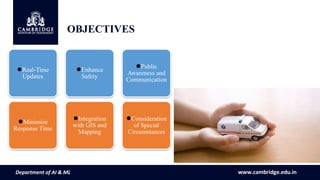
●Real-Time
Updates
●Minimize
Response Time
●Enhance
Safety
●Integration
with GIS and
Mapping
●Public
Awareness and
Communication
●Consideration
of Special
Circumstances
SYSTEM REQUIREMENTS ANALYSIS
www.cambridge.edu.in
Department of AI & ML
• Processor
• RAM
• Hard Disk
HARDWARE
REQUIREMENTS
• Operating System : Windows
• Platform : Jupyter Notebook
• Backend : Anaconda
• Language : Python
SOFTWARE
REQUIREMENTS
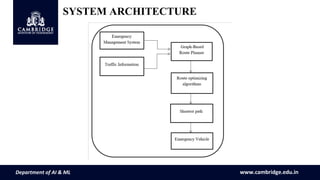
SYSTEM ARCHITECTURE
www.cambridge.edu.in
Department of AI & ML
DESIGN
www.cambridge.edu.in
Department of AI & ML
●GRAPH ALGORITHM
●DIJKSTRA’S ALGORITHM
●TIME ALGORITHM
GRAPH ALGORITHM
www.cambridge.edu.in
Department of AI & ML
• This method is based on graph theory, where the road network is
first converted into graph with nodes and edges.
• Here, nodes represent the area and the edge represents the time
required to travel through.
• The edges are given with different weight i.e. the distance and the
traffic percentage in that route.
www.cambridge.edu.in
Department of AI & ML
DIJKSTRA’S ALGORITHM
www.cambridge.edu.in
Department of AI & ML
• Dijkstra’s algorithm is used to find the shortest path among all the
available paths.
• This algorithm uses the weights of the edges to find the path that
minimizes the total distance between the source node and all other
nodes.
TIME ALGORITHM
www.cambridge.edu.in
Department of AI & ML
• The time taken to move from one location to another is obtained from the calculation of the
distance and weightage of the traffic in that route along with the standard average speed
calculation.
T = D / (S – ((S*P)/100))
D - Distance between two nodes
P - Percentage of traffic flow
S - Average speed
T – Time taken to reach destination
CONCLUSION
• In conclusion, it is evident that in the current world with developing
technology, efficiency and reliability are critical.
• The system developed shows that the fastest route from one point to
another can be determined with a suitable algorithm and also helps
to save many lives by its efficient traffic flow control methodology.
www.cambridge.edu.in
Department of AI & ML
REFERENCE
● W. Yu, W. Bai, W. Luan and L. Qi, "State-of-the-Art Review on Traffic Control Strategies for Emergency
Vehicles," in IEEE Access, vol. 10, pp. 109729-109742, 2022, doi: 10.1109/ACCESS.2022.3213798.
● X. Zhang, X. Yu and X. Wu, "Exponential Rank Differential Evolution Algorithm for Disaster Emergency
Vehicle Path Planning," in IEEE Access, vol. 9, pp. 10880-10892, 2021, doi: 10.1109/ACCESS.2021.3050764.
● Z. -L. Wang, Z. -y. Feng, G. -z. Rao, Y. Wang and C. Zhang, "Public emergency oriented SOA-based logistics
system," 2010 International Conference on Computer Application and System Modeling (ICCASM 2010),
Taiyuan, China, 2010, pp. V1-588-V1-591, doi: 10.1109/ICCASM.2010.5620634.
● Y. Zhang and J. Liu, "Emergency Logistics Scheduling Under Uncertain Transportation Time Using Online
Optimization Methods," in IEEE Access, vol. 9, pp. 36995-37010, 2021, doi: 10.1109/ACCESS.2021.3061454.
● N. Rathore, P. K. Jain and M. Parida, "A ROUTING MODEL FOR EMERGENCY VEHICLES USING THE
REAL TIME TRAFFIC DATA," 2018 IEEE International Conference on Service Operations and Logistics, and
Informatics (SOLI), Singapore, 2018, pp. 175-179, doi: 10.1109/SOLI.2018.8476771.
● H. Wen, Y. Lin and J. Wu, "Co-Evolutionary Optimization Algorithm Based on the Future Traffic Environment
for Emergency Rescue Path Planning," in IEEE Access, vol. 8, pp. 148125-148135, 2020, doi:
10.1109/ACCESS.2020.3014609.
www.cambridge.edu.in
Department of AI & ML
THANK YOU
Department of AI & ML www.cambridge.edu.in

Project Phase 2 ppt.pptx

  • 1.
    “Emergency Vehicle Route OptimizationSystem: Ensuring Rapid Response in Critical Situations” ANANYA V 1CD20AI004 MALAVIKA G 1CD20AI028 MEHAK FATHIMA 1CD20AI033 Project Guide: Dr. Rajani K C
  • 2.
    PROBLEM STATEMENT “Emergency VehicleRoute Optimization System: Ensuring Rapid Response in Critical Situations” www.cambridge.edu.in Department of AI & ML
  • 3.
    ABSTRACT ● This studyfocuses on optimizing traffic flow in busy areas to facilitate the movement of emergency vehicles efficiently. ● The proposed method utilizes graph theory, converting data into a graph with nodes representing areas and edges representing travel time. ● The total travel time is calculated using these weights, and Dijkstra's algorithm is employed to determine the shortest path for emergency vehicles. ● “This approach aims to reduce travel time and enhance the effectiveness of emergency vehicle routes in congested traffic scenarios” www.cambridge.edu.in Department of AI & ML
  • 4.
    INTRODUCTION • In thismodern era approximately 60% of the people get struck in the traffic in their day-to-day life which results in major problems. • To introduce an algorithm that preciously finds the shortest path and guide the emergency vehicle to reach the destination at faster rate. • The solution helps not only emergency vehicle but also the common people who wishes to reach their destination on time. www.cambridge.edu.in Department of AI & ML
  • 5.
    LITERATURE SURVEY www.cambridge.edu.in Department ofAI & ML Paper Title Journal Name Methodology State-of-the-art review in traffic control-strategies for emergency vehicles IEEE Involves deep reinforcement learning methods and the A* algorithm as Dijkstra algorithm for optimizing vehicle routes in complex urban environments. Emergency Logistics Scheduling Under Uncertain Transportation Time Using Optimization Methods. IEEE MOEA, which stands for Multi-Objective Evolutionary Algorithm, is a methodology used in the field of computational optimization to solve problems with multiple conflicting objectives or criteria A routing model for emergency vehicles using the real time traffic data IEEE This paper proposes a method for estimating total travel time in a Vehicle Routing Problem (VRP) network.
  • 6.
    OBJECTIVES www.cambridge.edu.in Department of AI& ML ●Real-Time Updates ●Minimize Response Time ●Enhance Safety ●Integration with GIS and Mapping ●Public Awareness and Communication ●Consideration of Special Circumstances
  • 7.
    SYSTEM REQUIREMENTS ANALYSIS www.cambridge.edu.in Departmentof AI & ML • Processor • RAM • Hard Disk HARDWARE REQUIREMENTS • Operating System : Windows • Platform : Jupyter Notebook • Backend : Anaconda • Language : Python SOFTWARE REQUIREMENTS
  • 8.
  • 9.
    DESIGN www.cambridge.edu.in Department of AI& ML ●GRAPH ALGORITHM ●DIJKSTRA’S ALGORITHM ●TIME ALGORITHM
  • 10.
    GRAPH ALGORITHM www.cambridge.edu.in Department ofAI & ML • This method is based on graph theory, where the road network is first converted into graph with nodes and edges. • Here, nodes represent the area and the edge represents the time required to travel through. • The edges are given with different weight i.e. the distance and the traffic percentage in that route.
  • 11.
  • 12.
    DIJKSTRA’S ALGORITHM www.cambridge.edu.in Department ofAI & ML • Dijkstra’s algorithm is used to find the shortest path among all the available paths. • This algorithm uses the weights of the edges to find the path that minimizes the total distance between the source node and all other nodes.
  • 14.
    TIME ALGORITHM www.cambridge.edu.in Department ofAI & ML • The time taken to move from one location to another is obtained from the calculation of the distance and weightage of the traffic in that route along with the standard average speed calculation. T = D / (S – ((S*P)/100)) D - Distance between two nodes P - Percentage of traffic flow S - Average speed T – Time taken to reach destination
  • 15.
    CONCLUSION • In conclusion,it is evident that in the current world with developing technology, efficiency and reliability are critical. • The system developed shows that the fastest route from one point to another can be determined with a suitable algorithm and also helps to save many lives by its efficient traffic flow control methodology. www.cambridge.edu.in Department of AI & ML
  • 16.
    REFERENCE ● W. Yu,W. Bai, W. Luan and L. Qi, "State-of-the-Art Review on Traffic Control Strategies for Emergency Vehicles," in IEEE Access, vol. 10, pp. 109729-109742, 2022, doi: 10.1109/ACCESS.2022.3213798. ● X. Zhang, X. Yu and X. Wu, "Exponential Rank Differential Evolution Algorithm for Disaster Emergency Vehicle Path Planning," in IEEE Access, vol. 9, pp. 10880-10892, 2021, doi: 10.1109/ACCESS.2021.3050764. ● Z. -L. Wang, Z. -y. Feng, G. -z. Rao, Y. Wang and C. Zhang, "Public emergency oriented SOA-based logistics system," 2010 International Conference on Computer Application and System Modeling (ICCASM 2010), Taiyuan, China, 2010, pp. V1-588-V1-591, doi: 10.1109/ICCASM.2010.5620634. ● Y. Zhang and J. Liu, "Emergency Logistics Scheduling Under Uncertain Transportation Time Using Online Optimization Methods," in IEEE Access, vol. 9, pp. 36995-37010, 2021, doi: 10.1109/ACCESS.2021.3061454. ● N. Rathore, P. K. Jain and M. Parida, "A ROUTING MODEL FOR EMERGENCY VEHICLES USING THE REAL TIME TRAFFIC DATA," 2018 IEEE International Conference on Service Operations and Logistics, and Informatics (SOLI), Singapore, 2018, pp. 175-179, doi: 10.1109/SOLI.2018.8476771. ● H. Wen, Y. Lin and J. Wu, "Co-Evolutionary Optimization Algorithm Based on the Future Traffic Environment for Emergency Rescue Path Planning," in IEEE Access, vol. 8, pp. 148125-148135, 2020, doi: 10.1109/ACCESS.2020.3014609. www.cambridge.edu.in Department of AI & ML
  • 17.
    THANK YOU Department ofAI & ML www.cambridge.edu.in