PREPARED BY :- JYOTISMAT RAUL
ROLL NO :-15PHY028
Objective is to
explain what a heat engine is, and
compute its thermal efficiency
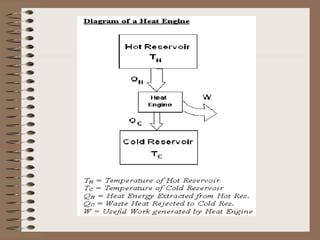
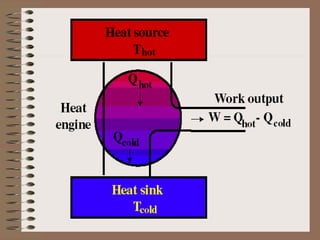
Heat engine is a device by which a
system is made to undergo a cyclic
process that results in conversion of heat
into work.
The different parts of heat engine are
HOT RESERVOIR or Source is a
material kept at high temperature and
having infinite thermal capacity. Any
amount of heat can be taken from it
without changing its temperature.
COLD RESERVOIR or Sink is a
material kept at low temperature and
having infinite thermal capacity. Any
amount of heat can be given to it
without changing its temperature.
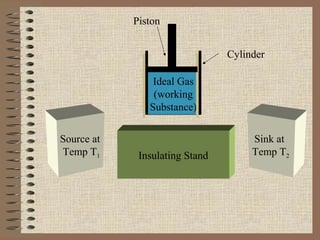
Working substance is a material which
converts heat energy in to work. It is taken
in a cylinder fitted with tight movable
frictionless piston. The lower side of the
cylinder will be thermally conducting.
It insulates the working substance
from thermal contact with the surroundings.
That is used for performing the adiabatic
process.
Insulating Stand
Source at
Temp T1
Sink at
Temp T2
Ideal Gas
(working
Substance)
Cylinder
Piston
Carnot engine is an ideal heat
engine whose efficiency is maximum.
In carnot engine, carnot cycle is used.
In carnot engine, ideal gas is the
working substance and all the dissipative
forces are absent.
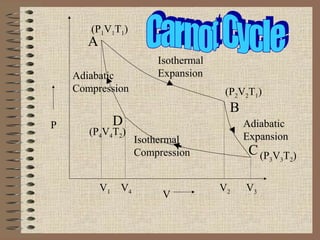
Carnot devised an ideal cycle of
operation for a heat engine and is know as
carnot cycle.
In one complete cycle of operation,
there are four different thermodynamic
processes.
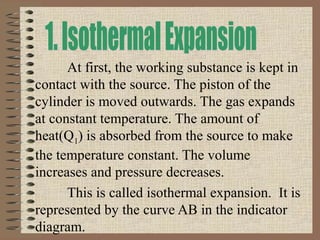
At first, the working substance is kept in
contact with the source. The piston of the
cylinder is moved outwards. The gas expands
at constant temperature. The amount of
heat(Q1) is absorbed from the source to make
the temperature constant. The volume
increases and pressure decreases.
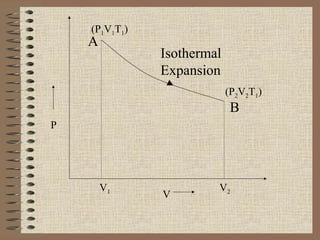
This is called isothermal expansion. It is
represented by the curve AB in the indicator
diagram.
V
P
(P1V1T1)
(P2V2T1)
A
B
V1 V2
Isothermal
Expansion
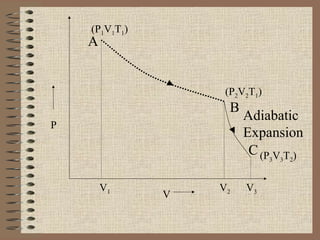
The lower conducting side of the cylinder
is kept in contact with the insulating stand. The
piston of the cylinder is moved outwards. The
gas expands such that no heat enters the system
or leaves from it. The volume increases and
pressure decreases. The temperature is
decreased from T1 to T2.
This is called adiabatic expansion. It is
represented by the curve BC in the indicator
diagram.
V
P
(P1V1T1)
(P2V2T1)
(P3V3T2)
A
B
C
V1 V2 V3
Adiabatic
Expansion
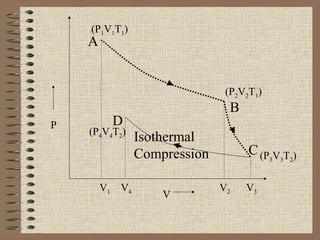
The cylinder is kept in contact with
the sink. The piston of the cylinder is
moved inwards. The gas is compressed at
constant temperature. The excess heat
produced(Q2) will flow to the sink to make
the temperature constant. The volume
decreases and pressure increases.
This is called isothermal
compression. It is represented by the
curve CD in the indicator diagram.
V
P
(P1V1T1)
(P2V2T1)
(P4V4T2)
A
B
C
D
V1 V2 V3V4
Isothermal
Compression (P3V3T2)
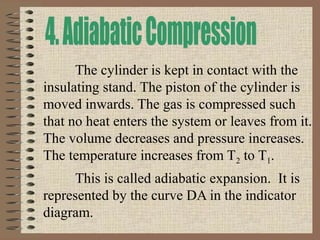
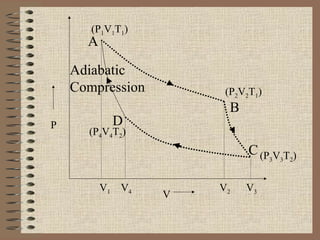
The cylinder is kept in contact with the
insulating stand. The piston of the cylinder is
moved inwards. The gas is compressed such
that no heat enters the system or leaves from it.
The volume decreases and pressure increases.
The temperature increases from T2 to T1.
This is called adiabatic expansion. It is
represented by the curve DA in the indicator
diagram.
V
P
(P1V1T1)
(P2V2T1)
(P4V4T2)
A
B
C
D
V1 V2 V3V4
Adiabatic
Compression
(P3V3T2)
V
P
(P1V1T1)
(P2V2T1)
(P3V3T2)
(P4V4T2)
A
B
C
D
V1 V2 V3V4
Isothermal
Expansion
Adiabatic
ExpansionIsothermal
Compression
Adiabatic
Compression
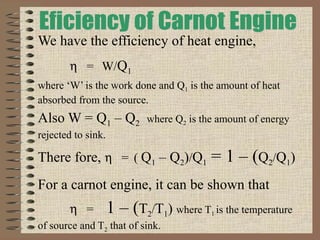
We have the efficiency of heat engine,
η = W/Q1
where ‘W’ is the work done and Q1 is the amount of heat
absorbed from the source.
Also W = Q1 – Q2 where Q2 is the amount of energy
rejected to sink.
There fore, η = ( Q1 – Q2)/Q1 = 1 – (Q2/Q1)
For a carnot engine, it can be shown that
η = 1 – (T2/T1) where T1 is the temperature
of source and T2 that of sink.
 Carnot engine is purely an
imaginary engine. But all real engines
are constructed based on carnot cycle.
 No other engine can have same
efficiency as that of a carnot engine
working between the same
temperature range.

Project on Carnot Engine

  • 1.
    PREPARED BY :-JYOTISMAT RAUL ROLL NO :-15PHY028
  • 2.
    Objective is to explainwhat a heat engine is, and compute its thermal efficiency
  • 3.
    Heat engine isa device by which a system is made to undergo a cyclic process that results in conversion of heat into work.
  • 4.
    The different partsof heat engine are HOT RESERVOIR or Source is a material kept at high temperature and having infinite thermal capacity. Any amount of heat can be taken from it without changing its temperature.
  • 5.
    COLD RESERVOIR orSink is a material kept at low temperature and having infinite thermal capacity. Any amount of heat can be given to it without changing its temperature.
  • 6.
    Working substance isa material which converts heat energy in to work. It is taken in a cylinder fitted with tight movable frictionless piston. The lower side of the cylinder will be thermally conducting.
  • 7.
    It insulates theworking substance from thermal contact with the surroundings. That is used for performing the adiabatic process.
  • 8.
    Insulating Stand Source at TempT1 Sink at Temp T2 Ideal Gas (working Substance) Cylinder Piston
  • 11.
    Carnot engine isan ideal heat engine whose efficiency is maximum. In carnot engine, carnot cycle is used. In carnot engine, ideal gas is the working substance and all the dissipative forces are absent.
  • 12.
    Carnot devised anideal cycle of operation for a heat engine and is know as carnot cycle. In one complete cycle of operation, there are four different thermodynamic processes.
  • 13.
    At first, theworking substance is kept in contact with the source. The piston of the cylinder is moved outwards. The gas expands at constant temperature. The amount of heat(Q1) is absorbed from the source to make the temperature constant. The volume increases and pressure decreases. This is called isothermal expansion. It is represented by the curve AB in the indicator diagram.
  • 14.
  • 15.
    The lower conductingside of the cylinder is kept in contact with the insulating stand. The piston of the cylinder is moved outwards. The gas expands such that no heat enters the system or leaves from it. The volume increases and pressure decreases. The temperature is decreased from T1 to T2. This is called adiabatic expansion. It is represented by the curve BC in the indicator diagram.
  • 16.
  • 17.
    The cylinder iskept in contact with the sink. The piston of the cylinder is moved inwards. The gas is compressed at constant temperature. The excess heat produced(Q2) will flow to the sink to make the temperature constant. The volume decreases and pressure increases. This is called isothermal compression. It is represented by the curve CD in the indicator diagram.
  • 18.
  • 19.
    The cylinder iskept in contact with the insulating stand. The piston of the cylinder is moved inwards. The gas is compressed such that no heat enters the system or leaves from it. The volume decreases and pressure increases. The temperature increases from T2 to T1. This is called adiabatic expansion. It is represented by the curve DA in the indicator diagram.
  • 20.
  • 21.
  • 22.
    We have theefficiency of heat engine, η = W/Q1 where ‘W’ is the work done and Q1 is the amount of heat absorbed from the source. Also W = Q1 – Q2 where Q2 is the amount of energy rejected to sink. There fore, η = ( Q1 – Q2)/Q1 = 1 – (Q2/Q1) For a carnot engine, it can be shown that η = 1 – (T2/T1) where T1 is the temperature of source and T2 that of sink.
  • 23.
     Carnot engineis purely an imaginary engine. But all real engines are constructed based on carnot cycle.  No other engine can have same efficiency as that of a carnot engine working between the same temperature range.