WELCOME TO THE
PRESENTATION ON
“EMPLOYEE
PERCEPTION ON
JOB APPRAISAL IN
PHARMACEUTICAL
COMPANIES”
Team : Snipers
INTRODUCTION
Performance management is a process by
which managers and employees work together to plan,
monitor and review an employee's work objectives and
overall contribution to the organization.
Perceptions of employees about the targets, outcomes
and uses of performance appraisal (PA) results would
be beneficial depending on a number of factors.
OBJECTIVES OF THE STUDY
 To get a clear scenario of employee perception
of job appraisal practices
 To find the relation between performance
appraisal and work performance.
 Assessment of the level of employees’ work
outcomes in the form of work performance
PERFORMANCE APPRAISAL
 Employee appraisal is a method by which the job performance of
an employee is documented and evaluated. Performance
appraisals are a part of career development and consist of regular
reviews of employee performance within organizations.
 It is a systematic and periodic process that assesses an
individual employee’s job performance and productivity
 Helps to assess an employee's performance goals
 To involve the employee in setting goals for the organization
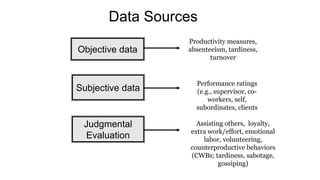
Objective data
Subjective data
Judgmental
Evaluation
Productivity measures,
absenteeism, tardiness,
turnover
Assisting others, loyalty,
extra work/effort, emotional
labor, volunteering,
counterproductive behaviors
(CWBs; tardiness, sabotage,
gossiping)
Performance ratings
(e.g., supervisor, co-
workers, self,
subordinates, clients
Data Sources
METHODS OF
PERFORMANCE
APPRAISALS
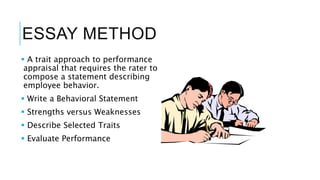
ESSAY METHOD
 A trait approach to performance
appraisal that requires the rater to
compose a statement describing
employee behavior.
 Write a Behavioral Statement
 Strengths versus Weaknesses
 Describe Selected Traits
 Evaluate Performance
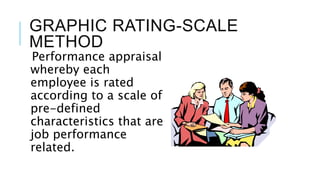
GRAPHIC RATING-SCALE
METHOD
Performance appraisal
whereby each
employee is rated
according to a scale of
pre-defined
characteristics that are
job performance
related.
FORCED-CHOICE METHOD
A trait approach to
performance appraisal that
requires the rater to choose
from statements designed
to distinguish between
successful and unsuccessful
performance.
BEHAVIORALLY ANCHORED RATING
SCALE (BARS)
A behavioral approach
to performance
appraisal that consists
of a series of vertical
scales, one for each
important dimension
of job performance.
CRITICAL INCIDENT
Unusual event that
denotes superior or
inferior employee
performance in some
part of the job.
WHO PERFORMS THE
APPRAISAL?
 Immediate Supervisor
 Higher Management
 Self-Appraisals
 Peers (Co-Workers)
 Evaluation Teams
 Customers
 “360° Appraisals”
SUPERVISOR APPRAISAL
Performance appraisal
done by an employee’s
manager and often
reviewed by a manager
one level higher.
SELF-APPRAISAL
Performance appraisal done
by the employee being
evaluated, generally on an
appraisal form completed by
the employee prior to the
performance review.
SUBORDINATE APPRAISAL
Performance appraisal
of a superior by an
employee, which is
more appropriate for
developmental than for
administrative
purposes.
PEER APPRAISAL
Performance appraisal done
by one’s fellow employees,
generally on forms that are
complied into a single profile
for use in the performance
interview conducted by the
employee’s manager.
TEAM APPRAISAL
Performance appraisal,
based on TQM
concepts, that
recognizes team
accomplishment rather
than individual
performance.
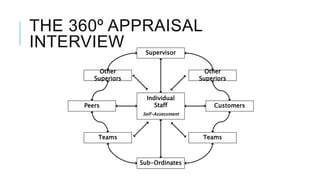
THE 360º APPRAISAL
INTERVIEW
Individual
Staff
Self-Assessment
Supervisor
Other
Superiors
Peers
Teams
Sub-Ordinates
Teams
Customers
Other
Superiors
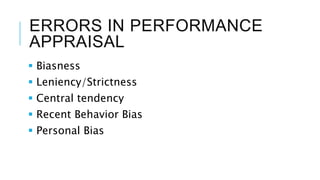
ERRORS IN PERFORMANCE
APPRAISAL
 Biasness
 Leniency/Strictness
 Central tendency
 Recent Behavior Bias
 Personal Bias
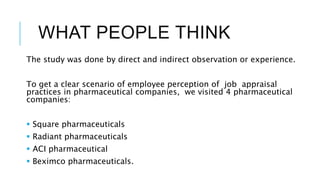
WHAT PEOPLE THINK
The study was done by direct and indirect observation or experience.
To get a clear scenario of employee perception of job appraisal
practices in pharmaceutical companies, we visited 4 pharmaceutical
companies:
 Square pharmaceuticals
 Radiant pharmaceuticals
 ACI pharmaceutical
 Beximco pharmaceuticals.
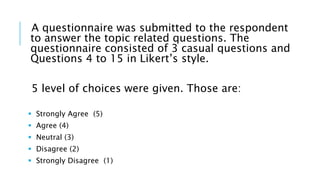
A questionnaire was submitted to the respondent
to answer the topic related questions. The
questionnaire consisted of 3 casual questions and
Questions 4 to 15 in Likert’s style.
5 level of choices were given. Those are:
 Strongly Agree (5)
 Agree (4)
 Neutral (3)
 Disagree (2)
 Strongly Disagree (1)
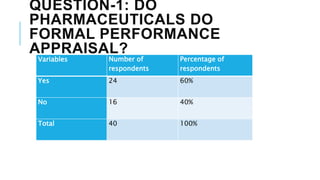
QUESTION-1: DO
PHARMACEUTICALS DO
FORMAL PERFORMANCE
APPRAISAL?
Variables Number of
respondents
Percentage of
respondents
Yes 24 60%
No 16 40%
Total 40 100%
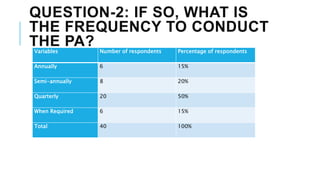
QUESTION-2: IF SO, WHAT IS
THE FREQUENCY TO CONDUCT
THE PA?Variables Number of respondents Percentage of respondents
Annually 6 15%
Semi-annually 8 20%
Quarterly 20 50%
When Required 6 15%
Total 40 100%
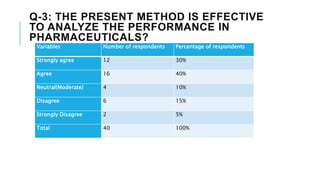
Q-3: THE PRESENT METHOD IS EFFECTIVE
TO ANALYZE THE PERFORMANCE IN
PHARMACEUTICALS?
Variables Number of respondents Percentage of respondents
Strongly agree 12 30%
Agree 16 40%
Neutral(Moderate) 4 10%
Disagree 6 15%
Strongly Disagree 2 5%
Total 40 100%
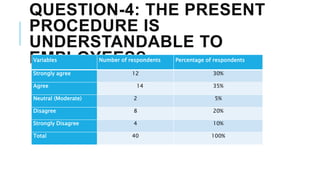
QUESTION-4: THE PRESENT
PROCEDURE IS
UNDERSTANDABLE TO
EMPLOYEES?Variables Number of respondents Percentage of respondents
Strongly agree 12 30%
Agree 14 35%
Neutral (Moderate) 2 5%
Disagree 8 20%
Strongly Disagree 4 10%
Total 40 100%
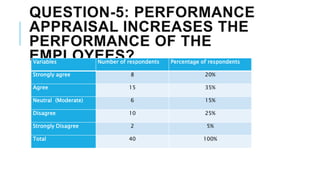
QUESTION-5: PERFORMANCE
APPRAISAL INCREASES THE
PERFORMANCE OF THE
EMPLOYEES?Variables Number of respondents Percentage of respondents
Strongly agree 8 20%
Agree 15 35%
Neutral (Moderate) 6 15%
Disagree 10 25%
Strongly Disagree 2 5%
Total 40 100%
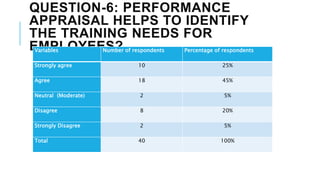
QUESTION-6: PERFORMANCE
APPRAISAL HELPS TO IDENTIFY
THE TRAINING NEEDS FOR
EMPLOYEES?Variables Number of respondents Percentage of respondents
Strongly agree 10 25%
Agree 18 45%
Neutral (Moderate) 2 5%
Disagree 8 20%
Strongly Disagree 2 5%
Total 40 100%
RECOMMENDATIONS
 Pharmaceutical companies should adopt specific job
analysis and performance evaluation method for specific
job.
 There should have room for employees to choose their
job location.
 Basic pay should be increased along with incentives.
 They should follow proper policy regarding employee
evaluation.
RECOMMENDATIONS
 Fresh graduate or inexperienced employees should also
be given the chance to get flexibility.
 Current condition of job appraisal should be reviewed on
regular basis.
 The job description should be more precise & complete.
 Job specification should be somewhat flexible than that of
present time.
 Job analysis should be more attractive to the new job
seekers.
CONCLUSION
The primary objective of this study was to assess the
influence of perception of performance appraisal on
employee work outcomes, because performance
appraisal has been an issue of major concern with its
long lasting impacts on the employees’ work outcomes
The study has been successful in accomplishing its
objectives.
In the part of the descriptive finding we have been able
to present the perceptions of the employees with
regard to the performance appraisal system where in
the employees express that they had moderate level of
CONCLUSION
We tried to present the relationship between employees’
perception of performance appraisal and their expected work
outcomes, in the form of
 Work performance
 Commitment
 Turn over intention
Thus, based on the correlation analysis result, employees’
perception of performance appraisal has significant and positive
relation with work performance and affective organizational
commitment.
THANK YOU

Final employee-performance

  • 1.
    WELCOME TO THE PRESENTATIONON “EMPLOYEE PERCEPTION ON JOB APPRAISAL IN PHARMACEUTICAL COMPANIES” Team : Snipers
  • 2.
    INTRODUCTION Performance management isa process by which managers and employees work together to plan, monitor and review an employee's work objectives and overall contribution to the organization. Perceptions of employees about the targets, outcomes and uses of performance appraisal (PA) results would be beneficial depending on a number of factors.
  • 3.
    OBJECTIVES OF THESTUDY  To get a clear scenario of employee perception of job appraisal practices  To find the relation between performance appraisal and work performance.  Assessment of the level of employees’ work outcomes in the form of work performance
  • 4.
    PERFORMANCE APPRAISAL  Employeeappraisal is a method by which the job performance of an employee is documented and evaluated. Performance appraisals are a part of career development and consist of regular reviews of employee performance within organizations.  It is a systematic and periodic process that assesses an individual employee’s job performance and productivity  Helps to assess an employee's performance goals  To involve the employee in setting goals for the organization
  • 5.
    Objective data Subjective data Judgmental Evaluation Productivitymeasures, absenteeism, tardiness, turnover Assisting others, loyalty, extra work/effort, emotional labor, volunteering, counterproductive behaviors (CWBs; tardiness, sabotage, gossiping) Performance ratings (e.g., supervisor, co- workers, self, subordinates, clients Data Sources
  • 6.
  • 7.
    ESSAY METHOD  Atrait approach to performance appraisal that requires the rater to compose a statement describing employee behavior.  Write a Behavioral Statement  Strengths versus Weaknesses  Describe Selected Traits  Evaluate Performance
  • 8.
    GRAPHIC RATING-SCALE METHOD Performance appraisal wherebyeach employee is rated according to a scale of pre-defined characteristics that are job performance related.
  • 9.
    FORCED-CHOICE METHOD A traitapproach to performance appraisal that requires the rater to choose from statements designed to distinguish between successful and unsuccessful performance.
  • 10.
    BEHAVIORALLY ANCHORED RATING SCALE(BARS) A behavioral approach to performance appraisal that consists of a series of vertical scales, one for each important dimension of job performance.
  • 11.
    CRITICAL INCIDENT Unusual eventthat denotes superior or inferior employee performance in some part of the job.
  • 12.
    WHO PERFORMS THE APPRAISAL? Immediate Supervisor  Higher Management  Self-Appraisals  Peers (Co-Workers)  Evaluation Teams  Customers  “360° Appraisals”
  • 13.
    SUPERVISOR APPRAISAL Performance appraisal doneby an employee’s manager and often reviewed by a manager one level higher.
  • 14.
    SELF-APPRAISAL Performance appraisal done bythe employee being evaluated, generally on an appraisal form completed by the employee prior to the performance review.
  • 15.
    SUBORDINATE APPRAISAL Performance appraisal ofa superior by an employee, which is more appropriate for developmental than for administrative purposes.
  • 16.
    PEER APPRAISAL Performance appraisaldone by one’s fellow employees, generally on forms that are complied into a single profile for use in the performance interview conducted by the employee’s manager.
  • 17.
    TEAM APPRAISAL Performance appraisal, basedon TQM concepts, that recognizes team accomplishment rather than individual performance.
  • 18.
  • 19.
    ERRORS IN PERFORMANCE APPRAISAL Biasness  Leniency/Strictness  Central tendency  Recent Behavior Bias  Personal Bias
  • 20.
    WHAT PEOPLE THINK Thestudy was done by direct and indirect observation or experience. To get a clear scenario of employee perception of job appraisal practices in pharmaceutical companies, we visited 4 pharmaceutical companies:  Square pharmaceuticals  Radiant pharmaceuticals  ACI pharmaceutical  Beximco pharmaceuticals.
  • 21.
    A questionnaire wassubmitted to the respondent to answer the topic related questions. The questionnaire consisted of 3 casual questions and Questions 4 to 15 in Likert’s style. 5 level of choices were given. Those are:  Strongly Agree (5)  Agree (4)  Neutral (3)  Disagree (2)  Strongly Disagree (1)
  • 22.
    QUESTION-1: DO PHARMACEUTICALS DO FORMALPERFORMANCE APPRAISAL? Variables Number of respondents Percentage of respondents Yes 24 60% No 16 40% Total 40 100%
  • 23.
    QUESTION-2: IF SO,WHAT IS THE FREQUENCY TO CONDUCT THE PA?Variables Number of respondents Percentage of respondents Annually 6 15% Semi-annually 8 20% Quarterly 20 50% When Required 6 15% Total 40 100%
  • 24.
    Q-3: THE PRESENTMETHOD IS EFFECTIVE TO ANALYZE THE PERFORMANCE IN PHARMACEUTICALS? Variables Number of respondents Percentage of respondents Strongly agree 12 30% Agree 16 40% Neutral(Moderate) 4 10% Disagree 6 15% Strongly Disagree 2 5% Total 40 100%
  • 25.
    QUESTION-4: THE PRESENT PROCEDUREIS UNDERSTANDABLE TO EMPLOYEES?Variables Number of respondents Percentage of respondents Strongly agree 12 30% Agree 14 35% Neutral (Moderate) 2 5% Disagree 8 20% Strongly Disagree 4 10% Total 40 100%
  • 26.
    QUESTION-5: PERFORMANCE APPRAISAL INCREASESTHE PERFORMANCE OF THE EMPLOYEES?Variables Number of respondents Percentage of respondents Strongly agree 8 20% Agree 15 35% Neutral (Moderate) 6 15% Disagree 10 25% Strongly Disagree 2 5% Total 40 100%
  • 27.
    QUESTION-6: PERFORMANCE APPRAISAL HELPSTO IDENTIFY THE TRAINING NEEDS FOR EMPLOYEES?Variables Number of respondents Percentage of respondents Strongly agree 10 25% Agree 18 45% Neutral (Moderate) 2 5% Disagree 8 20% Strongly Disagree 2 5% Total 40 100%
  • 28.
    RECOMMENDATIONS  Pharmaceutical companiesshould adopt specific job analysis and performance evaluation method for specific job.  There should have room for employees to choose their job location.  Basic pay should be increased along with incentives.  They should follow proper policy regarding employee evaluation.
  • 29.
    RECOMMENDATIONS  Fresh graduateor inexperienced employees should also be given the chance to get flexibility.  Current condition of job appraisal should be reviewed on regular basis.  The job description should be more precise & complete.  Job specification should be somewhat flexible than that of present time.  Job analysis should be more attractive to the new job seekers.
  • 30.
    CONCLUSION The primary objectiveof this study was to assess the influence of perception of performance appraisal on employee work outcomes, because performance appraisal has been an issue of major concern with its long lasting impacts on the employees’ work outcomes The study has been successful in accomplishing its objectives. In the part of the descriptive finding we have been able to present the perceptions of the employees with regard to the performance appraisal system where in the employees express that they had moderate level of
  • 31.
    CONCLUSION We tried topresent the relationship between employees’ perception of performance appraisal and their expected work outcomes, in the form of  Work performance  Commitment  Turn over intention Thus, based on the correlation analysis result, employees’ perception of performance appraisal has significant and positive relation with work performance and affective organizational commitment.
  • 32.