TMHG 526 
Project Management 
Nawanan Theera‐Ampornpunt, M.D., Ph.D. 
Faculty of Medicine Ramathibodi Hospital 
Mahidol University 
October 10, 2014
IT Project Management 
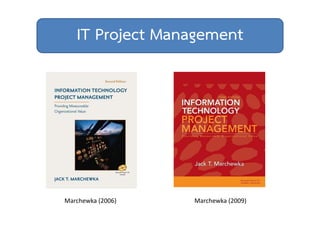
Marchewka (2006) Marchewka (2009)
Introduction 
• Information Technology (IT) projects are organizational 
investments that require 
– Time 
– Money 
– Other resources such as people, technology, facilities, etc. 
• Organizations expect some type of value in return of this 
investment 
• IT Project Management is a relatively new discipline that 
combines traditional Project Management with Software 
Engineering/Management Information Systems to make IT 
projects more successful.
An ITPM Approach 
• Organizational resources are limited, so 
organizations must choose among competing 
interests to fund specific projects. 
• This decision should be based on the value a 
competing project will provide to an organization.
Which Situation Is Worse? 
• Successfully building and implementing a system 
that provides little or no value to the 
organization. 
Or… 
• Failing to implement an information system that 
could have provided value to the organization, 
but was poorly developed or poorly managed.
The Software Crisis 
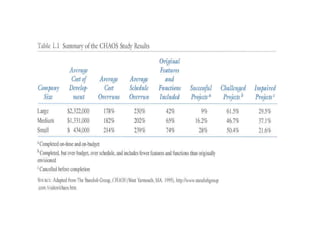
• The CHAOS study published in 1995 by The Standish 
Group found that although the U.S. spent over $250 
billion on IT projects, approximately… 
–31% were cancelled before completion 
–53% were completed but over budget, over 
schedule, and did not meet original specifications. 
• For mid-size companies, average cost overruns 
were 182%, while average schedule overruns 
were 202%!
Why Do IT Projects Fail? 
• Larger projects have the lowest success rate and 
appear to be more risky than medium and smaller 
projects 
–Technology, business models and markets change 
so rapidly that a project that takes more than a 
year can be obsolete before they are completed. 
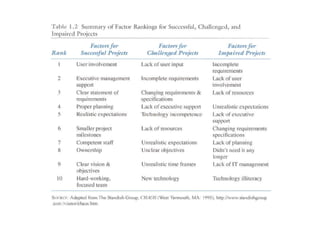
• The Chaos study also provides some insight as to the 
factors that influence project success.
Has the Current State of IT Projects 
Changed Since 1995? 
• The Standish Group has continued to study IT 
projects over the years. 
• In general, IT Projects are showing higher success 
rates due to 
–Better project management tools & processes 
–Smaller projects 
–Improved communication among stakeholders 
–More skillful IT project managers 
• But there is still ample opportunity for improvement!
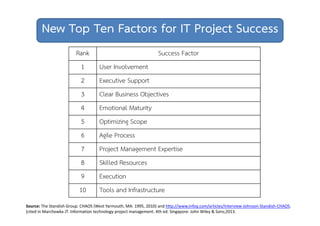
New Top Ten Factors for IT Project Success 
Rank Success Factor 
1 User Involvement 
2 Executive Support 
3 Clear Business Objectives 
4 Emotional Maturity 
5 Optimizing Scope 
6 Agile Process 
7 Project Management Expertise 
8 Skilled Resources 
9 Execution 
10 Tools and Infrastructure 
Source: The Standish Group. CHAOS (West Yarmouth, MA: 1995, 2010) and http://www.infoq.com/articles/Interview‐Johnson‐Standish‐CHAOS. 
(cited in Marchewka JT. Information technology project management. 4th ed. Singapore: John Wiley & Sons;2013.
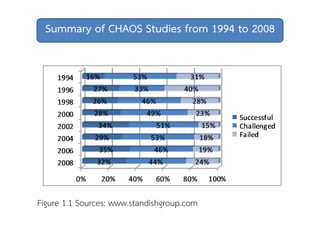
Summary of CHAOS Studies from 1994 to 2008 
Figure 1.1 Sources: www.standishgroup.com
Improving the Likelihood of Success 
• Socio-technical Approach 
• Project Management Approach 
– processes and infrastructure (Methodology) 
– resources 
– expectations 
– competition 
– efficiency and effectiveness 
• Knowledge Management Approach 
– lessons learned, best practices and shared knowledge
IT Project Management 
• A project: “a temporary endeavor undertaken to 
accomplish a unique purpose” 
• Project management: “the application of 
knowledge, skills, tools, and techniques to 
project activities in order to meet or exceed 
project requirements” 
Marchewka (2006)
The Context of Project Management - Project Attributes 
• Time Frame 
• Purpose (to provide value!) 
• Ownership 
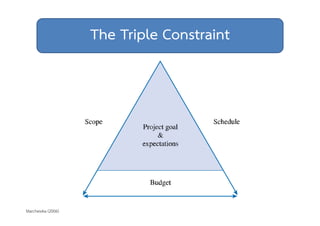
• Resources (the triple constraint) 
• Roles 
– Project Manager 
– Project Sponsor 
– Subject Matter Experts 
– Technical Experts 
• Risk & Assumptions 
• Interdependent Tasks 
• Planned Organizational Change 
• Operate in Environments Larger than the Project Itself
Class Exercise 
The Importance of Project Management 
Group discussion: Without proper Project 
Management, what can go wrong with the IT 
projects?
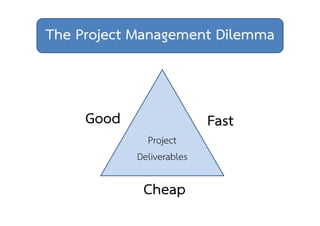
The Project Management Dilemma 
Good Fast 
Project 
Deliverables 
Cheap
The Triple Constraint 
Marchewka (2006)
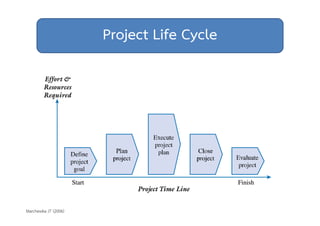
The Project Life Cycle & IT Development 
• Project Life Cycle (PLC) 
– A collection of logical stages or phases that maps the life 
of a project from its beginning to its end in order to define, 
build and deliver the product of the project – i.e., the 
information system 
• Projects are divided into phases to increase 
manageability and reduce risk 
– Phase exits, stage gates, or kill points are decision points 
at the end of each phase to evaluate performance, correct 
problems or cancel the project 
– Fast tracking is the overlapping of phases to reduce the 
project’s schedule 
• Can be risky!
Project Life Cycle 
Marchewka JT (2006)
Software Development Life Cycle (SDLC) 
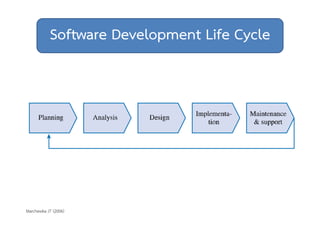
• Represents the sequential phases or stages an information 
system follows throughout its useful life 
• Useful for understanding the development of the project’s 
largest work product – the application system 
• Phases/Stages 
– Planning 
– Analysis 
– Design 
– Implementation 
– Maintenance and Support
Software Development Life Cycle 
Marchewka JT (2006)
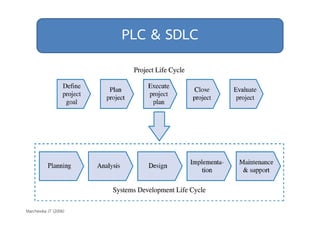
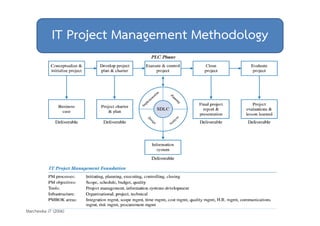
Relationship Between PLC & SDLC 
• The systems development life cycle (SDLC) 
becomes part of the project life cycle (PLC). 
–The PLC focuses on the project management 
phases, processes, tools and techniques for 
effectively managing the project. 
–The SDLC focuses on the software engineering 
phases, processes, tools and techniques for building 
and/or implementing the IT solution.
PLC & SDLC 
Marchewka JT (2006)
IT Project Management Methodology 
Marchewka JT (2006)
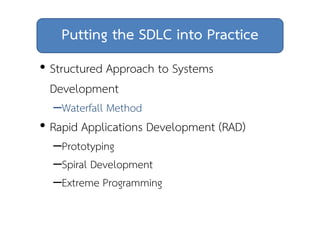
Putting the SDLC into Practice 
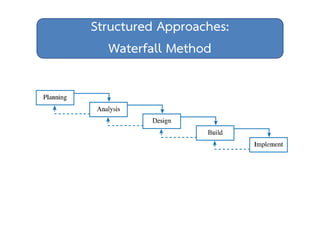
• Structured Approach to Systems 
Development 
–Waterfall Method 
• Rapid Applications Development (RAD) 
–Prototyping 
–Spiral Development 
–Extreme Programming
Structured Approaches: 
Waterfall Method
Extreme Project Management (XPM) 
• A new approach and philosophy to project management that 
is becoming increasingly popular. 
• Characterizes many of today’s projects that exemplify speed, 
uncertainty, changing requirements and high risks. 
• Traditional project management often takes an orderly 
approach while XPM embraces the fact that projects are often 
chaotic and unpredictable. 
• XPM focuses on flexibility, adaptability and innovation 
• Traditional and new approaches together can provide us with 
a better understanding of how to improve the likelihood of 
project success.
The Project Management 
Body of Knowledge (PMBOK®) 
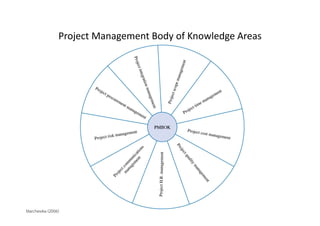
• The Guide to the Project Management Body of Knowledge (PMBOK® 
Guide) documents 9 project management knowledge areas. 
• The PMBOK® Guide is published and maintained by the Project 
Management Institute (PMI). 
– http://www.pmi.org 
• PMI provides a certification in project management called the Project 
Management Professional (PMP) that many people today believe will 
be as relevant as a CPA certification. 
• PMP certification requires that you pass a PMP certification exam to 
demonstrate a level of understanding about project management, as 
well as satisfy education and experience requirements, and agree to a 
professional code of conduct.
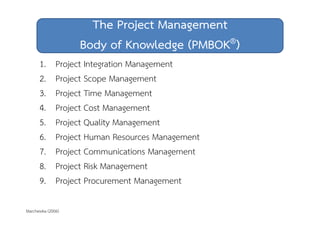
The Project Management 
Body of Knowledge (PMBOK®) 
1. Project Integration Management 
2. Project Scope Management 
3. Project Time Management 
4. Project Cost Management 
5. Project Quality Management 
6. Project Human Resources Management 
7. Project Communications Management 
8. Project Risk Management 
9. Project Procurement Management 
Marchewka (2006)
Project Management Body of Knowledge Areas 
Marchewka (2006)
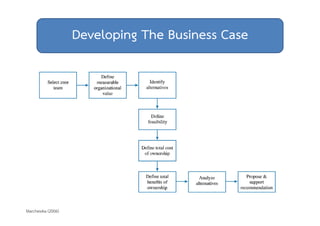
Developing The Business Case 
Marchewka (2006)
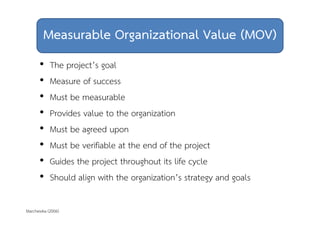
Measurable Organizational Value (MOV) 
• The project’s goal 
• Measure of success 
• Must be measurable 
• Provides value to the organization 
• Must be agreed upon 
• Must be verifiable at the end of the project 
• Guides the project throughout its life cycle 
• Should align with the organization’s strategy and goals 
Marchewka (2006)
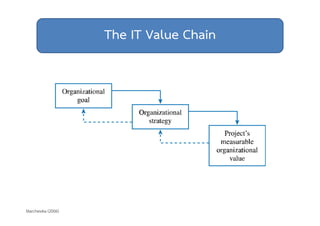
The IT Value Chain 
Marchewka (2006)
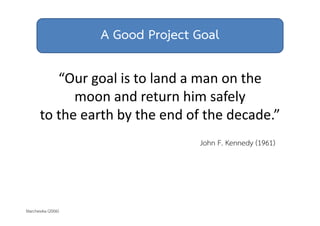
A Good Project Goal 
“Our goal is to land a man on the 
moon and return him safely 
to the earth by the end of the decade.” 
Marchewka (2006) 
John F. Kennedy (1961)
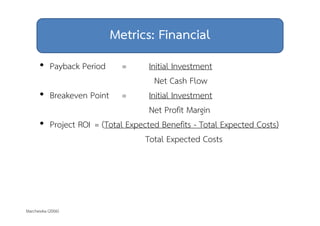
Metrics: Financial 
• Payback Period = Initial Investment 
Marchewka (2006) 
Net Cash Flow 
• Breakeven Point = Initial Investment 
Net Profit Margin 
• Project ROI = (Total Expected Benefits - Total Expected Costs) 
Total Expected Costs
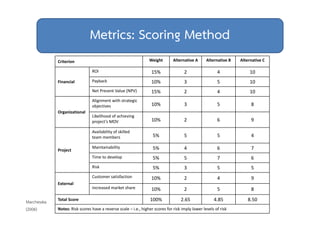
Metrics: Scoring Method 
Marchewka 
(2006) 
Criterion Weight Alternative A Alternative B Alternative C 
Financial 
ROI 15% 2 4 10 
Payback 10% 3 5 10 
Net Present Value (NPV) 15% 2 4 10 
Organizational 
Alignment with strategic 
objectives 10% 3 5 8 
Likelihood of achieving 
project’s MOV 10% 2 6 9 
Project 
Availability of skilled 
team members 5% 5 5 4 
Maintainability 5% 4 6 7 
Time to develop 5% 5 7 6 
Risk 5% 3 5 5 
External 
Customer satisfaction 10% 2 4 9 
Increased market share 10% 2 5 8 
Total Score 100% 2.65 4.85 8.50 
Notes: Risk scores have a reverse scale – i.e., higher scores for risk imply lower levels of risk
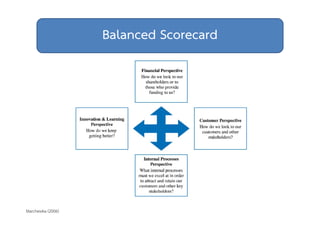
Balanced Scorecard 
Marchewka (2006)
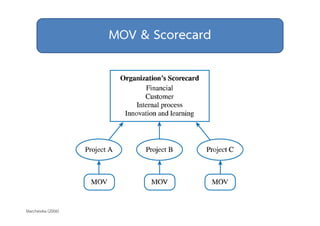
MOV & Scorecard 
Marchewka (2006)
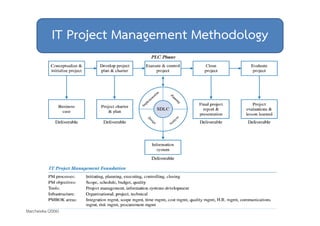
IT Project Management Methodology 
Marchewka (2006)
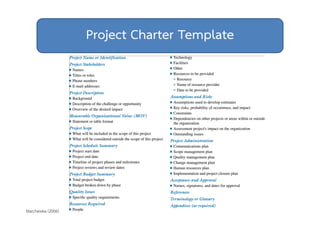
Project Charter Template 
Marchewka (2006)
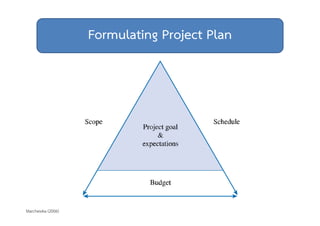
Formulating Project Plan 
Marchewka (2006)
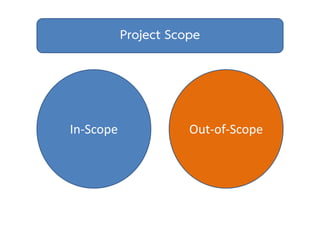
Project Scope 
In‐Scope Out‐of‐Scope
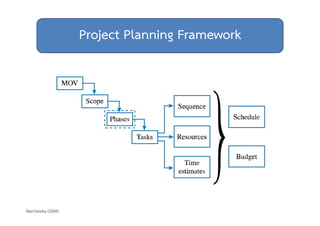
Project Planning Framework 
Marchewka (2006)
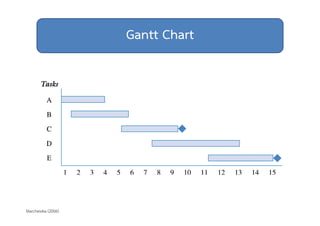
Gantt Chart 
Marchewka (2006)
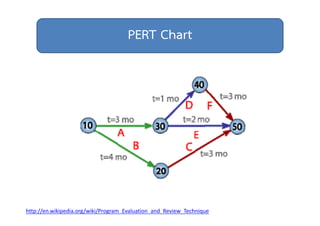
PERT Chart 
http://en.wikipedia.org/wiki/Program_Evaluation_and_Review_Technique
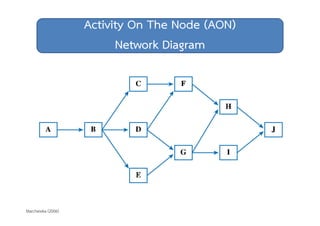
Activity On The Node (AON) 
Network Diagram 
Marchewka (2006)
Project Scheduling 
• Critical Path Method (CPM) 
• Precedence Diagramming Method (PDM) 
• Lead Time & Lag Time 
Marchewka (2006)
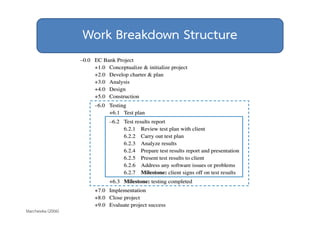
Work Breakdown Structure 
Marchewka (2006)
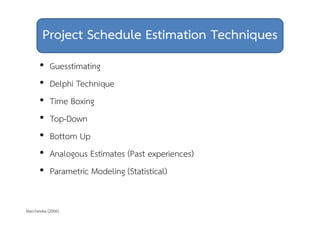
Project Schedule Estimation Techniques 
• Guesstimating 
• Delphi Technique 
• Time Boxing 
• Top-Down 
• Bottom Up 
• Analogous Estimates (Past experiences) 
• Parametric Modeling (Statistical) 
Marchewka (2006)
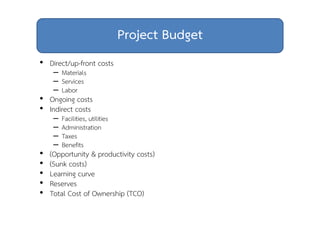
Project Budget 
• Direct/up-front costs 
– Materials 
– Services 
– Labor 
• Ongoing costs 
• Indirect costs 
– Facilities, utilities 
– Administration 
– Taxes 
– Benefits 
• (Opportunity & productivity costs) 
• (Sunk costs) 
• Learning curve 
• Reserves 
• Total Cost of Ownership (TCO)
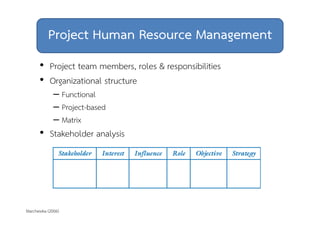
Project Human Resource Management 
• Project team members, roles & responsibilities 
• Organizational structure 
– Functional 
– Project-based 
– Matrix 
• Stakeholder analysis 
Marchewka (2006)
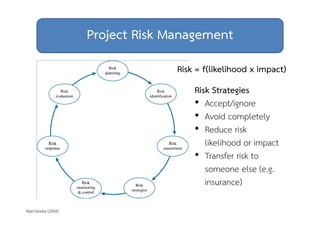
Project Risk Management 
Risk Strategies 
• Accept/ignore 
• Avoid completely 
• Reduce risk 
likelihood or impact 
• Transfer risk to 
someone else (e.g. 
insurance) 
Marchewka (2006) 
Risk = f(likelihood x impact)

Project Management

  • 1.
    TMHG 526 ProjectManagement Nawanan Theera‐Ampornpunt, M.D., Ph.D. Faculty of Medicine Ramathibodi Hospital Mahidol University October 10, 2014
  • 2.
    IT Project Management Marchewka (2006) Marchewka (2009)
  • 3.
    Introduction • InformationTechnology (IT) projects are organizational investments that require – Time – Money – Other resources such as people, technology, facilities, etc. • Organizations expect some type of value in return of this investment • IT Project Management is a relatively new discipline that combines traditional Project Management with Software Engineering/Management Information Systems to make IT projects more successful.
  • 4.
    An ITPM Approach • Organizational resources are limited, so organizations must choose among competing interests to fund specific projects. • This decision should be based on the value a competing project will provide to an organization.
  • 5.
    Which Situation IsWorse? • Successfully building and implementing a system that provides little or no value to the organization. Or… • Failing to implement an information system that could have provided value to the organization, but was poorly developed or poorly managed.
  • 6.
    The Software Crisis • The CHAOS study published in 1995 by The Standish Group found that although the U.S. spent over $250 billion on IT projects, approximately… –31% were cancelled before completion –53% were completed but over budget, over schedule, and did not meet original specifications. • For mid-size companies, average cost overruns were 182%, while average schedule overruns were 202%!
  • 8.
    Why Do ITProjects Fail? • Larger projects have the lowest success rate and appear to be more risky than medium and smaller projects –Technology, business models and markets change so rapidly that a project that takes more than a year can be obsolete before they are completed. • The Chaos study also provides some insight as to the factors that influence project success.
  • 10.
    Has the CurrentState of IT Projects Changed Since 1995? • The Standish Group has continued to study IT projects over the years. • In general, IT Projects are showing higher success rates due to –Better project management tools & processes –Smaller projects –Improved communication among stakeholders –More skillful IT project managers • But there is still ample opportunity for improvement!
  • 11.
    New Top TenFactors for IT Project Success Rank Success Factor 1 User Involvement 2 Executive Support 3 Clear Business Objectives 4 Emotional Maturity 5 Optimizing Scope 6 Agile Process 7 Project Management Expertise 8 Skilled Resources 9 Execution 10 Tools and Infrastructure Source: The Standish Group. CHAOS (West Yarmouth, MA: 1995, 2010) and http://www.infoq.com/articles/Interview‐Johnson‐Standish‐CHAOS. (cited in Marchewka JT. Information technology project management. 4th ed. Singapore: John Wiley & Sons;2013.
  • 12.
    Summary of CHAOSStudies from 1994 to 2008 Figure 1.1 Sources: www.standishgroup.com
  • 13.
    Improving the Likelihoodof Success • Socio-technical Approach • Project Management Approach – processes and infrastructure (Methodology) – resources – expectations – competition – efficiency and effectiveness • Knowledge Management Approach – lessons learned, best practices and shared knowledge
  • 14.
    IT Project Management • A project: “a temporary endeavor undertaken to accomplish a unique purpose” • Project management: “the application of knowledge, skills, tools, and techniques to project activities in order to meet or exceed project requirements” Marchewka (2006)
  • 15.
    The Context ofProject Management - Project Attributes • Time Frame • Purpose (to provide value!) • Ownership • Resources (the triple constraint) • Roles – Project Manager – Project Sponsor – Subject Matter Experts – Technical Experts • Risk & Assumptions • Interdependent Tasks • Planned Organizational Change • Operate in Environments Larger than the Project Itself
  • 16.
    Class Exercise TheImportance of Project Management Group discussion: Without proper Project Management, what can go wrong with the IT projects?
  • 17.
    The Project ManagementDilemma Good Fast Project Deliverables Cheap
  • 18.
    The Triple Constraint Marchewka (2006)
  • 19.
    The Project LifeCycle & IT Development • Project Life Cycle (PLC) – A collection of logical stages or phases that maps the life of a project from its beginning to its end in order to define, build and deliver the product of the project – i.e., the information system • Projects are divided into phases to increase manageability and reduce risk – Phase exits, stage gates, or kill points are decision points at the end of each phase to evaluate performance, correct problems or cancel the project – Fast tracking is the overlapping of phases to reduce the project’s schedule • Can be risky!
  • 20.
    Project Life Cycle Marchewka JT (2006)
  • 21.
    Software Development LifeCycle (SDLC) • Represents the sequential phases or stages an information system follows throughout its useful life • Useful for understanding the development of the project’s largest work product – the application system • Phases/Stages – Planning – Analysis – Design – Implementation – Maintenance and Support
  • 22.
    Software Development LifeCycle Marchewka JT (2006)
  • 23.
    Relationship Between PLC& SDLC • The systems development life cycle (SDLC) becomes part of the project life cycle (PLC). –The PLC focuses on the project management phases, processes, tools and techniques for effectively managing the project. –The SDLC focuses on the software engineering phases, processes, tools and techniques for building and/or implementing the IT solution.
  • 24.
    PLC & SDLC Marchewka JT (2006)
  • 25.
    IT Project ManagementMethodology Marchewka JT (2006)
  • 26.
    Putting the SDLCinto Practice • Structured Approach to Systems Development –Waterfall Method • Rapid Applications Development (RAD) –Prototyping –Spiral Development –Extreme Programming
  • 27.
  • 28.
    Extreme Project Management(XPM) • A new approach and philosophy to project management that is becoming increasingly popular. • Characterizes many of today’s projects that exemplify speed, uncertainty, changing requirements and high risks. • Traditional project management often takes an orderly approach while XPM embraces the fact that projects are often chaotic and unpredictable. • XPM focuses on flexibility, adaptability and innovation • Traditional and new approaches together can provide us with a better understanding of how to improve the likelihood of project success.
  • 29.
    The Project Management Body of Knowledge (PMBOK®) • The Guide to the Project Management Body of Knowledge (PMBOK® Guide) documents 9 project management knowledge areas. • The PMBOK® Guide is published and maintained by the Project Management Institute (PMI). – http://www.pmi.org • PMI provides a certification in project management called the Project Management Professional (PMP) that many people today believe will be as relevant as a CPA certification. • PMP certification requires that you pass a PMP certification exam to demonstrate a level of understanding about project management, as well as satisfy education and experience requirements, and agree to a professional code of conduct.
  • 30.
    The Project Management Body of Knowledge (PMBOK®) 1. Project Integration Management 2. Project Scope Management 3. Project Time Management 4. Project Cost Management 5. Project Quality Management 6. Project Human Resources Management 7. Project Communications Management 8. Project Risk Management 9. Project Procurement Management Marchewka (2006)
  • 31.
    Project Management Bodyof Knowledge Areas Marchewka (2006)
  • 32.
    Developing The BusinessCase Marchewka (2006)
  • 33.
    Measurable Organizational Value(MOV) • The project’s goal • Measure of success • Must be measurable • Provides value to the organization • Must be agreed upon • Must be verifiable at the end of the project • Guides the project throughout its life cycle • Should align with the organization’s strategy and goals Marchewka (2006)
  • 34.
    The IT ValueChain Marchewka (2006)
  • 35.
    A Good ProjectGoal “Our goal is to land a man on the moon and return him safely to the earth by the end of the decade.” Marchewka (2006) John F. Kennedy (1961)
  • 36.
    Metrics: Financial •Payback Period = Initial Investment Marchewka (2006) Net Cash Flow • Breakeven Point = Initial Investment Net Profit Margin • Project ROI = (Total Expected Benefits - Total Expected Costs) Total Expected Costs
  • 37.
    Metrics: Scoring Method Marchewka (2006) Criterion Weight Alternative A Alternative B Alternative C Financial ROI 15% 2 4 10 Payback 10% 3 5 10 Net Present Value (NPV) 15% 2 4 10 Organizational Alignment with strategic objectives 10% 3 5 8 Likelihood of achieving project’s MOV 10% 2 6 9 Project Availability of skilled team members 5% 5 5 4 Maintainability 5% 4 6 7 Time to develop 5% 5 7 6 Risk 5% 3 5 5 External Customer satisfaction 10% 2 4 9 Increased market share 10% 2 5 8 Total Score 100% 2.65 4.85 8.50 Notes: Risk scores have a reverse scale – i.e., higher scores for risk imply lower levels of risk
  • 38.
  • 39.
    MOV & Scorecard Marchewka (2006)
  • 40.
    IT Project ManagementMethodology Marchewka (2006)
  • 41.
    Project Charter Template Marchewka (2006)
  • 42.
    Formulating Project Plan Marchewka (2006)
  • 43.
    Project Scope In‐ScopeOut‐of‐Scope
  • 44.
    Project Planning Framework Marchewka (2006)
  • 45.
  • 46.
  • 47.
    Activity On TheNode (AON) Network Diagram Marchewka (2006)
  • 48.
    Project Scheduling •Critical Path Method (CPM) • Precedence Diagramming Method (PDM) • Lead Time & Lag Time Marchewka (2006)
  • 49.
    Work Breakdown Structure Marchewka (2006)
  • 50.
    Project Schedule EstimationTechniques • Guesstimating • Delphi Technique • Time Boxing • Top-Down • Bottom Up • Analogous Estimates (Past experiences) • Parametric Modeling (Statistical) Marchewka (2006)
  • 51.
    Project Budget •Direct/up-front costs – Materials – Services – Labor • Ongoing costs • Indirect costs – Facilities, utilities – Administration – Taxes – Benefits • (Opportunity & productivity costs) • (Sunk costs) • Learning curve • Reserves • Total Cost of Ownership (TCO)
  • 52.
    Project Human ResourceManagement • Project team members, roles & responsibilities • Organizational structure – Functional – Project-based – Matrix • Stakeholder analysis Marchewka (2006)
  • 53.
    Project Risk Management Risk Strategies • Accept/ignore • Avoid completely • Reduce risk likelihood or impact • Transfer risk to someone else (e.g. insurance) Marchewka (2006) Risk = f(likelihood x impact)