COMPETITIVE ANALYSIS
OF
HINDUSTAN UNILEVER LTD.
Submitted To,
Prof. Devina Upadhyay
Submitted By,
Aruna G. Lambha
(1276804320)
Table Of Contents
 Introduction to Company
 Industry at a Glance
 Research Methodology
 Data analysis and Interpretation
 Findings
 Recommendations
 Conclusion
Introduction To Company
 Hindustan Unilever Limited, Formerly Known as Hindustan
Lever Ltd, is India’s largest FMCG Company
 The Anglo-Dutch company Unilever owns a majority stake in
Hindustan Unilever Limited
 has More than 16,000 employees, including 1,300 managers and
more than 200 highly qualified scientists and technologists
 HUL's brands, spread across 20 distinct consumer categories
such as soaps, tea, detergents and shampoos amongst others
with over 700 million Indian consumers using its products
 HUL touches the lives of two out of every three Indians everyday
 Mission of the company-” To Add Vitality To Life”
Vision Of The Company
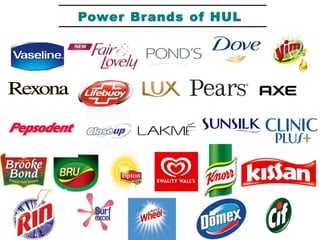
Power Brands of HUL
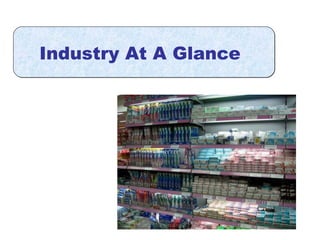
Industry At A Glance
Fast Moving Consumer Goods
Industry
 fast moving consumer goods are the essential items we purchase
when we go shopping and use in our everyday lives
 They're the household items you pick up when you're buying
groceries or visit your local chemist or pharmacy
 FMCG goods are referred to as 'fast moving', quite simply,
because they're the quickest items to leave the Store shelves
 The prices of the FMCG are relatively less and don’t require a lot
of thought , time and financial investment to purchase
 As prices of FMCG are relatively less, Profits earned through
such sales are more volume based
 FMCG Sector is one of the most important sectors for each and
every Economy
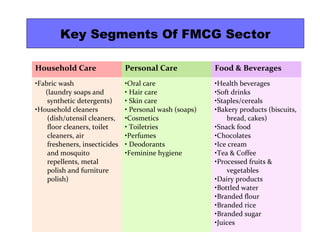
Household Care Personal Care Food & Beverages
•Fabric wash
(laundry soaps and
synthetic detergents)
•Household cleaners
(dish/utensil cleaners,
floor cleaners, toilet
cleaners, air
fresheners, insecticides
and mosquito
repellents, metal
polish and furniture
polish)
•Oral care
• Hair care
• Skin care
• Personal wash (soaps)
•Cosmetics
• Toiletries
•Perfumes
• Deodorants
•Feminine hygiene
•Health beverages
•Soft drinks
•Staples/cereals
•Bakery products (biscuits,
bread, cakes)
•Snack food
•Chocolates
•Ice cream
•Tea & Coffee
•Processed fruits &
vegetables
•Dairy products
•Bottled water
•Branded flour
•Branded rice
•Branded sugar
•Juices
Key Segments Of FMCG Sector
FMCG Industry In India
 The Indian FMCG sector is the fourth largest sector of the
economy with a total market size of US$ 13.1 billion
 The FMCG market in India is expected to be worth USD 33.4
billion by the year 2015
 The Indian FMCG Industry is characterized by low penetration
levels, lower per capita consumption and intense competition
between the organized and unorganized segments
 The FMCG sector in India continues on a strong growth path (on
an average of 11% a year) with both Urban and Rural India
contributing to its growth
 Growth driven by increasing consumption led by growing
population, rising incomes, changing lifestyles and favorable
demographics
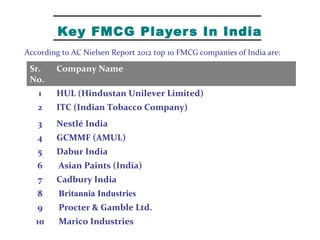
Key FMCG Players In India
According to AC Nielsen Report 2012 top 10 FMCG companies of India are:
Sr.
No.
Company Name
1 HUL (Hindustan Unilever Limited)
2 ITC (Indian Tobacco Company)
3 Nestlé India
4 GCMMF (AMUL)
5 Dabur India
6 Asian Paints (India)
7 Cadbury India
8 Britannia Industries
9 Procter & Gamble Ltd.
10 Marico Industries
MARKET SHARE OF FMCG COMPANIES IN INDIA
HUL
34%
ITC
29%
NESTLE
8%
BRITANNIA
6%
DABUR
4%
OTHERS
19%
Source: AC Nielsen Report 2012
Research Methodology
Primary Objectives:
1) To find out the market position of HUL in various categories
2) To identify who are the competitors of HUL and to study category wise
competition.
3) To perform SWOT analysis
4) To find out what strategies are adopted by the company to get
competitive edge over its competitors.
Research Objectives:
Secondary Objectives:
1) To measure consumer preference for HUL’s products versus
competition
2) To study how consumers perceive the quality of HUL’s
products compared to its competitors
3) To find out which are the unique attributes of HUL’s products
that are perceived by consumers as the most distinctive from
its competitors
Research Plan
Sampling Plan
Sampling Unit Existing and expected customers of the
company
Sampling Size 100
Sampling Procedure Snowball Sampling
Research Instrument Structured Questionnaire
Target Area India
Sources of Data
Primary Data Online Survey, Informal talks & discussion
with employees of UIEL, KASEZ
Secondary Data Annual report, websites, journals, articles,
company literature and company brochure
Research Design
Type of Research Descriptive Research
Scope of Research Indian FMCG Market
Beneficiary of the Study Company: HUL
Method of Data Presentation Description, Tabular forms and Graphs
Data Analysis
and Interpretation
of
Primary Objectives
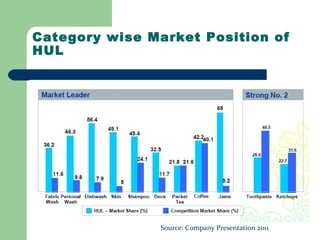
Category wise Market Position of
HUL
Source: Company Presentation 2011
Category wise Competition
Personal Wash:
Market share of Soaps
46%
10%
9%
8%
15%
3%
9%
HUL
GCPL
Reckitt Benckiser
Wipro
Nirma
ITC
Others
HUL’s Brands Competing Brands
• Lux
• Rexona
• Breeze
• Lifebouy
• Pears
• Dove
• Hamam
• Santoor
• Fair Glow
• Cinthol
• Godrej No.1
• Nirma
• Dettol
• Fiama Di Wills
• Vivel
• Margo
Category wise Competition (cntd.)
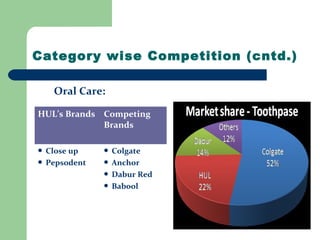
HUL’s Brands Competing
Brands
 Close up
 Pepsodent
 Colgate
 Anchor
 Dabur Red
 Babool
Oral Care:
Category wise Competition (cntd.)
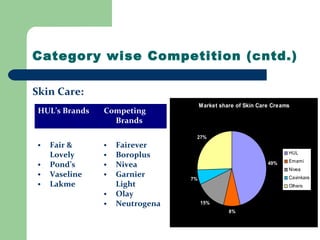
Skin Care:
HUL’s Brands Competing
Brands
• Fair &
Lovely
• Pond’s
• Vaseline
• Lakme
• Fairever
• Boroplus
• Nivea
• Garnier
Light
• Olay
• Neutrogena
Market share of Skin Care Creams
49%
8%
15%
7%
27%
HUL
Emami
Nivea
Cavinkare
Others
Category wise Competition (cntd.)
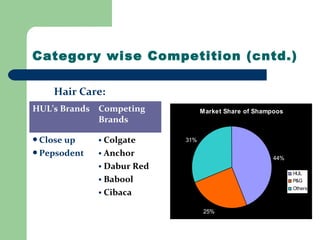
Hair Care:
Market Share of Shampoos
44%
25%
31%
HUL
P&G
Others
HUL’s Brands Competing
Brands
Close up
Pepsodent
• Colgate
• Anchor
• Dabur Red
• Babool
• Cibaca
Category wise Competition (cntd.)
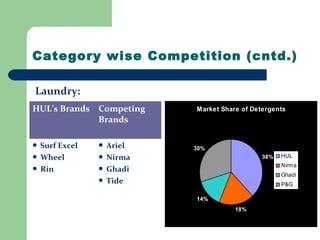
HUL’s Brands Competing
Brands
 Surf Excel
 Wheel
 Rin
 Ariel
 Nirma
 Ghadi
 Tide
Laundry:
Market Share of Detergents
38%
18%
14%
30%
HUL
Nirma
Ghadi
P&G
Category wise Competition (cntd.)
HUL’s Brands Competing
Brands
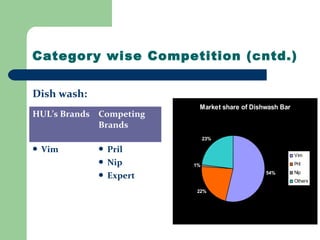
 Vim  Pril
 Nip
 Expert
Dish wash:
Market share of Dishwash Bar
54%
22%
1%
23%
Vim
Pril
Nip
Others
Category wise Competition (cntd.)
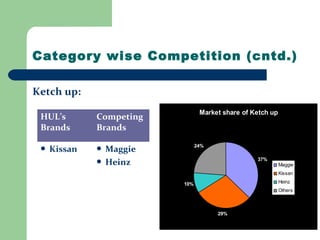
Ketch up:
HUL’s
Brands
Competing
Brands
 Kissan  Maggie
 Heinz
Market share of Ketch up
37%
29%
10%
24%
Maggie
Kissan
Heinz
Others
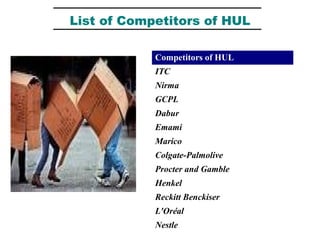
List of Competitors of HUL
Competitors of HUL
ITC
Nirma
GCPL
Dabur
Emami
Marico
Colgate-Palmolive
Procter and Gamble
Henkel
Reckitt Benckiser
L'Oréal
Nestle
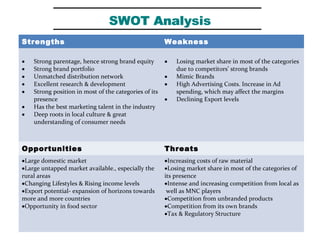
SWOT Analysis
Strengths Weakness
• Strong parentage, hence strong brand equity
• Strong brand portfolio
• Unmatched distribution network
• Excellent research & development
• Strong position in most of the categories of its
presence
• Has the best marketing talent in the industry
• Deep roots in local culture & great
understanding of consumer needs
• Losing market share in most of the categories
due to competitors’ strong brands
• Mimic Brands
• High Advertising Costs. Increase in Ad
spending, which may affect the margins
• Declining Export levels
Opportunities Threats
•Large domestic market
•Large untapped market available., especially the
rural areas
•Changing Lifestyles & Rising income levels
•Export potential- expansion of horizons towards
more and more countries
•Opportunity in food sector
•Increasing costs of raw material
•Losing market share in most of the categories of
its presence
•Intense and increasing competition from local as
well as MNC players
•Competition from unbranded products
•Competition from its own brands
•Tax & Regulatory Structure
SWOT AnalysisSWOT Analysis
Competitive Strategies of HUL
Expansion StrategiesExpansion StrategiesExpansion Strategies
Distribution Strategies
Innovation Strategies
Promotional Strategies
Pricing Strategies
Premiumiztion Strategies
Digital Strategies
Sustainable Growth Strategies
Data Analysis
and Interpretation
of
Secondary Objectives
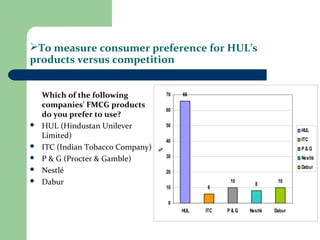
To measure consumer preference for HUL’s
products versus competition
Which of the following
companies' FMCG products
do you prefer to use?
 HUL (Hindustan Unilever
Limited)
 ITC (Indian Tobacco Company)
 P & G (Procter & Gamble)
 Nestlé
 Dabur
66
6
10
8
10
0
10
20
30
40
50
60
70
HUL ITC P & G Nestlé Dabur
%
HUL
ITC
P & G
Nestlé
Dabur
To study how consumers perceive the quality of HUL’s
products compared to its competitors
compared to our
competitors, what do you
feel about the quality of our
products?
 Better
 Worse
 About the same
66
34
0
0
10
20
30
40
50
60
70
Better Worse About the
same
%
Better
Worse
About the same
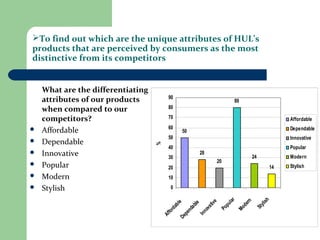
To find out which are the unique attributes of HUL’s
products that are perceived by consumers as the most
distinctive from its competitors
What are the differentiating
attributes of our products
when compared to our
competitors?
 Affordable
 Dependable
 Innovative
 Popular
 Modern
 Stylish
50
28
20
80
24
14
0
10
20
30
40
50
60
70
80
90
AffordableDependable
Innovative
Popular
Modern
Stylish
%
Affordable
Dependable
Innovative
Popular
Modern
Stylish
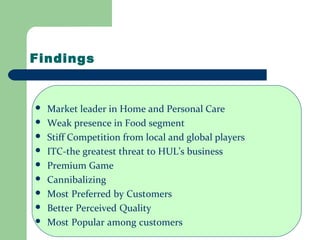
Findings
 Market leader in Home and Personal Care
 Weak presence in Food segment
 Stiff Competition from local and global players
 ITC-the greatest threat to HUL’s business
 Premium Game
 Cannibalizing
 Most Preferred by Customers
 Better Perceived Quality
 Most Popular among customers
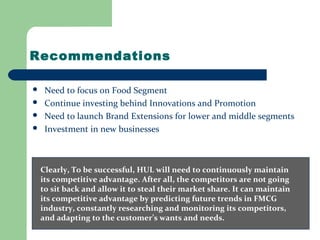
Recommendations
 Need to focus on Food Segment
 Continue investing behind Innovations and Promotion
 Need to launch Brand Extensions for lower and middle segments
 Investment in new businesses
Clearly, To be successful, HUL will need to continuously maintain
its competitive advantage. After all, the competitors are not going
to sit back and allow it to steal their market share. It can maintain
its competitive advantage by predicting future trends in FMCG
industry, constantly researching and monitoring its competitors,
and adapting to the customer’s wants and needs.
Conclusion
Company is having good position in the market, despite facing
intense competition from local and global FMCG players. It is
enjoying market leadership in various consumer categories of its
presence. HUL's up-and-running business model is a treat for
investors seeking exposure in the FMCG segment. The company has
delivered in the past and has the potential to do better in future.
HUL’s growth story is evolving.
summer internship project report presentation on HUL

summer internship project report presentation on HUL

  • 1.
    COMPETITIVE ANALYSIS OF HINDUSTAN UNILEVERLTD. Submitted To, Prof. Devina Upadhyay Submitted By, Aruna G. Lambha (1276804320)
  • 2.
    Table Of Contents Introduction to Company  Industry at a Glance  Research Methodology  Data analysis and Interpretation  Findings  Recommendations  Conclusion
  • 3.
    Introduction To Company Hindustan Unilever Limited, Formerly Known as Hindustan Lever Ltd, is India’s largest FMCG Company  The Anglo-Dutch company Unilever owns a majority stake in Hindustan Unilever Limited  has More than 16,000 employees, including 1,300 managers and more than 200 highly qualified scientists and technologists  HUL's brands, spread across 20 distinct consumer categories such as soaps, tea, detergents and shampoos amongst others with over 700 million Indian consumers using its products  HUL touches the lives of two out of every three Indians everyday  Mission of the company-” To Add Vitality To Life”
  • 4.
  • 5.
  • 6.
  • 7.
    Fast Moving ConsumerGoods Industry  fast moving consumer goods are the essential items we purchase when we go shopping and use in our everyday lives  They're the household items you pick up when you're buying groceries or visit your local chemist or pharmacy  FMCG goods are referred to as 'fast moving', quite simply, because they're the quickest items to leave the Store shelves  The prices of the FMCG are relatively less and don’t require a lot of thought , time and financial investment to purchase  As prices of FMCG are relatively less, Profits earned through such sales are more volume based  FMCG Sector is one of the most important sectors for each and every Economy
  • 8.
    Household Care PersonalCare Food & Beverages •Fabric wash (laundry soaps and synthetic detergents) •Household cleaners (dish/utensil cleaners, floor cleaners, toilet cleaners, air fresheners, insecticides and mosquito repellents, metal polish and furniture polish) •Oral care • Hair care • Skin care • Personal wash (soaps) •Cosmetics • Toiletries •Perfumes • Deodorants •Feminine hygiene •Health beverages •Soft drinks •Staples/cereals •Bakery products (biscuits, bread, cakes) •Snack food •Chocolates •Ice cream •Tea & Coffee •Processed fruits & vegetables •Dairy products •Bottled water •Branded flour •Branded rice •Branded sugar •Juices Key Segments Of FMCG Sector
  • 9.
    FMCG Industry InIndia  The Indian FMCG sector is the fourth largest sector of the economy with a total market size of US$ 13.1 billion  The FMCG market in India is expected to be worth USD 33.4 billion by the year 2015  The Indian FMCG Industry is characterized by low penetration levels, lower per capita consumption and intense competition between the organized and unorganized segments  The FMCG sector in India continues on a strong growth path (on an average of 11% a year) with both Urban and Rural India contributing to its growth  Growth driven by increasing consumption led by growing population, rising incomes, changing lifestyles and favorable demographics
  • 10.
    Key FMCG PlayersIn India According to AC Nielsen Report 2012 top 10 FMCG companies of India are: Sr. No. Company Name 1 HUL (Hindustan Unilever Limited) 2 ITC (Indian Tobacco Company) 3 Nestlé India 4 GCMMF (AMUL) 5 Dabur India 6 Asian Paints (India) 7 Cadbury India 8 Britannia Industries 9 Procter & Gamble Ltd. 10 Marico Industries
  • 11.
    MARKET SHARE OFFMCG COMPANIES IN INDIA HUL 34% ITC 29% NESTLE 8% BRITANNIA 6% DABUR 4% OTHERS 19% Source: AC Nielsen Report 2012
  • 12.
    Research Methodology Primary Objectives: 1)To find out the market position of HUL in various categories 2) To identify who are the competitors of HUL and to study category wise competition. 3) To perform SWOT analysis 4) To find out what strategies are adopted by the company to get competitive edge over its competitors. Research Objectives: Secondary Objectives: 1) To measure consumer preference for HUL’s products versus competition 2) To study how consumers perceive the quality of HUL’s products compared to its competitors 3) To find out which are the unique attributes of HUL’s products that are perceived by consumers as the most distinctive from its competitors
  • 13.
    Research Plan Sampling Plan SamplingUnit Existing and expected customers of the company Sampling Size 100 Sampling Procedure Snowball Sampling Research Instrument Structured Questionnaire Target Area India Sources of Data Primary Data Online Survey, Informal talks & discussion with employees of UIEL, KASEZ Secondary Data Annual report, websites, journals, articles, company literature and company brochure Research Design Type of Research Descriptive Research Scope of Research Indian FMCG Market Beneficiary of the Study Company: HUL Method of Data Presentation Description, Tabular forms and Graphs
  • 14.
  • 15.
    Category wise MarketPosition of HUL Source: Company Presentation 2011
  • 16.
    Category wise Competition PersonalWash: Market share of Soaps 46% 10% 9% 8% 15% 3% 9% HUL GCPL Reckitt Benckiser Wipro Nirma ITC Others HUL’s Brands Competing Brands • Lux • Rexona • Breeze • Lifebouy • Pears • Dove • Hamam • Santoor • Fair Glow • Cinthol • Godrej No.1 • Nirma • Dettol • Fiama Di Wills • Vivel • Margo
  • 17.
    Category wise Competition(cntd.) HUL’s Brands Competing Brands  Close up  Pepsodent  Colgate  Anchor  Dabur Red  Babool Oral Care:
  • 18.
    Category wise Competition(cntd.) Skin Care: HUL’s Brands Competing Brands • Fair & Lovely • Pond’s • Vaseline • Lakme • Fairever • Boroplus • Nivea • Garnier Light • Olay • Neutrogena Market share of Skin Care Creams 49% 8% 15% 7% 27% HUL Emami Nivea Cavinkare Others
  • 19.
    Category wise Competition(cntd.) Hair Care: Market Share of Shampoos 44% 25% 31% HUL P&G Others HUL’s Brands Competing Brands Close up Pepsodent • Colgate • Anchor • Dabur Red • Babool • Cibaca
  • 20.
    Category wise Competition(cntd.) HUL’s Brands Competing Brands  Surf Excel  Wheel  Rin  Ariel  Nirma  Ghadi  Tide Laundry: Market Share of Detergents 38% 18% 14% 30% HUL Nirma Ghadi P&G
  • 21.
    Category wise Competition(cntd.) HUL’s Brands Competing Brands  Vim  Pril  Nip  Expert Dish wash: Market share of Dishwash Bar 54% 22% 1% 23% Vim Pril Nip Others
  • 22.
    Category wise Competition(cntd.) Ketch up: HUL’s Brands Competing Brands  Kissan  Maggie  Heinz Market share of Ketch up 37% 29% 10% 24% Maggie Kissan Heinz Others
  • 23.
    List of Competitorsof HUL Competitors of HUL ITC Nirma GCPL Dabur Emami Marico Colgate-Palmolive Procter and Gamble Henkel Reckitt Benckiser L'Oréal Nestle
  • 24.
    SWOT Analysis Strengths Weakness •Strong parentage, hence strong brand equity • Strong brand portfolio • Unmatched distribution network • Excellent research & development • Strong position in most of the categories of its presence • Has the best marketing talent in the industry • Deep roots in local culture & great understanding of consumer needs • Losing market share in most of the categories due to competitors’ strong brands • Mimic Brands • High Advertising Costs. Increase in Ad spending, which may affect the margins • Declining Export levels Opportunities Threats •Large domestic market •Large untapped market available., especially the rural areas •Changing Lifestyles & Rising income levels •Export potential- expansion of horizons towards more and more countries •Opportunity in food sector •Increasing costs of raw material •Losing market share in most of the categories of its presence •Intense and increasing competition from local as well as MNC players •Competition from unbranded products •Competition from its own brands •Tax & Regulatory Structure SWOT AnalysisSWOT Analysis
  • 25.
    Competitive Strategies ofHUL Expansion StrategiesExpansion StrategiesExpansion Strategies Distribution Strategies Innovation Strategies Promotional Strategies Pricing Strategies Premiumiztion Strategies Digital Strategies Sustainable Growth Strategies
  • 26.
  • 27.
    To measure consumerpreference for HUL’s products versus competition Which of the following companies' FMCG products do you prefer to use?  HUL (Hindustan Unilever Limited)  ITC (Indian Tobacco Company)  P & G (Procter & Gamble)  Nestlé  Dabur 66 6 10 8 10 0 10 20 30 40 50 60 70 HUL ITC P & G Nestlé Dabur % HUL ITC P & G Nestlé Dabur
  • 28.
    To study howconsumers perceive the quality of HUL’s products compared to its competitors compared to our competitors, what do you feel about the quality of our products?  Better  Worse  About the same 66 34 0 0 10 20 30 40 50 60 70 Better Worse About the same % Better Worse About the same
  • 29.
    To find outwhich are the unique attributes of HUL’s products that are perceived by consumers as the most distinctive from its competitors What are the differentiating attributes of our products when compared to our competitors?  Affordable  Dependable  Innovative  Popular  Modern  Stylish 50 28 20 80 24 14 0 10 20 30 40 50 60 70 80 90 AffordableDependable Innovative Popular Modern Stylish % Affordable Dependable Innovative Popular Modern Stylish
  • 30.
    Findings  Market leaderin Home and Personal Care  Weak presence in Food segment  Stiff Competition from local and global players  ITC-the greatest threat to HUL’s business  Premium Game  Cannibalizing  Most Preferred by Customers  Better Perceived Quality  Most Popular among customers
  • 31.
    Recommendations  Need tofocus on Food Segment  Continue investing behind Innovations and Promotion  Need to launch Brand Extensions for lower and middle segments  Investment in new businesses Clearly, To be successful, HUL will need to continuously maintain its competitive advantage. After all, the competitors are not going to sit back and allow it to steal their market share. It can maintain its competitive advantage by predicting future trends in FMCG industry, constantly researching and monitoring its competitors, and adapting to the customer’s wants and needs.
  • 32.
    Conclusion Company is havinggood position in the market, despite facing intense competition from local and global FMCG players. It is enjoying market leadership in various consumer categories of its presence. HUL's up-and-running business model is a treat for investors seeking exposure in the FMCG segment. The company has delivered in the past and has the potential to do better in future. HUL’s growth story is evolving.