Bernoulli's Equation The Hydrodynamic Law Alba Hahn, Andrea Extraña, Clàudia Maravalle and Carles Vàzquez.
Index Who   was   Bernoulli ? Precedents of Bernoulli Equation What Bernoulli discovered? The consequences of Bernoulli's theory. The equation in our words.
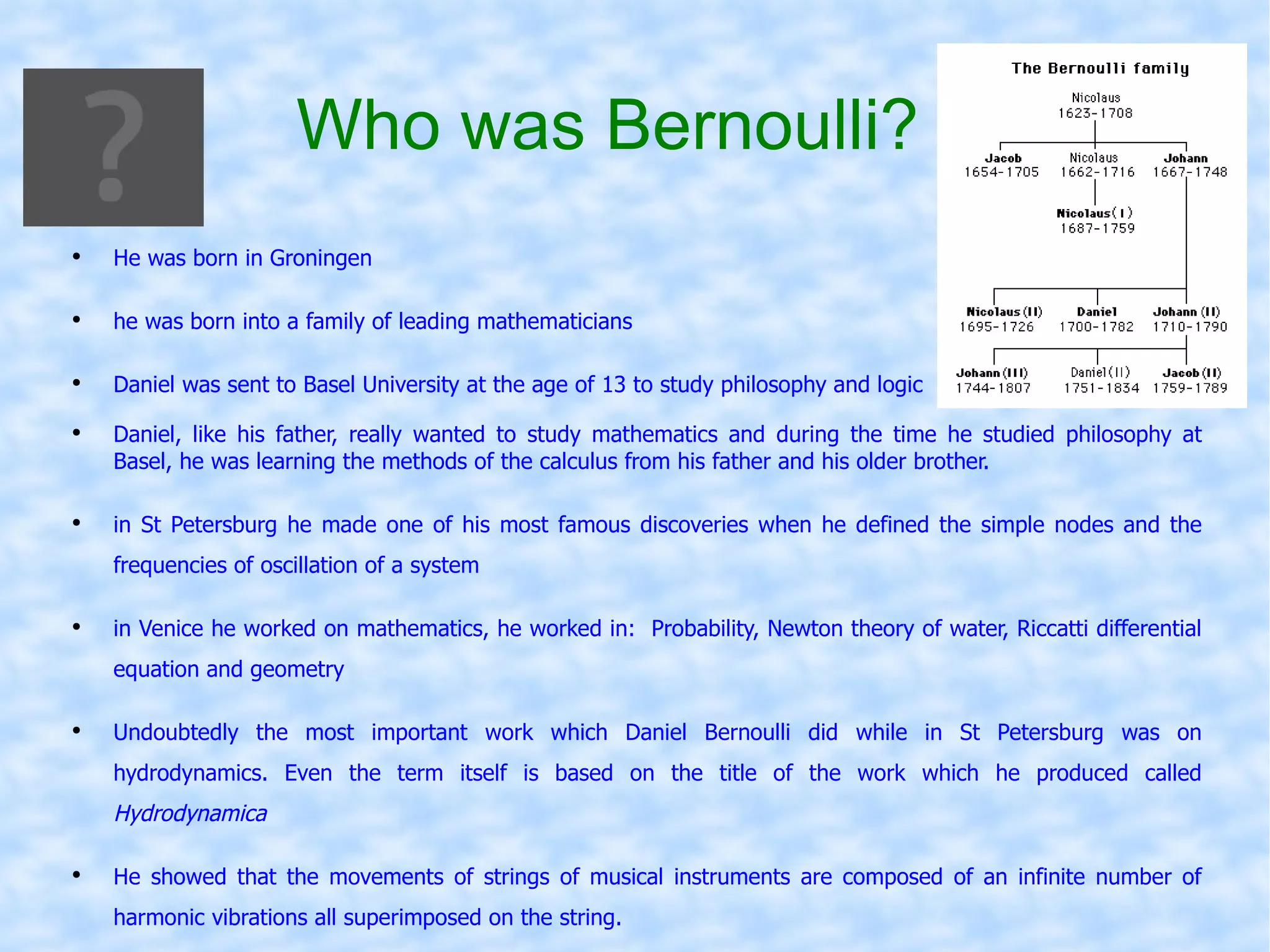
Who   was   Bernoulli ? He was born in Groningen he was born into a family of leading mathematicians  Daniel was sent to Basel University at the age of 13 to study philosophy and logic Daniel, like his father, really wanted to study mathematics and during the time he studied philosophy at Basel, he was learning the methods of the calculus from his father and his older brother. in St Petersburg he made one of his most famous discoveries when he defined the simple nodes and the frequencies of oscillation of a system in Venice he worked on mathematics, he worked in:  Probability, Newton theory of water, Riccatti differential equation and geometry Undoubtedly the most important work which Daniel Bernoulli did while in St Petersburg was on hydrodynamics. Even the term itself is based on the title of the work which he produced called  Hydrodynamica He showed that the movements of strings of musical instruments are composed of an infinite number of harmonic vibrations all superimposed on the string.
Precedents of Bernoulli Equation Archimedes Discovery:   Any object, wholly or partly immersed in a fluid, is buoyed up by a force equal to the weight of the fluid displaced by the object." Leonardo Da Vinci:  If you keep the liquid level in communicating vessels, and if both vessels are filled with different liquids, their high level will be inversely proportional to their densities. Leibniz:   Leibniz assumed that the force needed to lift a weight can be determined by the product of weight and height.
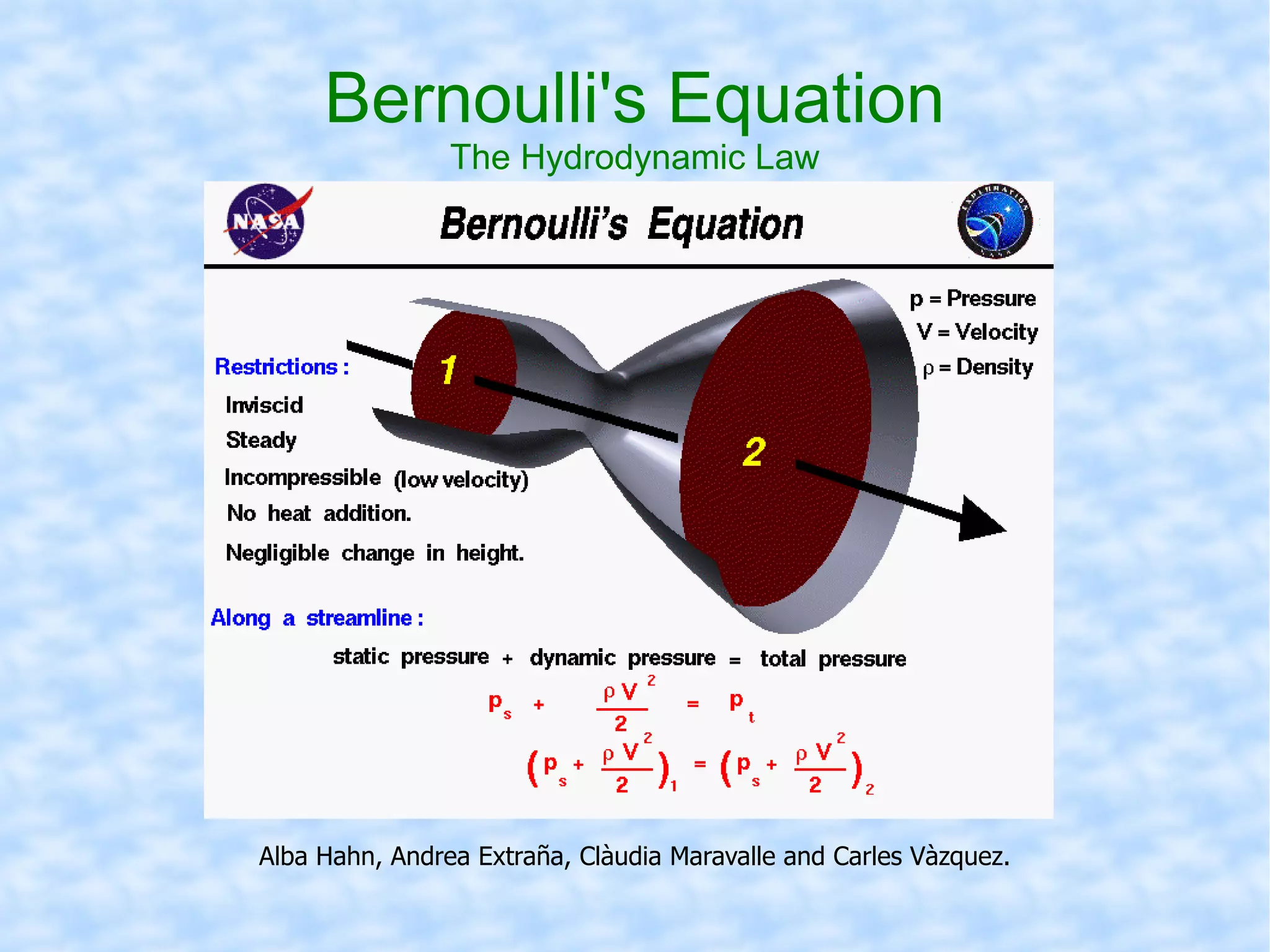
What Bernoulli discovered? In  fluid dynamics ,  Bernoulli's principle  states that for an  inviscid flow , an increase in the speed of the fluid occurs simultaneously with a decrease in  pressure Daniel Bernoulli  in shows one of many forms of  Bernoulli's equation . The equation states that the  static pressure   ps  in the flow plus the  dynamic pressure , one half of the density  r  times the velocity  V  squared, is equal to a constant throughout the flow. We call this constant the total pressure  pt  of the flow.
Consequences of Bernoulli's theory It seems to make sense when we apply it to blood vessels. Where the blood moves faster, the more it pushes forward, the less it pushes on the walls. The airplane and Bernoulli’s equation, were not connected until a Russian scientist by the name of Nikolai Zhukovsky made an excellent observation. He noticed that the tops of the wings of the plane were rounded. When he tested a plane in a wind tunnel, he noticed that the wings created two jet streams. The upper jet stream was narrower than the lower.  Air is considered a fluid, so therefore the jet stream can be viewed as a river. According to Leonardo DA Vinci’s “Law of Continuity”, which says “A river of uniform depth will have a more rapid flow at the narrower section than at the wider”, the upper jet stream is faster than the lower.  Zhukovsky had discovered how airplanes flew. Using Bernoulli’s equation, one can see that since the upper jet stream is faster than the lower, it has less pressure than the lower. Then, the airplane is able to fly because the pressure on the lower side of the airplane is greater than the upper and it pushes it up.
The equation in our words  So, we think that in short: As faster go the water in a pipe, less pressure are there.

Project Bernoulli

  • 1.
    Bernoulli's Equation TheHydrodynamic Law Alba Hahn, Andrea Extraña, Clàudia Maravalle and Carles Vàzquez.
  • 2.
    Index Who was Bernoulli ? Precedents of Bernoulli Equation What Bernoulli discovered? The consequences of Bernoulli's theory. The equation in our words.
  • 3.
    Who was Bernoulli ? He was born in Groningen he was born into a family of leading mathematicians Daniel was sent to Basel University at the age of 13 to study philosophy and logic Daniel, like his father, really wanted to study mathematics and during the time he studied philosophy at Basel, he was learning the methods of the calculus from his father and his older brother. in St Petersburg he made one of his most famous discoveries when he defined the simple nodes and the frequencies of oscillation of a system in Venice he worked on mathematics, he worked in: Probability, Newton theory of water, Riccatti differential equation and geometry Undoubtedly the most important work which Daniel Bernoulli did while in St Petersburg was on hydrodynamics. Even the term itself is based on the title of the work which he produced called Hydrodynamica He showed that the movements of strings of musical instruments are composed of an infinite number of harmonic vibrations all superimposed on the string.
  • 4.
    Precedents of BernoulliEquation Archimedes Discovery: Any object, wholly or partly immersed in a fluid, is buoyed up by a force equal to the weight of the fluid displaced by the object." Leonardo Da Vinci: If you keep the liquid level in communicating vessels, and if both vessels are filled with different liquids, their high level will be inversely proportional to their densities. Leibniz: Leibniz assumed that the force needed to lift a weight can be determined by the product of weight and height.
  • 5.
    What Bernoulli discovered?In fluid dynamics , Bernoulli's principle states that for an inviscid flow , an increase in the speed of the fluid occurs simultaneously with a decrease in pressure Daniel Bernoulli in shows one of many forms of Bernoulli's equation . The equation states that the static pressure ps in the flow plus the dynamic pressure , one half of the density r times the velocity V squared, is equal to a constant throughout the flow. We call this constant the total pressure pt of the flow.
  • 6.
    Consequences of Bernoulli'stheory It seems to make sense when we apply it to blood vessels. Where the blood moves faster, the more it pushes forward, the less it pushes on the walls. The airplane and Bernoulli’s equation, were not connected until a Russian scientist by the name of Nikolai Zhukovsky made an excellent observation. He noticed that the tops of the wings of the plane were rounded. When he tested a plane in a wind tunnel, he noticed that the wings created two jet streams. The upper jet stream was narrower than the lower. Air is considered a fluid, so therefore the jet stream can be viewed as a river. According to Leonardo DA Vinci’s “Law of Continuity”, which says “A river of uniform depth will have a more rapid flow at the narrower section than at the wider”, the upper jet stream is faster than the lower. Zhukovsky had discovered how airplanes flew. Using Bernoulli’s equation, one can see that since the upper jet stream is faster than the lower, it has less pressure than the lower. Then, the airplane is able to fly because the pressure on the lower side of the airplane is greater than the upper and it pushes it up.
  • 7.
    The equation inour words So, we think that in short: As faster go the water in a pipe, less pressure are there.