Ameeta K , ZIET CHANDIGARH
in respect to NCF 2005
Project Based
Learning
 Project Based Learning is one approach to create a learning
environment where students construct personal knowledge
based on real world issues and practices.
 Learning activities are long term and open-ended,
empowering the students with the ability to make choices
and decisions.
 In these types of activities, students are more likely to
internalize the learning that takes place because they feel a
greater sense of ownership over their work when required to
make decisions based on real world issues.
 The teacher's role shifts from that of transferring knowledge
to that of a learning facilitator in this student-directed
environment.
Ameeta K , ZIET CHANDIGARH
coLLaBoration
 A Key Element in Project Based Learning
 Students have the opportunity to gain skills that are
desired by today's employer as they work in teams by
collaborating, communicating and decision making.
 They decide how to find answers, solve problems, and
present information while collaborating with teachers,
peers, and community members.
Ameeta K , ZIET CHANDIGARH
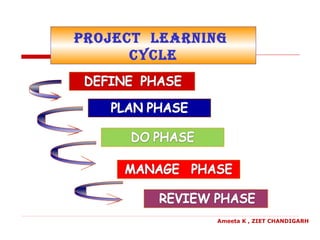
Project Learning
cYcLe
Ameeta K , ZIET CHANDIGARH
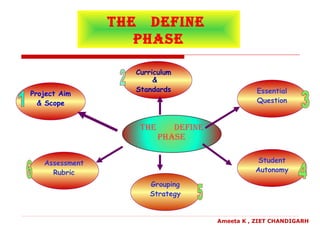
tHe deFine
PHase
tHe deFine
PHase
Essential
Question
Student
Autonomy
Grouping
Strategy
Assessment
Rubric
Project Aim
& Scope
Curriculum
&
Standards
Ameeta K , ZIET CHANDIGARH
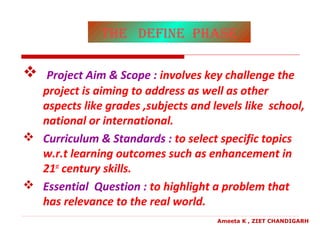
 Project Aim & Scope : involves key challenge the
project is aiming to address as well as other
aspects like grades ,subjects and levels like school,
national or international.
 Curriculum & Standards : to select specific topics
w.r.t learning outcomes such as enhancement in
21st
century skills.
 Essential Question : to highlight a problem that
has relevance to the real world.
THE DEFINE PHASE
Ameeta K , ZIET CHANDIGARH
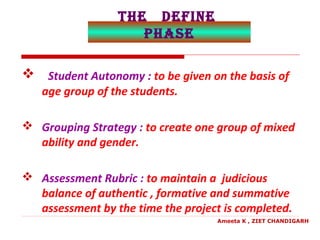
 Student Autonomy : to be given on the basis of
age group of the students.
 Grouping Strategy : to create one group of mixed
ability and gender.
 Assessment Rubric : to maintain a judicious
balance of authentic , formative and summative
assessment by the time the project is completed.
THE DEFINE
PHASE
Ameeta K , ZIET CHANDIGARH
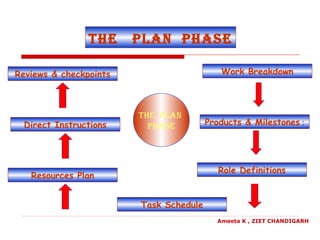
Reviews & checkpoints
Direct Instructions
Resources Plan
Role Definitions
Products & Milestones :
Work Breakdown
Task Schedule
THE PLAN
PHASE
THE PLAN PHASE
Ameeta K , ZIET CHANDIGARH
THE PLAN
PHASE
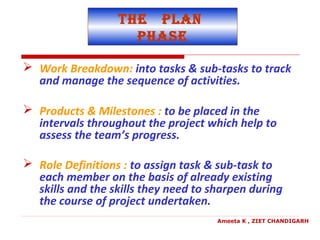
 Work Breakdown: into tasks & sub-tasks to track
and manage the sequence of activities.
 Products & Milestones : to be placed in the
intervals throughout the project which help to
assess the team’s progress.
 Role Definitions : to assign task & sub-task to
each member on the basis of already existing
skills and the skills they need to sharpen during
the course of project undertaken.
Ameeta K , ZIET CHANDIGARH
THE PLAN
PHASE
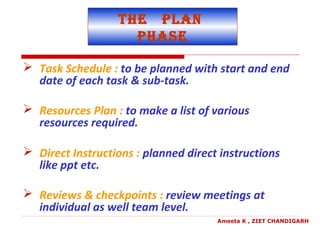
 Task Schedule : to be planned with start and end
date of each task & sub-task.
 Resources Plan : to make a list of various
resources required.
 Direct Instructions : planned direct instructions
like ppt etc.
 Reviews & checkpoints : review meetings at
individual as well team level.
Ameeta K , ZIET CHANDIGARH
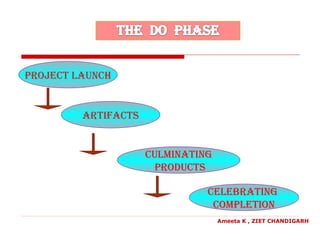
Project Launch
artifacts
cuLminating
Products
ceLebrating
comPLetion
Ameeta K , ZIET CHANDIGARH
the do Phase
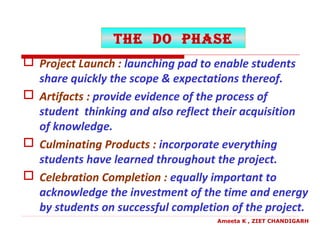
 Project Launch : launching pad to enable students
share quickly the scope & expectations thereof.
 Artifacts : provide evidence of the process of
student thinking and also reflect their acquisition
of knowledge.
 Culminating Products : incorporate everything
students have learned throughout the project.
 Celebration Completion : equally important to
acknowledge the investment of the time and energy
by students on successful completion of the project.
Ameeta K , ZIET CHANDIGARH
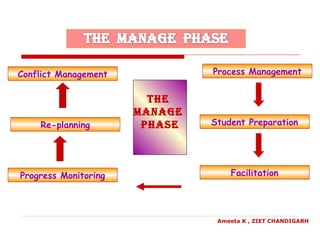
Conflict Management
Re-planning
Progress Monitoring Facilitation
Student Preparation
Process Management
the
manage
Phase
Ameeta K , ZIET CHANDIGARH
the manage Phase
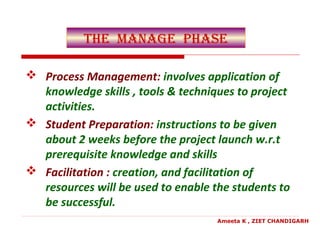
 Process Management: involves application of
knowledge skills , tools & techniques to project
activities.
 Student Preparation: instructions to be given
about 2 weeks before the project launch w.r.t
prerequisite knowledge and skills
 Facilitation : creation, and facilitation of
resources will be used to enable the students to
be successful.
Ameeta K , ZIET CHANDIGARH
the manage Phase
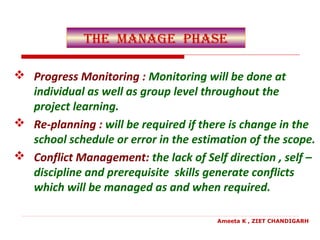
 Progress Monitoring : Monitoring will be done at
individual as well as group level throughout the
project learning.
 Re-planning : will be required if there is change in the
school schedule or error in the estimation of the scope.
 Conflict Management: the lack of Self direction , self –
discipline and prerequisite skills generate conflicts
which will be managed as and when required.
Ameeta K , ZIET CHANDIGARH
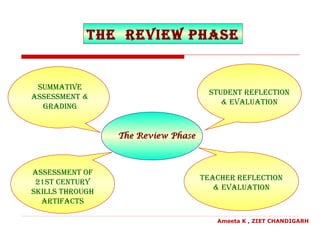
Summative
aSSeSSment &
GradinG
aSSeSSment of
21St Century
SkillS throuGh
artifaCtS
teaCher refleCtion
& evaluation
the revieW PhaSe
Student refleCtion
& evaluation
The Review PhaseThe Review Phase
Ameeta K , ZIET CHANDIGARH
the revieW
PhaSe
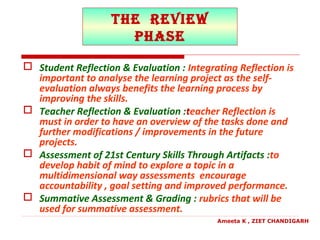
 Student Reflection & Evaluation : Integrating Reflection is
important to analyse the learning project as the self-
evaluation always benefits the learning process by
improving the skills.
 Teacher Reflection & Evaluation :teacher Reflection is
must in order to have an overview of the tasks done and
further modifications / improvements in the future
projects.
 Assessment of 21st Century Skills Through Artifacts :to
develop habit of mind to explore a topic in a
multidimensional way assessments encourage
accountability , goal setting and improved performance.
 Summative Assessment & Grading : rubrics that will be
used for summative assessment.
Ameeta K , ZIET CHANDIGARH
Dear Educators
"When teachers and their students are
"connected" through project based
learning the "world" becomes an
indispensible curriculum resource.”
This helps steer the students’ path towards higher
education and prepares them for a productive
career path.
Thanks !
Ameeta K , ZIET CHANDIGARH

Project based learning BASICS

  • 1.
    Ameeta K ,ZIET CHANDIGARH in respect to NCF 2005
  • 2.
    Project Based Learning  ProjectBased Learning is one approach to create a learning environment where students construct personal knowledge based on real world issues and practices.  Learning activities are long term and open-ended, empowering the students with the ability to make choices and decisions.  In these types of activities, students are more likely to internalize the learning that takes place because they feel a greater sense of ownership over their work when required to make decisions based on real world issues.  The teacher's role shifts from that of transferring knowledge to that of a learning facilitator in this student-directed environment. Ameeta K , ZIET CHANDIGARH
  • 3.
    coLLaBoration  A KeyElement in Project Based Learning  Students have the opportunity to gain skills that are desired by today's employer as they work in teams by collaborating, communicating and decision making.  They decide how to find answers, solve problems, and present information while collaborating with teachers, peers, and community members. Ameeta K , ZIET CHANDIGARH
  • 4.
  • 5.
  • 6.
     Project Aim& Scope : involves key challenge the project is aiming to address as well as other aspects like grades ,subjects and levels like school, national or international.  Curriculum & Standards : to select specific topics w.r.t learning outcomes such as enhancement in 21st century skills.  Essential Question : to highlight a problem that has relevance to the real world. THE DEFINE PHASE Ameeta K , ZIET CHANDIGARH
  • 7.
     Student Autonomy: to be given on the basis of age group of the students.  Grouping Strategy : to create one group of mixed ability and gender.  Assessment Rubric : to maintain a judicious balance of authentic , formative and summative assessment by the time the project is completed. THE DEFINE PHASE Ameeta K , ZIET CHANDIGARH
  • 8.
    Reviews & checkpoints DirectInstructions Resources Plan Role Definitions Products & Milestones : Work Breakdown Task Schedule THE PLAN PHASE THE PLAN PHASE Ameeta K , ZIET CHANDIGARH
  • 9.
    THE PLAN PHASE  WorkBreakdown: into tasks & sub-tasks to track and manage the sequence of activities.  Products & Milestones : to be placed in the intervals throughout the project which help to assess the team’s progress.  Role Definitions : to assign task & sub-task to each member on the basis of already existing skills and the skills they need to sharpen during the course of project undertaken. Ameeta K , ZIET CHANDIGARH
  • 10.
    THE PLAN PHASE  TaskSchedule : to be planned with start and end date of each task & sub-task.  Resources Plan : to make a list of various resources required.  Direct Instructions : planned direct instructions like ppt etc.  Reviews & checkpoints : review meetings at individual as well team level. Ameeta K , ZIET CHANDIGARH
  • 11.
  • 12.
    the do Phase Project Launch : launching pad to enable students share quickly the scope & expectations thereof.  Artifacts : provide evidence of the process of student thinking and also reflect their acquisition of knowledge.  Culminating Products : incorporate everything students have learned throughout the project.  Celebration Completion : equally important to acknowledge the investment of the time and energy by students on successful completion of the project. Ameeta K , ZIET CHANDIGARH
  • 13.
    Conflict Management Re-planning Progress MonitoringFacilitation Student Preparation Process Management the manage Phase Ameeta K , ZIET CHANDIGARH
  • 14.
    the manage Phase Process Management: involves application of knowledge skills , tools & techniques to project activities.  Student Preparation: instructions to be given about 2 weeks before the project launch w.r.t prerequisite knowledge and skills  Facilitation : creation, and facilitation of resources will be used to enable the students to be successful. Ameeta K , ZIET CHANDIGARH
  • 15.
    the manage Phase Progress Monitoring : Monitoring will be done at individual as well as group level throughout the project learning.  Re-planning : will be required if there is change in the school schedule or error in the estimation of the scope.  Conflict Management: the lack of Self direction , self – discipline and prerequisite skills generate conflicts which will be managed as and when required. Ameeta K , ZIET CHANDIGARH
  • 16.
    Summative aSSeSSment & GradinG aSSeSSment of 21StCentury SkillS throuGh artifaCtS teaCher refleCtion & evaluation the revieW PhaSe Student refleCtion & evaluation The Review PhaseThe Review Phase Ameeta K , ZIET CHANDIGARH
  • 17.
    the revieW PhaSe  StudentReflection & Evaluation : Integrating Reflection is important to analyse the learning project as the self- evaluation always benefits the learning process by improving the skills.  Teacher Reflection & Evaluation :teacher Reflection is must in order to have an overview of the tasks done and further modifications / improvements in the future projects.  Assessment of 21st Century Skills Through Artifacts :to develop habit of mind to explore a topic in a multidimensional way assessments encourage accountability , goal setting and improved performance.  Summative Assessment & Grading : rubrics that will be used for summative assessment. Ameeta K , ZIET CHANDIGARH
  • 18.
    Dear Educators "When teachersand their students are "connected" through project based learning the "world" becomes an indispensible curriculum resource.” This helps steer the students’ path towards higher education and prepares them for a productive career path. Thanks ! Ameeta K , ZIET CHANDIGARH