3-Day workshop for TGT
Science “Formatting Formative
Assessment Tasks”
21st July ,2014 to 23rdJuly ,2014.
AMEETA K. PGT CHEMISTRY ZIET
Chandigarh
We want that education
by which character is formed,
strength of mind is increased,
the intellect is expanded,
and by which
one can stand on one's own feet.
~Swami Vivekananda
AMEETA K. PGT CHEMISTRY ZIET
Chandigarh
Science Essential Standards
Teachers know the content they teach
Teachers facilitate learning for their students
Teachers demonstrate leadership
AMEETA K. PGT CHEMISTRY ZIET
Chandigarh
What comes to mind when you
think of “formative
assessment”?
“Formative assessment” is not
another gimmick in teaching;
science teachers have been
formatively assessing students
since the inception of public
education.AMEETA K. PGT CHEMISTRY ZIET
Chandigarh
What do science teachers
need to know about formative
assessments?What are FACTs
• Formative
• Assessment
• Classroom
• Techniques
AMEETA K. PGT CHEMISTRY ZIET
Chandigarh
AMEETA K. PGT CHEMISTRY ZIET
Chandigarh
Your ice breaking
activity theme was an
effort to introduce the
various probable
Classroom techniques .
Classroom techniques depend upon
the types of learning styles.
Learning styles are simply different
approaches or ways of learning
.
AMEETA K. PGT CHEMISTRY ZIET
Chandigarh
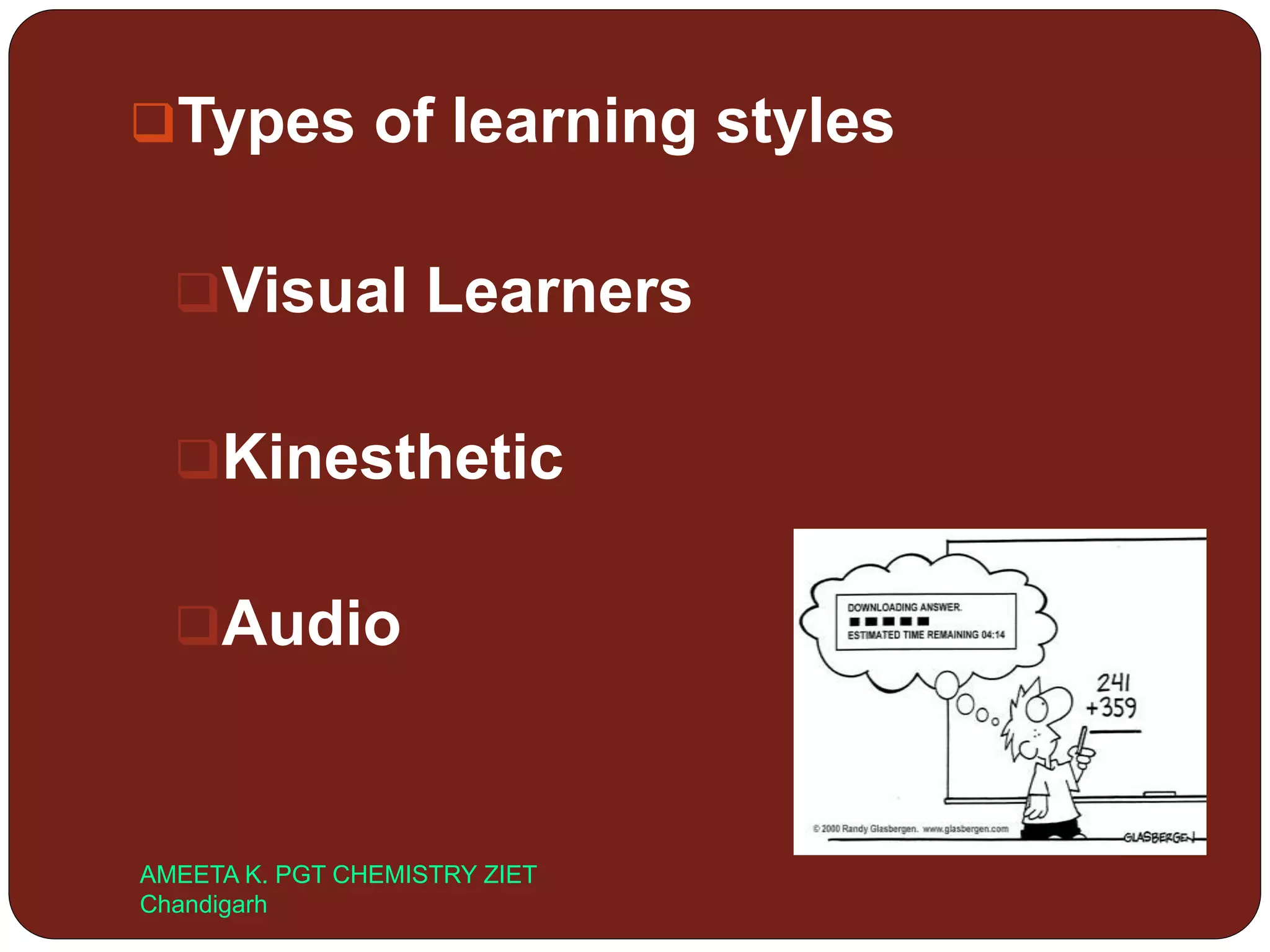
Types of learning styles
Visual Learners
Kinesthetic
Audio
AMEETA K. PGT CHEMISTRY ZIET
Chandigarh
Visual Learners:
Learn through seeing...
 need to see the teacher's body language and
facial expression to understand.
 prefer sitting at the front
 think in pictures and learn best from visual
displays including: diagrams, illustrated text
books, overhead transparencies, videos,
flipcharts and hand-outs.
 during a lecture or discussion, visual learners
often take detailed notes.
AMEETA K. PGT CHEMISTRY ZIET
Chandigarh
Auditory Learners:
 learn through listening...
 learn best through verbal lectures,
discussions, talking things through
and listening to what others have to
say
 written information may have little
meaning until it is heard.
 benefit from reading text aloud and
using a tape recorder.
AMEETA K. PGT CHEMISTRY ZIET
Chandigarh
Tactile / Kinesthetic Learners:
 learn through , moving, doing &
touching...
 learn best through a hands-on activities
and exploring the physical world around
them.
 They may find it hard to sit still for long
periods and may become distracted by
their need for activity and exploration.
AMEETA K. PGT CHEMISTRY ZIET
Chandigarh
Multiple Intelligences
 7 areas
1. Visual/Spatial Learner
2. Verbal Learner
3. Logical/Mathematical Learner
4. Bodily/Kinesthetic Learner
5. Musical learner
6. Intrapersonal Learner
7. Interpersonal Learner
AMEETA K. PGT CHEMISTRY ZIET
Chandigarh
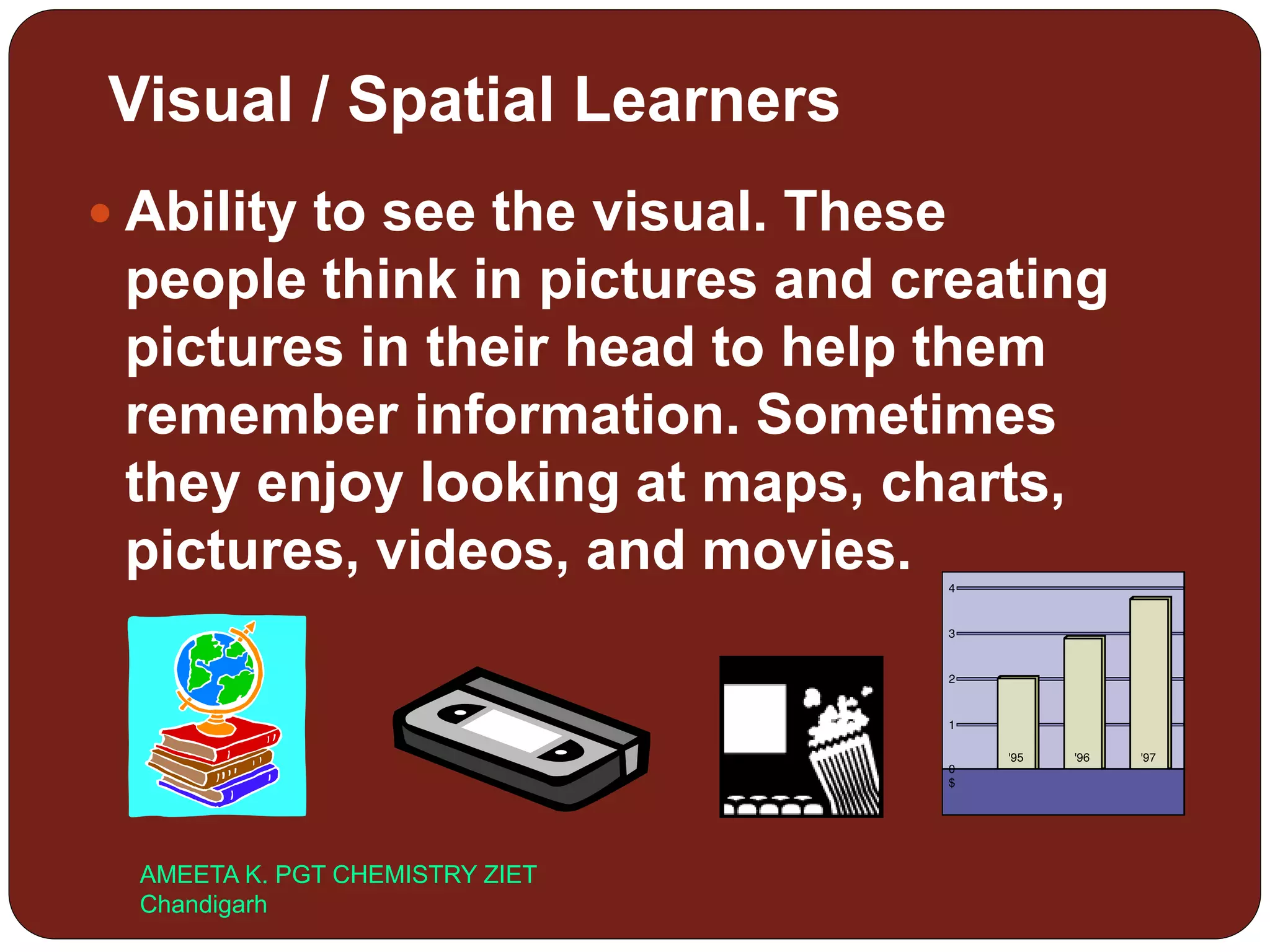
Visual / Spatial Learners
 Ability to see the visual. These
people think in pictures and creating
pictures in their head to help them
remember information. Sometimes
they enjoy looking at maps, charts,
pictures, videos, and movies.
AMEETA K. PGT CHEMISTRY ZIET
Chandigarh
Their Skills Include
 puzzle building, reading,
writing, understanding
charts and graphs, a good
sense of direction,
sketching, painting,
creating visual metaphors
and analogies (perhaps
through the visual arts),
manipulating images,
constructing, fixing,
designing practical objects,
interpreting visual images.
AMEETA K. PGT CHEMISTRY ZIET
Chandigarh
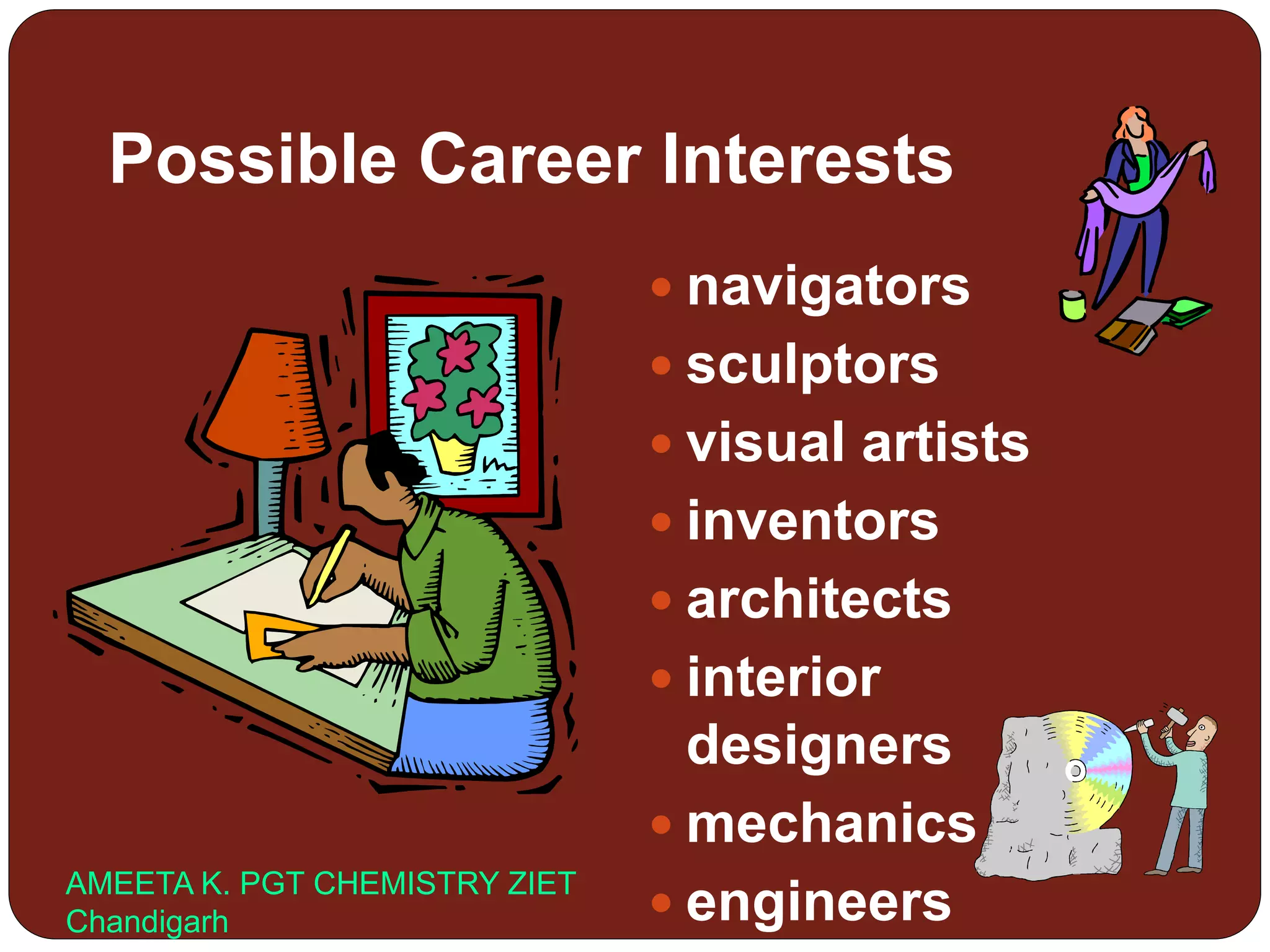
Possible Career Interests
 navigators
 sculptors
 visual artists
 inventors
 architects
 interior
designers
 mechanics
 engineersAMEETA K. PGT CHEMISTRY ZIET
Chandigarh
Verbal Learning
 They use words and language.
These learners have good hearing
skills and normally are good at
talking/speaking. They think in
words rather than pictures.
AMEETA K. PGT CHEMISTRY ZIET
Chandigarh
Their Skills Include
 listening, speaking,
writing, story telling,
explaining, teaching,
using humor,
understanding the
meaning of words,
remember information,
and can convince
someone to see their
point of view.
AMEETA K. PGT CHEMISTRY ZIET
Chandigarh
Logical/Mathematical Learning
 Have the ability to use reason, logic
(common sense) and numbers. These
people think in patterns making
connections between pieces of
information. They are curious about
the world around them, ask lots of
questions, and like to do
experiments.
AMEETA K. PGT CHEMISTRY ZIET
Chandigarh
Their Skills Include
 problem solving,
classifying and
categorizing
information, working to
figure out the
relationship of objects
to each other, doing
controlled experiments,
questioning and
wondering about
natural events,
performing complex
mathematical
calculations, working
with geometric shapes
AMEETA K. PGT CHEMISTRY ZIET
Chandigarh
Possible Career Paths
 Scientists
 engineers
 computer
programmers
 researchers
 accountants
 mathematicians
AMEETA K. PGT CHEMISTRY ZIET
Chandigarh
Bodily/Kinesthetic Learning
 ability to control body
movements and handle
objects well. Try to do
things that involve
movement. They have a
good sense of balance
and eye-hand co-
ordination. (e.g. ball
play, balancing beams).
Through interacting with
the space around them,
they are able to
remember and process
information (hands-on).AMEETA K. PGT CHEMISTRY ZIET
Chandigarh
Their Skills Include
 dancing, sports,
hands on
experimentation,
using body
language, crafts,
acting, miming,
using their hands to
create or build,
expressing
emotions through
the body
AMEETA K. PGT CHEMISTRY ZIET
Chandigarh
Possible Career Paths
 Athletes
 physical
education
teachers
 dancers
 actors
 firefighters
 artisansAMEETA K. PGT CHEMISTRY ZIET
Chandigarh
Musical Learners
 Can make and appreciate music.
These learners think in sounds,
rhythms and patterns. They
immediately respond to music either
appreciating or criticizing what they
hear. Many of these learners are
extremely sensitive to environmental
sounds (e.g. crickets, bells, dripping
taps).
AMEETA K. PGT CHEMISTRY ZIET
Chandigarh
Their Skills Include
 singing, whistling,
playing musical
instruments,
recognizing tonal
patterns,
composing music,
remembering
melodies,
understanding the
structure and
rhythm of musicAMEETA K. PGT CHEMISTRY ZIET
Chandigarh
Possible career paths
 Musician
 disc jockey
 singer
 composer
AMEETA K. PGT CHEMISTRY ZIET
Chandigarh
Interpersonal Learning
 Can relate and understand
others. These people try to see
things from other people's
point of view in order to
understand how they think and
feel. They often have a strange
ability to sense feelings,
intentions and motivations.
They are great organizers. They
try to keep peace in-group
settings and want cooperation.
The use of verbal (speaking)
and non-verbal language (eye
contact, body language) isAMEETA K. PGT CHEMISTRY ZIET
Chandigarh
Their Skills Include
 seeing things from other
perspectives, listening,
feeling bad for others in bad
situations, understanding
other people's moods and
feelings, counseling,
cooperating with groups,
noticing people's moods,
communicating both
verbally and non-verbally,
building trust, conflict
resolution, create good
relationships with others.
AMEETA K. PGT CHEMISTRY ZIET
Chandigarh
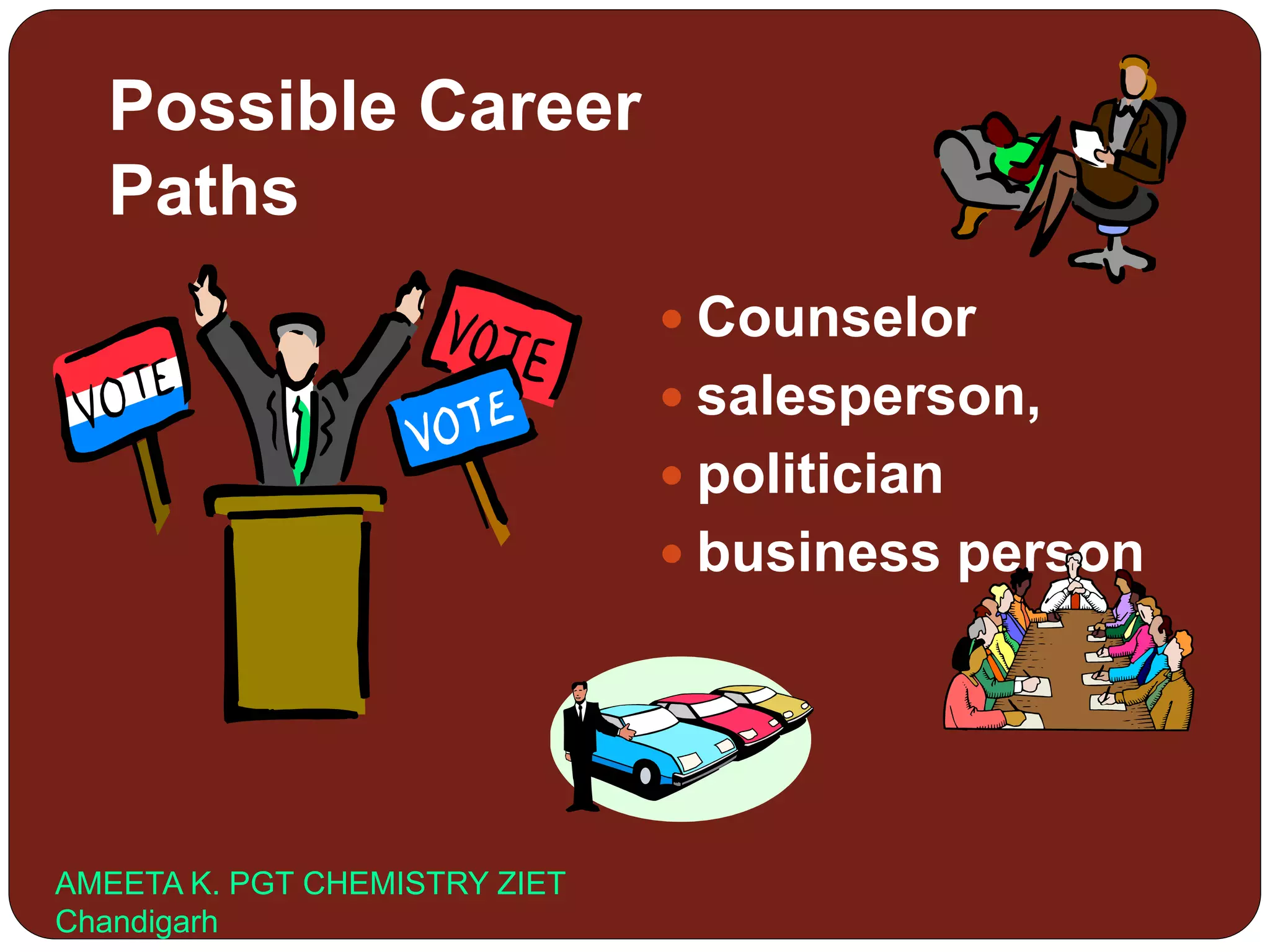
Possible Career
Paths
 Counselor
 salesperson,
 politician
 business person
AMEETA K. PGT CHEMISTRY ZIET
Chandigarh
Intrapersonal Learners
 These people reflect on their actions
and know themselves very well.
These learners try to understand their
own feelings, dreams, relationships
with others, and strengths and
weaknesses.
AMEETA K. PGT CHEMISTRY ZIET
Chandigarh
Their Skills Include
 Recognizing their own
strengths and
weaknesses, reflecting
on and studying
themselves, have
awareness of their
feelings, desires and
dreams, evaluate their
thinking patterns,
understanding their role
in relationship to others
AMEETA K. PGT CHEMISTRY ZIET
Chandigarh
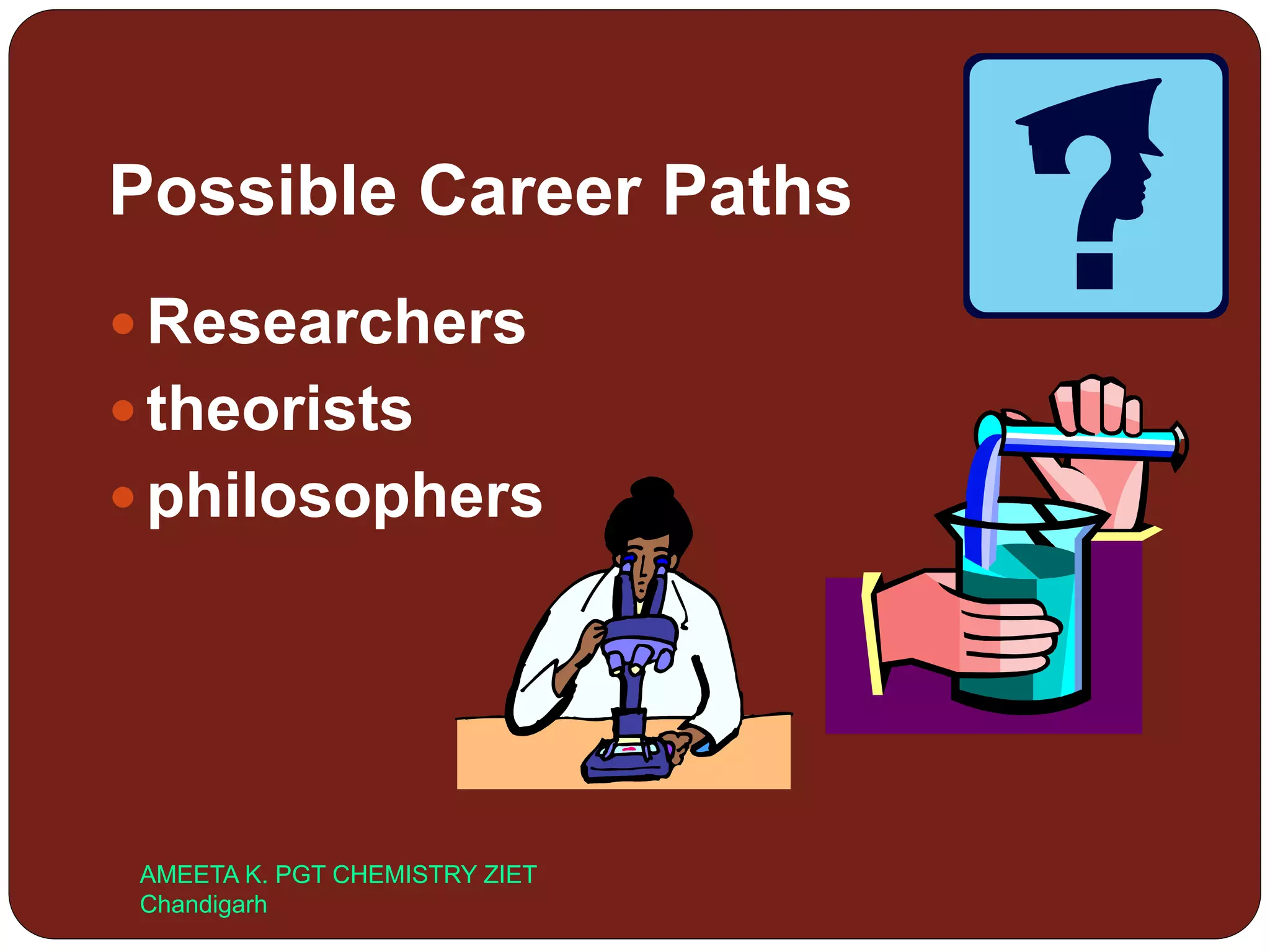
Possible Career Paths
 Researchers
 theorists
 philosophers
AMEETA K. PGT CHEMISTRY ZIET
Chandigarh
What are our goals?
 Conceptual understanding
 Problem solving
 Scientific abilities (Ability to represent a
process in multiple ways, design an
experimental investigation , to collect and
analyze experimental data to construct and
modify explanations , to evaluate all of the
above
AMEETA K. PGT CHEMISTRY ZIET
Chandigarh
The goal of formative assessment is
to monitor student learning to
provide ongoing feedback that can
be used by the classroom teacher to
drive instruction and to improve
learning for students.
Formative assessments help students
identify their strengths and
weaknesses while also providing
important data for classroom teacher
to address problems immediatelyAMEETA K. PGT CHEMISTRY ZIET
Chandigarh
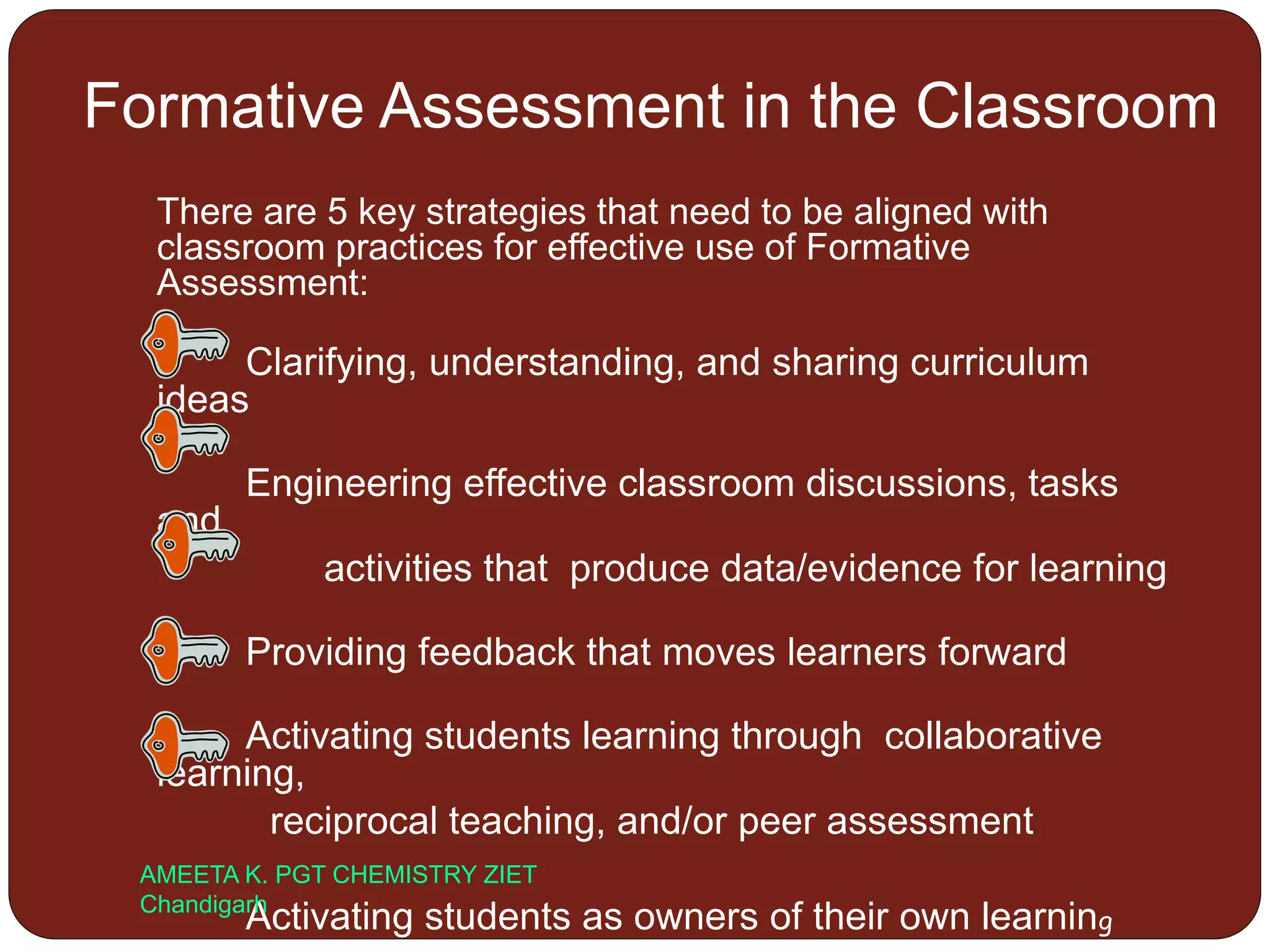
Formative Assessment in the Classroom
There are 5 key strategies that need to be aligned with
classroom practices for effective use of Formative
Assessment:
Clarifying, understanding, and sharing curriculum
ideas
Engineering effective classroom discussions, tasks
and
activities that produce data/evidence for learning
Providing feedback that moves learners forward
Activating students learning through collaborative
learning,
reciprocal teaching, and/or peer assessment
Activating students as owners of their own learning
AMEETA K. PGT CHEMISTRY ZIET
Chandigarh
Conclusion
 The effective classroom teacher drives
instruction through evidence/data gathered by
purposeful formative assessments and
differentiated activities.
 It is the classroom teachers’ role to prepare and
organize the content and curriculum to be
presented ; it is also a teachers’ role to adjust
instruction to accommodate students’
differences; and finally
 All teachers must encourage and engage
students in the learning process for deeper
understanding of content .
AMEETA K. PGT CHEMISTRY ZIET
Chandigarh
Ameeta K . Z I E T Chandigarh
Let us make
teaching a
positive
celebration of
learning.
AMEETA K. PGT CHEMISTRY ZIET
Chandigarh

Learning styles basis of formative assesment 2

  • 1.
    3-Day workshop forTGT Science “Formatting Formative Assessment Tasks” 21st July ,2014 to 23rdJuly ,2014. AMEETA K. PGT CHEMISTRY ZIET Chandigarh
  • 2.
    We want thateducation by which character is formed, strength of mind is increased, the intellect is expanded, and by which one can stand on one's own feet. ~Swami Vivekananda AMEETA K. PGT CHEMISTRY ZIET Chandigarh
  • 3.
    Science Essential Standards Teachersknow the content they teach Teachers facilitate learning for their students Teachers demonstrate leadership AMEETA K. PGT CHEMISTRY ZIET Chandigarh
  • 4.
    What comes tomind when you think of “formative assessment”? “Formative assessment” is not another gimmick in teaching; science teachers have been formatively assessing students since the inception of public education.AMEETA K. PGT CHEMISTRY ZIET Chandigarh
  • 5.
    What do scienceteachers need to know about formative assessments?What are FACTs • Formative • Assessment • Classroom • Techniques AMEETA K. PGT CHEMISTRY ZIET Chandigarh
  • 6.
    AMEETA K. PGTCHEMISTRY ZIET Chandigarh Your ice breaking activity theme was an effort to introduce the various probable Classroom techniques .
  • 7.
    Classroom techniques dependupon the types of learning styles. Learning styles are simply different approaches or ways of learning . AMEETA K. PGT CHEMISTRY ZIET Chandigarh
  • 8.
    Types of learningstyles Visual Learners Kinesthetic Audio AMEETA K. PGT CHEMISTRY ZIET Chandigarh
  • 9.
    Visual Learners: Learn throughseeing...  need to see the teacher's body language and facial expression to understand.  prefer sitting at the front  think in pictures and learn best from visual displays including: diagrams, illustrated text books, overhead transparencies, videos, flipcharts and hand-outs.  during a lecture or discussion, visual learners often take detailed notes. AMEETA K. PGT CHEMISTRY ZIET Chandigarh
  • 10.
    Auditory Learners:  learnthrough listening...  learn best through verbal lectures, discussions, talking things through and listening to what others have to say  written information may have little meaning until it is heard.  benefit from reading text aloud and using a tape recorder. AMEETA K. PGT CHEMISTRY ZIET Chandigarh
  • 11.
    Tactile / KinestheticLearners:  learn through , moving, doing & touching...  learn best through a hands-on activities and exploring the physical world around them.  They may find it hard to sit still for long periods and may become distracted by their need for activity and exploration. AMEETA K. PGT CHEMISTRY ZIET Chandigarh
  • 12.
    Multiple Intelligences  7areas 1. Visual/Spatial Learner 2. Verbal Learner 3. Logical/Mathematical Learner 4. Bodily/Kinesthetic Learner 5. Musical learner 6. Intrapersonal Learner 7. Interpersonal Learner AMEETA K. PGT CHEMISTRY ZIET Chandigarh
  • 13.
    Visual / SpatialLearners  Ability to see the visual. These people think in pictures and creating pictures in their head to help them remember information. Sometimes they enjoy looking at maps, charts, pictures, videos, and movies. AMEETA K. PGT CHEMISTRY ZIET Chandigarh
  • 14.
    Their Skills Include puzzle building, reading, writing, understanding charts and graphs, a good sense of direction, sketching, painting, creating visual metaphors and analogies (perhaps through the visual arts), manipulating images, constructing, fixing, designing practical objects, interpreting visual images. AMEETA K. PGT CHEMISTRY ZIET Chandigarh
  • 15.
    Possible Career Interests navigators  sculptors  visual artists  inventors  architects  interior designers  mechanics  engineersAMEETA K. PGT CHEMISTRY ZIET Chandigarh
  • 16.
    Verbal Learning  Theyuse words and language. These learners have good hearing skills and normally are good at talking/speaking. They think in words rather than pictures. AMEETA K. PGT CHEMISTRY ZIET Chandigarh
  • 17.
    Their Skills Include listening, speaking, writing, story telling, explaining, teaching, using humor, understanding the meaning of words, remember information, and can convince someone to see their point of view. AMEETA K. PGT CHEMISTRY ZIET Chandigarh
  • 18.
    Logical/Mathematical Learning  Havethe ability to use reason, logic (common sense) and numbers. These people think in patterns making connections between pieces of information. They are curious about the world around them, ask lots of questions, and like to do experiments. AMEETA K. PGT CHEMISTRY ZIET Chandigarh
  • 19.
    Their Skills Include problem solving, classifying and categorizing information, working to figure out the relationship of objects to each other, doing controlled experiments, questioning and wondering about natural events, performing complex mathematical calculations, working with geometric shapes AMEETA K. PGT CHEMISTRY ZIET Chandigarh
  • 20.
    Possible Career Paths Scientists  engineers  computer programmers  researchers  accountants  mathematicians AMEETA K. PGT CHEMISTRY ZIET Chandigarh
  • 21.
    Bodily/Kinesthetic Learning  abilityto control body movements and handle objects well. Try to do things that involve movement. They have a good sense of balance and eye-hand co- ordination. (e.g. ball play, balancing beams). Through interacting with the space around them, they are able to remember and process information (hands-on).AMEETA K. PGT CHEMISTRY ZIET Chandigarh
  • 22.
    Their Skills Include dancing, sports, hands on experimentation, using body language, crafts, acting, miming, using their hands to create or build, expressing emotions through the body AMEETA K. PGT CHEMISTRY ZIET Chandigarh
  • 23.
    Possible Career Paths Athletes  physical education teachers  dancers  actors  firefighters  artisansAMEETA K. PGT CHEMISTRY ZIET Chandigarh
  • 24.
    Musical Learners  Canmake and appreciate music. These learners think in sounds, rhythms and patterns. They immediately respond to music either appreciating or criticizing what they hear. Many of these learners are extremely sensitive to environmental sounds (e.g. crickets, bells, dripping taps). AMEETA K. PGT CHEMISTRY ZIET Chandigarh
  • 25.
    Their Skills Include singing, whistling, playing musical instruments, recognizing tonal patterns, composing music, remembering melodies, understanding the structure and rhythm of musicAMEETA K. PGT CHEMISTRY ZIET Chandigarh
  • 26.
    Possible career paths Musician  disc jockey  singer  composer AMEETA K. PGT CHEMISTRY ZIET Chandigarh
  • 27.
    Interpersonal Learning  Canrelate and understand others. These people try to see things from other people's point of view in order to understand how they think and feel. They often have a strange ability to sense feelings, intentions and motivations. They are great organizers. They try to keep peace in-group settings and want cooperation. The use of verbal (speaking) and non-verbal language (eye contact, body language) isAMEETA K. PGT CHEMISTRY ZIET Chandigarh
  • 28.
    Their Skills Include seeing things from other perspectives, listening, feeling bad for others in bad situations, understanding other people's moods and feelings, counseling, cooperating with groups, noticing people's moods, communicating both verbally and non-verbally, building trust, conflict resolution, create good relationships with others. AMEETA K. PGT CHEMISTRY ZIET Chandigarh
  • 29.
    Possible Career Paths  Counselor salesperson,  politician  business person AMEETA K. PGT CHEMISTRY ZIET Chandigarh
  • 30.
    Intrapersonal Learners  Thesepeople reflect on their actions and know themselves very well. These learners try to understand their own feelings, dreams, relationships with others, and strengths and weaknesses. AMEETA K. PGT CHEMISTRY ZIET Chandigarh
  • 31.
    Their Skills Include Recognizing their own strengths and weaknesses, reflecting on and studying themselves, have awareness of their feelings, desires and dreams, evaluate their thinking patterns, understanding their role in relationship to others AMEETA K. PGT CHEMISTRY ZIET Chandigarh
  • 32.
    Possible Career Paths Researchers  theorists  philosophers AMEETA K. PGT CHEMISTRY ZIET Chandigarh
  • 33.
    What are ourgoals?  Conceptual understanding  Problem solving  Scientific abilities (Ability to represent a process in multiple ways, design an experimental investigation , to collect and analyze experimental data to construct and modify explanations , to evaluate all of the above AMEETA K. PGT CHEMISTRY ZIET Chandigarh
  • 34.
    The goal offormative assessment is to monitor student learning to provide ongoing feedback that can be used by the classroom teacher to drive instruction and to improve learning for students. Formative assessments help students identify their strengths and weaknesses while also providing important data for classroom teacher to address problems immediatelyAMEETA K. PGT CHEMISTRY ZIET Chandigarh
  • 35.
    Formative Assessment inthe Classroom There are 5 key strategies that need to be aligned with classroom practices for effective use of Formative Assessment: Clarifying, understanding, and sharing curriculum ideas Engineering effective classroom discussions, tasks and activities that produce data/evidence for learning Providing feedback that moves learners forward Activating students learning through collaborative learning, reciprocal teaching, and/or peer assessment Activating students as owners of their own learning AMEETA K. PGT CHEMISTRY ZIET Chandigarh
  • 36.
    Conclusion  The effectiveclassroom teacher drives instruction through evidence/data gathered by purposeful formative assessments and differentiated activities.  It is the classroom teachers’ role to prepare and organize the content and curriculum to be presented ; it is also a teachers’ role to adjust instruction to accommodate students’ differences; and finally  All teachers must encourage and engage students in the learning process for deeper understanding of content . AMEETA K. PGT CHEMISTRY ZIET Chandigarh
  • 37.
    Ameeta K .Z I E T Chandigarh
  • 38.
    Ameeta K .Z I E T Chandigarh
  • 39.
    Ameeta K .Z I E T Chandigarh
  • 40.
    Let us make teachinga positive celebration of learning. AMEETA K. PGT CHEMISTRY ZIET Chandigarh