GOOGLE: PROJECT ARA
PRESENTED BY-
RUNA JASIA
REGN NO.- 1301292108
CSE-”A”
GROUP-01
GUIDED BY-
PROF. N.K ROUT
Gandhi engineering college
CONTENTS
i) INTRODUCTION
ii) INITIATION
iii)HISTORY BEHOLDS
iv)NEED OF PROJECT ARA
v) WORKING AND ITS COMPONENTS
vi)TECHNOLOGIES RELATED
vii)PROS
viii)CONS
ix)CHALLENGES
x) FUTURE SCOPE
xi)REFERENCES
xii)QUESTIONS??
INTRODUCTION
PROJECT ARA IS THE CODENAME
FOR AN INITIATIVE BY GOOGLE
THAT AIMS TO DEVELOP A FREE ,
OPEN HARDWARE PLATFORM FOR
CREATING HIGHLY MODULAR
SMARTPHONES .
It is made up of swappable and
replaceable parts. The phone is
designed to be a long-term
sustainable product tailored to
customers’ changing needs
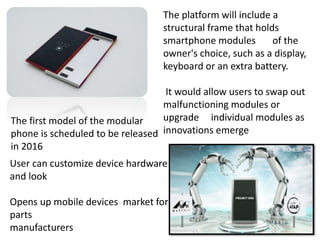
The platform will include a
structural frame that holds
smartphone modules of the
owner's choice, such as a display,
keyboard or an extra battery.
It would allow users to swap out
malfunctioning modules or
upgrade individual modules as
innovations emerge
The first model of the modular
phone is scheduled to be released
in 2016
User can customize device hardware
and look
Opens up mobile devices market for
parts
manufacturers
The project was
originally headed by the
Advanced Technologies
and Projects team
within Motorola
Mobility while it was a
subsidiary of Google.
INITIATION
THE PROJECT ARA IS LEAD BY
PAUL EREMENKO
It's a philosophy that's imported from the
Defense Advanced Research Projects
Agency (DARPA),where Eremenko and his
boss, Regina Dugan, once worked. Dugan
came to Google in 2012,where she was put
in charge of ATAP , which was then meant to
help reinvigorate the Motorola division.
When Motorola was sold off to Lenovo in
January 2014 Google kept ATAP and Project
Ara, which became Google Ara
PROJECT ARA AND PHONEBLOKS
- In September 2013,Dutch
designer Dave Hakkens announced
the Phonebloks modular phone
concept independently in
September 2013
- Motorola publicly announced
Project Ara on October 29,2013
and said they will be working
collaboratively with Phonebloks
Dave Hakkens-Master
mind behind the
concept ‘Phonebloks
Initial exploration of this concept
began in 2012 and work started on
April 1 , 2013.
Dutch designer Dave Hakkens
announced the Phonebloks
modular phone concept
independently in September 2013.
Motorola publicly announced
Project Ara on October 29, 2013
and said they will be working
collaboratively with Phonebloks.
A near-working
prototype of an Ara
phone was presented
at Google I/O 2014;
however, the device
froze on the boot
screen and failed to
BOOT COMPLETELY
HISTORY
Stop the E-waste
As the electronic market changes
every day, it has increased a lot of
e-waste. For a single upgrade, we
need to change the whole phone.
Precise shape and structure leads
to inconvenience to some
customers. Mobile needs to be
flexible. It must only have the
customer’s required features.
NEED OF PROJECT
ARA
Phonebloks would consist of main
board onto which Bloks could be
snapped by the Lego bricks. Each
Blok is responsible for a unique
function of the phone, much as a
desktop computer has a distinct
sound card, processor, monitor,
and power suppLY.
WORKING AND ITS
COMPONENTS
Project ARA has two core component :
The ENDOSKELETON and
The MODULE
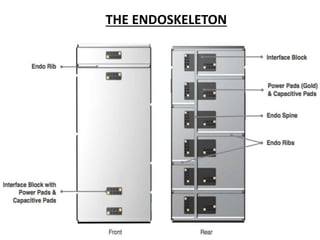
The endoskeleton is made of
aluminium to provide strength .
Also it means different sizes and
different types of components can
be added and permits ‘growth of
device’ from, for example, phone
to phablet, according to Google.
‘The framework of the
endoskeleton and interchangeable
modules promise to democratize
hardware in the same way that the
app opened up the world of
software.
THE
ENDOSKELETON
THE ENDOSKELETON
Modules can be anything
that users can think of
battery , speaker , camera ,
etc . They can be developed
by anyone; 3D-printed on
demand, used, replaced and
even re-sold ensuring your
phone is completely made for
each user. Module
development is open-source
and there is a toolkit
provided to help developers
understand the hierarchy
of functions and how
components can be
integrated.
THE MODULE
TECHNOLOGIES USED
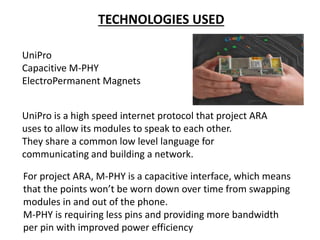
UniPro
Capacitive M-PHY
ElectroPermanent Magnets
UniPro is a high speed internet protocol that project ARA
uses to allow its modules to speak to each other.
They share a common low level language for
communicating and building a network.
For project ARA, M-PHY is a capacitive interface, which means
that the points won’t be worn down over time from swapping
modules in and out of the phone.
M-PHY is requiring less pins and providing more bandwidth
per pin with improved power efficiency
Electropermanent magnets are
used for affixing the modules in
place in the ‘ENDO’.
Normal Electromagnets magnetize
depending on if current is running
through them – that would be a
battery drain.
But Electropermanent magnets
only use current to flip
magnetization on and off.
It is able to retain its magnetized
state without drainig additional
power.
Phone is very cheap.
You only buy the features that you
want.
Your phone could last indefinitely.
Repairs are easier and cheaper.
You could have two versions of
your phone
PROS
LOW PRICE
CHEAPER REPAIRS
CUSTOMIZATION
INCREASED LIFE
BATTERY LIFE
SUPPORT
SPECIALISATION
CONS
I) It will be bigger and heavier than a
smartphone.
II) The connectors are bound to cause
problems.
III) Certain combinations won’t work.
It won’t be optimized.
*SIZE OF THE PHONE
*TESTING ISSUE
*DESIGN
*THE CONNECTORS ARE
BOUND TO CAUSE
PROBLEMS
*CERTAIN COMBINATIONS
WON’T WORK
*IT WON’T BE OPTIMISED
Limited manufacturers
Getting such a phone accepted by
operators
Software integration
Changing components that
potentially have impact on
performance could disrupt the
service experience
CHALLENGES
The benefits of a modular phone
will become compelling tom
consume consumers once ATAP
Can get issues of weight, battery
life, and size reduce down to a
certain point. Also custom and
closures and super charged
batteries may appeal tom the high
end of the market.
FUTURE SCOPE
REFERENCES
1) www.projectara.com
2)
www.theverge.com/2015/8
/19/.../google-explains-
project-ara-delay
3)
https://www.youtube.com/w
atch?v=0He3Jr-fZh0
Project ara
Project ara

Project ara

  • 1.
    GOOGLE: PROJECT ARA PRESENTEDBY- RUNA JASIA REGN NO.- 1301292108 CSE-”A” GROUP-01 GUIDED BY- PROF. N.K ROUT Gandhi engineering college
  • 2.
    CONTENTS i) INTRODUCTION ii) INITIATION iii)HISTORYBEHOLDS iv)NEED OF PROJECT ARA v) WORKING AND ITS COMPONENTS vi)TECHNOLOGIES RELATED vii)PROS viii)CONS ix)CHALLENGES x) FUTURE SCOPE xi)REFERENCES xii)QUESTIONS??
  • 3.
    INTRODUCTION PROJECT ARA ISTHE CODENAME FOR AN INITIATIVE BY GOOGLE THAT AIMS TO DEVELOP A FREE , OPEN HARDWARE PLATFORM FOR CREATING HIGHLY MODULAR SMARTPHONES . It is made up of swappable and replaceable parts. The phone is designed to be a long-term sustainable product tailored to customers’ changing needs
  • 5.
    The platform willinclude a structural frame that holds smartphone modules of the owner's choice, such as a display, keyboard or an extra battery. It would allow users to swap out malfunctioning modules or upgrade individual modules as innovations emerge The first model of the modular phone is scheduled to be released in 2016 User can customize device hardware and look Opens up mobile devices market for parts manufacturers
  • 6.
    The project was originallyheaded by the Advanced Technologies and Projects team within Motorola Mobility while it was a subsidiary of Google. INITIATION THE PROJECT ARA IS LEAD BY PAUL EREMENKO
  • 7.
    It's a philosophythat's imported from the Defense Advanced Research Projects Agency (DARPA),where Eremenko and his boss, Regina Dugan, once worked. Dugan came to Google in 2012,where she was put in charge of ATAP , which was then meant to help reinvigorate the Motorola division. When Motorola was sold off to Lenovo in January 2014 Google kept ATAP and Project Ara, which became Google Ara
  • 8.
    PROJECT ARA ANDPHONEBLOKS - In September 2013,Dutch designer Dave Hakkens announced the Phonebloks modular phone concept independently in September 2013 - Motorola publicly announced Project Ara on October 29,2013 and said they will be working collaboratively with Phonebloks Dave Hakkens-Master mind behind the concept ‘Phonebloks
  • 9.
    Initial exploration ofthis concept began in 2012 and work started on April 1 , 2013. Dutch designer Dave Hakkens announced the Phonebloks modular phone concept independently in September 2013. Motorola publicly announced Project Ara on October 29, 2013 and said they will be working collaboratively with Phonebloks. A near-working prototype of an Ara phone was presented at Google I/O 2014; however, the device froze on the boot screen and failed to BOOT COMPLETELY HISTORY
  • 10.
    Stop the E-waste Asthe electronic market changes every day, it has increased a lot of e-waste. For a single upgrade, we need to change the whole phone. Precise shape and structure leads to inconvenience to some customers. Mobile needs to be flexible. It must only have the customer’s required features. NEED OF PROJECT ARA
  • 11.
    Phonebloks would consistof main board onto which Bloks could be snapped by the Lego bricks. Each Blok is responsible for a unique function of the phone, much as a desktop computer has a distinct sound card, processor, monitor, and power suppLY. WORKING AND ITS COMPONENTS Project ARA has two core component : The ENDOSKELETON and The MODULE
  • 12.
    The endoskeleton ismade of aluminium to provide strength . Also it means different sizes and different types of components can be added and permits ‘growth of device’ from, for example, phone to phablet, according to Google. ‘The framework of the endoskeleton and interchangeable modules promise to democratize hardware in the same way that the app opened up the world of software. THE ENDOSKELETON
  • 13.
  • 14.
    Modules can beanything that users can think of battery , speaker , camera , etc . They can be developed by anyone; 3D-printed on demand, used, replaced and even re-sold ensuring your phone is completely made for each user. Module development is open-source and there is a toolkit provided to help developers understand the hierarchy of functions and how components can be integrated. THE MODULE
  • 15.
    TECHNOLOGIES USED UniPro Capacitive M-PHY ElectroPermanentMagnets UniPro is a high speed internet protocol that project ARA uses to allow its modules to speak to each other. They share a common low level language for communicating and building a network. For project ARA, M-PHY is a capacitive interface, which means that the points won’t be worn down over time from swapping modules in and out of the phone. M-PHY is requiring less pins and providing more bandwidth per pin with improved power efficiency
  • 16.
    Electropermanent magnets are usedfor affixing the modules in place in the ‘ENDO’. Normal Electromagnets magnetize depending on if current is running through them – that would be a battery drain. But Electropermanent magnets only use current to flip magnetization on and off. It is able to retain its magnetized state without drainig additional power.
  • 17.
    Phone is verycheap. You only buy the features that you want. Your phone could last indefinitely. Repairs are easier and cheaper. You could have two versions of your phone PROS LOW PRICE CHEAPER REPAIRS CUSTOMIZATION INCREASED LIFE BATTERY LIFE SUPPORT SPECIALISATION
  • 18.
    CONS I) It willbe bigger and heavier than a smartphone. II) The connectors are bound to cause problems. III) Certain combinations won’t work. It won’t be optimized. *SIZE OF THE PHONE *TESTING ISSUE *DESIGN *THE CONNECTORS ARE BOUND TO CAUSE PROBLEMS *CERTAIN COMBINATIONS WON’T WORK *IT WON’T BE OPTIMISED
  • 19.
    Limited manufacturers Getting sucha phone accepted by operators Software integration Changing components that potentially have impact on performance could disrupt the service experience CHALLENGES
  • 20.
    The benefits ofa modular phone will become compelling tom consume consumers once ATAP Can get issues of weight, battery life, and size reduce down to a certain point. Also custom and closures and super charged batteries may appeal tom the high end of the market. FUTURE SCOPE
  • 21.