*
-BUILDING THE MODULAR SMARTPHONE
*
*Introduction
*History
*Goal
*Need
*Structure & Components
*Price
*Advantages
*Disadvantages
*Challenges
*Future Scope
*
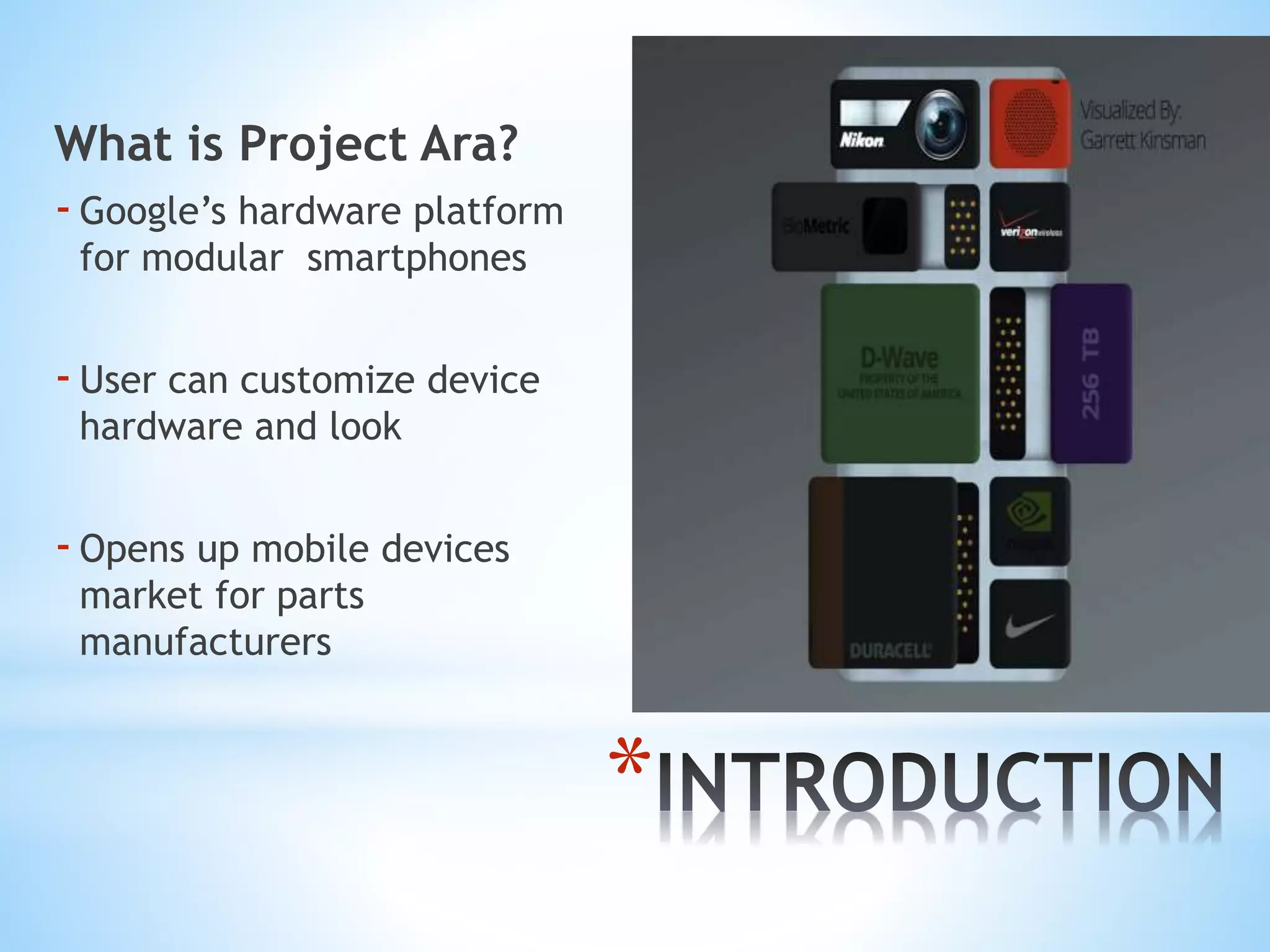
What is Project Ara?
-Google’s hardware platform
for modular smartphones
-User can customize device
hardware and look
-Opens up mobile devices
market for parts
manufacturers
*
*The project was originally headed by the
Advanced Technologies and Projects(ATAP)
team within Motorola Mobility while it was
subsidiary of Google. Although Google had sold
Motorola to Lenovo in January 2014,but Google
kept ATAP and Project Ara, which became
Google Ara
*
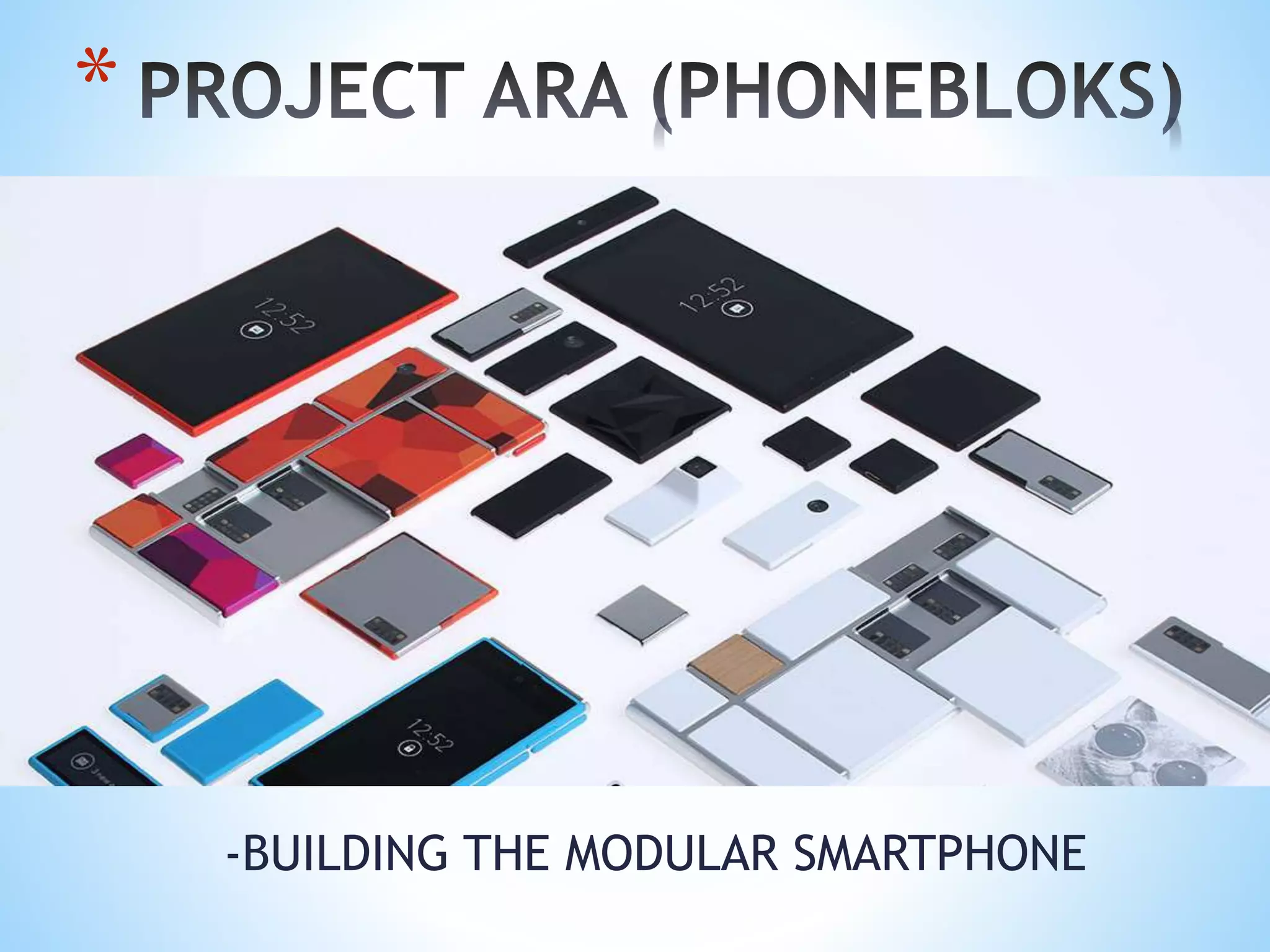
PROJECT ARA AND PHONEBLOKS
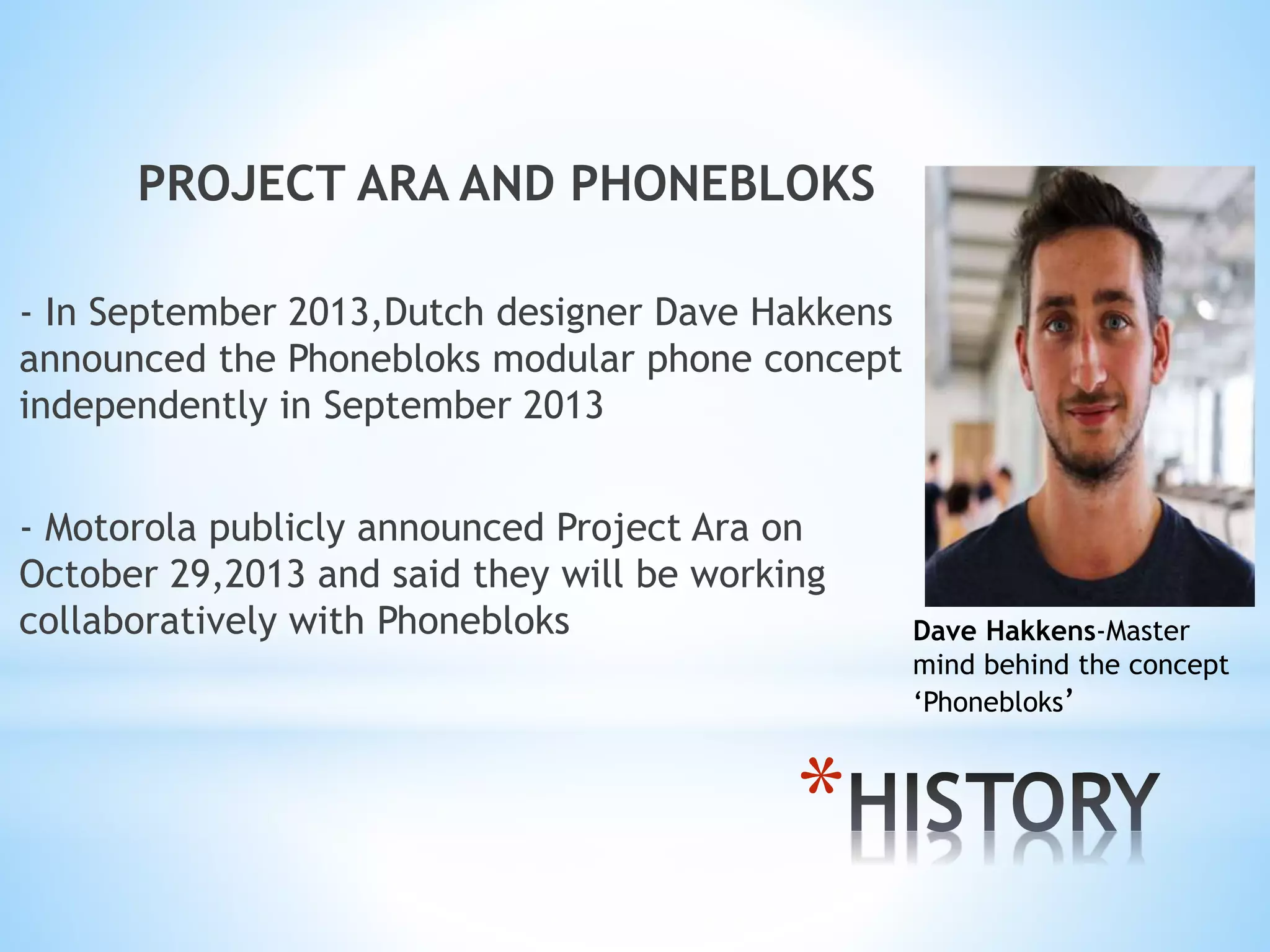
- In September 2013,Dutch designer Dave Hakkens
announced the Phonebloks modular phone concept
independently in September 2013
- Motorola publicly announced Project Ara on
October 29,2013 and said they will be working
collaboratively with Phonebloks Dave Hakkens-Master
mind behind the concept
‘Phonebloks’
*
*The goal is to drive the more thoughtful
expressive, and open relationship between user
developers, and their phones.
*
Stop the E-waste
As the electronic market changes every day, it
has increased a lot of e-waste. For a single
upgrade, we need to change the whole phone.
Precise shape and structure leads to
inconvenience to some customers. Mobile needs
to be flexible. It must only have the customer’s
required features.
*
*
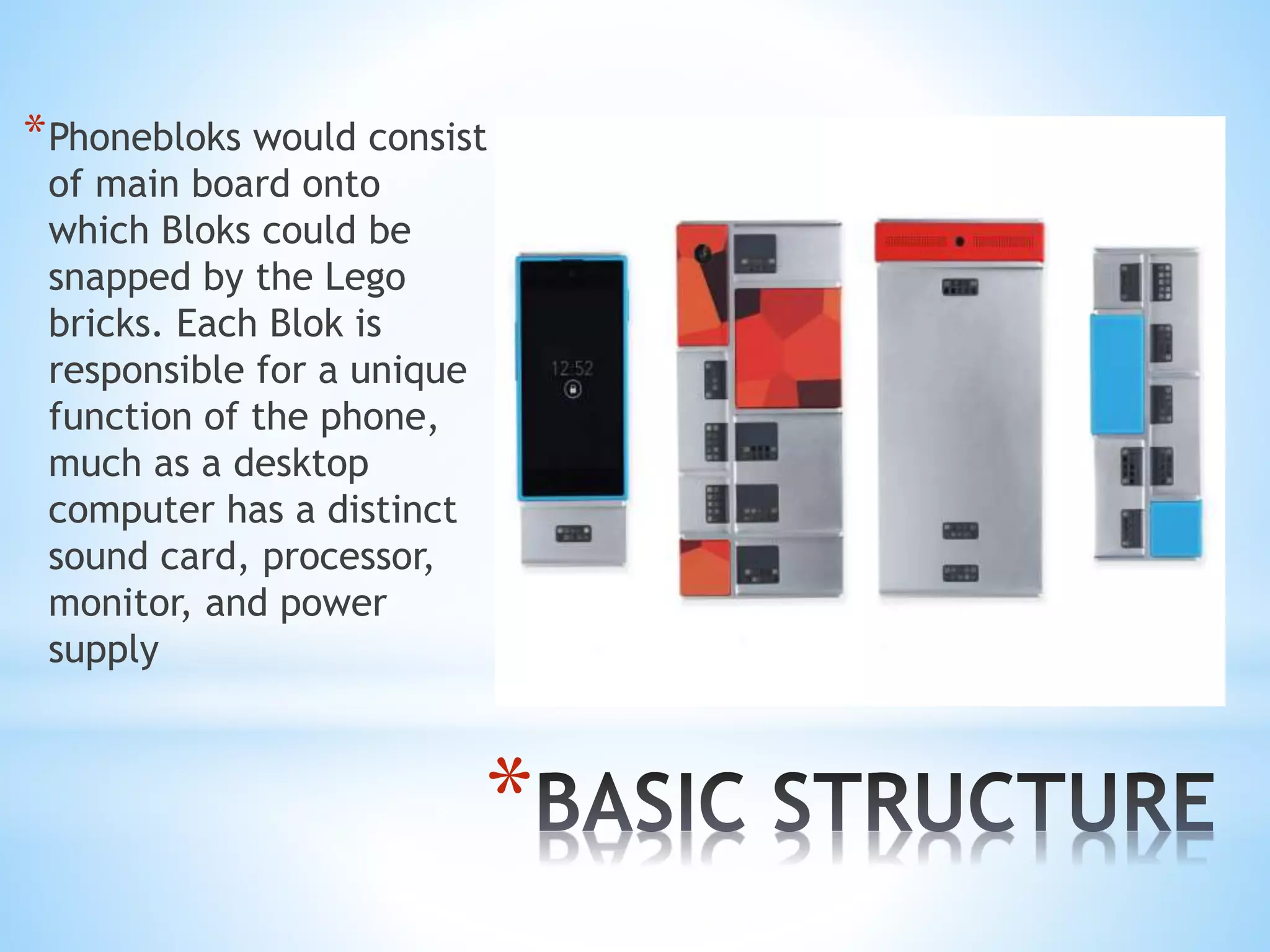
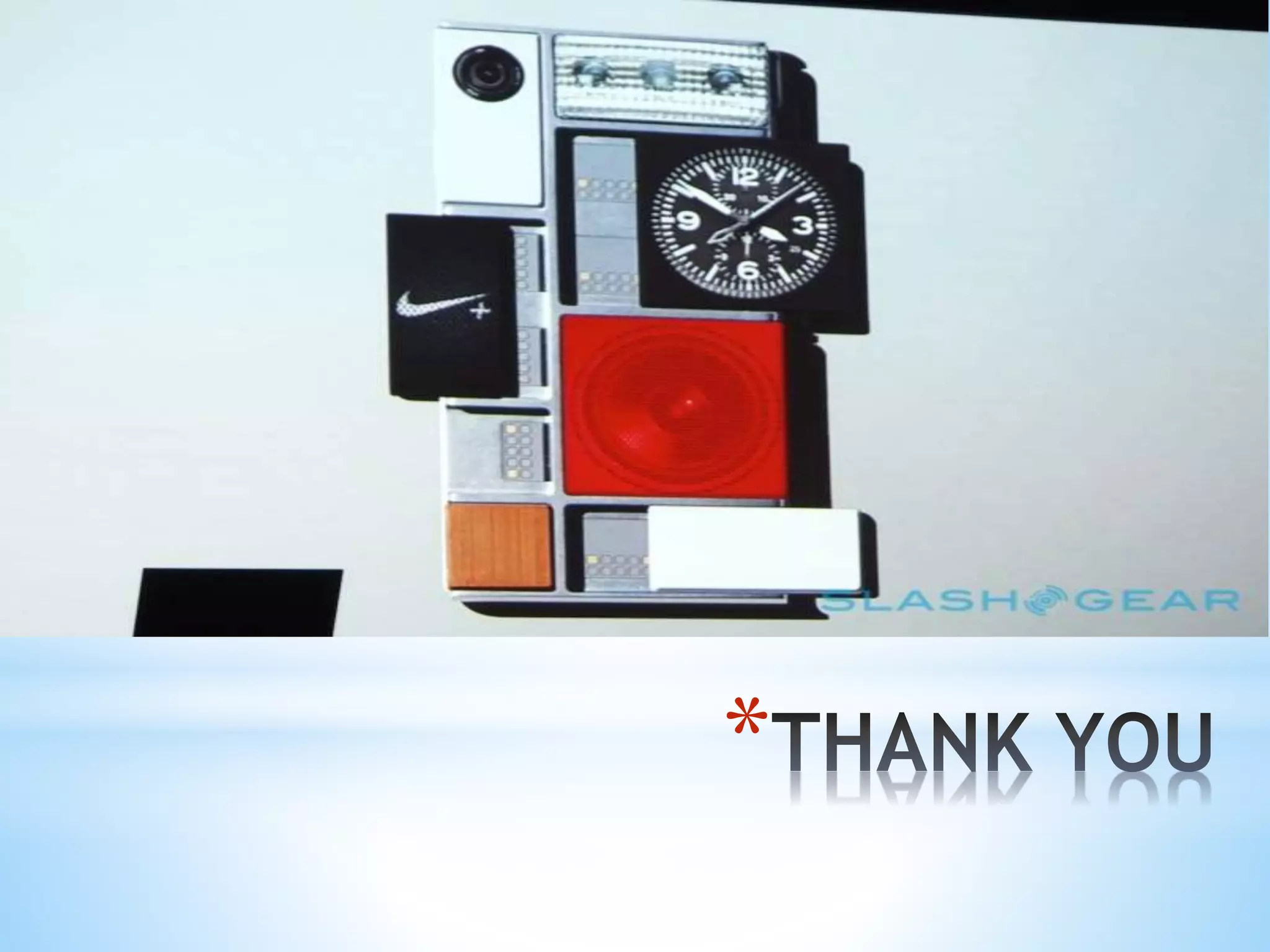
*Phonebloks would consist
of main board onto
which Bloks could be
snapped by the Lego
bricks. Each Blok is
responsible for a unique
function of the phone,
much as a desktop
computer has a distinct
sound card, processor,
monitor, and power
supply
*
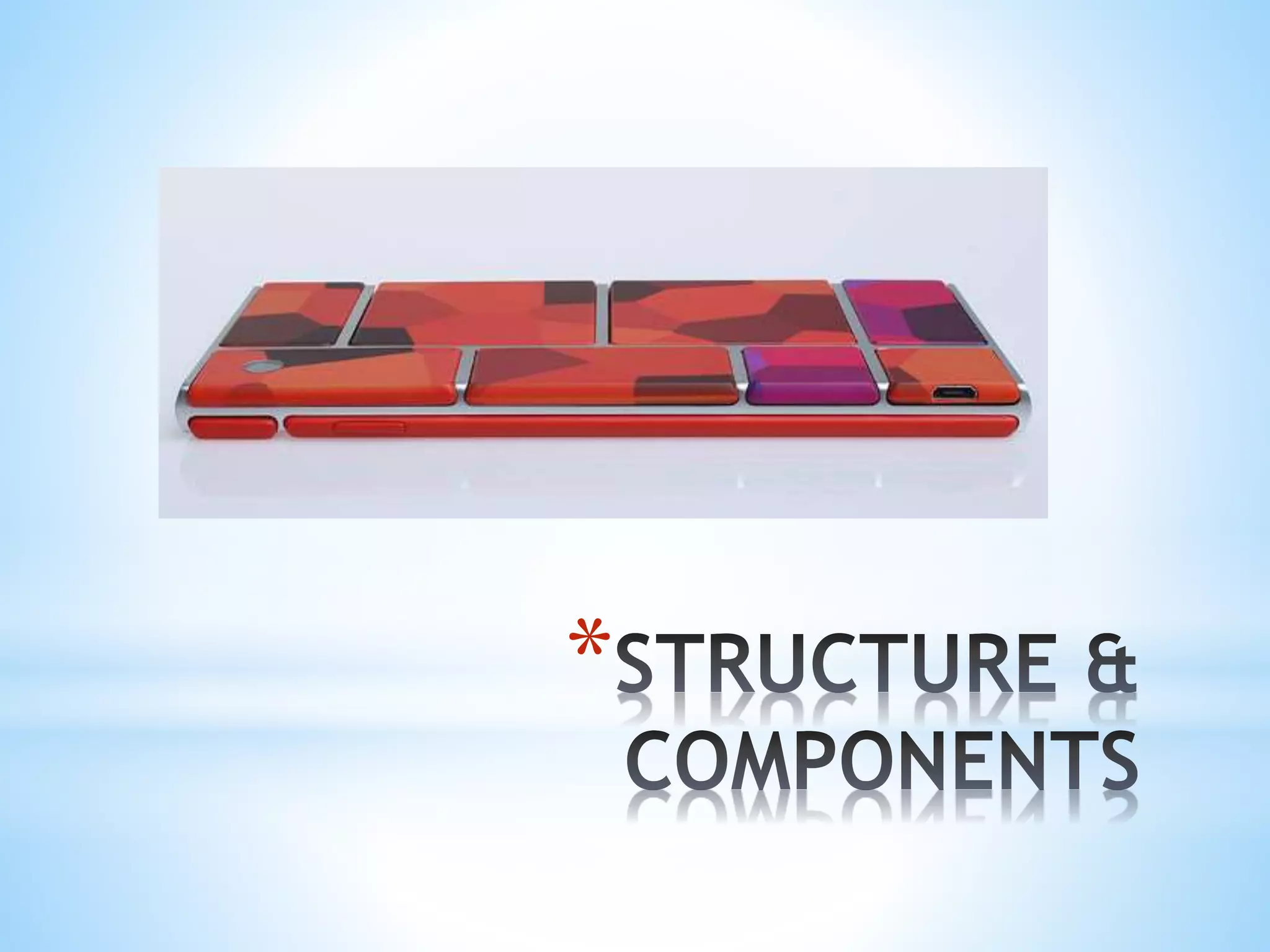
Two main components:
1) The Endoskeleton
2)The Module
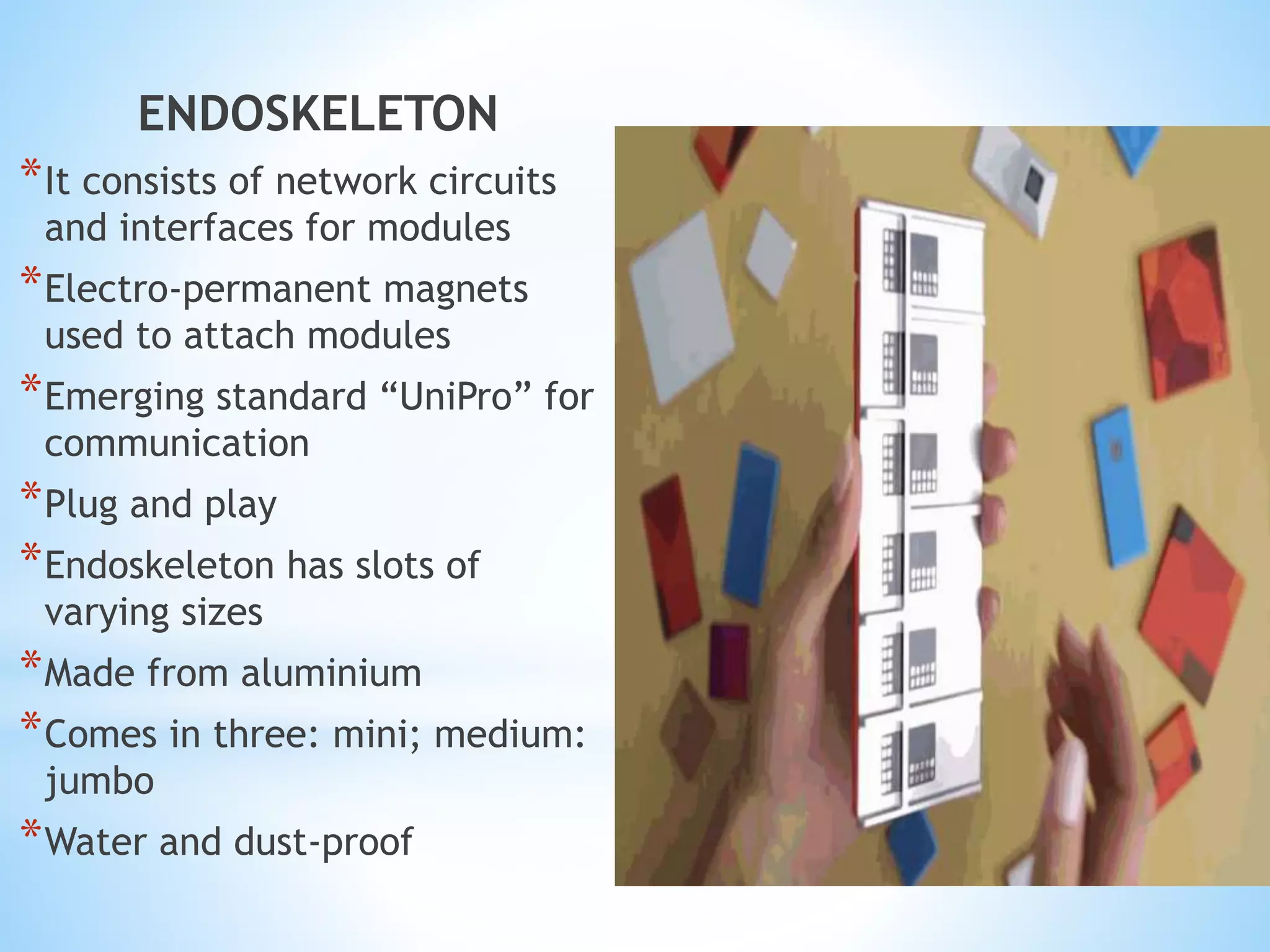
ENDOSKELETON
*It consists of network circuits
and interfaces for modules
*Electro-permanent magnets
used to attach modules
*Emerging standard “UniPro” for
communication
*Plug and play
*Endoskeleton has slots of
varying sizes
*Made from aluminium
*Comes in three: mini; medium:
jumbo
*Water and dust-proof
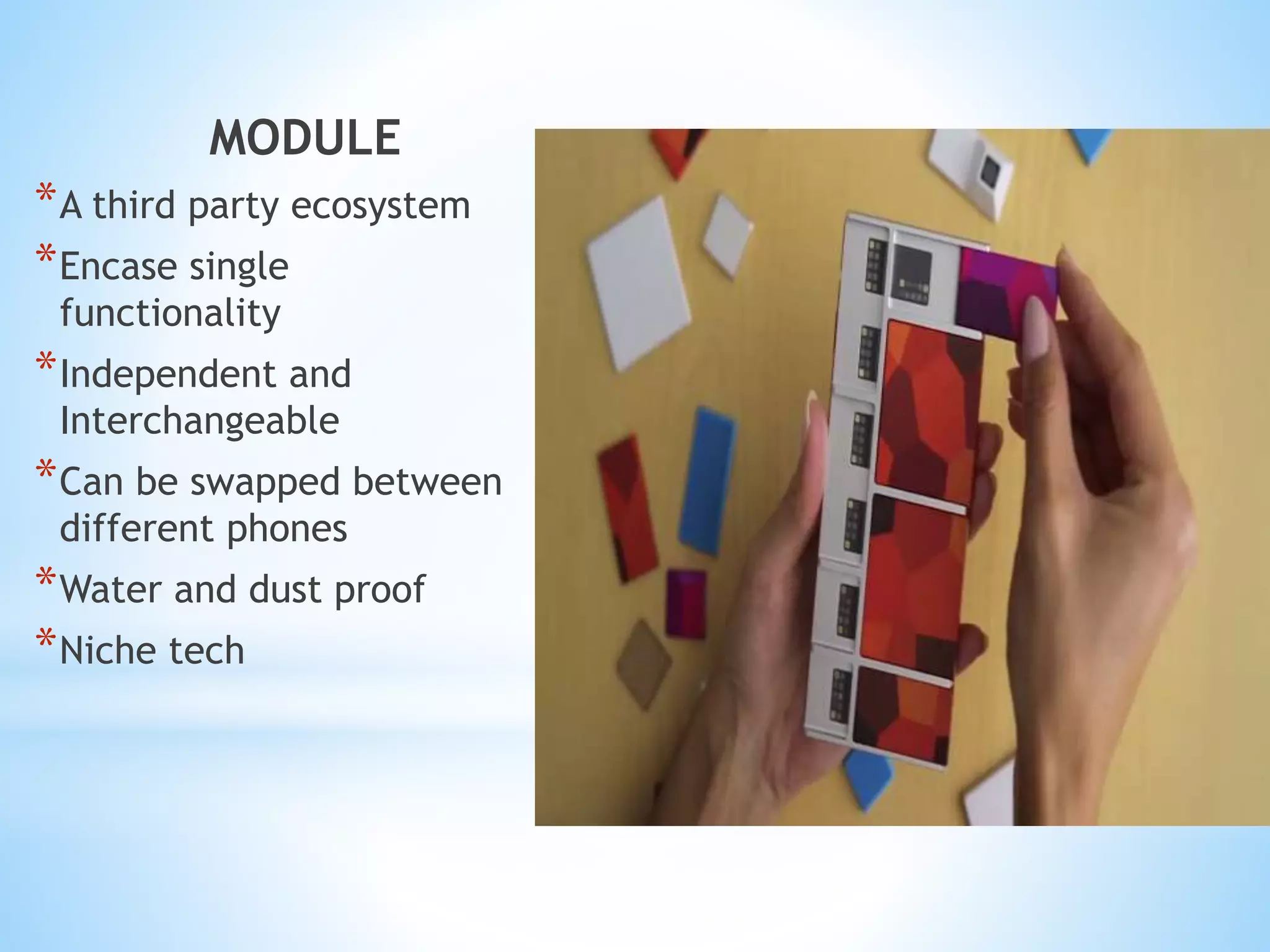
MODULE
*A third party ecosystem
*Encase single
functionality
*Independent and
Interchangeable
*Can be swapped between
different phones
*Water and dust proof
*Niche tech
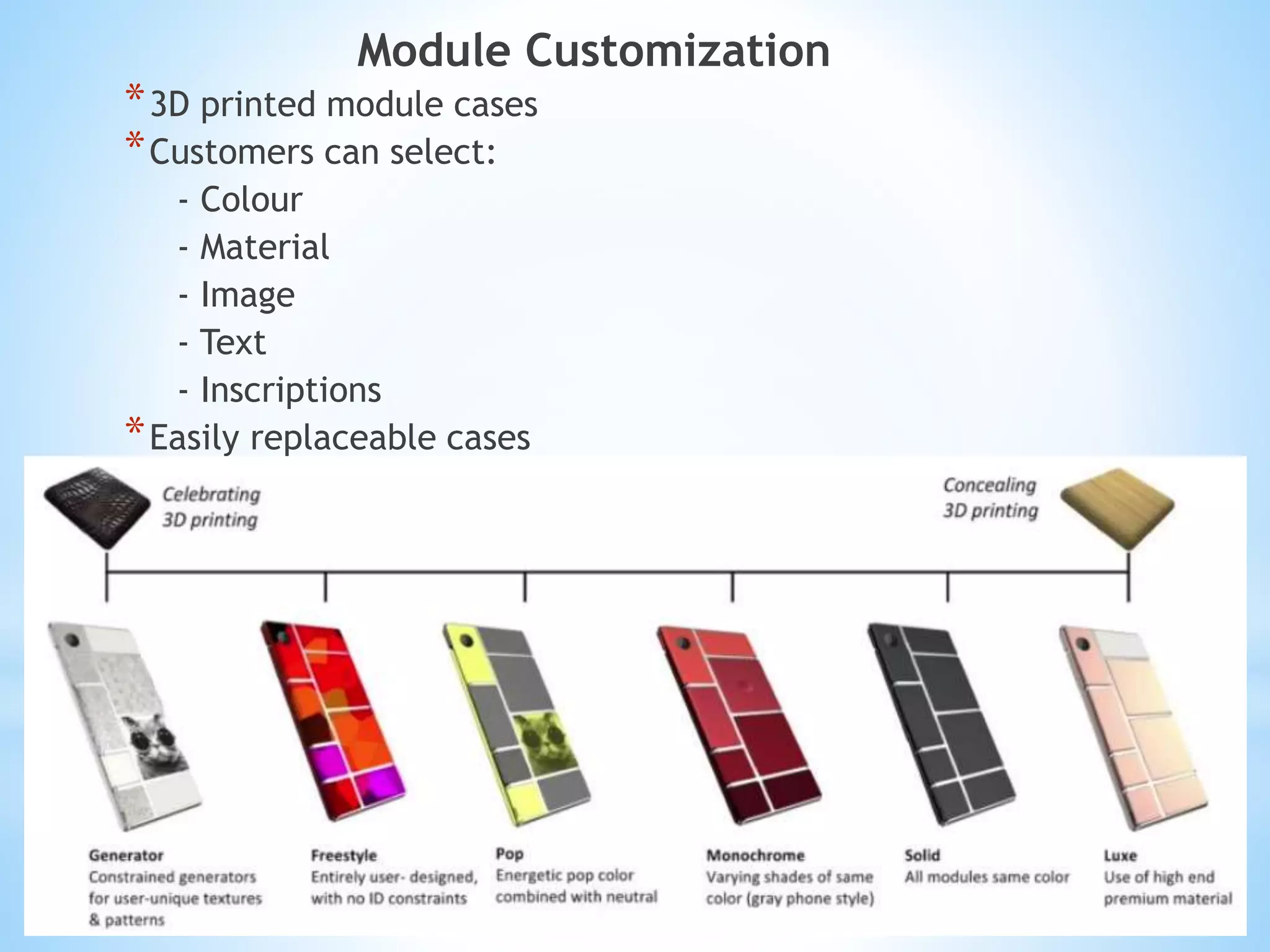
Module Customization
*3D printed module cases
*Customers can select:
- Colour
- Material
- Image
- Text
- Inscriptions
*Easily replaceable cases
*
*Price starts at $50!
*Depends solely on modules used
*Google plans to sell “barebones” version at $50
consisting of:
- Wi-Fi chip
- Processor
- Screen
- Battery
*
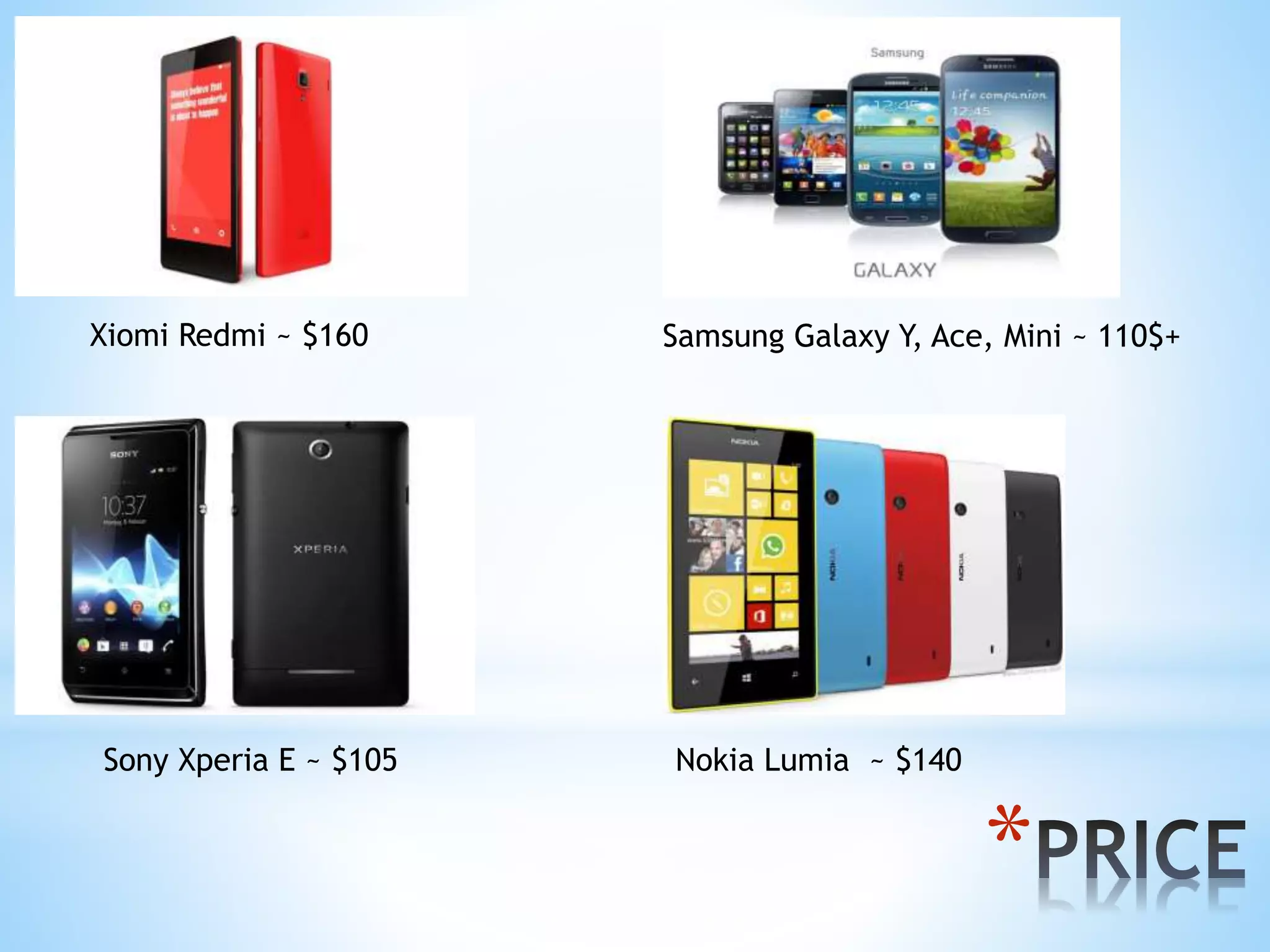
Xiomi Redmi ~ $160 Samsung Galaxy Y, Ace, Mini ~ 110$+
Sony Xperia E ~ $105 Nokia Lumia ~ $140
*
*Eco-friendly/reduces E-waste
*Customization
*More flexibility
*Never be out dated
*Solar powered batteries
*Innovative product
*
*Replacing the blocks/modules can cause
damage to the endoskeleton
*It will be bigger and heavier than the standard
phone
*Quality of connection requires expensive pins
and sockets
*The sharp edges of blocks make it
uncomfortable to hold
*
*Limited manufacturers
*Getting such a phone accepted by operators
*Software integration
*Changing components that potentially have
impact on performance could disrupt the
service experience
*
*The benefits of a modular phone will become
compelling tom consume consumers once ATAP
Can get issues of weight, battery life, and size
reduce down to a certain point. Also custom
and closures and super charged batteries may
appeal tom the high end of the market.
*

Project Ara (Phonebloks)

  • 1.
  • 2.
  • 3.
    * What is ProjectAra? -Google’s hardware platform for modular smartphones -User can customize device hardware and look -Opens up mobile devices market for parts manufacturers
  • 4.
    * *The project wasoriginally headed by the Advanced Technologies and Projects(ATAP) team within Motorola Mobility while it was subsidiary of Google. Although Google had sold Motorola to Lenovo in January 2014,but Google kept ATAP and Project Ara, which became Google Ara
  • 5.
    * PROJECT ARA ANDPHONEBLOKS - In September 2013,Dutch designer Dave Hakkens announced the Phonebloks modular phone concept independently in September 2013 - Motorola publicly announced Project Ara on October 29,2013 and said they will be working collaboratively with Phonebloks Dave Hakkens-Master mind behind the concept ‘Phonebloks’
  • 6.
    * *The goal isto drive the more thoughtful expressive, and open relationship between user developers, and their phones.
  • 7.
    * Stop the E-waste Asthe electronic market changes every day, it has increased a lot of e-waste. For a single upgrade, we need to change the whole phone. Precise shape and structure leads to inconvenience to some customers. Mobile needs to be flexible. It must only have the customer’s required features.
  • 8.
  • 9.
    * *Phonebloks would consist ofmain board onto which Bloks could be snapped by the Lego bricks. Each Blok is responsible for a unique function of the phone, much as a desktop computer has a distinct sound card, processor, monitor, and power supply
  • 10.
    * Two main components: 1)The Endoskeleton 2)The Module
  • 11.
    ENDOSKELETON *It consists ofnetwork circuits and interfaces for modules *Electro-permanent magnets used to attach modules *Emerging standard “UniPro” for communication *Plug and play *Endoskeleton has slots of varying sizes *Made from aluminium *Comes in three: mini; medium: jumbo *Water and dust-proof
  • 12.
    MODULE *A third partyecosystem *Encase single functionality *Independent and Interchangeable *Can be swapped between different phones *Water and dust proof *Niche tech
  • 13.
    Module Customization *3D printedmodule cases *Customers can select: - Colour - Material - Image - Text - Inscriptions *Easily replaceable cases
  • 14.
    * *Price starts at$50! *Depends solely on modules used *Google plans to sell “barebones” version at $50 consisting of: - Wi-Fi chip - Processor - Screen - Battery
  • 15.
    * Xiomi Redmi ~$160 Samsung Galaxy Y, Ace, Mini ~ 110$+ Sony Xperia E ~ $105 Nokia Lumia ~ $140
  • 16.
    * *Eco-friendly/reduces E-waste *Customization *More flexibility *Neverbe out dated *Solar powered batteries *Innovative product
  • 17.
    * *Replacing the blocks/modulescan cause damage to the endoskeleton *It will be bigger and heavier than the standard phone *Quality of connection requires expensive pins and sockets *The sharp edges of blocks make it uncomfortable to hold
  • 18.
    * *Limited manufacturers *Getting sucha phone accepted by operators *Software integration *Changing components that potentially have impact on performance could disrupt the service experience
  • 19.
    * *The benefits ofa modular phone will become compelling tom consume consumers once ATAP Can get issues of weight, battery life, and size reduce down to a certain point. Also custom and closures and super charged batteries may appeal tom the high end of the market.
  • 20.