Michelangelo
Buonarroti

By: Alexis Effler and Destiny
Queen
Background Information

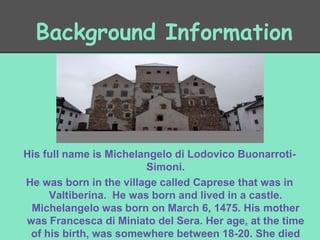
His full name is Michelangelo di Lodovico BuonarrotiSimoni.
He was born in the village called Caprese that was in
Valtiberina. He was born and lived in a castle.
Michelangelo was born on March 6, 1475. His mother
was Francesca di Miniato del Sera. Her age, at the time
of his birth, was somewhere between 18-20. She died
Background Information
In the book The Life & Times Of
Michelangelo, his family is
described as “a family of solid
bugher and artisan stock.” In that
same book it says his “ancestry
could be traced back two
centuries.” He was an apprentice
in 1488. He worked at the
Country of Origin

The country that
Michelangelo
was from was
Valtiberina.
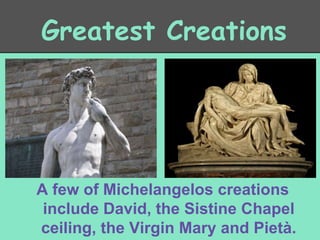
Greatest Creations

A few of Michelangelos creations
include David, the Sistine Chapel
ceiling, the Virgin Mary and Pietà.
Significant
Contributions
His artwork was one of the significant
contributes. This affected the world because
many of people such as art lovers still visit and
worship his masterpieces like the picture on
the Sistine Chapel. The chapel still has popes
to this day. Another thing is his building
abilities. Michelangelo built a library called
Laurentian Library. This library houses the
most important books in Italy. There were also
many other buildings in Rome that
Michelangelo built. The buildings affected the
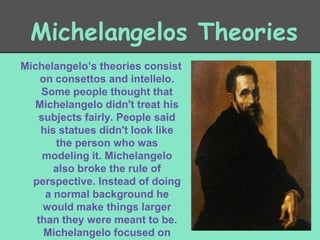
Michelangelos Theories
Michelangelo’s theories consist
on consettos and intellelo.
Some people thought that
Michelangelo didn't treat his
subjects fairly. People said
his statues didn't look like
the person who was
modeling it. Michelangelo
also broke the rule of
perspective. Instead of doing
a normal background he
would make things larger
than they were meant to be.
Michelangelo focused on
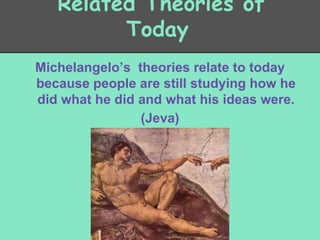
Related Theories of
Today
Michelangelo’s theories relate to today
because people are still studying how he
did what he did and what his ideas were.
(Jeva)
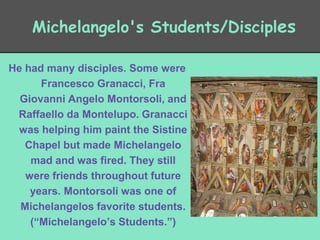
Michelangelo's Students/Disciples
He had many disciples. Some were
Francesco Granacci, Fra
Giovanni Angelo Montorsoli, and
Raffaello da Montelupo. Granacci
was helping him paint the Sistine
Chapel but made Michelangelo
mad and was fired. They still
were friends throughout future
years. Montorsoli was one of
Michelangelos favorite students.
(“Michelangelo’s Students.”)
Secret Societies
Michelangelo was part of a few
select secret societies. Those
included were the Lutheran Society
and a gay society. They were kept
secret because they were not
popular and would not be taken
well if know about. For the second
one there were many famous
artists included throughout the
His Ideas Were Received
With...
Michelangelos ideas were
popular. He was very
famous. He influenced
many people.
Michelangelo was given
many jobs and created
many great works of art.
Some people thought
that he could not see
truth. He looked at ideal
beauty. It could be said
they thought of him, in a
way, as a liar. Some of
Information
on the
Renaissance
Where Did The Renaissance
Occur?
How Long Did It Last?

The Renaissance
occurred during the
late Middle Ages. The
Renaissance lasted
from 1350 to 1555.
(Susan)
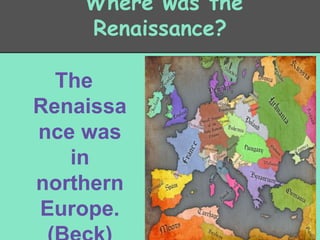
Where was the
Renaissance?
The
Renaissa
nce was
in
northern
Europe.
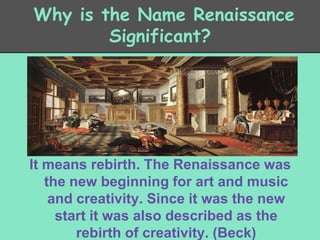
Why is the Name Renaissance
Significant?

It means rebirth. The Renaissance was
the new beginning for art and music
and creativity. Since it was the new
start it was also described as the
rebirth of creativity. (Beck)
Why Do We Study the
Renaissance?
The reason why we study the Renaissance
is because when then Europe left France
they entered a time period of so much
more than the middle ages. The middle
ages were so dark and coming from that
we have light. The renaissance was the
beginning of the the world we live in
today. There were so many new things
being built. People were getting richer
which then lead to the blossoming of new
and better ideas.
Identifying Elements of the
Renaissance Period
According to eHow “The Renaissance
period was a time of rebirth of humanism
and new discoveries in fine
arts, music, literature, philosophy, scienc
e and technology, architecture, religion
and spirituality (eHow).”
(Elkins)
Works Cited
Argenburg, Vyacheslav. “Michelangelo’s David.” Photograph. Flickr. Flickr, 11 May 2006. Media. 12 Oct. 2013.
<http://www.flickr.com/photos/argenberg/308891417/>.
Beck, Roger B. and Linda Black and Larry S. Krieger and Phillip C. Naylor and Dahia Ibo Shabaka. “McDougal Littell World

History.” North Carolina. Evanston. McDougal Littell, 2008. Print.
“Castle of Turku, courtyard renaissance part.” Photograph. Wikipedia. Wikipedia, 28 June 2006. Media. 12 Oct. 2013.
<http://en.wikipedia.org/wiki/File:Castle_of_Turku,_courtyard_renaissance_part.jpg>.
Chenq, Sandra. “Discussion Topic: Virtual Michelangelo.” Photograph. Open Lab. 4 Nov. 2012. Media. 12 Oct. 2013.

<http://openlab.citytech.cuny.edu/arth11036415f2012/2012/11/04/discussion-topic-virtual-michelangelo/>.
Conte, Jacopino del. “Michelangelo Buonarroti.” Painting. Wikipedia. Wikipedia, 31 Dec. 2006. Web. 3 Oct. 2013.
<http://en.wikipedia.org/wiki/File:Michelangelo-Buonarroti1.jpg>.
Elkins,Marlee. “Characteristics of the Renaissance Period”.ehow . Demand Media, n.d. Web.10 Oct. 2013.
<http://www.ehow.com/about_5448785_characteristics-renaissance-period.html>.
Forli da Melozzo. “Melozzo da Forli”. Photograph. Wikipedia.Wikipedia,1477. Media. 10 Oct 2013.
<http://en.wikipedia.org/wiki/File:Melozzo_da_Forl%C3%AC_001.jpg>.
Works Cited Continued...
“Laurentian Library”. The Museums of Florence. n.p, n.d. Web. 8 Oct. 2013.
<http://www.museumsinflorence.com/musei/Laurentian_Library.html>.
“Lightmatter Sistine Chapel ceiling.” Painting. Wikipedia Commons. Wikipedia. Media. 11 Oct. 2013.
<http://commons.wikimedia.org/wiki/File:Lightmatter_Sistine_Chapel_ceiling.jpg>.
Jeva Anand. “ How Did Michelango Change the World?”. Local. Local, n.d. Web 10 Oct 2013.
<http://entertainmentguide.local.com/did-michelangelo-change-world-10918.html>
Michelangelo Buonarroti. “Michelangelo Buonarroti”. Photograph. Wikipedia. Wikipedia, 1508-1512. Media. 10
Oct 2013. <http://en.wikipedia.org/wiki/File:Michelangelo_Buonarroti_017.jpg>
“Michelangelos students.” Michelangelo Gallery. Auctori, 2013. Web. 11 Oct. 2013. <http://www.michelangelogallery.com/students.aspx>.
Niabot, Stanislav Traykov. “Michelangelo’s Pieta.” Photograph. Wikipedia. Wikipedia, 6 March 2008. Media. 12
Oct. 2013. <http://en.wikipedia.org/wiki/File:Michelangelo%27s_Pieta_5450_cut_out_black.jpg>.
Orlandi, Dr. Enzo and Maria Luisa Rizzotti and C.J. Richards. “The Life & Times Of Michelangelo.” 1st Edition.
Philadelphia: Arnoldo Mondadori Editore and The Curtis Publishing Company, 1966. Print. Pages 4, 75.
Works Cited Continued 2
“Renaissance Europe.” Digital Art. deviantART. 11 Feb. 2011. Media. 12 Oct. 2013. <http://gtdorion.deviantart.com/art/Renaissance-Europe-1500-197032526>.
“Renaissance Interior.” Painting. Wikipedia. Wikipedia, 24 Jan. 2013. Media. 12 Oct. 2013.
<http://commons.wikimedia.org/wiki/File:BASSEN,_Bartholomeus_van,_Renaissance_Interior_with_Banqueters,_
1618-20.jpg>.
Susan. “When Did the Middle Ages End and the Renaissance Begin? The Last in a Three-Part Reflection”. The History of
the whole World. The History of the Whole World, 10 March 2013. Web. 10 oct
2013.<http://www.susanwisebauer.com/blog/production/when-did-the-middle-ages-end-and-the-renaissance-beginthe-last-in-a-three-part-reflection/>

“ The Influence of the Renaissance”. The Art of Anatomy. St. John’s College, n.d. 10 Oct. 2013. <

http://www.joh.cam.ac.uk/library/special_collections/early_books/pix/anatomy/The_Influence_of_the_renaissance.
htm>.
Vess Deborah Dr.. “ The Influence of Neoplatonism on Michelangelo”. n.p, n.d. 10 Oct. 2013.
<http://myhomepage.ferris.edu/~norcrosa/2006WEB/NeoPlatonism.html >.
Work Cited Continue 3
Veith, Gene. “Michelangelo as secret Lutheran.” Patheos. Patheos, 15 May 2009. Web. 12 Oct. 2013.
<http://www.patheos.com/blogs/geneveith/2009/05/michelangelo-as-secret-lutheran/>.

Project

  • 1.
  • 2.
    Background Information His fullname is Michelangelo di Lodovico BuonarrotiSimoni. He was born in the village called Caprese that was in Valtiberina. He was born and lived in a castle. Michelangelo was born on March 6, 1475. His mother was Francesca di Miniato del Sera. Her age, at the time of his birth, was somewhere between 18-20. She died
  • 3.
    Background Information In thebook The Life & Times Of Michelangelo, his family is described as “a family of solid bugher and artisan stock.” In that same book it says his “ancestry could be traced back two centuries.” He was an apprentice in 1488. He worked at the
  • 5.
    Country of Origin Thecountry that Michelangelo was from was Valtiberina.
  • 6.
    Greatest Creations A fewof Michelangelos creations include David, the Sistine Chapel ceiling, the Virgin Mary and Pietà.
  • 7.
    Significant Contributions His artwork wasone of the significant contributes. This affected the world because many of people such as art lovers still visit and worship his masterpieces like the picture on the Sistine Chapel. The chapel still has popes to this day. Another thing is his building abilities. Michelangelo built a library called Laurentian Library. This library houses the most important books in Italy. There were also many other buildings in Rome that Michelangelo built. The buildings affected the
  • 8.
    Michelangelos Theories Michelangelo’s theoriesconsist on consettos and intellelo. Some people thought that Michelangelo didn't treat his subjects fairly. People said his statues didn't look like the person who was modeling it. Michelangelo also broke the rule of perspective. Instead of doing a normal background he would make things larger than they were meant to be. Michelangelo focused on
  • 9.
    Related Theories of Today Michelangelo’stheories relate to today because people are still studying how he did what he did and what his ideas were. (Jeva)
  • 10.
    Michelangelo's Students/Disciples He hadmany disciples. Some were Francesco Granacci, Fra Giovanni Angelo Montorsoli, and Raffaello da Montelupo. Granacci was helping him paint the Sistine Chapel but made Michelangelo mad and was fired. They still were friends throughout future years. Montorsoli was one of Michelangelos favorite students. (“Michelangelo’s Students.”)
  • 11.
    Secret Societies Michelangelo waspart of a few select secret societies. Those included were the Lutheran Society and a gay society. They were kept secret because they were not popular and would not be taken well if know about. For the second one there were many famous artists included throughout the
  • 12.
    His Ideas WereReceived With... Michelangelos ideas were popular. He was very famous. He influenced many people. Michelangelo was given many jobs and created many great works of art. Some people thought that he could not see truth. He looked at ideal beauty. It could be said they thought of him, in a way, as a liar. Some of
  • 13.
  • 14.
    Where Did TheRenaissance Occur? How Long Did It Last? The Renaissance occurred during the late Middle Ages. The Renaissance lasted from 1350 to 1555. (Susan)
  • 15.
  • 16.
    Why is theName Renaissance Significant? It means rebirth. The Renaissance was the new beginning for art and music and creativity. Since it was the new start it was also described as the rebirth of creativity. (Beck)
  • 17.
    Why Do WeStudy the Renaissance? The reason why we study the Renaissance is because when then Europe left France they entered a time period of so much more than the middle ages. The middle ages were so dark and coming from that we have light. The renaissance was the beginning of the the world we live in today. There were so many new things being built. People were getting richer which then lead to the blossoming of new and better ideas.
  • 18.
    Identifying Elements ofthe Renaissance Period According to eHow “The Renaissance period was a time of rebirth of humanism and new discoveries in fine arts, music, literature, philosophy, scienc e and technology, architecture, religion and spirituality (eHow).” (Elkins)
  • 19.
    Works Cited Argenburg, Vyacheslav.“Michelangelo’s David.” Photograph. Flickr. Flickr, 11 May 2006. Media. 12 Oct. 2013. <http://www.flickr.com/photos/argenberg/308891417/>. Beck, Roger B. and Linda Black and Larry S. Krieger and Phillip C. Naylor and Dahia Ibo Shabaka. “McDougal Littell World History.” North Carolina. Evanston. McDougal Littell, 2008. Print. “Castle of Turku, courtyard renaissance part.” Photograph. Wikipedia. Wikipedia, 28 June 2006. Media. 12 Oct. 2013. <http://en.wikipedia.org/wiki/File:Castle_of_Turku,_courtyard_renaissance_part.jpg>. Chenq, Sandra. “Discussion Topic: Virtual Michelangelo.” Photograph. Open Lab. 4 Nov. 2012. Media. 12 Oct. 2013. <http://openlab.citytech.cuny.edu/arth11036415f2012/2012/11/04/discussion-topic-virtual-michelangelo/>. Conte, Jacopino del. “Michelangelo Buonarroti.” Painting. Wikipedia. Wikipedia, 31 Dec. 2006. Web. 3 Oct. 2013. <http://en.wikipedia.org/wiki/File:Michelangelo-Buonarroti1.jpg>. Elkins,Marlee. “Characteristics of the Renaissance Period”.ehow . Demand Media, n.d. Web.10 Oct. 2013. <http://www.ehow.com/about_5448785_characteristics-renaissance-period.html>. Forli da Melozzo. “Melozzo da Forli”. Photograph. Wikipedia.Wikipedia,1477. Media. 10 Oct 2013. <http://en.wikipedia.org/wiki/File:Melozzo_da_Forl%C3%AC_001.jpg>.
  • 20.
    Works Cited Continued... “LaurentianLibrary”. The Museums of Florence. n.p, n.d. Web. 8 Oct. 2013. <http://www.museumsinflorence.com/musei/Laurentian_Library.html>. “Lightmatter Sistine Chapel ceiling.” Painting. Wikipedia Commons. Wikipedia. Media. 11 Oct. 2013. <http://commons.wikimedia.org/wiki/File:Lightmatter_Sistine_Chapel_ceiling.jpg>. Jeva Anand. “ How Did Michelango Change the World?”. Local. Local, n.d. Web 10 Oct 2013. <http://entertainmentguide.local.com/did-michelangelo-change-world-10918.html> Michelangelo Buonarroti. “Michelangelo Buonarroti”. Photograph. Wikipedia. Wikipedia, 1508-1512. Media. 10 Oct 2013. <http://en.wikipedia.org/wiki/File:Michelangelo_Buonarroti_017.jpg> “Michelangelos students.” Michelangelo Gallery. Auctori, 2013. Web. 11 Oct. 2013. <http://www.michelangelogallery.com/students.aspx>. Niabot, Stanislav Traykov. “Michelangelo’s Pieta.” Photograph. Wikipedia. Wikipedia, 6 March 2008. Media. 12 Oct. 2013. <http://en.wikipedia.org/wiki/File:Michelangelo%27s_Pieta_5450_cut_out_black.jpg>. Orlandi, Dr. Enzo and Maria Luisa Rizzotti and C.J. Richards. “The Life & Times Of Michelangelo.” 1st Edition. Philadelphia: Arnoldo Mondadori Editore and The Curtis Publishing Company, 1966. Print. Pages 4, 75.
  • 21.
    Works Cited Continued2 “Renaissance Europe.” Digital Art. deviantART. 11 Feb. 2011. Media. 12 Oct. 2013. <http://gtdorion.deviantart.com/art/Renaissance-Europe-1500-197032526>. “Renaissance Interior.” Painting. Wikipedia. Wikipedia, 24 Jan. 2013. Media. 12 Oct. 2013. <http://commons.wikimedia.org/wiki/File:BASSEN,_Bartholomeus_van,_Renaissance_Interior_with_Banqueters,_ 1618-20.jpg>. Susan. “When Did the Middle Ages End and the Renaissance Begin? The Last in a Three-Part Reflection”. The History of the whole World. The History of the Whole World, 10 March 2013. Web. 10 oct 2013.<http://www.susanwisebauer.com/blog/production/when-did-the-middle-ages-end-and-the-renaissance-beginthe-last-in-a-three-part-reflection/> “ The Influence of the Renaissance”. The Art of Anatomy. St. John’s College, n.d. 10 Oct. 2013. < http://www.joh.cam.ac.uk/library/special_collections/early_books/pix/anatomy/The_Influence_of_the_renaissance. htm>. Vess Deborah Dr.. “ The Influence of Neoplatonism on Michelangelo”. n.p, n.d. 10 Oct. 2013. <http://myhomepage.ferris.edu/~norcrosa/2006WEB/NeoPlatonism.html >.
  • 22.
    Work Cited Continue3 Veith, Gene. “Michelangelo as secret Lutheran.” Patheos. Patheos, 15 May 2009. Web. 12 Oct. 2013. <http://www.patheos.com/blogs/geneveith/2009/05/michelangelo-as-secret-lutheran/>.