Labor Unions Workers had to fight to end exploitation.
Labor Unions . . . . Key Organizations:
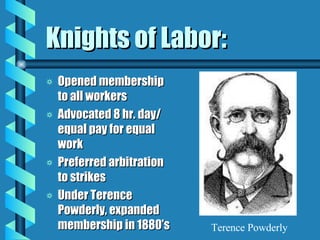
Knights of Labor: Opened membership to all workers Advocated 8 hr. day/ equal pay for equal work Preferred arbitration to strikes Under Terence Powderly, expanded membership in 1880’s Terence Powderly
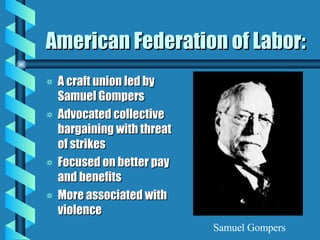
American Federation of Labor: A craft union led by Samuel Gompers Advocated collective bargaining with threat of strikes Focused on better pay and benefits More associated with violence Samuel Gompers
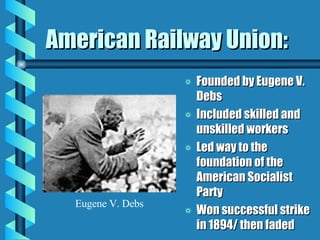
American Railway Union: Founded by Eugene V. Debs Included skilled and unskilled workers Led way to the foundation of the American Socialist Party Won successful strike in 1894/ then faded Eugene V. Debs
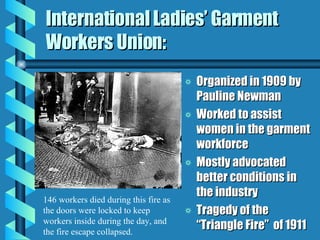
International Ladies’ Garment Workers Union: Organized in 1909 by Pauline Newman Worked to assist women in the garment workforce Mostly advocated better conditions in the industry Tragedy of the “Triangle Fire”  of 1911 146 workers died during this fire as the doors were locked to keep workers inside during the day, and the fire escape collapsed.
Tools of the Union: Collective Bargaining:  negotiations between representatives of labor and management to reach agreement on wages, benefits and conditions Arbitration : allowing outside “referee” to decide issues between sides Strike : refusal to work until demands are met
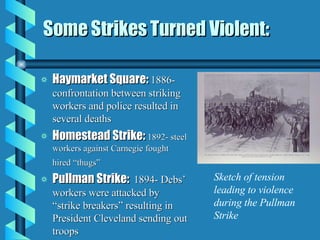
Some Strikes Turned Violent: Haymarket Square:  1886- confrontation between striking workers and police resulted in several deaths Homestead Strike:  1892- steel workers against Carnegie fought hired “thugs”   Pullman Strike:  1894- Debs’ workers were attacked by “strike breakers” resulting in President Cleveland sending out troops Sketch of tension leading to violence during the Pullman Strike
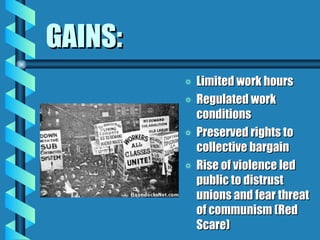
GAINS: Limited work hours Regulated work conditions Preserved rights to collective bargain Rise of violence led public to distrust unions and fear threat of communism (Red Scare)

Labor Unions

  • 1.
    Labor Unions Workershad to fight to end exploitation.
  • 2.
    Labor Unions .. . . Key Organizations:
  • 3.
    Knights of Labor:Opened membership to all workers Advocated 8 hr. day/ equal pay for equal work Preferred arbitration to strikes Under Terence Powderly, expanded membership in 1880’s Terence Powderly
  • 4.
    American Federation ofLabor: A craft union led by Samuel Gompers Advocated collective bargaining with threat of strikes Focused on better pay and benefits More associated with violence Samuel Gompers
  • 5.
    American Railway Union:Founded by Eugene V. Debs Included skilled and unskilled workers Led way to the foundation of the American Socialist Party Won successful strike in 1894/ then faded Eugene V. Debs
  • 6.
    International Ladies’ GarmentWorkers Union: Organized in 1909 by Pauline Newman Worked to assist women in the garment workforce Mostly advocated better conditions in the industry Tragedy of the “Triangle Fire” of 1911 146 workers died during this fire as the doors were locked to keep workers inside during the day, and the fire escape collapsed.
  • 7.
    Tools of theUnion: Collective Bargaining: negotiations between representatives of labor and management to reach agreement on wages, benefits and conditions Arbitration : allowing outside “referee” to decide issues between sides Strike : refusal to work until demands are met
  • 8.
    Some Strikes TurnedViolent: Haymarket Square: 1886- confrontation between striking workers and police resulted in several deaths Homestead Strike: 1892- steel workers against Carnegie fought hired “thugs” Pullman Strike: 1894- Debs’ workers were attacked by “strike breakers” resulting in President Cleveland sending out troops Sketch of tension leading to violence during the Pullman Strike
  • 9.
    GAINS: Limited workhours Regulated work conditions Preserved rights to collective bargain Rise of violence led public to distrust unions and fear threat of communism (Red Scare)