DEFINATION OF SEQUENCE
ANDSERIES
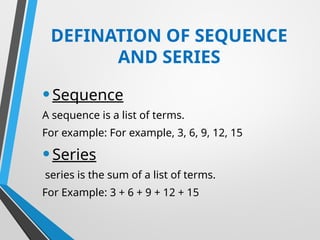
•Sequence
A sequence is a list of terms.
For example: For example, 3, 6, 9, 12, 15
•Series
series is the sum of a list of terms.
For Example: 3 + 6 + 9 + 12 + 15
3.
SEQUENCE AND SERIES
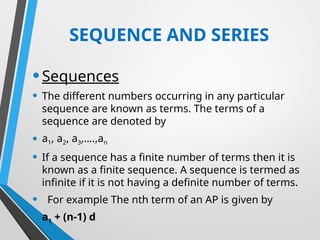
•Sequences
•The different numbers occurring in any particular
sequence are known as terms. The terms of a
sequence are denoted by
• a1, a2, a3,….,an
• If a sequence has a finite number of terms then it is
known as a finite sequence. A sequence is termed as
infinite if it is not having a definite number of terms.
• For example The nth term of an AP is given by
• a1 + (n-1) d
4.
SEQUENCE AND SERIES
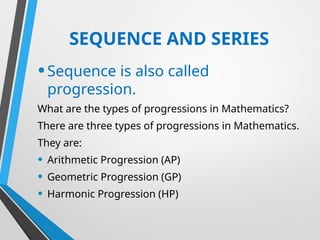
•Sequenceis also called
progression.
What are the types of progressions in Mathematics?
There are three types of progressions in Mathematics.
They are:
• Arithmetic Progression (AP)
• Geometric Progression (GP)
• Harmonic Progression (HP)
5.
ARITHMETICS PROGRESSION
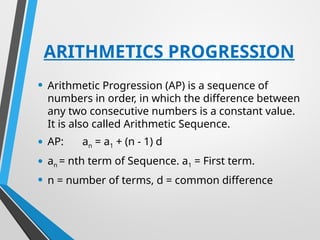
• ArithmeticProgression (AP) is a sequence of
numbers in order, in which the difference between
any two consecutive numbers is a constant value.
It is also called Arithmetic Sequence.
• AP: an = a1 + (n - 1) d
• an = nth term of Sequence. a1 = First term.
• n = number of terms, d = common difference
6.
ARITHMETICS PROGRESSION
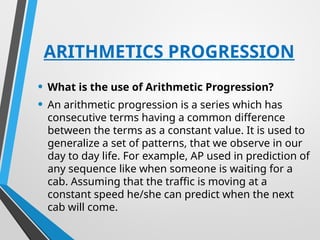
• Whatis the use of Arithmetic Progression?
• An arithmetic progression is a series which has
consecutive terms having a common difference
between the terms as a constant value. It is used to
generalize a set of patterns, that we observe in our
day to day life. For example, AP used in prediction of
any sequence like when someone is waiting for a
cab. Assuming that the traffic is moving at a
constant speed he/she can predict when the next
cab will come.
7.
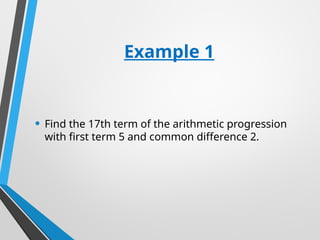
Example 1
• Findthe 17th term of the arithmetic progression
with first term 5 and common difference 2.
8.
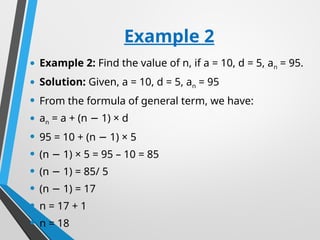
Example 2
• Example2: Find the value of n, if a = 10, d = 5, an = 95.
• Solution: Given, a = 10, d = 5, an = 95
• From the formula of general term, we have:
• an = a + (n 1) × d
−
• 95 = 10 + (n 1) × 5
−
• (n 1) × 5 = 95 – 10 = 85
−
• (n 1) = 85/ 5
−
• (n 1) = 17
−
• n = 17 + 1
• n = 18
9.
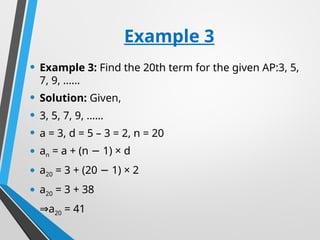
Example 3
• Example3: Find the 20th term for the given AP:3, 5,
7, 9, ……
• Solution: Given,
• 3, 5, 7, 9, ……
• a = 3, d = 5 – 3 = 2, n = 20
• an = a + (n 1) × d
−
• a20 = 3 + (20 1) × 2
−
• a20 = 3 + 38
• ⇒a20 = 41
10.
Arithmetic Series
• Aseries is the sum of a list of terms. The sum of
nth terms of arithmetic progression is called
arithmetic series.
• Sum of nth term:
• Sn = n/2 [2a + (n-1)d]
• where n = number of terms, a = first term and d =
common difference
Arithmetic
Series(Examples)
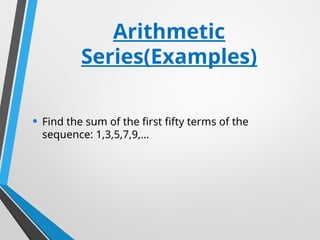
• Find thesum of the first 30 multiples of 4.
• Solution:
• The first 30 multiples of 4 are: 4, 8, 12, ….., 120
• Here, a = 4, n = 30, d = 4
• We know,
• S30 = n/2 [2a + (n 1) × d]
−
• S30 = 30/2[2 (4) + (30 1) × 4]
−
• S30 = 15[8 + 116]
• S30 = 1860
13.
Geometrical Progression
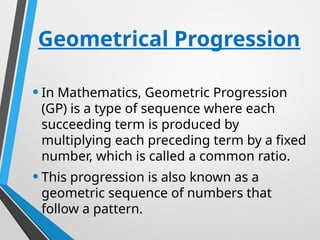
•In Mathematics,Geometric Progression
(GP) is a type of sequence where each
succeeding term is produced by
multiplying each preceding term by a fixed
number, which is called a common ratio.
•This progression is also known as a
geometric sequence of numbers that
follow a pattern.
GP Examples
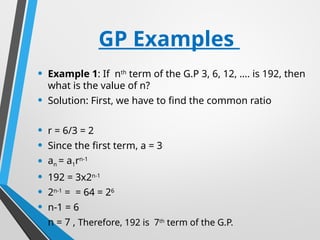
• Example1: If nth
term of the G.P 3, 6, 12, …. is 192, then
what is the value of n?
• Solution: First, we have to find the common ratio
• r = 6/3 = 2
• Since the first term, a = 3
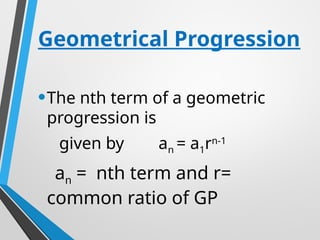
• an = a1rn-1
• 192 = 3x2n-1
• 2n-1
= = 64 = 26
• n-1 = 6
• n = 7 , Therefore, 192 is 7th
term of the G.P.
17.
GP Examples
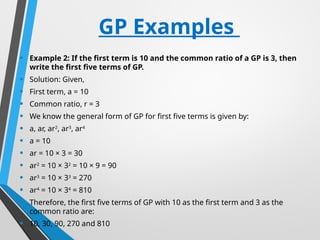
• Example2: If the first term is 10 and the common ratio of a GP is 3, then
write the first five terms of GP.
• Solution: Given,
• First term, a = 10
• Common ratio, r = 3
• We know the general form of GP for first five terms is given by:
• a, ar, ar2
, ar3
, ar4
• a = 10
• ar = 10 × 3 = 30
• ar2
= 10 × 32
= 10 × 9 = 90
• ar3
= 10 × 33
= 270
• ar4
= 10 × 34
= 810
• Therefore, the first five terms of GP with 10 as the first term and 3 as the
common ratio are:
• 10, 30, 90, 270 and 810
18.
GP Examples
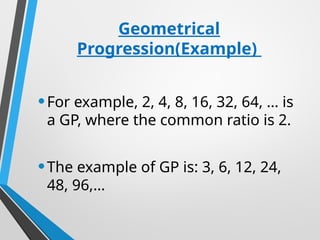
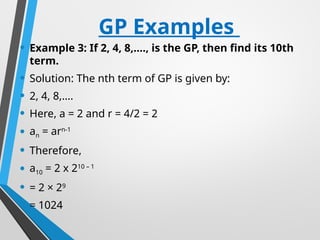
• Example3: If 2, 4, 8,…., is the GP, then find its 10th
term.
• Solution: The nth term of GP is given by:
• 2, 4, 8,….
• Here, a = 2 and r = 4/2 = 2
• an = arn-1
• Therefore,
• a10 = 2 x 210 – 1
• = 2 × 29
• = 1024
19.
GP Examples
• Example3: If 2, 4, 8,…., is the GP, then find its 10th
term.
• Solution: The nth term of GP is given by:
• 2, 4, 8,….
• Here, a = 2 and r = 4/2 = 2
• an = arn-1
• Therefore,
• a10 = 2 x 210 – 1
• = 2 × 29
• = 1024
20.
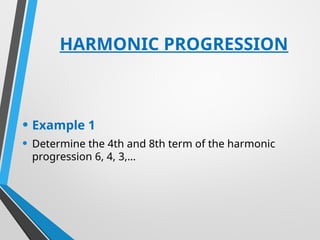
HARMONIC PROGRESSION
• AHarmonic Progression (HP) is defined as a
sequence of real numbers which is determined
by taking the reciprocals of the arithmetic
progression that does not contain 0.
• The nth term of the Harmonic Progression (H.P)
= 1/ [a+(n-1)d]
21.
HARMONIC PROGRESSION
• Formula:
•The nth term of the Harmonic Progression
(H.P) = 1/ [a+(n-1)d]
Where
• “a” is the first term of A.P
• “d” is the common difference
• “n” is the number of terms in A.P
The above formula can also be written as:
• The nth term of H.P = 1/ (nth term of the
corresponding A.P)
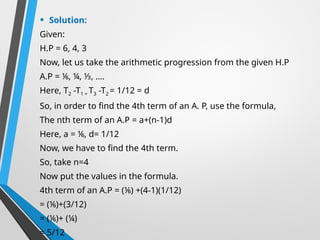
• Solution:
Given:
H.P =6, 4, 3
Now, let us take the arithmetic progression from the given H.P
A.P = ⅙, ¼, ⅓, ….
Here, T2 -T1 = T3 -T2 = 1/12 = d
So, in order to find the 4th term of an A. P, use the formula,
The nth term of an A.P = a+(n-1)d
Here, a = ⅙, d= 1/12
Now, we have to find the 4th term.
So, take n=4
Now put the values in the formula.
4th term of an A.P = (⅙) +(4-1)(1/12)
= (⅙)+(3/12)
= (⅙)+ (¼)
= 5/12
24.
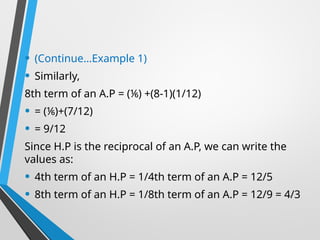
• (Continue…Example 1)
•Similarly,
8th term of an A.P = (⅙) +(8-1)(1/12)
• = (⅙)+(7/12)
• = 9/12
Since H.P is the reciprocal of an A.P, we can write the
values as:
• 4th term of an H.P = 1/4th term of an A.P = 12/5
• 8th term of an H.P = 1/8th term of an A.P = 12/9 = 4/3
25.
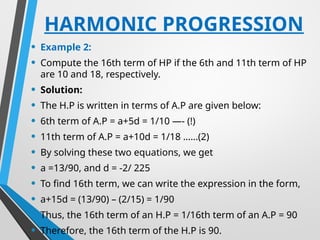
HARMONIC PROGRESSION
• Example2:
• Compute the 16th term of HP if the 6th and 11th term of HP
are 10 and 18, respectively.
• Solution:
• The H.P is written in terms of A.P are given below:
• 6th term of A.P = a+5d = 1/10 —- (!)
• 11th term of A.P = a+10d = 1/18 ……(2)
• By solving these two equations, we get
• a =13/90, and d = -2/ 225
• To find 16th term, we can write the expression in the form,
• a+15d = (13/90) – (2/15) = 1/90
• Thus, the 16th term of an H.P = 1/16th term of an A.P = 90
• Therefore, the 16th term of the H.P is 90.


![Arithmetic Series
• A series is the sum of a list of terms. The sum of
nth terms of arithmetic progression is called
arithmetic series.
• Sum of nth term:
• Sn = n/2 [2a + (n-1)d]
• where n = number of terms, a = first term and d =
common difference](https://image.slidesharecdn.com/1-250513195952-5a564b7b/85/1-SEQUENCE-AND-SERIES-in-real-life-problems-pptx-10-320.jpg)
![Arithmetic
Series(Examples)
• Find the sum of the first 30 multiples of 4.
• Solution:
• The first 30 multiples of 4 are: 4, 8, 12, ….., 120
• Here, a = 4, n = 30, d = 4
• We know,
• S30 = n/2 [2a + (n 1) × d]
−
• S30 = 30/2[2 (4) + (30 1) × 4]
−
• S30 = 15[8 + 116]
• S30 = 1860](https://image.slidesharecdn.com/1-250513195952-5a564b7b/85/1-SEQUENCE-AND-SERIES-in-real-life-problems-pptx-12-320.jpg)
![HARMONIC PROGRESSION
• A Harmonic Progression (HP) is defined as a
sequence of real numbers which is determined
by taking the reciprocals of the arithmetic
progression that does not contain 0.
• The nth term of the Harmonic Progression (H.P)
= 1/ [a+(n-1)d]](https://image.slidesharecdn.com/1-250513195952-5a564b7b/85/1-SEQUENCE-AND-SERIES-in-real-life-problems-pptx-20-320.jpg)
![HARMONIC PROGRESSION
• Formula:
• The nth term of the Harmonic Progression
(H.P) = 1/ [a+(n-1)d]
Where
• “a” is the first term of A.P
• “d” is the common difference
• “n” is the number of terms in A.P
The above formula can also be written as:
• The nth term of H.P = 1/ (nth term of the
corresponding A.P)](https://image.slidesharecdn.com/1-250513195952-5a564b7b/85/1-SEQUENCE-AND-SERIES-in-real-life-problems-pptx-21-320.jpg)