Programming the SQL Way
with Common Table Expressions
BRUCE MOMJIAN
Common Table Expressions (CTEs) allow queries to be more
imperative, allowing looping and processing hierarchical structures
that are normally associated only with imperative languages.
Creative Commons Attribution License http://momjian.us/presentations
Last updated: November, 2019
1 / 96
Outline
1. Imperative vs. declarative
2. Syntax
3. Recursive CTEs
4. Examples
5. Writable CTEs
6. Why use CTEs
2 / 96
1. Imperative vs. Declarative
https://www.flickr.com/photos/visit_cape_may/
3 / 96
Imperative Programming Languages
In computer science, imperative programming is a programming
paradigm that describes computation in terms of statements that
change a program state. In much the same way that imperative mood
in natural languages expresses commands to take action, imperative
programs define sequences of commands for the computer to
perform.
http://en.wikipedia.org/wiki/Imperative_programming
4 / 96
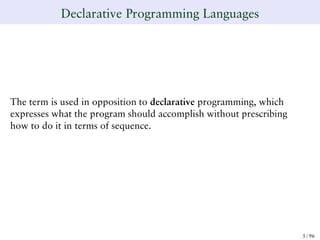
Declarative Programming Languages
The term is used in opposition to declarative programming, which
expresses what the program should accomplish without prescribing
how to do it in terms of sequence.
5 / 96
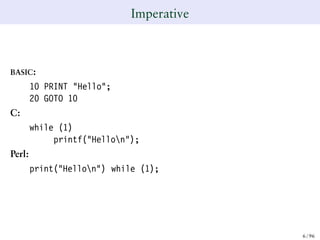
Imperative
BASIC:
10 PRINT "Hello";
20 GOTO 10
C:
while (1)
printf("Hellon");
Perl:
print("Hellon") while (1);
6 / 96
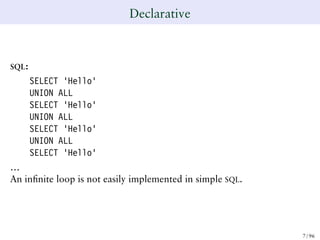
Declarative
SQL:
SELECT ’Hello’
UNION ALL
SELECT ’Hello’
UNION ALL
SELECT ’Hello’
UNION ALL
SELECT ’Hello’
…
An infinite loop is not easily implemented in simple SQL.
7 / 96
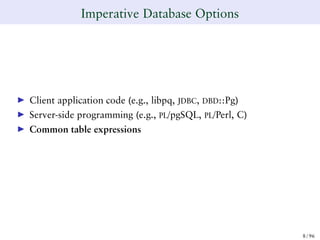
Imperative Database Options
◮ Client application code (e.g., libpq, JDBC, DBD::Pg)
◮ Server-side programming (e.g., PL/pgSQL, PL/Perl, C)
◮ Common table expressions
8 / 96
2. Syntax
https://www.flickr.com/photos/kylewhitney/
9 / 96
Common Table Expression (CTE) Syntax
WITH [ RECURSIVE ] with_query_name [ ( column_name [, ...] ) ] AS
( select ) [ , ... ]
SELECT ...
10/ 96
Keep Your Eye on the Red (Text)
https://www.flickr.com/photos/alltheaces/
11/ 96
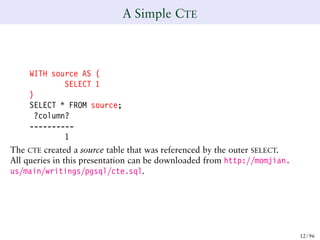
A Simple CTE
WITH source AS (
SELECT 1
)
SELECT * FROM source;
?column?
----------
1
The CTE created a source table that was referenced by the outer SELECT.
All queries in this presentation can be downloaded from http://momjian.
us/main/writings/pgsql/cte.sql.
12/ 96
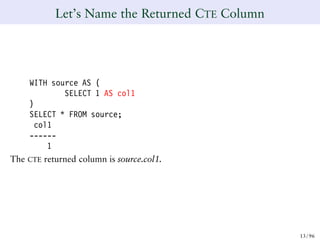
Let’s Name the Returned CTE Column
WITH source AS (
SELECT 1 AS col1
)
SELECT * FROM source;
col1
------
1
The CTE returned column is source.col1.
13/ 96
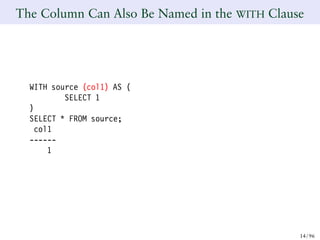
The Column Can Also Be Named in the WITH Clause
WITH source (col1) AS (
SELECT 1
)
SELECT * FROM source;
col1
------
1
14/ 96
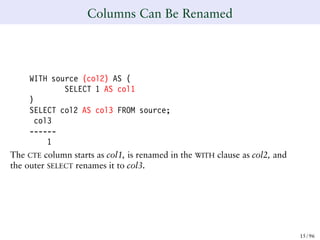
Columns Can Be Renamed
WITH source (col2) AS (
SELECT 1 AS col1
)
SELECT col2 AS col3 FROM source;
col3
------
1
The CTE column starts as col1, is renamed in the WITH clause as col2, and
the outer SELECT renames it to col3.
15/ 96
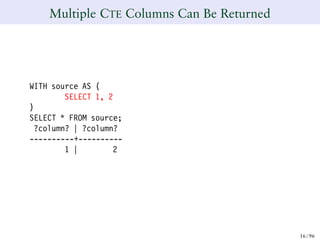
Multiple CTE Columns Can Be Returned
WITH source AS (
SELECT 1, 2
)
SELECT * FROM source;
?column? | ?column?
----------+----------
1 | 2
16/ 96
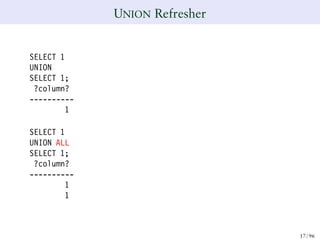
UNION Refresher
SELECT 1
UNION
SELECT 1;
?column?
----------
1
SELECT 1
UNION ALL
SELECT 1;
?column?
----------
1
1
17/ 96
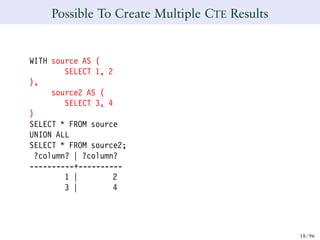
Possible To Create Multiple CTE Results
WITH source AS (
SELECT 1, 2
),
source2 AS (
SELECT 3, 4
)
SELECT * FROM source
UNION ALL
SELECT * FROM source2;
?column? | ?column?
----------+----------
1 | 2
3 | 4
18/ 96
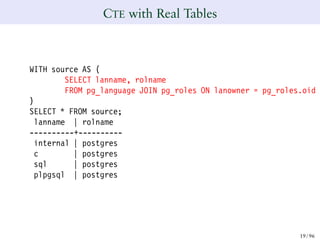
CTE with Real Tables
WITH source AS (
SELECT lanname, rolname
FROM pg_language JOIN pg_roles ON lanowner = pg_roles.oid
)
SELECT * FROM source;
lanname | rolname
----------+----------
internal | postgres
c | postgres
sql | postgres
plpgsql | postgres
19/ 96
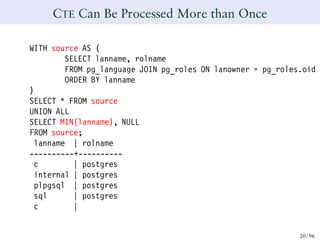
CTE Can Be Processed More than Once
WITH source AS (
SELECT lanname, rolname
FROM pg_language JOIN pg_roles ON lanowner = pg_roles.oid
ORDER BY lanname
)
SELECT * FROM source
UNION ALL
SELECT MIN(lanname), NULL
FROM source;
lanname | rolname
----------+----------
c | postgres
internal | postgres
plpgsql | postgres
sql | postgres
c |
20/ 96
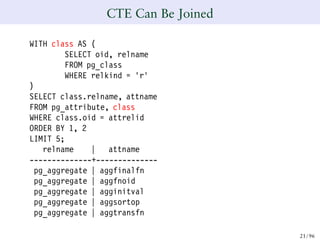
CTE Can Be Joined
WITH class AS (
SELECT oid, relname
FROM pg_class
WHERE relkind = ’r’
)
SELECT class.relname, attname
FROM pg_attribute, class
WHERE class.oid = attrelid
ORDER BY 1, 2
LIMIT 5;
relname | attname
--------------+--------------
pg_aggregate | aggfinalfn
pg_aggregate | aggfnoid
pg_aggregate | agginitval
pg_aggregate | aggsortop
pg_aggregate | aggtransfn
21/ 96
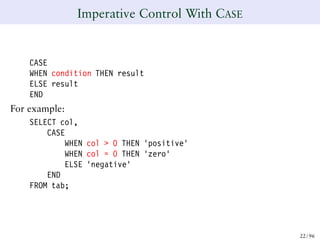
Imperative Control With CASE
CASE
WHEN condition THEN result
ELSE result
END
For example:
SELECT col,
CASE
WHEN col > 0 THEN ’positive’
WHEN col = 0 THEN ’zero’
ELSE ’negative’
END
FROM tab;
22/ 96
3. Recursive CTEs
https://www.flickr.com/photos/rbh/
23/ 96
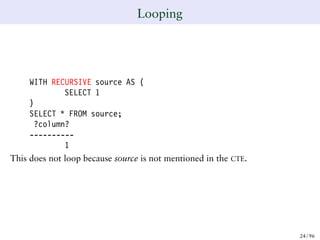
Looping
WITH RECURSIVE source AS (
SELECT 1
)
SELECT * FROM source;
?column?
----------
1
This does not loop because source is not mentioned in the CTE.
24/ 96
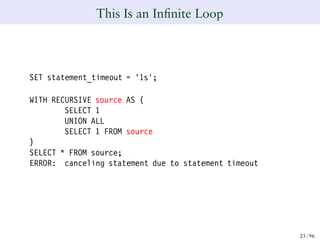
This Is an Infinite Loop
SET statement_timeout = ’1s’;
WITH RECURSIVE source AS (
SELECT 1
UNION ALL
SELECT 1 FROM source
)
SELECT * FROM source;
ERROR: canceling statement due to statement timeout
25/ 96
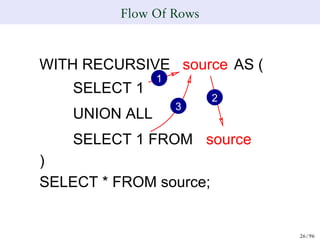
Flow Of Rows
WITH RECURSIVE source AS (
SELECT * FROM source;
SELECT 1
)
SELECT 1 FROM source
UNION ALL
33
2
1
26/ 96
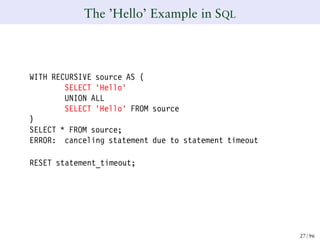
The ’Hello’ Example in SQL
WITH RECURSIVE source AS (
SELECT ’Hello’
UNION ALL
SELECT ’Hello’ FROM source
)
SELECT * FROM source;
ERROR: canceling statement due to statement timeout
RESET statement_timeout;
27/ 96
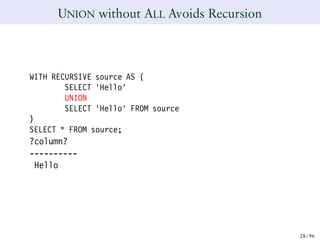
UNION without ALL Avoids Recursion
WITH RECURSIVE source AS (
SELECT ’Hello’
UNION
SELECT ’Hello’ FROM source
)
SELECT * FROM source;
?column?
----------
Hello
28/ 96
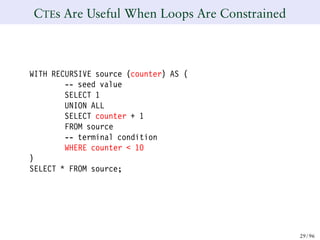
CTEs Are Useful When Loops Are Constrained
WITH RECURSIVE source (counter) AS (
-- seed value
SELECT 1
UNION ALL
SELECT counter + 1
FROM source
-- terminal condition
WHERE counter < 10
)
SELECT * FROM source;
29/ 96
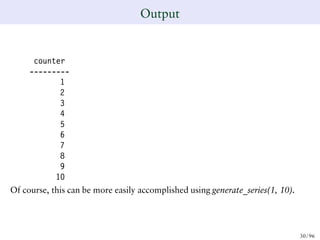
Output
counter
---------
1
2
3
4
5
6
7
8
9
10
Of course, this can be more easily accomplished using generate_series(1, 10).
30/ 96
Perl Example
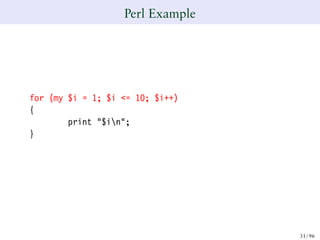
for (my $i = 1; $i <= 10; $i++)
{
print "$in";
}
31/ 96
Perl Using Recursion
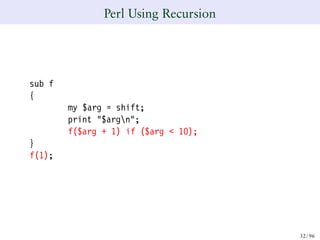
sub f
{
my $arg = shift;
print "$argn";
f($arg + 1) if ($arg < 10);
}
f(1);
32/ 96
Perl Recursion Using an Array
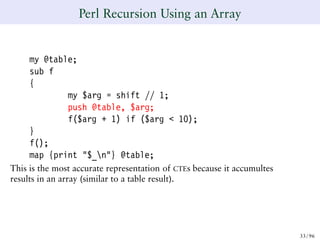
my @table;
sub f
{
my $arg = shift // 1;
push @table, $arg;
f($arg + 1) if ($arg < 10);
}
f();
map {print "$_n"} @table;
This is the most accurate representation of CTEs because it accumultes
results in an array (similar to a table result).
33/ 96
4. Examples
https://www.flickr.com/photos/82134796@N03/
34/ 96
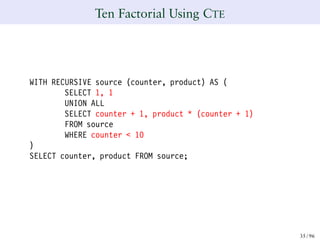
Ten Factorial Using CTE
WITH RECURSIVE source (counter, product) AS (
SELECT 1, 1
UNION ALL
SELECT counter + 1, product * (counter + 1)
FROM source
WHERE counter < 10
)
SELECT counter, product FROM source;
35/ 96
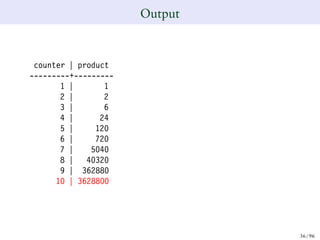
Output
counter | product
---------+---------
1 | 1
2 | 2
3 | 6
4 | 24
5 | 120
6 | 720
7 | 5040
8 | 40320
9 | 362880
10 | 3628800
36/ 96
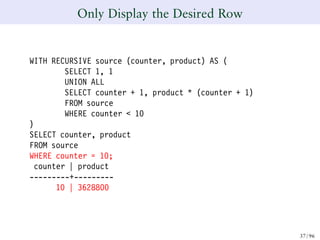
Only Display the Desired Row
WITH RECURSIVE source (counter, product) AS (
SELECT 1, 1
UNION ALL
SELECT counter + 1, product * (counter + 1)
FROM source
WHERE counter < 10
)
SELECT counter, product
FROM source
WHERE counter = 10;
counter | product
---------+---------
10 | 3628800
37/ 96
Ten Factorial in Perl
my @table;
sub f
{
my ($counter, $product) = @_;
my ($counter_new, $product_new);
if (!defined($counter)) {
$counter_new = 1;
$product_new = 1;
} else {
$counter_new = $counter + 1;
$product_new = $product * ($counter + 1);
}
push(@table, [$counter_new, $product_new]);
f($counter_new, $product_new) if ($counter < 10);
}
f();
map {print "@$_n" if ($_->[0]) == 10} @table;
38/ 96
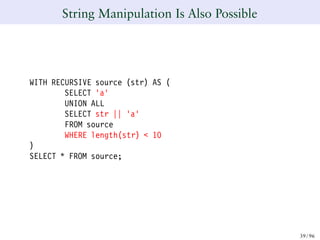
String Manipulation Is Also Possible
WITH RECURSIVE source (str) AS (
SELECT ’a’
UNION ALL
SELECT str || ’a’
FROM source
WHERE length(str) < 10
)
SELECT * FROM source;
39/ 96
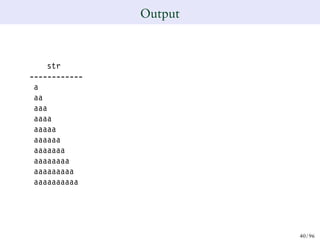
Output
str
------------
a
aa
aaa
aaaa
aaaaa
aaaaaa
aaaaaaa
aaaaaaaa
aaaaaaaaa
aaaaaaaaaa
40/ 96
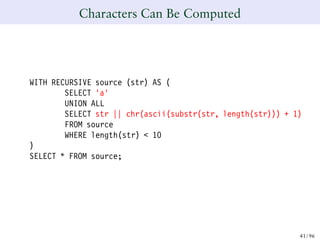
Characters Can Be Computed
WITH RECURSIVE source (str) AS (
SELECT ’a’
UNION ALL
SELECT str || chr(ascii(substr(str, length(str))) + 1)
FROM source
WHERE length(str) < 10
)
SELECT * FROM source;
41/ 96
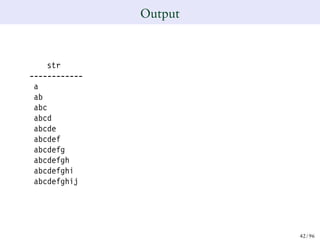
Output
str
------------
a
ab
abc
abcd
abcde
abcdef
abcdefg
abcdefgh
abcdefghi
abcdefghij
42/ 96
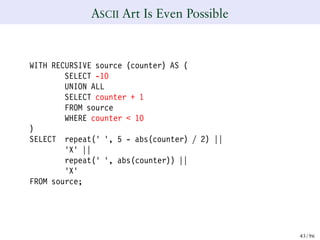
ASCII Art Is Even Possible
WITH RECURSIVE source (counter) AS (
SELECT -10
UNION ALL
SELECT counter + 1
FROM source
WHERE counter < 10
)
SELECT repeat(’ ’, 5 - abs(counter) / 2) ||
’X’ ||
repeat(’ ’, abs(counter)) ||
’X’
FROM source;
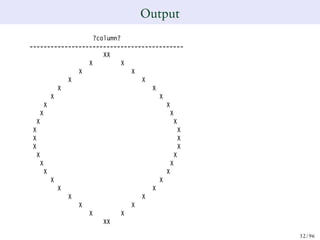
43/ 96
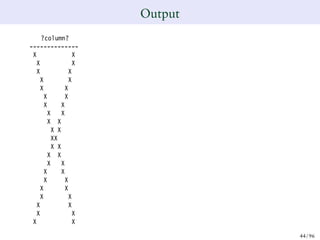
Output
?column?
--------------
X X
X X
X X
X X
X X
X X
X X
X X
X X
X X
XX
X X
X X
X X
X X
X X
X X
X X
X X
X X
X X
44/ 96
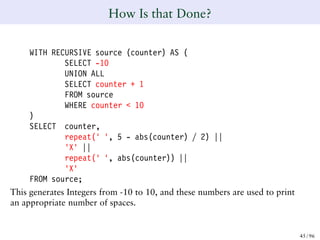
How Is that Done?
WITH RECURSIVE source (counter) AS (
SELECT -10
UNION ALL
SELECT counter + 1
FROM source
WHERE counter < 10
)
SELECT counter,
repeat(’ ’, 5 - abs(counter) / 2) ||
’X’ ||
repeat(’ ’, abs(counter)) ||
’X’
FROM source;
This generates Integers from -10 to 10, and these numbers are used to print
an appropriate number of spaces.
45/ 96
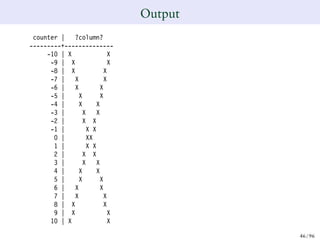
Output
counter | ?column?
---------+--------------
-10 | X X
-9 | X X
-8 | X X
-7 | X X
-6 | X X
-5 | X X
-4 | X X
-3 | X X
-2 | X X
-1 | X X
0 | XX
1 | X X
2 | X X
3 | X X
4 | X X
5 | X X
6 | X X
7 | X X
8 | X X
9 | X X
10 | X X
46/ 96
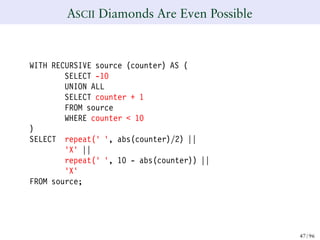
ASCII Diamonds Are Even Possible
WITH RECURSIVE source (counter) AS (
SELECT -10
UNION ALL
SELECT counter + 1
FROM source
WHERE counter < 10
)
SELECT repeat(’ ’, abs(counter)/2) ||
’X’ ||
repeat(’ ’, 10 - abs(counter)) ||
’X’
FROM source;
47/ 96
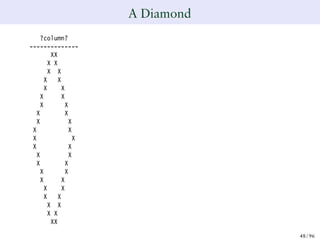
A Diamond
?column?
--------------
XX
X X
X X
X X
X X
X X
X X
X X
X X
X X
X X
X X
X X
X X
X X
X X
X X
X X
X X
X X
XX
48/ 96
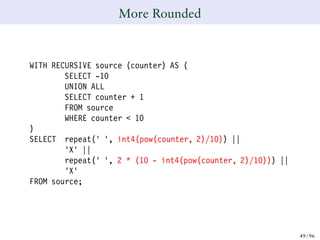
More Rounded
WITH RECURSIVE source (counter) AS (
SELECT -10
UNION ALL
SELECT counter + 1
FROM source
WHERE counter < 10
)
SELECT repeat(’ ’, int4(pow(counter, 2)/10)) ||
’X’ ||
repeat(’ ’, 2 * (10 - int4(pow(counter, 2)/10))) ||
’X’
FROM source;
49/ 96
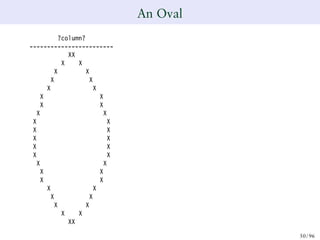
An Oval
?column?
------------------------
XX
X X
X X
X X
X X
X X
X X
X X
X X
X X
X X
X X
X X
X X
X X
X X
X X
X X
X X
X X
XX
50/ 96
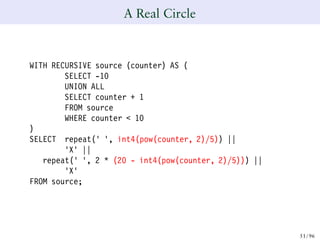
A Real Circle
WITH RECURSIVE source (counter) AS (
SELECT -10
UNION ALL
SELECT counter + 1
FROM source
WHERE counter < 10
)
SELECT repeat(’ ’, int4(pow(counter, 2)/5)) ||
’X’ ||
repeat(’ ’, 2 * (20 - int4(pow(counter, 2)/5))) ||
’X’
FROM source;
51/ 96
Output
?column?
--------------------------------------------
XX
X X
X X
X X
X X
X X
X X
X X
X X
X X
X X
X X
X X
X X
X X
X X
X X
X X
X X
X X
XX
52/ 96
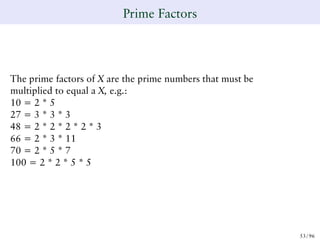
Prime Factors
The prime factors of X are the prime numbers that must be
multiplied to equal a X, e.g.:
10 = 2 * 5
27 = 3 * 3 * 3
48 = 2 * 2 * 2 * 2 * 3
66 = 2 * 3 * 11
70 = 2 * 5 * 7
100 = 2 * 2 * 5 * 5
53/ 96
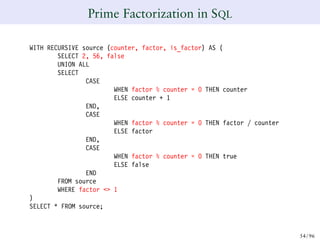
Prime Factorization in SQL
WITH RECURSIVE source (counter, factor, is_factor) AS (
SELECT 2, 56, false
UNION ALL
SELECT
CASE
WHEN factor % counter = 0 THEN counter
ELSE counter + 1
END,
CASE
WHEN factor % counter = 0 THEN factor / counter
ELSE factor
END,
CASE
WHEN factor % counter = 0 THEN true
ELSE false
END
FROM source
WHERE factor <> 1
)
SELECT * FROM source;
54/ 96
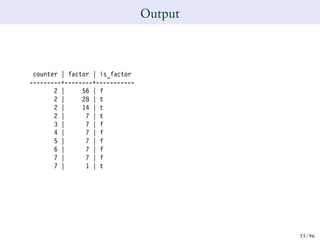
Output
counter | factor | is_factor
---------+--------+-----------
2 | 56 | f
2 | 28 | t
2 | 14 | t
2 | 7 | t
3 | 7 | f
4 | 7 | f
5 | 7 | f
6 | 7 | f
7 | 7 | f
7 | 1 | t
55/ 96
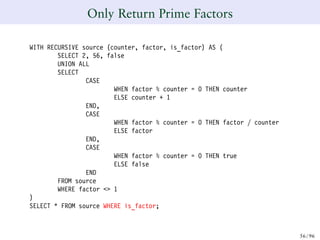
Only Return Prime Factors
WITH RECURSIVE source (counter, factor, is_factor) AS (
SELECT 2, 56, false
UNION ALL
SELECT
CASE
WHEN factor % counter = 0 THEN counter
ELSE counter + 1
END,
CASE
WHEN factor % counter = 0 THEN factor / counter
ELSE factor
END,
CASE
WHEN factor % counter = 0 THEN true
ELSE false
END
FROM source
WHERE factor <> 1
)
SELECT * FROM source WHERE is_factor;
56/ 96
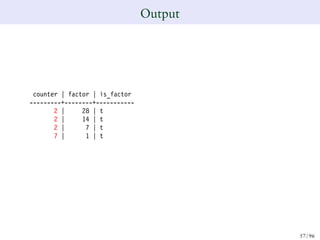
Output
counter | factor | is_factor
---------+--------+-----------
2 | 28 | t
2 | 14 | t
2 | 7 | t
7 | 1 | t
57/ 96
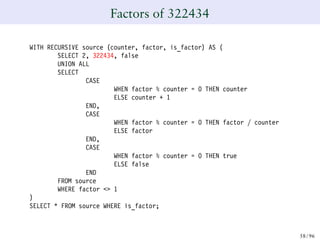
Factors of 322434
WITH RECURSIVE source (counter, factor, is_factor) AS (
SELECT 2, 322434, false
UNION ALL
SELECT
CASE
WHEN factor % counter = 0 THEN counter
ELSE counter + 1
END,
CASE
WHEN factor % counter = 0 THEN factor / counter
ELSE factor
END,
CASE
WHEN factor % counter = 0 THEN true
ELSE false
END
FROM source
WHERE factor <> 1
)
SELECT * FROM source WHERE is_factor;
58/ 96
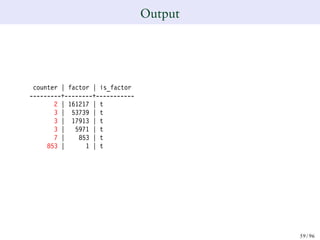
Output
counter | factor | is_factor
---------+--------+-----------
2 | 161217 | t
3 | 53739 | t
3 | 17913 | t
3 | 5971 | t
7 | 853 | t
853 | 1 | t
59/ 96
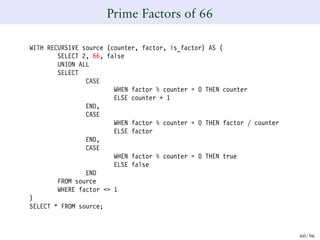
Prime Factors of 66
WITH RECURSIVE source (counter, factor, is_factor) AS (
SELECT 2, 66, false
UNION ALL
SELECT
CASE
WHEN factor % counter = 0 THEN counter
ELSE counter + 1
END,
CASE
WHEN factor % counter = 0 THEN factor / counter
ELSE factor
END,
CASE
WHEN factor % counter = 0 THEN true
ELSE false
END
FROM source
WHERE factor <> 1
)
SELECT * FROM source;
60/ 96
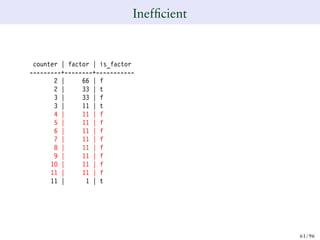
Inefficient
counter | factor | is_factor
---------+--------+-----------
2 | 66 | f
2 | 33 | t
3 | 33 | f
3 | 11 | t
4 | 11 | f
5 | 11 | f
6 | 11 | f
7 | 11 | f
8 | 11 | f
9 | 11 | f
10 | 11 | f
11 | 11 | f
11 | 1 | t
61/ 96
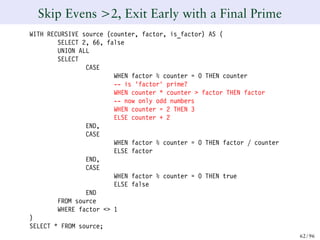
Skip Evens >2, Exit Early with a Final Prime
WITH RECURSIVE source (counter, factor, is_factor) AS (
SELECT 2, 66, false
UNION ALL
SELECT
CASE
WHEN factor % counter = 0 THEN counter
-- is ’factor’ prime?
WHEN counter * counter > factor THEN factor
-- now only odd numbers
WHEN counter = 2 THEN 3
ELSE counter + 2
END,
CASE
WHEN factor % counter = 0 THEN factor / counter
ELSE factor
END,
CASE
WHEN factor % counter = 0 THEN true
ELSE false
END
FROM source
WHERE factor <> 1
)
SELECT * FROM source;
62/ 96
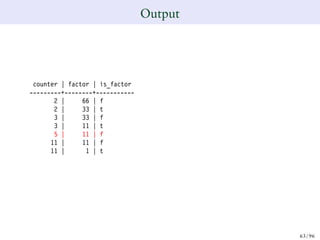
Output
counter | factor | is_factor
---------+--------+-----------
2 | 66 | f
2 | 33 | t
3 | 33 | f
3 | 11 | t
5 | 11 | f
11 | 11 | f
11 | 1 | t
63/ 96
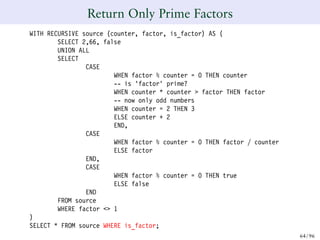
Return Only Prime Factors
WITH RECURSIVE source (counter, factor, is_factor) AS (
SELECT 2,66, false
UNION ALL
SELECT
CASE
WHEN factor % counter = 0 THEN counter
-- is ’factor’ prime?
WHEN counter * counter > factor THEN factor
-- now only odd numbers
WHEN counter = 2 THEN 3
ELSE counter + 2
END,
CASE
WHEN factor % counter = 0 THEN factor / counter
ELSE factor
END,
CASE
WHEN factor % counter = 0 THEN true
ELSE false
END
FROM source
WHERE factor <> 1
)
SELECT * FROM source WHERE is_factor;
64/ 96
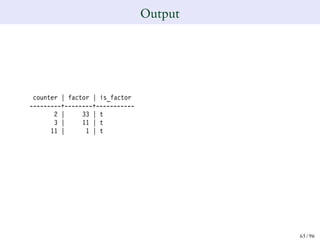
Output
counter | factor | is_factor
---------+--------+-----------
2 | 33 | t
3 | 11 | t
11 | 1 | t
65/ 96
Optimized Prime Factors of 66 in Perl
my @table;
sub f
{
my ($counter, $factor, $is_factor) = @_;
my ($counter_new, $factor_new, $is_factor_new);
if (!defined($counter)) {
$counter_new = 2;
$factor_new = 66;
$is_factor_new = 0;
} else {
$counter_new = ($factor % $counter == 0) ?
$counter :
($counter * $counter > $factor) ?
$factor :
($counter == 2) ?
3 :
$counter + 2;
$factor_new = ($factor % $counter == 0) ?
$factor / $counter :
$factor;
$is_factor_new = ($factor % $counter == 0);
}
push(@table, [$counter_new, $factor_new, $is_factor_new]);
f($counter_new, $factor_new) if ($factor != 1);
}
f();
map {print "$_->[0] $_->[1] $_->[2]n" if ($_->[2]) == 1} @table;
66/ 96
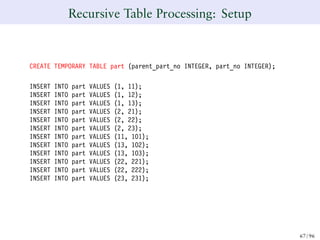
Recursive Table Processing: Setup
CREATE TEMPORARY TABLE part (parent_part_no INTEGER, part_no INTEGER);
INSERT INTO part VALUES (1, 11);
INSERT INTO part VALUES (1, 12);
INSERT INTO part VALUES (1, 13);
INSERT INTO part VALUES (2, 21);
INSERT INTO part VALUES (2, 22);
INSERT INTO part VALUES (2, 23);
INSERT INTO part VALUES (11, 101);
INSERT INTO part VALUES (13, 102);
INSERT INTO part VALUES (13, 103);
INSERT INTO part VALUES (22, 221);
INSERT INTO part VALUES (22, 222);
INSERT INTO part VALUES (23, 231);
67/ 96
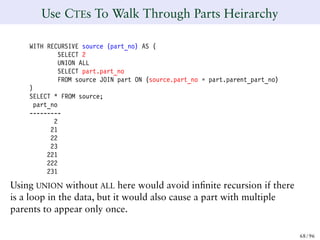
Use CTEs To Walk Through Parts Heirarchy
WITH RECURSIVE source (part_no) AS (
SELECT 2
UNION ALL
SELECT part.part_no
FROM source JOIN part ON (source.part_no = part.parent_part_no)
)
SELECT * FROM source;
part_no
---------
2
21
22
23
221
222
231
Using UNION without ALL here would avoid infinite recursion if there
is a loop in the data, but it would also cause a part with multiple
parents to appear only once.
68/ 96
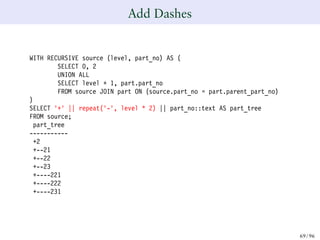
Add Dashes
WITH RECURSIVE source (level, part_no) AS (
SELECT 0, 2
UNION ALL
SELECT level + 1, part.part_no
FROM source JOIN part ON (source.part_no = part.parent_part_no)
)
SELECT ’+’ || repeat(’-’, level * 2) || part_no::text AS part_tree
FROM source;
part_tree
-----------
+2
+--21
+--22
+--23
+----221
+----222
+----231
69/ 96
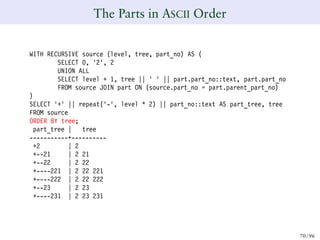
The Parts in ASCII Order
WITH RECURSIVE source (level, tree, part_no) AS (
SELECT 0, ’2’, 2
UNION ALL
SELECT level + 1, tree || ’ ’ || part.part_no::text, part.part_no
FROM source JOIN part ON (source.part_no = part.parent_part_no)
)
SELECT ’+’ || repeat(’-’, level * 2) || part_no::text AS part_tree, tree
FROM source
ORDER BY tree;
part_tree | tree
-----------+----------
+2 | 2
+--21 | 2 21
+--22 | 2 22
+----221 | 2 22 221
+----222 | 2 22 222
+--23 | 2 23
+----231 | 2 23 231
70/ 96
The Parts in Numeric Order
WITH RECURSIVE source (level, tree, part_no) AS (
SELECT 0, ’{2}’::int[], 2
UNION ALL
SELECT level + 1, array_append(tree, part.part_no), part.part_no
FROM source JOIN part ON (source.part_no = part.parent_part_no)
)
SELECT ’+’ || repeat(’-’, level * 2) || part_no::text AS part_tree, tree
FROM source
ORDER BY tree;
part_tree | tree
-----------+------------
+2 | {2}
+--21 | {2,21}
+--22 | {2,22}
+----221 | {2,22,221}
+----222 | {2,22,222}
+--23 | {2,23}
+----231 | {2,23,231}
71/ 96
Full Output
WITH RECURSIVE source (level, tree, part_no) AS (
SELECT 0, ’{2}’::int[], 2
UNION ALL
SELECT level + 1, array_append(tree, part.part_no), part.part_no
FROM source JOIN part ON (source.part_no = part.parent_part_no)
)
SELECT *, ’+’ || repeat(’-’, level * 2) || part_no::text AS part_tree
FROM source
ORDER BY tree;
level | tree | part_no | part_tree
-------+------------+---------+-----------
0 | {2} | 2 | +2
1 | {2,21} | 21 | +--21
1 | {2,22} | 22 | +--22
2 | {2,22,221} | 221 | +----221
2 | {2,22,222} | 222 | +----222
1 | {2,23} | 23 | +--23
2 | {2,23,231} | 231 | +----231
72/ 96
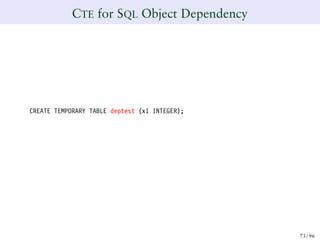
CTE for SQL Object Dependency
CREATE TEMPORARY TABLE deptest (x1 INTEGER);
73/ 96
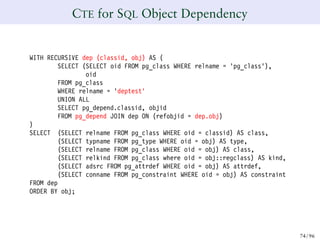
CTE for SQL Object Dependency
WITH RECURSIVE dep (classid, obj) AS (
SELECT (SELECT oid FROM pg_class WHERE relname = ’pg_class’),
oid
FROM pg_class
WHERE relname = ’deptest’
UNION ALL
SELECT pg_depend.classid, objid
FROM pg_depend JOIN dep ON (refobjid = dep.obj)
)
SELECT (SELECT relname FROM pg_class WHERE oid = classid) AS class,
(SELECT typname FROM pg_type WHERE oid = obj) AS type,
(SELECT relname FROM pg_class WHERE oid = obj) AS class,
(SELECT relkind FROM pg_class where oid = obj::regclass) AS kind,
(SELECT adsrc FROM pg_attrdef WHERE oid = obj) AS attrdef,
(SELECT conname FROM pg_constraint WHERE oid = obj) AS constraint
FROM dep
ORDER BY obj;
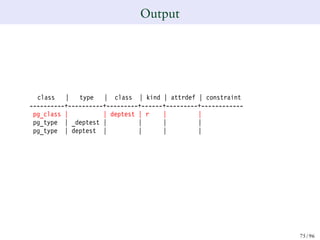
74/ 96
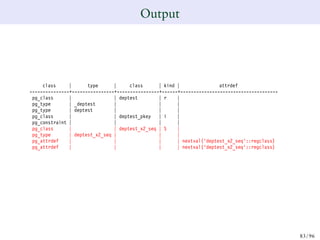
Output
class | type | class | kind | attrdef | constraint
----------+----------+---------+------+---------+------------
pg_class | | deptest | r | |
pg_type | _deptest | | | |
pg_type | deptest | | | |
75/ 96
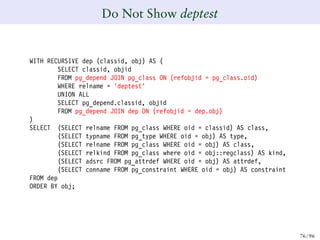
Do Not Show deptest
WITH RECURSIVE dep (classid, obj) AS (
SELECT classid, objid
FROM pg_depend JOIN pg_class ON (refobjid = pg_class.oid)
WHERE relname = ’deptest’
UNION ALL
SELECT pg_depend.classid, objid
FROM pg_depend JOIN dep ON (refobjid = dep.obj)
)
SELECT (SELECT relname FROM pg_class WHERE oid = classid) AS class,
(SELECT typname FROM pg_type WHERE oid = obj) AS type,
(SELECT relname FROM pg_class WHERE oid = obj) AS class,
(SELECT relkind FROM pg_class where oid = obj::regclass) AS kind,
(SELECT adsrc FROM pg_attrdef WHERE oid = obj) AS attrdef,
(SELECT conname FROM pg_constraint WHERE oid = obj) AS constraint
FROM dep
ORDER BY obj;
76/ 96
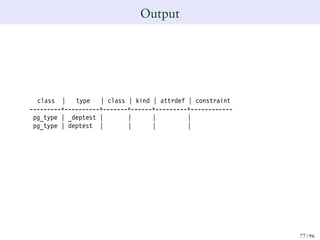
Output
class | type | class | kind | attrdef | constraint
---------+----------+-------+------+---------+------------
pg_type | _deptest | | | |
pg_type | deptest | | | |
77/ 96
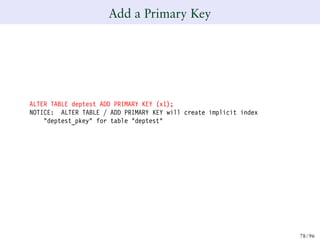
Add a Primary Key
ALTER TABLE deptest ADD PRIMARY KEY (x1);
NOTICE: ALTER TABLE / ADD PRIMARY KEY will create implicit index
"deptest_pkey" for table "deptest"
78/ 96
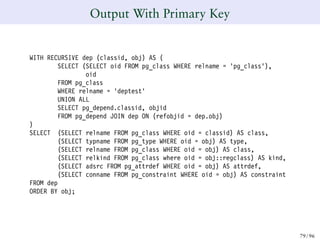
Output With Primary Key
WITH RECURSIVE dep (classid, obj) AS (
SELECT (SELECT oid FROM pg_class WHERE relname = ’pg_class’),
oid
FROM pg_class
WHERE relname = ’deptest’
UNION ALL
SELECT pg_depend.classid, objid
FROM pg_depend JOIN dep ON (refobjid = dep.obj)
)
SELECT (SELECT relname FROM pg_class WHERE oid = classid) AS class,
(SELECT typname FROM pg_type WHERE oid = obj) AS type,
(SELECT relname FROM pg_class WHERE oid = obj) AS class,
(SELECT relkind FROM pg_class where oid = obj::regclass) AS kind,
(SELECT adsrc FROM pg_attrdef WHERE oid = obj) AS attrdef,
(SELECT conname FROM pg_constraint WHERE oid = obj) AS constraint
FROM dep
ORDER BY obj;
79/ 96
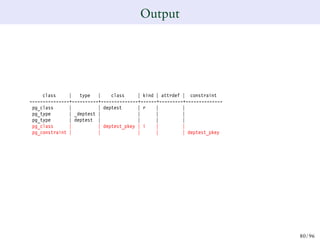
Output
class | type | class | kind | attrdef | constraint
---------------+----------+--------------+------+---------+--------------
pg_class | | deptest | r | |
pg_type | _deptest | | | |
pg_type | deptest | | | |
pg_class | | deptest_pkey | i | |
pg_constraint | | | | | deptest_pkey
80/ 96
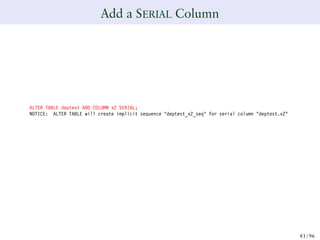
Add a SERIAL Column
ALTER TABLE deptest ADD COLUMN x2 SERIAL;
NOTICE: ALTER TABLE will create implicit sequence "deptest_x2_seq" for serial column "deptest.x2"
81/ 96
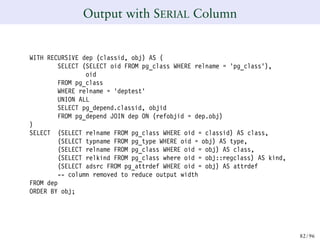
Output with SERIAL Column
WITH RECURSIVE dep (classid, obj) AS (
SELECT (SELECT oid FROM pg_class WHERE relname = ’pg_class’),
oid
FROM pg_class
WHERE relname = ’deptest’
UNION ALL
SELECT pg_depend.classid, objid
FROM pg_depend JOIN dep ON (refobjid = dep.obj)
)
SELECT (SELECT relname FROM pg_class WHERE oid = classid) AS class,
(SELECT typname FROM pg_type WHERE oid = obj) AS type,
(SELECT relname FROM pg_class WHERE oid = obj) AS class,
(SELECT relkind FROM pg_class where oid = obj::regclass) AS kind,
(SELECT adsrc FROM pg_attrdef WHERE oid = obj) AS attrdef
-- column removed to reduce output width
FROM dep
ORDER BY obj;
82/ 96
Output
class | type | class | kind | attrdef
---------------+----------------+----------------+------+-------------------------------------
pg_class | | deptest | r |
pg_type | _deptest | | |
pg_type | deptest | | |
pg_class | | deptest_pkey | i |
pg_constraint | | | |
pg_class | | deptest_x2_seq | S |
pg_type | deptest_x2_seq | | |
pg_attrdef | | | | nextval(’deptest_x2_seq’::regclass)
83/ 96
Show Full Output
WITH RECURSIVE dep (level, tree, classid, obj) AS (
SELECT 0, array_append(null, oid)::oid[],
(SELECT oid FROM pg_class WHERE relname = ’pg_class’),
oid
FROM pg_class
WHERE relname = ’deptest’
UNION ALL
SELECT level + 1, array_append(tree, objid),
pg_depend.classid, objid
FROM pg_depend JOIN dep ON (refobjid = dep.obj)
)
SELECT tree,
(SELECT relname FROM pg_class WHERE oid = classid) AS class,
(SELECT typname FROM pg_type WHERE oid = obj) AS type,
(SELECT relname FROM pg_class WHERE oid = obj) AS class,
(SELECT relkind FROM pg_class where oid = obj::regclass) AS kind
-- column removed to reduce output width
FROM dep
ORDER BY tree, obj;
84/ 96
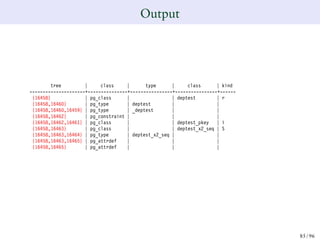
Output
tree | class | type | class | kind
---------------------+---------------+----------------+----------------+------
{16458} | pg_class | | deptest | r
{16458,16460} | pg_type | deptest | |
{16458,16460,16459} | pg_type | _deptest | |
{16458,16462} | pg_constraint | | |
{16458,16462,16461} | pg_class | | deptest_pkey | i
{16458,16463} | pg_class | | deptest_x2_seq | S
{16458,16463,16464} | pg_type | deptest_x2_seq | |
{16458,16463,16465} | pg_attrdef | | |
{16458,16465} | pg_attrdef | | |
85/ 96
5. Writable CTEs
https://www.flickr.com/photos/dmelchordiaz/
86/ 96
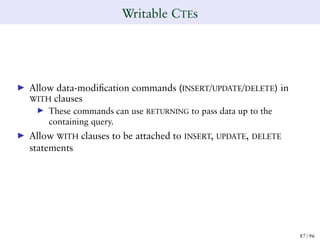
Writable CTEs
◮ Allow data-modification commands (INSERT/UPDATE/DELETE) in
WITH clauses
◮ These commands can use RETURNING to pass data up to the
containing query.
◮ Allow WITH clauses to be attached to INSERT, UPDATE, DELETE
statements
87/ 96
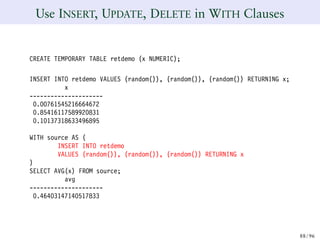
Use INSERT, UPDATE, DELETE in WITH Clauses
CREATE TEMPORARY TABLE retdemo (x NUMERIC);
INSERT INTO retdemo VALUES (random()), (random()), (random()) RETURNING x;
x
---------------------
0.00761545216664672
0.85416117589920831
0.10137318633496895
WITH source AS (
INSERT INTO retdemo
VALUES (random()), (random()), (random()) RETURNING x
)
SELECT AVG(x) FROM source;
avg
---------------------
0.46403147140517833
88/ 96
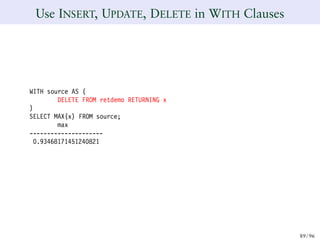
Use INSERT, UPDATE, DELETE in WITH Clauses
WITH source AS (
DELETE FROM retdemo RETURNING x
)
SELECT MAX(x) FROM source;
max
---------------------
0.93468171451240821
89/ 96
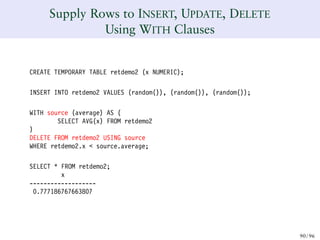
Supply Rows to INSERT, UPDATE, DELETE
Using WITH Clauses
CREATE TEMPORARY TABLE retdemo2 (x NUMERIC);
INSERT INTO retdemo2 VALUES (random()), (random()), (random());
WITH source (average) AS (
SELECT AVG(x) FROM retdemo2
)
DELETE FROM retdemo2 USING source
WHERE retdemo2.x < source.average;
SELECT * FROM retdemo2;
x
-------------------
0.777186767663807
90/ 96
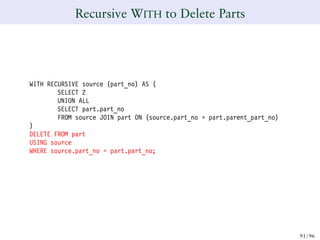
Recursive WITH to Delete Parts
WITH RECURSIVE source (part_no) AS (
SELECT 2
UNION ALL
SELECT part.part_no
FROM source JOIN part ON (source.part_no = part.parent_part_no)
)
DELETE FROM part
USING source
WHERE source.part_no = part.part_no;
91/ 96
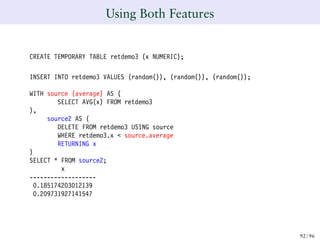
Using Both Features
CREATE TEMPORARY TABLE retdemo3 (x NUMERIC);
INSERT INTO retdemo3 VALUES (random()), (random()), (random());
WITH source (average) AS (
SELECT AVG(x) FROM retdemo3
),
source2 AS (
DELETE FROM retdemo3 USING source
WHERE retdemo3.x < source.average
RETURNING x
)
SELECT * FROM source2;
x
-------------------
0.185174203012139
0.209731927141547
92/ 96
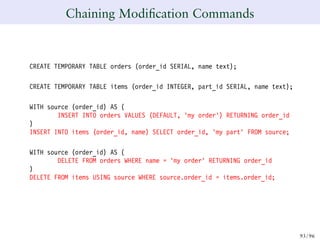
Chaining Modification Commands
CREATE TEMPORARY TABLE orders (order_id SERIAL, name text);
CREATE TEMPORARY TABLE items (order_id INTEGER, part_id SERIAL, name text);
WITH source (order_id) AS (
INSERT INTO orders VALUES (DEFAULT, ’my order’) RETURNING order_id
)
INSERT INTO items (order_id, name) SELECT order_id, ’my part’ FROM source;
WITH source (order_id) AS (
DELETE FROM orders WHERE name = ’my order’ RETURNING order_id
)
DELETE FROM items USING source WHERE source.order_id = items.order_id;
93/ 96
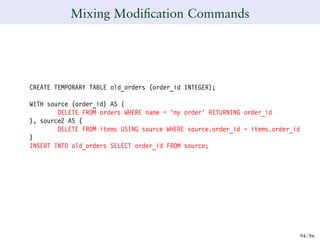
Mixing Modification Commands
CREATE TEMPORARY TABLE old_orders (order_id INTEGER);
WITH source (order_id) AS (
DELETE FROM orders WHERE name = ’my order’ RETURNING order_id
), source2 AS (
DELETE FROM items USING source WHERE source.order_id = items.order_id
)
INSERT INTO old_orders SELECT order_id FROM source;
94/ 96
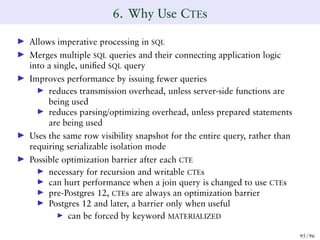
6. Why Use CTEs
◮ Allows imperative processing in SQL
◮ Merges multiple SQL queries and their connecting application logic
into a single, unified SQL query
◮ Improves performance by issuing fewer queries
◮ reduces transmission overhead, unless server-side functions are
being used
◮ reduces parsing/optimizing overhead, unless prepared statements
are being used
◮ Uses the same row visibility snapshot for the entire query, rather than
requiring serializable isolation mode
◮ Possible optimization barrier after each CTE
◮ necessary for recursion and writable CTEs
◮ can hurt performance when a join query is changed to use CTEs
◮ pre-Postgres 12, CTEs are always an optimization barrier
◮ Postgres 12 and later, a barrier only when useful
◮ can be forced by keyword MATERIALIZED
95/ 96
Conclusion
http://momjian.us/presentations https://www.flickr.com/photos/theophilusphotography/
96/ 96

Programming the SQL Way with Common Table Expressions

  • 1.
    Programming the SQLWay with Common Table Expressions BRUCE MOMJIAN Common Table Expressions (CTEs) allow queries to be more imperative, allowing looping and processing hierarchical structures that are normally associated only with imperative languages. Creative Commons Attribution License http://momjian.us/presentations Last updated: November, 2019 1 / 96
  • 2.
    Outline 1. Imperative vs.declarative 2. Syntax 3. Recursive CTEs 4. Examples 5. Writable CTEs 6. Why use CTEs 2 / 96
  • 3.
    1. Imperative vs.Declarative https://www.flickr.com/photos/visit_cape_may/ 3 / 96
  • 4.
    Imperative Programming Languages Incomputer science, imperative programming is a programming paradigm that describes computation in terms of statements that change a program state. In much the same way that imperative mood in natural languages expresses commands to take action, imperative programs define sequences of commands for the computer to perform. http://en.wikipedia.org/wiki/Imperative_programming 4 / 96
  • 5.
    Declarative Programming Languages Theterm is used in opposition to declarative programming, which expresses what the program should accomplish without prescribing how to do it in terms of sequence. 5 / 96
  • 6.
    Imperative BASIC: 10 PRINT "Hello"; 20GOTO 10 C: while (1) printf("Hellon"); Perl: print("Hellon") while (1); 6 / 96
  • 7.
    Declarative SQL: SELECT ’Hello’ UNION ALL SELECT’Hello’ UNION ALL SELECT ’Hello’ UNION ALL SELECT ’Hello’ … An infinite loop is not easily implemented in simple SQL. 7 / 96
  • 8.
    Imperative Database Options ◮Client application code (e.g., libpq, JDBC, DBD::Pg) ◮ Server-side programming (e.g., PL/pgSQL, PL/Perl, C) ◮ Common table expressions 8 / 96
  • 9.
  • 10.
    Common Table Expression(CTE) Syntax WITH [ RECURSIVE ] with_query_name [ ( column_name [, ...] ) ] AS ( select ) [ , ... ] SELECT ... 10/ 96
  • 11.
    Keep Your Eyeon the Red (Text) https://www.flickr.com/photos/alltheaces/ 11/ 96
  • 12.
    A Simple CTE WITHsource AS ( SELECT 1 ) SELECT * FROM source; ?column? ---------- 1 The CTE created a source table that was referenced by the outer SELECT. All queries in this presentation can be downloaded from http://momjian. us/main/writings/pgsql/cte.sql. 12/ 96
  • 13.
    Let’s Name theReturned CTE Column WITH source AS ( SELECT 1 AS col1 ) SELECT * FROM source; col1 ------ 1 The CTE returned column is source.col1. 13/ 96
  • 14.
    The Column CanAlso Be Named in the WITH Clause WITH source (col1) AS ( SELECT 1 ) SELECT * FROM source; col1 ------ 1 14/ 96
  • 15.
    Columns Can BeRenamed WITH source (col2) AS ( SELECT 1 AS col1 ) SELECT col2 AS col3 FROM source; col3 ------ 1 The CTE column starts as col1, is renamed in the WITH clause as col2, and the outer SELECT renames it to col3. 15/ 96
  • 16.
    Multiple CTE ColumnsCan Be Returned WITH source AS ( SELECT 1, 2 ) SELECT * FROM source; ?column? | ?column? ----------+---------- 1 | 2 16/ 96
  • 17.
    UNION Refresher SELECT 1 UNION SELECT1; ?column? ---------- 1 SELECT 1 UNION ALL SELECT 1; ?column? ---------- 1 1 17/ 96
  • 18.
    Possible To CreateMultiple CTE Results WITH source AS ( SELECT 1, 2 ), source2 AS ( SELECT 3, 4 ) SELECT * FROM source UNION ALL SELECT * FROM source2; ?column? | ?column? ----------+---------- 1 | 2 3 | 4 18/ 96
  • 19.
    CTE with RealTables WITH source AS ( SELECT lanname, rolname FROM pg_language JOIN pg_roles ON lanowner = pg_roles.oid ) SELECT * FROM source; lanname | rolname ----------+---------- internal | postgres c | postgres sql | postgres plpgsql | postgres 19/ 96
  • 20.
    CTE Can BeProcessed More than Once WITH source AS ( SELECT lanname, rolname FROM pg_language JOIN pg_roles ON lanowner = pg_roles.oid ORDER BY lanname ) SELECT * FROM source UNION ALL SELECT MIN(lanname), NULL FROM source; lanname | rolname ----------+---------- c | postgres internal | postgres plpgsql | postgres sql | postgres c | 20/ 96
  • 21.
    CTE Can BeJoined WITH class AS ( SELECT oid, relname FROM pg_class WHERE relkind = ’r’ ) SELECT class.relname, attname FROM pg_attribute, class WHERE class.oid = attrelid ORDER BY 1, 2 LIMIT 5; relname | attname --------------+-------------- pg_aggregate | aggfinalfn pg_aggregate | aggfnoid pg_aggregate | agginitval pg_aggregate | aggsortop pg_aggregate | aggtransfn 21/ 96
  • 22.
    Imperative Control WithCASE CASE WHEN condition THEN result ELSE result END For example: SELECT col, CASE WHEN col > 0 THEN ’positive’ WHEN col = 0 THEN ’zero’ ELSE ’negative’ END FROM tab; 22/ 96
  • 23.
  • 24.
    Looping WITH RECURSIVE sourceAS ( SELECT 1 ) SELECT * FROM source; ?column? ---------- 1 This does not loop because source is not mentioned in the CTE. 24/ 96
  • 25.
    This Is anInfinite Loop SET statement_timeout = ’1s’; WITH RECURSIVE source AS ( SELECT 1 UNION ALL SELECT 1 FROM source ) SELECT * FROM source; ERROR: canceling statement due to statement timeout 25/ 96
  • 26.
    Flow Of Rows WITHRECURSIVE source AS ( SELECT * FROM source; SELECT 1 ) SELECT 1 FROM source UNION ALL 33 2 1 26/ 96
  • 27.
    The ’Hello’ Examplein SQL WITH RECURSIVE source AS ( SELECT ’Hello’ UNION ALL SELECT ’Hello’ FROM source ) SELECT * FROM source; ERROR: canceling statement due to statement timeout RESET statement_timeout; 27/ 96
  • 28.
    UNION without ALLAvoids Recursion WITH RECURSIVE source AS ( SELECT ’Hello’ UNION SELECT ’Hello’ FROM source ) SELECT * FROM source; ?column? ---------- Hello 28/ 96
  • 29.
    CTEs Are UsefulWhen Loops Are Constrained WITH RECURSIVE source (counter) AS ( -- seed value SELECT 1 UNION ALL SELECT counter + 1 FROM source -- terminal condition WHERE counter < 10 ) SELECT * FROM source; 29/ 96
  • 30.
    Output counter --------- 1 2 3 4 5 6 7 8 9 10 Of course, thiscan be more easily accomplished using generate_series(1, 10). 30/ 96
  • 31.
    Perl Example for (my$i = 1; $i <= 10; $i++) { print "$in"; } 31/ 96
  • 32.
    Perl Using Recursion subf { my $arg = shift; print "$argn"; f($arg + 1) if ($arg < 10); } f(1); 32/ 96
  • 33.
    Perl Recursion Usingan Array my @table; sub f { my $arg = shift // 1; push @table, $arg; f($arg + 1) if ($arg < 10); } f(); map {print "$_n"} @table; This is the most accurate representation of CTEs because it accumultes results in an array (similar to a table result). 33/ 96
  • 34.
  • 35.
    Ten Factorial UsingCTE WITH RECURSIVE source (counter, product) AS ( SELECT 1, 1 UNION ALL SELECT counter + 1, product * (counter + 1) FROM source WHERE counter < 10 ) SELECT counter, product FROM source; 35/ 96
  • 36.
    Output counter | product ---------+--------- 1| 1 2 | 2 3 | 6 4 | 24 5 | 120 6 | 720 7 | 5040 8 | 40320 9 | 362880 10 | 3628800 36/ 96
  • 37.
    Only Display theDesired Row WITH RECURSIVE source (counter, product) AS ( SELECT 1, 1 UNION ALL SELECT counter + 1, product * (counter + 1) FROM source WHERE counter < 10 ) SELECT counter, product FROM source WHERE counter = 10; counter | product ---------+--------- 10 | 3628800 37/ 96
  • 38.
    Ten Factorial inPerl my @table; sub f { my ($counter, $product) = @_; my ($counter_new, $product_new); if (!defined($counter)) { $counter_new = 1; $product_new = 1; } else { $counter_new = $counter + 1; $product_new = $product * ($counter + 1); } push(@table, [$counter_new, $product_new]); f($counter_new, $product_new) if ($counter < 10); } f(); map {print "@$_n" if ($_->[0]) == 10} @table; 38/ 96
  • 39.
    String Manipulation IsAlso Possible WITH RECURSIVE source (str) AS ( SELECT ’a’ UNION ALL SELECT str || ’a’ FROM source WHERE length(str) < 10 ) SELECT * FROM source; 39/ 96
  • 40.
  • 41.
    Characters Can BeComputed WITH RECURSIVE source (str) AS ( SELECT ’a’ UNION ALL SELECT str || chr(ascii(substr(str, length(str))) + 1) FROM source WHERE length(str) < 10 ) SELECT * FROM source; 41/ 96
  • 42.
  • 43.
    ASCII Art IsEven Possible WITH RECURSIVE source (counter) AS ( SELECT -10 UNION ALL SELECT counter + 1 FROM source WHERE counter < 10 ) SELECT repeat(’ ’, 5 - abs(counter) / 2) || ’X’ || repeat(’ ’, abs(counter)) || ’X’ FROM source; 43/ 96
  • 44.
    Output ?column? -------------- X X X X XX X X X X X X X X X X X X X X XX X X X X X X X X X X X X X X X X X X X X 44/ 96
  • 45.
    How Is thatDone? WITH RECURSIVE source (counter) AS ( SELECT -10 UNION ALL SELECT counter + 1 FROM source WHERE counter < 10 ) SELECT counter, repeat(’ ’, 5 - abs(counter) / 2) || ’X’ || repeat(’ ’, abs(counter)) || ’X’ FROM source; This generates Integers from -10 to 10, and these numbers are used to print an appropriate number of spaces. 45/ 96
  • 46.
    Output counter | ?column? ---------+-------------- -10| X X -9 | X X -8 | X X -7 | X X -6 | X X -5 | X X -4 | X X -3 | X X -2 | X X -1 | X X 0 | XX 1 | X X 2 | X X 3 | X X 4 | X X 5 | X X 6 | X X 7 | X X 8 | X X 9 | X X 10 | X X 46/ 96
  • 47.
    ASCII Diamonds AreEven Possible WITH RECURSIVE source (counter) AS ( SELECT -10 UNION ALL SELECT counter + 1 FROM source WHERE counter < 10 ) SELECT repeat(’ ’, abs(counter)/2) || ’X’ || repeat(’ ’, 10 - abs(counter)) || ’X’ FROM source; 47/ 96
  • 48.
    A Diamond ?column? -------------- XX X X XX X X X X X X X X X X X X X X X X X X X X X X X X X X X X X X X X X X XX 48/ 96
  • 49.
    More Rounded WITH RECURSIVEsource (counter) AS ( SELECT -10 UNION ALL SELECT counter + 1 FROM source WHERE counter < 10 ) SELECT repeat(’ ’, int4(pow(counter, 2)/10)) || ’X’ || repeat(’ ’, 2 * (10 - int4(pow(counter, 2)/10))) || ’X’ FROM source; 49/ 96
  • 50.
    An Oval ?column? ------------------------ XX X X XX X X X X X X X X X X X X X X X X X X X X X X X X X X X X X X X X X X XX 50/ 96
  • 51.
    A Real Circle WITHRECURSIVE source (counter) AS ( SELECT -10 UNION ALL SELECT counter + 1 FROM source WHERE counter < 10 ) SELECT repeat(’ ’, int4(pow(counter, 2)/5)) || ’X’ || repeat(’ ’, 2 * (20 - int4(pow(counter, 2)/5))) || ’X’ FROM source; 51/ 96
  • 52.
    Output ?column? -------------------------------------------- XX X X X X XX X X X X X X X X X X X X X X X X X X X X X X X X X X X X X X X X XX 52/ 96
  • 53.
    Prime Factors The primefactors of X are the prime numbers that must be multiplied to equal a X, e.g.: 10 = 2 * 5 27 = 3 * 3 * 3 48 = 2 * 2 * 2 * 2 * 3 66 = 2 * 3 * 11 70 = 2 * 5 * 7 100 = 2 * 2 * 5 * 5 53/ 96
  • 54.
    Prime Factorization inSQL WITH RECURSIVE source (counter, factor, is_factor) AS ( SELECT 2, 56, false UNION ALL SELECT CASE WHEN factor % counter = 0 THEN counter ELSE counter + 1 END, CASE WHEN factor % counter = 0 THEN factor / counter ELSE factor END, CASE WHEN factor % counter = 0 THEN true ELSE false END FROM source WHERE factor <> 1 ) SELECT * FROM source; 54/ 96
  • 55.
    Output counter | factor| is_factor ---------+--------+----------- 2 | 56 | f 2 | 28 | t 2 | 14 | t 2 | 7 | t 3 | 7 | f 4 | 7 | f 5 | 7 | f 6 | 7 | f 7 | 7 | f 7 | 1 | t 55/ 96
  • 56.
    Only Return PrimeFactors WITH RECURSIVE source (counter, factor, is_factor) AS ( SELECT 2, 56, false UNION ALL SELECT CASE WHEN factor % counter = 0 THEN counter ELSE counter + 1 END, CASE WHEN factor % counter = 0 THEN factor / counter ELSE factor END, CASE WHEN factor % counter = 0 THEN true ELSE false END FROM source WHERE factor <> 1 ) SELECT * FROM source WHERE is_factor; 56/ 96
  • 57.
    Output counter | factor| is_factor ---------+--------+----------- 2 | 28 | t 2 | 14 | t 2 | 7 | t 7 | 1 | t 57/ 96
  • 58.
    Factors of 322434 WITHRECURSIVE source (counter, factor, is_factor) AS ( SELECT 2, 322434, false UNION ALL SELECT CASE WHEN factor % counter = 0 THEN counter ELSE counter + 1 END, CASE WHEN factor % counter = 0 THEN factor / counter ELSE factor END, CASE WHEN factor % counter = 0 THEN true ELSE false END FROM source WHERE factor <> 1 ) SELECT * FROM source WHERE is_factor; 58/ 96
  • 59.
    Output counter | factor| is_factor ---------+--------+----------- 2 | 161217 | t 3 | 53739 | t 3 | 17913 | t 3 | 5971 | t 7 | 853 | t 853 | 1 | t 59/ 96
  • 60.
    Prime Factors of66 WITH RECURSIVE source (counter, factor, is_factor) AS ( SELECT 2, 66, false UNION ALL SELECT CASE WHEN factor % counter = 0 THEN counter ELSE counter + 1 END, CASE WHEN factor % counter = 0 THEN factor / counter ELSE factor END, CASE WHEN factor % counter = 0 THEN true ELSE false END FROM source WHERE factor <> 1 ) SELECT * FROM source; 60/ 96
  • 61.
    Inefficient counter | factor| is_factor ---------+--------+----------- 2 | 66 | f 2 | 33 | t 3 | 33 | f 3 | 11 | t 4 | 11 | f 5 | 11 | f 6 | 11 | f 7 | 11 | f 8 | 11 | f 9 | 11 | f 10 | 11 | f 11 | 11 | f 11 | 1 | t 61/ 96
  • 62.
    Skip Evens >2,Exit Early with a Final Prime WITH RECURSIVE source (counter, factor, is_factor) AS ( SELECT 2, 66, false UNION ALL SELECT CASE WHEN factor % counter = 0 THEN counter -- is ’factor’ prime? WHEN counter * counter > factor THEN factor -- now only odd numbers WHEN counter = 2 THEN 3 ELSE counter + 2 END, CASE WHEN factor % counter = 0 THEN factor / counter ELSE factor END, CASE WHEN factor % counter = 0 THEN true ELSE false END FROM source WHERE factor <> 1 ) SELECT * FROM source; 62/ 96
  • 63.
    Output counter | factor| is_factor ---------+--------+----------- 2 | 66 | f 2 | 33 | t 3 | 33 | f 3 | 11 | t 5 | 11 | f 11 | 11 | f 11 | 1 | t 63/ 96
  • 64.
    Return Only PrimeFactors WITH RECURSIVE source (counter, factor, is_factor) AS ( SELECT 2,66, false UNION ALL SELECT CASE WHEN factor % counter = 0 THEN counter -- is ’factor’ prime? WHEN counter * counter > factor THEN factor -- now only odd numbers WHEN counter = 2 THEN 3 ELSE counter + 2 END, CASE WHEN factor % counter = 0 THEN factor / counter ELSE factor END, CASE WHEN factor % counter = 0 THEN true ELSE false END FROM source WHERE factor <> 1 ) SELECT * FROM source WHERE is_factor; 64/ 96
  • 65.
    Output counter | factor| is_factor ---------+--------+----------- 2 | 33 | t 3 | 11 | t 11 | 1 | t 65/ 96
  • 66.
    Optimized Prime Factorsof 66 in Perl my @table; sub f { my ($counter, $factor, $is_factor) = @_; my ($counter_new, $factor_new, $is_factor_new); if (!defined($counter)) { $counter_new = 2; $factor_new = 66; $is_factor_new = 0; } else { $counter_new = ($factor % $counter == 0) ? $counter : ($counter * $counter > $factor) ? $factor : ($counter == 2) ? 3 : $counter + 2; $factor_new = ($factor % $counter == 0) ? $factor / $counter : $factor; $is_factor_new = ($factor % $counter == 0); } push(@table, [$counter_new, $factor_new, $is_factor_new]); f($counter_new, $factor_new) if ($factor != 1); } f(); map {print "$_->[0] $_->[1] $_->[2]n" if ($_->[2]) == 1} @table; 66/ 96
  • 67.
    Recursive Table Processing:Setup CREATE TEMPORARY TABLE part (parent_part_no INTEGER, part_no INTEGER); INSERT INTO part VALUES (1, 11); INSERT INTO part VALUES (1, 12); INSERT INTO part VALUES (1, 13); INSERT INTO part VALUES (2, 21); INSERT INTO part VALUES (2, 22); INSERT INTO part VALUES (2, 23); INSERT INTO part VALUES (11, 101); INSERT INTO part VALUES (13, 102); INSERT INTO part VALUES (13, 103); INSERT INTO part VALUES (22, 221); INSERT INTO part VALUES (22, 222); INSERT INTO part VALUES (23, 231); 67/ 96
  • 68.
    Use CTEs ToWalk Through Parts Heirarchy WITH RECURSIVE source (part_no) AS ( SELECT 2 UNION ALL SELECT part.part_no FROM source JOIN part ON (source.part_no = part.parent_part_no) ) SELECT * FROM source; part_no --------- 2 21 22 23 221 222 231 Using UNION without ALL here would avoid infinite recursion if there is a loop in the data, but it would also cause a part with multiple parents to appear only once. 68/ 96
  • 69.
    Add Dashes WITH RECURSIVEsource (level, part_no) AS ( SELECT 0, 2 UNION ALL SELECT level + 1, part.part_no FROM source JOIN part ON (source.part_no = part.parent_part_no) ) SELECT ’+’ || repeat(’-’, level * 2) || part_no::text AS part_tree FROM source; part_tree ----------- +2 +--21 +--22 +--23 +----221 +----222 +----231 69/ 96
  • 70.
    The Parts inASCII Order WITH RECURSIVE source (level, tree, part_no) AS ( SELECT 0, ’2’, 2 UNION ALL SELECT level + 1, tree || ’ ’ || part.part_no::text, part.part_no FROM source JOIN part ON (source.part_no = part.parent_part_no) ) SELECT ’+’ || repeat(’-’, level * 2) || part_no::text AS part_tree, tree FROM source ORDER BY tree; part_tree | tree -----------+---------- +2 | 2 +--21 | 2 21 +--22 | 2 22 +----221 | 2 22 221 +----222 | 2 22 222 +--23 | 2 23 +----231 | 2 23 231 70/ 96
  • 71.
    The Parts inNumeric Order WITH RECURSIVE source (level, tree, part_no) AS ( SELECT 0, ’{2}’::int[], 2 UNION ALL SELECT level + 1, array_append(tree, part.part_no), part.part_no FROM source JOIN part ON (source.part_no = part.parent_part_no) ) SELECT ’+’ || repeat(’-’, level * 2) || part_no::text AS part_tree, tree FROM source ORDER BY tree; part_tree | tree -----------+------------ +2 | {2} +--21 | {2,21} +--22 | {2,22} +----221 | {2,22,221} +----222 | {2,22,222} +--23 | {2,23} +----231 | {2,23,231} 71/ 96
  • 72.
    Full Output WITH RECURSIVEsource (level, tree, part_no) AS ( SELECT 0, ’{2}’::int[], 2 UNION ALL SELECT level + 1, array_append(tree, part.part_no), part.part_no FROM source JOIN part ON (source.part_no = part.parent_part_no) ) SELECT *, ’+’ || repeat(’-’, level * 2) || part_no::text AS part_tree FROM source ORDER BY tree; level | tree | part_no | part_tree -------+------------+---------+----------- 0 | {2} | 2 | +2 1 | {2,21} | 21 | +--21 1 | {2,22} | 22 | +--22 2 | {2,22,221} | 221 | +----221 2 | {2,22,222} | 222 | +----222 1 | {2,23} | 23 | +--23 2 | {2,23,231} | 231 | +----231 72/ 96
  • 73.
    CTE for SQLObject Dependency CREATE TEMPORARY TABLE deptest (x1 INTEGER); 73/ 96
  • 74.
    CTE for SQLObject Dependency WITH RECURSIVE dep (classid, obj) AS ( SELECT (SELECT oid FROM pg_class WHERE relname = ’pg_class’), oid FROM pg_class WHERE relname = ’deptest’ UNION ALL SELECT pg_depend.classid, objid FROM pg_depend JOIN dep ON (refobjid = dep.obj) ) SELECT (SELECT relname FROM pg_class WHERE oid = classid) AS class, (SELECT typname FROM pg_type WHERE oid = obj) AS type, (SELECT relname FROM pg_class WHERE oid = obj) AS class, (SELECT relkind FROM pg_class where oid = obj::regclass) AS kind, (SELECT adsrc FROM pg_attrdef WHERE oid = obj) AS attrdef, (SELECT conname FROM pg_constraint WHERE oid = obj) AS constraint FROM dep ORDER BY obj; 74/ 96
  • 75.
    Output class | type| class | kind | attrdef | constraint ----------+----------+---------+------+---------+------------ pg_class | | deptest | r | | pg_type | _deptest | | | | pg_type | deptest | | | | 75/ 96
  • 76.
    Do Not Showdeptest WITH RECURSIVE dep (classid, obj) AS ( SELECT classid, objid FROM pg_depend JOIN pg_class ON (refobjid = pg_class.oid) WHERE relname = ’deptest’ UNION ALL SELECT pg_depend.classid, objid FROM pg_depend JOIN dep ON (refobjid = dep.obj) ) SELECT (SELECT relname FROM pg_class WHERE oid = classid) AS class, (SELECT typname FROM pg_type WHERE oid = obj) AS type, (SELECT relname FROM pg_class WHERE oid = obj) AS class, (SELECT relkind FROM pg_class where oid = obj::regclass) AS kind, (SELECT adsrc FROM pg_attrdef WHERE oid = obj) AS attrdef, (SELECT conname FROM pg_constraint WHERE oid = obj) AS constraint FROM dep ORDER BY obj; 76/ 96
  • 77.
    Output class | type| class | kind | attrdef | constraint ---------+----------+-------+------+---------+------------ pg_type | _deptest | | | | pg_type | deptest | | | | 77/ 96
  • 78.
    Add a PrimaryKey ALTER TABLE deptest ADD PRIMARY KEY (x1); NOTICE: ALTER TABLE / ADD PRIMARY KEY will create implicit index "deptest_pkey" for table "deptest" 78/ 96
  • 79.
    Output With PrimaryKey WITH RECURSIVE dep (classid, obj) AS ( SELECT (SELECT oid FROM pg_class WHERE relname = ’pg_class’), oid FROM pg_class WHERE relname = ’deptest’ UNION ALL SELECT pg_depend.classid, objid FROM pg_depend JOIN dep ON (refobjid = dep.obj) ) SELECT (SELECT relname FROM pg_class WHERE oid = classid) AS class, (SELECT typname FROM pg_type WHERE oid = obj) AS type, (SELECT relname FROM pg_class WHERE oid = obj) AS class, (SELECT relkind FROM pg_class where oid = obj::regclass) AS kind, (SELECT adsrc FROM pg_attrdef WHERE oid = obj) AS attrdef, (SELECT conname FROM pg_constraint WHERE oid = obj) AS constraint FROM dep ORDER BY obj; 79/ 96
  • 80.
    Output class | type| class | kind | attrdef | constraint ---------------+----------+--------------+------+---------+-------------- pg_class | | deptest | r | | pg_type | _deptest | | | | pg_type | deptest | | | | pg_class | | deptest_pkey | i | | pg_constraint | | | | | deptest_pkey 80/ 96
  • 81.
    Add a SERIALColumn ALTER TABLE deptest ADD COLUMN x2 SERIAL; NOTICE: ALTER TABLE will create implicit sequence "deptest_x2_seq" for serial column "deptest.x2" 81/ 96
  • 82.
    Output with SERIALColumn WITH RECURSIVE dep (classid, obj) AS ( SELECT (SELECT oid FROM pg_class WHERE relname = ’pg_class’), oid FROM pg_class WHERE relname = ’deptest’ UNION ALL SELECT pg_depend.classid, objid FROM pg_depend JOIN dep ON (refobjid = dep.obj) ) SELECT (SELECT relname FROM pg_class WHERE oid = classid) AS class, (SELECT typname FROM pg_type WHERE oid = obj) AS type, (SELECT relname FROM pg_class WHERE oid = obj) AS class, (SELECT relkind FROM pg_class where oid = obj::regclass) AS kind, (SELECT adsrc FROM pg_attrdef WHERE oid = obj) AS attrdef -- column removed to reduce output width FROM dep ORDER BY obj; 82/ 96
  • 83.
    Output class | type| class | kind | attrdef ---------------+----------------+----------------+------+------------------------------------- pg_class | | deptest | r | pg_type | _deptest | | | pg_type | deptest | | | pg_class | | deptest_pkey | i | pg_constraint | | | | pg_class | | deptest_x2_seq | S | pg_type | deptest_x2_seq | | | pg_attrdef | | | | nextval(’deptest_x2_seq’::regclass) pg_attrdef | | | | nextval(’deptest_x2_seq’::regclass) 83/ 96
  • 84.
    Show Full Output WITHRECURSIVE dep (level, tree, classid, obj) AS ( SELECT 0, array_append(null, oid)::oid[], (SELECT oid FROM pg_class WHERE relname = ’pg_class’), oid FROM pg_class WHERE relname = ’deptest’ UNION ALL SELECT level + 1, array_append(tree, objid), pg_depend.classid, objid FROM pg_depend JOIN dep ON (refobjid = dep.obj) ) SELECT tree, (SELECT relname FROM pg_class WHERE oid = classid) AS class, (SELECT typname FROM pg_type WHERE oid = obj) AS type, (SELECT relname FROM pg_class WHERE oid = obj) AS class, (SELECT relkind FROM pg_class where oid = obj::regclass) AS kind -- column removed to reduce output width FROM dep ORDER BY tree, obj; 84/ 96
  • 85.
    Output tree | class| type | class | kind ---------------------+---------------+----------------+----------------+------ {16458} | pg_class | | deptest | r {16458,16460} | pg_type | deptest | | {16458,16460,16459} | pg_type | _deptest | | {16458,16462} | pg_constraint | | | {16458,16462,16461} | pg_class | | deptest_pkey | i {16458,16463} | pg_class | | deptest_x2_seq | S {16458,16463,16464} | pg_type | deptest_x2_seq | | {16458,16463,16465} | pg_attrdef | | | {16458,16465} | pg_attrdef | | | 85/ 96
  • 86.
  • 87.
    Writable CTEs ◮ Allowdata-modification commands (INSERT/UPDATE/DELETE) in WITH clauses ◮ These commands can use RETURNING to pass data up to the containing query. ◮ Allow WITH clauses to be attached to INSERT, UPDATE, DELETE statements 87/ 96
  • 88.
    Use INSERT, UPDATE,DELETE in WITH Clauses CREATE TEMPORARY TABLE retdemo (x NUMERIC); INSERT INTO retdemo VALUES (random()), (random()), (random()) RETURNING x; x --------------------- 0.00761545216664672 0.85416117589920831 0.10137318633496895 WITH source AS ( INSERT INTO retdemo VALUES (random()), (random()), (random()) RETURNING x ) SELECT AVG(x) FROM source; avg --------------------- 0.46403147140517833 88/ 96
  • 89.
    Use INSERT, UPDATE,DELETE in WITH Clauses WITH source AS ( DELETE FROM retdemo RETURNING x ) SELECT MAX(x) FROM source; max --------------------- 0.93468171451240821 89/ 96
  • 90.
    Supply Rows toINSERT, UPDATE, DELETE Using WITH Clauses CREATE TEMPORARY TABLE retdemo2 (x NUMERIC); INSERT INTO retdemo2 VALUES (random()), (random()), (random()); WITH source (average) AS ( SELECT AVG(x) FROM retdemo2 ) DELETE FROM retdemo2 USING source WHERE retdemo2.x < source.average; SELECT * FROM retdemo2; x ------------------- 0.777186767663807 90/ 96
  • 91.
    Recursive WITH toDelete Parts WITH RECURSIVE source (part_no) AS ( SELECT 2 UNION ALL SELECT part.part_no FROM source JOIN part ON (source.part_no = part.parent_part_no) ) DELETE FROM part USING source WHERE source.part_no = part.part_no; 91/ 96
  • 92.
    Using Both Features CREATETEMPORARY TABLE retdemo3 (x NUMERIC); INSERT INTO retdemo3 VALUES (random()), (random()), (random()); WITH source (average) AS ( SELECT AVG(x) FROM retdemo3 ), source2 AS ( DELETE FROM retdemo3 USING source WHERE retdemo3.x < source.average RETURNING x ) SELECT * FROM source2; x ------------------- 0.185174203012139 0.209731927141547 92/ 96
  • 93.
    Chaining Modification Commands CREATETEMPORARY TABLE orders (order_id SERIAL, name text); CREATE TEMPORARY TABLE items (order_id INTEGER, part_id SERIAL, name text); WITH source (order_id) AS ( INSERT INTO orders VALUES (DEFAULT, ’my order’) RETURNING order_id ) INSERT INTO items (order_id, name) SELECT order_id, ’my part’ FROM source; WITH source (order_id) AS ( DELETE FROM orders WHERE name = ’my order’ RETURNING order_id ) DELETE FROM items USING source WHERE source.order_id = items.order_id; 93/ 96
  • 94.
    Mixing Modification Commands CREATETEMPORARY TABLE old_orders (order_id INTEGER); WITH source (order_id) AS ( DELETE FROM orders WHERE name = ’my order’ RETURNING order_id ), source2 AS ( DELETE FROM items USING source WHERE source.order_id = items.order_id ) INSERT INTO old_orders SELECT order_id FROM source; 94/ 96
  • 95.
    6. Why UseCTEs ◮ Allows imperative processing in SQL ◮ Merges multiple SQL queries and their connecting application logic into a single, unified SQL query ◮ Improves performance by issuing fewer queries ◮ reduces transmission overhead, unless server-side functions are being used ◮ reduces parsing/optimizing overhead, unless prepared statements are being used ◮ Uses the same row visibility snapshot for the entire query, rather than requiring serializable isolation mode ◮ Possible optimization barrier after each CTE ◮ necessary for recursion and writable CTEs ◮ can hurt performance when a join query is changed to use CTEs ◮ pre-Postgres 12, CTEs are always an optimization barrier ◮ Postgres 12 and later, a barrier only when useful ◮ can be forced by keyword MATERIALIZED 95/ 96
  • 96.